Our Own Life and the Life of the Universe Are One

In many posts on this blog, I have been exploring the concept of God. I hope to help us to move past old rigid images of the big man in the sky with a beard and white robe, the judge, the king, these all too human inventions that people have created in the quest for understanding, or often, in the quest for power.

The mystics of almost every tradition tell us that our images cannot come close to what divinity might be all about. But the mystics also speak to us of something, or no-thing, that is not a being, but more like a process, more like an energy that permeates all beings, an energy of which we are a part, and of which we can come to greater awareness.

“We are here to awaken from the illusion of our separateness.” Zen Buddhist teacher, Thich Nhat Hanh invites people to do an exercise, to begin to grasp with our minds the symphony of the larger whole. He invites us to think about an object—it could be any object. He talked about a table, but I like to reflect on a piece of bread. Find a piece of bread and hold it in your hand. Then, let yourself imagine what has conspired in order for this bread to be here in your hand.  

First of all, think of the wheat. In order for it to grow, it needed topsoil, with its fungal and bacterial components, its minerals and small worms. It needed the decomposition of the plants of many years, decades, and even centuries to create this fertile soil. You can continue to let yourself follow in this line of imagination, or if you want to follow my imaginings, go to this link to an earlier post.

One could keep talking all day to follow all the threads of connection linked to just one piece of bread. Paraphrasing what Thich Nhat Hanh would say:

If you grasp the bread’s reality then you see that in the bread itself are present all those things which we normally think of as the non-bread world. If you took away any of those non-bread elements and returned them to their sources…[the honey to the bees, the metal to the mines, or the farmers to their parents], the bread would no longer exist. A person who looks at the bread and can see the universe, is a person who can see the way.

As long as we think of God as “up there” somewhere, like a father or a king or some other kind of person, we imagine that we are separate from God, we imagine that we can think or not think about, believe or not believe in, pray or not pray to that God. But in a spirituality of connection, the gaze shifts to understand that there are no truly separate things, that there is no separate self or separate God—that our “own life and the life of the universe are one.” Maple in Spring MJ DSC03502

Threads of Connection

I believe God is everything, say Shug. Everything that is or ever was or ever will be. And when you can feel that, and be happy to feel that, you’ve found It.
                                                                                                 Alice Walker

Daffodils Early MJ DSC03512

We’ve finally arrived in April. In a couple of weeks, the daffodils will begin to bloom in our front yard, and the first bright yellow dandelions will pop open behind the house. The forsythias will be first–maybe as soon as next Sunday?  But I can’t wait for the moment when the first daffodil breaks through its luminescent green casing, opening up pale yellow to reveal an orange center.

In spring, I keep taking short walks around our yard and down the street just to see what will happen next. The small wild strawberry flowers. The green buds of bushes opening into curled leaves. The leaves of the violets coming up out of the bare ground where I thought they might have perished in the fall. And down the road, the first fiddleheads of the ferns beginning to poke through the ground that a day ago had been fern-less.

This awakening seems to happen all at the same time. This week there are the bare branches and brown grasses, and then suddenly, everything will be green and lush and colorful. How do they know to break through, all in the same week? It helps me to understand what I have read about evolution—that species co-evolved with each other. That flowers emerged along with their pollinators, and each flower with its particular pollinator, so interdependent that we do them a sort of injustice to think of them as separate entities.

And of course, the insects will also come out with the flowers here in the spring, small ground bees hovering over the grass as if waking from a long sleep. The hummingbirds will arrive when the pink flowers of the viburnum open near our kitchen window. When the buds begin to get ready, it is our signal to put out the feeder, so we can join in.

All around us, like a choreography of dance, like a vast symphony, the beings of the earth move in harmony. And in this particular time of the year, this beautiful season of awakening, we can see it and hear it and smell it and feel it, if we pay attention. We can feel the threads of connection that make of many beings, one indivisible whole.

Fiddleheads DSC00234

The Power of the Story

Today I am concluding my series of blogs about Dr. Martin Luther King, Jr., in honor of the anniversary of his death, April 4th. I have been exploring what his life can teach us about the experience of the Divine Mystery.

I don’t understand the mechanics of experiencing the divine presence. I wonder if, as for Dr. Martin Luther King, Jr., it has something to do with the commitment to give oneself to a sacred calling, or to do the work of justice. I don’t know why some people call for help, and never seem to hear an answer. There is no formula that I can teach you, except to say that trouble can sometimes be a doorway, too, if we knock.

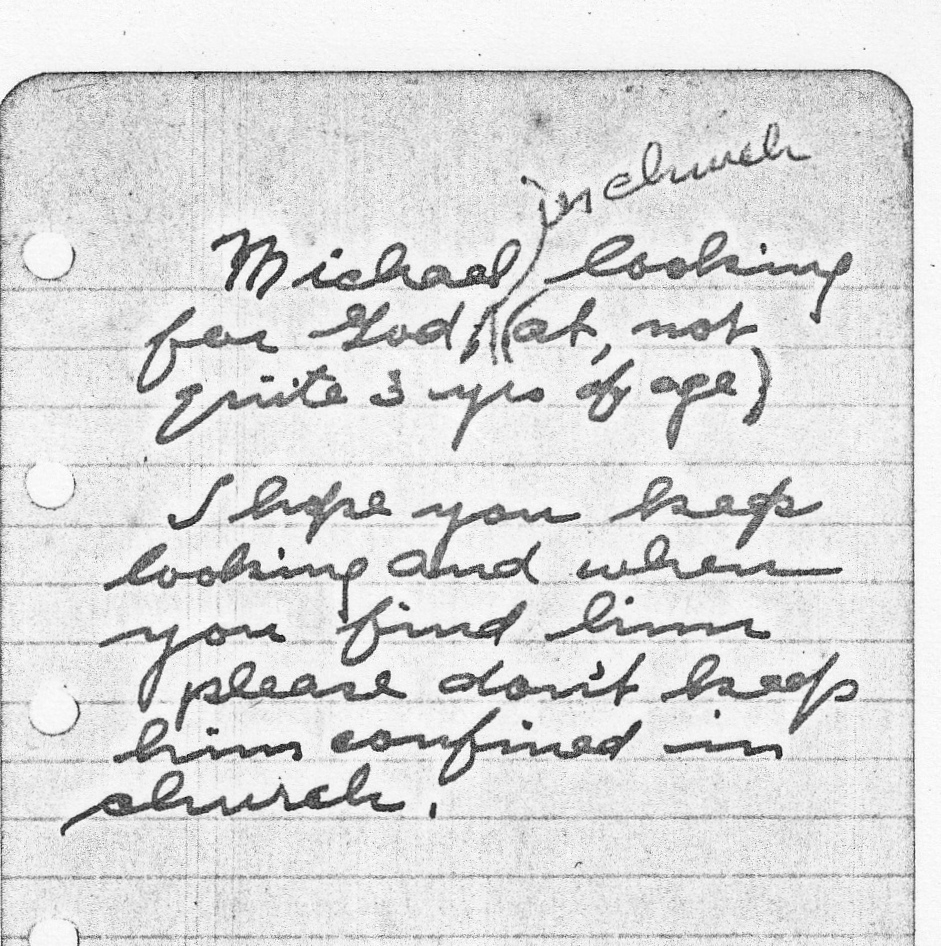
It makes me think about something my grandfather wrote in a little black notebook that disappeared for many years. April 4th, the anniversary of King’s death, is also the anniversary of the death of my grandfathers, one in 1964, and one in 1967. My grandpa Johnson died when I was not quite 11 years old. He was not a Catholic, which was a big deal in my family. But I am told he had been a spiritual man, and had even considered a call to ministry as a Unitarian or a Lutheran. The story I remembered from the notebook was this: My grandfather said that my young cousin Michael at the age of three had gone into a church building and was looking for God. My grandfather commented, “If you can’t find God outside of the church, you will never find him inside the church.”

But just before Easter a few years ago, while my uncle was dying, another cousin sent me a message on Facebook, about going through papers of her father, and finding a copy of Grandpa’s note. It turned out the actual quote was slightly different than I remembered. He had written, “I hope you keep looking. And when you find him don’t keep him confined in church.” But it speaks to the same impulse—that God is beyond what happens in church.

Grandpa's Notebook

Grandpa’s Notebook

Even without a formula, even without a sure way to find this God who helps the lowly, I believe the stories of such a God can give us hope and courage. I am reminded of an old Jewish legend recounted by Elie Wiesel. Whether it is true or not, I do not know. But that is the thing about stories. The truth to be found in stories is not about whether or not they are factual. Some of the most helpful stories happen only in fiction.

This is a story about a Jewish community who had a very wise and powerful Rabbi. When the people were in trouble, their Rabbi used to go into the woods, to a special place, where he prayed a very special prayer, with ritual and song, and the people would be helped. But eventually the rabbi died, and his successor did not know the full ritual with all its songs. So when the people were in trouble, he went into the woods, and prayed the special prayer, and it was enough, and the people were helped.

Eventually, he too died, and the next Rabbi who came to them did not know the place in the woods. But he did know the special prayer, and so when the people were in trouble, he prayed the prayer, and it was enough, and the people were helped. Finally, he too died, and the next Rabbi didn’t know the rituals or the songs, he didn’t know the place in the woods, or even the special prayer. But he knew the story. And it was enough. And the people were helped.

Leslie Marmon Silko writes, in her novel Ceremony:

I will tell you something about stories,…
They aren’t just entertainment.
Don’t be fooled.
They are all we have, you see,
All we have to fight off
illness and death

You don’t have anything
if you don’t have the stories.

I found God in myself and I loved Her fiercely

I am continuing in my series of blogs about Dr. Martin Luther King, Jr., in honor of the anniversary of his death, April 4th. I am exploring what his life can teach us about the experience of the Divine Mystery.

I want to acknowledge that there are many people who do the work of justice, without relating to a God of justice. Their work comes out of a belief in human dignity and connection, and God has nothing to do with it, for them. And that is really fine with me. When we have experienced the connection we share with other human beings, I believe it naturally leads to a concern about justice and equality.

But for some of us, there have been moments when we were in despair about injustice, or afraid of what our truth was revealing to us, or ready to give up, like Dr. King had been in his moment of despair. And in those moments, we also felt a divine presence, a presence of courage and hope and strength, empowering us into transformation. This God may not have intervened to take away a difficult challenge, but rather enabled us to find wholeness and self-worth in the meeting of it.

For me, the divine presence gave me the courage to leave the church of my childhood, and leap into the unknown, to find myself as a woman, as a whole and equal person. When all around me the church was saying that women had their place, and it was not in the priesthood or the leadership, when I was hearing that women were weak and vulnerable and needed men to guide and protect them, something enabled me to reject that characterization, and claim fullness. Something I barely even had a name for—but it was a sacred power nonetheless.

Photo by Rick Kimball

Photo by Rick Kimball

For me, the risk involved imagining that God might be a woman, a Goddess. That I might be created in the image of that Goddess. And even though there was nothing in the Bible that described this Goddess, yet it was still the stories of the God of justice that led me out of those old male-dominant images and into new possibilities. As Ntozake Shange put it, “I found God in myself and I loved her fiercely.”

This experience in my own life became a window to understand, at least in part, the kind of transformation the slaves had experienced. How miraculous and lonely it could be, how long the journey, and how frightening the desert. But yet, something unmistakable like a fire to guide the way. It taught me that the divine is a power beyond institutions, beyond containers, yet able to be present in our lives—especially in those moments of transformation, when “the mighty are cast down from their thrones, and the lowly are lifted up.”

I do not ask that anyone believe in the God of my own transformation. It doesn’t work like that. But I do offer it to you as an option of hope. If you are going through a hard time, if you are discouraged, if you are seeking to follow the truth of your heart, if you are sore oppressed. If you are having trouble believing in your own worth and dignity. I invite you to call on that God, and see whether there might be a presence that can help you through.

The God of the Bible is the God of Justice

I am continuing in my series of blogs about Dr. Martin Luther King, Jr., in honor of the anniversary of his death, April 4th. I am exploring what his life can teach us about the experience of the Divine Mystery.

mlkmemphisspeech1968On April 3rd, 1968, the night before he was killed, Dr. King delivered a speech in Memphis, Tennessee, where he had come to support the sanitation workers’ strike. There had been threats against King related to this trip to Memphis; he mentioned the threats in his speech. He mentioned earlier dangers, too, including the time he was stabbed by a deranged woman in New York City. But he talks more about his gladness. He speaks about his gratitude for being alive to witness the sit-ins, and the bus boycott, and all the other ways that black people had aroused the conscience of the nation and stood up for freedom. He encourages the striking workers not to be afraid, and talks about all the practical necessities of their current struggle.

He ended his speech in words that his listeners would have known were an echo of the story of Moses. As the Hebrew people were close to entering the promised land, God brought Moses up on a mountain, where he could see the promised land, even though he would not be allowed to enter it with them. It was on that mountain that Moses died.

Here is what Dr. King said:

Well, I don’t know what will happen now. We’ve got some difficult days ahead. But it doesn’t matter with me now. Because I’ve been to the mountaintop. And I don’t mind. Like anybody, I would like to live a long life. Longevity has its place. But I’m not concerned about that now. I just want to do God’s will. And He’s allowed me to go up to the mountain. And I’ve looked over. And I’ve seen the promised land. I may not get there with you. But I want you to know tonight, that we, as a people, will get to the promised land. And I’m happy, tonight. I’m not worried about anything. I’m not fearing any man. Mine eyes have seen the glory of the coming of the Lord.

There is power in a story. For Dr. King, the story of Moses was a doorway into the power of God to lift up the lowly. King said that preachers should draw on the prophet Amos to say, “Let justice roll down like waters and righteousness like a mighty stream.” He said that preachers should say with Jesus, who himself was quoting the prophet Isaiah, “The spirit of the Lord is upon me, because he hath anointed me to deal with the problems of the poor.” Dr. King took the stories of the prophets and wove them into new words of hope and liberation, words that gave people the power to make a change.

There are still many people who try to argue against this justice-loving God of the Bible. Four years ago, just a few weeks before the anniversary of Dr. King’s death, Fox News commentator and radio personality Glenn Beck attacked churches that preach a gospel of social and economic justice. Glenn Beck said if your church preaches that, you should “run as fast as you can.” According to Beck, social and economic justice are code words for communism and Nazism.

Rev. Jim Wallis, founder of the progressive Christian group Sojourners, responded to Beck on his own videoblog. He said,

When I was in seminary, we did a study of the Bible and we found 2000 verses in the Bible about the poor, about God’s concerns for the left out, the left behind, the vulnerable and God’s call for justice. One of my classmates took an old Bible, and cut out every single reference to the poor, to social justice, to economic justice, and when we were done, the Bible was just in shreds. If I were ever to talk to Glenn Beck, I would like to hand him that old Bible from seminary and say, Glenn, this would have to be your Bible. …The God of the Bible is the God of justice.