Solstice Fledging

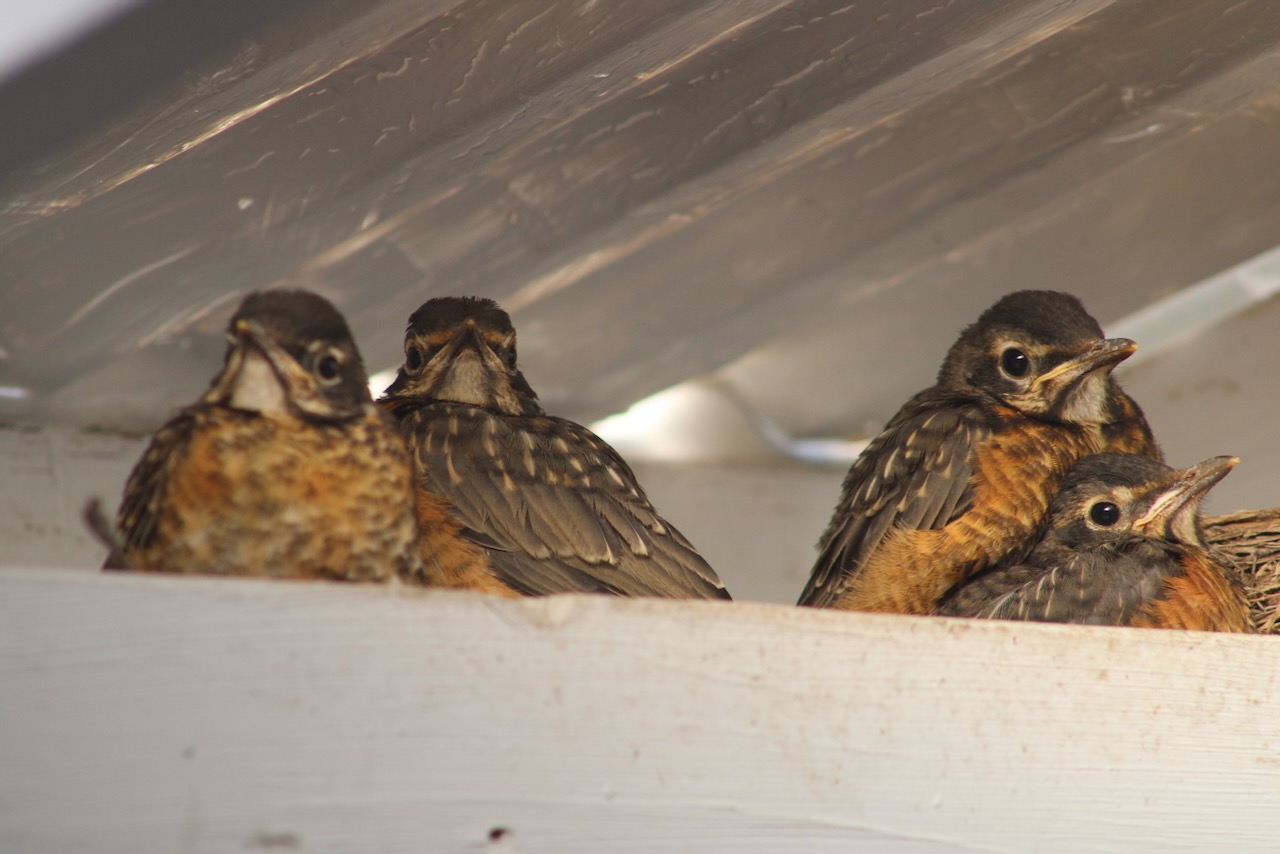
Four nestling robins on a beam next to their nest.

It is Solstice morning, and as always these days, I look out the back door to check on the robin’s nest. I find the four nestlings have all jumped out of the nest and are perching on the beam. They preen their feathers and move around.

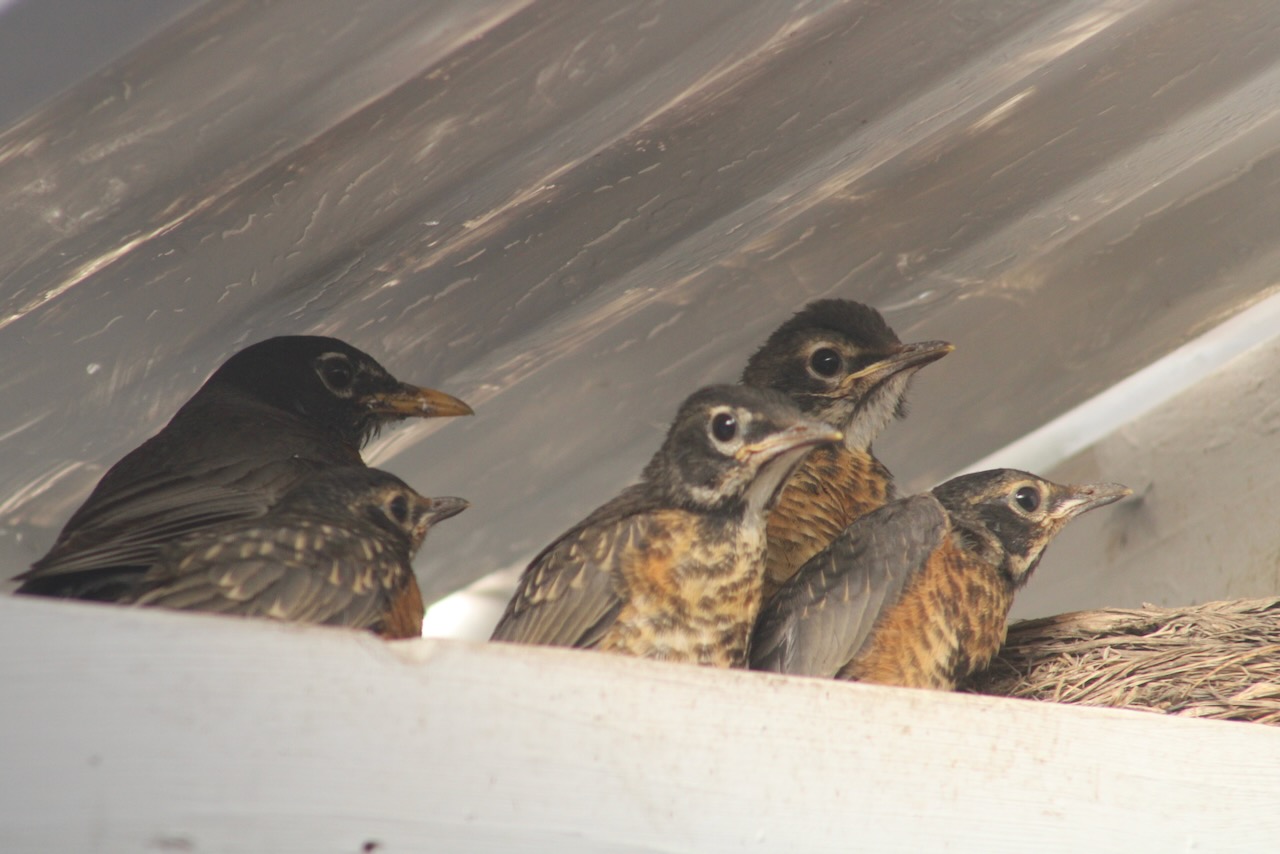
Parent robin with the four nestlings on the beam.

Parent robin flies in to join them. We can’t tell the difference between the mom and the dad–they both come round to feed the babies.

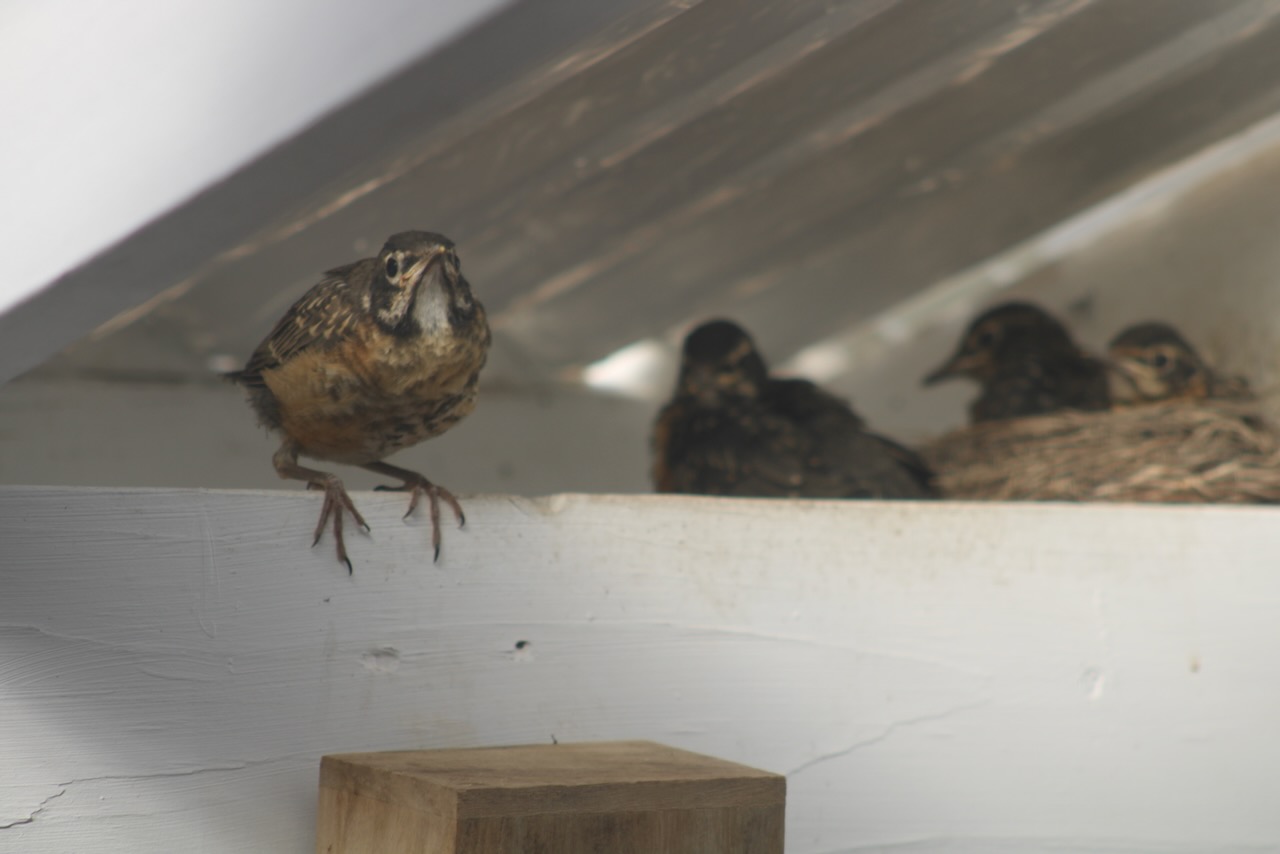
One baby robin perches on the edge of the beam, its claw like feet over the edge. The other three are in the background, two back in the nest.

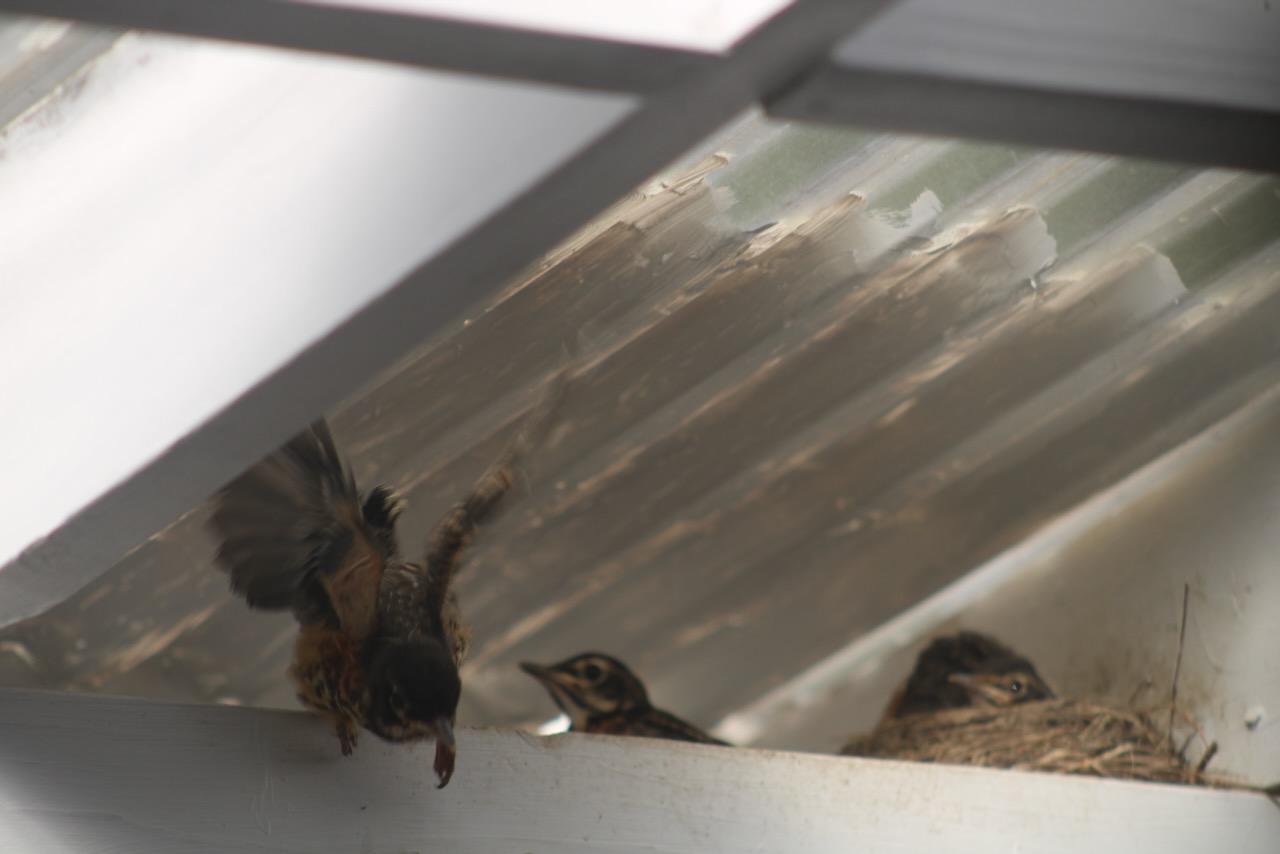
One of the babies is perching on the edge of the beam, eager! A moment later, they take the leap and fly down to the deck.

Blurry image of baby robin taking flight down from the beam. Others watching from background.
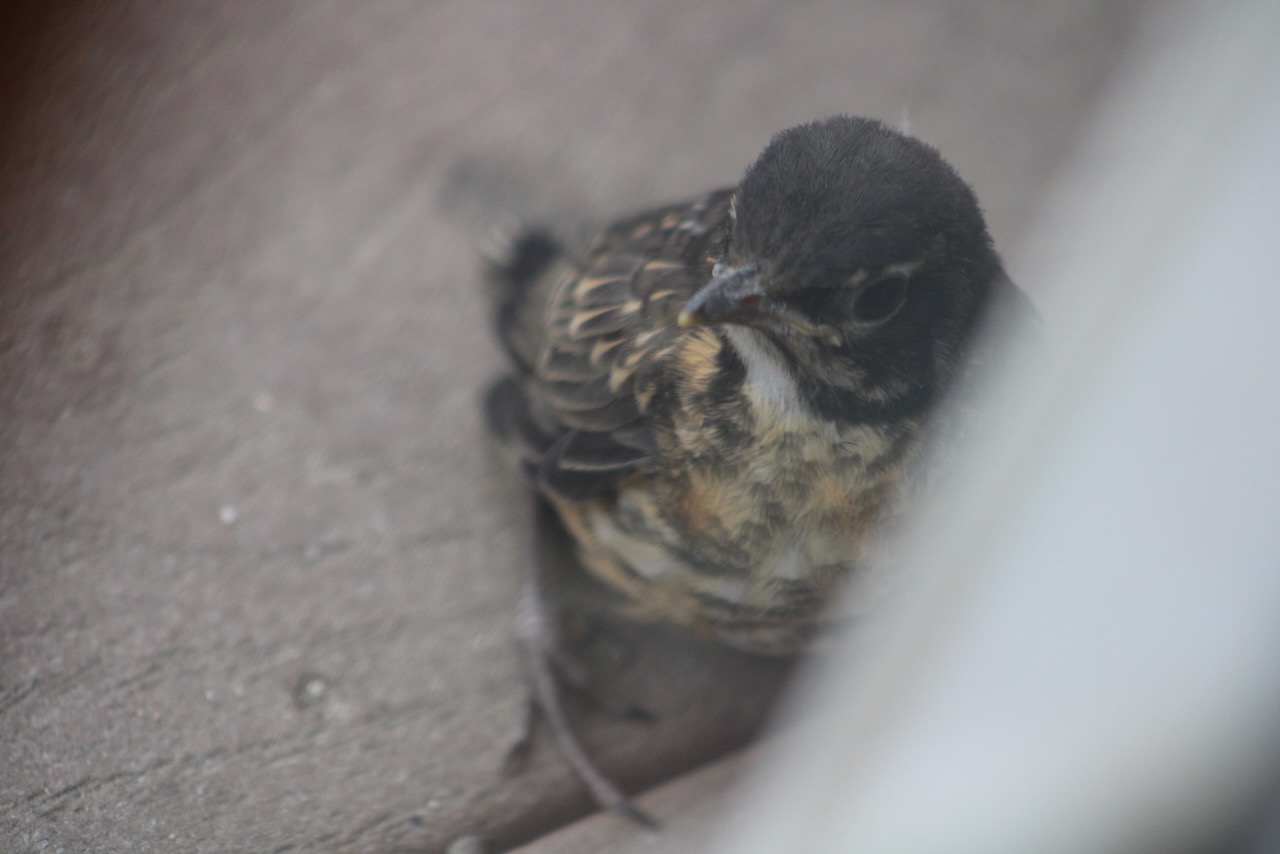
Baby robin now a fledgling poised on the floor of the deck.

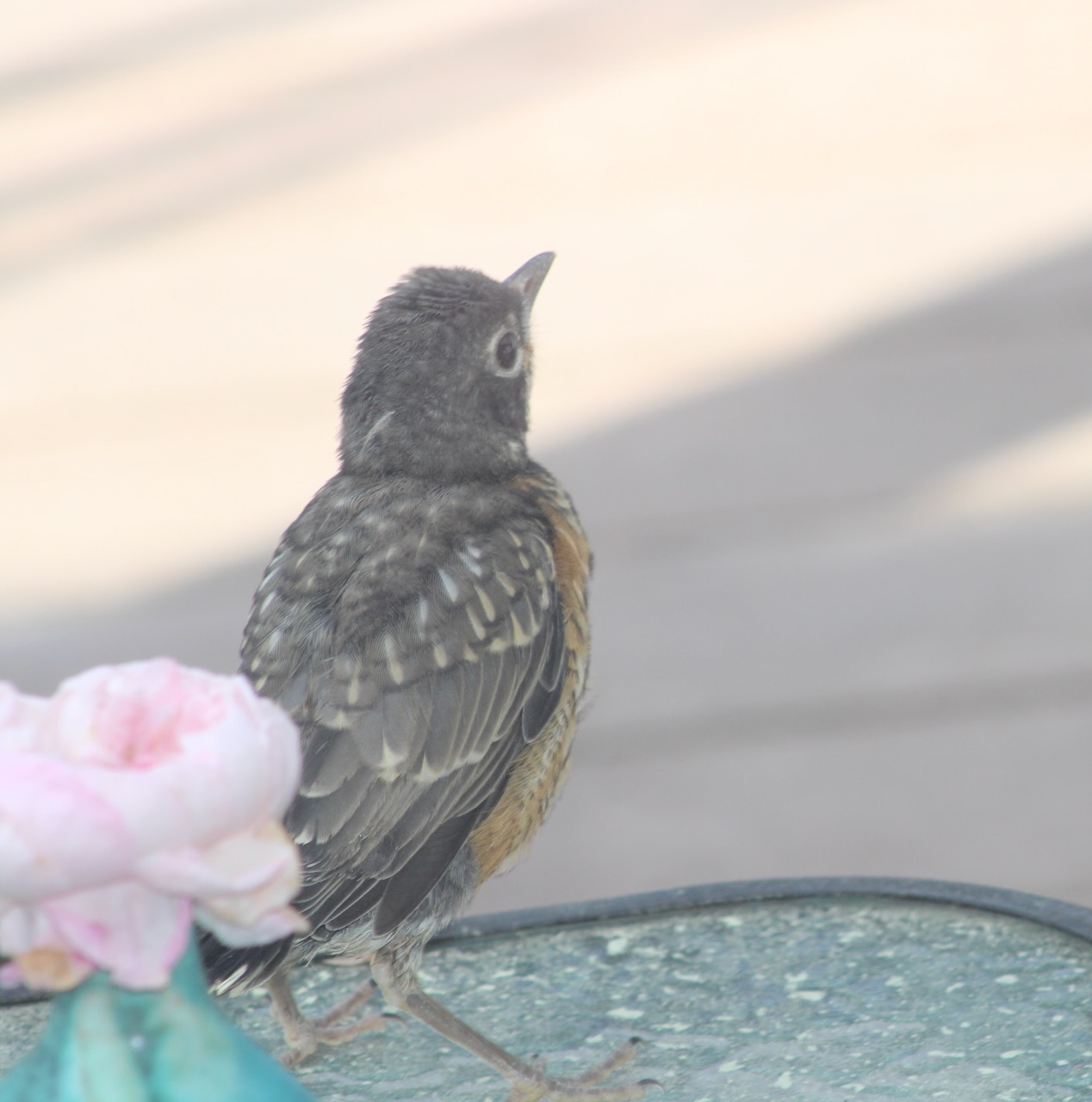
“What am I doing down here? I did it! I flew. I think I will fly some more. Up to that little table with a pink rose.”

on the left is a pink rose flower in a turquoise vase. the fledgling is posed to the right of it looking right.

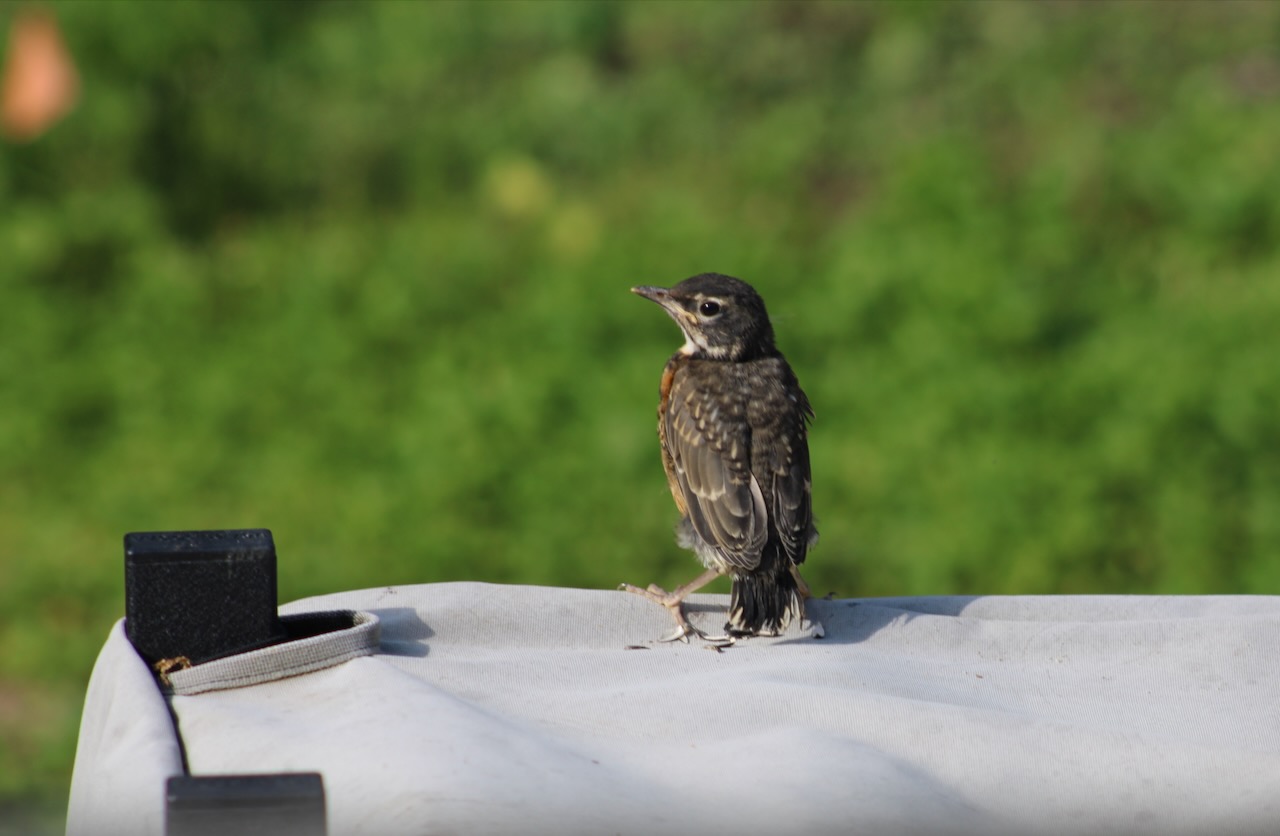
“Now what? I think I will fly some more.”

Fledgling on top of gray canvas cover, green blurry background.

The fledgling sits on top of the woodpile cover, a few chirps that I imagine are saying, “Mom, Dad, where are you? I’m out here in the big world. Help!”

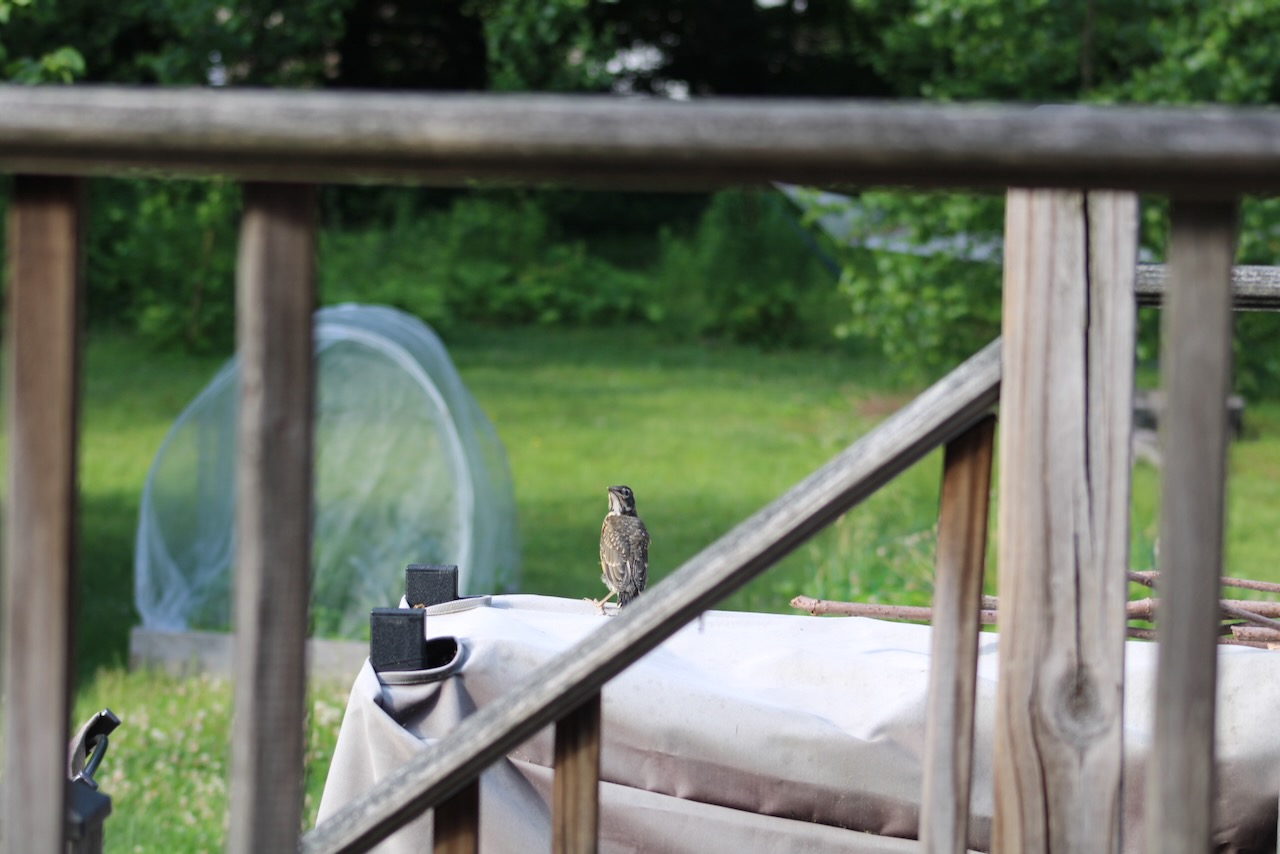
Small fledgling seen through deck rails with backyard in the background, netted raised bed, trees, grass.

Eventually, the parent robins come nearby, enticing the baby with juicy worms, calling to them from nearby perches, and even coming to the woodpile cover to encourage them. Finally, one of them calls from the garage roof, and the baby flies up there to be with them. But quickly flies up to the deck roof, and then somewhere else, I don’t see it.

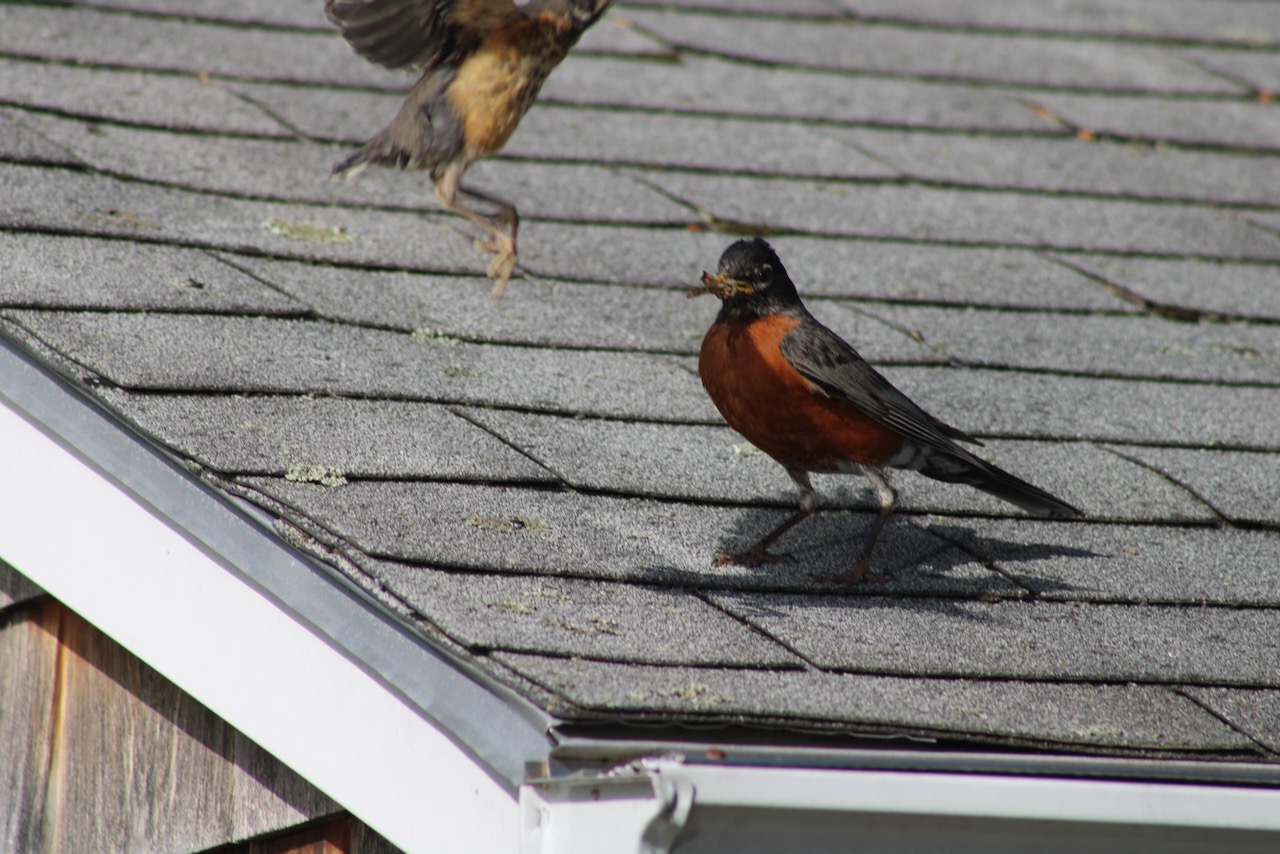
Adult robin perched on garage roof, and you can see the feet and part of the body of the fledgling coming into view from above.

I lost track of them then, and went outside to look around the driveway, and then I see what turns out to be another fledgling flying toward the neighbors house, and trying to grab onto the side, but floating down. Later, it emerged from their flower bed onto the grass, and the parent went to that one to lure them into a safer place. They seem to want them to be in hidden places, no doubt.

The other two nestlings decide to huddle in the nest to recover from all this excitement. Meanwhile, I come inside to eat breakfast and marvel at the miracles of birds and growth and life. So this is my gratitude for this Summer Solstice of 2026. May life and growth and wonder fill your hearts today. May this season be filled with such moments of wonder.

Beauty of the Roadside Border

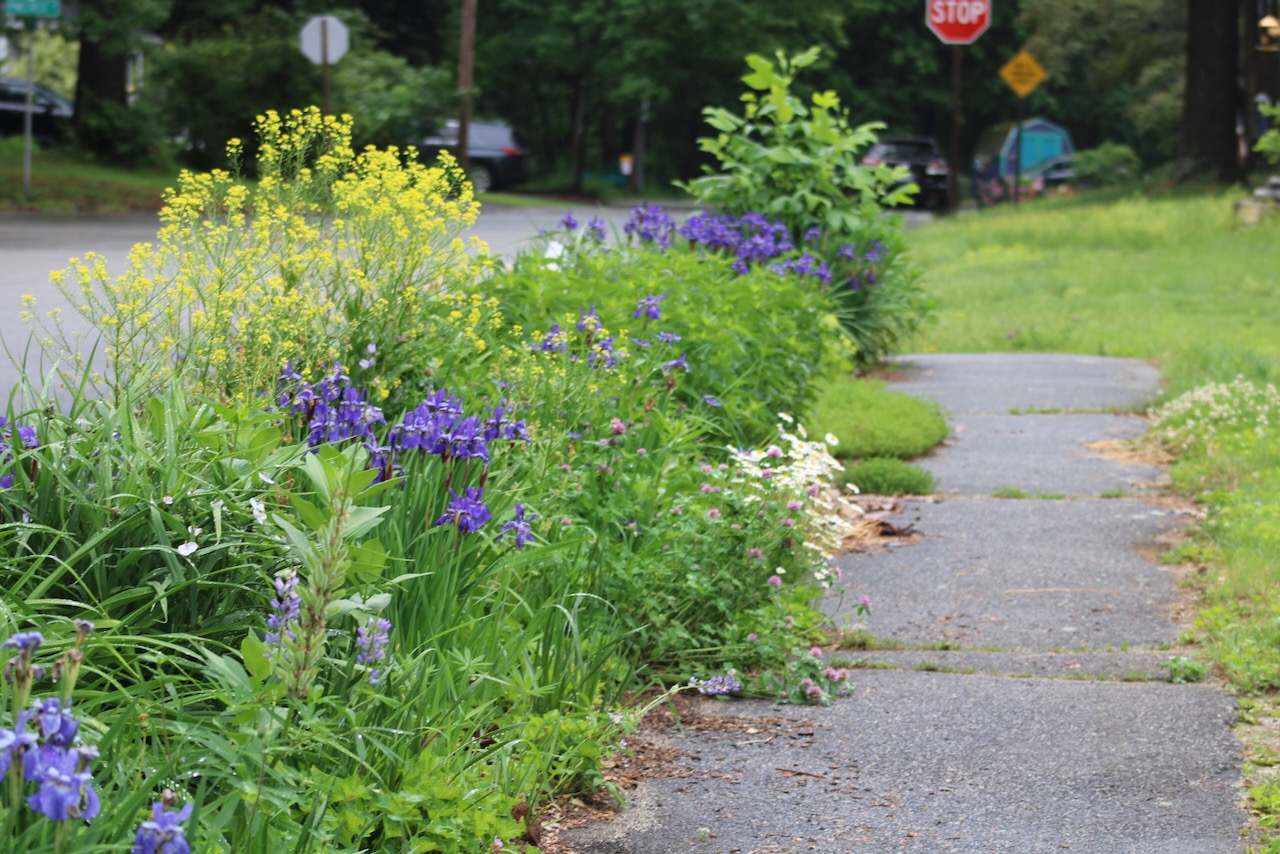
Roadside flower bed with purple siberian irises blooming, and yellow turkish rocket, and many other plants crowded together next to a sidewalk.

The border I created next to the road is perhaps the most beautiful it has ever been. Right now, Siberian Irises are blooming in their blue-purple glory, set off by the cloud of yellow of the Turkish rocket, volunteer white daisies and a patch of white irises, along with the green of other perennial leaves filling in the gaps. The purple is reflected in 3 patches of Bachelor Buttons/perennial blue cornflowers, and 3 patches of Spiderwort. I just love looking out our front window and seeing this flourishing of my favorite color. Later, there will be a lot of yellow flowers. That was the original theme–yellow and blue/purple hardy perennials. We also encouraged milkweed to seed itself in the in between spaces, hopefully offering nurseries for monarch butterflies.

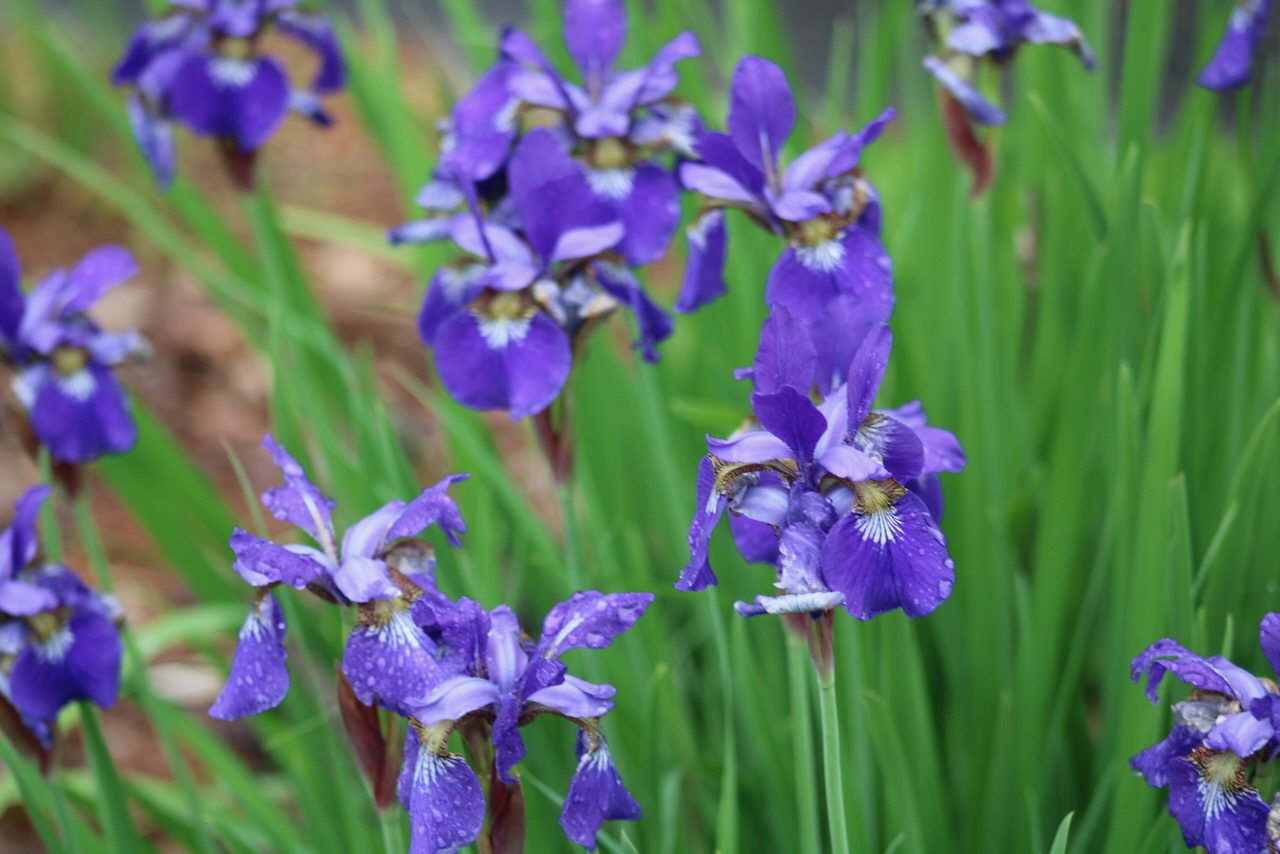
close up of purple Siberian Irises.

I’ve been trying to garden this spring, bit by bit, with what energy I can muster. For the roadside border, that just meant some weeding of crabgrass this year. I appreciate plants that take care of themselves and give so much! We also harvested sea kale earlier on, and chives, and asparagus. But something about the state of the world inspired me to plant more vegetables from seed, so now we have kale and carrots in one raised bed, broccoli and beets seedlings in the hugelmound, snap peas and zucchini in one raised bed in the front yard, and beans and yellow zucchini in the other. We also have potato plants in a grow bag on the patio, and cucumbers in a pot on the deck.

What has been harder to plant, I am not sure why, has been the seeds of ideas for writing in this blog. But this week I have been reading a book by Leah Lakshmi Piepzna-Samarasinha, “Care Work: Dreaming Disability Justice.” Perhaps it is her stories of trying to write as a chronically ill queer femme of color, her openness about the ups and downs of activism, creativity, and survival. Perhaps it is the feeling of a community of writers that once upon a time I felt connected to. It is a great book for so many reasons other than those. The kind of book that sparks one to think differently about disability and justice and care. Please do check it out. But for whatever reason, each day when I read a section, I find wisdom for living the life I am living right now.

There is so much that is horrific happening in our world these days. It all feels overwhelming to me. I don’t have the capacity to write about all of that. Perhaps that is part of why I haven’t been able to write here. I can bear witness, I can pray. But it is so overwhelming. Or perhaps I can’t write because of the further diminishment of energy in this chronic but always variable illness that surrounds my living. It seems to rob me of motivation and the urge to create. Perhaps I am not sure of the connection between illness and “the spiritual journey to earth community,” which I defined as the guiding topic of this blog site. Leah Lakshmi’s voice somehow affirms the validity of illness as a topic for writing, for activism, for imagining.

So who knows if I will be able to blog some more, but for some reason, today, between the beauty of the roadside border and the beauty of Care Work, I found some inspiration, and I am grateful for that.

Stillness

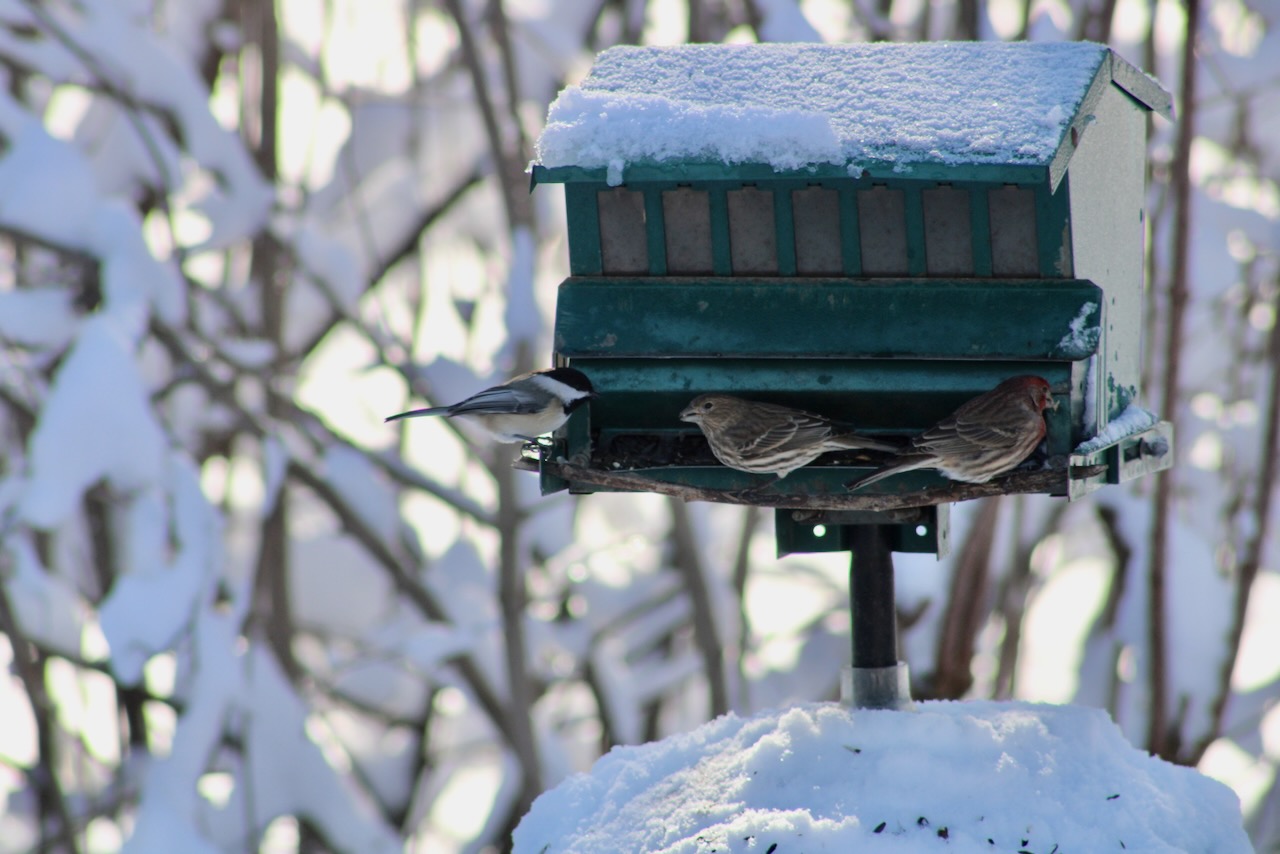
Snowy setting, dark green bird feeder with three birds, a chickadee and two finches.

I have much less energy than I used to. I notice it in my spiritual practices. I don’t seem to do rituals anymore such as lighting candles or building a fire in the yard. I haven’t written a blog post for a month. All that I still do is to write in my journal each morning, and if I can, take a short walk to the nearby Capisic Brook. During each of these, I express gratitude for my life, and sometimes I ask for help. This is my spiritual practice now.

I am grateful for a new day of living. When I reach the brook, I turn to the four directions. To the East, I express my gratitude for the sky, for birds, for their singing. To the South, I am grateful for the sun, for fire, for plants. To the west, I am grateful for water, for the brook, for snow on the ground. To the North, I am grateful for soil, for animals, for the earth.

I am still trying to learn and speak Passamaquoddy/Wolastoqey, so I speak these gratitudes in the Wabanaki language of this place. I can do these sentences, but I’ve reached a point in my learning that is very challenging. I don’t know if it is my tired brain that can’t move forward, or if it is the differences between the shape of the language and the shape of English. My teachers seem pleased with my progress, but I can’t seem to get my mind to think in the language even when I am listening to the language. Still, one of the primary lessons I have learned is the importance of gratitude, so perhaps that will be enough if I can’t do more. I am grateful for the gift of learning the language.

I still have my questions about what this time of my life is all about. The limits of illness keep me from activism in a time of great oppression and cruelty in our country. Genocide continues and my heart hurts with not being able to do anything. I count it a good day when I can bring fresh water to the birds, fill the feeder with new sunflower seeds, and then do our dishes and prepare meals to eat. Still, the birds continue with their small lives, happy to eat the seeds and drink water. So perhaps they are my teachers. Grateful for food and water. Can it be enough?

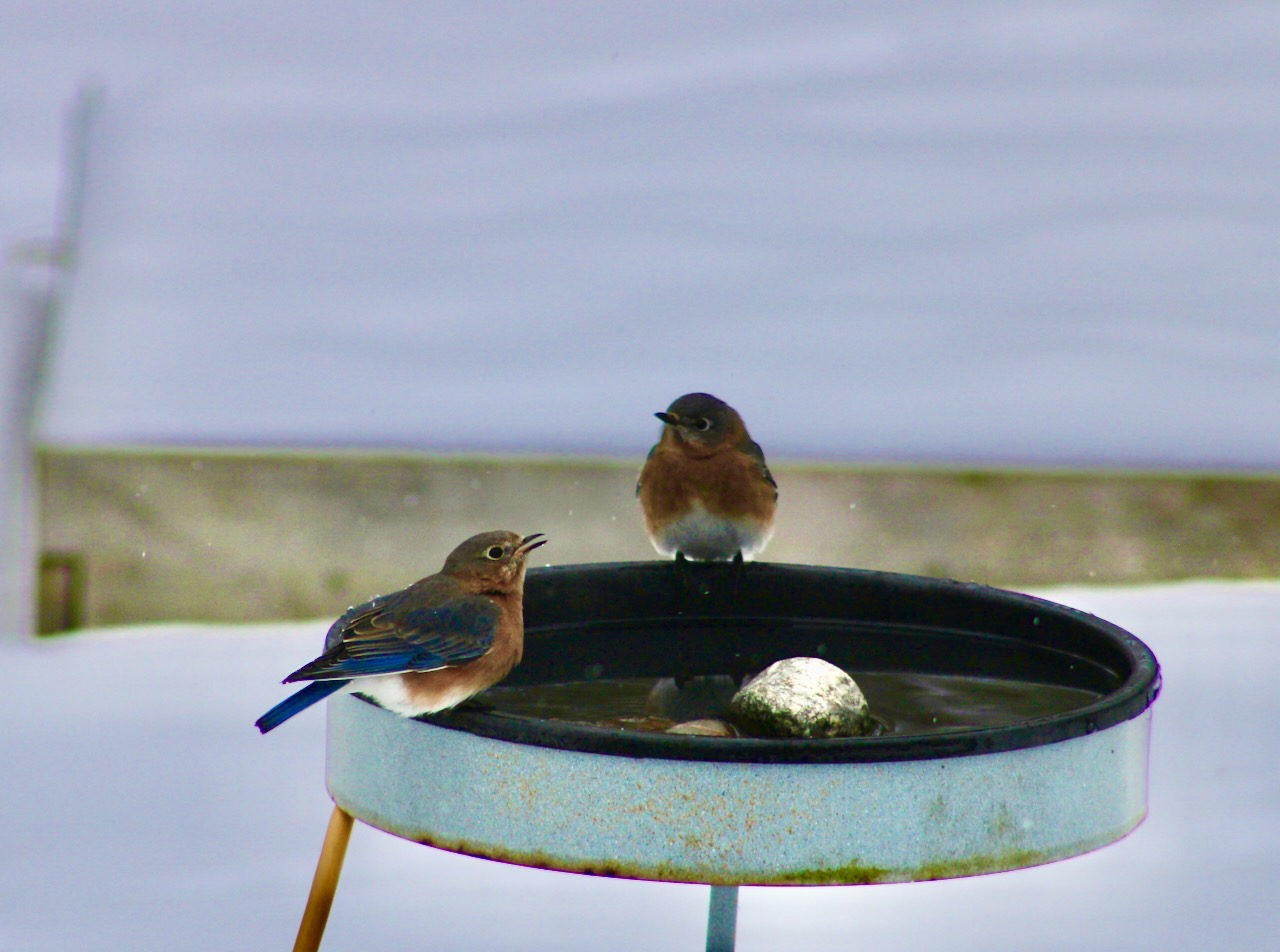
Two bluebirds perches on a circular heated bird bath.

September Musings

Four huge turkeys in the shade of some green grass, behind leaves of zucchini in the front corner of the photo

The summer garden had some successes and some fails. And it is sometimes hard to tell which is which. This turkey family visited the yard many days, and walked through the garden beds in the back. They mostly left the veggies alone, except they liked to eat the tops off the bean plants. We still got a few beans even so. And they left alone the zucchinis, which did well, the cucumbers which did fair, and the broccoli, also fair. We appreciated their visits–we want to support wildlife after all.

However, we tried to lessen our support for the chipmunks and squirrels that became such little rogues. Despite netting over the blueberries, once they figured out they could squeeze holes into it, they got the rest of the blueberries, though we did get a bunch before that. I am happy to say that the baffle on the bird feeder totally worked. They never got up to the feeder after the baffle was installed. So I am hoping that without all that extra food to stash, the population won’t explode like it did this year. The long game. And the birds keep coming back to the feeder.

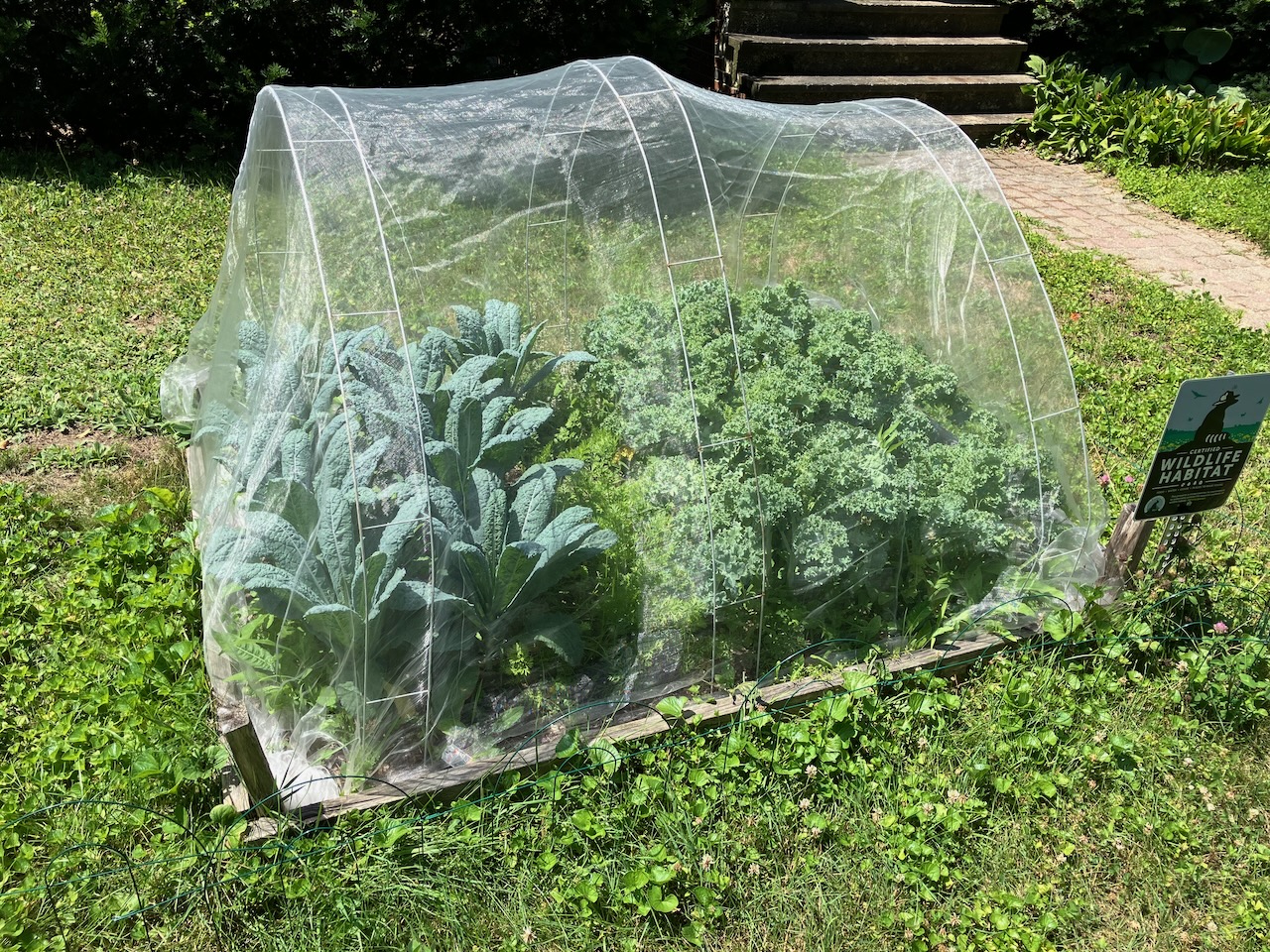
In the front yard, we never had monarchs lay eggs on our milkweed plants, despite their visit. Maybe next year? The netting on our kale and carrot bed was a great success. It protected the kale from cabbage moths, and no one tried to get into it. We have a ton of kale harvested and still to harvest.

Rectangle garden bed filled with green kale of two kinds, covered over with a translucent net on white metal supports.

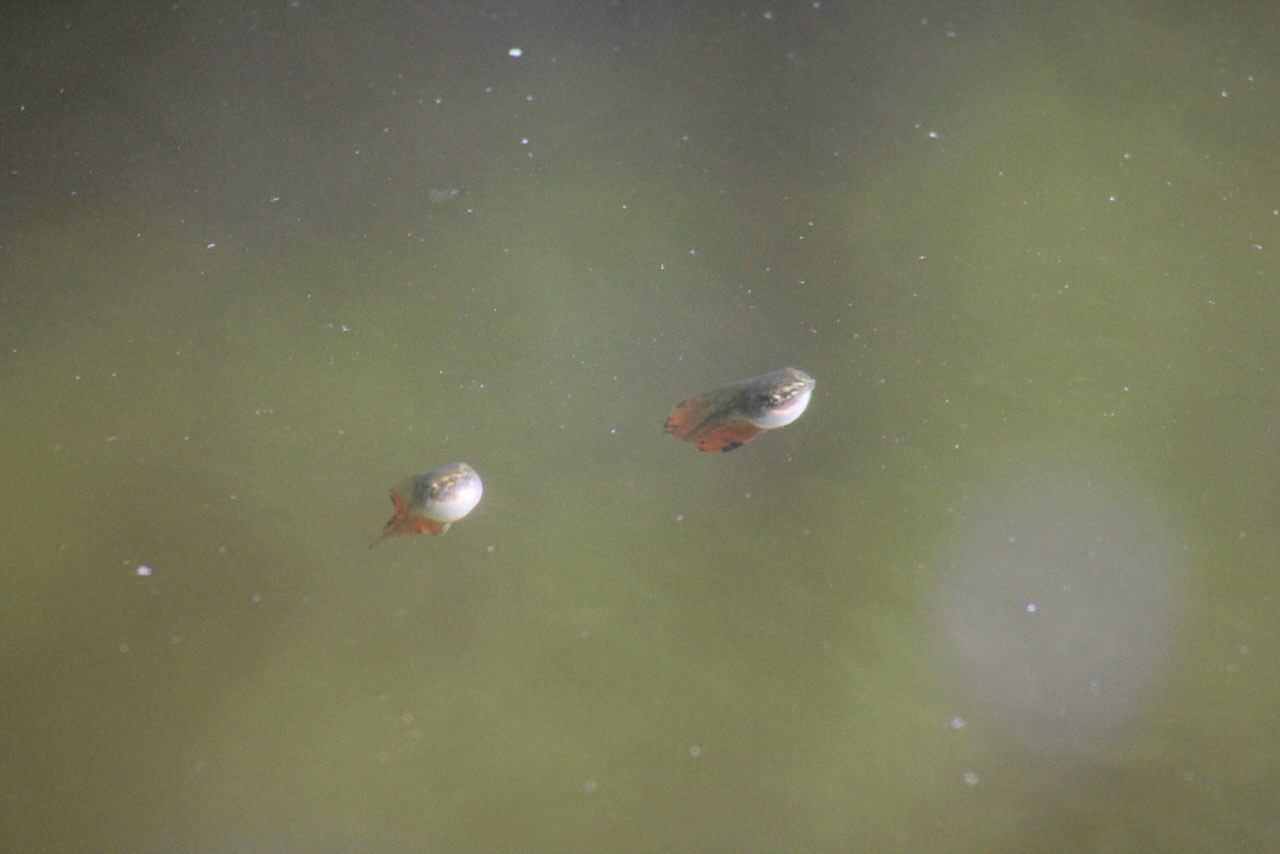
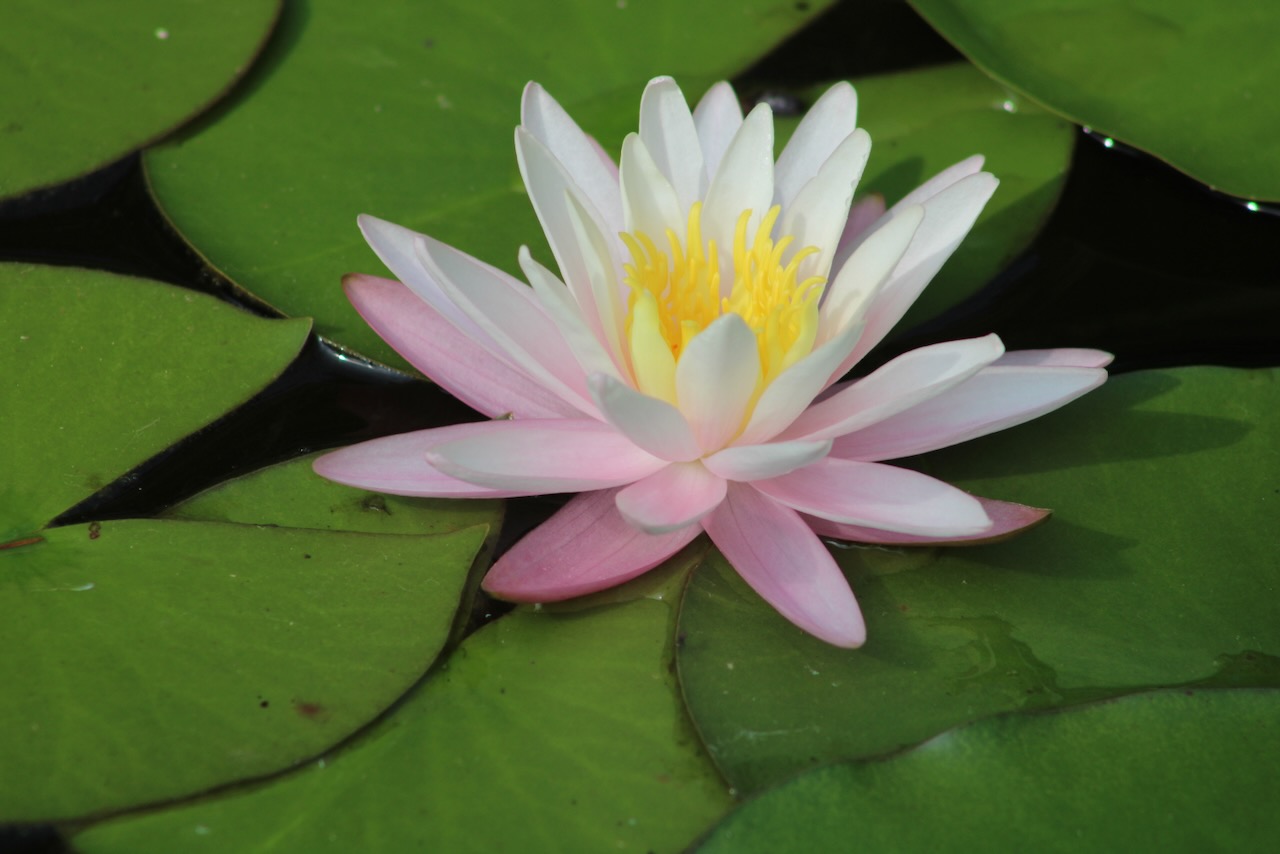
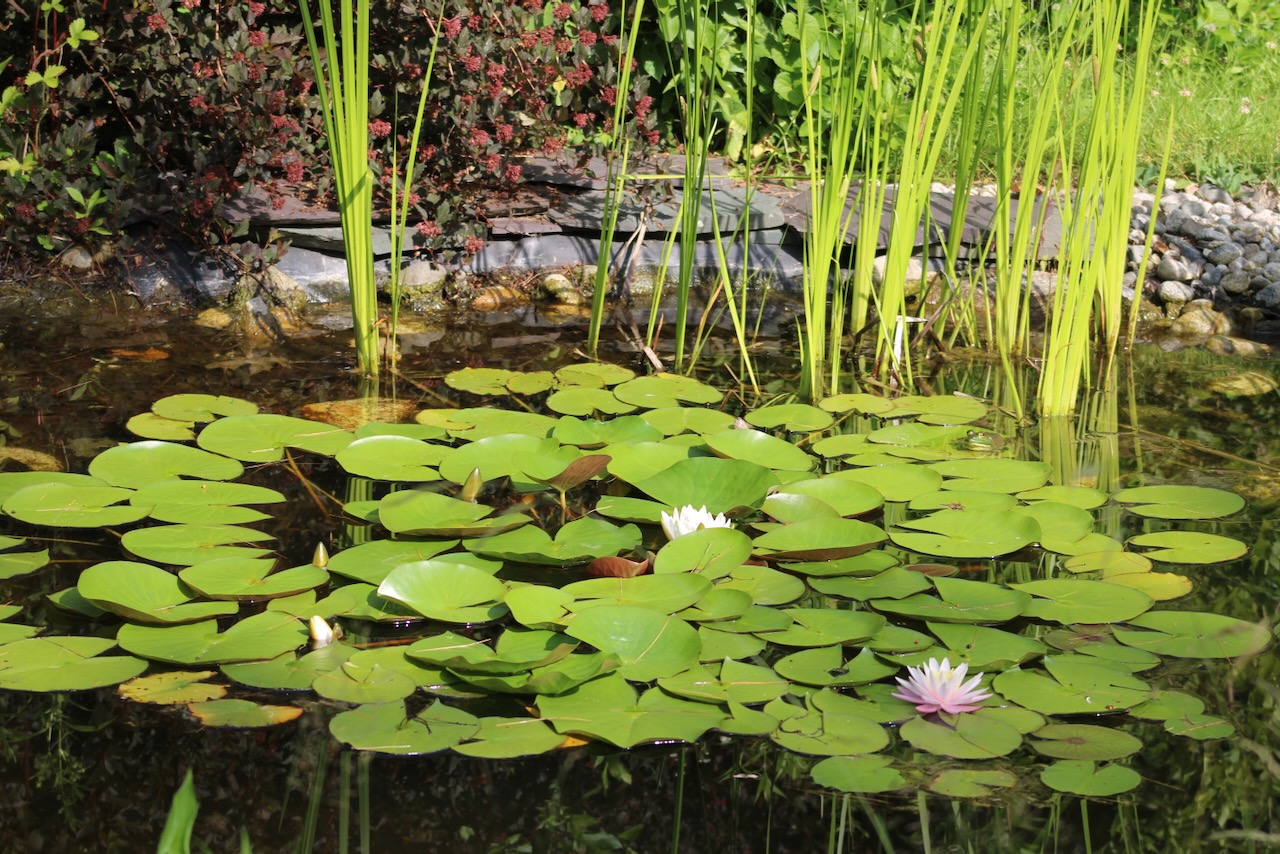
The robins never came back to their nest on our back porch after the babies had been attacked. Still so sad about that. We’ve had some lovely visits with human friends out by the pond. The pond water level went down with the drought, but this weekend’s rain helped, especially after adding water from the newly filled rain barrels. Still a few frogs, though I am not sure about the tadpoles. They hide under the lily pads, and it’s a lucky day to see them.

And… and… and… Gaza is still being attacked night and day, and starved by blockades. International resistance is growing but too slowly for the people killed each day. I keep bearing witness, and praying. It’s the same with the rising fascism of our country, and the attacks on immigrants both documented and undocumented, and citizens who are brown or black or speak Spanish. The only thing that gives me hope are the multiple levels of resistance from huge demonstrations to lawsuits to governors who slap back. Here we do the best we can to get by, day by day, accepting our situation as elders and those who are chronically ill. In the face of so much cruelty and hate, we add our little love to the mix, hoping to be part of the larger Love which is our only real hope.

Fighting with Squirrels (and Chipmunks)

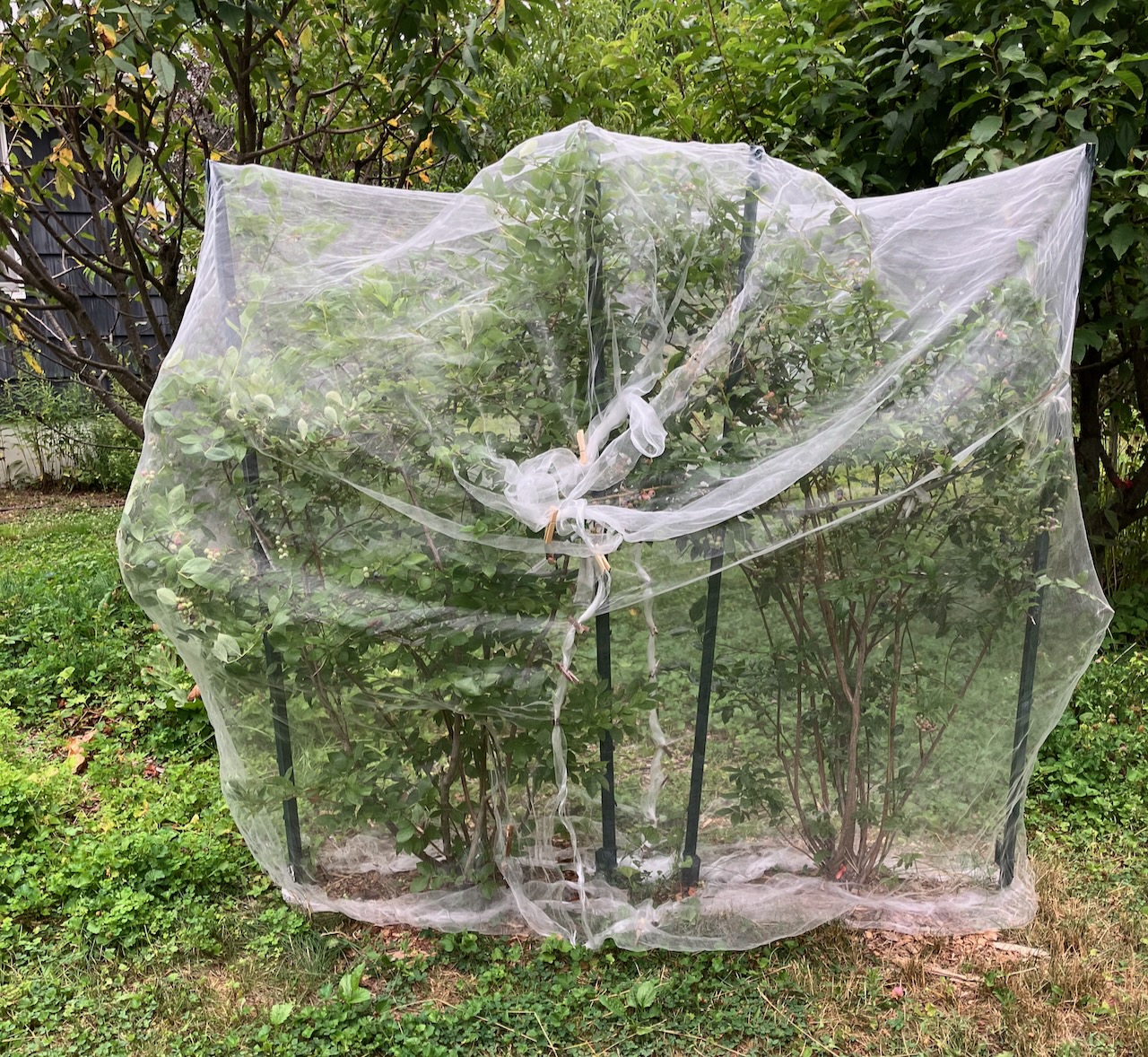
White netting draped over two blueberry bushes, using fence stakes

The intent of our permaculture gardening is to create a mutually beneficial relationship with the earth and all her creatures. But lately, it feels like a little backyard battle. The squirrels have literally eaten all of the green peaches off our peach tree. (Last year there seemed to be enough for all of us.) They have been also eating raspberries, hazelnuts (still green) and mulberries, but I sort of gave up on all of those. I have tried to protect these two blueberry bushes by covering them with netting, garden-stapled down, and using clothes pins to close the side opening. I have actually harvested some blueberries. But the last couple days, they’ve pushed their way through holes they make in the netting. When I see them, I run out yelling and clapping, and they dart around the edges to find their way out and run away.

To be fair, there is another variable this summer. I stopped filling the bird feeder some weeks back because the chipmunks would immediately climb up, fill their cheeks, climb down, and transport the seed to their underground lairs; and then repeat until all the seed was gone. The squirrels also took a fair amount. I wonder if the sunflower seeds were the tribute I had been paying to our little neighbors that ensured that they’d save us a few peaches? But yesterday, perhaps I upped the ante, because I installed a baffle on the feeder, and coated the pole with coconut oil. I really do want to feed the birds, not all the greedy chipmunks and squirrels. So here is the new set-up, (the bush is at least five feet away–I pruned it to make sure):

Green metal bird feeder with clear plastic baffle a few inches down, in front of a green bush background.

Margy and I have a little side bet going as to when they might be able to breach these new security measures. It has been up for twenty-four hours so far. No squirrels, chipmunks so far. But the birds haven’t come back yet either. The next few days will tell. And in case it isn’t easy to see, the original bird-feeder is also “squirrel-proof,” with a weight dependent bar that drops down to close the seed opening. But they figured that out long ago. They are so smart, and acrobatic. In many ways I love them. But I don’t love that they take all the fruit in our garden.

Anyway, I just needed to write about this other side of gardening. I am so impressed by the work farmers do! If we relied only on our own gardening skills, we would go hungry. But perhaps this is one of the lessons I am learning about how to be in a mutually beneficial relationship with the earth, and during climate warming too. We are all under a lot of stress, trying to survive. We don’t have complete systems in place, we don’t have our own ancestral knowledge, we are trying to recover from great imbalance. So we keep showing up, keep going outside, keep being grateful for the gifts of the earth.

And these days, I can’t write about anything food-related without also expressing rage at the intentional starvation of the Palestinians in Gaza by the state of Israel. They destroyed their farms and gardens, and destroyed access to water, and access to help from outside. How many more people will die before the world powers stop this genocide?

Monarch and milkweed

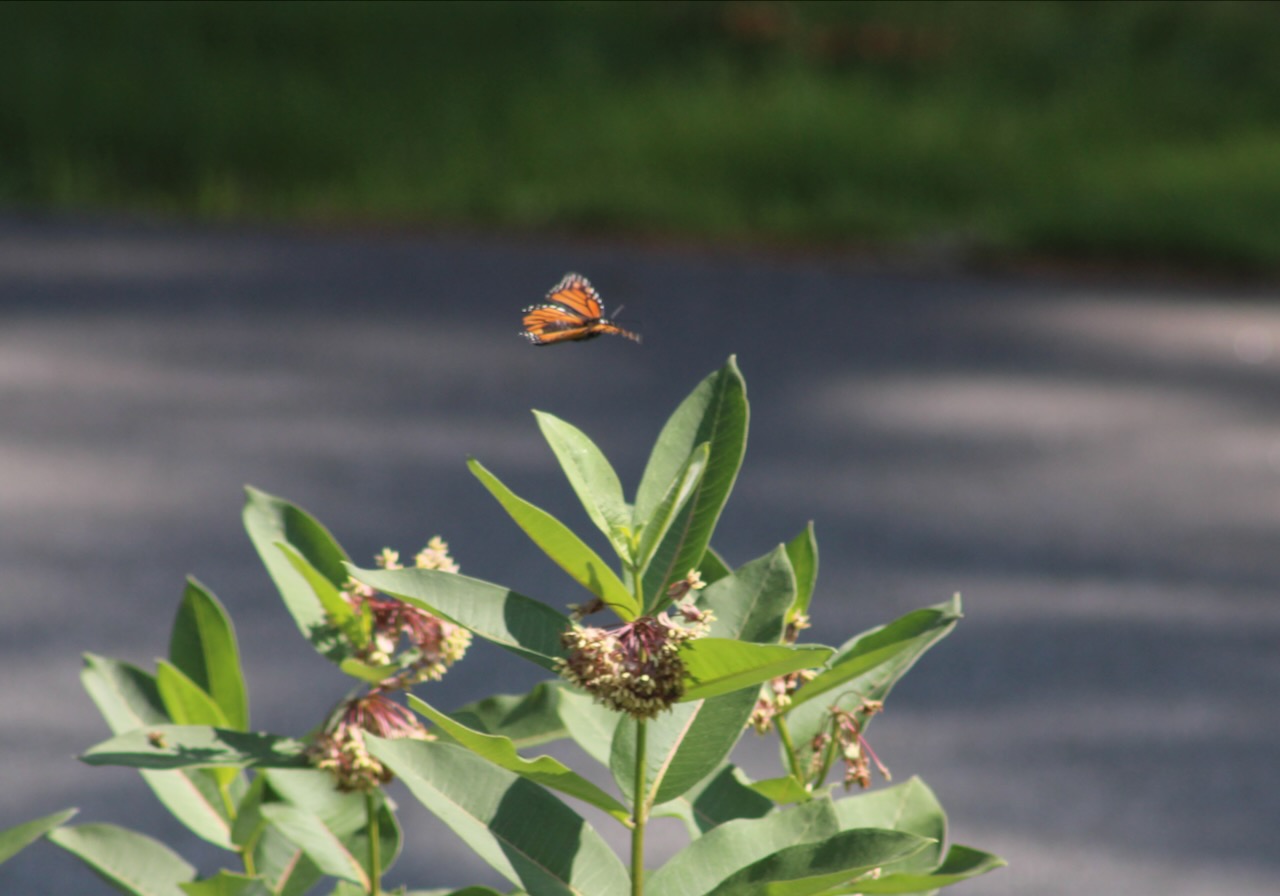
Orange and black monarch butterfly is flying above milkweek plants with green leaves and pinks flower clusters.

Today a monarch butterfly finally found our little milkweed patch in our roadside garden bed.

Last year, three plants appeared there on their own, and in late July we saw a caterpillar. In the spring we scattered some fluffy seedpods in the soil hoping to expand the numbers. This year we have a patch of about a dozen. As they grew and then bloomed, I’d look out the front windows, hoping to see a monarch. But nothing until today. It is amazing that the monarchs can find such tiny patches of milkweed, scattered in city neighborhoods.

In the midst of all that is heavy, it feels good to support these far-traveling little migrants.

Robin survivor?

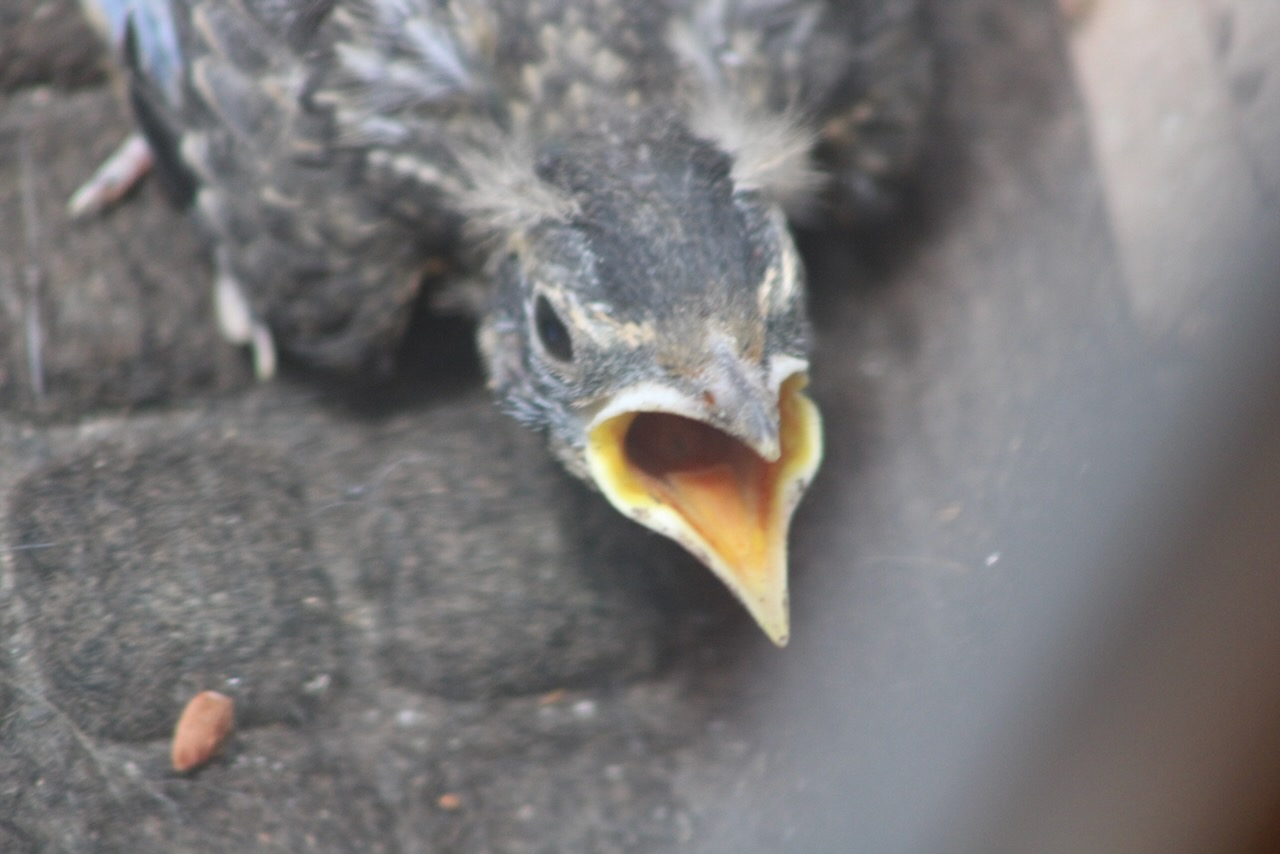
This morning there was more excitement concerning the sole surviving baby robin. It had walked out from the nest onto the nearby beam, even into the next section of beam. So it was alive! But the parents went back and forth calling several times. I was watching through the glass of the back door, hoping that they would find it and feed it. Then, finally, one of the parents brought the baby a big mouthful of worms–and just as it got them it its mouth, it fell down to the deck below. There it sat, seemingly stunned for a long time. I kept watch, not wanting it to be gotten by some predator, but also not knowing what to do. I even put in a call to Avian Haven, but it was before business hours. (8:30 a.m.) I wondered if it was injured.

Finally, I went outside, and went near to it, and it started to walk away. It seemed able to walk, but it never flapped its wings like it was trying to fly. Too young I think. Only 9 days old. So I gently picked it up and put it back up into the nest. And it seemed like that might work, and the parents came back and forth, and fed it up on the ledge, where it had once again walked on to. The parents were both very solicitous and sometimes called to the chick, and sometimes scolded at me. When Avian Haven called back (after I had put it back in the nest) they suggested that if the parents were still attending to the chick, it was best to leave it with them, and not take it away.

However, would you believe it? It once again fell or jumped from the beam and landed on the deck again. It was lying on its side but then righted itself quickly and literally walked over to our glass door and looked up at me. As if to say, “help, here I am on the deck again.” So fierce its little face!

Margy was here by now, and we knew a grocery delivery would be coming soon to the back porch, so there was that pressure. So finally I went out on the deck with a shoebox, thinking to put it in that for safety, but it quickly walked away along the wall and jumped off the deck (about 2 1/2 feet down maybe) and was in a little side corner near the steps with no way out. I thought I’d try to get it to jump in the box–but by now it was acting more lively. When my hand came over its head, though, it opened its beak as if I might feed it. I was able to shoo it toward the open box, but once in the box it did not like that at all, so I quickly brought it over to the other side of the porch steps and set it onto a patch of ground cover plants. Then it decided to walk under the deck, out of my sight.

The whole morning I was never sure what to do, to leave everything alone, or to help, and in what way. I don’t know why the parents kept calling to the chick. It reminded me of when they were trying to get their previous set of chicks to fledge, but this one was obviously too young to fly. I wondered if whatever trauma had happened the night before, that left two chicks dead, and one missing, might have freaked them out so they wanted to get their chick away from that nest. Or maybe they were giving protective warnings to whatever might have disturbed the nest before. (For example, the chipmunk that frequents the area.) As a human neighbor, is my presence helpful or harmful?

The parents have come back now and are calling repeatedly, but at least one of them was down on the ground, so maybe they’ve figured out that the chick is underneath the deck. I hope so. It is too dark under there for me to see. So I may never know the fate of the chick. But I do take comfort in how fierce it was in those last moments of our interaction. It probably only needs a few more days to grow before it would be ready to fly.

Heartbreak among the robins

Something got at our baby robins… of the four in the nest, we just found three on the deck floor, two were dead, and one still alive–I gently put that one back in the nest, but not sure if it is really okay or how it might survive, we hope the parents will come back for it. They were calling loudly, but not around now. We don’t know what happened. One had disappeared entirely. So heartbreaking… We wondered if it might have been a chipmunk.

This is not the way I hoped to mark the Solstice. How fragile all of life is right now.

Garden Blue

My favorite color in the garden is this blue/purple of the Siberian iris. They’ve multiplied in the roadside garden bed, and blossomed all along the way. And now they are gone. So we had maybe a week to enjoy their beauty. I feel the time rushing by with all these spring and early summer flowers. Nothing goes on and on. With photos we try to capture the moment and make it last a little longer, but nothing really lasts in that way. If we don’t pay attention to the moment, we miss it.

It is easy for me to get caught up in what needs to be done, the projects, the planting and watering, the weeding, the holistic sprays for the orchard. But probably what is most important is to walk around the yard noticing the flowers and plants and critters, noticing the birds and frogs and tadpoles. When we came to this yard, our hope was to nurture our relationship with the land, with all of the wisdom it had to teach us, with all of the tending that it asked of us. It was the tangible finding our way home that my spirit was hungry for.

We’ve been tending this particular small place for about nine years, and we feel such a bond with it. In these times of wars and rumors of wars, walking through the yard restores my soul. What must it be like to live for generations in a place? I can only begin to imagine. One of the crimes of the destruction of Gaza, along with the horrific killing of human beings, is the destruction of the land, the olive trees, the plants, the gardens. All those homes. It makes me weep.

I walk around the garden in the mornings, and I pray. I give thanks for another day of living. Not just my life, but the life all around me, of which I am a part. I am happy to see that the spiderwort plants are blooming, another in that shade of blue/purple. This seems to be the very favorite flower of the bees, and it lasts for a long time, with multiple little buds on each stalk, taking their turn to shine. It is the very diversity and multiplicity of the plants that bring abundance to life in the garden.

Balance in the Garden

Raised bed with wooden sides, on left are pea plants on string and bamboo, middle is broccoli seedlings surrounded by pine cones, wire fencing around edge.

This earth love is a balancing act. We love critters in the yard, after all, they live here too, and have the right to be here. They bring so much joy to us. But we want to grow food too. The last time we bought organic broccoli at Hannafords, it was $8 for one crown. These twelve broccoli plants in this raised bed will be very valuable food for us. I’ve also planted cucumber seeds here. So we try to use gentle methods to discourage the critters from eating the plants we want for our food.

Margy saw a groundhog poke its head up out of a hole in the grass, over near the fence. There was a burrow underneath where a spruce tree fell before, and after it was removed there was still a mound of old roots and dirt. Groundhogs can be the worst for eating garden food, despite how cute they are. At times, we’ve used human pee to mark a line around the beds. Last year, we covered that bed with an old screen tent to protect the kale–and it did. All of it is a kind of communication, with respect.

This year, I am trying out a new method for deterring critters from the garden bed–putting pine cones in between the plants as mulch. (I saw it on Facebook.) Apparently many critters do not like the prickly feel of the pine cones under their feet–and these pine cones are very prickly. They come from our pitch pine, and we have tons of them everywhere. Margy had a bag full of them in the garage, so I used those first, and then started twisting them off fallen branches under the pitch pine. I had to wear gloves to do it, that’s how prickly they are. I’m putting them in the hugel mound as well.

We’ll see how it works.

In the meantime, in critter news, a few days ago we saw a mother turkey walk through the yard with about ten baby turkeys. Ducks stop in to take a dip in the pond. The frogs hang out there, and the tadpoles are getting big. They like to linger under the lily pads. The robin has four new eggs she is incubating. The chipmunks fill up on sunflower seeds at the bird feeder, but are also eating the maple seeds that blew all over the yard.

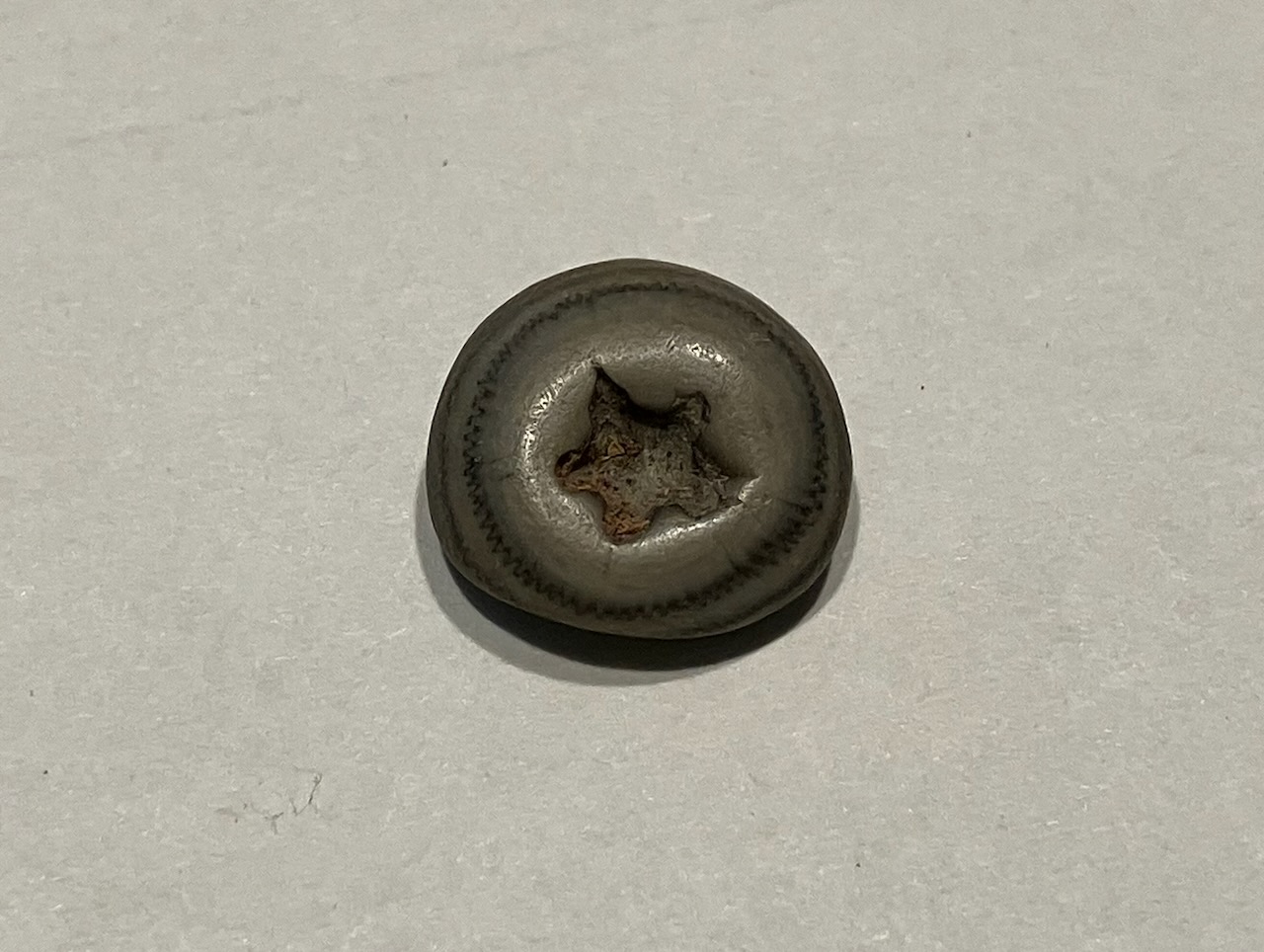
And sometimes, beauty emerges in unlikely ways–this is a dandelion after the rain washed away all the fluffy seeds. A perfect star.

a white star shape of a dandelion plant, surround by angular green iris leaves.