
My first “ugly” bittersweet basket.
What does it mean to make a relationship with parts of the natural world that we ordinarily think of as trouble? I am wrestling with this question as we wrestle with the bittersweet vines that surround our yard. Asian Bittersweet is classified as an invasive species, because it takes over an area and can wipe out other species. It is very hard to get rid of it. This has provoked some places, including Falmouth, Maine, to plan to use horrible pesticides in its eradication–which seems to me an even worse problem–and a never ending one, because they admit that they won’t be able to ever completely eradicate it.
Some folks are taking a different approach however. Yesterday, Margy and I attended a workshop led by Zack De La Rouda about weaving baskets with bittersweet vines. I loved Zack’s attitude–since we brought this plant here, then we need to find ways to deal with the consequences. And with climate change and other pests threatening species like ash and willow, which have traditionally been used for baskets, we need to keep looking for options. So he brought us into his experiments with making useful items with bittersweet. Which, as he said, is everywhere. The vines had been cut, dried, and then soaked in water for a couple days. I have to say it was not an easy material to work with–hard to bend and shape, at least for a beginner. But Zack assured us that everyone has an ugly basket–when our first attempts to learn the skills result in less than usable outcomes. So I took a pic of my ugly basket.
Another presentation in April got me started on this question. Tao Orion, author of Beyond the War on Invasive Species: A Permaculture Approach to Ecosystem Restoration spoke at the Resilience Hub. We might think of getting rid of invasives as important to promoting a balanced eco-system. But what she discovered is that in the professional world of land management, what usually happens first is a complete destruction of the “invaded” area with powerful pesticides. She helped us to look beyond “the war” and explore other options for dealing with invasives. For example, we can look at the function invasive plants are playing in the ecosystem where they have taken root, and address imbalances in the soil and other factors that may need attention.

Bittersweet vine shoots.
Orion was from the west coast, and didn’t specifically address bittersweet. Margy started cutting off huge vine stems that are surrounding other tree trunks, to try to save those trees from choking. But the vines are so resilient. Tiny shoots start coming up in the lawn, from root networks spread beneath the soil. Non-pesticide ways to deal with them include pulling out what you can, cutting off what you can, and ongoing cutting, to keep the roots from getting the nourishment they need. (Even people who use pesticides have to do all that, by the way.) In the final analysis, there is no way to completely eradicate them, so you have to learn to manage them.
On the plus side, bittersweet is a remarkable example of resilience. They propagate by seeds, by roots spreading through the soil, and can re-grow from small root segments. You’ve got to admire that multi-functionality. And birds love the seeds in winter. There are dozens of birds who live in the uncultivated area just west of our yard–which is overrun with bittersweet, as well as raspberries and blackberries and grape vines growing wild.
But on the other hand, I can’t help but compare it in my mind with the European peoples who invaded this continent, including my own ancestors from France and Scotland in Quebec, and my Germanic ancestors who came later–as immigrants being used to settle the west. Just like an invasive plant, the European invaders took over the landscape, wiped out other communities of people, and destroyed the balance of the eco-system. On an even wider scale, modern human beings as a whole species have overrun our planet and are destroying our ecosystem.
So perhaps the most important lesson bittersweet might teach us is to look in the mirror, at our own invasions, and together we might learn about how to live within respectful boundaries with all of our siblings on this planet.
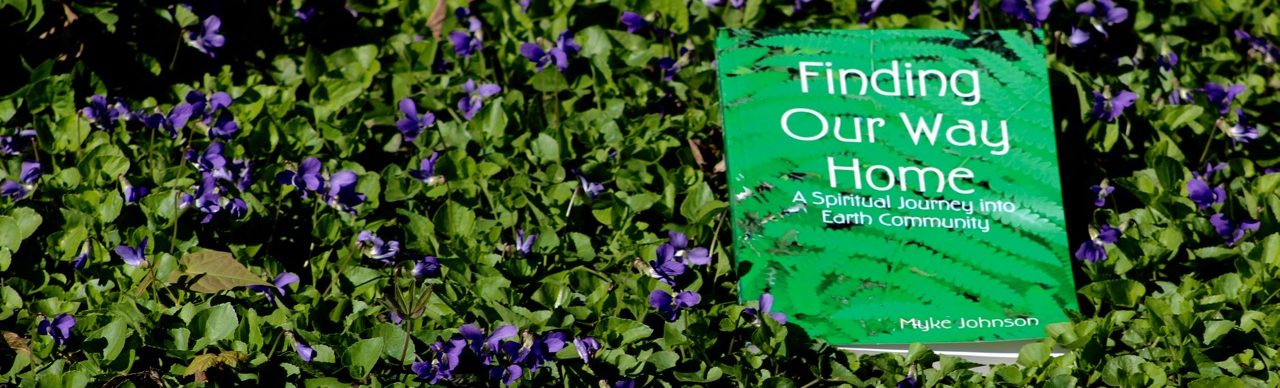
 I am beginning to wonder if the book I have been writing (whether I publish it or not) is creating a kind of unexpected magic to manifest the visions within its pages. Yesterday, for the new moon, I read my journal from the last new moon until this one–a practice I do every new moon day. This particular month has been a time for spiritual restoration. But I noticed something rather curious as I read. Old rituals and practices are finding their way back into my life after a time of absence. And it seems related to the writing of the book, Finding Our Way Home.
 I also write about the spiritual practice of writing–and the book as a ceremony of reconnection to the earth, to each other, to the spirit within all. But the magic I have been noticing this month was completely unexpected, beyond my wildest dreams, and uncanny in its particularity. I wonder if when we write our hopes and visions, when we express our gratitude, when we imagine and tell the stories, there might be an energy that starts to percolate. What has lain dormant wakes up and tries to find a way to express itself. All I can say is wow, and thank you.
 Finding Our Way Home