Still COVIDing

Screened in pop-tent situated near trees and grassy yard.
Our new screened in pop-up tent is set up, ready for summer visits.

There is a phrase I’ve seen online that applies to Margy and I–we are “still COVIDing.” It means that we know the COVID virus is still circulating, still dangerous especially to elders and those with other health issues, and we are still taking all precautions. This despite the end of the declared public emergency and the end of mask mandates. So we always wear N95 masks if we have to go inside stores or offices, we don’t eat inside restaurants, and we don’t go inside where crowds are gathered. We try to keep a six foot distance even outside.

Sadly, we feel more isolated now that so many people have chosen to live with or ignore any risk. (It felt so different to be in it all together, even alone in our homes.) I am sure that many people are very carefully weighing the risks and benefits to make their choices, but I am guessing that many others are just following along with the culture’s decision that the emergency is over. We are often the only people masked in a store or even a doctor’s office.

I read an excellent article in The Conversation.com which explores how ageism plays a role in this issue.

“COVID is not over, but we are acting like it is. Many COVID research programs are winding down. Can you imagine winding down research into any other condition on the top five mortality list? The reason for not doing more to prevent COVID-19 appears to be ageism, plain and simple. There is no logical explanation for accepting an unnatural degree of hospitalization and premature deaths in elders except that we value the lives of younger people more.”

https://theconversation.com/ageism-and-the-pandemic-how-canada-continues-to-let-older-adults-suffer-and-die-from-covid-19-201630

It is baffling to me, even with this analysis. Because even programs for elders are dropping precautions. I try to understand why people make the choices they make, but it also fills me with sadness. It seems there is a great divide between us.

In the midst of all this, we decided to treat ourselves to a screen tent, a pop-up gazebo. (I have had screen tents before, but they had all worn out a while ago.) We have been looking forward to the possibility of more visits with friends during the summer, when we can sit outside in our yard. But the weather has been so rainy all of June, and the forecast predicts more of the same. With this gazebo, we can visit during more kinds of weather, and still be safe together. It is an investment in our happiness. How are you keeping safe and happy during these hard times?
Fledging Day!

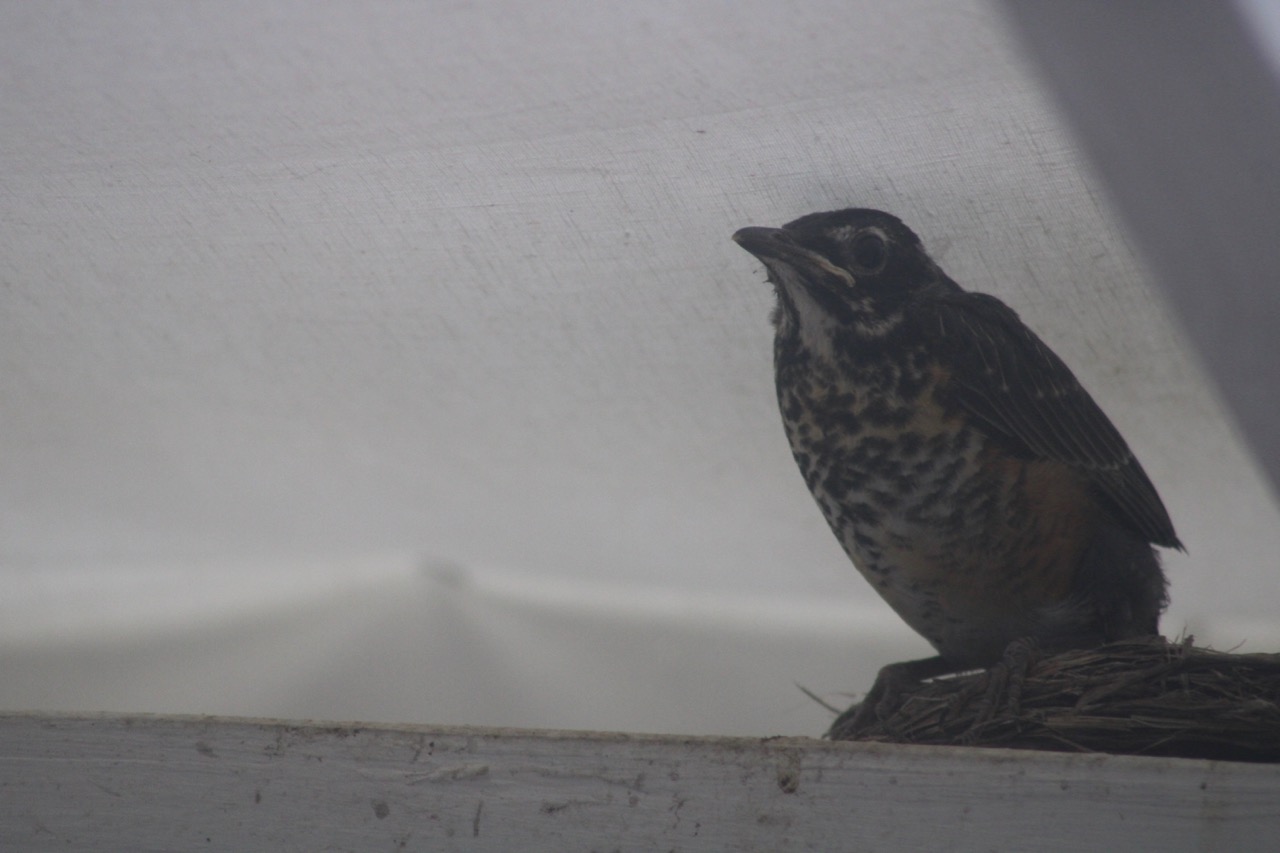
Robin chick perched in nest, under cream colored covering.
The last robin chick in the nest. The others have left in the night.

Today all the robin babies fledged from the nest. When I woke, there was just this one left. Its parent came by to check on it, not bringing food, but flying up to the nest and then back down, as if to say, here is what you do now.

Robin perched on wooden deck railing near post.

Shortly after, I saw it take its first flight, flopping over to the screen window of our house, where it tried to grab hold but then fell down to a soft patch of lemon balm below the window. (Now I am wondering about a sound I heard last night, of something bouncing on the screens in my room. Might that have been earlier chicks making their first flights?) A bit later, I went down to the patio, and something flew by from a perch on the chairs, then to the grass on the other side of the orchard. All the while the parent robins were chirping loudly and continuously, whether to warn me away, or to reassure the chick, I don’t know.

Robin fledgling in grass.

I was wondering what would happen next for the fledglings, and learned via research that the parents will keep feeding and teaching them for the next few weeks, while they hide on the ground or in bushes, trying to avoid predators and learning to find their own food. I am so glad that there are no more neighborhood cats roaming in our yard. The mother might start another brood soon, but the father will keep watching out for these fledglings during this time. All the chicks will stay in this territory for about 4 months or so.

I wandered around the orchard and the yard trying to see what I could see, while the parents chirped at me, and I spotted this chick on the pallets that form our yard waste bins, with a parent nearby perched on the same bin.

Robin fledgling with mottled feathers perched on wooden slats of bin.

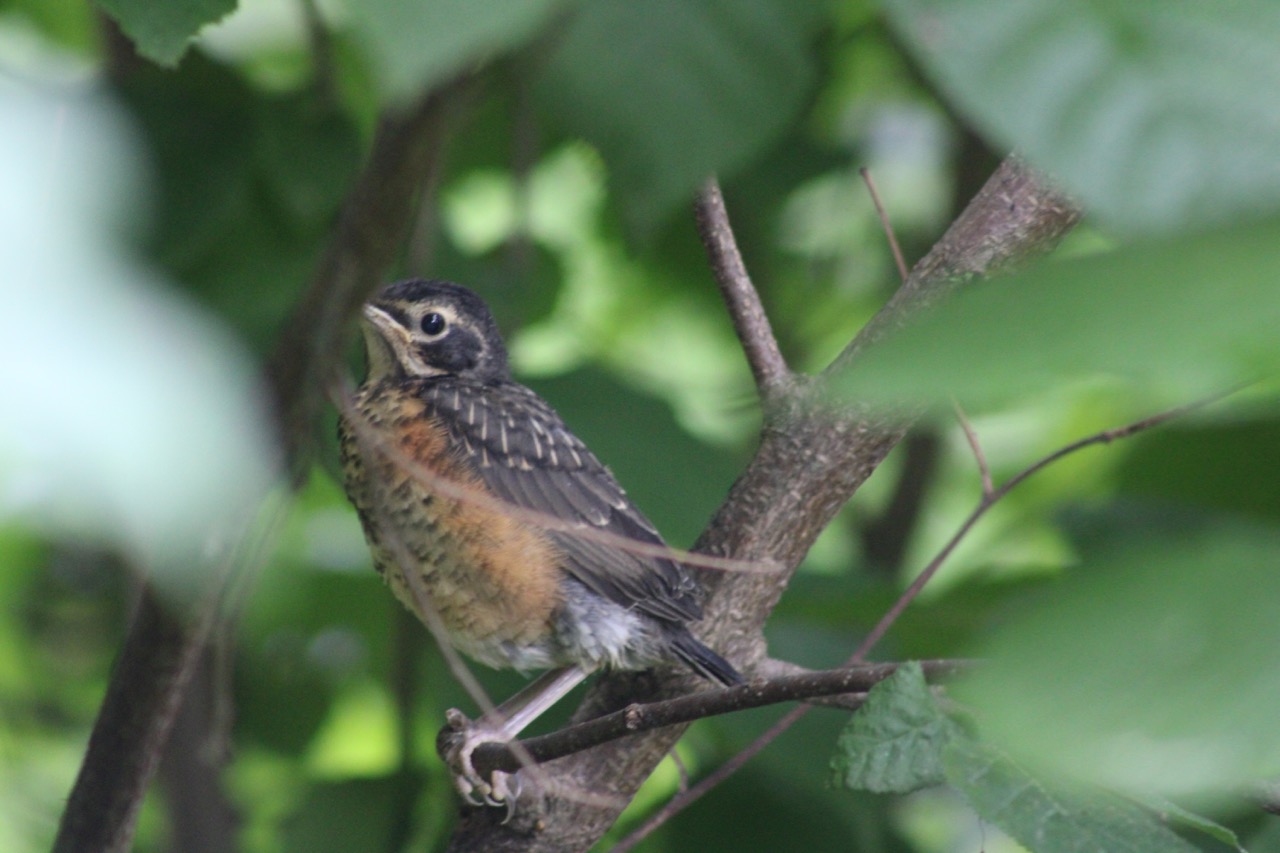
Finally, I was heading back to the house and suddenly saw another chick perched quietly in the hazelnut bush.

Robin fledgling on branch surrounded by green leaves.

I had to go inside then to eat my own breakfast, and download the photos. As I have been writing this, outside on the patio, I’ve seen the parent robins go into that bush with food, so it must still be there–it is a great hiding spot. I am torn by competing desires: to observe and photograph the young ones, or to just go inside and ease the parents alarm. They should know by now that I won’t hurt their babies. Actually, they don’t seem to mind me when I am sitting at the patio table, not walking about.

In the meantime, I am glad we have lots of tall plants and bushes and trees that make good spaces for the next phase of their young lives. It all happens so quickly–less than four weeks from the eggs in the nest to the small birds out and about. I wish them all the best!

Cute fuzzy heads

three baby robins in nest, heads lifted, beak open on the one in the middle, fuzz on its head.
Baby robins, beaks open.

During this cold rainy spring season, we have been delighted with the baby robins, batch number two. There seem to be four babies this time, and they seem more lively than the first batch of two. But maybe it is just that there is less room in the nest. Still, they all can fit underneath mom, or hidden sleeping in the nest. But then they poke up their little fuzzy heads, with mouths open wide like a choir performing. (Not very loud though–we don’t hear a sound.) Both parents are busy going back and forth with worms and grubs. If we come out on the porch near them, the babies all lower their heads and hide. Well-trained. So we watch from the windows.

Two baby robins with beaks open visible, in front of parent robin, in nest.

No smoke here right now…

purple and pale lavender spiderwort blossoms in spiky green leaves, with rain drops clinging to leaves
Spiderwort blossoms after rain

We’ve had two weeks of very cool rainy weather, and that counter-clockwise low pressure weather system has kept away the wildfire smoke from Canada, while folks to our south are facing orange skies and unsafe air. Still, we’ve paid attention, following the news, and thinking about what might happen if it does come our way. It is easy enough for Margy and I to stay inside, or wear our N95 masks outside.

But now that we are deeper in relationship with our land, I am anxious about how such bad air might affect the robins and frogs and squirrels and other critters who live here with us. They don’t have masks and can’t get inside. I wonder if the babies of these critters wouldn’t make it, so vulnerable in those first weeks of life. My heart is wide open to our little microcosm of earth life.

And yet it is the macrocosm that emerges most in this story, because the smoke is coming from far away in Quebec, from wildfires made more destructive by climate change. We aren’t alone in our microcosm, we are all connected by the winds that blow across the globe, undeterred by artificial boundaries. I have been somewhat removed from wildfire problems. I have seen them on the news in California, Alberta, Australia. This is the first time they have come close to where I live. But truly we are all more and more vulnerable. And of course, some much more vulnerable than others. I worry about people without houses, struggling just to survive, in a tent or with a tarp. They can’t get out of the bad air.

There is so little I can personally do about these large issues at this time in my life. That is some of my motivation for trying to tend our little garden–to love this small place of earth in hopes that more and more people can learn to love the larger earth, our great mother. To share the beauty of this earth in writings and photos on this blog, that beauty might inspire love. But love includes grief, and the more we love the earth, the more we grieve for the destruction that human beings are perpetrating.

Irises in bloom, purple, with hints of paler purple and yellow.
Irises in bloom

Roadside Garden Flowers

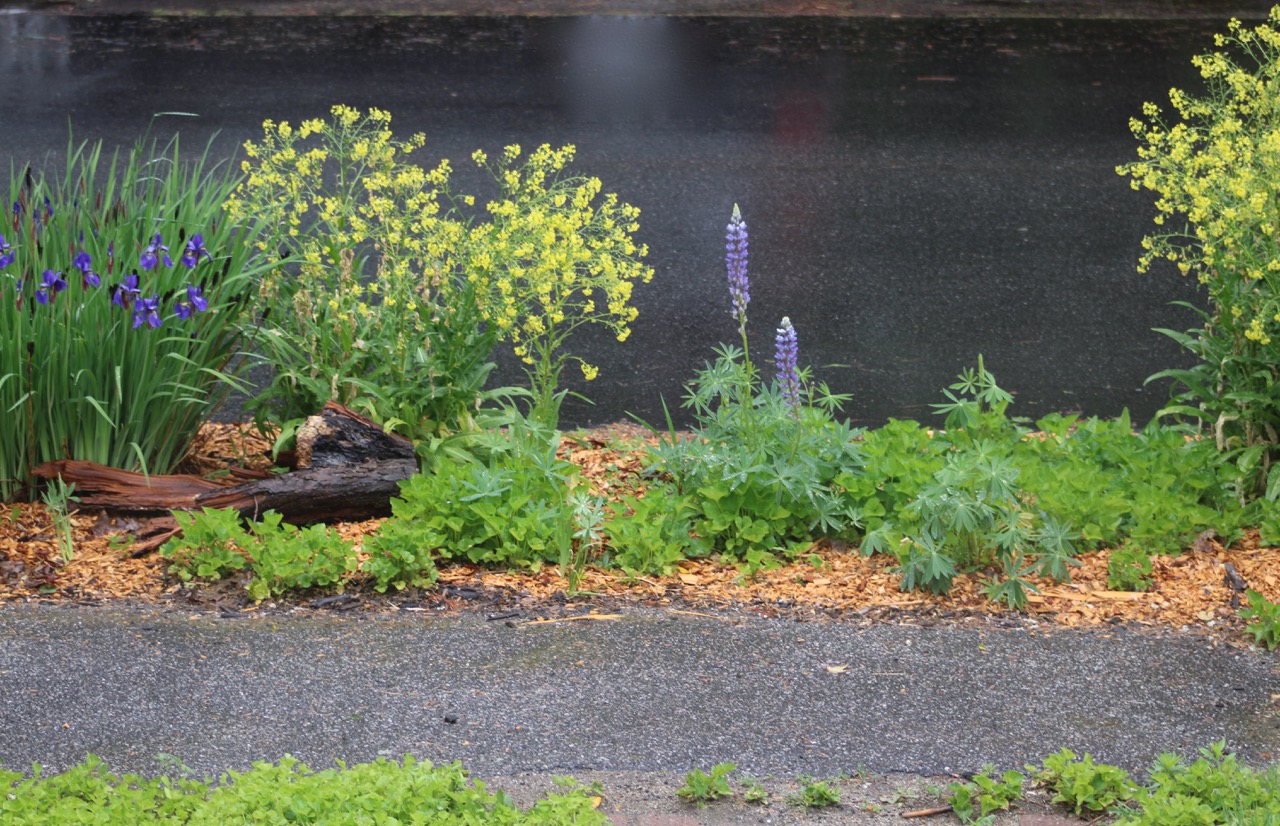
Roadside garden with siberian iris purple flowers, turkish rocket yellow flowers, lupine purple flowers.
Siberian iris, turkish rocket, lupines in bloom.

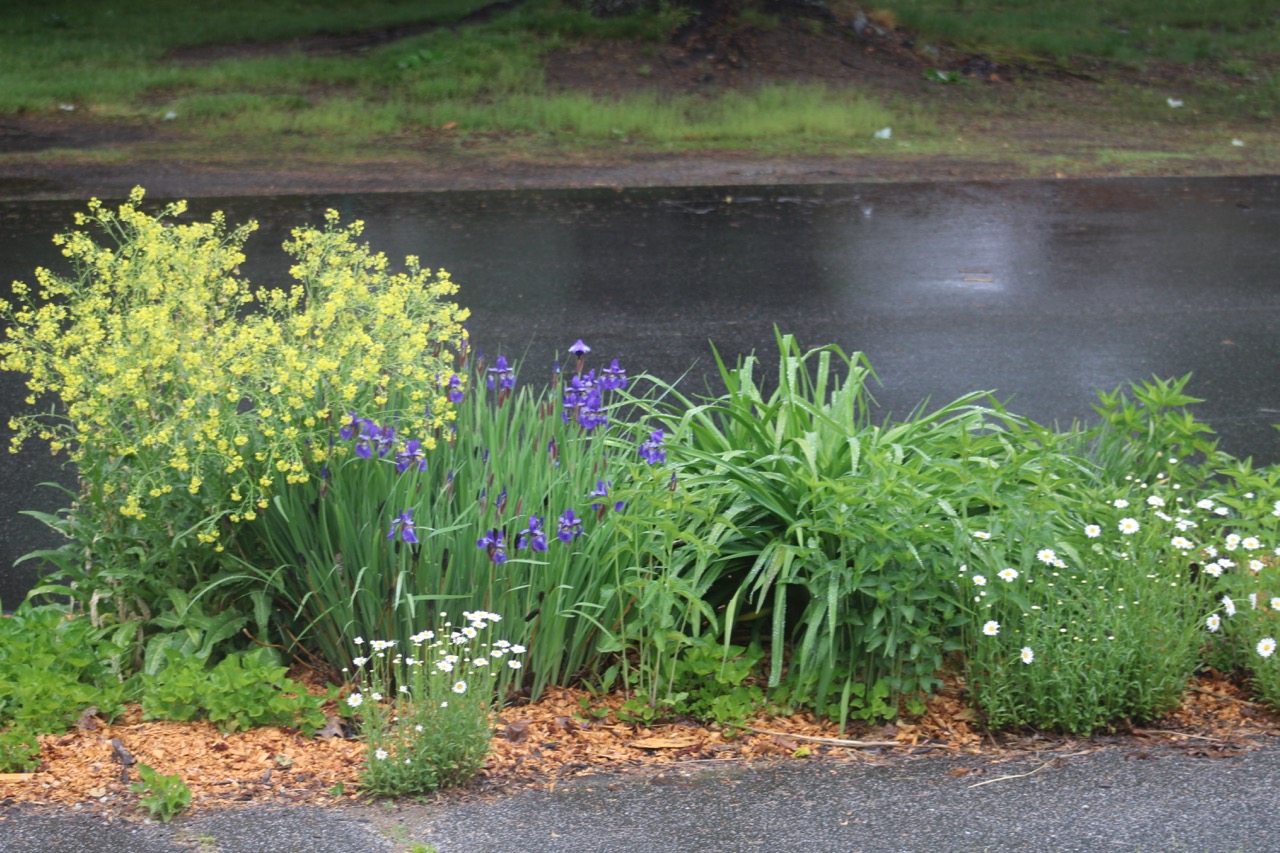
This is my favorite time of year for the roadside garden. The flowers are in contrasting colors of bright yellow, purple/blue, and white, with lovely green leaves of all shapes and sizes. Despite the cold and rain of the past week, it seems to send off a glow into the gloom. It was a garden formed originally from gifted hardy perennials, and others have naturalized to find their own places, like the white daisies.

Yellow flowers of turkish rocket, purple Siberian irises, daisies, in front of rain slicked pavement road.
Turkish rocket, Siberian iris, wild daisies in bloom.

Before the rain, we planted random and unknown flower seeds in one of the garden beds in the front, and carrot seeds in the other (next to broccoli seedlings). I had also planted zucchini and cucumber seeds in the hugelkultur mound. I hope the rain waters them gently and they sprout. Most of our seeds are from prior years, so it is a gamble. But it did seem like good timing.

And for those who have been following this blog, you might be delighted to learn that after the robins fledged, the parents are now starting a second batch of eggs. Once again, she laid one egg per day, but this time, there are four!

Four blue robin's eggs in nest

Pond lily surfacing

Pond, with stone edges, ninebark bush in back, spiky green blue flag leaves in front, and on surface of pond, two round red leaves of a pond lily.
The pond lily leaves have reached the surface of the water.

Last fall, I moved my pond lily plant, pot and all, to the bottom of the pond, from where it had been positioned on a step about 18 inches down. This was to help it survive freezing temperatures in winter. I wasn’t sure what would happen, but I was delighted to see red leaves starting to form around April 22, when I took the following blurry photo through the water.

blurry all over, through water, faint sign of red leaves forming in pot.
Red pond leaves seen through the water.

Thursday, the first leaf reached the surface on a tall thin stem, and others are following. They are red and round, but I imagine that they will turn green as the sun shines on them, since last year they were green. In the up and down world of gardening, it is thrilling when the perennial plants thrive on their own.

Red round leaves on surface of water.

The sweet flags I planted this year are also doing well–you can see them in the top photo near the stones. The blue flag irises are also coming back strong–their leaves are in the foreground. Meanwhile, the green frogs are happy–I’ve seen three so far. The bees are happy, and the tadpoles are still around. The maple trees scattered their seeds all over the yard, and many fell into the pond, but I didn’t scoop them out.

Green frog with stripey green and brown body sitting in water, with honey bee nearby on rock, drinking, and small tadpoles swimming.
Green frog, bee, and tadpoles in the pond.