Practicing the Power of Love

Sometimes we learn best by seeing someone else—to watch someone practice love in the face of hostility can create a light in us as we observe it. Once, when I was in my twenties, I saw a young woman named Nelia arrested in an act of civil disobedience. She refused to walk, refused to give answers to questions on any forms, refused to cooperate with the police who were arresting her. But she radiated such kindness and love to each person who interacted with her. She smiled, and reached out her hand to shake theirs, and told them her name, and asked about theirs. She spoke of why nuclear submarines were not useful for human beings, and invited conversation.

I don’t think I had ever been able to imagine this combination of non-cooperation and love, until I saw her doing it. Yet once I saw it, it seemed so simple. She was practicing the power of love, and it discomfited and engaged all of us around her. Her tenderness was compelling. Her vulnerability was profound, because the other thing about Nelia was that she is blind.

Make no mistake—it wasn’t about being nice to everyone or pretending not to notice the painful realities that cause suffering in our world. Nelia was practicing her simple acts of tender engagement right on the front lines of the conflicts that seem so hard to confront. She showed me what courageous, creative people can do in the face of violence, what the power of love can do.

Marianne Williamson, in A Return to Love, asserts that whenever we encounter another person, we always have the choice to see them through the lens of fear, or through the lens of love.1 Our lives are meant to be a school for learning to let go of our fear, and to choose more and more the power of love. This is not an easy thing to do. It may take a whole lifetime to let go of fear, to learn how to live in the power of love.

And perhaps there is not such a big difference between loving our enemy and loving our neighbor. Each demands the same respect for self, and respect for the other. Each requires seeing the utmost dignity in our selves and in the other.

Clergy Testify in Favor of Equal Marriage 2009

Clergy Testify in Favor of Equal Marriage 2009

Loving Nonviolent Action Is Always a Force for Human Dignity

When African American students sat down at the segregated lunch counters, they were asserting their own dignity by refusing to obey a law that treated them with contempt. They were holding onto the dignity of their harassers by refusing to engage in violence or harm. They were harnessing the power of love to make a change in an unjust system. Dr. Martin Luther King, Jr., and all of the many heroic civil rights activists, used loving nonviolent action to restore the dignity of an oppressed people, and also to restore the soul of the oppressor.  

Loving nonviolent action is always a force for human dignity. Whether the political outcome is successful or not, a change has already taken place. The night before Dr. King was killed, he said, “I’ve been to the mountaintop. It doesn’t matter what happens to me now. I’ve seen the Promised Land.” I used to think this meant that in some mysterious way he had seen the future, and he had faith that black people would eventually win their rights.

But I saw it differently after I was involved in the struggle for equal marriage for same-sex couples in Massachusetts. I believe the mountaintop is less about the future, and more about the present. When lesbian and gay people began to imagine that they might get married, they had an inner experience of equality. It didn’t happen all at once. Two members of my congregation on Cape Cod were part of the  lawsuit for equal marriage. They told me how terrifying it was, in the days leading up to the lawsuit, to ask the town clerk for a marriage license when they knew the answer would be no. It was also terrifying for many others to carry a sign in public, or to have a conversation with their legislator or their neighbor.

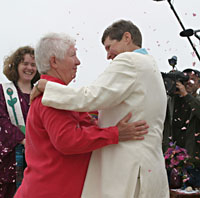
Wedding of Linda & Gloria Dewitt Photo 5/17/04

Wedding of Linda & Gloria
Dewitt Photo 5/17/04

But each new act in honor of love lessened their fear and strengthened their dignity. Same sex couples became aware of the burden they had been carrying, the hidden assumption that they were somehow less than the others. Once they felt a glimpse of equality, they couldn’t go back. They had put down the burden, and they were free. So even if there were opponents holding signs that said, “Homosexuals are demons,” it didn’t matter. A young lesbian woman carried another poster that said, “Your signs are mean but we love you anyway.” No matter what happens next, such love releases an inner power that is indestructible.

I think that is part of what Dr. King was talking about. It was visceral and immediate. By tapping the power of love through non-violent action, he felt first hand a new way of being in the world. He fully experienced his own dignity and the dignity of his people. After that, what else could matter? He had been to the mountaintop. As he said, “whenever men and women straighten their backs up, they are going somewhere.” He knew there was no turning back.

King quotes from “I See the Promised Land”, reprinted in A Testament of Hope, The Essential Writings and Speeches of Martin Luther King Jr.

Tea with the Enemy

Another example of the power of the nonviolent way is expressed in the Japanese story of the tea master. The tea master was traveling with his Lord to visit the Shogun, the military commander of all Japan. In order to enter the court to perform the tea ceremony, he was required to wear the swords of a samurai. So, although he had never used a sword, he was wearing them after he left the palace. As he was walking over a bridge, a ronin, a local mercenary, knocked him over and tried picked a fight with him. When he explained he was not a warrior, the mercenary claimed he was a coward for not fighting.

The tea master did not wish any dishonor to come to his Lord, so he felt obliged to face this ruffian. But he asked leave to do an errand first. The mercenary suspected he might be going for a bribe, so he let him go. The tea master went to the school of a renowned sword master, and asked for his advice on how to hold a sword, so that he might die with dignity. The sword master was astonished, and said, “Most people come to me to ask how to bring death to an enemy, not to face it themselves. You are the first! But before I teach you my art, would you show me yours?”

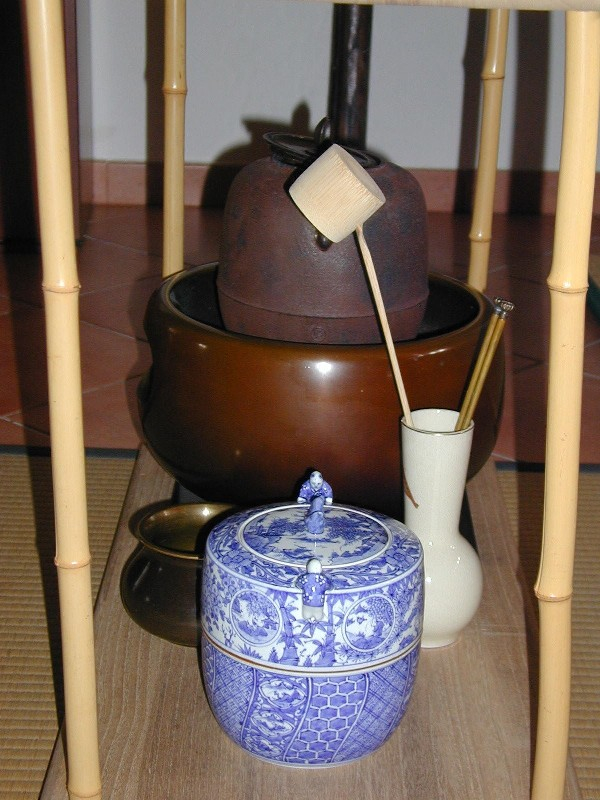
Tea Ceremony Tools Wiki Commons Photo

Tea Ceremony Tools
Wiki Commons Photo

Knowing this might be the last time he would practice his art, the tea master carefully assembled the elements and utensils of the tea ceremony: the tea, the water, the whisk, the tea scoop, the clay tea bowl, and the iron pot for holding the fire to heat the water. Then he prepared himself. When all was ready, with a peaceful spirit he prepared the tea and served it to the sword master.

The sword master observed the tea master carefully. After he had sipped from the bowl of tea, he said, “I can see you are already a master. I have nothing to teach you that you do not know. All I would say is to approach the mercenary as if he were an honored guest at a tea ceremony. Then, take off your jacket and fold it neatly, draw your sword and hold it up over your head, and let him know you are ready. Then close your eyes. When your opponent yells, bring the sword down.”

When the tea master returned to the bridge, he prepared himself all along the way, not as if for a fight, but for a tea ceremony. He let go of his fears and his hopes, and imagined the ruffian as an honored guest. When he reached the bridge, there was a crowd gathered. He did everything as the sword master had instructed. But after closing his eyes, he heard nothing. When he opened them, he was astonished to see that the ruffian had dropped his own sword and was running away. When the ruffian had looked at the face of the tea master, standing calmly in front of him, he lost his nerve. He did not know how to fight such an enemy.

The Tea Master is a traditional Japanese story.  I’ve adapted it here from the version by Dan Yashinsky, in Suddenly They Heard Footsteps

Love Your Enemy: What?

For much of my life I have been intrigued with the words of Jesus about loving our enemies. It is one thing to love those who are open to loving us. But it is a different challenge to love those who seek to harm us.

We read in the gospels of Matthew and Luke that Jesus said, “Don’t react violently against the one who is evil: when someone slaps you on the right cheek, turn the other as well…” and then “We once were told, ‘You are to love your neighbor’ and ‘You are to hate your enemy.’ But I tell you: Love your enemies.”

According to the Biblical scholars of the Jesus Seminar, these phrases are two of three passages that are the most likely to be the actual words of Jesus, rather than edited or added by a later commentator or preacher. They are at the very heart of his teachings. They are also among the most misunderstood.

The injunction to “turn the other cheek” has fostered a kind of doormat approach to conflict. Christian preachers have used this teaching to admonish those who were suffering to simply endure, rather than try to make a change. Until very recently, most ministers or priests would tell a battered woman that she should remain with her abuser, and suffer abuse as a Christian virtue.

But Biblical theologian Walter Wink says this is not what Jesus meant by loving your enemy.  He has offered a new insight into this passage by looking more closely at its cultural context. Jesus said, “If anyone strikes you on the right cheek, turn the other also.” As we hear it, this saying does seems to counsel surrender. But let’s try to hear it as his listeners might.

First century Palestine was a right-handed culture, even more than our own. A blow from the right hand would normally fall on the left cheek. So, if someone wants to strike me on the right cheek—as Jesus is referring to—he has to do it with the back of his right hand. This kind of blow was intended to humiliate, to put an inferior in his or her place. It was a blow that masters gave to slaves, husbands to wives, Romans to Jews.

Dr. Wink suggests that “By turning the other cheek, the person struck puts the striker in an untenable spot. He cannot repeat the backhand, because the other’s nose is now in the way.”

The only target is now the left cheek, which would have to be hit with a fist. But in that culture, only persons who were equals would fight with fists. “…By turning the other cheek, the oppressed person is saying that she refuses to submit to further humiliation. This is not submission, as the churches have insisted. It is defiance.”

Of course, this turning the other cheek was “no way to avoid trouble; the master might have the slave flogged to within an inch of her life. But the point has been irrevocably made: the ‘inferior’ is saying, in no uncertain terms, ‘I won’t take such treatment anymore. I am your equal. I am a child of God.’”

Jesus was not just giving people a new commandment. He was revealing a new option, a new tool. Our instinctive impulses are fight or flight, but he showed a third way to engage with an enemy that simultaneously offers and demands respect and equality. It is surprising, and it is creative. Don’t respond with violence, but don’t accept humiliation either. Don’t be a doormat, but choose equal human dignity for each person.

MLK March 2011

MLK March 2011

See also: Walter Wink, Jesus and Nonviolence: A Third Way

Martin Luther King, Jr. and the Power of Nonviolence

Martin Luther King Jr.Today, we celebrate the birthday of Dr. Martin Luther King, Jr. I appreciate this holiday for many reasons, but especially because it gives us a chance to consider the power of nonviolent action to bring justice to our society. There are times when it seems like oppressive powers are taking over, when greed and hate are overwhelming. It helps my soul to recall those courageous people who came before us, who, even facing insurmountable oppression, were able to harness the power of love to make change. Dr. King is one of the greatest witnesses in our country to such fearless and powerful love.

Nonviolence has often been misunderstood, stereotyped as passive, or weak, or a tool for those who were afraid of violence. But this could not be further from reality. Dr. King described the fundamental principles of nonviolence in an article in Christian Century magazine, in 1957. He challenged that stereotype, and asserted that nonviolence is not for cowards, but requires strong courage. It is an active resistance to injustice, and the nonviolent resister is just as firmly opposed to injustice as one who might use violence. The method is passive physically, but active mentally and emotionally and spiritually.

A defining characteristic of nonviolence is that it does not seek to defeat or humiliate the opponent, but to win his or her friendship and understanding. King wrote, “The aftermath of violence is bitterness. The aftermath of nonviolence is reconciliation and the creation of a beloved community. …The end is redemption.” Nonviolent action is directed against evil, not against the persons who are caught in the forces of evil. He said, “..the basic tension is not between races. …The tension is at bottom between justice and injustice.”

Nonviolence is based on the conviction that the universe itself is on the side of justice. For Dr. King, this faith was rooted in his religious conviction that all people are the children of one God, and loved by God. But he also pointed out that this trust in the power of justice did not require a belief in a personal God. It might also arise out of a heartfelt awareness of the unity of all people, or the interconnected web of all existence. Faith that the universe is on our side gives strength to the nonviolent resister to accept suffering without retaliation, and continue in the struggle through the dark times before the victory is assured.

Nonviolence avoids not only external violence, but also internal violence of spirit. It is based on the principle of love. “To retaliate with hate and bitterness would do nothing but intensify the hate in the world,” King wrote. “Along the way of life, someone must have sense enough and morality enough to cut off the chain of hate. This can only be done by projecting the ethics of love to the center of our lives.” He goes on to explain that he is not talking about romantic or affectionate love, but agape love—a redeeming spirit of good will toward all.

Perhaps the most challenging part of nonviolence is this requirement that we love our opponent, that we love our enemy. Someone once said to me, “We shouldn’t even use that word, enemy. We are all one family.” And we are all one family. When we know that each person is part of us, we don’t want to think of anyone as an enemy.

The dictionary defines enemy as “a person who feels hatred for, or fosters harmful designs against another.” By that definition, my enemy is someone who hates me, or who seeks to harm me. We live in a world where, however much we love, others still will hate us or seek to do us harm. So for me, it feels more honest to acknowledge that internal tension—that tension between love and harm—when we say that nonviolence demands that we love our enemy.

Quotes from “Nonviolence and Racial Justice” and “The Power of Nonviolence,” reprinted in A Testament of Hope, The Essential Writings and Speeches of Martin Luther King Jr.

To Be Whole We Must Experience the Broken

Sun in branches DSC01449If I believe that all people, and all beings are connected, then in order to be whole, I must open my heart to that larger whole, to the connections between all people and all beings. However, when I open to the whole, I experience more profoundly its brokenness, the ways we hurt each other and our earth, the ways we are not in harmony. It is tempting to retreat, to draw a circle around myself to try to achieve some sort of individual harmony and balance—but that would cut me off, into the brokenness of separation.

I realize in this tension that there can be no individual salvation. If we want to heal ourselves, we must be healers of our world. If we want to heal our world, we must be connected to all the broken people. We must embrace the broken to heal the broken. Relationship is at the heart of everything. So, to be whole is to experience the broken. To be whole is to be broken.

It might be too much to bear. How do we find joy in the midst of it? Always, I remember the sun. The sun shining on each being, the sun the source of all life on earth. When I feel the sun warming my face, I realize that I am connected to the sun. Each moment of connection can be a source of joy. Each moment of connection rings true to our deepest purpose. To be connected to Mystery, to each other, to the earth, awakens joy.

And the truth is, even our brokenness, our limitations, can become doorways into connection. We are all incomplete without each other. We each have just one small piece of the puzzle. Alone, all we see are jagged edges and random colors… and maybe all together we see just a jumbled pile of jagged pieces—but sometimes we catch a glimpse of the puzzle box cover—what we might become all together. That glimpse can fill us with joy. And sometimes, we find another piece that fits together with our own jagged edge. We have to find our joy in each moment of connection.

Our jagged edges teach us that we need each other. When I reach the limits of my knowledge or ability, it is a gift to reach out to another person, whose knowledge and ability might balance my own. All returning soldiers from the battlefield need the tenderness of others to find self-forgiveness. One day, when I was weary and sad about my recurring impulse to tell my partner what to do, my partner said, “I know you can be controlling sometime, but I love you just the way you are.”

We must embrace the jagged edges, embrace the broken pieces. Forgive and be forgiven. Ask for help. This is the path to wholeness. The sun shines down on all of us, each day, whether cloudy or clear, making no distinction between the good and the bad. May we return to the great circle of life, may we hold each other and all beings tenderly, for we are one.

The Sun Shines on All

Reconciliation and forgiveness require us to seek out those whom we have hurt, or who have hurt us, to make things whole again. We must mend the threads of connection between ourselves and other people, between ourselves and the earth, between ourselves and the Mystery of life.

This is not easy work. It is not just big societal evils that we face. We also face the everyday betrayals and regrets. Self-forgiveness may be the hardest of all. We face the perennial faults that are unique to us, yet common to so many. We mean to be kind, but find ourselves cranky and rude instead. We mean to be supportive to a friend or family member, but feel judgmental instead. We mean to be honest, but tell little lies to avoid upsetting someone. We mean to be generous, but feel greedy about our pleasures.

Can I forgive myself the belief that I am right when I argue with my neighbor? Can you forgive yourself the angry words shouted at your child as you are trying to get out of the house to make it to school or work on time? Can we forgive ourselves the end of a relationship with a partner or spouse? Can I forgive myself for needing help when I don’t know how to face a situation on my own?

Sun and Snow DSC06016What helps me to forgive is to remember the sun. The sun shines down on all of us, each day, making no distinction between the good and the bad, making no distinction between when I am in tune with all my values, or when I fail. Its light is constant, never changing because of virtue or vice, but merely following the rhythm of the seasons and lighting up the blue sky or the gray clouds. Its light keeps shining, giving life to all creatures. When I remember that I am accepted as part of the circle of life, it seems easier to open my heart to forgive myself.

And if I am a part of the circle of life, so is everyone else. If I believe that all people, and all beings are connected, then in order to be whole, I must open my heart to that larger whole, to the connections between all people and all beings. This is the heart of spiritual practice—to open our hearts to the larger whole of which we are a part.

How can we heal when we fail our ideals?

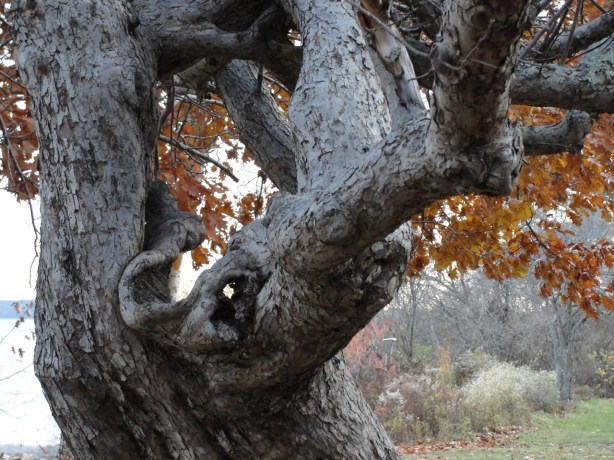
Gnarled Apple Tree DSC01742During the time when I was struggling with our failure to truly live our ideals, I read the novel, March, by Geraldine Brooks. The story is centered on the absent father figure, Mr. March, in Louisa May Alcott’s Little Women, and draws on the actual life story of her father, Bronson Alcott. Mr. March has gone off to be a chaplain for the Union Army during the Civil War. He is passionately opposed to slavery. The whole family has been involved in the underground railroad, and Mr. March had lost most of his fortune supporting the work of abolitionists. So it seems unconscionable not also to support the military effort to free the slaves. He is following his highest ideals.

But Mr. March’s actual experience as a chaplain in the war proves profoundly disillusioning. The Union soldiers, his heroes, are often cruel to each other and to the former slaves who seek refuge. Many battles are ill-planned and disastrous, with horrific loss of life and injury and disease. Finding himself in a deadly situation, he lacks the courage to give up his own life to save the life of one of the slaves he has been teaching to read. When he tries to follow the abductors and help to save the other captured slaves, the mission ultimately fails, despite his efforts. Eventually, he succumbs to fever and is sent to a Union hospital, a broken and despairing man.

How do any of us heal from the despair that evil or failure can bring to our hearts? Sometimes we try to isolate ourselves from what is broken—to separate the good from the bad. For our ecological values, this might mean we decide to build our own zero-carbon home off the grid, grow all our own food, and stop participating in the larger society. In some religious traditions, it takes the form of identifying sinners and banishing them from the community of the holy. For others, it may be more subtle: we may be tempted to connect only with people with whom we agree, who share our values and ideals, and stop relating to those who seem to us, “unenlightened.” We imagine ourselves on the right side of a very great conflict.

But it is not so simple as that. Mr. March found that the people on the “right” side of the civil war were also broken, that he himself failed to live up to his own high ideals. How can we heal from the wounds of self-betrayal?

Near the end of the Civil War, after securing the freedom of the slaves, Abraham Lincoln reached out to the whole nation, north and south, to try to bring people back together into one community. His second inaugural address closed with these words for healing:

With malice toward none; with charity for all;
with firmness in the right, as God gives us to see the right,
let us strive on to finish the work we are in;
to bind up the nation’s wounds;
to care for him who shall have borne the battle,
and for his widow and his orphan…
to do all which may achieve and cherish a just and lasting peace
among ourselves and with all nations.

Our brokenness tears us apart, but our healing must bring all of us together. Mr. March slowly finds his healing through the love of the people who care for him, just as he is. Marmee comes to him at the military hospital, and eventually he returns to his family, chastened, fragile, not whole yet, but able to be united to those familiar little women, his daughters.

Did the nation take to heart Lincoln’s words? A short time later, he was assassinated. Perhaps we are still living with the brokenness in our nation that erupted in the civil war. The divides between black and white, between south and north, between liberal and conservative, between rich and poor, still undermine our capacity to live up to our country’s ideals. I don’t have an answer to fix it.

But I believe that all people and all beings are connected, that the earth is a whole. That belief shapes how I can imagine a way forward. The way forward is always rooted in forgiveness. Forgiveness for the failures we see all around us, the ways that others betray the ideals we hold dear, and hurt and wound each other. And forgiveness for our selves, when we too are unable to live up to our values and ideals, which happens almost every day. Only when we can forgive, can we return to the dreams we hold, can we find wholeness, and receive a new start.
Forgiving the Broken

Apple Tree Fall DSC01738Life will break you. Nobody can protect you from that, and living alone won’t either, for solitude will also break you with its yearning. You have to love. You have to feel. It is the reason you are here on earth. You are here to risk your heart. You are here to be swallowed up. And when it happens that you are broken, or betrayed, or left, or hurt, or death brushes near, let yourself sit by an apple tree and listen to the apples falling all around you in heaps, wasting their sweetness. Tell yourself that you tasted as many as you could.
                                                                                           Louise Erdrich

One day, caught in the gap between my ideals for living in harmony with the earth and what I am actually able to do, I went outside to share my sorrow with the trees and the green earth. I want human society to be better than it is—I want there to be a path forward that is not so lonely and hard, so expensive and out of reach. I was in a painful, broken place. I sat down on a blanket on the ground, and looked to the four sacred elements of the earth for help; the earth, the air, the fire, the water. They were kinder than I expected.

The Earth said, “Forgive the people of your society. Don’t hate your own kind. They didn’t know the oil would run out. They were creating what seemed to be good with all this abundance. It’s not evil to use oil. It is evil to fight wars and oppress workers and sully the waters in your attempts to keep it and secure it.”

The Air reminded me that the songs of birds can dispel sadness, and awaken joy and beauty.

The Fire surrounded me with the warmth of love, and said these energy issues can only be resolved through your connection to the sun. All of our energy comes from the sun.

The Water said, “Weep when you are sad. Don’t always try to fix it.” And so I eventually came to a place of peace.

One of my ecological dreams is a “net-zero carbon” home that generates more energy than it needs. I’ve heard about these homes and the architects that are designing them. That would be ideal. But in order to be alive in this world, I need to forgive the messiness of what is, as it is now. I need to accept that human beings as a species do not live in harmony with the earth right now. We are broken off.

I am able to accept our brokenness when I feel the Sun shining down on us despite it all. When I feel the water claiming us as her own, the flowers blooming, the food growing, the birds singing. The beauty of this earth teaches me that there is something very good even in the midst of our brokenness. The next day, the newspaper had a story about green homes in New England. If I can expand my perspective, I can be joyful that some people are creating zero-carbon homes, that something is awakening among human beings that will lead to greater wholeness with the earth. I feel hopeful when I learn that the United Kingdom has a goal of all new constructed homes being zero-carbon homes by 2016.Apple DSC01750

Louise Erdrich quote from The Painted Drum, p. 274.

Trying to Find an Ecological Water Heater

When we awaken to a vision of living in harmony with the earth and other beings, we enter an in-between place, a place of increasing awareness of the brokenness of our world today. Our social and economic system was built upon exploitation of the earth for resources, and the options we have as individuals are limited because of that.

During one spring, Margy and I noticed that our hot water wouldn’t get hot anymore. We put up with lukewarm showers while we were trying to sort out what to do. We are always trying to make our home more easy on the environment, so we took time to research a lot of options.

Our hot water came from a coil in our boiler, and we were told that it would be quite expensive to clean out the coil, using lots of nasty chemicals. Did we need a new boiler? At that time, a very state-of-the art efficient new boiler would cost $11,000 to install. A boiler that used wood pellets instead of oil—even better—would cost $22,000, including an automatic pellet feeder. Well, we didn’t have enough money for either of those options, and our current boiler had some years left in it. Solar hot water is also expensive, and we don’t have a south facing roof, and we have a lot of trees. One company recommended heat exchange water heaters—they were about $3000 to install.

Water Heater DSC01555I also researched more traditional hot water heaters—we don’t have natural gas where we live, so that wasn’t an option. I lined up all the brands and all their energy efficiency. But I found that the ones that were the most energy efficient cost a whole more, for the tiniest fraction of greater efficiency. I did a whole lot of work on it, but eventually, we chose a standard electric hot water heater installed for about $1000. The good news is that we can shut off our boiler during the summer months, since it won’t be needed to heat water. And we have hot showers again. The bad news is that our electric bill will go up about $50 a month. So all in all, we might be using more energy than before.

I share this story because I felt so sad after our experience, so disappointed and angry that there weren’t good ecological solutions. Despite our values and idealism about how we want to live on the earth, despite how much time we put into research, it wasn’t possible to find workable and affordable choices. The options we have as families depend on what our society chooses do with its resources.