Almost Heaven

Rich & Mitzy 2016

[My dad & mom in 2016]

On Saturday May 26, at about 7:45 a.m., my father Rich Johnson breathed his last breath. I was sitting beside him with my mother, and it happened very gently and quietly. My sister Julie and brother Tim had just left the room, after playing a song for my mom. Tears sprang to my chest in a sob, but they were not tears of sadness. Rather they were a spilling over of love, the primal love I feel for my dad, and the overflowing love of my family that filled his room during the preceding days as we gathered.

I can barely describe what that week was like. I had arrived in West Virginia on Monday evening, and met my sister Julie and my mom at the nursing home. Others continued to arrive through the next days. We gathered in Dad’s room–they had moved him to a private room. Dad was mostly sleeping, but would wake sometimes, not talking, but aware of us. We gave each of us time alone with Dad as we needed it, but mostly we were together, sometimes all of us, sometimes various combinations of us, and one or two people would stay the night each night. We kept in touch with our siblings who were not able to travel to be with us through texts and phone calls.

Mostly, I remember the music–so much music. At first we played CD’s he had in his room, but then folks started playing songs on their phones–country songs, God songs, sad songs, songs of love. Then my brother brought in a guitar and we started singing songs. We have such a musical family! In between, we’d remember jokes my dad would tell, and how sometimes he’d start laughing so hard that he couldn’t get to the punchline. And we’d be laughing too. For example, my dad once talked about starting a nursing home in West Virginia. He would name it “Almost Heaven.” (And we sang that John Denver song too.) We filled his room with music and laughter and tears and grace.

Raccoon – CloserOutside his window was a bird feeder (that was true of all the windows at his nursing home) and sometimes the birds would sing too. Then in the evening, a little raccoon would come to the window, totally fearless, to get his dinner at the bird feeder, and bring us more laughs. My nephew named him (or her) Bandit.

I came home on Sunday the 27th, still overflowing with tears of love. I feel grateful that my dad had a long life–87 years–a good life, and a good death, surrounded by love. I feel grateful for my family. We live far apart from each other, from Maine to Montana, from Michigan to Texas, and we have very diverse viewpoints and perspectives on the world. But we make music and laugh and love so beautifully. These days were like being in ceremony, in the presence of the holy, we were touching mystery. Maybe our time together was a last blessing from our dad, who gave us so many blessings during our lives. Or maybe the blessings just continue.

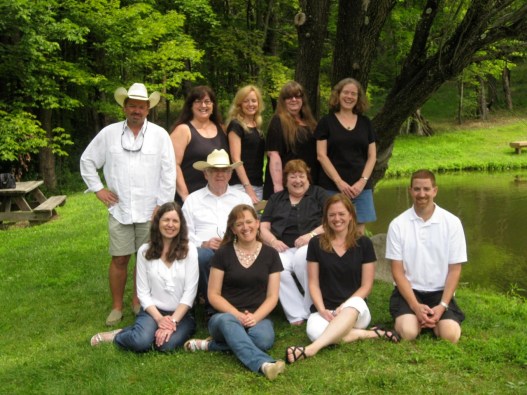
Johnson family 2013

[Johnson parents and siblings in 2013]

Critters


Squirrel on deckSo I was sitting on the deck, just writing in my journal, and this little being came within a few feet, just looking at me.  No fear, just curiosity.  We live together in this beautiful place, and perhaps he/she is acknowledging that?  Or saying “Thank you for the sunflower seeds, but why do you make them so hard to get in that crazy contraption?”

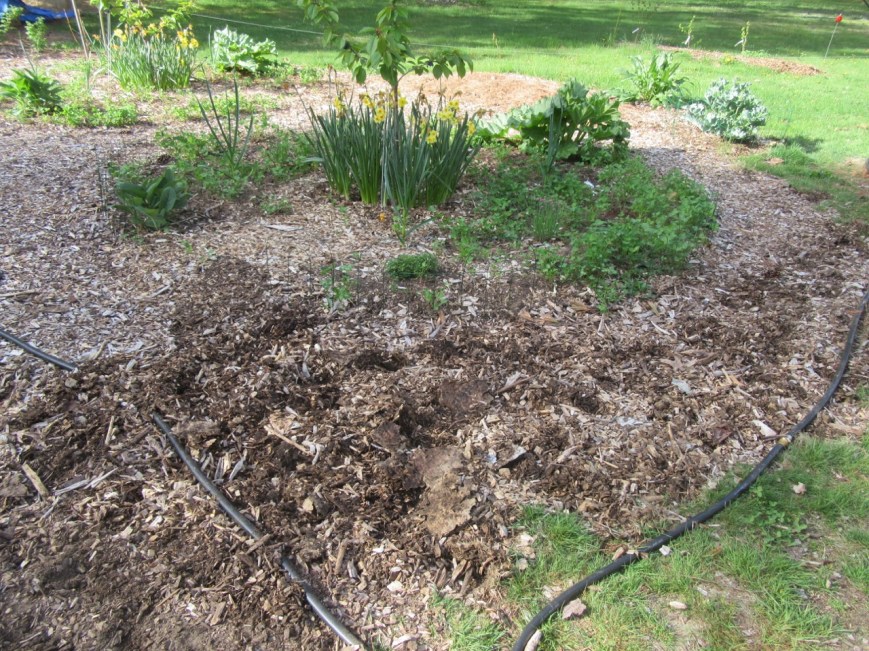
Meanwhile, our nocturnal digger has also returned, very politely avoiding the plants and digging up the paths.  I am assuming it is our resident nearby skunk, though it is here earlier than last summer. This year I haven’t even been trying to straighten everything back again, unless it has dug a hole close to a plant.  But as you can see, everything is getting lush and leafy–rhubarb, sea kale, turkish rocket along the back.  Every tree is surrounded by herbs and clover.Nocturnal digger back

This morning I wandered for an hour in the garden to feel the ground and do last minute care-taking before I fly to see my parents today.  I planted some lovely basil that was a gift, watered the annual bed (and discovered some other little neighbor has eaten one of the broccoli seedlings–oh well I hope you enjoyed it), put more compost on the growing asparagus plants, and also watered the summer sweet bush cuttings that are temporarily in a pile of compost as well waiting to be planted.  Margy will tend the garden while I am gone.

I am thinking of my dad today, my spirit is with his spirit during this journey.  May this day be blessed with safe and smooth travels of whatever kind.

Hoya Plant

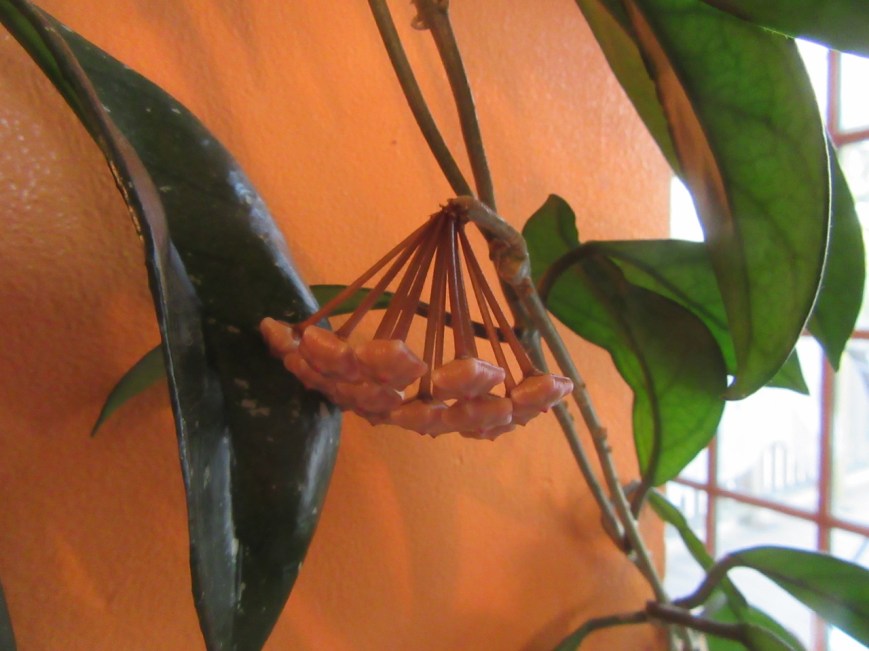
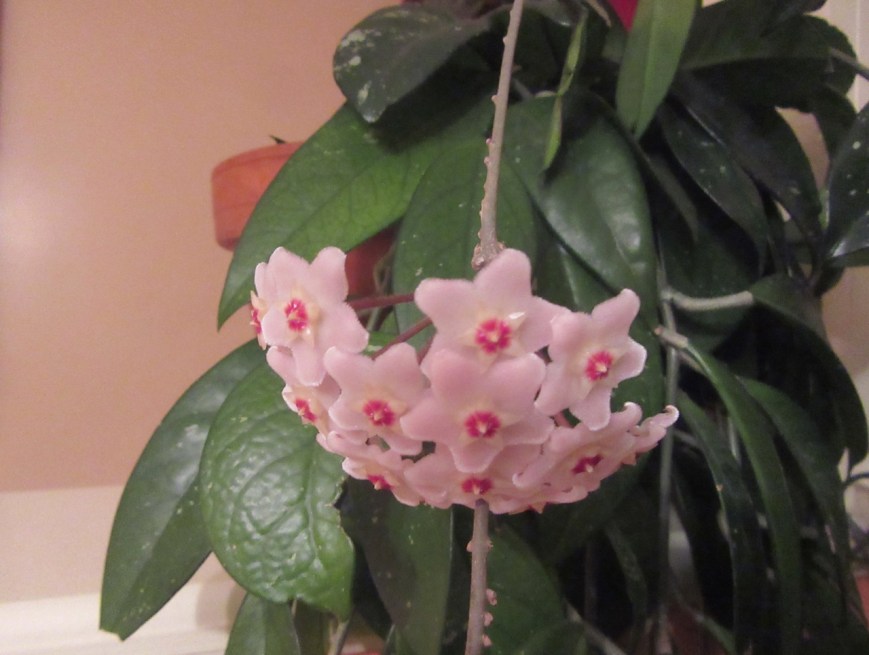
Hoya Plant pre-blossoms

It has been many years since our hoya plant has blossomed.  It is a great and easy plant to care for.  I have had it since I lived in Grand Rapids, Michigan around 1979.  My partner at the time, Gary, and I inherited the plant from the collective who had lived in the house before passing the house along to us.  We became a Catholic Worker house, and offered hospitality to homeless families.  In 1983 we moved to Chicago and took the plant with us, and when Gary and I separated in 1985, I eventually ended up with the plant, and have moved it with me ever since.

One of the names I learned for the plant was “Widow’s Tears.”  When it blooms, the flowers have a sweet nectar that falls from their center.  That name had an emotional resonance for me when Gary died in a car accident in 1988.  Just after I learned about his death, the plant began to bloom.  That blooming became one of several signs that touched me with Gary’s presence following his death.  It is hard to explain, but it comforted me, it felt like a gift he had sent to me from beyond.

So this week, the hoya started to flower again, with two little umbrellas of florets beginning to form waxy pre-blooms.  And this week, I learned that my dad, who has been in a nursing home for almost a year and a half, has taken a turn for the worse, and has slept through the last two days.  A priest who is a friend of the family came today to pray and anoint him.  My sister Julie has been the primary support person for my mom and dad since they moved to West Virginia in 2005.  Most of us live at a distance.  A few of my siblings have visited in the last couple weeks, and I will fly out on Monday.

Life is mysterious.  They don’t really know what will happen next.  It is possible he will rally, but it is starting to seem more likely that he is preparing for the transition into death, which for him signifies going home to eternal life.  I asked my mom to hold the phone to his ear so I could speak to him, to tell him I love him, and I was coming on Monday, but I am with him in spirit, so whatever he needs to do will be okay.  Which is true.  And there is something about the hoya plant blooming that comforts me today, alerts me to the mysteries beyond life and death, and the bonds that unite us across many divides.  May all of us be held in love.Hoya Plant bloom

Just Be

Hammock View

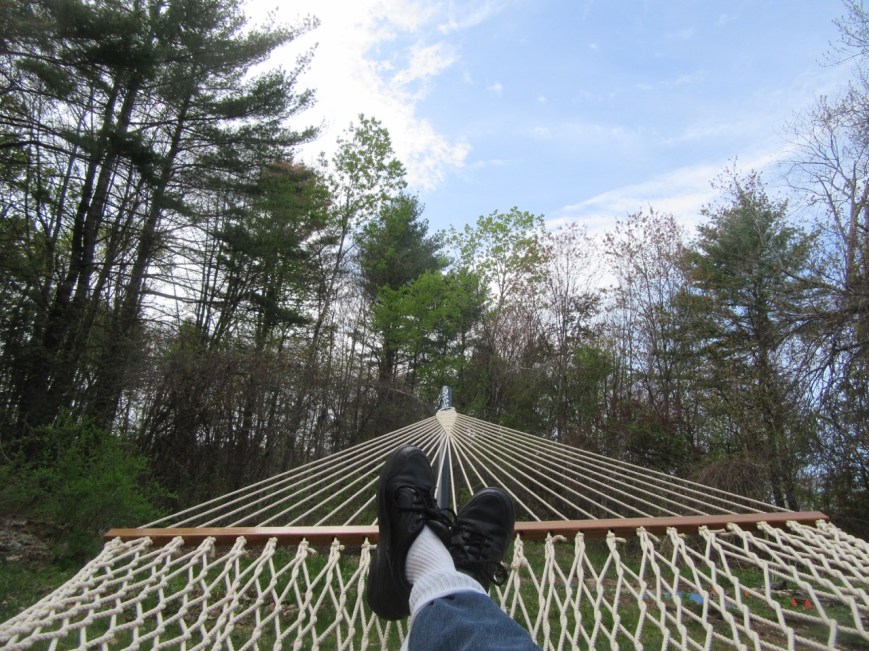
My birthday isn’t until the end of June, but Margy gave me a wonderful free-standing hammock as an early birthday gift.  With all of the working in the garden, it is easy to forget to just BE–to just lie there and watch the sky and the trees and the birds.  It is large enough for both of us, and on Friday afternoon Margy and I were just being in it together.  Several little birds came to check us out in the trees close by–a tufted titmouse was singing, so much louder than one might expect from its small size.  Catbirds, cardinals.  “What is this new nest in the back of the yard?” they seemed to be asking.  “What new thing are you humans doing here?”

But we weren’t doing anything.  We were just being, watching, enjoying, listening, seeing.  On Saturday, I came back and tried again.  I especially like the symbolism of this gift, since this summer I will be retiring from my work at the church.  It is a bittersweet time, because I have loved my work at the church, and I will miss the people there.  But I like to imagine that in retirement I will have more opportunity for just being.  The hammock is a reminder to take that time–to not get caught up in all the projects I might be doing in the yard or the house or out there in the wide world–but to be still and spacious, to relax, to observe, to delight.  Thank you, Margy!  I love this gift!

Curanderismo

Open My Eyes left

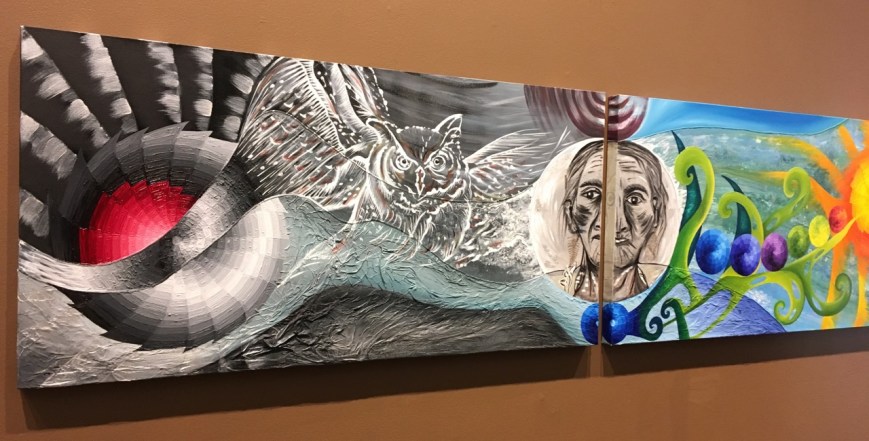
[Open My Eyes by Catalina Salinas]

If there is a thread running through these days in New Mexico, perhaps it would be the book, Bless Me, Ultima, by Rudolfo Anaya.  My friend Virginia Marie had told me before my trip about an event we could attend related to the book, so I got a digital copy and read it on the plane on my way here.  It is about a young boy growing up in rural new Mexico around the time of World War Two, and his relationship with the curandera Ultima who came to live with his family when he was seven.  A curandera is a traditional healer in the Mexican (and New Mexican) tradition.

The National Hispanic Cultural Center, has a special exhibit on visual interpretations of the book.  The event we attended included a talk by Toñita Gonzales, curandera and educator, and Dr. Eliseo Torres, author and scholar of Curanderismo at the University of New Mexico.  Virginia Marie is herself a curandera, as well as an Episcopal priest.  The talk began with a ritual to honor the four directions and the Creator and the Mother Earth.

Curanderismo includes the use of herbs for healing, and many other modalities.  It works in conjunction with western medicine, though for many years was viewed with suspicion, as most traditional healing methods have been viewed. It includes making a relationship with plants, treating them with honor and respect for their power to heal us. Ultima would always say a prayer to the plants before she dug them up for use in healing.  I think about the plants I have been getting to know back in Maine.

Back at Virginia Marie’s home, we also watched the movie that was made from the book.  Today, she will do a healing session with me, though in reality, this whole time has been a healing ceremony.

Open My Eyes right

[Open My Eyes by Catalina Salinas]

Hawk Talk

Hawk – Version 2

I was sitting outside in a little park writing in my journal, and a young hawk started vocalizing at me–almost like a bark or squawk.  She flew across the little grassy area, and was sitting in the tree when I took her picture.  She came back to the tree above me, and then flew off with another bird.

Meanwhile I was writing in my journal and working on a part of myself that I’ve been troubled by.  I was trying to sort out how to stop being critical, or thinking I know better than someone else.  Rather than try to get rid of a part, a more helpful practice can be to befriend the parts that we don’t like.  So I decided to name that part Athena Advice-giver.  Since the goddess Athena was born from the head of her father.  And I know my critical self was born from the critical side of my father, and from the critical side of his mother.  I asked Athena what she needed.  I wrote a lot.

And then the hawk came back again squawking at me, and flying around the park.  Getting my attention.  She really did seem to be talking to me, rather than occupied with something else.  Maybe she was just annoyed that I was sitting there.  Or maybe she just enjoyed my being there.  I got up from my writing and took pictures of her with my phone, and a video so I could remember her calls.

And writing again, another voice of wisdom came to help Athena evolve, to honor her essence, and bring it to a deeper maturity.  It said:

If you keep thinking you have the best way, you don’t get to learn the wisdom in other ways.  If you stay open to all wisdom, your own will grow–remember that. The wisdom of the hawk, the wisdom of the white pine, the wisdom of your partner, the wisdom of the groundhog, the wisdom of the drum, the wisdom of the desert.  Remember your curiosity.  Curiosity can be the antidote to criticism.  

Let yourself be curious and honor the wisdom of all beings.  They are your teachers.  Each being is wise.  And you are not the only one to deal with these challenges.

When I walked back to the apartment, my friend Virginia Marie told me that hawks represent transformation.  They often appear when we are in ceremonies of transformation.  My writing is a form of ceremony, and this time in New Mexico, a ceremony.  So I give thanks!

Healing Waters

Healing Mineral Waters Jemez Hot Spring

I am on retreat with my friend in Albuquerque, and we started off by visiting the Jemez Hot Springs, and soaked for an hour in their healing mineral waters.  All of our tensions floated away, and our bodies and souls felt renewed and relaxed. I loved that we were under the watchful arms of an ancient Egyptian river Goddess.

My intention for this time of retreat is to re-emerge myself in Spirit after a long hard winter, to prepare myself for the transition ahead as I retire this summer from my work as a parish minister, and venture into the next phase of my journey.

Times of big changes are liminal times, sacred times, but perhaps also times of anxiety and danger.  I want to stay true to the leadings of my body and spirit that have brought me to this crossroads.  One of those leadings came from the weariness of my body, its chronic illness and auto-immune flare-ups that left me bedraggled and exhausted. I know it is time to stop pushing it so hard.  How fitting for my first day here to bring my body to these healing springs.

I am also already absorbing so much nurture from deep conversations with a sister in spirit who understands the call of ministry and justice, and who understands the lessons of the body, the lessons we learn from limitation and illness.  I am nurtured by this sister traveler into the country of elderhood.  River Goddess


To Be of Use

Biddeford Pool Ocean view

One evening, during my first year in college, my best friend Lori and I were sitting in the quiet candlelit chapel of our campus. A few other people were also there, scattered about the pews. I remember feeling we each seemed so isolated in our private meditations. I was moved to reach out and take the hand of my friend. Little did I realize, at that very moment, she had been wrestling with her own inner spiritual struggles.

Feeling a certain despair, she had just prayed, “God if you are real, I need a sign. It doesn’t have to be a miracle; I just need you to touch me in some way.” Then, I innocently took her hand, and it was the touch of God she experienced.

I shared this story with my colleagues last week.  From Wednesday through Friday, I was on retreat with other Unitarian Universalist ministers at Biddeford Pool, by the sea.  They had invited me, because of my upcoming retirement, to share my “Odyssey,” my story of ministry.  So on Thursday evening, I talked about the long path and the many transformations that have been a part of that ministry journey, starting with this story of my being used unknowingly by the Spirit.

Years ago, even as a child, I had opened my life to that Spirit, that Mystery, that flowing River of Life.  Ministry has meant, for me, at root, that opening to be of use.  At different times in my life, that has included many different types of work.  Most lately, as a minister in a congregation, I have been preaching, offering pastoral care, teaching, writing, going to many meetings.  But ministry is not always about our intentions or our plans or our activities.

I shared another story that happened only a few years ago.  At that time, I was planning to join my congregation at our annual retreat at Ferry Beach.  We were happy to be including a visiting UU minister from Burundi, and I was going to drive him to the retreat.  But then I got sick with a bad cold or flu–can’t remember which.  I called a member of the congregation to see if she could give him a ride instead.  She did, and later she told me that it had changed her life.  She was transformed by hearing his story, and she eventually went to visit Burundi with other UUs.

I was struck by how even our limitations–even getting sick–even being missing–can be an occasion of unknowingly triggering a blessing for someone’s life.  If we are in the flow of Spirit, the flow of the River, even our flaws can be of use.  This gives me great comfort as I deal with health issues that drain my energy and interrupt my intentions and activities, and are the impetus for my decision to retire this year.  I remind myself to trust in that same Spirit who has been undergirding my life and my ministry for all these many years.  Trust in the flow of the River.


Spring Arrives in Maine

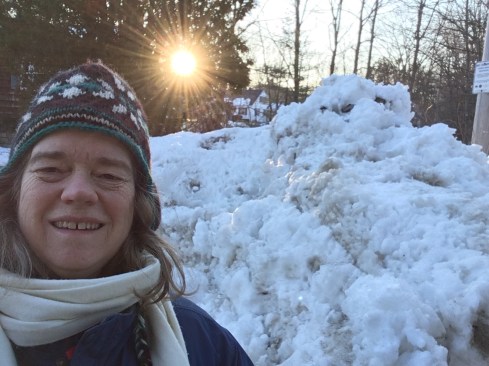
Spring Arrives in MaineToday is the first day of spring everywhere in the Northern Hemisphere.  What it looks like in my neighborhood is huge piles of snow and a really cold morning, but with a bright sun leading us into a clear day.

Margy and I hosted an Equinox ritual at our house last night.  It was a small group of five this time, and most of us were weary from the winter, so our ritual was simple and low key.  We named the friends who had joined us for Solstice and Imbolc, and sent blessings to all of them.  (You know who you are!)  We shared thoughts and readings about our lives and about winter and spring.  We talked about what we wanted to let go from the winter season, and what intentions we wanted to carry into this new season.

I thought about the next several weeks until Mayday.  The snow will disappear, and the ground thaw, and begin to fill with green.  Our plants will arrive from Fedco:  an apple tree, a peach tree, two blueberry bushes, three hazelnut bushes, a mulberry tree, a licorice plant, 25 asparagus plants, and 3 golden seal plants.  By Mayday, I hope they will be in the ground.  Our friends volunteered to help with the planting.

I remember when we first imagined this new home, when we began to lay out our intentions to find greener housing in the summer of 2015.  Our intentions included creating a permaculture garden, and having space in our living room for people to gather.  And here we are!  Living those dreams into reality.  The magic of deeply felt intentions can be surprisingly powerful.

The Poetry of Preaching

As I move toward retirement, I have been bringing back old favorite sermons to preach again.  This one, called Patience and Poetry,  reminded me of the poetry that preaching itself can be.  It feels like poetry when I am able to weave together certain images, vivid metaphors, weave together the words of others with my own, creating some sort of whole from these previously unrelated parts.  So in this sermon, the image of the grasshopper became a central thread, and perhaps also the grass below our feet.  I will miss this form of poetic endeavor, so different from other forms of writing, (though I will not miss the suffering that each sermon required to create.)  I don’t often share sermons on the blog–too long–but here it is for today.

Grasshopper

[Photo by Margy Dowzer]

Reading:  On The Grasshopper And Cricket (1817) by John Keats

The poetry of earth is never dead:
When all the birds are faint with the hot sun,
And hide in cooling trees, a voice will run
From hedge to hedge about the new-mown mead;
That is the Grasshopper’s—he takes the lead
In summer luxury,—he has never done
With his delights; for when tired out with fun
He rests at ease beneath some pleasant weed.
The poetry of earth is ceasing never:
On a lone winter evening, when the frost
Has wrought a silence, from the stove there shrills
The Cricket’s song, in warmth increasing ever,
And seems to one in drowsiness half lost,
The Grasshopper’s among some grassy hills.

What is patience? The dictionary describes it as the bearing of provocation, annoyance, misfortune, or pain, without complaint, loss of temper, irritation or the like; or, an ability or willingness to suppress restlessness or annoyance when confronted with delay; or, quiet steady perseverance, diligence, and care. Its root is in the Latin, pati, which means to undergo or suffer, connoting the bearing of an action caused by another or beyond our own control.

What is poetry? The dictionary says it is the art of rhythmical composition, written or spoken, for exciting pleasure by beautiful, imaginative, or elevated thoughts; or, lofty thought or impassioned feeling expressed in imaginative words. The word comes from poet which derives from the Greek poiein, which means to make, plus tes, which connotes an agent.

At their roots then, these words patience and poetry are almost opposites—one implying quiet acceptance of what comes our way, and the other pointing to active creation. And yet, I think perhaps that any poet would say: no word is merely fashioned simply and easily on the page, child of the act of writing. Rather there is some mysterious deeper quality of waiting, or receptivity, even suffering, to bring it forth. And in the midst of bearing the most tumultuous of storms, when life overthrows our well-imagined plans, we can discover moments of pure creativity—songs we choose to carry us through the night.

Poet Adrienne Rich wrote:1

A wild patience has taken me this far
as if I had to bring to shore
a boat with a spasmodic outboard motor
old sweaters, nets, spray-mottled books
tossed in the prow
some kind of sun burning my shoulder-blades.
Splashing the oarlocks. Burning through.”

And then later,

After so long, this answer.
As if I had always known
I steer the boat in, simply.
The motor dying on the pebbles
cicadas taking up the hum
dropped in the silence.”

The thing is, she isn’t really talking about a boat; she is talking about life. And that is how poetry is. Poetry connects one thing to another, and by those connections seeks to understand something of the imponderable questions that are stirred up in our souls by all that is beyond our control.

Life is both a suffering of what happens to us, and a sometimes heroic story told by ourselves as we make of our lives something beautiful. That is the real poetry—the whole wide range of creativity that human beings bring forth from our messy, muddled, magical lives.

Where does creativity come from? The writer looks out the window and sees the sunlight melting ice from the trees, with a sound like rain strangely falling on the dazzling bright snow. The gold finch’s olive drab feathers are turning yellow at the feeder. A rhythmic beat, a moment of beauty. But something more. In March, already the buds are forming on the tips of tree branches. Already the seeds are stirring. Then the ice comes with bracing wind. There is a struggle between winter and spring, shifting alliances moving back and forth each morning. But the sun is patient, each day bringing a few more minutes of light.

Some things can be rushed. Phone calls made, shopping done, bills paid, floors swept, dishes washed. But some things can only be brought forth in their own good time. A wild patience is needed for creativity. Patience like the patience of the sun in March. Life carries the original rhythms.

In Elizabeth Barrett Browning’s poem, entitled: “Patience Taught By Nature”, she wrote:

‘O dreary life,’ we cry, ‘ O dreary life ! ‘
And still the generations of the birds
Sing through our sighing, and the flocks and herds
Serenely live while we are keeping strife
…Meek leaves drop yearly from the forest-trees
To show, above, the unwasted stars that pass
In their old glory: O thou God of old,
Grant me some smaller grace than comes to these !–
But so much patience as a blade of grass
Grows by, contented through the heat and cold.

Jeffrey Lockwood is an entomologist who studies grasshoppers. During his first summer of research, he spent hours and days and weeks in a field, observing and videotaping. He wrote:

The greatest virtue of my summer’s work would be patience. …I didn’t analyze the ten-foot shelf of videotapes until later that fall, but even in the summer I knew full well what grasshoppers did most of the time: nothing. Absolutely nothing. Despite my focus on the times when the grasshoppers were “doing” something, for forty-three minutes of every hour they were not doing anything.2

Mary Oliver wrote:3

Who made the world?
Who made the swan, and the black bear?
Who made the grasshopper?
This grasshopper, I mean-
the one who has flung herself out of the grass,
the one who is eating sugar out of my hand,
who is moving her jaws back and forth instead of up and down-
who is gazing around with her enormous and complicated eyes.
Now she lifts her pale forearms and thoroughly washes her face.
Now she snaps her wings open, and floats away.
I don’t know exactly what a prayer is.
I do know how to pay attention, how to fall down
into the grass, how to kneel down in the grass,
how to be idle and blessed, how to stroll through the fields,
which is what I have been doing all day.
Tell me, what else should I have done?
Doesn’t everything die at last, and too soon?
Tell me, what is it you plan to do
with your one wild and precious life?

There is a creativity that can only come to us through quiet waiting. Through doing absolutely nothing. Through paying attention. That is one kind of patience. Robert Epstein, a professor in human behavioral studies and one-time editor in chief of Psychology Today, wrote, “In my laboratory research, I’ve learned about the enormous benefits waiting has for creativity. When people are struggling to solve a problem, the more time they have, the more creative they become. Even long periods of inactivity are eventually followed by breakthroughs. The main challenge is to teach people to relax while ‘nothing’ seems to be happening.”4

Entomologist Lockwood writes, “Our struggle to understand the languor [of the grasshopper] arises from our approaching these creatures with the same question with which we approach each other: ‘What do you do?’ It is as if we can define all worth in terms of what someone or something does.” He goes on to say,

If we seek to reveal the inherent worth and dignity of life—…then it is not surprising that a grasshopper might spend a couple of hours just sitting. I am reminded that Thich Nhat Hanh, the Buddhist priest, suggested that when people are hurrying about and shouting, “Don’t just sit there, do something!” the crisis might be more effectively addressed if a quiet voice admonished us, “Don’t do something, just sit there.” Maybe grasshoppers would make good Buddhists.”

In one of my idle moments, I googled the words patience and grasshopper, and discovered that there are T-shirts that say “Patience Grasshopper” on them. Actually, they say “Patience,” with a picture of a grasshopper. What is this about? I wondered. Through much more googling, I finally found a reference to the old television series, Kung Fu. Master Po, apparently, was always saying to Kwai-Chang Kane, “Patience, Grasshopper, Patience.” Kane wasn’t patient. That is why the Master gave him the name, Grasshopper—because he wasn’t quiet enough—he wasn’t paying attention enough—to notice the sound of a grasshopper near his feet.

Going back to the work of Jeffrey Lockwood, who pays attention to grasshoppers—the irony is that his job is to kill them. He works for cattle ranchers in Wyoming, and grasshoppers can wipe out the fields that cattle need to graze on. He is an ecologist, and has helped to figure out how to kill grasshoppers with fewer pesticides, and less overall harm to the environment. But the role of respectful observer doesn’t sit easily with the role of careful executioner. He writes:

At the beginning and end of each summer, I sneak away from my field assistants… to be alone, to pray. This is a time when I experience the fullness of the prairie, when I seek what lies at the core of my intentions as a scientist, and when I release the guilt and shame. The thought-words are different each time, but the question I ask myself persists: Why do I continue to develop the means of killing these creatures?

I justify killing grasshoppers because my intentions are purified by love for them. I am soothed by the notion that I mean well, that I foster a world in which there is less killing, and fewer misunderstandings between species. I tell myself that intentions are all that we really control; outcomes are evasive and uncertain. But spraying thousands of acres with insecticides, regardless of intentions, is going to do a lot of harm.”

Life is always messy and our choices are complicated. Lockwood compares his work with that of his father, a nuclear weapons researcher who believed that what he was doing would prevent war with the Soviet Union. How do we create change in the world? How is peace brought forth? Can we find the patience to wait until we have clarity about what we should do? Or must we have patience with our own imperfect attempts, as we dirty our hands and muddy our feet seeking to create the path forward?

After all, nature itself is not merely sparkling sun and singing birds. Lockwood talks of walking along a barbwire fence, on which every forth or fifth barb held a grasshopper. This was the doing of the shrike, a bird that impales its prey for safe storage, and barbed wire was an alternative to its standard thornbush. He comments that brutality was not the exclusive purview of humans. Grasshoppers, too, are cannibals, and will quickly eat their dead companions.

Mary Oliver, in “A Dream of Trees,”8 wrote:

There is a thing in me that dreamed of trees,
A quiet house, some green and modest acres
A little way from every troubling town,
A little way from factories, schools, laments.
I would have time, I thought, and time to spare,
With only streams and birds for company.
To build out of my life a few wild stanzas.
And then it came to me, that so was death,
A little way away from everywhere.
There is a thing in me still dreams of trees,
But let it go. Homesick for moderation,
Half the world’s artists shrink or fall away.
If any find solution, let him tell it.
Meanwhile I bend my heart toward lamentation
Where, as the times implore our true involvement,
The blades of every crisis point the way.
I would it were not so, but so it is.
Who ever made music of a mild day?

Creativity emerges in the heat of crisis. Patience is forged in the fiery struggle to sort out impossible choices. When I first planted a garden I was surprised—most of the work was about killing things—pulling weeds, drowning slugs in stale beer, thinning seedlings, by which it is meant, throwing away some perfectly fine little carrots so that the others can grow larger roots. Patience is a forgiveness for the tragedy of this world—that nothing is quite what we might like to imagine or dream, that everything is tinged with lamentation. Can we still embrace the stained and messy whole of it? Can we shape the clay of each day into a vessel that might hold a flower?

In the ancient Celtic world, Brigit, the Goddess of poetry was also the goddess of healing and of smithcraft—she shaped the broken things of the world through fire, into beauty and usefulness.

Mary Oliver wrote, in a poem entitled “Where Does the Temple Begin, Where Does It End”:9

There are things you can’t reach. But
you can reach out to them, and all day long.
The wind, the bird flying away. The idea of God.
And it can keep you as busy as anything else, and happier.
The snake slides away; the fish jumps, like a little lily,
out of the water and back in; the goldfinches sing
from the unreachable top of the tree.
I look; morning to night I am never done with looking.
Looking I mean not just standing around, but standing around
as though with your arms open.
And thinking: maybe something will come, some
shining coil of wind,
or a few leaves from any old tree –
they are all in this too.
And now I will tell you the truth.
Everything in the world
comes.
At least, closer.
And, cordially.
Like the nibbling, tinsel-eyed fish; the unlooping snake.
Like goldfinches, little dolls of gold
fluttering around the corner of the sky
of God, the blue air.

Creativity comes to those who wait, “as though with your arms open.” And maybe that is also the definition of prayer. A kind of active waiting. A wild patience in the middle of the muddiness. Whatever the grasshopper is doing, before it leaps into the air.

CLOSING WORDS
As those who are struggling will say, each day,
God grant us the patience to accept the things we cannot change,
the courage to change the things we can,
and the wisdom to know the difference.

Citations, where known:
1 From the poem “Integrity,” by Adrienne Rich.
2 Jeffrey Lockwood, Grasshopper Dreaming (Skinner House Books, 2002) pp. 5-6.
3 Mary Oliver, “The Summer Day,” in New and Selected Poems, p. 94.
4 Robert Epstein, Psychology Today, 9/01/2001, at https://www.psychologytoday.com/articles/200109/waiting?collection=10059
8 New and Selected Poems, p. 247.
9 “Where Does the Temple Begin, Where Does It End” in Why I Wake Early, p. 8-9.