Robins at Lammas

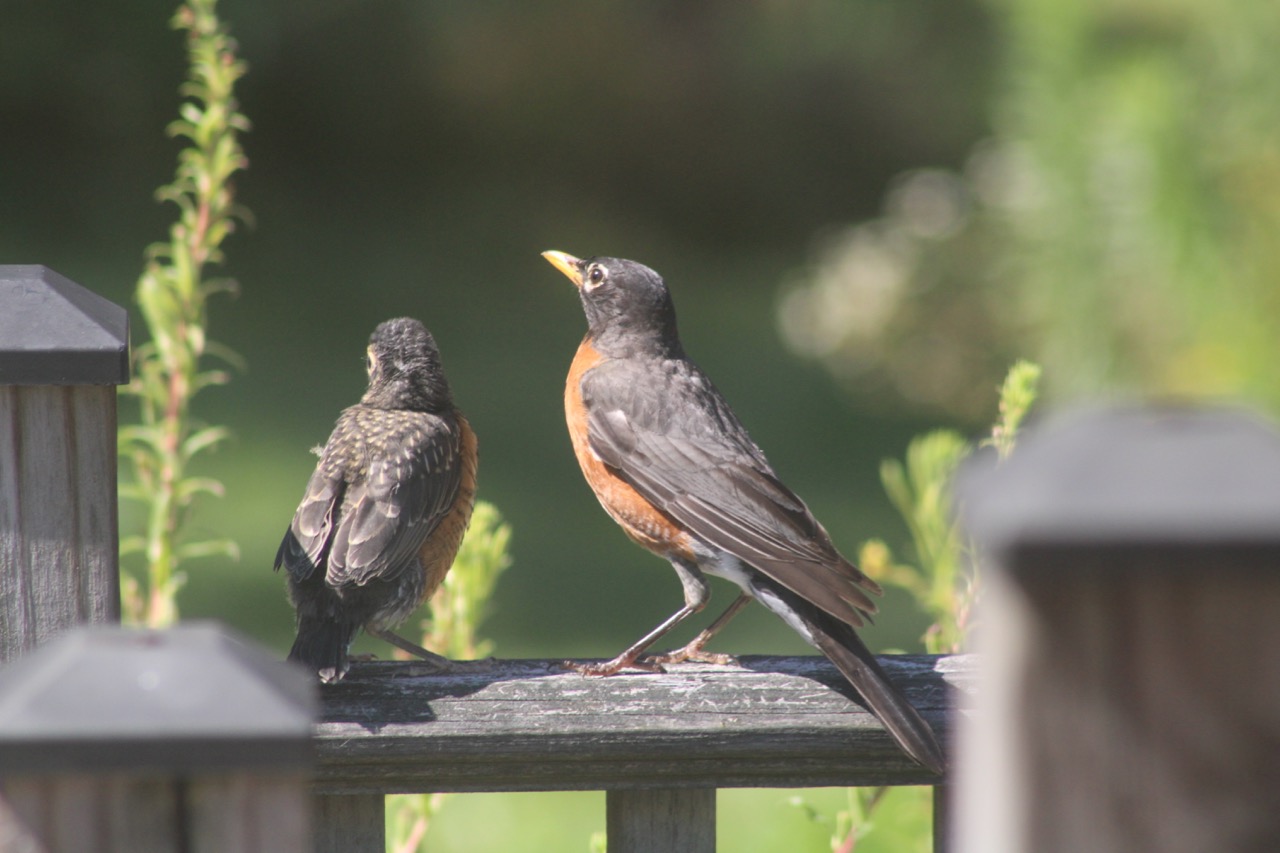
Fledgling robin looking at mother robin who is looking back, perched on gray wooden railing, greenery behind.
Fledgling robin with mom on the deck railing.

Our Lammas harvest festival blessing was being able to watch the fledging of the robins’ third brood of three chicks. (That makes nine chicks all together!) They had been getting active the last couple days so we were expecting it. But what a nice surprise to look out the window and see the first fledgling perched all alone on the deck railing, looking around at the big wide world for the first time.

Fledgling robin alone on gray deck railing looking out to greener beyond.

They probably saw their mother hopping on the ground further in the back yard. (We did too.) Then the mother flew up next to it on the railing for encouragement. (That was photo number one). After looking at each other, they each looked out beyond, and then the mother flew off, and the baby soon followed, alighting high in the hazelnut bushes.

Fledgling and mother robin on gray wooden deck railing looking away from camera toward greenery beyond.

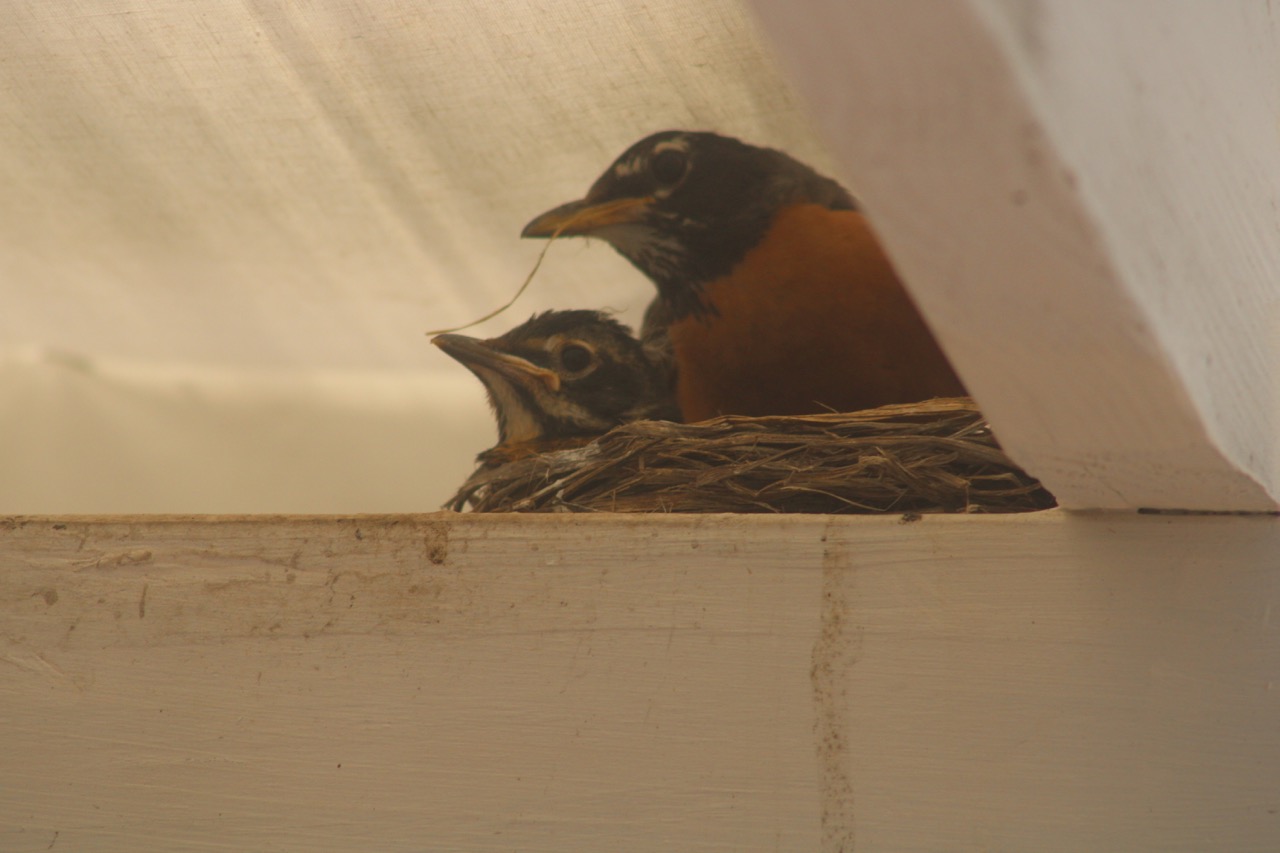
The other two remained in the nest for a little while, but soon the second one flew out toward the orchard. Finally there was just one left. I wandered around outside, but the parents were chirping at me, their warning calls. I saw the parent robins also diving and shrieking at squirrels in the pitch pine tree branches, and angrily calling at a cardinal who came into the cherry tree–too close as far as the robins were concerned. Back inside for a while, I saw the dad robin come to the nest–with a piece of grass in his beak, but I didn’t see food. He sat with the third baby for a while, so tender. After he left, the baby shrunk down into the nest, only its beak visible. Hiding mode.

Baby robin, just head showing above brown grassy nest, with dad robin above and behind in nest, between white painted beams underneath and on side.

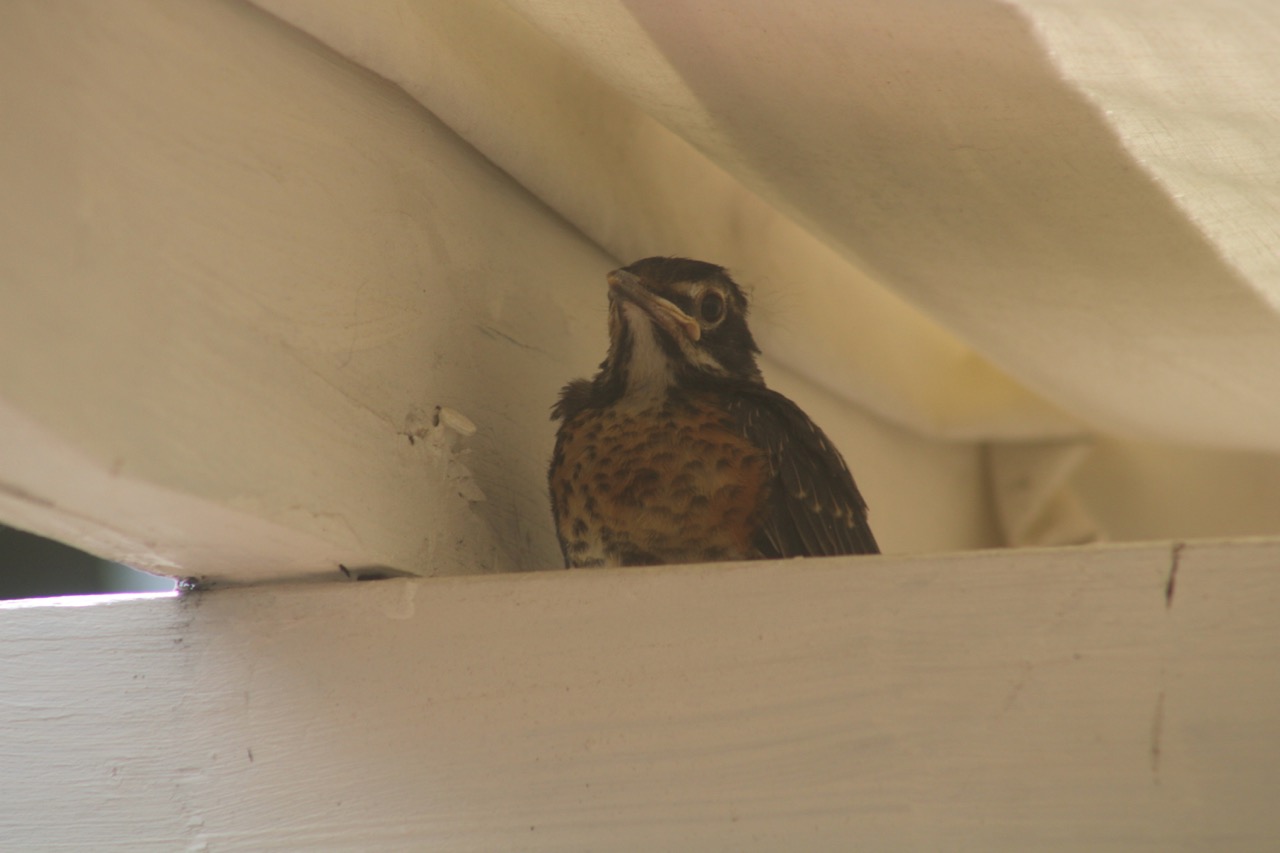
I had to go out in the orchard to do some mulching, and then I sat at the patio table. I could hear number three chirping every so often from the nest, their head visible again, and then I’d hear another chirp from the direction of the hazelnut bushes. When I came back inside, I kept an eye on them through the windows. They got out of the nest finally, and hopped along the beam to the other side. While the first fledgling had seem so confident and proud of itself, this one seemed quite scared about jumping from its safe little home. But everybody had left. It huddled up next to the opposite side beam.

Baby robin visible from belly up, on white beam, next to side beam, looking toward the camera.

Finally, the little one started to stretch their legs, and move their wings a tiny bit. They moved up to the very edge of the beam. They hovered there for quite a while. One of the parents came back to the deck railing down below and behind the nest. I also saw a female gold finch perched on the railing in front of the nest. Not sure what that was about. A chipmunk was scurrying below on the patio. I stood still next to the back windows and just watched–I didn’t take any more photos. The gold finch left, the parent left, the chipmunk left. The little one perched on the edge. Then they bravely jumped off.

I heard a flutter of wings against the screen window of our music room, just to the left of the deck out of my sight. I went out the door to observe, and saw that the baby was hanging by one claw stuck in the screen, and flapping their wings against it. I walked to the edge of the deck, reached over and cupped my hands gently around the baby, careful to contain their wings, lifted them to release the claw. I let go and they flew down to the lemon balm patch. Be still my heart. They slowly hopped out onto the patio, hopped over some garden hoses, making their way over to the mulched area under the cherry tree. They hopped into the grass behind, and finally they flew up over the grass into the trees.

And then the nest was empty. They say that robins raise two or three broods a season, and if that is true, they may be done with the nest for now. They’ll feed the babies for a few more weeks out in the bushes and trees. I wonder how all nine of their children are doing? Did they all survive? I hope they are thriving. We don’t see them once they leave the nest, so we never know.

I feel a sense of joy, and a sense of loss, all at the same time. I feel grateful for the privilege to observe the robin family, and for the moments I was able to capture in photos. I feel sad to look out the window and see them gone. I am also grateful that I was able to give them a little shade from the sun, and maybe that helped.

Humble

Red rain barrel in front of house, heat pump seen on upper right, behind oregano plants all over the place, green with white flowers
Overgrown oregano all around the rain barrels and heat pump.

I love sharing photos of beauty in the yard. But it is harder to know how to share the challenges and failures. I actually feel like a failed gardener right now. Yes, there are little harvests, yes there are elements of beauty. But there is so much that is overwhelming. I don’t enjoy “weeding” which seems to be what real gardeners often talk about enjoying. A weed is merely a wrong plant in the wrong place. We make further distinctions to talk about invasive plants that are harmful to the local ecosystem. And there are also native plants that are aggressive in the ecosystem.

One of my overwhelming senses of failure comes from the oregano that is spreading all over the orchard. When I originally planted some donated oregano as a companion plant to the orchard trees, I had no idea how it would take over. Oregano is a tasty herb, not native, but useful, and the bees love the flowers; I’ve dried some of the plant for seasoning. Last year as it spread, I thought, okay, just let it go where it wants. This year I tried taking out a tiny patch using a garden fork. Its roots form a thick mat under the soil. Even a tiny patch was challenging to remove. I’ve lately taken the mower through the orchard a few times. With the rain and heat inhibiting our outdoor time this summer, I can’t imagine how to get it under control. I hate the feeling of needing to get a plant under control.

Everything in the yard is ragged and overwhelming. For each native plant I newly discover and appreciate (like the evening primrose that the goldfinches adore), there is another tall unknown plant that I have no idea about. The orchard trees have to be pruned each year, and face challenges from mysterious pests and diseases. Will the Lapins cherry survive its challenges?

Perhaps in all of this, I discover that I don’t enjoy tending and caring for this patch of earth the way I thought I would? I am not good at gardening? I’ll never be good at harvesting much food? I want to give up sometimes, but how can I? Everything is right outside my door. I acknowledge that it is much more difficult for all gardeners because of the climate catastrophe of our times. I realize that I don’t have teachers to show me how–mostly just books really, and the internet. I don’t think gardening was meant to be so all alone.

But I have made this commitment to a spiritual journey into earth community. These overwhelming challenges are part of that journey too. So what can I do? This morning, I took myself out to our new screen tent, placed a blanket on the ground, and sat on the ground. It has been a while since I have done that. At our old yard, I used to sit on the ground in a screen tent almost every day. Lately, instead, I have been walking around looking at things that need tending. Today, I sat on the ground and let the ground tend to me. I turned to each of the four directions, to honor the powers of east, south, west, and north–and the powers of the earth below, the sky above, the spirit within.

The sun shining through in the eastern sky, from within the screen tent.

It reminds me that I am small, and these powers are large. Spirit is large. They are my teachers and carers. I hear the cardinal singing from the tall trees. Truthfully, I am not really the one who tends the earth, the earth is the one who tends to me.

I am remembering a chant song I learned from a friend in English, and then heard later in Wolastoqey; As far as I can discern, it originated from Wolastoq people, and has since been performed by other indigenous people as well. My friends and I sang it something like this, in several verses substituting the word “creator” with all manner of beings, such as trees, ancestors, water, stars, dragonflies, children–all the creatures around us.

We've got to humble ourselves in the eyes of the creator, we've got to bend down low.
We've got to humble ourselves in the eyes of the creator, we've got to know what they know.
We can raise each other up, higher and higher. We can raise each other up.

Perhaps the failures are also teachers, a reminder of our ultimate dependence, an opening into something more mysterious and powerful in whose eyes we are seen and held.

There are things we cannot control

Green shoots emerging in brown leaves and old stems
Going through old files, I found this reflection poem from 2014. It feels even more fitting for today, especially living as I do in the "realm" of chronic illness. I cannot control how much energy I will have each day, and rarely can I take action that might have an influence in the world outside our home. But this morning I was reminded that I can still choose to love in all of my hours, and be grateful.

There are things we cannot control.
It is a long list.  The weather, the seasons, 
the coming of day and night.
Another person's joy and sorrow, or love and grief.
We cannot control anything 
	about another person, most of the time.
The things we cannot control 
       are more numerous than the things we can.
The economy.  The price of milk.  
The coming of storms or the blooming 
       of lady slippers.
The return of the hummingbirds,
       or the death of poets.
If you are like me, you sometimes imagine 
you have more power than you really have.  
You try to control what you can, 
and even what you cannot.  You worry.
You want your children to be happy and fulfilled.
You want your parents to be healthy and content.
You want your partner to be a good match, and loving.
You may want the members of your community
	to be enthusiastic and generous,
and your staff to be talented and never to move away.
Big things or small things, no matter.
There are long lists of things we cannot control.
We want for all children to be safe, and girls who are lost to come home again.
We want angry young men to work out at the gym 
        and never to buy large amounts of guns and ammunition. 
We want politicians to be dedicated to the common good,
        and news media to the truth.
We cannot control anything about another person,
        most of the time.
We cannot control another person's joy and sorrow, loss and grief.
We cannot control the ways that joy and sorrow come into our own life.

But there are a few things we can control.
We can choose the values we want to follow in our own lives.
We can choose to speak up and act 
	in ways that share our values with the world.
We can choose to greet a stranger
	and listen to a friend.
We can choose kindness. No matter what.
We can choose to love.
	(and love ourselves too)
May you find the places of choice in your life, 
      and be at peace about all that is out of our control.

Resisters

Small open water pond, with stones surrounding it and small white dock on left.
Pond has open water today, first time this spring!

Back in 1981, I wrote a poem that meant so much to me at the time–an expression of the spiritual path I was attempting to follow as a social change activist. It is interesting to me to read it today–do I still agree with it or not? Since that time, I have been involved in several organizations working for change. I would love to change the system, and I grew to think much more collectively. But after many years, and seeing the backlash against so many changes we tried to create, there is some grounding in remembering that we are creating a new way, no matter how the larger system reacts. I am curious what other activists or spirit kin might think about it all. (I do still love the word kin-dom.) (And one can make a small pond by digging a hole and pouring in water–it will never be the ocean, but it gives me joy none the less.)

We are not reformers
We are resisters
We are not reformers with a cause
We are resisters with a way
A reformer is one who tries to change the system
A resister is one who tries to change herself
A resister does not try to answer the question	
    of what the system should be
A resister does not try to organize a new system
A resister resists the system
A reformer is like someone trying to make an ocean	
    She digs a big hole and pours in water
A resister is like a river
A river doesn’t know what the ocean looks like	
But it knows the way to the ocean


Now here is a mystery
The organizers of groups try to organize people	
    into organization which resist the system
But only individual persons can become resisters
Only individual persons can change themselves
But when a person becomes a resister	
    she finds a kinship with other resisters
She becomes part of the kin-dom
The kin-dom is always in the midst of the system
The kin-dom is always in resistance to the system
The kin-dom is not an organization to be joined
It is the kinship with other resisters one finds	
    when a person becomes a resister
Only individual persons can change themselves
Only individual persons can become resisters


When resisters protest this or that evil	
    we are not trying to change the system
A resister protests to strengthen the change	
    in her own life
A resister protests to let other people know	
    that there is another way
A resister protests to invite other people	
    to become resisters
If everyone became a resister
	the system would collapse
But a resister is not waiting or working 
    for that goal 
The kin-dom is not waiting or working 	
    for that goal
The kin-dom is at hand.

Interrupted by Ancestors

Full moon shining between dark pine branches on a dark sky

Yesterday, going through old files on my laptop, I found a letter from October 1994 that I never sent–so really, more of a letter to myself. It described how my Innu ancestors would interrupt my daily life with their insistence on being recognized and acknowledged. I hadn’t thought about that for a long time, and wanted to remember it by including some excerpts of those reflections here. What a magical time it was.

“A few weeks ago, a friend from Vermont told me he had heard a rumor that Yvette Michel, an Innu leader from Maliotenam, was coming to visit me in Boston. This was the first odd thing. I certainly hadn’t heard anything about it. I had met her very briefly but didn’t expect her to remember me. A few days later I learned from someone else that she was doing a speaking tour in New England for the Coalition for Nitassinan. The Coalition was a group of activist traditionalists. Nitassinan is the Innu name for Innu territory, meaning ‘our land.’

“Then, I got a message from Mary Frongillo, a white woman who has been living in the community of Maliotenam for a couple years. We had spoken once before by phone. She said they had heard there was a Native spiritual gathering of some kind in Boston the coming weekend, and someone had told them I would know about it. Well, I didn’t know anything, but I made a few phone calls and found out about a gathering a couple hours away from Boston. That’s when I got a hint that maybe I should go too. But I didn’t know how I’d be able to get there, and I couldn’t afford a donation (to help with food for the elders), etc.

“Still, it felt like spirits were interrupting my regularly scheduled programs for a special bulletin. So when I called Mary back, I told her all the info, and that I was thinking about coming. She said they would be near Boston before hand and could give me a ride there and back, and we could be a camp together. So that’s when I cancelled everything, and decided to go for it. By Friday afternoon I was sitting in the sun in front of our two little tents, watching eagles fly overhead, trying to follow French (Yvette speaks French and Innu) through a mixture of translation and memory. The weekend weather seemed totally in love with us–it was sunny and warm during the day, cold and clear at night. I felt afraid at first, being shy, and especially without my favorite power: easy words.

“But eventually, I relaxed into a bilingual state of consciousness, full of the earth again and taking in so many little stories and practices of Innu culture, in a way in which I had never before had the opportunity. Things like bannock, a simple Innu bread, which we ate with our meals. I watched Yvette make two loaves, stirring flour and salt and baking powder together with water, forming a flat round loaf, pressed into a cast iron pan with flour in it, cooked about half an hour on each side. Mary was a wonderful translator, in the wider sense of the term, for she told me many things from her experience, things which someone notices because they are not from that place.

“During the last two years, the more I reckon with being white, the more the Innu part of me asserts its presence. I now believe I need both of those parts. The better white person I can be, the better I can also be Innu. So the white person fights the racism I see in the New Age theft of symbol and ritual, and searches out the spiritual wisdoms of European ancestors. And I do believe white women need to be doing this–we need to search out our own ancestral traditions and powers of the earth, rather than turn to Native or African American women as a kind of ‘spiritual surrogate.’

“But in the meantime, whenever I have thought I should let go of my desire for the Innu part of me (‘I’m not Indian enough for it to count–five generations back.’ ‘Don’t be a wannabe.’ ‘I should just be white, acknowledge my privilege and leave it at that.’) it hasn’t been supported by the spirits. It was after I was learning the Runes, and creating a link to Freya, ancestor goddess of Northern Europe, that I first met people who were helping the Innu and learned about their struggle against hydrodams. I said to myself, I am chasing after my European ancestors, but the Innu ancestors are chasing after me. A month later I was in Quebec city testifying against the dams, and meeting members of the Coalition for Nitassinan. That was another spirit interruption.

“So even as I was trying to be more ‘successful’ as a white person–ie. using my educational privilege, trying to make more money than just barely getting by, still in service to my values–I was interrupted to spend a weekend on the earth, on Indian time, in a setting where people don’t have much at all but share what they have with who needs it–all these values that exist in Innu culture, (and in other Native cultures), and which I wish existed more in our culture.”

The Innu ancestors won’t let me go.

Our Love Is Holy

Mar 11 2004 Margy and Myke at a rally at the state house in Massachusetts, for the constitutional convention trying to take away equal marriage, holding a poster that says Our Love Is Holy
March 11 2004 Margy and Myke at a rally at the state house in Massachusetts, in support of equal marriage

This week in my basement archives I revisited my life in Massachusetts in 2003 and 2004, during the time when its Supreme Judicial Court declared that to deny civil marriage to same sex couples was unconstitutional. In the six months following their declaration, state legislators were arguing over trying to stop it from happening, or support it to happen, and we were at the state house too, lobbying, and rallying. I had forgotten many of the details of those months, but I had not forgotten the strange mix of joy and fear as we anticipated this unimaginable possibility. It is hard to believe that was only 19 years ago. Now marriage is accessible to same sex couples across the land, but it is still under threat. I found my remarks from a forum we held on Cape Cod that spring, and they still seem relevant today.

This was Civil Rights, Civil Marriage: A Forum on Equal Marriage Rights for Lesbian and Gay Couples, Cape Cod Community College, May 3rd, 2004, where I was part of a panel presentation. At that time I was a minister at First Parish Brewster, Unitarian Universalist. Linda Davies and Gloria Bailey were members of our church, and one of the plaintiff couples in the lawsuit. They also had just spoken at the event.

“I want to start by saying how much I am looking forward to signing the marriage license of Linda and Gloria on May 17th. When I sign that license, I won’t be acting merely on my own behalf, but representing the whole community of First Parish Brewster. I believe I speak for all of us when I say how grateful we are to Linda and Gloria for taking a risk with their lives to end discrimination against gay and lesbian couples, and what a joy it has been to join them at the front lines of this historic civil rights effort. I know that your courage and your transparent love for each other have touched people’s hearts and opened their minds.

“Our struggle is far from over. Many of our opponents use the teachings of Christianity to claim that gay and lesbian couples should be excluded from marriage. I think Jesus would be horrified to see how his message has been twisted.

“Someone once said that even the devil can quote the Bible. Every religious community that draws inspiration from the Bible has the challenge of interpreting a collection of documents that were written and gathered over 1800 years ago in languages and cultures not our own. Some people will tell you that they take the Bible literally word for word. I will tell you, following Karl Barth, that I take the Bible far too seriously to take it literally. As even my Catholic professors used to say, the Bible is ‘the word of God written in the words of men.’ It is full of contradictions and its heroes are entangled mixtures of good and evil. The Bible tells the stories of a community’s experience of the Holy in their midst. If we are to be true to its message, we must also pay attention to the working of the Holy within our midst.

“You know, Jesus actually said very little about marriage, and nothing about homosexuality. He wasn’t so concerned with family arrangements. He was concerned about love. He was concerned about how we care for each other, and especially, about how we care for those who are—what he called—’the least’ among us. He called on his followers to welcome the stranger, to take in the outcast; to bear witness to the kingdom of God within each person. He said, when we live in love, God is in our midst.

“I am a minister and I am a lesbian. So this moment in history is meaningful to me in two ways. I want to say that I respect how difficult this issue is for those who are religious. It was difficult for me when I was a young Catholic woman. It was easy to imagine that everyone could just follow the rules if they tried. It wasn’t until I became friends with a gay man in college that this ‘issue’ took on a human face—the face of a brother who was in deep pain because of the contradictions between the teachings of his religious tradition, and the inner truth of his own body and soul.

“When we risk honoring the truth in our own soul, we are entering dangerous ground. What if we are deluding ourselves? Some would say we are. But on the other hand, what if the truth in our souls is the voice of the Holy in our midst?

“The God of the prophets was always leading them beyond the comfort of the familiar in the direction of greater love. I believe that we are living in a prophetic moment. Something holy and miraculous is going on here. It has always been the Holy who has lifted up the downtrodden. It has always been the Holy who has filled the hearts of people with compassion. It has been the Holy who made strong the faint of heart, and transformed the lowly.

“Equal marriage is a civil rights issue, a legal issue, an issue of respect for diversity. But for my part, I want to take off my shoes, for I believe we are standing on holy ground.”

Gloria Bailey, left, and Linda Davies of Orleans rejoice moments after being pronounced married by First Parish Brewster Unitarian Universalist minister Rev. Dr. Mykel Johnson, left, on Nauset Beach during a 1:00 ceremony on Nauset Beach Monday. The couple, who have been together three decades, were married in front of a group of about 40-50 friends and press. Monday is the first day of legalized same-sex marriage in Massachusetts and the US. A dinner party is planned at a friends house to celebrate the event. (Dewitt photo 5/17/04)

Envy

A confession: there is a kind of envy that sometimes creeps up in me when I notice famous people, like authors with many popular books, or those widely praised or described as “influencers” and “visionaries.” (Especially when those books are most similar to my own one book.) I grapple with the fact that in the great scheme of worldly success I often feel like a nobody, and more so in my life today with chronic illness and retirement isolation. Margy reminds me that it is only human to feel such feelings. My critical thinking also notes that in the capitalist system, these hierarchies are meant to elicit self-hate and hunger. Hierarchy and domination are the underpinnings of all oppression.

Taking a brief walk today, I imagine my ancestors curious and baffled at this strange descendent who is a writer, who has strange cravings for fame. They never thought about such things. Then I remembered a poem I wrote many years ago, and went looking for it. I had titled it The Inner Wounds of Class Oppression. It is still a healing incantation for me.

Every day, envy gnaws at your fingers.
Your eyes watch the movers and shakers
climbing into dream cars, Going Places.
You want to be Somebody.  You would ride,
eyes averted from the rear view mirror
where all of the Nobodies recede
like small dark flies to brush away
from smooth shoulders.

Every day, anger fills your gut like a pile of bricks.
Your own hard shoulders ache to reach in
and hurl them forward one by one.
Your ears would strain to hear the glass
shattering and rubber squealing,
as the fine white shine of the dream machine
careens sidelong off the grade
into a deep obituary.

Every day, you clutch at the bark of trees,
knees trembling, moved and shaken.
Your fingertips feel for hidden messages
left there on some other blue morning when somebody
was repeating poems into gnarled crevices,
quiet voice seeping down the edges of roots
into rock under sand:  Remember who you are.
Precious as soil.  Worthy of the sun.
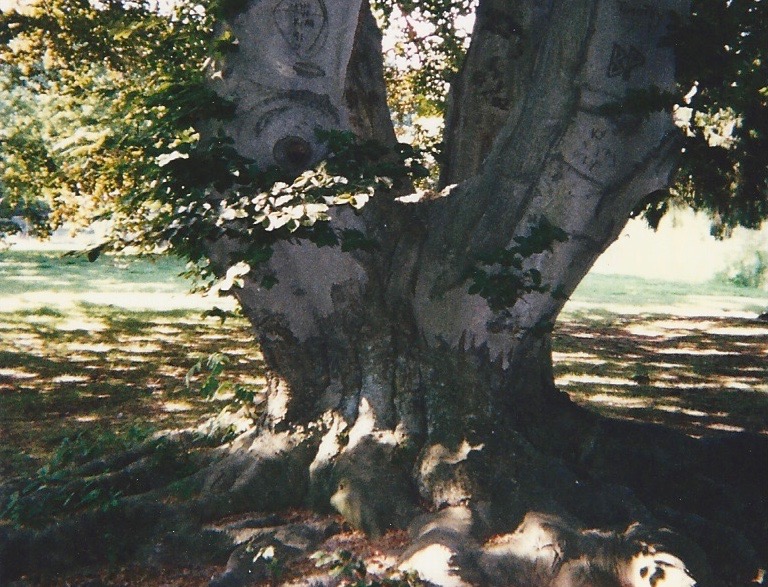
Beech tree with markings and roots
Copper beech tree with markings

February Sunlight

Bright sun shining on snow with small dark tree on left side, shadows marking places where tracks were made.
Bright February sun shining on bright snow.

We are halfway to Spring! So many cultures celebrate this day, or this change of season. For just a few examples: Imbolc or Brigid’s Day for Celtic people, Apuknajit (the winter spirit) for Mi’kmaq people, Candlemas in Catholic liturgy, Groundhog Day in secular America. They hearken to the coming Spring, and offer courage for getting through the rest of the winter. Here at our home in Maine, I can feel the change in the quality and angle of the sunlight. My heart is lifted by its brightness.

We’ve recently had a triple set of snowstorms, so the ground is finally covered in snow after nothing much in December. It too adds to the brightness. I love how it also reveals the creatures who live here with us. I’ve seen deer tracks going through the orchard all the way back across the frozen pond and into the hedgerow. You can see their traces in the photo above. I was also delighted to find these distinct squirrel prints after a rain on top of the snow a week ago. Like little hands.

Squirrel prints on snow, on a gray day.
Squirrel prints

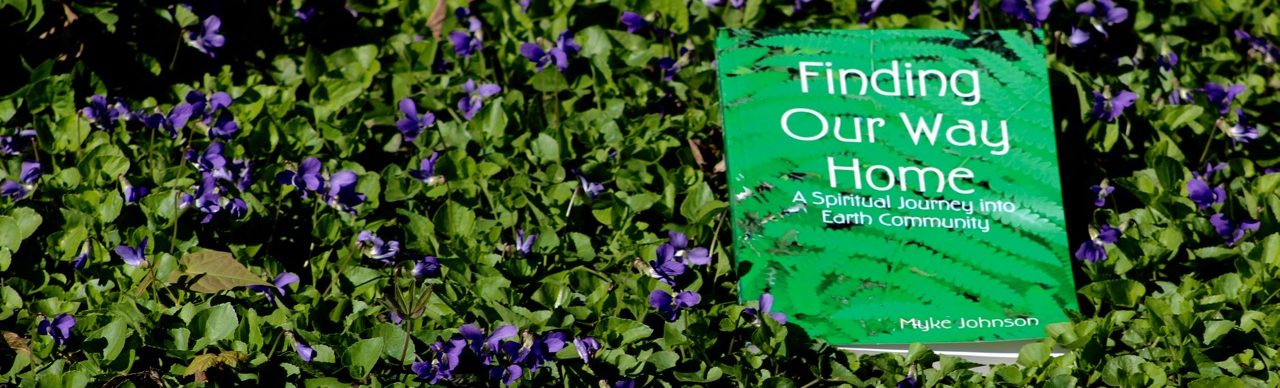
I’ve been continuing my winter project of sorting, organizing and winnowing old papers in the basement. I had started with my years in Boston 1986-1999, then moved backwards in time. I am now finished with the very earliest files-hurray! So then I moved forward from 1999. I’ve begun to sort through papers from my years on Cape Cod, 1999-2005. That has meant that I’ve also started to incorporate the winnowing of digital files on my laptop for the same years. Some of it is plodding work, comparing documents to put duplicates in the trash, renaming documents so they are easier to organize, stuff like that. But some of it includes moments of sweetness, like finding a letter from a young queer person whose life was helped along by a sermon I preached called “Believing in Fairies.” [A version of which found its way into my book, Finding Our Way Home, and was excerpted in the post The Mystery Seed.]

It does my heart good to think of those seeds of blessing planted in the hearts of people I met along the way. Sometimes we hear about it afterwards, and sometimes we may never know. When the interactions were not so blessed–since I had my share of conflict and trouble along the way–it does my heart good to shred the remnants of those interactions, and let go. Lighten the load.

Imbolc is a time for setting intentions, for shaping our hopes for the future. It is kind of like looking through seed catalogues imagining what we will plant when the next season turns. I’m not ready yet for seed catalogues and intentions. But it is good to remember that the sorting and winnowing of my past life will not go on forever. I don’t know what sort of seed I want to plant for the future. That is still a mystery to me. But I am good with a mystery seed.

I saw a funny story on Facebook about a child who thought that bird seed grew birds. They showed their parents the proof–they planted a big pile of bird seed outside, and the following day, there was a whole flock of birds gathered round the spot. Maybe that is what I will plant today–filling the bird feeder with seed so that they will have nourishment for the deep freeze we are expecting in a couple days. I understand that Mi’kmaq people put out food for Apuknajit so that the winter spirit will be remembered and be kind. Maybe that is part of feeding the birds too–to remember our fellow creatures during these cold winter times, so that all of us might make it through to the spring.

Small brown bird perched on a stick on green bird feeder, with snow on top of it.
Bird on feeder today.

Love Unconditional

Myke and Lori, 1977, two of us standing close together, smiling. Lori is wearing a veil on taking her first vows as a Franciscan Sister.
Me and Lori, 1977, when she took her first vows as a Franciscan sister.

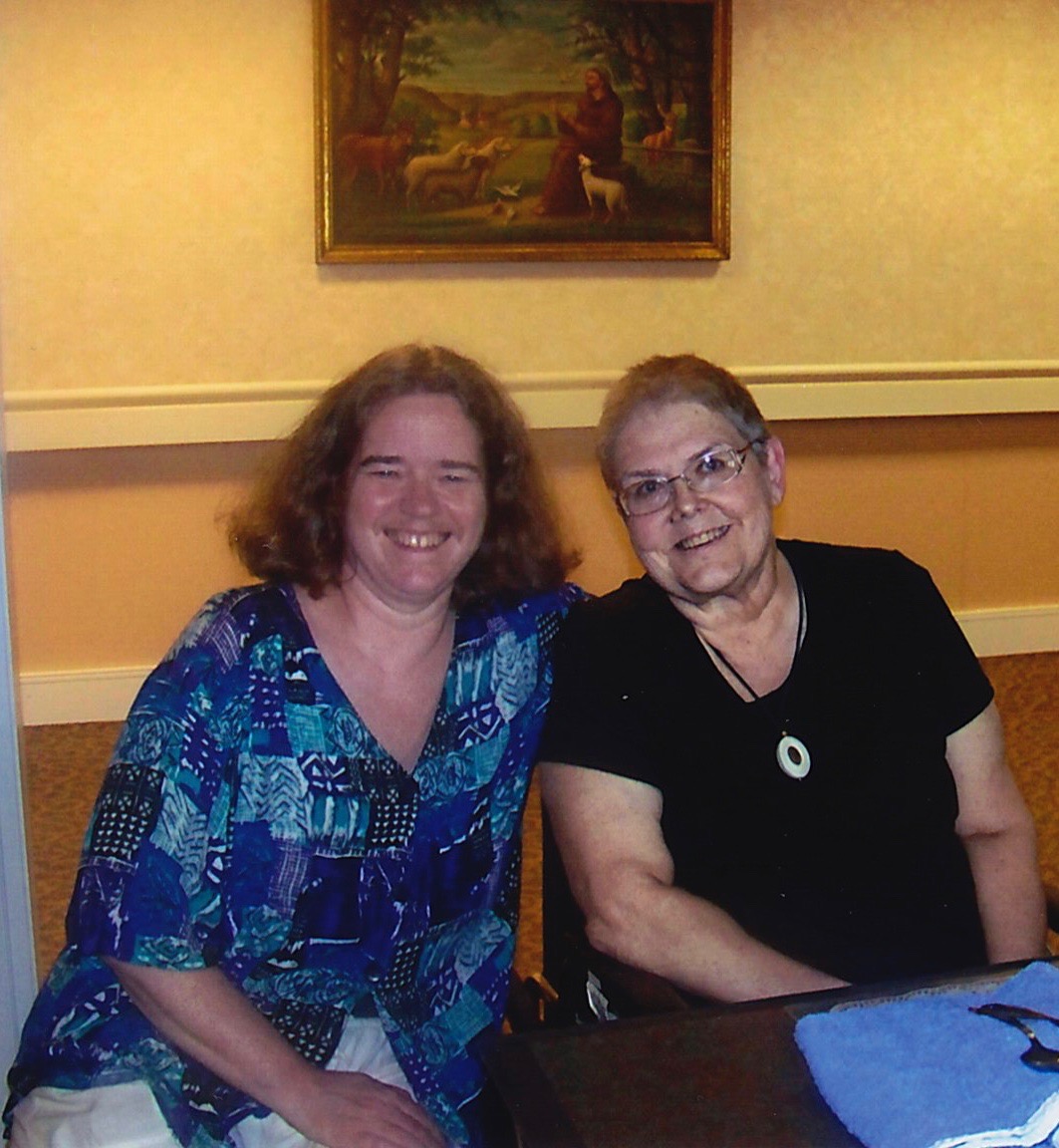
What does unconditional love mean? What does it gift to us in our lives? I first experienced unconditional love in my friendship with Lori Slawinski. I have been looking back on my life by going through old papers these last several weeks–my winter project. The other day, I reread dozens of letters from Lori from when we first knew each other. We met when I went to college in the fall of 1971. She was a sophomore at the time, and became the “big sister” I never had at home, my being the oldest child of so many. I haven’t found any photos from that time; this photo from 1977 is the earliest. Very quickly we became best friends, though there was a moment when she hesitated–she said she was afraid of corrupting my innocence. I can’t remember exactly what I said to her, but all I could see in her was her own bright goodness. I think each of us were surprised to be chosen and loved by the other.

Looking back from the perspective of being a lesbian, I wonder about our friendship. We were never sexual with each other, but our letters can only be described as love letters–mostly written on school vacations when we were apart from each other, missing each other, and expressing our affection with such deep passion. I had occasional crushes on boys during this time, but nothing could compare with the love I shared with Lori. Our love for each other was also expressed in the context of our passionate love for God. Lori and I were part of a small circle of friends who were trying to follow Jesus and figure out how to live the gospel in our times. All of it intermingled. From her I felt God as the unconditional lover, and from me she felt that too.

Unconditional love is a transforming energy, a grounding that helped me to believe in myself. Maybe because we weren’t trying to be “in a relationship,” we could grant each other the freedom to explore fully who we were, without expectations? Our maybe it was the spiritual rootedness that provided that freedom. We had a fantasy of continuing forever in our little community, but college is a temporary place. When she graduated, she left to join the Franciscan Sisters of Chicago. I didn’t follow her there, but tried another way, eventually discovering the Catholic Worker movement. Lori was very psychic, and I remember it took a lot to claim my own inner knowing, since she always seemed to know me so well. Separating was a challenge, after being so close. But we were able to let each other go, to try to work out our own destinies.

Our lives diverged significantly when I encountered feminism, and found myself leaving Catholicism, leaving Christianity, embarking on a new spiritual path. I imagine it must have been difficult for her, yet we stayed connected. I went to Chicago Theological Seminary in 1983, came out as a lesbian while there, and she came to my graduation in 1986. (It was years later, in 1999, that I was ordained a Unitarian Universalist minister, but that is another story.) Somehow, the love we had for each other never wavered. We kept in touch via occasional letters and long distance visits. Sadly, Lori died of cancer in July 2012; this second photo was from our final visit in May of that year.

I am so grateful that I was able to experience her unconditional love in my life. I have had other significant loves, and still do, but her love was the root. It enabled me to come alive, to feel joy, to trust the dreams I dreamed and the ideals that guided me. Despite our different paths, that unconditional love remained tangible. Perhaps that is why my image of the divine is rooted in a Larger Love, who loves all of us unconditionally.

Have you experienced such love in your lives? Please share your stories if you might be willing? Each story reminds me of the possibilities that surprise us when we least expect.

Myke & Lori, 2012

Humbling

Crabapple tree broken at trunk and lying on the faded green of winter lawn, with street behind, houses visible on other side.
Fallen crabapple tree

On December 23rd, a severe rain and wind storm passed through Maine, after also creating havoc with storms and snow in other states. In the early afternoon, I was sitting in the living room, and suddenly heard some sort of clattering outside. I had previously gone out in the rain to right overturned trash barrels, and so I went out again to look around. At that moment, Margy was driving into the driveway from an appointment, and she asked me–did you see the crabapple tree? Going round the side of the house, this is what came into view: one of the ornamental crabapple trees in our front yard had suddenly cracked through its trunk and fell over. It didn’t land on anything or damage anything, which was a relief, but the tree was dead.

A couple hours later, our electric power went out, along with many other thousands in Maine–though only a segment of the people on our street. The thing with power outages is–you never know if it is going to be a brief interlude, a few hours, or a few days. You enter this limbo time of unknown duration. We waited until dark, and then lit our wood stove–thank goodness our house had this wood stove when we purchased it. It is a very fine wood stove, and it will heat the entire house when needed. We don’t usually use it except for emergencies. But in fact we had used it just a week ago when our heat pumps were being repaired. We have a few flashlights and candles, so we lit those too. And I could connect to the world via my cell phone, and Facebook.

However, I have to acknowledge that it felt very dark, the sun setting at 4 p.m., and not rising until about 7 a.m. Keeping up with wood in the stove was exhausting. It was hard to just relax with the uncertainty of it all. After a Friday of warm and windy rain, the temperature dropped on Saturday to a frigid 12 degrees. I was worried about our refrigerator food, and the freezer in our basement. I covered the freezer with a few blankets. I put the food from the fridge freezer into rubber tubs, and put them out on the back deck. Then, an unexpected grace–our neighbor Brian came by, and offered to run an extension cord from their house to ours–they had not lost power. So by this gift, we were able to plug in our refrigerator.

Before the storm, we’d purchased a round shrimp plate for a holiday treat–so Friday dinner was shrimp and cheese and crackers and cucumber and carrots. A little picnic. Margy had also boiled some eggs before the storm, and we had some sliced ham, so those were other meals that didn’t need cooking. On Saturday early evening, I got a text that the power should come back at 7 p.m., but then it did not. I felt such disappointment then, and crankiness, and boredom. Later, we tried to work on a puzzle, but without a good light source, it was mostly frustrating.

It is humbling to realize how difficult I found this time without electricity. I felt disconnected, restless, and bereft. I tried reading the book I had started a little while ago, but it was a heavy subject, and I couldn’t manage it in the midst of everything else. I missed the entertainment and mental stimulation of television or streaming channels like Britbox and Prime. I missed connecting to Christmas Eve services through Zoom. I felt at a total loss. I had imagined that as I grew older, I would become more resilient with age. But I see that I am perhaps less resilient after all, that I am vulnerable and dependent in many ways. When I went to bed, I felt defeated.

For whatever reason, I woke at 3 a.m. on Christmas, and couldn’t get back to sleep. I added a log to the fire, and wrote in my journal. I think then that I surrendered to the situation I was in–that here we were, in the dark, and we didn’t know for how long–and yet, we were warm, and we had food, and kind neighbors, and offers of support via Facebook. We were not alone. I thought about the people in Ukraine right now, also facing the loss of electricity in winter, and maybe no heat or water, along with the devastation of war and bombs–so much loss and uncertainty. I found myself praying for those folks who were facing so much greater hardships. I acknowledged my vulnerability and exhaustion.

By the time the sun rose, I felt peaceful sitting near the fire, drinking some tea after I’d managed to heat water on the narrow five-inch ridge on the top of the wood stove. I was still exhausted, still humbled by the difficulty of my managing in these circumstances, but somehow at peace with all of that. It would be a lie to say that I was not relieved when our power came back on at 10 a.m. But I am glad I came to some peace within my spirit before the end of our 44 hours without power.

Fire burning in the wood stove.