Trying to Define the Undefinable

I want to delve deeper into the discussion from Karen Armstrong about logos and mythos. Modern religion has taken the language of reason, and attempted to apply it to the realm of mythos. Whereas, prior to the modern era, the word faith meant trust, commitment, and dedication, in the modern era, faith came to mean an intellectual affirmation of unprovable facts about a divine being. When reason was beginning its ascent, many Christian religionists fell into the trap of shifting to the language of reason to try to defend and define the undefinable. They drew further away from the mystical and miraculous elements of the faith stories. The Deists, for example, saw God as an unseen clockmaker, who had set the world in motion like a well-oiled machine.

But as Newtonian science began to explain more and more of origins, there was less and less need for this rational God, and eventually God became superfluous to the scientific endeavor. In the meantime, the logos way of looking at things had become the norm. So when religionists fought back in defense of God, some did so in a literalistic and idea-based mode—they claimed that truth could be found in the literal words of the bible, and that faith required that one believe every word of this literal bible as historic and scientific fact. Of course, some words were emphasized more than others, and this approach to truth fostered intolerance of anyone who held differing interpretations.

We have been so thoroughly immersed in the modern era, that it is difficult to imagine the realm of mythos. If our only option for understanding God is that big guy in the sky, no wonder that another phenomenon of the modern age has been the rise of atheism. Atheism affirms the methods of science and the language of logos as the only reliable path to truth, and concludes that it is impossible to find evidence to prove that God exists. Fair enough! But the only God some atheists are now choosing to debunk turns out to be the God of the fundamentalists—that big guy in the sky.

One of the criticisms of the work of contemporary atheist writers such as Richard Dawkins, Christopher Hitchens, and Sam Harris is that they refuse to debate with theologians who have more nuanced and expansive understandings of religion or divinity. They too can be intolerant of any who disagree. Barred GateBoth fundamentalists and these atheists are relating to a God in a box—a God that is defined and described as if it were possible to say exactly what God is.

There are many attributes of their God that I find good reason to debate—I don’t believe in a God who is male but not female. I don’t believe in a God who is squeamish about sex. I don’t believe in a God who would send His children to the eternal torment described as Hell. I don’t believe in a God who would arrange for his son to be killed, to satisfy his anger at the mistakes of human beings. I don’t believe in a God who would cavalierly destroy this earth, and bring up a few obedient followers to some new place, to gloat over the suffering in triumph. 

But deeper than any of these particular attributes is the fact that I don’t believe in a God that can be defined by human logic. The word define means to place limits around. That God is too small for me. 

Words about God: Reason vs. Myth

People have been searching for God, and making idols about God for a very long time. But we have some particular ways of doing it in the modern era. I believe one such phenomenon that has become an idolatry of our time is Biblical literalism. Fundamentalists claim to be bringing back the fundamentals of ancient Christianity, but in fact, their version of Christianity has not existed anywhere prior to the last one hundred years or so. They claim that every word in the Bible is the literal and factual truth. But scholar of religion Karen Armstrong reminds us that literalism is a very modern way to read the Bible, a way that was unheard of prior to this era. In A Case for God, she talks about the historical context for our modern idols.

After the destruction by the Romans of the Jewish Temple in Jerusalem, during the first century of what we call the Christian Era, there were various groups of Jews wrestling with their new religious predicament—much of the Hebrew Scriptures were centered around the temple, and the rites and rituals of the temple, but now there was no temple.

One group of rabbis began to re-work their faith into a guide for living as if the temple was everywhere, and how they lived should reflect the priestly status of all the Jewish people. They began to develop new practices for living, and created the beginnings of classical Judaism. They felt perfectly free to re-arrange the Biblical texts, or draw new meaning out of them, use them metaphorically, or even disagree with them. Eventually, a body of literature grew up around this effort, that we now call the Talmud.

There was also another group of Jews making new meaning out of the old scriptures. They were re-interpreting the old texts around the person of their teacher Jesus, whom they saw as the Messiah, who had been crucified by the Romans. They too re-arranged texts, interpreted them metaphorically, and added new writings and practices. They too were grappling as Jews with a temple-less Jewish faith, though now we call them the early Christians. But neither these early Christians, nor the rabbis who shaped the faith of Judaism, were biblical literalists.

Karen Armstrong writes that before the modern era, which was beginning about the time that Columbus set sail for America,

“religious discourse was not intended to be understood literally because [they believed] it was only possible to speak about a reality that transcended language in symbolic terms.”

Armstrong talks about how in premodern cultures there were two recognized ways of acquiring knowledge. Logos, or reason, “was the pragmatic mode of thought that enabled people to function effectively in the world.” Mythos, or myth, “focused on the more elusive, puzzling, and tragic aspects of the human predicament that lay outside of the remit of logos.” The modern world is a world devoted to scientific reason, and has lost track of the meaning of myth—in fact, myth is now defined as something that is not true. But in pre-modern times, myth was the common language of religion, and helped people to wrestle with the challenges that were not so easily solved by reason. Mythic words were meant to be a doorway into that which was beyond words.

The language of myth was linked to the practice of ritual, in which people entered into a communal experience of story in a way that transcended logical thought or emotion. They were brought to the limits of their rational understanding, into the presence of the mysterious and ineffable, and emerged with a new capacity for living within the tragedy and bliss of this world. Religion was not something that people thought, but something that they did. People who put in the hard work and perseverance it required “discovered a transcendent dimension of life” that was also “identical with the deepest levels of their being.” Potholes flow DSC00653

Exchanging God for an Idol?

Stone TowerIn the story of Exodus, we read that Moses led the Hebrew people out of their slavery in Egypt, with the help of great miracles performed by their God. As they traveled through the desert, they survived with the help of more miracles. They made an agreement with God—he would continue to protect and lead them and they would serve him forever. Then Moses went up the mountain to talk to God, to receive the law.

But after forty days and nights, the people grew restless, and asked Moses’ brother Aaron to build them another God to worship, saying “we don’t know what has happened to this Moses.” Aaron asked for all their gold earrings, melted them down, and formed them into the shape of a golden calf. Then the people brought sacrifices and burnt offerings, and began to create a great celebration for this calf God.

Well, the story goes on to tell us that God was angry, and Moses was angry, and many lives were lost, before the people repented and reconciled. But that is not what is most interesting to me about this story. What I find most curious is that even though this group of people had been up close and personal with God, even though God freed them, and did miracles to feed them—they still forgot all about that after only forty days. They wanted something solid that they could worship—and so they exchanged their God for an idol.

It is an old story, but it still rings true today. Human beings have a perennial problem. We are very quick to turn any idea or experience of God into an idol—something solidified, defined, predictable, and under control.

Think about the image of God that many of us absorbed as children from our American culture. This God is an old white man with a beard and a long white robe who sits on a golden throne in heaven. Remember him? He is supposed to control things on earth and grant favors to the good people who pray to him, while punishing the people who do bad things. There are plenty of preachers who will tell you that if you are good and give your life to Jesus and your money to them, that God will make you prosperous and successful and healthy.

And if you don’t follow their prescriptions, well, you’d better beware. A certain televangelist I won’t name blamed a number of disasters on pagans, feminists, and gays and lesbians. After the devastating 2010 earthquake in Haiti, he claimed that the Haitian people had been cursed by God, because they had made a deal with the devil during their 19th century liberation struggle.

I don’t believe in that God. Maybe that televangelist doesn’t want to see it, but I have noticed that goodness can go hand in hand with poverty, illness and misfortune, and those who are wealthy can more than occasionally be selfish, greedy, and downright mean. I don’t believe in a God who blesses the prosperous people and curses the misfortunate people. I think that particular God is a kind of idol, a golden calf, created by people to prop up their own prejudice or insecurity, and apparently, to put other people down.

Call It Forth

Ultimately, it isn’t really about the words at all. Rev. Davidson Loehr tells a story about a worship class in graduate school, when he was a part of a group of Unitarian and Christian students who had the assignment to create a worship service together. They spent quite a bit of time arguing about words, about how to address the focus of their worship. The Unitarians objected when the Christians wanted to pray to Jesus or to God. The Christians backed off when the Unitarians suggested maybe God and Goddess. The conversation went around and around.

Finally, their professor intervened. Loehr writes:

He glared at us: “And the only thing you have been able to agree on is that you would like the Spirit to be a part of your worship service?”
Yes, we all stammered: “But we don’t know what to call it.”
Still the stern father, he shot us a punishing glance and said three words: “Call it forth!” “Call it forth!” No matter what you choose to call it, he explained, call it forth. Because unless you can call forth the quality of spirit that is rightfully called holy, you don’t have a chance of staging a worship service anyway.

 It is not enough to ask, do you believe in God or not? It is not enough to ask, what do you believe about God? Rather we must ask, what God do you want to call forth into the world? What you call it isn’t so important. Use the word Mystery, or energy or power if you wish. What energy do you want to call forth into the world? What power do you want to call forth into the world?

Fireworks

Despite the transformations I experienced as I wrestled with the images of God and Goddess, I realized that there was a thread running through it that stayed the same: an experience of the power of love. At some point in my life, I realized I wanted to call forth the power of that love into the world.

The words and images we use to describe what we believe and experience are less important than living our faith to the fullest, testing it in practice, calling it forth into our community, for the benefit of all. When we live our faith to the fullest, then the real God will stand up in our midst.

And so I will ask you to consider: what kind of power will you call forth into the world? What do you hold in your heart and your hands? 

Quote from “Call it Forth: Religion for Atheists” by Davidson Loehr (in Religious Humanism, Volume XXXIV, #1 & 2, Winter/Spring 2000)
Photo by Margy Dowzer

Humility and Confidence

What do we do with people’s different understandings about God and the religious battles that go along with it? I believe we must begin by affirming that difference is real. People—in the same town and all over the world—think differently about the idea of God and have different experiences of God. That is real, and we can choose to fear it, or we can choose to welcome it, explore it, and even celebrate it.

But what does that do to our ideas about truth and reality? We might ask, for example, “Can God both exist and not exist at the same time?” That isn’t logical. But the truth is: both kinds of human experience exist! There are humans who experience or affirm God and there are humans who do not experience or affirm God. There are humans who experience or affirm certain images and ideas of God, and reject other images and ideas of God. We must take into account that all of our understanding about God comes through our human experience.

When my images and ideas about God began to change, something opened up before me. I embarked on a journey that demanded a deeper humility and a deeper confidence. I needed humility to recognize the incompleteness of my spiritual experience and the validity of truth beyond my understanding. I also needed to have confidence to claim my own experience as valid, whether or not others agreed with me.

I believe that each person’s experience is valid, at least in part, and the fullest truth is that which is weighed in community with the experience of others. This is one reason why I later chose to find a home within a Unitarian Universalist spiritual community that welcomes diverse beliefs. There is a Hebrew proverb: “Hospitality to strangers is greater than reverence for the name of God.” To live within a diverse spiritual community, we must cling more strongly to an open heart, than to specifics images and beliefs about God.

Heart StoneWhat this means for me is that the real God might be everywhere—hidden within each person, in each plant or animal, in each sunrise or stormy day, in the ordinary and the spectacular alike. Or God might be no where at all. It means that revelation is continuous and always unfolding. It means that words and images like God or Spirit or Mystery are metaphors trying to describe what is indescribable. The Sufi poet Rumi said,

“Just remember: it’s like saying of the king, he is not a weaver… words are on that level of God-knowing.”

My colleague the Rev. Forrest Church has said:

“The power which I cannot explain or know or name I call God. God is not God’s name. God is my name for the mystery that looms within and arches beyond the limits of my being. Life force, spirit of life, ground of being, these too are names for the unnamable which I am now content to call my God.”

Quote from The Soul of Rumi: A New Collection of Ecstatic Poems, translated by Coleman Barks, p. 77.

Re-imagining God?

If we seek some larger truth, we need to be open to our human experience. This approach sets me apart from people of some faiths, who have an idea of God that is mediated through external religious authority. Some religions believe that certain leaders or scriptures have the truth about God and reality, and the role of other persons is to follow and obey their authority. In these religions, a person may be instructed to discount their own experience as faulty or sinful, in favor of the wisdom of the leader. But that is not what I believe.

Perhaps I have been hurt too deeply by the misused authority of religious leaders. The very idea of God has felt corrupted by the betrayals of religious institutions. Alice Walker explores this question in her novel, The Color Purple. Two black women, Celie and Shug, talk about the God that they find in the white man’s Bible. Shug says, “Ain’t no way to read the bible and not think God white… When I found out I thought God was white, and a man, I lost interest.”

There was a time in my life, too, when the God of the churches didn’t work for me. At first, when I was a child, God was like a perfect father. I learned about this God from my Catholic family. My idea of God helped me as a child: I felt held in the care of a strong and loving presence. Later, when my family and I became a part of a Pentecostal movement among Catholics, this community also believed that God was a loving father. They emphasized that the Spirit would communicate with us directly and would guide us on our path. It opened a beautiful door to a spirituality of direct experience.

But by and by, a problem occurred for me. This Spirit seemed to be guiding people in really different directions. One man heard the Spirit say that men should be stronger leaders, and women should be only in supportive roles. But the Spirit in my heart was saying that men and women were equal. So why were my gifts and energy not valued? I didn’t feel equal enough in that group to express my truth, so I left instead. I felt like my heart was broken.

Later, the work of feminist philosopher Mary Daly helped me better understand how culture influences our most personal images and experiences. A white male-dominated culture will create white male-dominant images of God. We draw a picture of God shaped by our cultural expectations. And those images in turn reinforce the cultural values by which we live. The father God was white and male and reinforced a system of domination by white men. So where did that leave me and other women and those who were oppressed by racism?

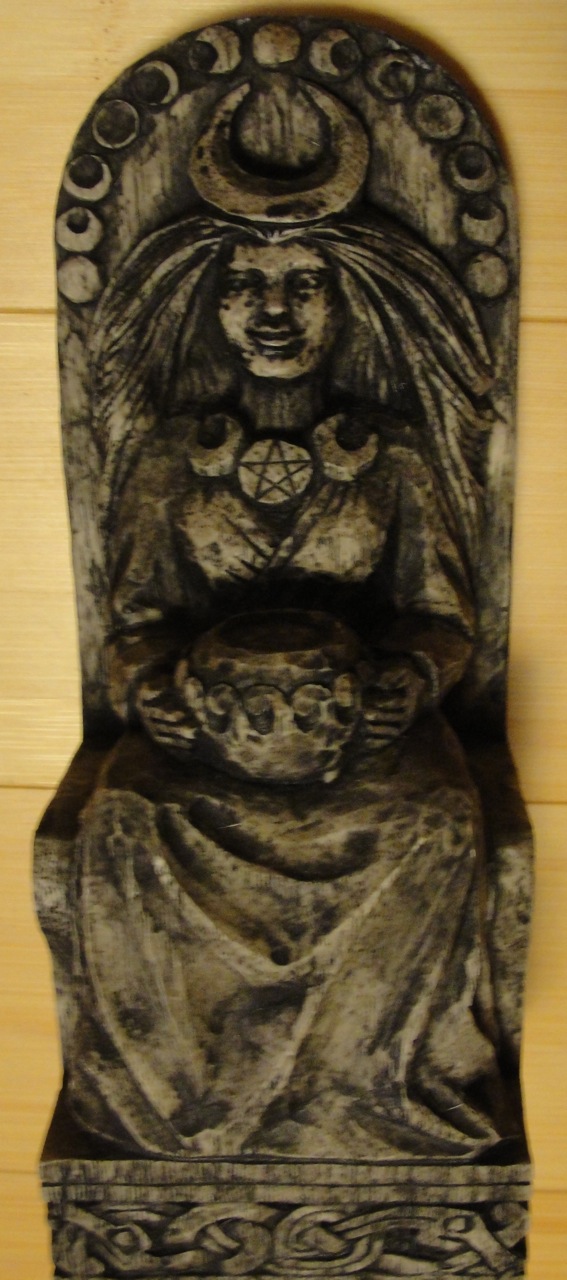
For many years I didn’t know what to do about God. The word had become almost noxious to me, and connected to oppressive forces in my life. Yet I still felt a relationship to some sort of spiritual experience. For a while I didn’t know how to imagine or think about it. Seated GoddessBut I was part of a group of women who were wrestling with all of this together. We began to counter the oppressive forces of religion by creating new images of the divine in a conscious way. We re-imagined God as female, by calling her Goddess. We realized that many cultures have worshipped the divine in female form.

But is it possible to imagine a Goddess and experience her as real? What is real and what is imaginary? Here’s the thing I discovered. The Goddess began to feel real to me when my life started to change. Something is real when it makes a difference to us, when it causes transformation in our lives. Images become real when they open a door. The Goddess became real when the power of women became real—when we were able to embrace our own sacredness, affirm our own intrinsic value and dignity, and live out our own gifts and talents and leadership.

In The Color Purple, Shug also found new ways to imagine God. She said,

My first step from the old white man was trees. Then air. Then birds. Then other people. But one day, when I was sitting quiet and feeling like a motherless child, which I was, it come to me: that feeling of being part of everything, not separate at all. I knew that if I cut a tree, my arm would bleed. And I laughed and I cried and I run all around the house. I knew just what it was.

Sun in Trees DSC05525

Quotes from Alice Walker, The Color Purple, p. 166.
Mary Daly, Beyond God the Father, (Beacon Press, 1973)

Will the Real God Please Stand Up

If I say the word God, people run away.
They’ve been frightened–sat on ’till the spirit cried ‘uncle.’
Tom Barrett

Steeple DSC01264Spirituality is our experience of the larger reality of which we are a part, the Mystery that connects and upholds all life. Many people call that Mystery God. But the word God is a challenging one. Some people have a hard time with it. A few may stop listening immediately. Others may call to mind particular beliefs and images from their own religious community that are difficult for them. Some may be very clear what it means to them, and very assured that everyone else is wrong about it. Some may be moved with emotion, wounded by the betrayals of those who used that word in hurtful ways. Others may feel a sense of confusion, perhaps tinged with longing. The word is powerful and charged with conflict. I want to wrestle with that word.

When I was growing up, there was a TV game show called, “To Tell the Truth.” Three contestants each claimed to be the same person. The first would say, “My name is Jane Doe.” The second would say, “My name is Jane Doe.” The third would also claim to be Jane Doe. A celebrity panel tried to guess which one was telling the truth. At the end, we all learned the truth when the game show host commanded: “Will the real Jane Doe please stand up!”

Don’t we wish sometimes that there were a game show host to shout—“Will the real God please stand up?” If only it wasn’t so confounding and mysterious! We know that this is not merely a debate about ideas. People fight wars and hurt each other over the issue of whose God is the real God. And, if God is real, others ask, why is there so much trouble in the world? Why aren’t our prayers answered when we are suffering? Why doesn’t the real God just show up, make it all clear?

Wendell Berry asked that question, too, through his character Jayber Crow, who was the town barber in a fictional village called Port William, Kentucky. Jayber was very troubled by the war going on—it was the time of the Second World War—troubled by all the pain it caused. He says: “In the most secret place of my soul I wanted to beg the Lord to reveal Himself in power… to lay His hands on the hurt children. Why didn’t He cow our arrogance? …Why hasn’t he done it at any one of a thousand good times…?” He goes on to say:

I knew the answer. I knew it a long time before I could admit it, for all the suffering of the world is in it. He didn’t, He hasn’t, because from the moment He did, He would be the absolute tyrant of the world and we would be His slaves. …From that moment the possibility that we might be bound to Him and He to us and us to one another by love forever would be ended.

 Berry asks how could we be human beings if God appeared in the sky and took away our ability to search, to struggle, to think for ourselves, to love? As soon as God stood up, the game would be over—the adventure of human life would lose its meaning. There would be nothing left to do.