Belonging

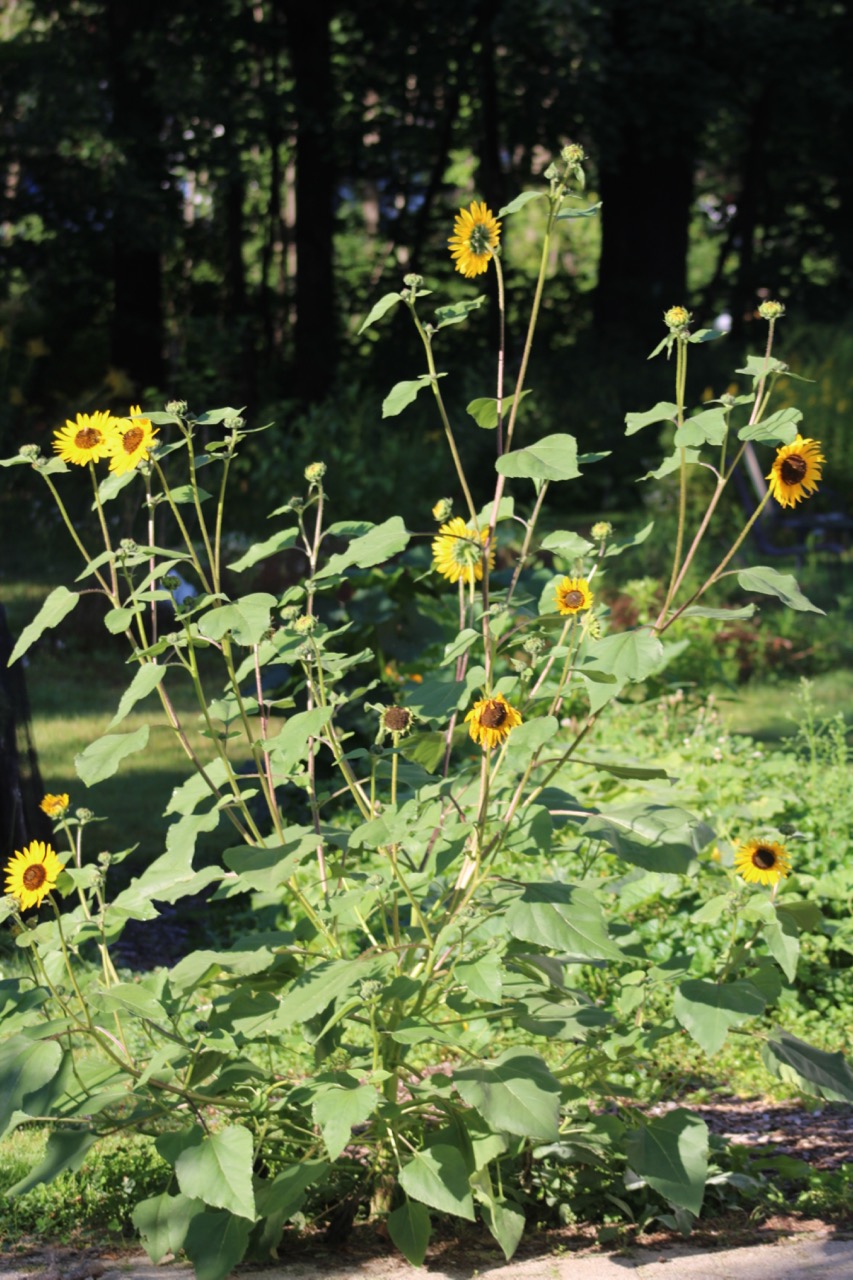
Multi-branched sunflower with many yellow flowers, tall with green leaves.
One sunflower plant has all these blooms!

This year one volunteer sunflower plant came up next to the patio, starting small. Now it has expanded into this multi-branched extravagantly flowering giant! Doing a little research, it seems to be a native wild sunflower, because of its branching habit and the size of its flowers, and its continuing blooms. It is still one plant though, a community of flowers that is connected at the root, and much loved by all sorts of bees, other insects, and birds. It is easy to see how they belong to this place and to each other.
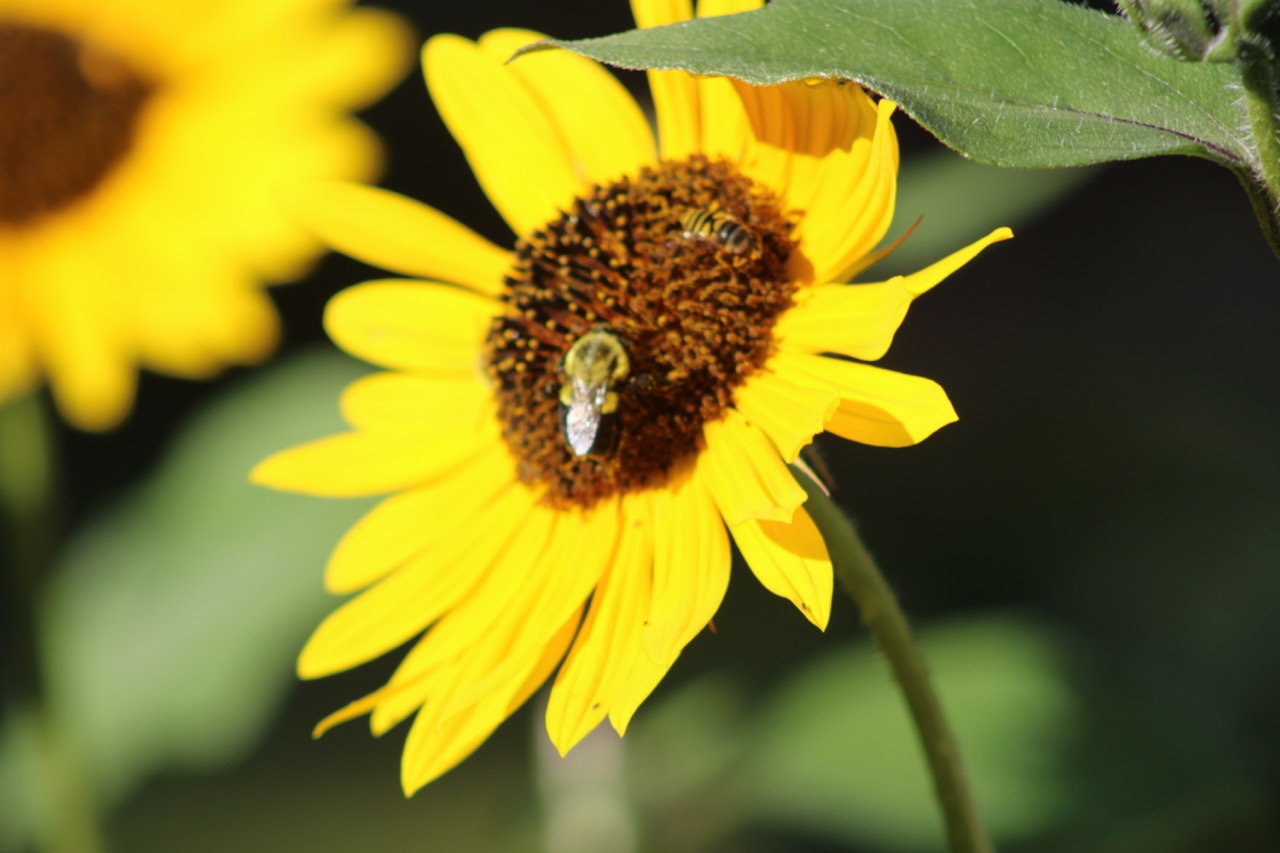
bumblebee and honey bee perched on center of yellow sunflower
Bumblebee and honey bee on center of the sunflower.

What does belonging mean? It is easy for me to get caught in a “not-belonging” wound, the scar of a childhood moving from place to place, always starting on the outside, trying to find my way in, feeling invisible and unconnected. It is not that I haven’t had some times of belonging–there was the group of friends at college, the group of activists at the Catholic Worker or the women’s peace camp, the lesbian community in Boston. Changing perspective sometimes took me away from earlier forms of belonging, sometimes into new communities–sometimes not. In some ways I belong to my family of origin, but my lesbian identity and feminist politics created a deep barrier.

On this personal journey, becoming a UU minister created an avenue for me to nurture community, to bring other people into a sense of belonging. And in that ministry, I had a form of belonging, too, right at the center of community, but also always a bit set apart in my role. And it also meant moving once again. Even though I have retired, I am still a bit set apart because of the role of a minister. Reflecting on it, I’ve also experienced a form of belonging in my connections with ministry colleagues. But the wound continues to shape the ways I navigate the current chapter of my life. I continue to wonder, “Where do I belong?”

As I explore various facets of belonging, the feeling remains elusive. Do I belong to this place like the sunflower and the bees? I am not indigenous to this land, it is Wabanaki land. When I reach back to my own ancestors, language is a barrier between us–I don’t speak the German of my father’s ancestors. I don’t speak French (even if I understand a little), the language of my Quebec ancestors, and even of my distant Innu relatives in these times. I don’t belong to Nitassinan (which would be my matrilineal homeland) or Quebec or Austria or Germany. I don’t belong to an ethnic community. What does belonging mean in white America, especially for those of us who reject the racism of its founding?

All these thoughts are coming round in a scattered fashion. When the feelings come up in me of “not-belonging,” it helps me to remember these childhood wounds, these societal wounds. I can acknowledge and honor those feelings but then make a choice to open my heart to new possibilities of interconnection. I am becoming interconnected to this land, as I tend the trees, appreciate the wildflowers, make habitat for birds and frogs, eat the blueberries that grow. There is a reciprocity that is developing between us. I must choose to open my heart to new people as well–not dwelling in the old fear that there will be no room for me, but being curious about the ways that we might be interconnected already, or the ways that we might find to connect right now.

Today I see one more lesson about belonging in a tall pink cosmos flower that we didn’t choose or plant, but somehow it rooted itself next to the road we live on. It is now blooming on its own after the rest of the plants have faded. It is not in the “color scheme” of the roadside garden bed. I guess its motto is a variation of the old adage: “Bloom where you are planted.” Bloom wherever your seed happens to land.
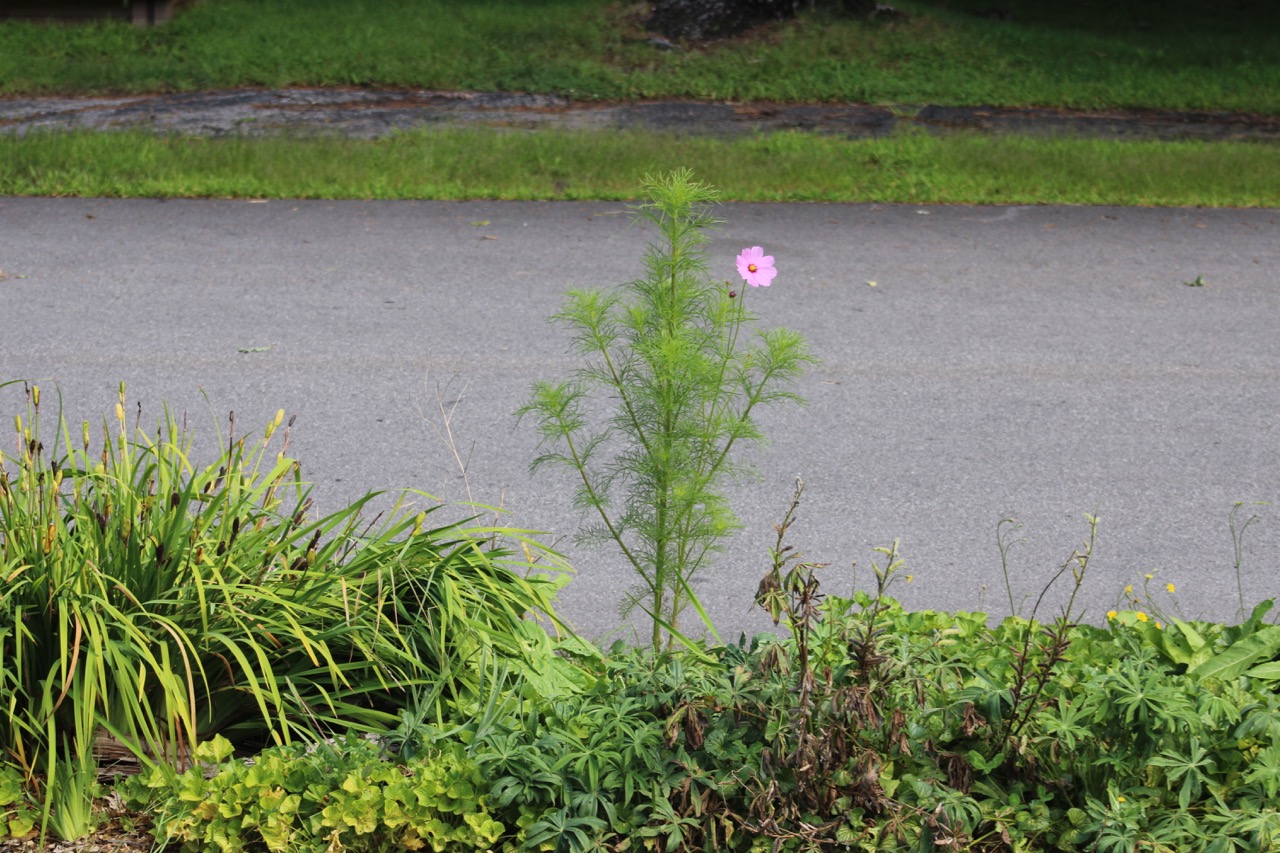
One pink cosmos flower on tall stem with feathery leaves, next to road, near greenery.

Native wild flowers

glowing yellow goldenrod flowers on tall stalks, with dark green background
Goldenrod flowers are in bloom.

We have now lived in our home in Portland for 7 years, and are gradually getting to know the plants around us. We have our share of invasive plants, but today I want to highlight a few of the beautiful native wildflowers that are blooming right now in our yard. They come up on their own, and Margy has encouraged them by pulling invasive species, and leaving certain areas alone as she mows paths around the back yard.

I believe our goldenrod might possibly be the solidago sempervirens, or seaside goldenrod, native to eastern North America. This identification fits with our sandy pine forest soil, and photos online look similar. But it is very difficult to distinguish between species of solidago. Solidago is considered a keystone species, and has been called the single most important plant for North American pollinator biodiversity. They are very loved by many bee and butterfly and moth species. We love them too.

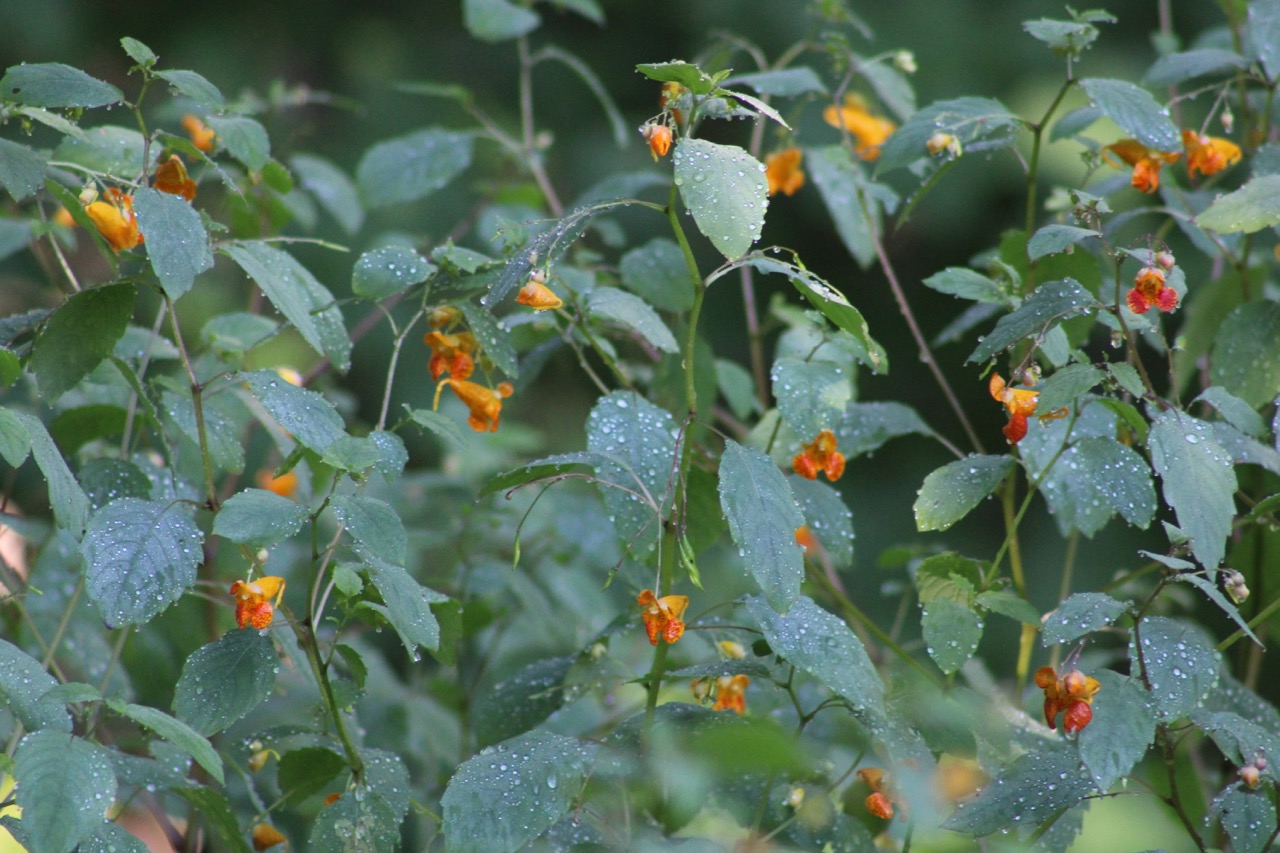
Tiny orange flowers on thin stems with oval serated leaves, droplets of water on the leaves.
Jewelweed after a rain.

Jewelweed grows profusely at the back and sides of our yard. Impatiens capensis is also called touch-me-not, because of the way the ripe seeds pop open when touched. It often grows near poison ivy (which we don’t have) and has traditionally been used as a remedy to prevent the rash caused by exposure to poison ivy. This year it has gone a little crazy all around our old white pine, and in Margy’s mound bed nearby. Hummingbirds and bumble bees are their major pollinators.

tall stems with small yellow flowers at the tips, many plants in 1/2 wine cask planter, on patio near deck railing.
Evening primrose in an old half wine cask container.

I got to know evening primrose last year, when it was the favorite plant for goldfinches after it had gone to seed. This year, it has self-propagated into two containers, as well as all around the patio and orchard. Oenothera biennis is a biennial plant, forming a small rosette the first year, and then in the second year shooting up to great height before blooming. It is native to eastern and central North America. Evening primrose oil is considered medicinal for a variety of conditions, though we haven’t tried harvesting it for such.

evening primrose closer
Evening primrose, closer look at the blooms.

What I love about these three species is that they grew on their own. We didn’t plant them, we just began to notice them and appreciate their presence. True gifts from the earth. There are many others we have begun to notice as well. It takes a while to learn about them and to identify them. It feels like such an important part of finding our way into earth community.

To Be of Use

Chipmunk drinking at the pond

Yesterday morning, I was sitting next to the pond, writing in my journal. After I’d been there, and quiet for a long time, this chipmunk approached the other side of the pond, climbed down the rocks and took long drinks of water. After a couple minutes, it quickly climbed back up the rocks and ran back into the field behind.

If you’ve been following my posts recently, you know that I’ve been dealing with chronic illness causing me to have much less energy this summer. So my relationship with the garden has changed. It has been less purposeful and project oriented, and more, “Let’s see what the yard wants to do this season.” To listen more, to do less, to observe more, to try less–and I’ve learned so much, actually.

It’s true that we had already done a lot to shape the yard–we planted many fruit trees and bushes, let wildflowers grow, planted perennials, pulled invasives, and created the pond last year. Some of the plants that were in the pond didn’t survive the winter, and I did add a few more this spring. But it wasn’t enough to prevent algae from flourishing. So periodically, I get inspired to pull out as much as I can. But I’ve also noticed that bees love to perch on the algae, to get a drink of water presumably. (There is always enough algae left for them.) It gives me gratitude to know that this pond, imperfect though it is, has been of use to these creatures in a drought-burdened summer.

Bees on green algae

Lately, my old nemesis the squirrel has come back to start eating peaches. But since I was doing so much less to nurture the peach tree–less holistic sprays, less thinning of peaches, and so on–and since I had somewhat resigned myself to having no peaches after last year, I haven’t been stressed out about that. And the squirrel or squirrels seem more mellow as well. The peaches are actually very crowded together, and every couple days, I twist off a few tightly squeezed ones, even though they are not ripe yet, to make room for the others to grow bigger. I’ve put a few on window sills in the house to see if they will ripen. I tell myself the squirrel is also thinning the peaches. We are collaborators, rather than enemies. Who knows, maybe there will be enough for all of us?

Squirrel sitting on a branch in the peach tree nibbling on a green peach.

In a world with so many horrors that I can do nothing to stop, or even to protest, I am grateful to be of use to these small companions who share our back yard with us.

[And thanks to Marge Piercy‘s poem, To Be of Use, for its evocative and helpful title.]

Prayer for Pollinators

Peach and two cherry trees

If you’ve been following my work on digging the pond, I will mention that I took a little break, first to find out what to do about the water that has seeped into the bottom, and then because I twisted my ankle on Friday while I was digging. So annoying! My ankle is not so bad–after a couple days of rest, I can hobble around now, and I will be digging again soon.

In the meantime I wanted to share this photo of the flowering peach and cherry trees in our food forest. They flowered a bit earlier this year than last. In the photo, the peach blossoms are pink, and it is hard to see the white cherry blossoms amid their green leaves in the photo. But they are so beautiful! There are more cherry blossoms this year than last, when we got just a few.

However, I’ve been concerned about pollination. Our neighbor keeps honey bee hives, and usually we have lots of her bees visiting over here, drinking nectar and drinking water from our bird baths. But this year, it has been very sparse for bees. I found out that our neighbor’s hives died in a cold snap earlier in the spring and she hasn’t replenished them yet with new bees.

One day, I did see bees of all sizes in the Lapins cherry tree (on the right in the photo), but I didn’t see them in the peach tree. (Not that I sit and stare all day.) But I’ve been doing so much TLC with the trees this year, with Kaolin clay, and holistic foliar sprays. It would be a shame if we didn’t get fruit because of pollination problems. It is too late now to try to hand-pollinate. The other potential glitch is that while the Lapins cherry is self-fertile, the Black Tartarian cherry needs the Lapins to cross-pollinate. They are both sort of blooming now, but the Lapins had peak blooms earlier, and the Black Tartarian has new blooms that just came out yesterday. So we wait and see.

It reminds me of the sad danger to pollinators everywhere because of climate change, environmental pollutants, pesticides, and development. All of our human food is dependent on these little creatures who pollinate the plants. If the bees die, so do the humans.

Today I pray for the pollinators, with gratitude and humility. Part of this prayer is offering to the bees so many other plants in our food forest: daffodils, dandelions, and violets are blooming now; soon we will also have chives, oregano, clover, thyme, and many more. All of us can do more to provide food for bees and other pollinators throughout the season. Only then can they also provide food for us. May this circle of life be blessed.