What Is Hidden

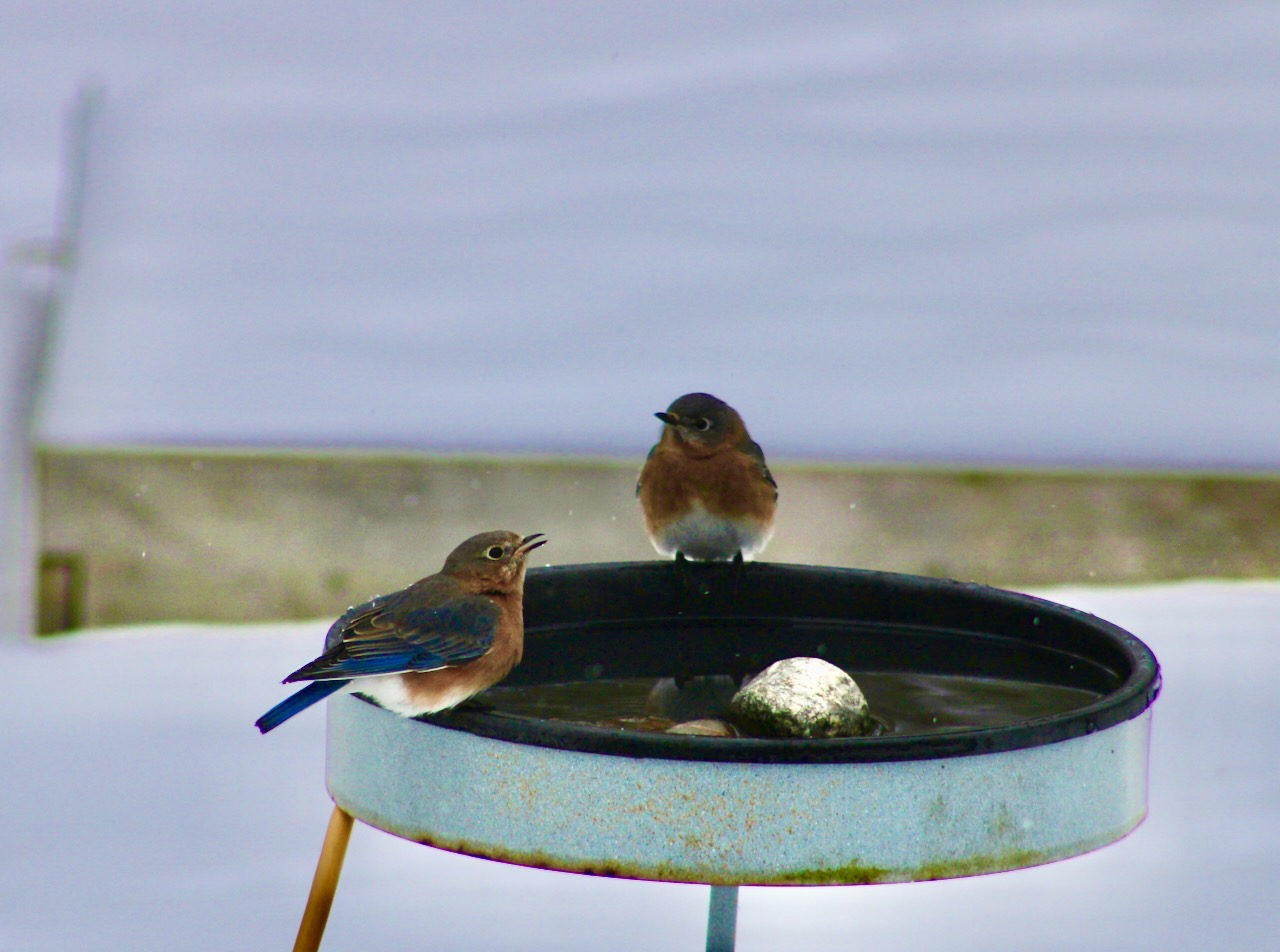
gray day photo, snow covered ground, dark green bird feeder on pole, bush branches nearby, faintly visible tracks in the snow

At 4 a.m. this morning, I woke in the dark of the night to pee. On the way back to bed, I saw a shadow outside the window. It was a bright night, with white snow on the ground, and a clouded sky backlit by a full moon. I opened the curtain and saw that the shadow was a small deer by the bird feeder. It was investigating the seeds on the ground below, and perhaps the water in the heated bird bath. Then it walked toward me and made its way through the orchard, passing over to the side of the house and then toward the road.

So beautiful. Things that are hidden, and then revealed. I had seen deer tracks since the snow fell a few days ago, but we rarely see the creatures themselves as they pass through our yard. What a thing to be awake at 4, and gazing toward the windows. As I lay back down in bed, I wanted to remember the blessing of the moment, not lose it to sleep. So I fed phrases to my mind, like “that which is hidden” and made associations, like, “I should pull up the small green fence around the licorice patch, so the deer won’t get caught in it if the snow covers it.” I took this photo this morning. Of course, the deer is gone, hidden again. But some tracks remain, reminding me of all that I cannot see.

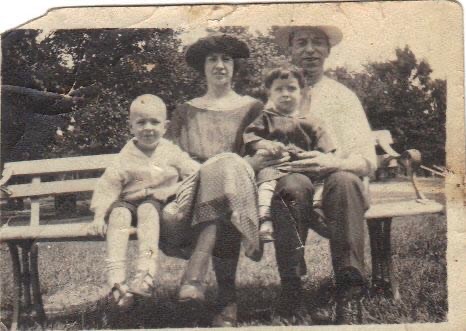
All of this also made me think of a photo I recently discovered, that I had never seen before. One of my relatives had posted it. It is a picture of my grandmother Yvonne (née Tremblay), with grandfather John Hochreiter and their two oldest children, about 1921. I had seen a photo of Yvonne when she married, in 1916, and a photo when she was holding me as a baby, sometime before she died in June of 1954. But this one brought to life a young woman in her early twenties, surrounding by her family. So much of her life was hidden from me, not by any conscious decision by anyone. My mother was the youngest of eight children, so perhaps this time before her birth was hidden from her as well. What a gift to get a small glimpse into their lives, over one hundred years ago now.

sepia toned photo of young woman and man seated on a park bench, holding two boys, one next to woman on the bench, and one on man's lap.

Last night before I fell asleep I prayed to the Spirits I have known. The moon, the cardinals, the frogs, mother Earth. Is seeing the deer a sign of connection? That my prayers are heard? Spirits, thank you for the gift of seeing that which is usually hidden. May we always remember that so much is hidden.

Feeding Each Other

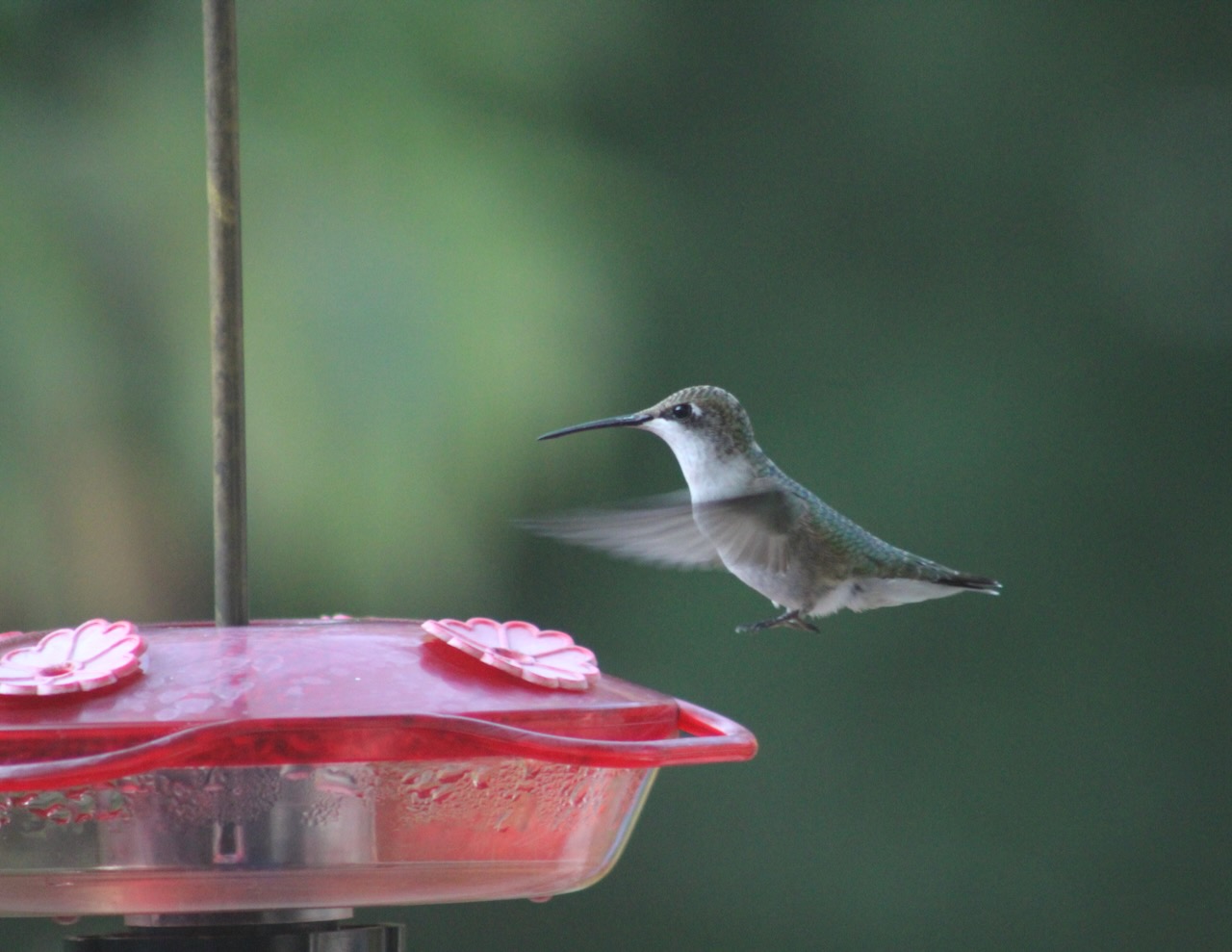
female hummingbird flying near red feeder

This summer, we’ve been blessed to feed hummingbirds in our yard, both through flowers like bee balm, and also through our little red hummingbird feeder that we fill with a sugar solution. Earth creatures feed each other. Everyone needs to eat. This happens through the incredible natural chain of life, some animals eating plants, other animals eating animals. But the deepest natural order is that all animals must eat. The interconnected circle of life. We participate in this circle, by what we eat, and by how we feed others.

Perhaps this is why forced starvation is such a horrific crime. To cut off a people from food is a crime against humanity, and also a crime against the natural order of life. I have been daily bearing witness to the forced starvation of people in Gaza by the Israeli government. There is food aid literally waiting at the border being denied entry. My heart is breaking every day. As the starvation goes on, it becomes impossible for people to heal from the damage it does to their bodies, even if they survive. Every day more people are dying and more people are reaching a point of no return. One action that is being organized is to pressure mainstream media to cover the fact that Israel is starving Gazans, which should be headline news everywhere in the world. You can find a template to flood media inboxes at https://writersagainstthewarongaza.com/action.

I also want to bear witness to the starvation happening in Sudan. I am not seeing so much about it in the news. When the current regime in Washington closed the doors on USAID, the situation there became dire. According to an article today in Closer to the Edge:

“The U.S. was once Sudan’s largest humanitarian donor. USAID funded almost half the international aid reaching the country. Then, with the flick of a legislative pen and the grinning cruelty of budget hawks who will never see a famine up close, that support was ripped away. Community kitchens—lifelines for displaced families—shut down. Nutrition programs vanished… The numbers are so obscene they should scream off the page: 25 million people acutely food insecure, over 770,000 children under five on track to suffer severe acute malnutrition this year, and nearly 100,000 cholera cases since last summer. ” 

We are all connected. I am remembering that the very first moral imperative according to the parables of Jesus, was simply this: “I was hungry and you fed me. I was thirsty and you gave me drink.”

Fighting with Squirrels (and Chipmunks)

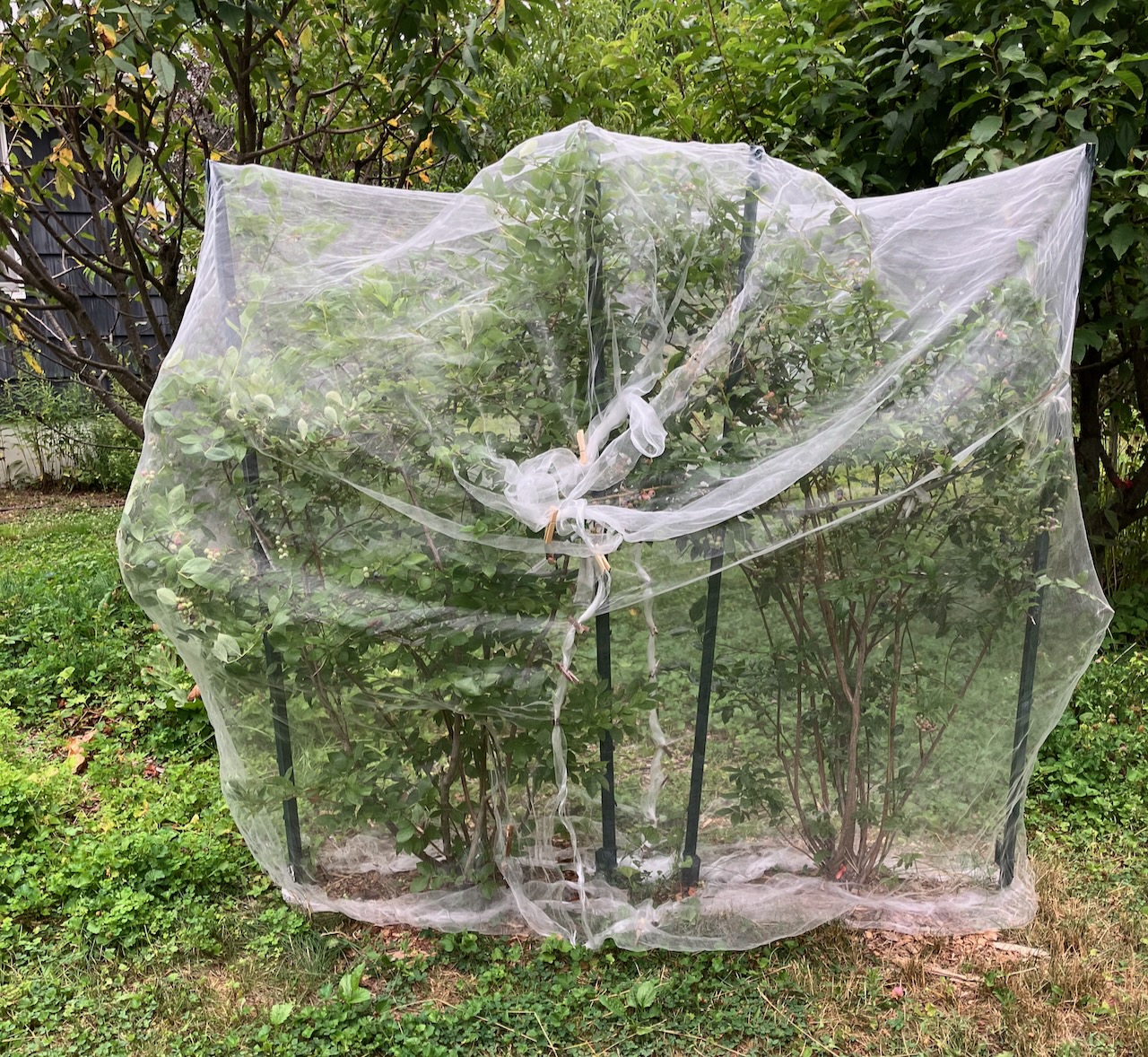
White netting draped over two blueberry bushes, using fence stakes

The intent of our permaculture gardening is to create a mutually beneficial relationship with the earth and all her creatures. But lately, it feels like a little backyard battle. The squirrels have literally eaten all of the green peaches off our peach tree. (Last year there seemed to be enough for all of us.) They have been also eating raspberries, hazelnuts (still green) and mulberries, but I sort of gave up on all of those. I have tried to protect these two blueberry bushes by covering them with netting, garden-stapled down, and using clothes pins to close the side opening. I have actually harvested some blueberries. But the last couple days, they’ve pushed their way through holes they make in the netting. When I see them, I run out yelling and clapping, and they dart around the edges to find their way out and run away.

To be fair, there is another variable this summer. I stopped filling the bird feeder some weeks back because the chipmunks would immediately climb up, fill their cheeks, climb down, and transport the seed to their underground lairs; and then repeat until all the seed was gone. The squirrels also took a fair amount. I wonder if the sunflower seeds were the tribute I had been paying to our little neighbors that ensured that they’d save us a few peaches? But yesterday, perhaps I upped the ante, because I installed a baffle on the feeder, and coated the pole with coconut oil. I really do want to feed the birds, not all the greedy chipmunks and squirrels. So here is the new set-up, (the bush is at least five feet away–I pruned it to make sure):

Green metal bird feeder with clear plastic baffle a few inches down, in front of a green bush background.

Margy and I have a little side bet going as to when they might be able to breach these new security measures. It has been up for twenty-four hours so far. No squirrels, chipmunks so far. But the birds haven’t come back yet either. The next few days will tell. And in case it isn’t easy to see, the original bird-feeder is also “squirrel-proof,” with a weight dependent bar that drops down to close the seed opening. But they figured that out long ago. They are so smart, and acrobatic. In many ways I love them. But I don’t love that they take all the fruit in our garden.

Anyway, I just needed to write about this other side of gardening. I am so impressed by the work farmers do! If we relied only on our own gardening skills, we would go hungry. But perhaps this is one of the lessons I am learning about how to be in a mutually beneficial relationship with the earth, and during climate warming too. We are all under a lot of stress, trying to survive. We don’t have complete systems in place, we don’t have our own ancestral knowledge, we are trying to recover from great imbalance. So we keep showing up, keep going outside, keep being grateful for the gifts of the earth.

And these days, I can’t write about anything food-related without also expressing rage at the intentional starvation of the Palestinians in Gaza by the state of Israel. They destroyed their farms and gardens, and destroyed access to water, and access to help from outside. How many more people will die before the world powers stop this genocide?

Hibernators Awake!

The chipmunks woke up from their hibernation earlier this week. Peeking out from their warrens beneath the garage. It’s a good thing we don’t have bears. My friend who lives in the woods had a bear arrive in the night to break apart their bird feeders this past week. Our chipmunks merely climb the pole and share in the bounty. The wake-up seems early this year, and probably is. The winter was too warm and too short. But here we are, in a climate changed world, loving the earth as well as we can.

Today is the Spring Equinox! Equal parts night and day. I want to take a moment, in the midst of the vast troubles of the world, to express delight at the turning of the seasons. Small bits of green emerging from the perennial plants. And I am grateful that after five sessions of physical therapy I am beginning to get some relief from my hip pain. My PT person uses Integrative Manual Therapy, and it is a miracle worker. There are still many sessions to go, and I am hopeful that healing will happen. I took a very short walk each of the last three days–my five minute walk to the end of the block–which actually takes ten minutes with my current walking status. It feels good to be outside.

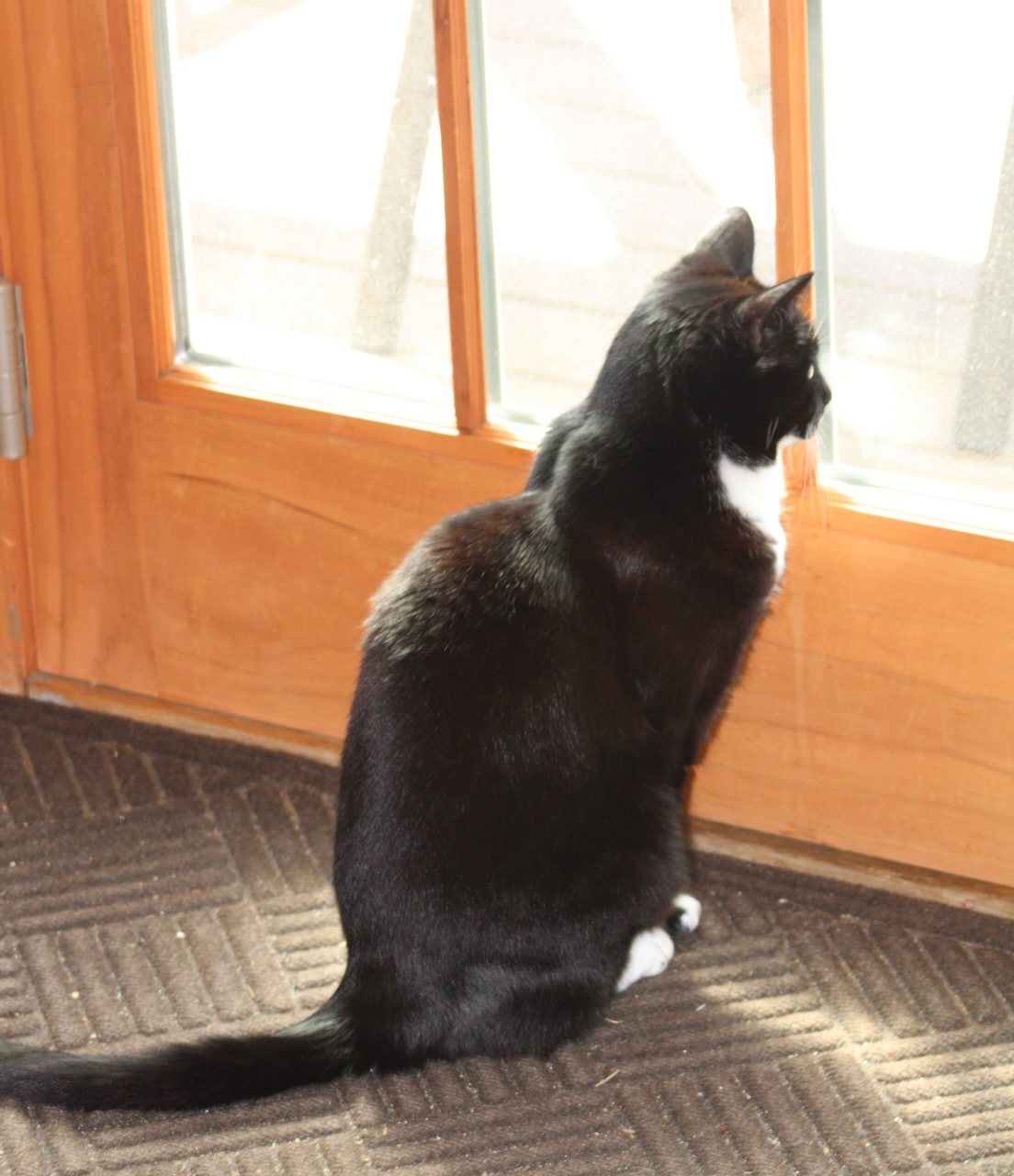
Meanwhile, the cats have new critters to watch through the windows. (They are indoor cats only.) Here is Billie looking out the back door.

I think about vulnerability. What it means for me to be 70 years old. I didn’t hurt my hip by falling or anything like that. I woke up one morning and there it was. It is a reminder to me to cherish the joys of each day. Who knows what tomorrow will bring? I can be prone to anxiety, and feel deeply the troubles of the world. I will keep bearing witness. But I will also find joy in these simple moments, these earth awakenings.

First Snow, Gaza, Small Birds

Green bird feeder in front of snow covered branches of hazelnut hedge.
Bird feeder near hazelnut hedge.

We have our first snow-covered morning here in our yard in Portland Maine. In places further from the shore they got several inches, but we had mostly rain until early morning. Now it feels like winter is really here. My internal clock has felt the shift, as the days grow shorter and darker. A few days ago, I started working again on sorting through my old documents–my winter project of the last few winters. This year, most of the documents are digital, though there is at least one box of paper files to go through in the basement. In prior winters, I looked back on all the years before we moved to Maine in 2005. This winter, I am looking through my time as minister of Allen Avenue Unitarian Universalist Church here in Portland, before I retired in 2018.

I started by reading all of the “annual reports” I wrote for the church to summarize the work of that year. It was a simple way to quickly turn the pages of thirteen years of ministry. I was astounded at the sheer number of times I marched in protests, or spoke at vigils in solidarity with issues of justice or worked on legislative change in support of human rights, usually along with other members of my congregation or other ministry colleagues. My life now is so much quieter and less intense, but also less connected. It was good to have that public voice, and to use my voice in service to all that I believe. I feel so far removed from that life and that work.

I suppose in some ways a blog is a kind of public voice, but much quieter and less visible. My life these days is much quieter and less visible. That is chronic illness, compounded by our continued COVID precautions in our household. I can’t put my body out on the line for love and justice. It takes most of my body’s energy just to manage our household tasks. It is like I am looking out a window at all that is happening in our world.

I was surprised to notice that I hadn’t blogged for a few weeks. Lately, all I can think about is Gaza and the way the people there are suffering and dying. In my files I found a sermon I preached in 2014 about Palestine and Israel. In many ways, the issues are all the same. In other ways, everything has gotten worse, much worse. So many deaths, so much destruction. I can’t even imagine the words I could say about it, and then I don’t have words for anything else. My heart is on the ground. My heart is on the ground.

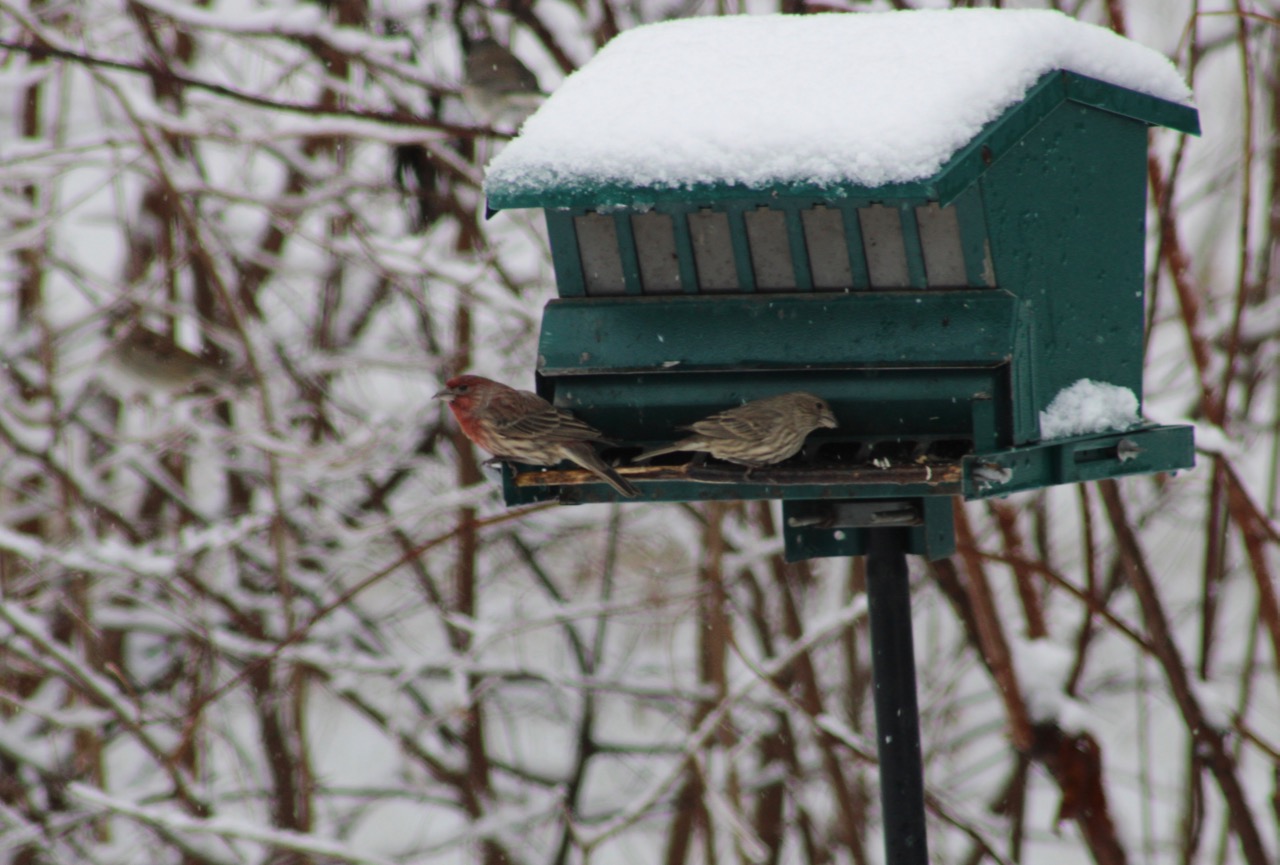
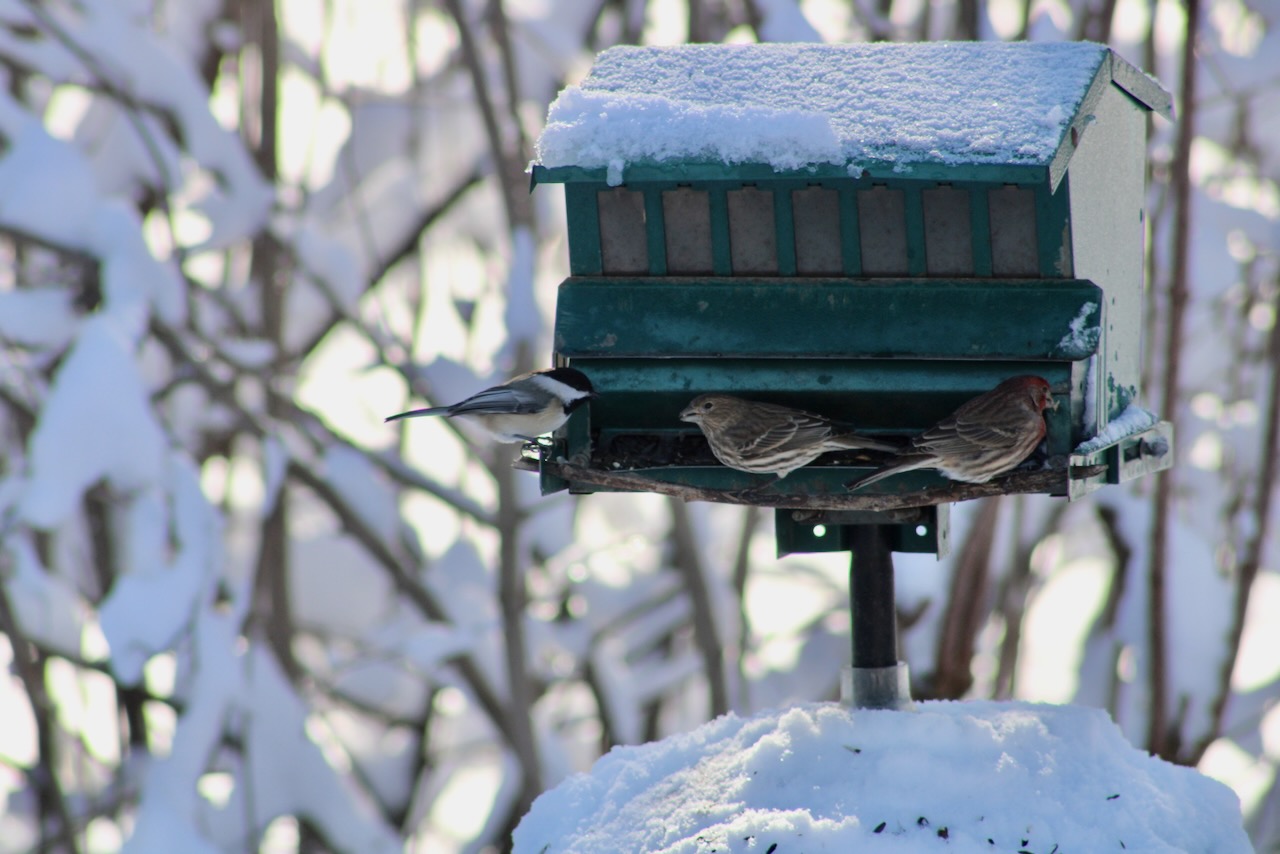
And then, out the window I see a large flock of small birds visiting the hazelnut hedge and the bird feeder. They find their way to our yard each day, traveling together as a group. They usually arrive mid-day, but today they are early. Tufted titmice, chickadees, goldfinches in their winter garb, sparrows, juncos, finches, even a bluebird. (Maybe they come more than once a day, but you have to be looking out a window to see them so I am not sure.) Often a few chickadees even stop at our back porch pecking for stray seeds. It is not so easy to take a photo of a flock of small birds. They scatter themselves across the orchard. They come through and then they are gone again. Traveling all together on their mysterious rounds.

And my heart is lifted just a little, with their flight and their community.

Finches at feeder.
Junco on a branch.

Where are the birds?

Bird Feeder no birds

We have always had birds in our back yard in the winter, coming to our feeder, or rooting around on the ground. But this year, we’ve seen almost none at all. We didn’t fill the feeder over the summer–but many birds visited during that time, in the orchard and in the nearby trees and all over the place. So we expected that filling it up again would bring the usual winter birds. But I can count on one hand the birds I’ve seen. And no cardinals.

In trying to comprehend this, I noticed that only one other thing has changed. The lot behind our neighbor’s house–not visible in this photo–had been overgrown with bittersweet, and then the vines took down part of a big maple tree. Plus Margy had been cutting a lot of the invasive bittersweet.  So that field has less tree and vine cover, which some birds may have preferred.  More ominously, I’ve read that in North America the total number of birds has declined by 25% in the last fifty years.  Is it finally affecting our own yard?

I have seen a few birds here and there on my walk in the neighborhood, and there have been a few in the crabapples in the front yard. But despite our full feeder, plus a thistle feeder, and even a suet cake, no one is around.  It seems so strange and empty.  Have you noticed fewer birds where you live?

All of this got me thinking sadly about extinction, and I happened to see a documentary about the early Neanderthal humans, who lived in Europe and Asia for several hundred thousand years, before becoming extinct about 40,000 years ago. According to the DNA testing company “23 and Me”, all modern humans, except for those from sub-Saharan Africa, have between 1 and 4 % Neanderthal DNA, from interbreeding of the two related species. So the Neanderthals can be counted among my ancestors too. By the way, they were much smarter and more cultured than the myths that were taught about them early on.

There are a lot of theories about why they went extinct. But this particular documentary, Neanderthal Apocalypse, made the hypothesis that one factor was the eruption of a super-volcano near present day Naples 39,000 years ago. However that might have effected the Neanderthals, I found myself more focused on what it might do to us today. If a super-volcano were to erupt in our time, ash and debris would cover miles and miles of land, and kill all vegetation, crops, and the animals who rely on them (including us.)  Ashes and toxic gases would rise up into the upper atmosphere and block out sunlight, plunging a large portion of the earth into a volcanic winter. Civilization over.

Now this might be a depressing thing to think about, but for some reason, I didn’t feel depressed. Instead, I was reminded of how very powerful the Earth really is.  We are so small, and so reliant on all of the Earth’s interwoven life.  So, in a funny way, I felt less afraid. We humans know some things, and the activity of our species is causing damage to the climate, and wreaking havoc everywhere. But so much is beyond our control and even our understanding. It is profoundly humbling and reminds me to be grateful for how the earth provides everything we need.

So I come round to this Winter Solstice holiday, today, and say thanks to the Earth for birthing us, for feeding us, for fire that warms us in winter, for so much beauty that inspires our lives.  And I say a prayer for the birds: please come back to once again feast with us in this little patch of land we call home.


Feeding the Birds

Female Cardinal

Photo by Margy Dowzer

It is also possible to make a relationship to animals by feeding them. At our house, we offer sunflower seeds that are loved by cardinals, chickadees, and tufted titmice; suet for the woodpeckers, and thistle for the gold finches. Some of the birds are around all year long, but in late spring it is a delight to see the travelers again. We put out a hummingbird feeder at the beginning of May, and we put out orange slices and wait for the orioles to show up. They bring so much beauty to our ears and eyes.

 Thich Naht Hanh says,

When we recognise the virtues, the talent, the beauty of Mother Earth, something is born in us, some kind of connection, love is born… We want to be connected. That is the meaning of love, to be at one. When you love someone you want to say I need you, I take refuge in you. You do anything for the benefit of the Earth and the Earth will do anything for your wellbeing.

When we make a deep connection with one small part of Mother Earth, we are helped to make a connection to the whole of our mother. We are helped to see that we too are a part of the Mother Earth, that we belong here. And then we can honor the whole harmony of connections that make up life. May we find a way to experience the joy that comes with knowing this deep harmony.

Thich Naht Hanh quote from an article by Jo Confino, “Beyond environment: falling back in love with Mother Earth,” Feb 20 2012, The Guardian