Broken Histories

Mab Segrest, in her book, Born to Belonging, examined the effect that the institution of slavery has had on the self-understanding of people in America, particularly the white people of her own family. She believes that a kind of spiritual anesthesia developed—a cutting off of compassion and connection—in order for a person to own slaves.

She ponders what it did to a man’s soul to sell his own children. Though it was not openly discussed, it was true that many of the children born into slavery had been fathered by the owner of the plantation. White people had to cut off their emotions, deny their relationships, and numb their spirits, to maintain this horrible institution for four centuries.

Segrest believes that the emphasis on individualism in America is an expression of our spiritual distress. We are all born into families, each with their own histories of disconnection or oppression that can cause a numbing of the soul. It feels less painful to imagine ourselves as separate, than to acknowledge the abusive and traumatic relationships that have closed our hearts. But when we close our hearts, we also lose our capacity for deep joy. We are not fully alive without each other.

Shortly after I first came to Maine, I visited Indian Island, home of the Penobscot Nation, in a trip sponsored by the Four Directions Development Corporation. During a beautiful traditional lunch that was prepared for us, we heard about some of the long history of brokenness between white people and indigenous people in Maine, as researched by Donna Loring, who at that time was the Penobscot representative in our State House of Representatives. Near the end she spoke of her belief that America needs to remember its roots. She wasn’t speaking of its ideals of freedom and democracy. Rather she meant that we cannot find the way to peace until we revisit our brokenness.

It is uncomfortable and painful to embrace our brokenness. But if we hope to find wholeness, we must be willing to hear the stories that we tried to forget. To return to wholeness is not to paint over the past with easy brush strokes, but to make awkward and painful attempts to cross over into the experience of the other. It takes a long time, and a lot of courage. In my experience, it is often easier to feel at one with nature than to feel at one with our fellow human beings. But I have also experienced, after the awkwardness, moments of grace and connection. Moments when we talk and share from our hearts, and feel a sense of wholeness restored.
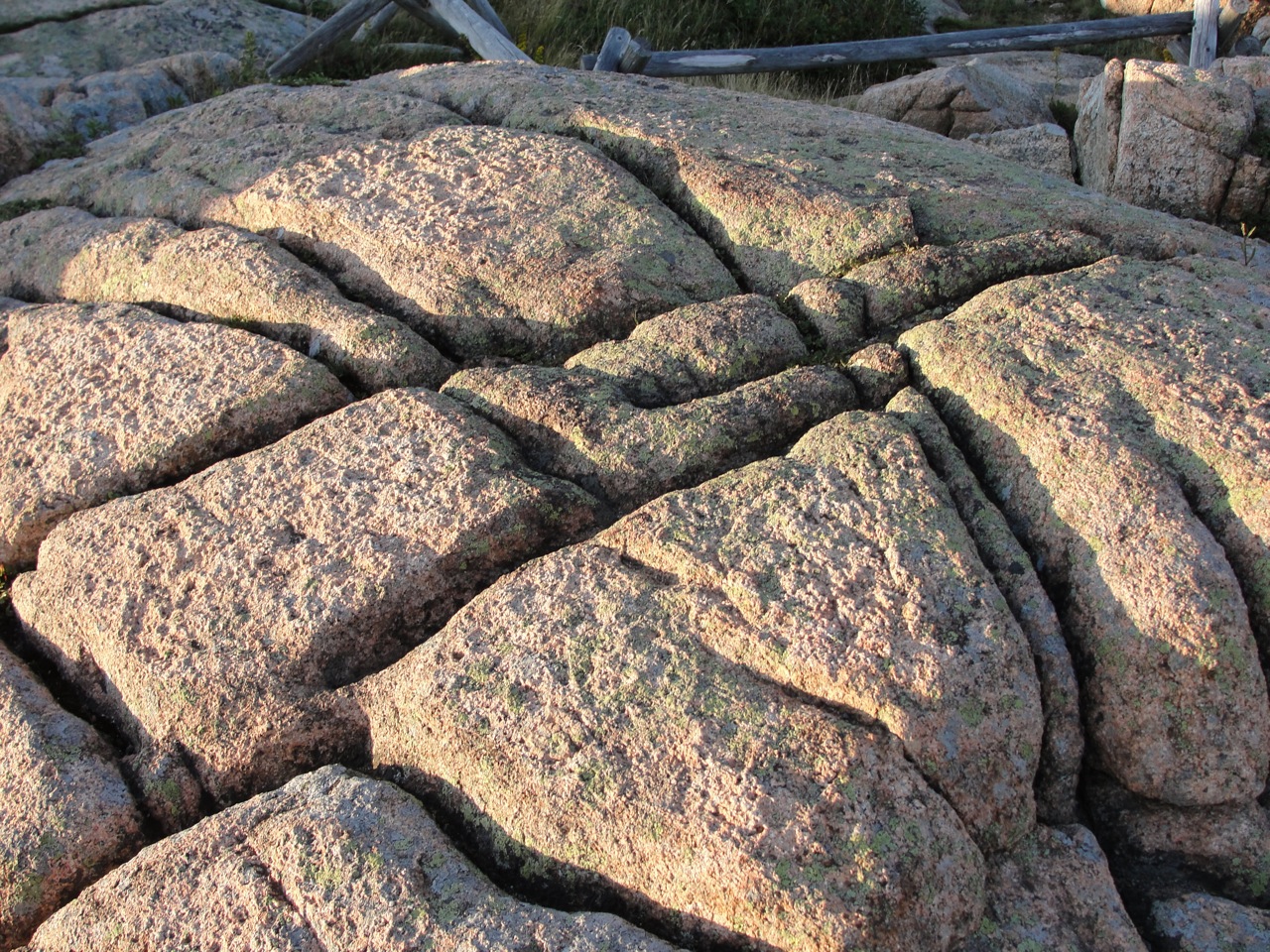
Broken Rock DSC00135

Photo by Margy Dowzer

Broken Shards of Light

The Jewish practice called Tikkun Olam has been translated as the mending of the world. This practice draws from the Kabbalistic ideas of Isaac Luria, a sixteenth century Jewish mystic.

He believed that when God created the world, God formed vessels to hold the Divine Light. As the light began to fill the vessels, they were unable to contain divinity and shattered. Sparks of Divine light were trapped in the shards of these vessels; they scattered throughout the cosmos and formed our world. The task of humanity is to reunite the scattered sparks of Light, to repair the broken world, and thus participate in finishing God’s work.

Light in HemlockBy acknowledging our brokenness we take the first step toward returning to wholeness. I observed this so often during my practice as a psychotherapist. As painful things happen in our lives, we learn to block off the memories and feelings that cause our pain. We become divided from ourselves, and divided from others. Perhaps we may shut down the angry feelings we feel, or despise the needy child that is deep within us. The first step in healing is to acknowledge those parts of ourselves that we have broken off.

According to the healing process of psychodrama, one might begin by imagining the broken off parts of the self as separate entities. A woman came in for therapy, anxious and lonely, and we chose an empty chair to represent her loneliness. I invited her to talk to the loneliness. At first she is dismissive. “I don’t need anything from you,” she says to the empty chair. “Just stop bothering me.” But then I asked her to move over and sit in the chair of the loneliness, to imagine herself as the loneliness talking back to her. In that other chair, tears start to fall, and something like a light dawns in her eyes. She has brought the loneliness back together with her own center.

People often come to therapy thinking they are going to get rid of the pain inside themselves. But they find healing only when they have learned to embrace the brokenness with love. It is that embracing of the pain which finally eases their pain, the return to wholeness.

Webs of Connection

Think about language. Humanity is a social species. Not only our bodies, but our minds are interwoven. Human beings speak to each other. I am able to create sounds with my voice, and a certain meaning awakens in your mind. When I say the color blue, you can hear the word blue, and see it within your imagination. When I say the word love, you can call to mind a whole wealth of feelings and memories.

Web

Photo by Margy Dowzer

We belong to each other. We are part of a larger whole. And yet, we forget. Wars rage on in the Middle East, millions die from disease in Africa for which treatments are already known, poverty sits alongside wealth, industry pollutes the air and water. This is why we need to understand brokenness as well as wholeness. Chickasaw writer Linda Hogan tells a beautiful story of a broken clay woman. She writes:

I remember the first time I saw the clay woman …in a museum gift shop. …Her black hair flowed behind her, and on her clay feet were little black shoes… Her stomach attached to earth, just above North America. Her name was written on a tag, “The Bruja Who Watches Over the Earth.” Bruja is the Spanish word for a woman healer, soothsayer, or sometimes a witch.

I loved the flying soothsayer who protected the lands beneath her. She was connected to them by her very body, the very same clay. …I bought the clay woman and asked the clerk to mail her back to me, then I returned home, anticipating the day The Woman Who Watches Over the World would appear.

When she arrived, she wasn’t whole. Her legs were broken off, the gray interior clay exposed beneath the paint. I glued them back on. Then she began to fall apart in other ways. Her nose broke. Soon one of her hands fell off. The woman who watches over the world was broken. Despite my efforts she remained that way, fragmented and unhealed. At first I was disappointed, but then I thought, Yes, the woman who watches over us is as broken as the land, as hurt as the flesh people. She is a true representation of the world she flies above. Something between us and the world has broken. That is what the soothsayer says.

Linda Hogan’s bruja is an image of a creator who is connected to us in our actual reality, broken as we are broken, not merely a perfection to which we might strive. Broken Web DSC01269The brokenness is within us, the brokenness is between us, and also between people and the earth. But—this is important—we feel broken because we are meant to be connected.

Quote from Linda Hogan,The Woman Who Watches Over the World: A Native Memoir (New York: Norton, 2001) pp. 17-18.