Resilience Circles

There are many people who are already hard at work building connections based on partnership and sustainability. In the fall of 2010 I had the opportunity to participate in a facilitator training for “Resilience Circles.” Resilience Circles are groups of ten to twenty people who gather together in regular meetings to support each other through economic and ecological changes.
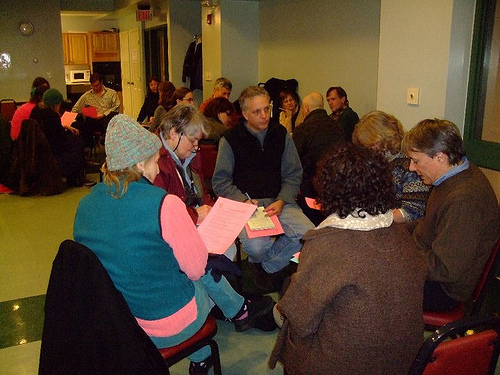
Resilience Circle Training/ Licensed by Creative Commons

Resilience Circle Training/ Licensed by Creative Commons

Our trainer Chuck Collins wrote:

The dominant messages in the U.S. economy are “you are on your own” and “some people are going to be left behind.” Countering this isn’t easy. For many, talking about their economic anxiety and asking for help is difficult and shaming. But to survive the coming period of uncertainty, we must regain use of our mutual-aid muscles, many of which have atrophied from lack of use.

The three main functions of Resilience Circles are to increase our understanding of the larger economic forces on our lives, to open up opportunities for mutual aid and support for local economic challenges, and finally, to engage in social action to create changes that can bring about a more secure and sustainable future.

We explored questions like: Why is the economy in distress? What is our vision for a healthy, sustainable economy? What are the sources of real security in our lives? What can we do together to increase our economic security at the local level? How can we help our neighbors facing foreclosure or economic insecurity? What public policies would make our communities more secure?

Social scientists say that the stronger our social networks, the more resilient we will be in a crisis. When I was working in direct support of homeless people, I noticed how often someone became homeless because of isolation—they did not have a strong social support system, and so a crisis became a catastrophe.

There are many ways that working together can enhance our economic well-being. The Resilience Circles begin with small mutual aid projects. For example, one idea was a weatherization round robin—a team of five people agree to help each other get ready for the winter. Each host buys materials such as caulk and plastic sheeting, and then the group spends a few weekends getting all their homes ready. Another idea was a babysitting coop, where parents take turns watching each other’s children, keeping track with tokens for hours of childcare. Tool sharing, job swapping, meal exchanges, bartering—the resources we have among us are many, and the options are only limited by our collective creativity.

The underlying principle of Resilience Circles is that our greatest source of security and wealth is in our connection to each other, and our shared stewardship of the earth.

Turning Toward Partnership

A revolution is underway because people are realizing that our needs can be met without destroying our world. … Future generations, if there is a livable world for them, will look back at the epochal transition we are making to a life-sustaining society. And they may well call this the time of the Great Turning.   Joanna Macy


Planting the Seeds

Photo by Margy Dowzer

Joanna Macy believes that the essential adventure of our time is the shift from our industrial growth society to a life-sustaining civilization. She calls it the Great Turning. She says that “the ecological and social crises we face are inflamed by an economic system dependent on accelerating growth,” on “how fast materials can be extracted from Earth and turned into consumer products, weapons, and waste.” Based on this analysis, the mainstream arguments about how to revive the economy and the financial markets miss the point. Rather, the trouble in the markets is linked to a deeper trouble—a whole economic system based ultimately on the destruction of our environment.

In 2006, David Korten published a book, called The Great Turning, to further reflect on this transition that Macy had articulated. He describes our work in this time as a shift from the ways of Empire to the ways of Earth Community. He warns that even if we fail to change our ways, the world will change. But it will be known as the Great Unraveling, because “profligate consumption [will lead] to an accelerating wave of collapsing environmental systems, violent competition for what remain[s] of the planet’s resources, a dramatic dieback of the human population, and a fragmentation of those who remain into warring fiefdoms ruled by ruthless local lords.”

The other possibility, the Great Turning, involves unlearning the practices of empire, of systems based on hierarchy, competition, and domination, and adopting systems that support Earth Community: “a life-centered, egalitarian, sustainable way of ordering human society based on democratic principles of partnership.” If we recognize that we are all connected to each other and to the earth, we must embrace this sustainable, partnership path.

Compete or Connect?

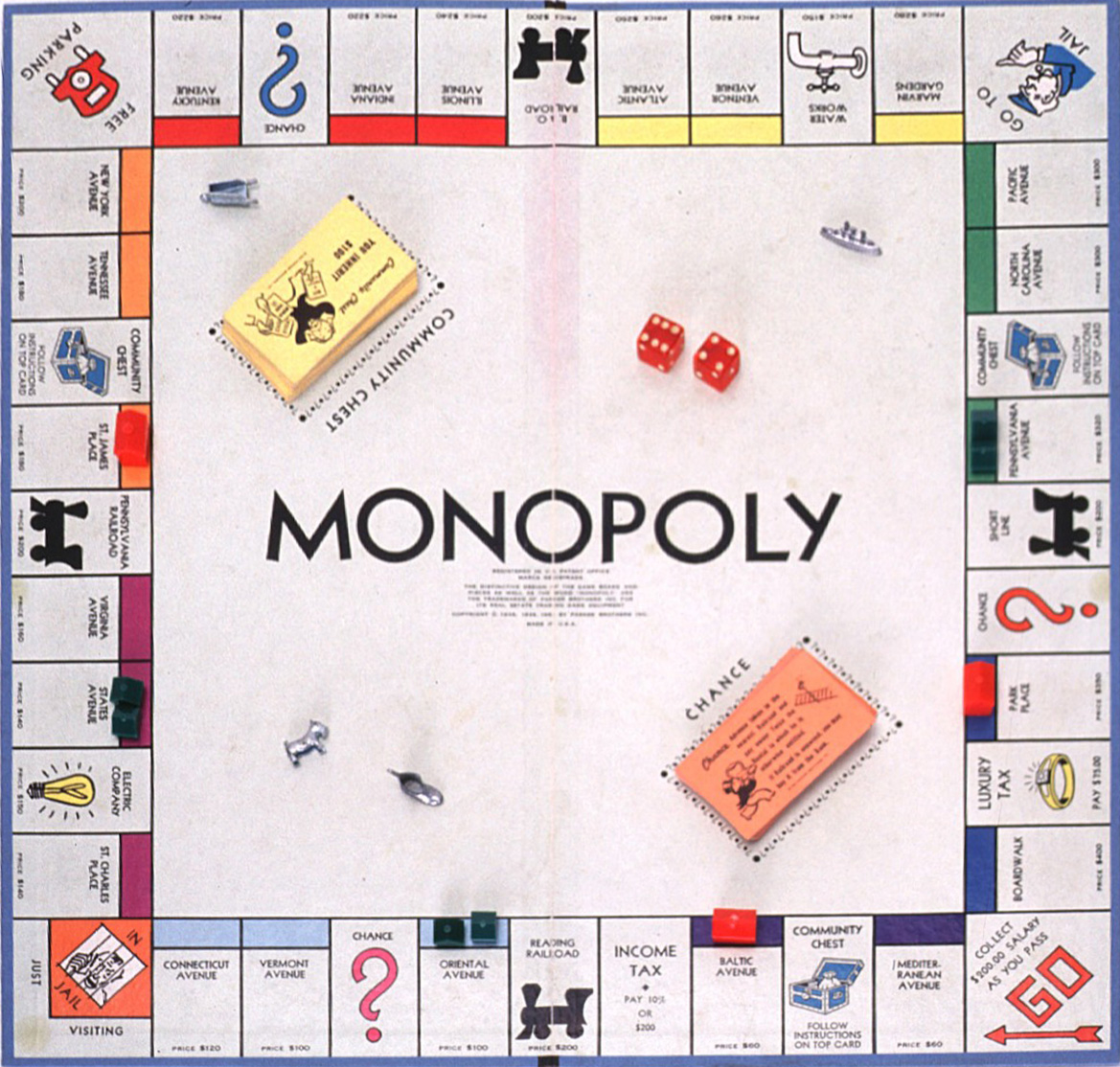
Monopoly BoardWhen I was ten, my younger sisters and I all got chicken-pox at the same time. My mom helped to keep us entertained at home by playing with us the board game Monopoly. My sister Nita and I were great little capitalists, and played the game to win. We would try to get as many properties and houses and hotels as we could, so we could charge huge rents when the other players landed on our spots. The goal was to bankrupt the other players until one of us was the last player in the game.

But my mom and my sister Vonnie had a totally different approach. They were tenderhearted, and didn’t want anyone to have to leave the game. So if someone was about to lose all their money, my mom and Vonnie would loan them some of their own Monopoly money to keep them in the game.

I remember this now and think—what a picture in miniature of the conflict of values in our larger society! One message we learn, even as children, is to try to get as much as we can, and try to win out over all the other people. Compete and consume. But my mother was bringing us another value, one that many parents want to teach their children, the value of connection and cooperation. She wanted to keep all of us at the table, so that everyone had a good time while we played our games.

What changes when we wake up to the reality that we are all connected to one another? 

Reality is a Dance

Kayaker Reality is a dance between making plans, and responding to small and large disruptions. So to embark on a spiritual journey is to grow our capacity to practice, to plan, to wait outside, and then to embrace all that reality offers.

A spiritual practice is meant to help us develop the skill of embracing what comes to us as an opportunity to wake up. A spiritual practice helps us to be fully present and to pay attention. If we have not been practicing, we can get thrown off by life’s disruptions, become grumpy and anxious, shut down or reactive. In fact, that can happen even when we have been practicing. Kayak Tipped OverBut I know from long experience that the more I practice this embrace of reality, the easier it becomes to shift from resistance to curiosity, from crankiness to compassion.

The spiritual journey is our search for an immediate, personal experience of the larger reality, our connection to the earth, to each other, and to the Mystery that connects and upholds life. Let us go back for a moment to an experiment.

Notice the energy in your heart right now.
If you wish, create an invitation in your heart, open your heart to experience the larger Mystery that connects and upholds all life.

As feelings come up, imagine your breath filling and embracing those feelings. Be present to what emerges in your heart. If you feel emptiness, breathe into the emptiness. If you feel joy, breathe into the joy. If you feel confused, breathe into the confusion.

The beginning and the ending of spiritual practice are in paying attention to the energy of the present moment.

After the wondrous, after the experience of Mystery, we must always come back to the everyday. In pagan rituals, they say we must “ground the energy.” We remember to eat food or have a drink of water. In Buddhism, there is a saying, “after the ecstasy, the laundry.” Sanity is being able to switch our consciousness from the mysterious to the ordinary. Life is not static, it keeps moving. We are not meant to remain in emptiness or in ecstatic feelings. We are meant to be fully involved in all that life is about. Says one Western lama, “What became clear is that spiritual practice is only what you’re doing now. Anything else is a fantasy.”

The most important grounding is how our spiritual experience affects the rest of our living. In the end, we may ask, What is spirituality for? I would answer that our experience of the Mystery that connects and upholds life is meant to bring greater power and resources into growing in community with all that lives. Authentic spiritual practice will energize us for greater kindness, compassion, peace, and humility. May it be so.

In the waterQuote from Jack Kornfield, After the Ecstasy the Laundry, (New York: Bantam, 2000). p. 126

Community as a Spiritual Practice

Here is how it works when we choose community. There will be people in any community who inspire us. And there will be people in any community who rub us the wrong way. Those irritating people are the ones who are the biggest blessings for us. There is a story about a rabbi who was the leader of a spiritual community. There was one member who always gave the rabbi a hard time. The other members of the community hated it.

After many years, this person died. And many people were secretly relieved that they wouldn’t have to put up with him any more. But the rabbi wept at the funeral. When they asked, he said, “That man was the only friend I had. Here I am surrounded by people who revere me. He was the only one who challenged me. I fear that with him gone, I shall stop growing.”

To choose community does not mean to accept abuse, or to let people walk all over us. It does not mean always agreeing with someone, or refraining from speaking our own truths. Community includes challenging each other, arguing with each other, and sometimes saying no. But we don’t write each other off, we don’t speak disparagingly of one another, we don’t give up on each other. We treat each other as if we were treasures to each other. Because that is what we are.

To choose community means to be glad that each other person is here, to assume that they belong here, and to revere them as a part of our family. To choose community means to hold ever ready an attitude of curiosity and respect. To choose community means to look for the insights that the other might offer to expand our own limited viewpoint. To choose community means to assume that even when someone is acting badly, they are doing the best they can do at the moment. When we can practice getting past the irritations that arise in us, we have a chance to discover the magic.

Choosing community is a form of spiritual practice because it opens us to that which is divine within our neighbor. What has been hidden is revealed by the light of love. We come to realize that we are not alone. We are surrounded by family. The divine light is shining in the threads between us, and deep within each person. Dostoyevsky said: “If you love everything you will perceive the Divine Mystery in all things.”

Sunset

Photo by Margy Dowzer

Quotes from Anthony De Mello, in The Heart of the Enlightened: A Book of Story Meditations, (New York: Image/Doubleday, 1991, 1989) p. 79. and Fyodor Dostoyevsky, The Brothers Karamazov, translated by Constance Garnett, (New York: MacMillan, 1922), p. 339.

Choosing Community

So often when we hear that we should love one another, it sounds like hard work, like a task, like a moral imperative that would be good to follow, but not very pleasant. And I admit there is something difficult about loving one another. But somewhere in the middle of it, comes a surprise. There really is divinity within each person—and when we see it, it is beautiful, joyful, mysterious, and wonderful. It is like the diamond that Dorothy Day was so quick to give to the homeless woman. 

And not only that, when we risk opening our hearts to others, sometimes we experience the divinity that happens in the connections between us. We experience something of that ancient belonging for which we have been yearning. Ubuntu. We experience the oneness of all beings, our part in the family of all things. We realize that we are all gathered in a circle already, we are all part of one dreaming.

Those moments give me energy for the work of creating circles of love and faithfulness. Because we really do have to work at community. We have to make a choice for community. In our society, the bonds are frayed, and the mainstream is drifting toward isolation and competition. There are people who have no one with whom to share their real feelings. So dreaming in circles is about choosing connection, choosing love, joining hands with one other, and then another, finding the people with whom we can cast our lot, those who are similarly looking to manifest ubuntu in our lives.

When we choose community, when we practice loving a particular group of people, we are letting the reality of the universe enter our hearts—we are learning how to experience the reality that we truly are all part of one another. Of course we don’t usually get it right. Otherwise we wouldn’t need to practice. We are not here to try to fix everything in order to create some sort of perfect circle—we are the circle right now, trying to wake up together. Every person is sacred, and we are all one circle. Stone Circle

Born to Belonging

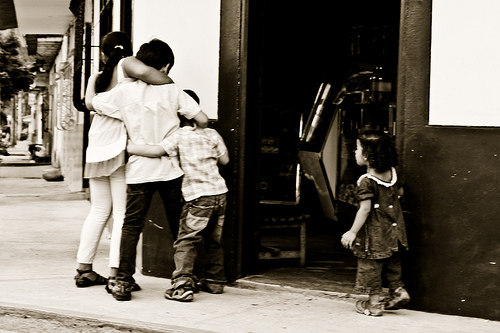
Excluded, Photo by Juan Ferr Alvarez, Flickr Creative Commons

Excluded, Photo by Juan Ferr Alvarez, Flickr Creative Commons

Have you ever felt on the outside of the circle? When I was in third grade, I went to a new school in the middle of the year. It was a Catholic school and when I arrived everyone was in church waiting for morning Mass. I went into the church but I had no clue what to do next. Everyone seemed to be sitting in groups by classes, but I didn’t know where I belonged.

I tentatively edged down into one pew, but the child next to me said, “This is for fifth graders, you don’t belong here.” I tried to move to another spot without being noticed. Again, the child near me looked askance: “You’re not a sixth grader!” I moved to yet another pew, with similar results. I was scared and embarrassed and out of place: I had no way to know where to go. Finally, one of the teachers noticed me, and brought me to where the third graders were supposed to sit.

It was a minor incident, yet a frightening moment of dislocation for a small child. Because my family moved frequently when I was young, that dislocation repeated itself often, and I was left with an unsettled feeling in my heart. I was left with perennial questions: How do we know if we belong or if we do not? What must we do to belong? Perhaps it was those moments of dislocation that made me aware just how important community is.

Activist and writer Mab Segrest wrote about a South African word that describes this essential need for community: ubuntu. “Ubuntu translates as ‘born to belonging.’” Ubuntu expresses the African idea that our human dignity and fulfillment is dependent upon our links to each other in community.

In contrast, our modern American society bases itself on the idea of individualism. John Locke formulated a theory of society as a contractual type of relationship freely entered into by individuals. Locke proposed that in the original state of nature, all humans were free and autonomous individuals, and from that state, they agreed to give up certain aspects of their independence, for mutual benefit and protection.

Today, this individualistic understanding is endemic. But Mab Segrest challenges individualism, and she begins her argument with the experience of motherhood. She writes,

It was after watching Barbara give birth to our daughter, Annie, …that it occurred to me the degree to which this Original Individual was a ridiculously transparent …fiction. None of us start out as individuals, but as fusions of sperm and egg, embedded and growing in the mother’s body for nine months. For months after birth, our consciousness is still merged with its environment, and a sense of the particular and separate self emerges only gradually.2

We start out in relationship, and our unique individuality grows out of that circle of relatedness. Not the other way around. We all need each other in order to flourish and to thrive in life.

To give Locke and others their due—the philosophy of individualism was created in rebellion against the authoritarian structures of an earlier age, the tyranny of church and monarch. To affirm relationship is not to deny the importance of human dignity and freedom. But we must recognize that relatedness comes first, and within that circle of relatedness, we find our inherent worth and dignity.

Quotes from Mab Segrest, Born to Belonging: Writings on Spirit and Justice, (Rutgers University Press, 2002) p. 2.

Dreaming In Circles

Red Moon

Photo by Margy Dowzer

It is said that if a group of people sleep arranged in a circle—heads at the center and feet out like spokes—they create a dream circle. Two or more people in the group may have the same dream at the same time. I tried this once with a group of friends, but I must confess, it didn’t really work for me. Mostly I just had a rather poor night’s sleep.

But I like the metaphor. The word dream is used to describe both our strange nighttime adventures and also our waking hopes and visions for our lives. For me, dreaming in circles is about sharing those waking dreams, entering into the magic that can happen when we join our visions together. We talk and we listen. We plan and we act. We are energized by each other, and we grow strong and bold. When we dream in circles, anything is possible. Margaret Mead has said,

Never doubt that a small group of thoughtful, committed citizens can change the world; indeed it’s the only thing that ever has.”

And here’s the important thing. When we dream in circles, the circle itself becomes the greatest magic of all. We wake up to the reality of our profound interconnection with all people and all beings. The circle is a symbol of this interconnection between people. In a circle, every person is linked to every other. Every person is equally valued and appreciated. Human beings cannot thrive as random individual strangers in a crowd; we are connected to one another at the deepest level, and we can only find wholeness through loving and mutual relationships. By sharing our dreams, we can come home to a community of love.