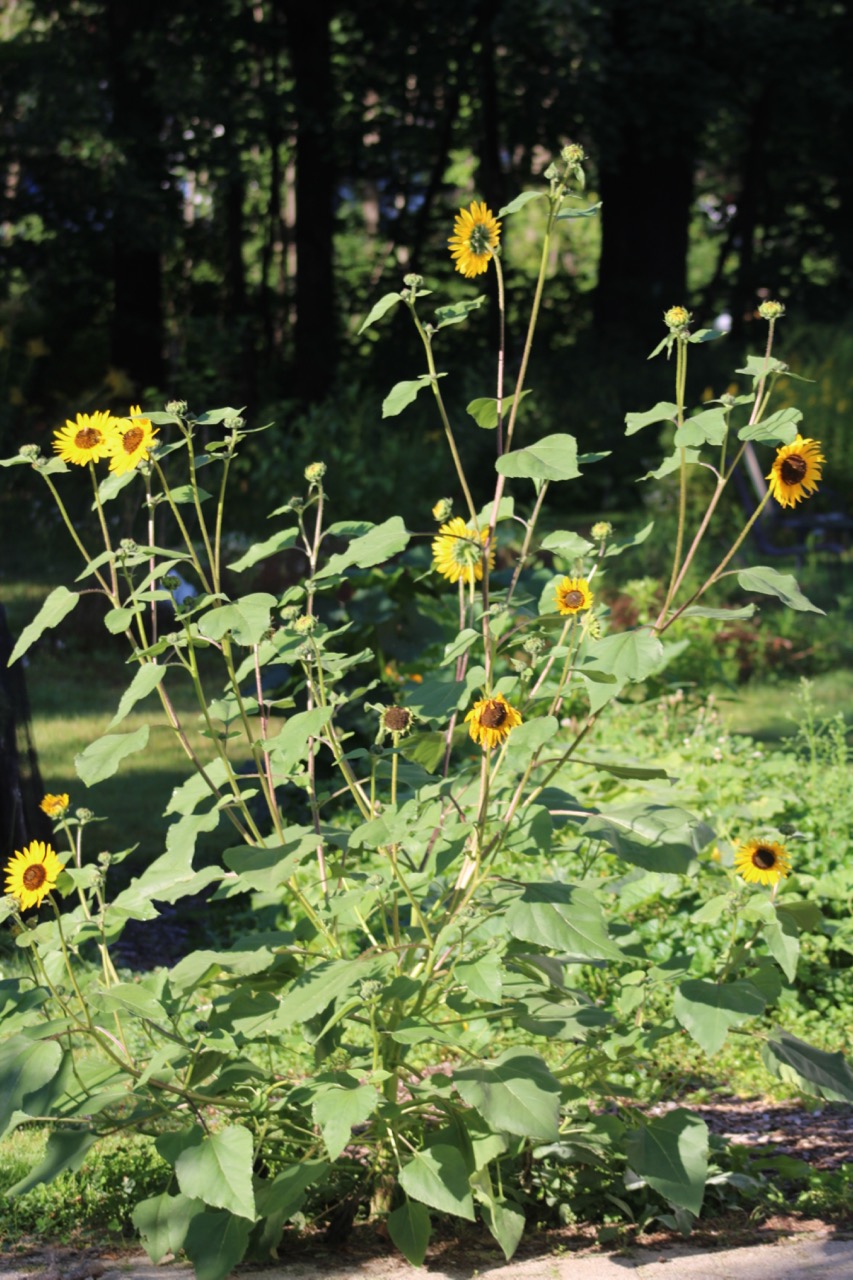
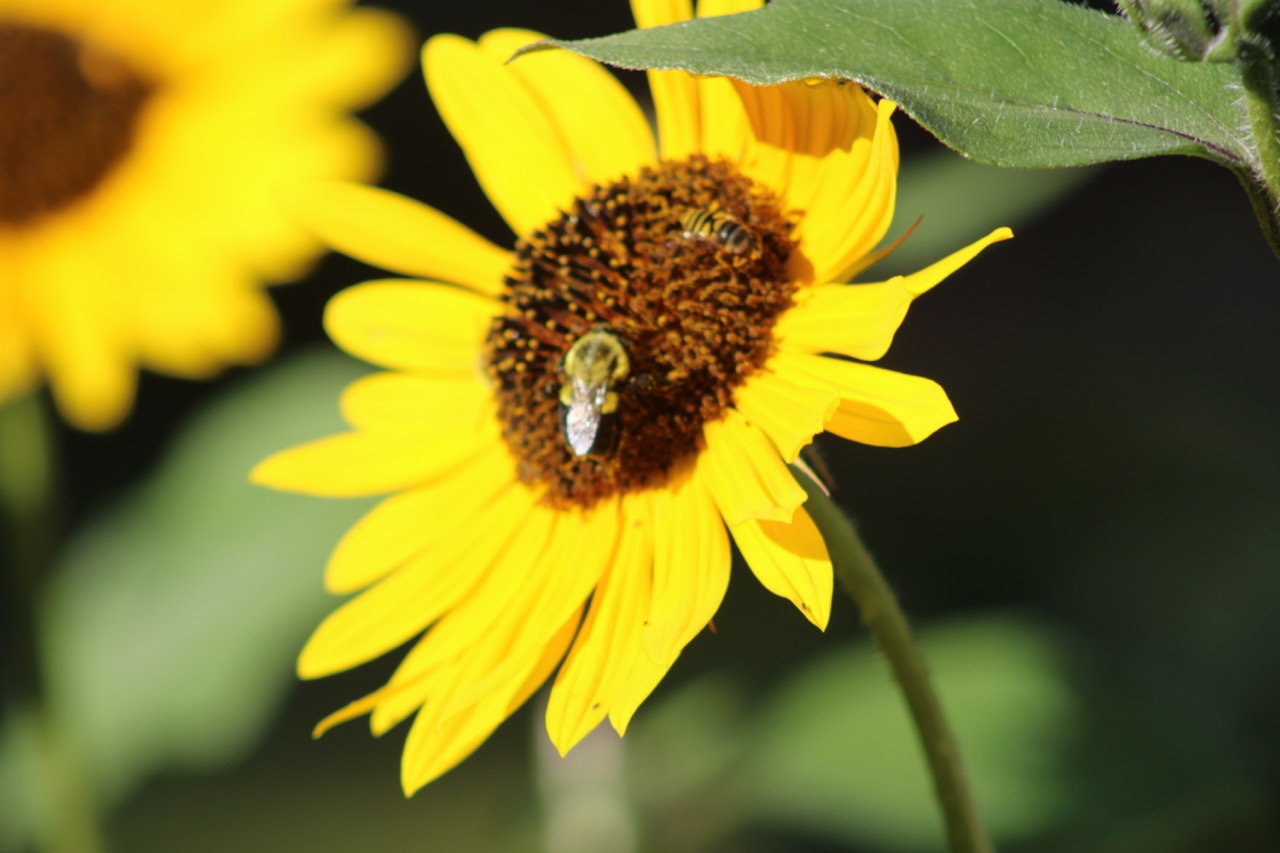
This year one volunteer sunflower plant came up next to the patio, starting small. Now it has expanded into this multi-branched extravagantly flowering giant! Doing a little research, it seems to be a native wild sunflower, because of its branching habit and the size of its flowers, and its continuing blooms. It is still one plant though, a community of flowers that is connected at the root, and much loved by all sorts of bees, other insects, and birds. It is easy to see how they belong to this place and to each other.
What does belonging mean? It is easy for me to get caught in a “not-belonging” wound, the scar of a childhood moving from place to place, always starting on the outside, trying to find my way in, feeling invisible and unconnected. It is not that I haven’t had some times of belonging–there was the group of friends at college, the group of activists at the Catholic Worker or the women’s peace camp, the lesbian community in Boston. Changing perspective sometimes took me away from earlier forms of belonging, sometimes into new communities–sometimes not. In some ways I belong to my family of origin, but my lesbian identity and feminist politics created a deep barrier.
On this personal journey, becoming a UU minister created an avenue for me to nurture community, to bring other people into a sense of belonging. And in that ministry, I had a form of belonging, too, right at the center of community, but also always a bit set apart in my role. And it also meant moving once again. Even though I have retired, I am still a bit set apart because of the role of a minister. Reflecting on it, I’ve also experienced a form of belonging in my connections with ministry colleagues. But the wound continues to shape the ways I navigate the current chapter of my life. I continue to wonder, “Where do I belong?”
As I explore various facets of belonging, the feeling remains elusive. Do I belong to this place like the sunflower and the bees? I am not indigenous to this land, it is Wabanaki land. When I reach back to my own ancestors, language is a barrier between us–I don’t speak the German of my father’s ancestors. I don’t speak French (even if I understand a little), the language of my Quebec ancestors, and even of my distant Innu relatives in these times. I don’t belong to Nitassinan (which would be my matrilineal homeland) or Quebec or Austria or Germany. I don’t belong to an ethnic community. What does belonging mean in white America, especially for those of us who reject the racism of its founding?
All these thoughts are coming round in a scattered fashion. When the feelings come up in me of “not-belonging,” it helps me to remember these childhood wounds, these societal wounds. I can acknowledge and honor those feelings but then make a choice to open my heart to new possibilities of interconnection. I am becoming interconnected to this land, as I tend the trees, appreciate the wildflowers, make habitat for birds and frogs, eat the blueberries that grow. There is a reciprocity that is developing between us. I must choose to open my heart to new people as well–not dwelling in the old fear that there will be no room for me, but being curious about the ways that we might be interconnected already, or the ways that we might find to connect right now.
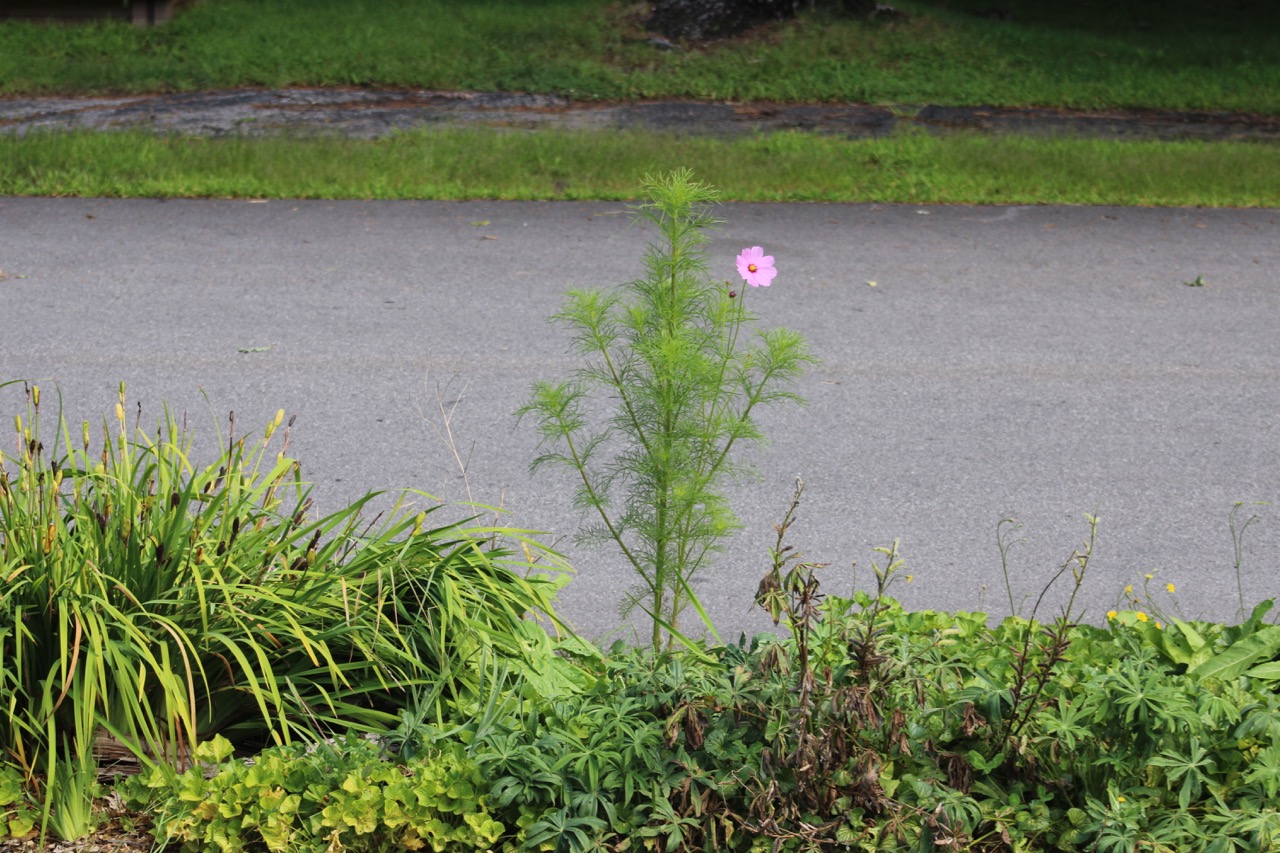
Today I see one more lesson about belonging in a tall pink cosmos flower that we didn’t choose or plant, but somehow it rooted itself next to the road we live on. It is now blooming on its own after the rest of the plants have faded. It is not in the “color scheme” of the roadside garden bed. I guess its motto is a variation of the old adage: “Bloom where you are planted.” Bloom wherever your seed happens to land.
 Finding Our Way Home