
Inside the pain

There may be times when we are powerless to prevent injustice but there must never be a time when we fail to protest. Elie Wiesel

The last few weeks, I have been dealing with severe pain in my hip, such that it makes it difficult for me to walk or sleep. I am grateful that I now have physical therapy which is slowly helping. But as I was lying on the table getting treatment today, I kept thinking about people in Gaza, right now, who also were dealing with hip pain, or chronic illness, or who were giving birth–any of the myriad kinds of human conditions that render us deeply vulnerable, even in the best of situations.

And instead of finding help or treatment, those human beings are being forced out of their homes, bombed, shot, starved. How would I evacuate when I can barely walk? How would I sleep on the ground with no pillows to ease the pain? How would I manage my illness with no medicines? How would I give birth with no clean water? It is not as if those human frailties cease to exist because of war. Underneath the other horrors, the deaths, the woundings, the destruction of homes, schools, libraries, hospitals, there is each human story.

I find in my body a small metaphor for this hurting world. I find in my body a deep scream of pain for this hurting world. They say the hips are the foundation for the balance of the body. And the earth is out of balance in so many ways. We see it in the chaotic weather, we see it in wildfires, we see it in an ocean warming faster than expected, we see it in cruelty toward children who are “different,” we see it in pandemics, we see it in politics of fear and hate. Who knows what the future will bring, with such a painful present.

I found encouragement in these words of Elie Wiesel, who survived the holocaust and wrestled with its meanings and repercussions for the rest of his life:

“There may be times when we are powerless to prevent injustice, but there must never be a time when we fail to protest.”

https://www.nobelprize.org/prizes/peace/1986/wiesel/lecture/

I found this image and quote posted by a friend on Facebook–the image is the Ukraine sunflower, and Ukraine is another country full of people in pain that linger in my own heart. But the flower feels full of beauty and hope. Wiesel goes on to say:

“The Talmud tells us that by saving a single human being, man can save the world. We may be powerless to open all the jails and free all the prisoners, but by declaring our solidarity with one prisoner, we indict all jailers. None of us is in a position to eliminate war, but it is our obligation to denounce it and expose it in all its hideousness. War leaves no victors, only victims.”

1986 Nobel lecture
The Power of the Story

Today I am concluding my series of blogs about Dr. Martin Luther King, Jr., in honor of the anniversary of his death, April 4th. I have been exploring what his life can teach us about the experience of the Divine Mystery.

I don’t understand the mechanics of experiencing the divine presence. I wonder if, as for Dr. Martin Luther King, Jr., it has something to do with the commitment to give oneself to a sacred calling, or to do the work of justice. I don’t know why some people call for help, and never seem to hear an answer. There is no formula that I can teach you, except to say that trouble can sometimes be a doorway, too, if we knock.

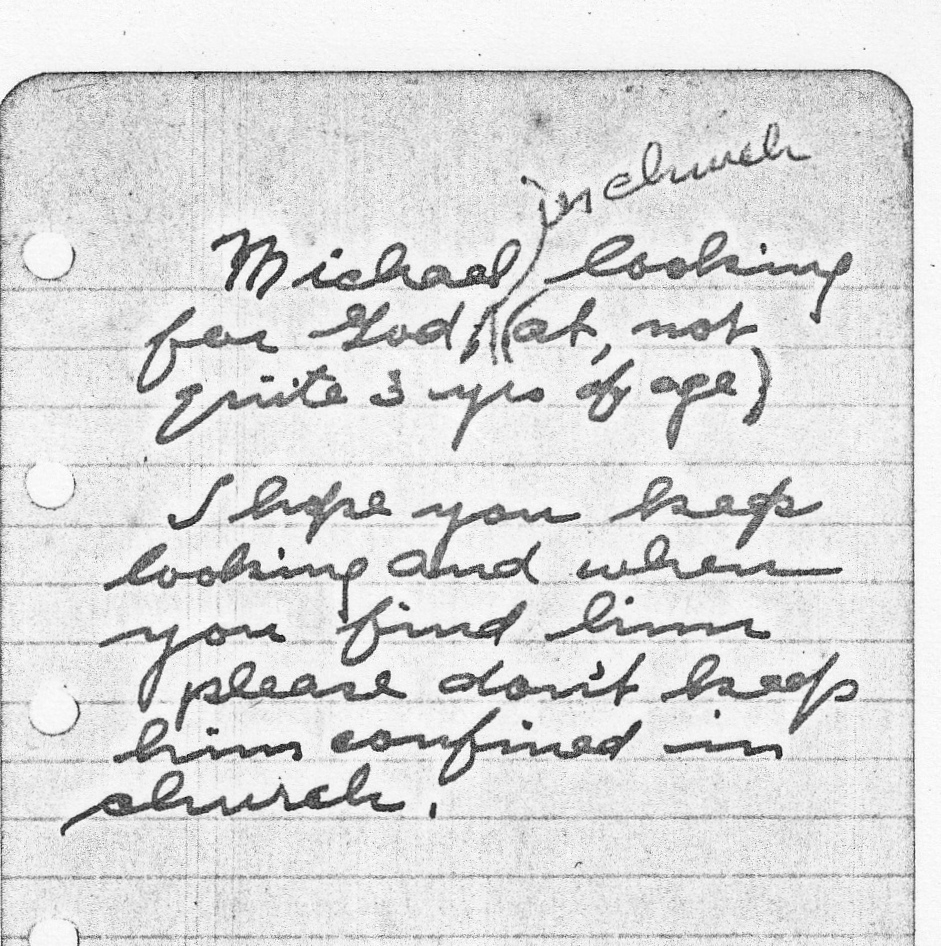
It makes me think about something my grandfather wrote in a little black notebook that disappeared for many years. April 4th, the anniversary of King’s death, is also the anniversary of the death of my grandfathers, one in 1964, and one in 1967. My grandpa Johnson died when I was not quite 11 years old. He was not a Catholic, which was a big deal in my family. But I am told he had been a spiritual man, and had even considered a call to ministry as a Unitarian or a Lutheran. The story I remembered from the notebook was this: My grandfather said that my young cousin Michael at the age of three had gone into a church building and was looking for God. My grandfather commented, “If you can’t find God outside of the church, you will never find him inside the church.”

But just before Easter a few years ago, while my uncle was dying, another cousin sent me a message on Facebook, about going through papers of her father, and finding a copy of Grandpa’s note. It turned out the actual quote was slightly different than I remembered. He had written, “I hope you keep looking. And when you find him don’t keep him confined in church.” But it speaks to the same impulse—that God is beyond what happens in church.

Grandpa's Notebook

Grandpa’s Notebook

Even without a formula, even without a sure way to find this God who helps the lowly, I believe the stories of such a God can give us hope and courage. I am reminded of an old Jewish legend recounted by Elie Wiesel. Whether it is true or not, I do not know. But that is the thing about stories. The truth to be found in stories is not about whether or not they are factual. Some of the most helpful stories happen only in fiction.

This is a story about a Jewish community who had a very wise and powerful Rabbi. When the people were in trouble, their Rabbi used to go into the woods, to a special place, where he prayed a very special prayer, with ritual and song, and the people would be helped. But eventually the rabbi died, and his successor did not know the full ritual with all its songs. So when the people were in trouble, he went into the woods, and prayed the special prayer, and it was enough, and the people were helped.

Eventually, he too died, and the next Rabbi who came to them did not know the place in the woods. But he did know the special prayer, and so when the people were in trouble, he prayed the prayer, and it was enough, and the people were helped. Finally, he too died, and the next Rabbi didn’t know the rituals or the songs, he didn’t know the place in the woods, or even the special prayer. But he knew the story. And it was enough. And the people were helped.

Leslie Marmon Silko writes, in her novel Ceremony:

I will tell you something about stories,…
They aren’t just entertainment.
Don’t be fooled.
They are all we have, you see,
All we have to fight off
illness and death

You don’t have anything
if you don’t have the stories.

A God Who Is Not All Powerful?

A while back I picked up a book by Andrew Greeley called God Game. His premise intrigued me. A man is asked to test a new computer game. In this game, he interacts with characters who are people in a computer generated world. He types in commands which the characters perceive as an inner voice coming from their God. He uses this influence to shape the direction of the story in progress. In a process similar to writing a novel, he can create a tragedy, a comedy, a romance. He can use commands to influence the weather, or physical objects.

When our narrator begins the game he discovers the people are fighting a war, and likely to soon destroy each other. Being a benevolent author, he begins to direct them to make peace with their enemies. But soon it is apparent that the game is more complicated than that.

First of all, he learns that he can command the characters to take certain actions, but sometimes they choose to ignore his direction. The programmers have included freedom as one of the parameters of the program. He must work with the characters that are open to his leading, and use the actual abilities written into their personalities. Then to top it off, sometimes trouble arrives in the form of random events. Eventually, he become totally immersed in the game and finds he loves the people under his care. He agonizes over how to help the peace succeed.

The book explores the premise of a loving God who is not all powerful. I found myself feeling sympathy for such a God who might feel frustrated, and worried, and angry sometimes. He wants the story to come out well. He wants the characters to live happily ever after. But all he can do is offer assistance and inspiration as they face the problems of their world: he was not able to eradicate evil in one fell swoop.

In contrast, I grew up with the idea of a God who was supposed to be in charge of everything. All-powerful, all knowing, and all good. Whatever happened, it must fit into the will of God, and therefore be for the good. Even when bad things happened, we were to accept it as a part of God’s mysterious plan. But Elie Wiesel challenged such a view with his unrelenting questions: How could anyone accept a God who could ordain such an evil as the Holocaust? How could anyone trust a God who would stand by and let it happen?

Photo Source Unknown

Photo Source Unknown

Episcopal theologian, Carter Heyward, was deeply influenced by the questions of Elie Wiesel. For Heyward, as for Wiesel, the Holocaust was an indictment of the churches’ understanding of God as a supreme power who dominates the world. It was an indictment of the idea of obedience as morally desirable. Likewise, it found unacceptable a God who is merely an observer, a spectator in the face of such horrors. If God is indifferent to human suffering, then there is no use to us for such a God.

Heyward writes that for Elie Wiesel nothing is of more fundamental value than mutual relationship. The only ethical God must be found in loving relationships between people. In the camps, the opposite happened: the Jews were treated as if they no longer existed. The camps were a systematic assault on every element of personhood: numbers instead of names, meaningless hard labor, separation from family, arbitrary selection for extermination. The only ethical response to such evil would be to make a connection with those who suffer, to resist evil’s capacity to destroy the power of relationship.

Irving Greenberg put it like this: “…to talk of love and of a God who cares in the presence of the burning children is obscene and incredible; to leap in and pull a child out of a pit, to clean its face and heal its body, is to make the only statement that counts.” In other words, to face the problem of evil, we must resist violence and dehumanization by acts of connection and relationship.

Facing Up to the Reality of Evil

It is an amazing thing to feel safe in our homes and communities. A while back I was reading a novel about the Lost Boys of Sudan, What Is the What, by Dave Eggers. The story stirred up questions in my heart.  What would it feel like, I wondered, to have marauders showing up in your village, shooting people, burning houses, assaulting women and children? What would it feel like to lose your whole family, and your whole village?

When the death camps of the Nazis were discovered after World War Two, people swore, “Never again!” Yet, genocide continues in our day. Bosnia, Rwanda, southern Sudan, Darfur.

We asked ourselves, “How could someone fly a plane into a building with thousands of innocent people inside? How could someone massacre thousands of women and children of their own country?” Elie Wiesel, a survivor of Auschwitz, spoke of the incredulity of his village of Sighet in Transylvania in the months leading up to their deportation to the camps.

One man of the village had been taken away earlier and managed to escape, returning with terrible news. The Gestapo had forced the Jewish prisoners to dig huge graves, and then slaughtered the prisoners. “Each one had to go up to the hole and present his neck.” The villagers refused to believe the man. How could such a thing even be imagined? Right up to the moment when they themselves arrived at Birkenau, they clung to the impossibility of such a horror. Most of us feel incredulous in the face of evil.

Elie Wiesel wrote,

Never shall I forget that night, the first night in camp, which has turned my life into one long night… Never shall I forget that smoke. Never shall I forget the little faces of the children, whose bodies I saw turned into wreaths of smoke beneath a silent blue sky. Never shall I forget those flames which consumed my faith forever… which murdered my God and my soul and turned my dreams to dust…

I have never had to face personally the horrors described by Wiesel or by the Lost Boys of Sudan. Am I willing to listen to their stories and the stories of others who have encountered evil? Am I willing to let go of my own incredulity to face up to the reality of evil?  And what about those of us do experience such horror? How do we make sense of evil in the world? Where does it come from, and what can we do about it?

n_holocaust_wiesel_130127

Elie Wiesel quotes are from Night.