Kindness or cruelty?

White woman on left of phot with tan baseball cap and rust shirt, just visible at hands, holding a phone facing pebbled shoreline with horseshoe crabs in the water mating, and huge boulders on the other side.

The other day, Margy and I went to Maquoit Bay to see horseshoe crabs that had come to shore to mate. Margy especially loves horseshoe crabs and has learned a great deal about them. It was shortly after high tide, and we noticed that a few of the crabs had wandered behind and between big boulders placed on the site, in a way that they were trapped. (Much worse than what can be seen in the photo above.) As the tide continued to go out, it was likely that they would be stuck high and dry. So we very carefully lifted them out by the sides of their shells, (never lift them by their spikey tails!) and placed them in the water where they were free to move where they wanted.

To us, it felt like a simple act of kindness for a fellow creature on this planet. We see someone in a vulnerable position, and do our best to be a helper.

I have been astonished and horrified by the cruelty I’ve witnessed (as reported via social media) of people in positions of power in our government. Separating families as they come out from immigration courts. Detaining a young child with leukemia. Sending migrants to horrible prisons in countries to which they have no connection. Terrorizing people as they garden, or shop, or go to work, while wearing masks and refusing identification. Detaining a pregnant woman and offering no medical care. Such is the state of DHS and ICE activity in our country. Cruelty seems to be the point.

I am thinking also of the people in Gaza, who are still being starved and bombed, and shot by IDF soldiers even as they line up to try to get food. Some soldiers even admitted that they were ordered to shoot deliberately at unarmed Gazans waiting for humanitarian aid. I feel so helpless to stop the harm, to stop the genocide.

It seems there is no end to cruelty. It has been troubling me greatly. And I wonder why? Why be as cruel as a human can be to fellow human beings? Don’t all religious and ethical traditions lift up our common human bonds and encourage us to love our neighbor, and love the stranger in our midst? What does it do to the human beings behind the masks or the guns to act with violence and cruelty every day?

Are the people in charge in our country trying to instigate retaliatory violence to justify further oppression? Is it some oligarchic strategy of conquest? Is it a way to convince themselves that some human beings are not really human beings? Are they truly this cruel and this evil? And then, how can they convince ordinary people to follow along? Ordinary people who might value kindness over cruelty.

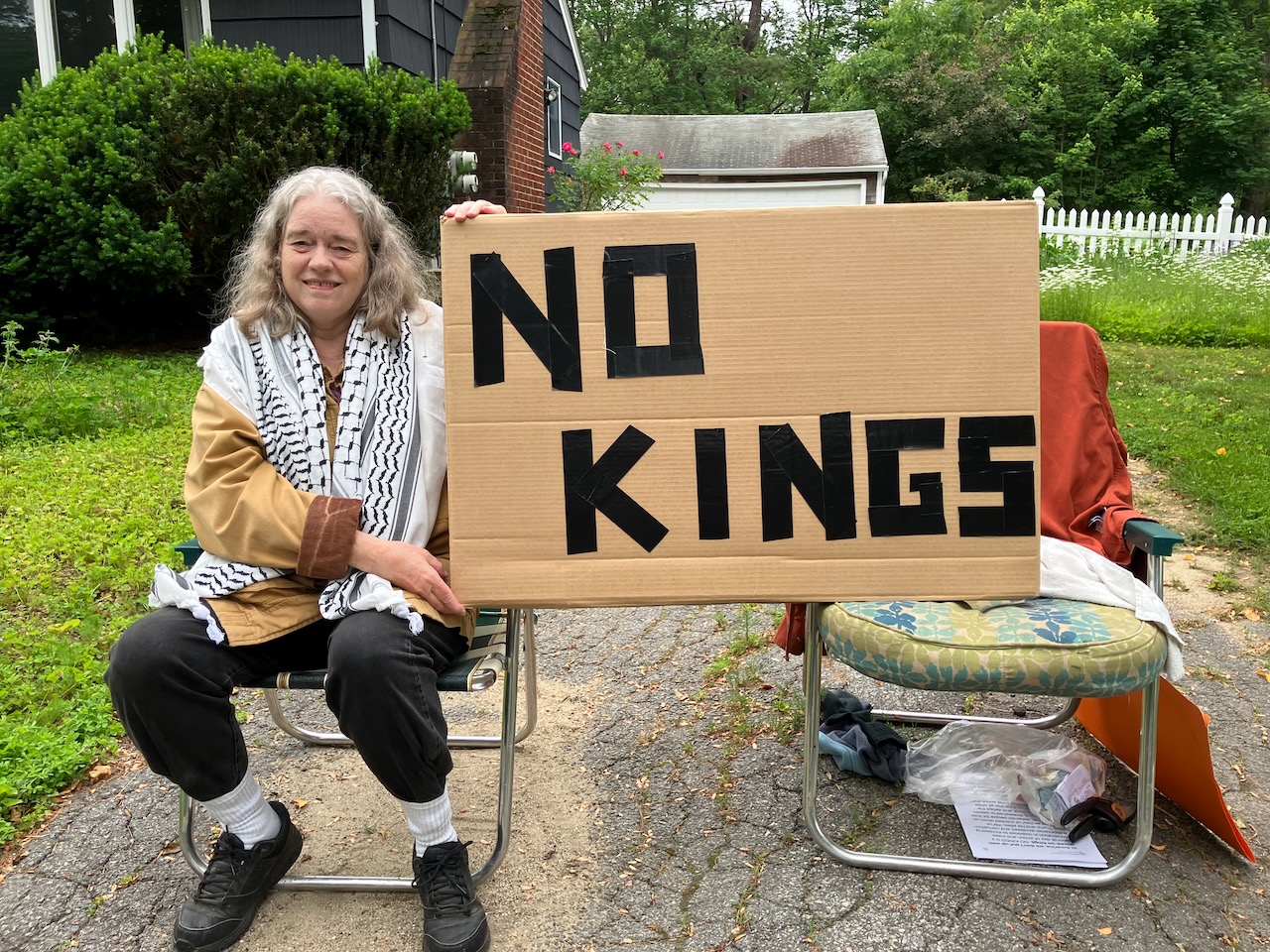
All I can do is to keep speaking out about it, to share the daily reports of the people who have been detained or killed, to see their names, to weep. I recently decided to do one more thing, to purchase a keffiyeh from Palestine. This traditional scarf was worn as a headdress or face covering, and in recent years has come to symbolize the Palestinian yearning for freedom. For those of us who are not Palestinian, it symbolizes solidarity. For me, I am moved by the fact that it was made by Palestinians in the West Bank, touched by their hands, their hopes. And now it is touched by my hands, my hopes for them. I feel that spiritual and physical connection. I wear it for the children being starved in Gaza, for the families being bombed in their tents or apartments. I wear it for all the helpers who do whatever they can to help, in the midst of so much cruelty. I wear it as a symbol of connection between human beings,

Myke, a white woman with reddish gray hair, wearing a black and white Palestinian keffiyeh wrapped over her shoulders.

On June 14, Margy and I couldn’t go to one of the thousands of No Kings rallies to protest the usurping of power that this regime is attempting. (This is life with chronic illness…) So we decided to sit in our own driveway with a sign, and bear witness in our neighborhood. During that hour and a half, we had about 20 positive responses from people driving by or walking by. A few people looked away but no one was angry or negative. Because we were out there, we also learned that a few neighbors had gone downtown to the rally as well. This photo was taken by Margy… it is her empty chair on the right. So we were two of the millions who protested that day!

Big cardboard sign saying "no Kings" held by Myke, seated, wearing keffiyeh, resting on second chair.

I hope that if I keep speaking up, it will inspire others to speak up as well. I think of the Ella Baker quote in the song by Sweet Honey in the Rock: “I want to be one in the number as we stand against tyranny.” Never let their cruelty cause us to lose our kindness. Never let their cruelty cause us to lose our sense of human connection.

Where is Mosab Abu Toha?

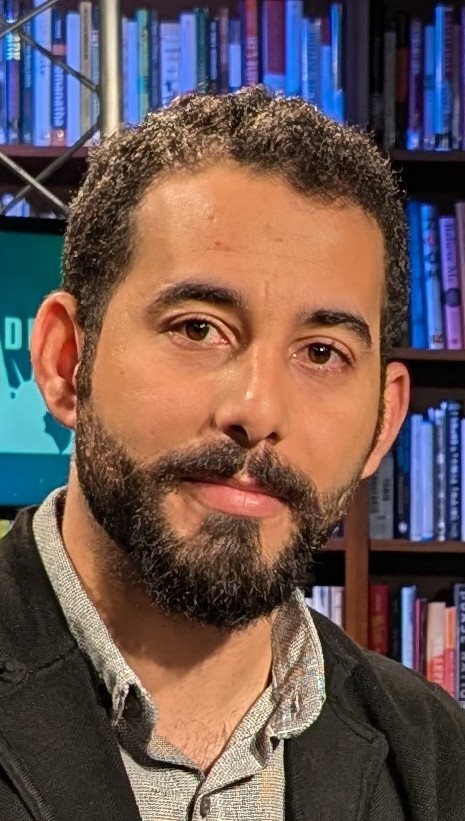
Mosab Abu Toha
Photo By Ishmaeldaro – Own work, CC BY 4.0, https://commons.wikimedia.org/w/index.php?curid=155046681

Update: It turned out to be Facebook that suspended his account for a few days. In other news, Mosab Abu Toha just won the Pulitzer Prize for commentary, for a series of essays in the New Yorker. Original post follows:

Mosab Abu Toha is a Palestinian poet and writer living in the United States with his wife and three children. I have been following him on Facebook because every day he posts so eloquently about what is happening in Gaza, he shares the details of people killed and the horrors of the genocide there. Today, I discovered that his Facebook page did not exist any more, and all the posts I had shared before had that little FB memo: “This content isn’t available right now.” The latest such post was April 27th.

I can’t help but wonder and fear what has happened. Has he been Facebook banned? Has he gone into hiding? Has he been arrested? He was so bold about speaking up for his people and appealing to the larger world to stop the genocide. This post from me is a prayer for his safety, and a prayer for all that he was trying to accomplish.

I have been posting articles from the Universal Declaration of Human Rights. Today I will highlight Article 19: “Everyone has the right to freedom of opinion and expression; this right includes freedom to hold opinions without interference and to seek, receive, and impart information and ideas through any media and regardless of frontiers.”

I want to close with a poem by Mosab Abu Toha published a year ago in AGNI journal. Abu Toha has two books of poetry available: Things You May Find Hidden In My Ear: Poems from Gaza (2022 City Lights Publishers) and Forest of Noise (2024 Knopf).

This Is Me!

A city whose streets escaped it,
a house without windows,
a rain with no clouds,
a swimmer in the desert,
a shirt with ripped-off buttons,
a book with loose pages,
a lightless moon and colorless grass,
a toothless smile and suffocated laugh,
a dark painting on black canvas.
I’m a table with no legs,
a noisy restaurant with no guests.
I write with a pen that has no ink.
I write my name in the air
and shout it, but no voice comes out.
I look around and see many things,
but I see no one.

Your silence will not protect you

Multiple bluish white flowers with green leaves in a bunch on the grass.

I am living in the strangest of paradoxes. A hateful dictator has taken over our country, but today my life looks about the same as yesterday. I wake up in the morning, the sun is shining through my windows, and the birds are singing. I see these bright spring flowers on my walk. And yet, US-made bombs are being targeted on children in Gaza, they are dying in flames or slowly starving because food aid has been locked out by the Israeli government. International students (here in the U.S. on legitimate visas) are being kidnapped and jailed by ICE and threatened with deportation for having spoken up against this genocide in Gaza.

And I can’t stop thinking about Kilmar Abrego Garcia being detained by “administrative error” and sent to the one country his immigration status said he could not be sent to (El Salvador), because of danger from gangs; and now he is trapped in a hellish prison there because the president will not bring him back. This regime is renditioning hundreds of people without trial to this “prison” in El Salvador–and really, without trial it is not a “prison” but an extra-judicial concentration camp. All the people the president sent there should be brought back to the U.S. If some of them are gangsters and criminals, they should face trials–everyone has human rights, or no one does. But the president jokes instead about sending “homegrowns” to El Salvador next.

So since I’ve spoken up publicly about genocide in Gaza, and about immigrants being deprived of human rights, does that mean that they will come for me one day? Maybe it does. But I can’t live my deepest ethics without bridging the gap between the bright sunshine of today’s ordinary morning and the nightmare that is going on all around us, just at a little distance from my house at the moment. Every day I read about more atrocities taking place, and I try to do the little that I can do: to bear witness, to speak up about them, to share my outrage, to protest the injustice. The temptation is to get quiet, to try to hide under the radar. But I do believe, as lesbian poet warrior Audre Lorde said, “Your silence will not protect you.”

The more of us who resist, the more chance we have to reverse this nightmare.

Inside the pain

There may be times when we are powerless to prevent injustice but there must never be a time when we fail to protest. Elie Wiesel

The last few weeks, I have been dealing with severe pain in my hip, such that it makes it difficult for me to walk or sleep. I am grateful that I now have physical therapy which is slowly helping. But as I was lying on the table getting treatment today, I kept thinking about people in Gaza, right now, who also were dealing with hip pain, or chronic illness, or who were giving birth–any of the myriad kinds of human conditions that render us deeply vulnerable, even in the best of situations.

And instead of finding help or treatment, those human beings are being forced out of their homes, bombed, shot, starved. How would I evacuate when I can barely walk? How would I sleep on the ground with no pillows to ease the pain? How would I manage my illness with no medicines? How would I give birth with no clean water? It is not as if those human frailties cease to exist because of war. Underneath the other horrors, the deaths, the woundings, the destruction of homes, schools, libraries, hospitals, there is each human story.

I find in my body a small metaphor for this hurting world. I find in my body a deep scream of pain for this hurting world. They say the hips are the foundation for the balance of the body. And the earth is out of balance in so many ways. We see it in the chaotic weather, we see it in wildfires, we see it in an ocean warming faster than expected, we see it in cruelty toward children who are “different,” we see it in pandemics, we see it in politics of fear and hate. Who knows what the future will bring, with such a painful present.

I found encouragement in these words of Elie Wiesel, who survived the holocaust and wrestled with its meanings and repercussions for the rest of his life:

“There may be times when we are powerless to prevent injustice, but there must never be a time when we fail to protest.”

https://www.nobelprize.org/prizes/peace/1986/wiesel/lecture/

I found this image and quote posted by a friend on Facebook–the image is the Ukraine sunflower, and Ukraine is another country full of people in pain that linger in my own heart. But the flower feels full of beauty and hope. Wiesel goes on to say:

“The Talmud tells us that by saving a single human being, man can save the world. We may be powerless to open all the jails and free all the prisoners, but by declaring our solidarity with one prisoner, we indict all jailers. None of us is in a position to eliminate war, but it is our obligation to denounce it and expose it in all its hideousness. War leaves no victors, only victims.”

1986 Nobel lecture

A Child in Gaza

I haven’t been able to write for a while. My heart is shattered by the continued assault on the people of Gaza by the government of Israel, supported by my own US government. If you follow this page, you know that I have chronic illnesses that keep me unable to go out to demonstrations or vigils or do much of anything. All I have been able to do is to bear witness, to keep looking for news, to keep posting on Facebook photos and stories of the devastation. Every day more devastation. Every day, bearing witness and sharing.

I want to tell you about Lama Jamous, a nine year old child in Gaza who is documenting and interviewing and posting on Instagram–she has become the youngest journalist in Gaza.

You can follow her here on Instagram. (I first found her on Facebook, but now I am not sure if that was a real account or a copycat account. Still, it led me to know about her.) In another post she writes:

My name is Lama Jamous and I was born on November 24, 2014. I have a sister Aya and two brothers Mohmmed and Kareem. I’m the youngest of the family. I am a great student in school and I have lots of friends. I enjoy working as a group with my classmates, participating in activities. My favorite subject is Arabic. Every weekend I would go visit my grandma in Khan Younes. Then we were going to see our farm by the beach. We were going on picnics too. Our apartment on the roofs in Gaza was magnificent.
Then came October 7, 2023 and our lives changed 180 degrees. No more school, no more education, no more picnic… Very difficult to live as situation. We went to Rafah to live in a tent. From now on, we have nothing of the basic of living well like no privacy for the toilet. My whole family live right beside us.
My aunt Sana was killed along with 14 yr old Malk, 11 yr old Brea, 16 yr old Malek and 10 yr old Salam. They were civilians, my friends, my family… I have suffered tremendously from this situation and being evacuated from one place to another. So I decided to be a journalist to show the world what’s happening.
We love our country very much and would like to stay but the reality is that we are facing genocide against civilians… Many witnesses told horrible things that happened or are happening. Media is not covering this.
It’s very expensive to evacuate a family… every person needs $5,000 to $7,000 but it depends. We hope to be safe soon and we will come back when the war is over. I want the war to stop so we can get back to normal life. So many of my friends and classmates are missing and we don’t know what happened to them… Everything has gotten worse than before. This war needs to be stopped.
Lama Jamous

https://www.instagram.com/reel/C3CTcxeM-bs/?utm_source=ig_web_copy_link&igsh=MzRlODBiNWFlZA==

Lama Jamous is a child, my friends. She is now in Rafah, which was to be the safe evacuation zone, but is under attack.

I first heard about Lama through the work of Motaz Azaiza, a photo journalist who has been documenting the atrocities. He was recently evacuated from Gaza, and was interviewed in the Guardian. He expresses it so eloquently:

“To be clear, this is not a war against Hamas,” says Azaiza. “This is and has always been a war against the Palestinian people. Israel’s plan is to bury us or push us out – as we have just seen with the Rafah bombing. There is literally nowhere else for us to go.”

Azaiza urges the world not to look away. “As humans, we all have a responsibility to bear witness to what is happening in Gaza,” he says. “I tried my best to show the world our reality, now the world needs to show where it stands. It is ordinary people, men and women, who have the power to save what remains of Palestine. Our plea is simple – we just want to live.”

https://www.theguardian.com/global-development/2024/feb/16/motaz-azaiza-interview-gaza-ghosts-photojournalist

Please bear witness with me. Please do whatever you can to stop this genocide.

Guidance

Turkey mother and two babies behind plants in the yard

How does the Spirit move? How does the Spirit guide us? Is it like the wind blowing this morning, shifting the trees every which way? Might it come disguised as a turkey mother, with two babies always following nearby, meandering through the yard? Might it be in the doors that close, as well as the doors that open? Might it be in a conversation with a friend, sparking new ideas?

These last few weeks have been hard in our nation. Human rights have been undermined by the supreme court, and the attempted overthrow of democracy has been detailed in congressional hearings; gun violence continues, and police violence against black men does not abate. Heat waves remind us of the continued crisis of our planet, and despite many people acting as if the pandemic is over, the latest variant is more contagious and more severe.

I have felt at a loss for words about the big issues of the nation. I turned 69 last month, and after working for justice all of my adult life, I feel discouraged about the horrible backlash which seems to have taken power. Not surprised really. With the long history of this nation rooted in genocide, enslavement, and violence, it is amazing that we have made any progress at all. But for much of my life, it felt as if things were moving in a better direction. Now it feels like the same issues have to be fought all over again. I feel discouraged personally because I no longer have the physical energy to go to protests or marches, to be out there in the streets making a big noise. And because of that, I feel cut off from the community of resistance, which gives one hope and resilience.

So I listen for the Spirit, try to find guidance for my own little life. I look for signs in the wind and in the creatures who visit. The little turkey babies stay close to their mother, even as they wander through the tall grasses and wildflowers. Am I like that baby turkey? When it gets tired or scared, it jumps right up on the back of its mother. Or am I like the turkey mother, and someone needs to jump up on my back? How important it is that we help each other, and recognize the help that comes our way.

Baby turkey on its mother’s back.

How does the Spirit guide us? At times I am at a loss about what I can do, what I should do. This next chapter of my life is new territory. I don’t always understand when one door closes, but can I trust that the Spirit is still guiding me? Can I keep hold of a “yes” in my heart to the next open door? Can I recognize the sound of the Spirit in all of its guises? I am listening.

Living into History

As we approach the holiday called Thanksgiving, how can we move past the American myths that support colonization, and find ways to decolonize our minds and our communities? I have not been able to blog recently, but want to share with you elements of a worship service on this topic I led on November 19th. 
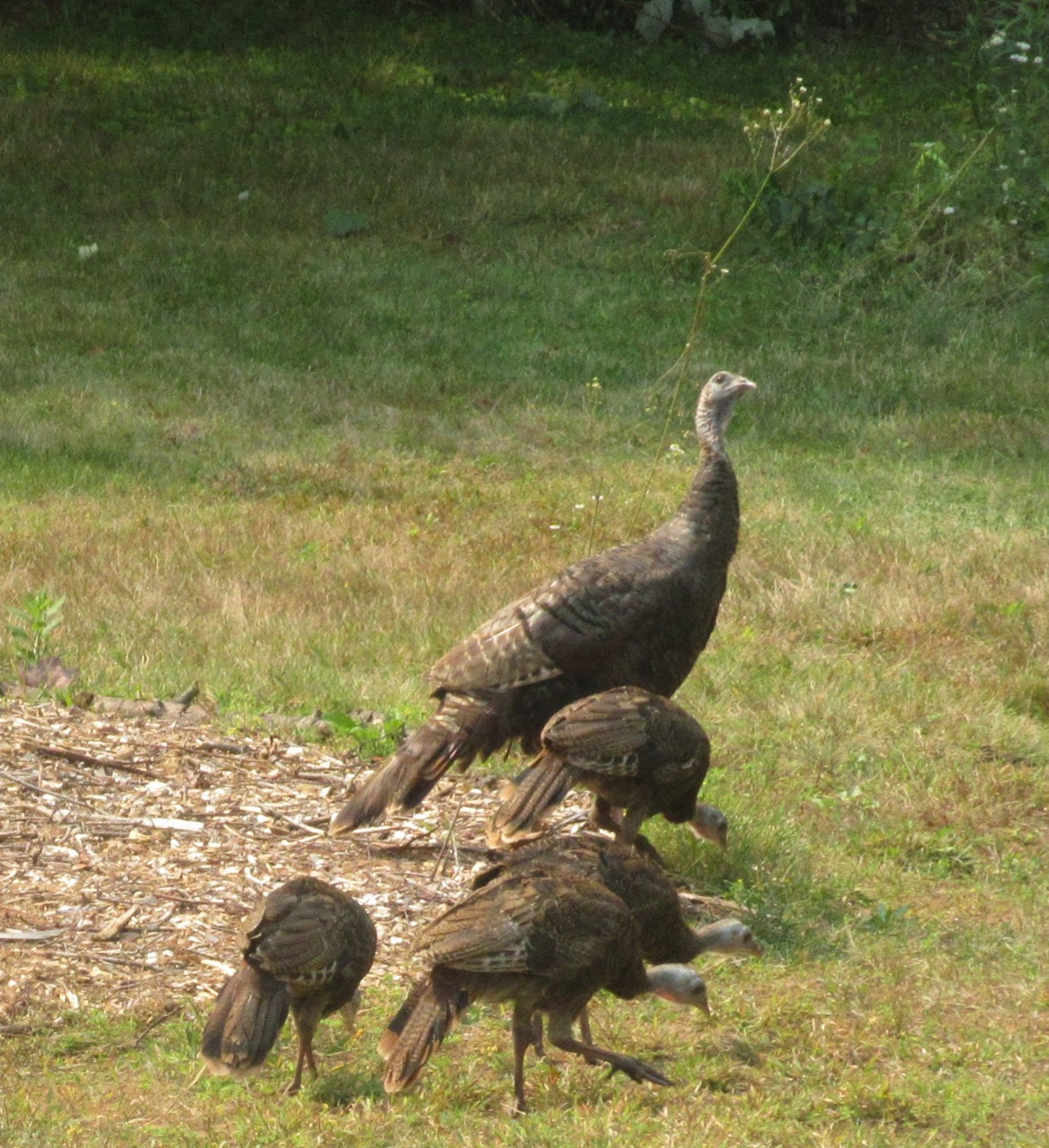
TurkeysOpening Words

It is always good to give thanks! All that we have is a gift from life. Our food, our relationships, our shelter from the cold. And when we give thanks, it is always good to be mindful of all people, and notice those who are suffering and do what we can to ease suffering and change its causes. Today we give thanks, and we explore suffering. We must always do both together, so that our hearts are strong for the journey.

Before our Centering Music:

When you came into church today, the ushers handed each of you four slips of paper. I invite you to write on those four slips of paper the names of things that are precious to you—perhaps people, perhaps values, perhaps places—it could be anything. Perhaps what you are most thankful for. I invite you to keep those four slips in a pocket or purse, or hold them in your hand. We’ll come back to them later in the service.

Reading: “I am tired of being invisible to you all” Winona LaDuke

LaDuke11Winona LaDuke is the executive director of Honor the Earth, and an Ojibwe activist and economist on Minnesota’s White Earth Reservation. She writes:

There is this magical made-up time between Columbus Day (or Indigenous People’s Day for the enlightened) and Thanksgiving where white Americans think about native people. That’s sort of our window. November is Native American Heritage month. Before that, of course, is Halloween. Until about three years ago, one of the most popular Halloween costumes was Pocahontas. People know nothing about us, but they like to dress up like us or have us as a mascot.

We are invisible. Take it from me. I travel a lot, and often ask this question: Can you name 10 indigenous nations? Often, no one can name us. The most common nations named are Lakota, Cherokee, Navajo, Cheyenne and Blackfeet—mostly native people from western movies. This is the problem with history. If you make the victim disappear, there is no crime. And we just disappeared.

…But here’s what I want people to know today about native Americans: There are over 700 indigenous nations in North America. …We are doctors, lawyers, writers, educators, and we are here. We are land-based, and intend to stay that way. … America was stolen or purchased for a pittance. …Of the 4 percent of our land base which remains, we intend to keep it. …

I am tired of being invisible to you all. …What I want to say is that we are beautiful, amazing, tough-as-can-be people. It would be nice if we thought of each other kindly and with compassion. I am certainly not too tired to battle, but I would really like us all to do our part, beyond Native American Heritage Month.

Reflection on Living into History

Winona LaDuke asks, “Can you name ten Indigenous nations?” I am going to simplify her question—how many of us can name the four Indigenous nations whose territories lie in what we call the state of Maine? I am not going to put anyone on the spot—I invite you just to think about it in your own mind. If you can name those nations, think about how you learned about them and why. If you cannot name those nations, think about why that might be something no one ever taught you.

Remember what LaDuke said, “If you make the victim disappear, there is no crime.” In 1875, citizens of Maine passed an amendment to the state constitution that would forbid, in all future printings of the constitution, the printing of several sections of Article Ten. Some of these sections were obsolete instructions about the forming of the state of Maine. But one section was about the new State’s obligations to Indians within the territory. These hidden sections of the constitution would remain in force, but could no longer be read.

The four nations, by the way, are Penobscot, Passamaquoddy, Micmac, and Maliseet, and collectively they are part of the Wabanaki confederacy. [There were many other nations who lived here, but these are the contemporary recognized nations.] Two years ago, the Maliseet Representative to the State Legislature, Henry Bear, petitioned for a bill to make those sections available, and now, though they are still not printed with the constitution, they can be found on the website of the legislature. Here is part of the critical passage:

The new State [that is, Maine] shall, as soon as the necessary arrangements can be made for that purpose, assume and perform all the duties and obligations of this Commonwealth [that is Massachusetts], towards the Indians within said District of Maine, whether the same arise from treaties, or otherwise; and for this purpose shall obtain the assent of said Indians, and their release to this Commonwealth of claims and stipulations arising under the treaty at present existing between the said Commonwealth and said Indians;4

A 2015 article in the Portland Press Herald by Colin Woodard points out that it also

“directs Maine to set aside land valued at $30,000 for tribal use, at a time when undeveloped land in Maine sold for between 3 and 4 cents an acre. In 1967, Maine’s first Indian affairs commissioner, anthropologist Edward Hinckley, discovered Maine had received $30,000 from Massachusetts in compensation, but the state never actually set aside new land for the tribes.”

“If you make the victim disappear, there is no crime.”

And so, every autumn between October 12th and the fourth Thursday in November, we find ourselves once again in the season of false and misleading stories about European settlers and Native Americans. The story that Columbus discovered America in 1492. The story about the feast of the Pilgrims and the Indians described as the first Thanksgiving.

What influence does the past hold over the present? History shapes the social landscape of today, but our social landscape also shapes the stories we canonize as history. A mythology about benign ancestors settling a new land is part of what ensures the continuity of the ongoing process of colonization. How can we reckon with the past, to live in greater wholeness in the present?

I realize, each Sunday, as we gather in worship, that many, if not most of us, are going around these days in some state of trauma. We are watching democracy fall under the weight of plutocracy, we are witnessing climate change’s effects in mega-storms and forest fires, we are watching the rise of neo-Nazi’s and attacks on immigrants. Many of us are fighting against the attempt to take away health care from millions, and a tax plan being voted on in Congress that might better be described as a huge theft from the majority of American citizens to benefit the richest 1 percent. The list could go on and on. Even to read the news these days can be a trigger for trauma.

So I ask myself when I prepare for worship, how do we come together in the midst of trauma? How can I ease the burdens that people are carrying, rather than add to them? And is there any value in sharing difficult information? I come back to that indelible link between history and the present day. If we don’t understand our history, we won’t be able to understand the present day. If we believe the myths that are told to us about our history, we won’t be able to pierce through to the truth within the myths that are generated today to keep us in confusion.

For the past year and a half, I have been involved in a Maine-Wabanaki REACH sponsored project called “Decolonizing Faith.” Led by a group of Wabanaki and non-Wabanaki people in partnership, we operate on the belief that decolonizing our minds and our communities means learning about and acknowledging the full truth of the past and the full truth of the present. It means committing to creating a just future, despite the obstacles.

The process of decolonizing ourselves as non-Indigenous people begins with letting go of guilt and instead opening to feelings of grief and anger in response to centuries of genocide and white domination.  It means recognizing and acknowledging the benefits that have come to us because of colonization, and holding ourselves accountable for what is happening now. It means turning away from the complacency encouraged by mainstream culture, toward resisting further harm.

Maria Girouard, a member of the Penobscot Nation, spoke at a 2014 gathering sponsored by Maine Wabanaki REACH, about the possibility for hope in these times. She said,

Everything that Native peoples have had to endure has been prophesized by my ancestors. A series of prophesies now referred to as the Seven Fires Prophesies describe all these eras or epochs through which Native peoples were going to have to live. Each era or epoch was called a fire. The seventh fire in the Seven Fires Prophesies talks about a time when the world is befouled, when the rivers and the waters run bitter with disrespect, and the fish become too poisoned and unfit to eat. It seems to me, sadly, that we’ve reached that time now.

So what’s next, you might wonder. What’s next is a period of great hope has been prophesized. Some ancestors call it the great healing. Many believe we are entering the times of the great healing now. But the great healing is not a spectator sport. It’s a critical call to action. All peoples, of all races and religions, must come together and work for the good of all. And in order for any change or healing to take place the truth must be told, and received on compassionate ears.

“The truth must be told, and received on compassionate ears.” The effort to understand old myths and uncover truth is an important part of the process of decolonization. I want to talk briefly about the myths of Thanksgiving, and I hope our ears can be full of compassion.

There is an idea that the Europeans conquered the Native nations by their superior weaponry and military might. This holds a partial truth. The Europeans did try to conquer and control every indigenous nation they encountered. But it would not have been possible without another factor. Between 1492 and 1650, possibly 90% of the Indigenous people of the Americas were killed by plague and other European diseases, to which they had no immunity. The Europeans, unwittingly and often purposefully, brought an unprecedented apocalypse to this land.

Millions upon millions of people died. And this figures importantly in the New England story.

In 1617, a few years before English settlers landed, an epidemic began to spread through the area that became southern New England. It likely came from British fishermen, who had been fishing the waters off the coast for decades, and also capturing Native people for slavery. By 1620, 90 to 96% of the population had died. Villages were left with so many bodies, that the survivors fled to the next town, and the disease continued to spread. It was a catastrophe never before seen anywhere in the world.

It is hard even to imagine it. It devastated the tribes, and left many of their villages empty. One of those villages was Patuxet. When the English settlers arrived in Plymouth harbor they found a cleared village, with fields recently planted in corn. This was a big part of the reason they chose it for their settlement. All of the village’s people had died from the epidemic, except for Tisquantum, whom we know as Squanto. We never usualy hear the whole story about Squanto either. We hear that he taught the settlers how to plant corn and fish and hunt the local area. When I first heard that, I remember wondering how it was he spoke English.

Well, here is the story told by James W. Loewen.*

As a boy, along with four Penobscots, he was probably stolen by a British captain in about 1605 and taken to England. There he probably spent nine years, two in the employ of a Plymouth merchant who later helped to finance the Mayflower. At length, the merchant helped him arrange a passage back to Massachusetts.

He was to enjoy home life for less than a year, however. In 1614, a British slave trader seized him and two dozen fellow Indians and sold them into slavery in Malaga, Spain. Squanto escaped from slavery, made his way back to England, and in 1619 talked a ship captain into taking him along [as a guide] on his next trip to Cape Cod.

… now Squanto walked to his home village, only to make the horrifying discovery that he was the sole member of his village still alive. All the others had perished in the epidemic two years before.

Perhaps this was why he was willing to help the Plymouth Colony which had settled in his people’s village. Another theory holds that he was sent there by the Wampanoag chief or Sachem, Massasoit, to keep an eye on them. It was a depleted and downhearted people who had survived the epidemics. Perhaps they thought it might prove beneficial to make an alliance with these newcomers.

The settlers, too, had lost half their people during the first hard winter. There were only 53 settlers who survived until the harvest festival that was later declared to be the first Thanksgiving. One theory suggests that when the settlers sent out men to hunt for fowl for the feast, the Wampanoags heard the gunfire and went to investigate. Massasoit and 90 of his men arrived. Seeing a harvest festival going on, they went out hunting and brought back 5 deer as a gift, and they all ate together and visited for three days. It was a brief moment of tentative peace. Colonization continued, and one generation later, the English settlers and the Wampanoag were at war.

For many Native people in our time, the day called Thanksgiving has become a Day of Mourning, to remember the hundreds of years of losses suffered by their peoples. But the story that is held up, the story that is remembered in elementary schools with fun pageants about Pilgrims and Indians, is a story that indicates all was well. This myth of Thanksgiving helps to erase the troubling history of genocide in our country.

Now, I know that what we share with children is often simplified and made more gentle. But I couldn’t help but contrast this approach to what I have read about how German people acknowledge the history of the Holocaust in their country.

Every German school child must visit a concentration camp; as essential a part of the curriculum as learning to write or count. The country’s cities are landscapes of remembrance. Streets and squares are named after resisters. Little brass squares in the pavements …contain the names and details of Holocaust victims who once lived at those addresses. Memorials dot the streets: plaques commemorating specific persecuted groups, boards listing the names of concentration camps…, a giant field of grey pillars in central Berlin attesting to the Holocaust.

What might it look like if we in our country acknowledged the devastating underpinnings of our own history? If we acknowledged the land thefts, the diseases, and the forced march relocations; the boarding schools that Indian children were forced to attend whose purpose was to wipe out Indigenous languages and cultures? What if we acknowledged the church’s role in this history?

But this country does not want to acknowledge its past, because in fact, it has not ended the colonization process—our understanding of our history is directly linked to our current social landscape. One of the effects of the myths about Columbus and Thanksgiving is to situate stories of Indigenous people in the distant past. To make disappear the ongoing pervasiveness of the colonization process.

Even when European Americans begin to acknowledge the real stories, and become aware of the devastation suffered by Indigenous peoples, we might feel a sense of disconnection—after all, we think, it wasn’t me, personally, who stole Indian land, or caused disease among the people, or took away children or killed anyone. Perhaps some of us might feel a sense of guilt by association, for what our ancestors have done. But we still imagine it as something long ago and far away.

However, land taking and destruction continue into the present day. For example, just this past week, November 15, 2017, the Old Town Planning Board gave final approval for a mega-expansion of the Juniper Ridge Landfill. This landfill expansion directly threatens the Penobscot River, which is the water home of the Penobscot people. The site is used for out-of-state waste storage. The US Army Corp of Engineers has also approved the expansion, and made the determination not to hold a public hearing on the project.

Back in June of this year, the 1st U.S. Circuit Court of Appeals in Boston sided by a 2-to-1 majority with a 2015 ruling by U.S. District Judge George Singal that the Penobscot Indian Reservation includes the islands,“Indian Island… and all islands in that river northward,” but not the river itself. The 1st Circuit dismissed a claim that the Penobscot Indian Nation’s sustenance fishing rights were threatened.

Kirk FrancisIn a dissenting opinion, Circuit Judge Juan Torruella noted that treaties signed in 1796, 1818 and 1833 preserving the Penobscot’s sustenance fishing rights “only make sense and can only be exercised” if their reservation includes at least part of the water of the river. Ironically, even the federal government sided with the Penobscots in this case, arguing that at least the river to the mid-line should belong to the reservation. This was a taking of Indian land done by our own state government in collusion with Federal judges.

Colonization in the form of land-taking and destruction continues into the present day. These are just two of many more examples I could name. From oil pipelines at Standing Rock, tar sands oil in Canada, uranium mining in Nevada, to sports team mascots and name-calling. Understanding our history can help us to understand the present.

I want to ask you to look again at the four slips on which you wrote things that are precious to you. That which you are most thankful for. Identify at least one slip that represents the kind of things that might have been taken from Native people, such as home, land, family, children, language, spirituality. I ask you to surrender this slip to my helpers as they go around with baskets. I will be reading what you give to them.

Now look at what remains in your hand, the three slips you have left. In the spirit of feeling what has happened in colonization, we are going to come around again and take another slip from each person and read them aloud. This time the helpers will take whatever slip they want.

I invite all of us to pause for a moment, and notice our feelings and responses to the loss of these precious items.

And what if I were to offer a prayer of thanks that these items were now mine?

Of course, this simulation was symbolic, not actual, and the takings from Native people occurred relentlessly over generations, in so many aspects of their lives. So we really can’t appreciate the magnitude of what has happened in our country.

One first step in the pursuit of decolonization is to listen to Indigenous people’s stories of loss and pain. Listening is not about fixing something, or feeling guilty, or giving advice. Listening is about being present and opening our hearts to the experience of someone who has a story to tell. We need to let our hearts be broken by the stories. Healing begins to be possible through telling the stories and through listening to the stories with compassion. When we listen together, there is hope.

I mentioned earlier that so many of us are now carrying trauma in our hearts from what is happening to our country and to the earth in these times. I believe that we can’t solve the problems of today, without being open to the roots of our society’s destructiveness. All of us need this truth-telling. All of us need a time of healing. I find hope in the Indigenous prophecy that we are entering a time of healing.

Maria Girouard finished her talk about the Seven Fires Prophesies with these words:

Interestingly enough, our traditional teachings tell us that this new change, this new move towards a new harmonious world, will begin in the East. And it is supposed to sweep across Turtle Island like the dawn of a new day. So here we are, perfectly positioned in Wabanaki land where the light from a new day first touches Turtle Island. … Thank you very much, you are pleasing to the eye, I’m glad you are here. The ancestors have been expecting us.


*From James W. Loewen, “Plagues & Pilgrims: The Truth About the First Thanksgiving,” in Rethinking Columbus, p. 81.


Why I don’t celebrate Columbus Day

Every October and November in the United States, we find ourselves once again in a season of false and misleading stories about European settlers and Native Americans.  First there is the story that Columbus discovered America in 1492.  (Later there is the story about the Pilgrims and the Indians at the first Thanksgiving.)  It is astonishing to me, after all the work done by Native activists and their allies in the last forty years, that these stories keep returning unchanged year after year.  In 1991, the organization Rethinking Schools published Rethinking Columbus, an excellent resource that pointed out for educators the fallacies of the stories we are told and offered practical alternatives.  Certainly in some places a lot has changed.  But there has also been a backlash.  Rethinking Columbus was one of the books banned from Arizona school systems in 2012.

Perhaps many people are willing to acknowledge, if pressed, that when Columbus supposedly “discovered” America, it was already full of people.  But the use of the word “discover” has a more sinister history that is not so often talked about.  Prior to 1492, European church leaders and monarchs had collaborated in a stunning series of proclamations, which became known as the Doctrine of Discovery.

In 1452, Pope Nicholas V issued a papal bull declaring that the Catholic king of Portugal had the right to conquer any Muslim and pagan peoples and enslave them.  A few years later he wrote a second letter, declaring all the Christian kings of Europe had the right to take the lands and possessions of any non-Christian people, and keep them in perpetuity.  If the pagan inhabitants could be converted to the Christian faith they might be spared, but otherwise they could be enslaved or killed.  The Doctrine of Discovery was also later claimed by the king of England in 1496, authorizing English explorers to seize any lands not already discovered by other Christian nations.

The Doctrine of Discovery became the legal basis for the “discoveries” of Columbus and others, and for the resulting attempts to conquer and colonize the western hemisphere, and unleash a genocide on its peoples.  It was also the legal basis for the slave trade.  And its influence did not remain in that distant past.  It is still a source of oppression to this day.  It became the basis of U.S. Indian Law, beginning in 1823, when Chief Justice John Marshall ruled that “Christian people” who had “discovered” the lands of “heathens” had assumed the right of “dominion,” and thus had “diminished” the Indians’ rights to complete sovereignty as independent nations.  He claimed Indians had merely a right of occupancy in their lands. This decision has never been overturned, and is still cited on a regular basis, as recently as 2010 in the Federal courts.

Responding to the requests of Indigenous peoples, several religious denominations have passed resolutions to repudiate the Doctrine of Discovery. Those of which I am aware are Episcopalians in 2009, Unitarian Universalists and the Society of Friends in 2012, and the United Church of Christ in 2013.  These resolutions are a first step toward reckoning with this history of stolen lands and stolen children.

But let’s go back to Columbus.  The stories of his “discovery” lead to another distortion of our European history in these lands.  This is the idea that the Europeans conquered the Native nations by their superior weaponry and military might.  This holds a partial truth.  The Europeans did try to conquer every Indigenous nation they encountered.  But it would not have been possible without another factor.  Between 1492 and 1650, possibly ninety percent of the Indigenous people of the Americas were killed by plague and other European diseases to which they had no immunity.  The Europeans, sometimes unwittingly but often purposefully, brought an unprecedented apocalypse to this land.

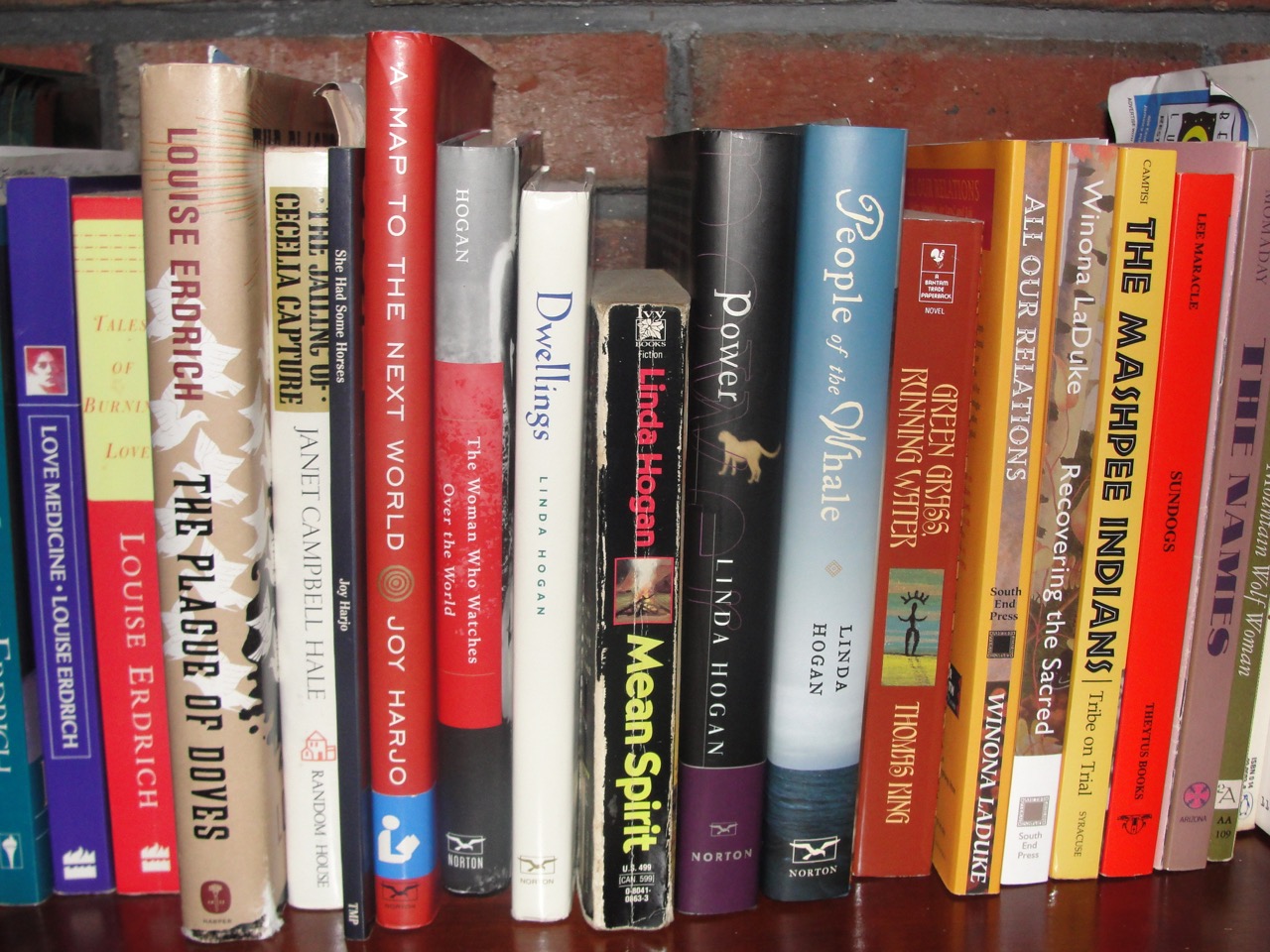
Estimates of the pre-contact population are hard to determine.  One scholar, William Denevan, tried to reconcile all the data and came up with fifty-four million in the Western Hemisphere.  But by 1650, the number had shrunk to six million.  Millions upon millions of people died.  In 1617, a few years before English settlers landed, an epidemic began to spread through the area that became southern New England.  It likely came from British fishermen, who had been fishing the waters off the coast for decades.  By 1620, ninety to ninety-six percent of the population had died.  Villages were left with so many bodies, the survivors fled to the next town, and the disease continued to spread.  It was a catastrophe never before seen anywhere in the world. Books on Shelf DSC00283


Projections from the Shadow Side of History

Turkeys DSC02379Thanksgiving is a holiday that always fills me with mixed feelings. Gratitude is wonderful, and getting together with family and friends can be a blessing. But I know that the stories we celebrate are white-washed versions of a history that has brought devastation to so many. I always remember that many Indigenous people call this the Day of Mourning.

The only time that foreign immigrants actually brought disease and destruction to this continent was when the English, Spanish, and French came to settle on its shores. Millions of Indigenous peoples died from diseases to which they had no resistance, or were killed in ongoing campaigns by the newcomers to destroy them and their way of life.

So while I give many thanks for my life, it feels sacrilegious to give thanks for prosperity that was built on the suffering and death of so many others. But it does illuminate for me, in a social psychological way, the possible roots of our American fear and hatred of foreign immigrants. I wonder if perhaps these feelings are a form of projection from this unacknowledged shadow side of American history. People imagine that new immigrants will bring destruction because the first settlers were the immigrants who did bring destruction.

This fear of the foreigner never proved realistic with later immigrants—with the Irish, the Italian, the Chinese, the German, the Jewish, the Puerto Rican, and so many others. Despite being hated and derided, they eventually became a part of the fabric of American life. Perhaps there is a link between facing more honestly our own shadowed and genocidal history, and letting go of our fear of the other.

Hard thoughts for a quiet holiday at home. But so many are cold and hungry and desperately seeking a safe harbor. And the tide of xenophobia and racism in our country seems to be rising out of control. Let’s help our friends and neighbors to keep their heads about them. I believe that when we are lucky enough to have shelter and food and clothing and safety, we are responsible for sharing what we can with those who are in need. To me, that is what thanksgiving should be all about.

Facing Up to the Reality of Evil

It is an amazing thing to feel safe in our homes and communities. A while back I was reading a novel about the Lost Boys of Sudan, What Is the What, by Dave Eggers. The story stirred up questions in my heart.  What would it feel like, I wondered, to have marauders showing up in your village, shooting people, burning houses, assaulting women and children? What would it feel like to lose your whole family, and your whole village?

When the death camps of the Nazis were discovered after World War Two, people swore, “Never again!” Yet, genocide continues in our day. Bosnia, Rwanda, southern Sudan, Darfur.

We asked ourselves, “How could someone fly a plane into a building with thousands of innocent people inside? How could someone massacre thousands of women and children of their own country?” Elie Wiesel, a survivor of Auschwitz, spoke of the incredulity of his village of Sighet in Transylvania in the months leading up to their deportation to the camps.

One man of the village had been taken away earlier and managed to escape, returning with terrible news. The Gestapo had forced the Jewish prisoners to dig huge graves, and then slaughtered the prisoners. “Each one had to go up to the hole and present his neck.” The villagers refused to believe the man. How could such a thing even be imagined? Right up to the moment when they themselves arrived at Birkenau, they clung to the impossibility of such a horror. Most of us feel incredulous in the face of evil.

Elie Wiesel wrote,

Never shall I forget that night, the first night in camp, which has turned my life into one long night… Never shall I forget that smoke. Never shall I forget the little faces of the children, whose bodies I saw turned into wreaths of smoke beneath a silent blue sky. Never shall I forget those flames which consumed my faith forever… which murdered my God and my soul and turned my dreams to dust…

I have never had to face personally the horrors described by Wiesel or by the Lost Boys of Sudan. Am I willing to listen to their stories and the stories of others who have encountered evil? Am I willing to let go of my own incredulity to face up to the reality of evil?  And what about those of us do experience such horror? How do we make sense of evil in the world? Where does it come from, and what can we do about it?

n_holocaust_wiesel_130127

Elie Wiesel quotes are from Night.