What If God Is a Fractal?

What if God is a fractal? What if God is a pattern that repeats itself from the infinitely large to the infinitely small, a pattern of life and love and creativity?

Human beings have always used images to help us understand the mysterious. Some images of God are like bigger versions of human beings—the Nicene Creed says “I believe in God, the father almighty.” God has often been seen as a father, a king, a ruler, a judge, or a lord.

But when our understanding of the universe grows more complex than these images, some have been tempted to give up on the idea of God. For many people, it doesn’t make any literal sense to imagine a huge king up in the sky somewhere. And if our experience of these authority figures has been difficult, their images are more likely to inspire fear and guilt rather than help us live our lives.

Ferns Full grown DSC05279If I imagine God as a fractal–a self-similar pattern both infinitely large and infinitely small–it helps me to be a whole person—to bring together my reasoning and my heart and my spirit.  It helps my mind to fathom the larger Mystery, as well as to understand the link to that Mystery I feel within my heart.

I am reminded that it is not a new thing to compare God to a geometric shape. The Christian tradition has used the triangle to describe God as trinity. But while the triangle is a static, simple, and smooth figure, a fractal has multiple dimensions, and infinitely complex variations and expressions. That fits my understanding of spirituality—I believe that there are infinite variations in the ways we can experience the holy. As the Sufi poet Rumi has said, “There are hundreds of ways to kneel and kiss the ground.”

There are other metaphors and images of fractal patterns that can expand our idea of God. For example, each cell of the human body contains the DNA pattern that shapes the whole body. If we use our imagination, we might say that human beings are like a single cell in the larger body of the universe and God is like the DNA within each cell, shaping it into its unique being.

Spirituality is a way of connecting our small selves to the mystery and grandeur of the larger whole of which we are a part.  If the larger whole is a fractal pattern, then in some deeply important way, we are already connected by the very pattern itself.


God, if You are real, I need a sign

If we’ve never tried to make a spiritual journey, it can seem complicated and difficult, like me trying to make sound come out of a saxophone. But once you’ve found the music, it can be as simple as turning a dial. We learn to recognize the sound of the Mystery’s still small voice. There isn’t just one right way to do it. The practices of the religions of the world are all attempts to find a way to tune in.

We might take up serpents, or practice sitting meditation, but we don’t need to. We don’t need to call it God or Goddess, or Spirit or Mystery, or call it anything at all, though that can be helpful to some people. We don’t have to come up with faith we don’t possess or sacrifice our desires. Whatever is going on in our deepest heart can help. Even doubt or despair can call it forth. We don’t have to abandon our intellect, or be a perfect icon of virtue. But we do need to slow down, change our frequency. We need to pay attention. We need to open a channel or a doorway, invite a connection.

Hands MJ DSC02028One evening, during my first year in college, my best friend and I were sitting in the quiet candlelit chapel of our campus. A few other people were also there, scattered about the pews. I remember feeling that we each seemed so isolated in our private meditation. I was moved to reach out and take the hand of my friend. Little did I realize, at that very moment, she had been wrestling with her own inner spiritual struggles.

Feeling a certain despair, she had just prayed, “God if you are real, I need a sign. It doesn’t have to be a miracle, I just need you to touch me in some way.” Then, I innocently took her hand, and it was the touch of God that she experienced.

Would you climb a mountain if you knew for sure that you could have a spiritual experience at the top? Would you go down into the river? Would you risk an invitation?

Experiencing the Mystery

I think back to the image of the radio waves that I have spoken about before. All the time, there is music moving through the air but we are unaware of it. However, if we tune our radio to the right frequency, we can suddenly hear the music. A whole invisible world opens up to our ears. In the same way, the larger reality, the Mystery, is already here, all the time. The Mystery is the unseen energy that connects and upholds all that exists. An even better image is wifi or a cell-phone. It isn’t just about hearing the voice of God, like music in the air, but also about our own voices being heard. We are connected. Someone, something, is paying attention to us, too.

We might think we are tiny insignificant specks of dust in a vast universe. Why would the Mystery want to pay attention to any of us, prophets or otherwise? I’m not sure, but I do know that there are moments when I feel paid attention to, when I feel connected. When that white truck took me to Massachusetts, I felt it. The Jewish religion has a belief that what we call angels are the manifestations of God into our individual lives. Not huge earthquakes, but a tiny whispering breeze that touches our hearts. A still small voice. Some call it synchronicity or serendipity. When I have opened my heart to the Mystery, the Mystery responds.

There is another part of the Elijah story that speaks to me. Just after Elijah heard that the queen was trying to kill him he went into the nearby wilderness. He prayed, “Yahweh, I have had enough! I wish I were dead.” Then he lay down and went to sleep. But an angel woke him and said, “Get up and eat.” He looked around, and there at his head was a scone. It doesn’t say what kind of scone. Did they have cinnamon or raisin scones then? I like to imagine that if God was thoughtful enough to send a scone, it would be a favorite kind. The angel said, “Get up and eat, or the journey will be too long for you.” So he ate the scone, and then he was ready to make that forty day trip to Mount Horeb.

My experiences of the Mystery are like that. A little scone, so I have the strength to make the long journey.  Or a small bird.  Or a hidden chipmunk watching me on the path.Chipmunk in Log MJ DSC04989

Recognizing Spirit–Keep Your Eyes Open or You Will Miss It

Misty Branch DSC05513Winifred Gallagher, in her memoir, Working on God, chronicled her own spiritual search in the context of what she called “millennial spirituality among the neo-agnostics.” Neo-agnostics are well-educated skeptics who are mistrustful of traditional religious dogma. Unlike believers, neo-agnostics don’t have ready answers to the big questions about the meaning of life. But unlike secular atheists, they sense something important beyond the tools of intellect and learning.

As part of her search, Gallagher studied Zen Buddhist meditation. She was curious about the Zen experience of kensho, which is translated as “see nature.” Kensho is a sudden, ecstatic transformation of a person’s perception of reality. She describes one practitioner’s experience of kensho:

One morning toward the end of a retreat, he despaired of his practice and wished to ‘turn back to the “normal” world.’ For some reason, he recalled the roshi saying ‘Keep your eyes open or you will miss it!’ Suddenly, he says… ‘the teacup in front of me seemed to “fly apart” and all the constituent matter in the cup, and in my body, and in the universe, were the same from all past to all future for endless time. I saw that what seems to be me or a cup is only due to where my self was sitting. This experience totally freed my self from the coming and going and caused the greatest gratitude to well up in my heart.

The word Buddha means the awakened one, and Buddhism offers itself as a method for waking up to the deep unity of reality all around us. Gallagher discovered, however, that Zen practitioners actually put little attention on these peak spiritual experiences. Part of their realization seems to be that ultimately ecstatic experiences do not matter, except perhaps as a help to waking up. The center of devotion for Zen is in the humble and simple practice of sitting and breathing meditation.

There is a similar lesson in the story of Elijah told in the Hebrew Bible. Elijah had displayed the power of his God Yahweh with great signs and wonders in a showdown with the prophets of the God Baal. But the queen, who was loyal to Baal and unconvinced by miracles, wanted to kill him, and he had to flee for his life. He walked for forty days and forty nights until he reached Horeb, the mountain of God.

The story goes on to say that he was told to wait out on the mountain and Yahweh would be passing by. Then there came a mighty wind, so strong it tore the mountains and shattered the rocks, but Yahweh was not in the wind. After the wind came an earthquake. But Yahweh was not in the earthquake. After the earthquake came a fire. But Yahweh was not in the fire. And after the fire there came the sound of a still small voice, like a gentle breeze. And when Elijah heard this, he covered his face with his cloak, for he knew that Yahweh was near.

Rabbi Burton Visottzky says, “A miracle is not God, but that which calls your attention to God, as pyrotechnics do. You have to stop, look—pay attention—before you hear God’s voice. Otherwise, you miss the miracle.”

The Limits of Mystical Experience

Rainbow in Branches DSC03269I come from a peculiar perspective on the topic of spirituality, because I grew up with a father who is a mystic. He later described to me his own pivotal experience of God. He told me he was lifted to a state of bliss that continued for two weeks. During that time, he could feel no pain, and he said if he went walking in the rain, he literally did not get wet. When he read the Christian scriptures, he was struck by the message that Jesus, who had been in glory with God, left that glory to become a human being. He felt then, that he too should let go of this heavenly state, and come back into the ordinary human world of suffering and joy, so he could be of service. And so he did.

When I was growing up, this God lived in our house like another member of the family. Learning to pray was like learning to talk—there was an expectation that someone was there listening. The other side of this story was that my father was far from perfect—he could be dogmatic about his experiences and beliefs, and critical of his children. He got angry and sad and frustrated and disappointed. Don’t get me wrong, he was and is a good and loving man. But once I grew up enough to form my own opinions, I realized that spiritual experiences were no guarantee of emotional compassion, or accuracy in the search for knowledge. Just because my father could have a spiritual experience, did not mean he was always right.

The biggest challenge for me in this regard came when my journey took a very different turn than my father’s. Our family had become involved in the Catholic Pentecostal movement, which in many ways was a very empowering and spiritually nurturing community for a teenage spiritual seeker. But during my last years of college, the Pentecostals were shaping themselves into a more institutional structure, and I found myself repelled by their hierarchical and sexist understandings of community. Where the Spirit seemed to be leading them was very different from where I felt the Spirit was leading me.

My great helper through that time was a woman professor of the Bible, who taught me about scholarly interpretation of sacred texts and the dangers of fundamentalism. I have talked about that in another post.  But I learned, then, that we cannot abandon mind and intellect, as we search for spiritual experience. We’d like to think that people who have spiritual experience will be always compassionate and wise. But it doesn’t necessarily work that way.

Our experience of the larger reality, the great Mystery, is mediated by our human limitations and our human failings. We must keep our eyes open. Spiritual community can be used to hurt and to oppress, as well as to help and uplift. Spiritual conviction can be used for destruction as well as for compassion. Jesus once said that you can know a tree by its fruit, and the apostle Paul wrote, “The fruits of the spirit are love, joy, peace, patience, kindness, goodness, faithfulness, gentleness and self-control.” We too must pay attention to the fruits that are borne by spiritual experience.

Eventually, my own spiritual and intellectual journey led me out of Christianity, and I became a part of the feminist revival of the Goddess. On the one hand, it could be said I was rejecting everything my father stood for. But on the other hand, the essence of the gospel message—the message of liberation for the downtrodden—had opened a door for this next stage of my journey. And it was a similar journey to his—a journey of being called beyond the familiar, into a new experience of reality; a journey of trusting this inner calling and conviction more than outer definitions.

Even though my father and I are worlds apart in the details of our spiritual expression, we can still sometimes find a deep connection because of the inner core of our spiritual journeying. My relationship to my father teaches me about the complications of searching after spirituality as experience. We must trust our own experience, we must honor the experience of others, but we must weigh everything according to our deep values.

Guilt or Love?

Steeple MJ DSC01914One of my hopes in this blog has been to expand our understanding of what God might be, what Mystery and Spirit might be, because so many people have been wounded by the false Gods of our culture. I want to take a closer look at one of those false Gods that I believe has hurt many people. If you have rejected the idea of God, perhaps you’ll recognize the one I am talking about. So I invite you to persevere with me as we explore it a little bit.

I think we can identify two approaches that people have taken to our relationship with the powers greater than ourselves. In one, the powers, the Gods, the Spirits were dangerous forces, and religious ritual was enlisted to appease these forces, and make the people safe from them. In the other, the Gods, the Spirits were benevolent forces, and religious ritual was enlisted to call upon the forces for help in dealing with the challenges of living. I am simplifying it of course, but still, there have been particular times in history when this battle between dangerous or fearful forces and kind and loving forces was in full blaze, and sometimes within the same religion.

When I was a child, I learned about one such conflict between a judging fearful God and a loving God. As a Catholic, I used to read about the lives of the saints, and one saint I liked a lot was Margaret Mary Alacoque. She lived during the 17th century in France. Just before her time, there had been a theologian named Cornelius Jansen who emphasized the idea of original sin. He believed that people were unworthy and evil, and only a few would be saved. Jansen discouraged people from participating in the communion ritual that happened every Sunday, saying it was reserved for only the very holy.

Sacred Heart

But Margaret Mary began to have visions—in her visions she saw Jesus, and she saw his heart, as if it were outside of his body, burning with love. He told her that God was full of love for people, and that God wanted to help people. Now, for those of you who have been Catholic, you may remember seeing pictures of the Sacred Heart of Jesus. It became an important devotion in Catholic life.

For me, this story was a gift—first of all, I thought it was cool that she had visions, and could talk to Jesus. But more importantly, this story told me that I was loved by God. All Catholic children learn a lot of guilt, and lessons about original sin, and mortal and venial sins, can weigh heavily upon us. But this story shifted the balance for me—it helped me to know deep in my heart that God was love, and that God loved me.

Now, I am guessing that very few people have ever heard of Cornelius Jansen or Margaret Mary, but perhaps you have your own memories of a church in which you felt guilt and shame, in which you learned that you were a sinner, or unworthy. Those ideas are just as pervasive today as in former centuries. The God of judgement has been a prevalent theme throughout the course of American history because of the teachings of someone much more famous that Jansen. More on that tomorrow.

Humility and Confidence

What do we do with people’s different understandings about God and the religious battles that go along with it? I believe we must begin by affirming that difference is real. People—in the same town and all over the world—think differently about the idea of God and have different experiences of God. That is real, and we can choose to fear it, or we can choose to welcome it, explore it, and even celebrate it.

But what does that do to our ideas about truth and reality? We might ask, for example, “Can God both exist and not exist at the same time?” That isn’t logical. But the truth is: both kinds of human experience exist! There are humans who experience or affirm God and there are humans who do not experience or affirm God. There are humans who experience or affirm certain images and ideas of God, and reject other images and ideas of God. We must take into account that all of our understanding about God comes through our human experience.

When my images and ideas about God began to change, something opened up before me. I embarked on a journey that demanded a deeper humility and a deeper confidence. I needed humility to recognize the incompleteness of my spiritual experience and the validity of truth beyond my understanding. I also needed to have confidence to claim my own experience as valid, whether or not others agreed with me.

I believe that each person’s experience is valid, at least in part, and the fullest truth is that which is weighed in community with the experience of others. This is one reason why I later chose to find a home within a Unitarian Universalist spiritual community that welcomes diverse beliefs. There is a Hebrew proverb: “Hospitality to strangers is greater than reverence for the name of God.” To live within a diverse spiritual community, we must cling more strongly to an open heart, than to specifics images and beliefs about God.

Heart StoneWhat this means for me is that the real God might be everywhere—hidden within each person, in each plant or animal, in each sunrise or stormy day, in the ordinary and the spectacular alike. Or God might be no where at all. It means that revelation is continuous and always unfolding. It means that words and images like God or Spirit or Mystery are metaphors trying to describe what is indescribable. The Sufi poet Rumi said,

“Just remember: it’s like saying of the king, he is not a weaver… words are on that level of God-knowing.”

My colleague the Rev. Forrest Church has said:

“The power which I cannot explain or know or name I call God. God is not God’s name. God is my name for the mystery that looms within and arches beyond the limits of my being. Life force, spirit of life, ground of being, these too are names for the unnamable which I am now content to call my God.”

Quote from The Soul of Rumi: A New Collection of Ecstatic Poems, translated by Coleman Barks, p. 77.

Re-imagining God?

If we seek some larger truth, we need to be open to our human experience. This approach sets me apart from people of some faiths, who have an idea of God that is mediated through external religious authority. Some religions believe that certain leaders or scriptures have the truth about God and reality, and the role of other persons is to follow and obey their authority. In these religions, a person may be instructed to discount their own experience as faulty or sinful, in favor of the wisdom of the leader. But that is not what I believe.

Perhaps I have been hurt too deeply by the misused authority of religious leaders. The very idea of God has felt corrupted by the betrayals of religious institutions. Alice Walker explores this question in her novel, The Color Purple. Two black women, Celie and Shug, talk about the God that they find in the white man’s Bible. Shug says, “Ain’t no way to read the bible and not think God white… When I found out I thought God was white, and a man, I lost interest.”

There was a time in my life, too, when the God of the churches didn’t work for me. At first, when I was a child, God was like a perfect father. I learned about this God from my Catholic family. My idea of God helped me as a child: I felt held in the care of a strong and loving presence. Later, when my family and I became a part of a Pentecostal movement among Catholics, this community also believed that God was a loving father. They emphasized that the Spirit would communicate with us directly and would guide us on our path. It opened a beautiful door to a spirituality of direct experience.

But by and by, a problem occurred for me. This Spirit seemed to be guiding people in really different directions. One man heard the Spirit say that men should be stronger leaders, and women should be only in supportive roles. But the Spirit in my heart was saying that men and women were equal. So why were my gifts and energy not valued? I didn’t feel equal enough in that group to express my truth, so I left instead. I felt like my heart was broken.

Later, the work of feminist philosopher Mary Daly helped me better understand how culture influences our most personal images and experiences. A white male-dominated culture will create white male-dominant images of God. We draw a picture of God shaped by our cultural expectations. And those images in turn reinforce the cultural values by which we live. The father God was white and male and reinforced a system of domination by white men. So where did that leave me and other women and those who were oppressed by racism?

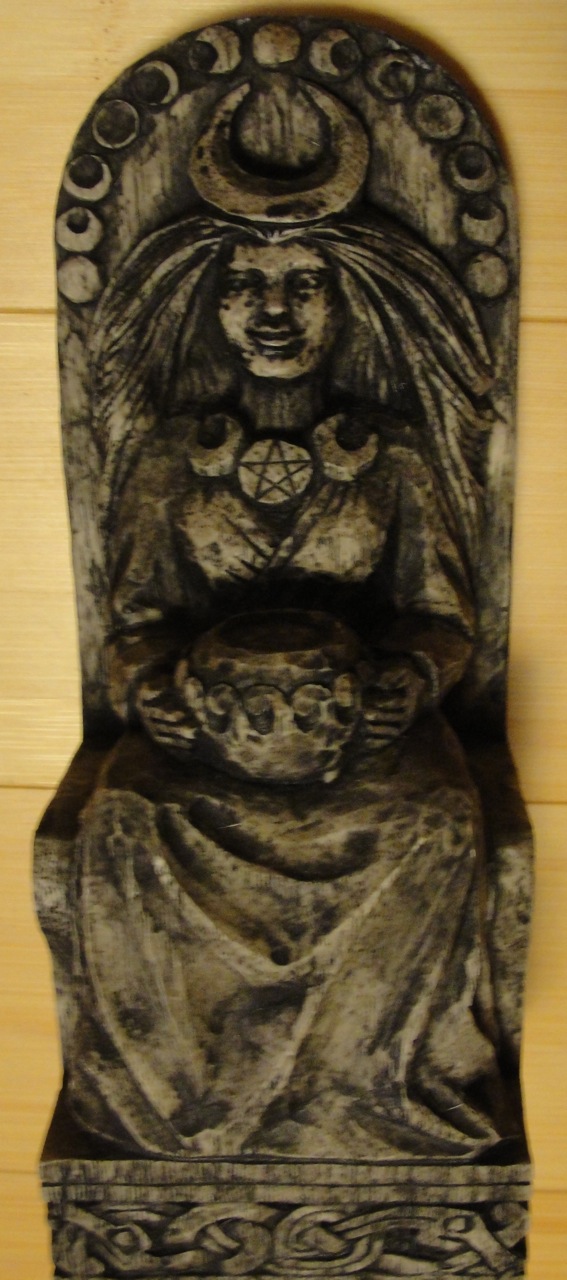
For many years I didn’t know what to do about God. The word had become almost noxious to me, and connected to oppressive forces in my life. Yet I still felt a relationship to some sort of spiritual experience. For a while I didn’t know how to imagine or think about it. Seated GoddessBut I was part of a group of women who were wrestling with all of this together. We began to counter the oppressive forces of religion by creating new images of the divine in a conscious way. We re-imagined God as female, by calling her Goddess. We realized that many cultures have worshipped the divine in female form.

But is it possible to imagine a Goddess and experience her as real? What is real and what is imaginary? Here’s the thing I discovered. The Goddess began to feel real to me when my life started to change. Something is real when it makes a difference to us, when it causes transformation in our lives. Images become real when they open a door. The Goddess became real when the power of women became real—when we were able to embrace our own sacredness, affirm our own intrinsic value and dignity, and live out our own gifts and talents and leadership.

In The Color Purple, Shug also found new ways to imagine God. She said,

My first step from the old white man was trees. Then air. Then birds. Then other people. But one day, when I was sitting quiet and feeling like a motherless child, which I was, it come to me: that feeling of being part of everything, not separate at all. I knew that if I cut a tree, my arm would bleed. And I laughed and I cried and I run all around the house. I knew just what it was.

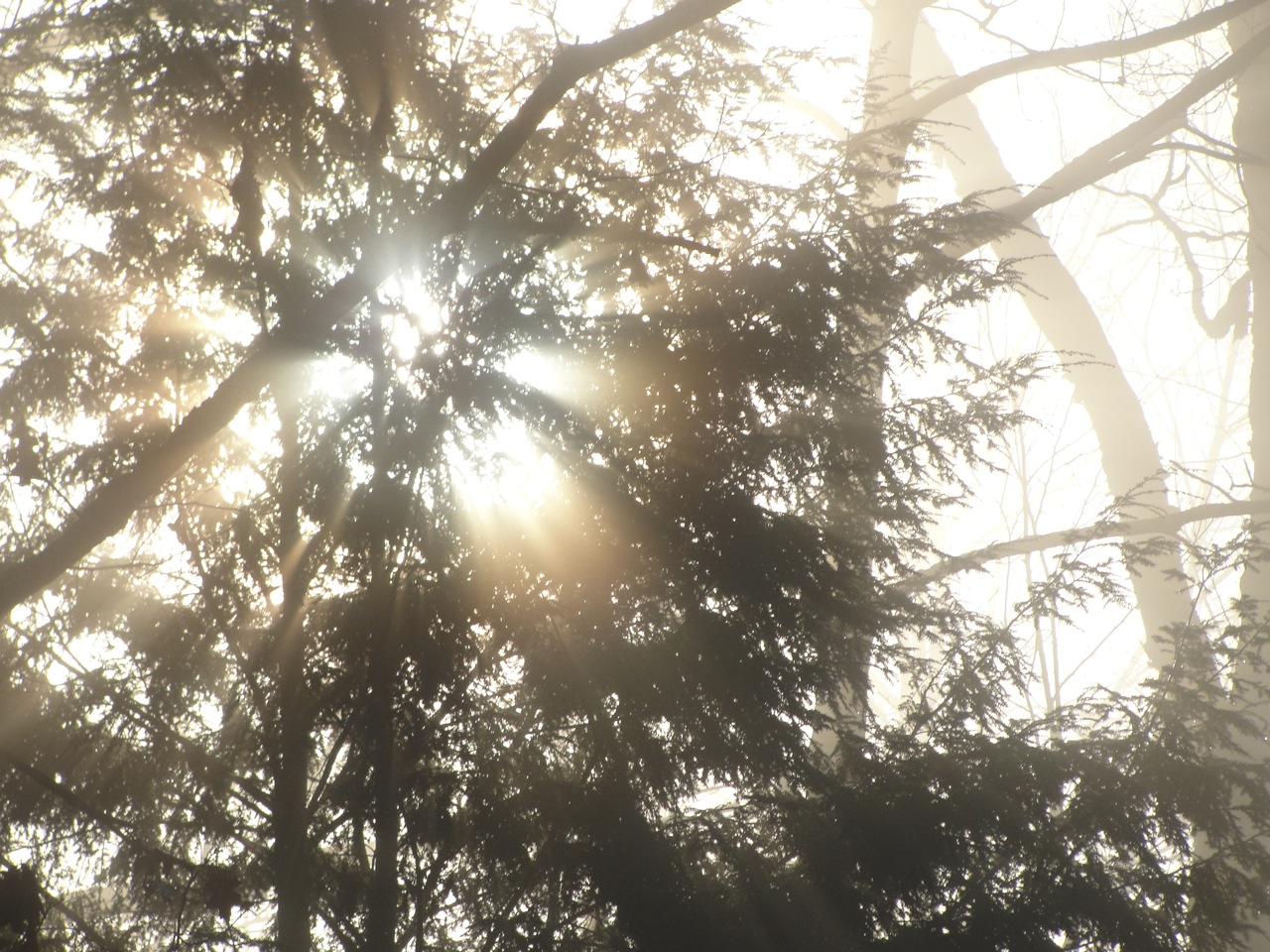
Sun in Trees DSC05525

Quotes from Alice Walker, The Color Purple, p. 166.
Mary Daly, Beyond God the Father, (Beacon Press, 1973)