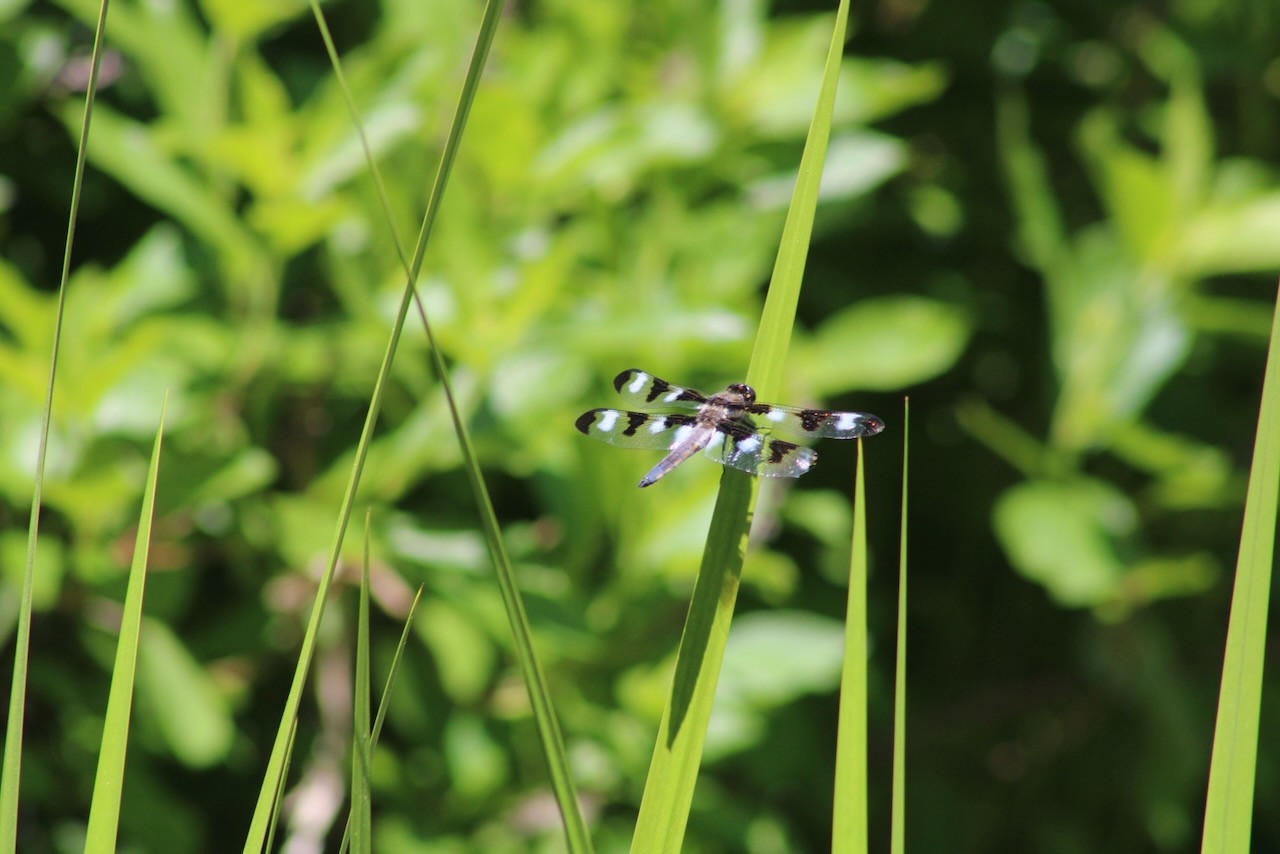
I’ve seen dragonflies flying around the pond, mating above the pond, and dipping their tales into the water to lay eggs. I’ve seen dragonfly larvae in the pond swimming around. But until this week, I never knew if any of the larvae had lived long enough to transform into adult dragonflies. During the last few days I saw what I thought might be some sort of insect perched near the bottom of an iris stalk. But with a little research, I now realize that it is an empty husk from which a dragonfly larva has molted.
The pond never ceases to delight with the cycles of life of so many creatures. This month also saw these toads clasped in their mating posture, the male on the back of the larger female. I don’t know if any of the tadpoles from before have survived–just because I don’t see them doesn’t mean that they aren’t hiding somewhere. But they are low on the food chain, eaten by frogs, and also by dragonfly larvae. However, with more eggs in long strings, maybe more tadpoles are on the way.
The heavy rains of the last several days have delighted the tree frogs who are singing in the night. I haven’t seen any of them in the pond this year. Each year it seems that different species choose to inhabit this little pool of water. Thankfully, even on days when I don’t have the energy to tend to the many plants in the garden that would love some attention, I can sit by the pond and appreciate all that it holds.
There is so much beauty in the spring, but it all seems to be moving so fast. I can’t keep up. Mayday has come and gone. Already this season is half over. After two months of physical therapy for my hip and lower back, I am able to walk fifteen minutes and more again. The other day I walked to Capisic brook and onto the path nearby, and saw the trout lilies that usually grow there, a lovely spring ephemeral. American Heritage Dictionary defines ephemeral:
Lasting for a markedly brief time.
Having a short lifespan or a short annual period of aboveground growth. Used especially of plants.
Spring itself and all its beauty feels markedly brief. Is my love of photos a way of trying to hold on to all that is ephemeral? Is my need to write an attempt to halt the relentless flow of time?
I have been drawn outside more and more each day, excited to see daffodils and violets and green shoots coming up everywhere. And, happily, the peach tree is now covered with pink blossoms, and the cherry trees have many blossoms too. Last year, because of the weather, there were none–so these beauties seem fragile and extra special because of that vulnerability.
Peach blossoms on a foggy day.
There are many projects in the yard to attend to. Many branches fell from trees in the storms of winter and early spring. Margy has been cutting them up and hauling them around. Some of these we’re using to make a brush pile in the back corner for wildlife habitat. The other day, I cleared that space of invasive plants. I also set up our eight rain barrels again. We are going to get an new order of firewood, after using up our last old logs in the storms. So we are working on the space for the firewood, and purchased a rack to keep them off the ground.
Yesterday, I added two more pond lilies to the plants in the little pond, and as I was tidying up old dead shoots from other plants, I found strings of toad eggs attached to the old ferns. (So of course I left those.) We haven’t had toad eggs in the pond before. But there are a few frogs beginning to make an appearance–shy ones who have been diving under when they hear me approach.
The robins did not come back to the nest on our back porch that they had used for two years. Maybe that pair are no longer living. I read that their average life span in the wild may be just two years. I also read that they often don’t reuse nest sites–so we were lucky to have them in that spot for two years. Another ephemeral.
Then we discovered a nest in the yew bush near our front door–able to be partly seen from our living room window. So new robins are raising young nearby again. Maybe one of them fledged from the back porch.
Blue robins egg barely visible behind branches.
Is my love of photos a way of trying to hold on to all that is ephemeral? Is my need to write an attempt to halt the relentless flow of time?
I was cuddling with my cat Billie on the couch and suddenly felt a deep sense of our own impermanence. She is 13, I am 70. Senior cat, senior human. How much more time do we have? Someday, I won’t be able to feel her warm little body, with its soft fur and sweet smell, curling up on the pillow near my face. Someday, she will be gone; someday, I will be gone. We too are ephemeral. I want to hold on, but life seems to be about movement, about letting go into the next moment.
Since we have been in Ireland, I have learned more about fairy trees than I knew before. On the first day we were here, I was taking photos on the grounds of the B & B, Ashley Park House, and took this one of some beautiful blooms I couldn’t identify. So many of the plants and birds I was seeing were unfamiliar to me. I wondered if it might be a hawthorn, because of the small thorns on the branches. But it had been a long time since I had been around a hawthorn. Years ago, when I was at the Seneca Women’s Peace Camp, my friend Estelle and I pitched our tents in a little opening of the hedgerow, under a hawthorn tree. And that was a magical place and time, though I didn’t know about fairy trees then.
When we came over to Ashford in County Wicklow the owner of our B & B had some of these blossoms on our dining table. I asked her what they were, and she said they were hawthorn. She herself is not Irish, though she has lived in Ireland for many years. The next day she told us that her Irish friend had sternly scolded her that it was bad luck to bring these flowers into the house. We later met that very friend, and she repeated her consternation. She told us that the hawthorn trees are where the “wee folk” live, and they are not to be disturbed. According to Irish lore, “If you cut one down, you will die.” You will often see a whole cleared farm field, with a solitary tree remaining–a hawthorn.
I do apologize to the wee folk on behalf of our host–I was glad that her misstep offered me an opportunity to confirm my hunch about the blossoms and gain more understanding about these beautiful trees. Because of so-called “superstitions” like this about the realm of fairy, many ancient sites have been preserved without disturbance for generations. Fairy mounds and fairy forts and burial sites. We visited a fairy fort at Ashley Park, a neolithic ring fort made of stones and earth, and covered now with beech trees, and yes, some hawthorn too. I left a gift of a coin before taking anything from that place. A strange thing happened. I was deciding where to leave the coin, and was finally drawn to the largest beech tree, somewhat near the entrance to the fort. I tossed the little coin into a deep crevice near the root of the tree.
Then, looking in more closely, I realized there was a tiny toad or frog at the very back of the crevice. I never saw any other toads in that area. How did it happen that one lived right where I was pulled to leave the offering? When Margy and I came back the next day together, it was still there, and I took this picture, somewhat blurry as it happened.
In each of these ancient holy places, I have honored the elements and the directions and the ancestors in the best way I can, and these small magics reassure me that we are welcome here.


 Finding Our Way Home