Linda Hogan’s Solar Storms

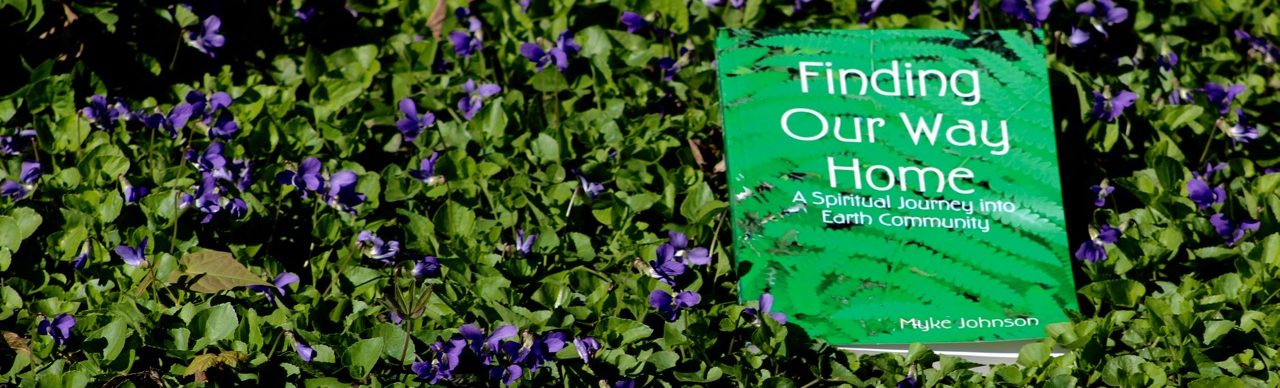
My favorite novel of all time is Chickasaw writer Linda Hogan’s Solar Storms.  Published in 1997, it is the story of Angel, a girl who was taken from her Native relatives as a tiny child and raised in foster care, after being abused by her mentally ill mother.  At 17, she comes back to find her grandmothers and learn about who she is.  During this time, people in her small village discover that hydroelectric dams are planned for their ancestral homeland in the north, so four women travel by canoe to help in the struggle against it.  I first read this book when I was working (with Massachusetts “Save James Bay”) against the hydroelectric dams that were being built in Quebec, and I learned later that Hogan had drawn from that situation in creating her fictional account.

But this brief description of the plot can’t do justice to the many layers of poetry and meaning that are woven into her narrative.  I learned about what it might mean to be deeply connected to a place–to be indigenous to a place.  I learned that loving the earth isn’t just about loving the planet, but rather about loving a particular island or river or peninsula or forest.  I learned that we can love the earth even if we are not indigenous, even if the earth keeps some secrets from us.  It helped me along my journey to find my own connection to the earth.  The elder Tulik tells Angel, “Here a person is only strong when they feel the land.  Until then a person is not a human being.”⁠ [p.235]

Linda Hogan tackles issues that face Native people–including the taking of children and the taking of land–and brings alive for all of us the heartbreak and courage that are born in this brokenness, and the beauty that may be created as people move toward healing.  As we face more and more destruction on our planet, we all so much need to learn to “feel the land.”
Broken Rock DSC00135

Helpers for Finding Our Way Home

Cardinal

Margy Dowzer Photo

There are beings all around us who want to be called upon, who want to help us in this work of returning to wholeness, this work of finding our way home. I have shared stories of a few of the beings who have helped me. The bright red cardinal singing its beautiful song. The four directions beech tree. The waters of lakes and streams. The ground, the very ground we walk upon, that holds me when all around me everything is falling apart.

Now that I know about the mycelial network, the ground feels more alive to me. But it was always true that something happened when I sat down upon the ground. If I sleep on the ground for a longer period of days, there is a glow that surrounds my body. I remember this from my time at the Women’s Peace Camp, where I was living in a tent for four months. I felt alive in some new way that I began to miss when I went back inside an apartment in Chicago. I forget it easily, but I feel more alive when I am outside.

Jesus has been such a helping presence too. First in my childhood and youth, when he was the one who loved me and who called me to the path of love. But even later, when I was leaving Christianity to follow the path of the Goddess, Jesus was a guide and a friend. If we can experience the divine within every being around us, the theological questions about Jesus seem less of a quandary. People have been asking, over the centuries, Was Jesus a man or a God? I would answer, Aren’t all of us both human and divine?

When Winifred Gallagher wrote about her quest for a spiritual home, she described the essential spiritual practice of the Christian tradition as the practice of love for everyone. She commented that it seemed a lot easier to meditate for an hour every day, than to have to practice love for everyone—it was not an easy alternative. It has been a deep tragedy that Christianity has been used to foster hate and oppression. Jesus stays in my life as the teacher of love, the human example of what divine love looks like.

I want you to know that we are not alone. In this time of great challenges and transitions, there are a host of beings who love life and want to help us find another way to live. As we reach out to them, they are reaching out to us. I understand that every person will have their own ways of connecting to earth, to each other, to Mystery. The mycelial network might not be the thing that helps you to experience the connection between all beings. You might not resonate with Jesus or with trees. But I encourage you to find out what it is that does help you. In these times we need critical thinking and activism and also mysticism.

Just as we can now sit in front of a plastic and metal panel and communicate with people across the world, so there are technologies to communicate across species and across dimensions. The threads of life weave us together in ways we have barely begun to imagine. But I know this: we belong here together and we need each other now more than ever. Poet Barbara Deming wrote:

Our own pulse beats in every stranger’s throat,
and also there within the flowered ground beneath our feet.
Teach us to listen:
We can hear it in water, in wood, and even in stone.
We are earth of this earth, and we are bone of its bone.
This is the prayer I sing.

Green Back Yard DSC05265

Have We Known the Anguish of an Unanswered Prayer?

Perhaps we fell in love with the person of our dreams, but despite our yearnings and furtive requests to a higher power, our feelings remained unrequited. Perhaps we were watching the game of our favorite sports team—but they lost despite the collective energy of millions of fans. I know that may seem trivial, but a huge number of people pray for their teams to win. Perhaps we were confronted with the serious illness of a loved one, yet all our begging and bargains with God did not make them well. When I think about prayer it is hard not to remember that anguish.

And yet, for me, there are also other memories. There have been times when, to my surprise, strange and wonderful things happened after prayers. As if, despite my appeals, I never really expected a response.

Several years ago, my youngest brother in Michigan was getting married. I am the oldest of nine siblings, and we are scattered across the country. It is rare for my family to be gathered all together. At that time, our finances were very tight, but I really hoped that Margy and I could attend the wedding, since she hadn’t had a chance to meet most of my family yet. But then we found out that two tickets would cost $850. We knew we couldn’t afford that. So I prayed; and I also called my dad and asked him to pray. (No, he did not send us the tickets.) The very next morning, an email came, announcing special bargain fares from Southwest Airlines. The two of us could go for a total of $325.

Perhaps you may have had similar unexplainable experiences. A friend of mine just recently told me a story. She was having a particularly difficult night, with chronic pain that flared up keeping her from being able to sleep. She had never done this before, but for some reason, she reached out and prayed for help with the pain. And then, suddenly, all the pain went away. She was completely pain free for the first time in weeks. She was able to rest, and fell asleep in a deep peace. This prayer did not take away the pain for good. But it did remove it during several hours that night.

We pray when we face a challenge that feels bigger than we are. Praying is a way to appeal to the larger Mystery of the universe, the force for kindness or benevolence, to aid us in our smallness, our vulnerability.

All of this implies that there is something or someone to whom we are reaching out for help. Do we need to believe in God to pray? The answer is not as simple as yes or no.  I define spirituality as our experience of connection to the larger Mystery of which we are a part. We don’t have to understand God in a literal way. In fact it might be better understood metaphorically.

I am thinking of it like a flow of water. If we dive into and relax in a large body of water, we can float; we can also choose to draw water into our bodies by drinking, we can shape water, use it to cause change, create something with it. Prayer is like that. We connect to the larger reality through some kind of opening up or diving in. And if our connection to the larger reality is real, it is not merely an experience like going to the movies, where we can watch but not participate. Our connection creates transformation for our lives.

Swan in water MJ DSC09904

If we wake up to the earth, we must listen to all her stories

All places and all beings of the earth are sacred. It is dangerous to designate some places sacred when all are sacred. Such compromises imply that there is a hierarchy of value, with some places and some living beings not as important as others. No part of the earth is expendable; the earth is a whole that cannot be fragmented…
Leslie Marmon Silko

Winter Path DSC01793When I was in theological school, we spoke of the sacred texts in which people find revelation of divinity. To be open to the sacredness of earth, is to let the earth be our text: let the earth be the revelation for the presence of divinity. The earth can be teacher, the earth can be sacrament, the earth can be worship, the earth can be Goddess.

But if we wake up to the earth, we must listen to all her stories. If we live in the Americas, we must pay attention to a story of brokenness in each place because of the theft of the land from the Indigenous peoples who belong here. If we are seeking to restore our connection to the land, we must reckon with that brokenness. All of us are a part of the brokenness.

Lakota writer Luther Standing Bear said, “Men must be born and reborn to belong. Their bodies must be formed of the dust of their forefathers’ bones.” To be indigenous is to belong to a particular place, through that interweaving of dust and food and knowledge which accumulates over centuries. When I lived in Jamaica Plain, I used to walk in Forest Hills Cemetery. None of my ancestors were buried there. No familiar ghosts recognized me or called my name. I was not indigenous to that place, nor to any of the places I have lived.

I learned more about what it might mean to be indigenous to a place through the marvelous novel, Solar Storms, by Chickasaw writer Linda Hogan. Her main character, Angel, is a young woman who had been separated from the Native community of her birth, and raised in foster care after being abused by her mentally ill mother. When Angel returns with her relatives to their ancestral lands, something happens for her.

A part of me remembered this world… it seemed to embody us. We were shaped out of this land by the hands of gods. Or maybe it was that we embodied the land. And in some way I could not yet comprehend, it also embodied my mother, both of them stripped and torn…. My heart and the beat of the land, the land I should have come from, were becoming the same thing.

In the novel, Angel’s family has returned to their homeland in the north of Canada because it is being threatened with hydro-electric development. This is no pristine wilderness or unspoiled scenery to which she is responding. The land is under assault, and they feel a responsibility to fight for its protection. She speaks of how the bonds between the land and the people had been broken by the developments of many years. The elder Tulik tells Angel, “Here a person is only strong when they feel the land. Until then a person is not a human being.”

Another member of her family was a woman named Bush who was Chickasaw from Oklahoma and had become part of the family through marriage. She had also come to help in the struggle. Angel talks about how it was different for Bush. The land in the far north loved Bush, “but it did not tell her the things it told the rest of us. It kept secrets from her.” Here was another Native American, yet she was not indigenous to that particular land. Through this story I began to better understand how loving the earth was not just about loving the planet, but about loving a particular river, a particular valley or hill or peninsula.

Quote from Leslie Marmon Silko is from Yellow Woman and a Beauty of the Spirit.
Luther Standing Bear was quoted by Vine Deloria quote in God Is Red.

Meandering Toward Wholeness

If I can remember to be thankful about water, then I have the capacity to take action on its behalf as well. There are many people mobilizing on behalf of clean water. Thankfulness can be the beginning of restoring our relationship with water. And then the water itself will guide us into the next steps on the journey.

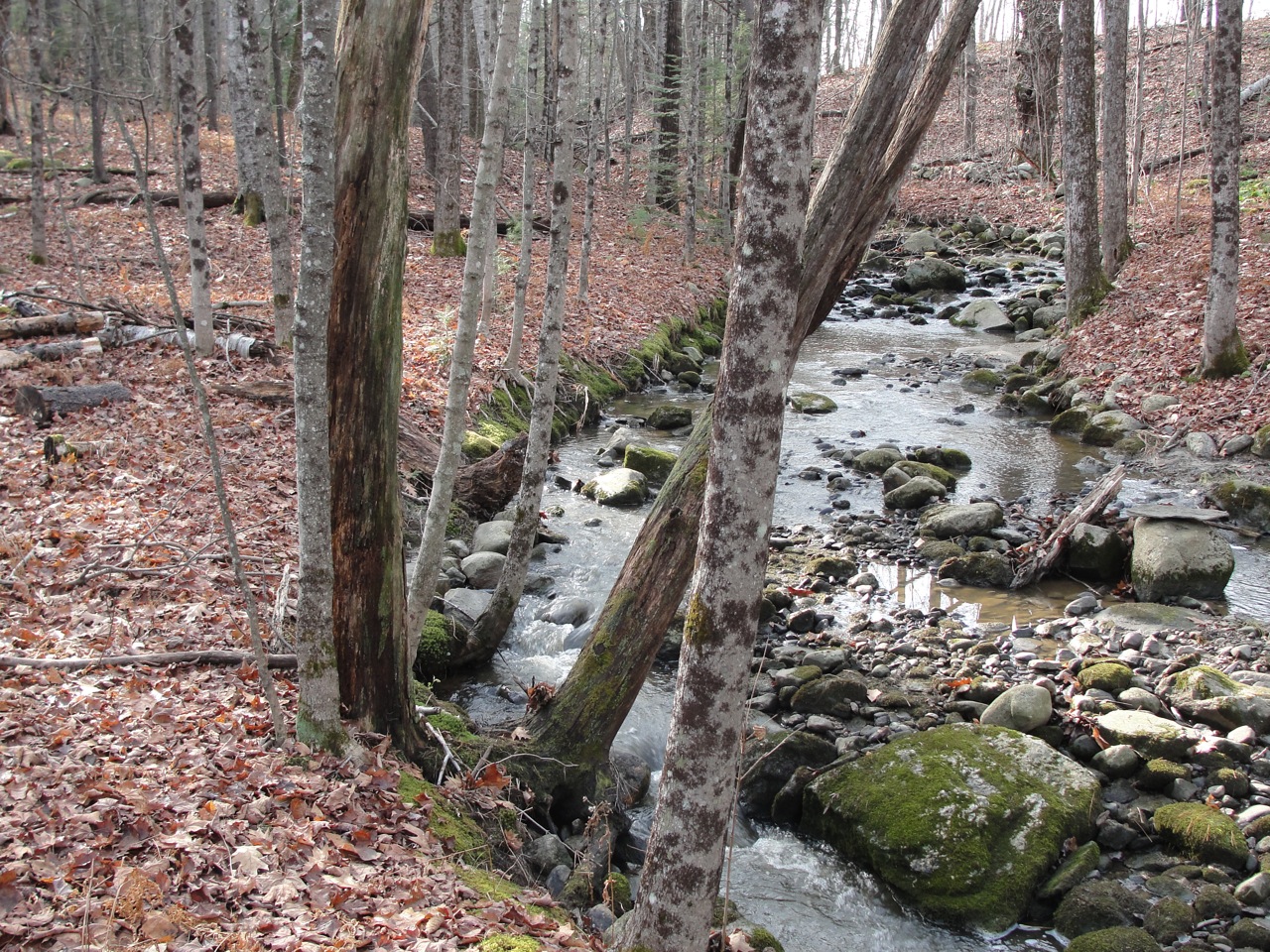
Stream DSC02225The path forward is never a straight line. I find hope in that. A river or stream meanders on its way to the sea. Starhawk explains that because of the friction of the river bed, the water on the bottom of the river moves more slowly than the water on the top. So it creates a spiraling current that wears down one bank and deposits sediment on the other, and then vice versa, as it move around and around in sweeping curves.1 Just so, our journey into a new relationship with all life on earth will meander—I imagine in this case, there is more movement at the bottom of our culture, while the top is going much slower. But since we are all connected, movement in any segment has a ripple effect on the whole.

For me, hope also comes with the choice to keeping taking steps, even small steps, in the direction of living in balance with the rest of our interdependent web. To keep meandering in the direction of wholeness. To keep learning from our elder siblings on this planet—learning from the plants, and animals, the soil and the seasons.


Photo by Margy Dowzer

Photo by Margy Dowzer

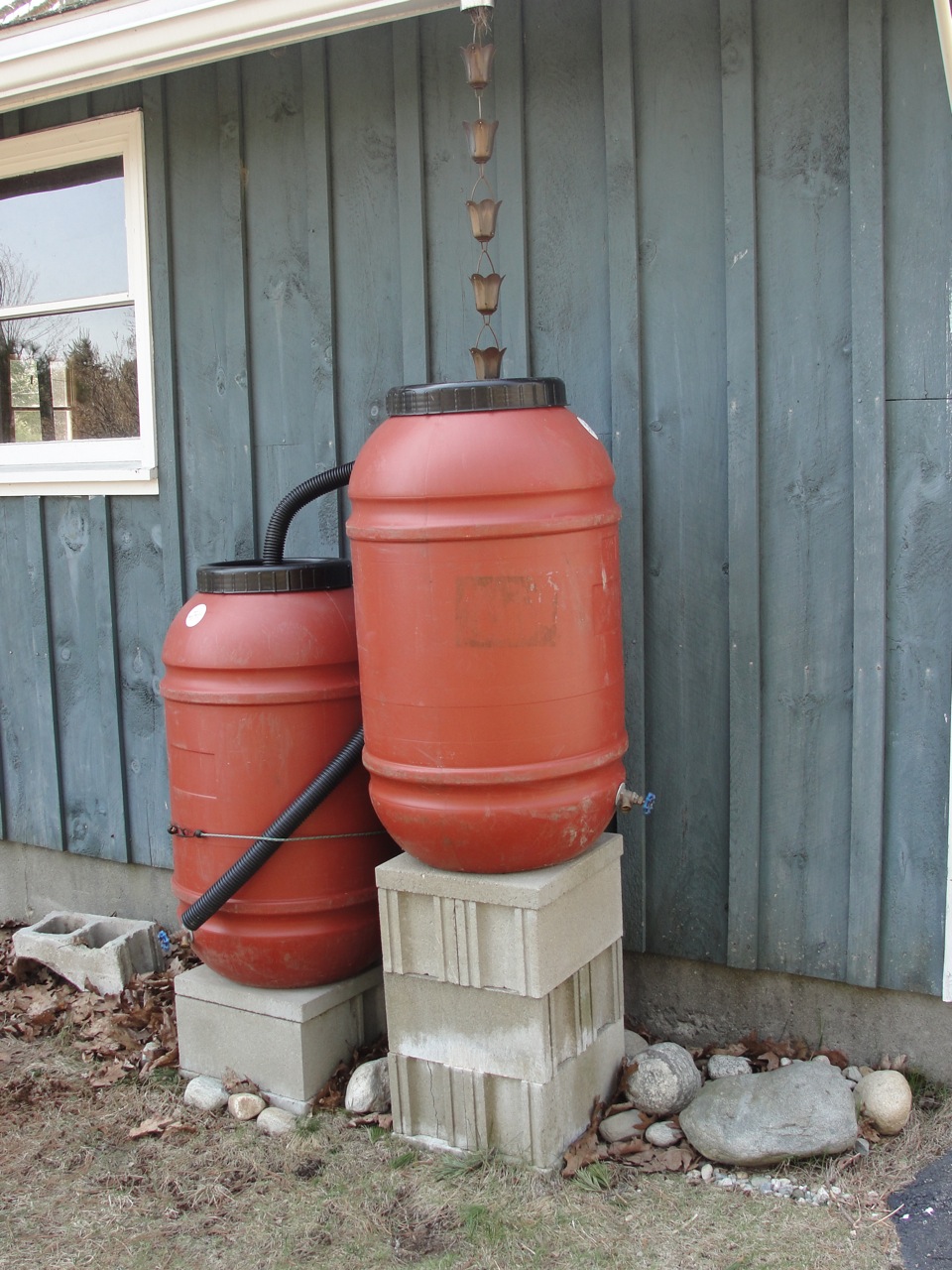
One summer, Margy and I purchased two rain barrels, as one step toward more conscious participation in the great cycle of water. We are collecting the rain-water that runs off our garage roof, for use in watering the blueberry bushes I planted in our front yard. We are learning about how high off the ground the barrels need to be, in order for gravity to pull the water all the way to the plants. We are learning that water in a rain barrel heats up rather quickly in the hot summer sun. We are learning how quickly a rainstorm can fill two fifty gallon barrels.

It is a very small step, especially here in our comparatively water abundant climate in Maine. No matter. Some people are taking bigger steps, and that gives me hope too. For example, some people are designing gray water systems that take the water from washing and showering and use it for the garden. Others are restoring rivers and lakes that once were declared dead.

All the earth is one earth. All the water is one water. We all belong to this great cycle of life. Each creative step forward will ripple out into a spiral momentum toward greater balance. I feel hopeful that so many human beings are embracing these deep truths and changing the way we imagine our futures.

We Are a Part of the Watershed

Photo by Margy Dowzer

Photo by Margy Dowzer

Analysts are predicting that water will be the number one political issue in the coming years. Just as wars are being fought over oil, so increasingly there are conflicts over access to water. The business solution is to introduce the “privatization” of water: the theory is that if water is a scarce resource, then the market should determine its price, and price will regulate its use. But citizen’s groups are fighting back to say that water cannot be commodified, because it is an absolute necessity for life. Rather, water must be recognized as a fundamental right and provided equitably to all.

The danger in the privatization of water is that it takes water out of its relationship to all living beings, and into the hands of a system which is set up to think only in terms of profit. Water is not something separate from us, something we have made, that we might think of it in terms of selling and buying. Water is in us and we are in water. We must think of ourselves as part of the watershed.

The water we drink passes through us, and is returned to the earth. When we open our hearts to the wonder of this cycle, we can begin to heal from the out-of-balance patterns we all have learned in our society. Weeping is a part of it too. The water of tears moves our grief, heals and cleanses, as water does, moves us on the journey. The cycles of water teach us that we are all related.

Each of us has a choice. Will we approach water as a commodity to be used, or as a blessing to be honored? If we acknowledge water as a blessing, we recognize its essential importance. Water is the mother of all life. There is no life without water. Whether we view it scientifically or spiritually, water is the womb from which all living beings have been born. We are made of water and we need the constant flowing through of water to remain alive in this world. When I made the conscious choice to regard water as a blessing, I decided to stop using plastic bottled water as much as I was able. I like to carry water with me, so now I carry tap water in a special reusable metal bottle. Anytime I drink water, I am reminded to offer thanks for the blessing.

All religious traditions have recognized the sacredness of water in some way. The old earth religions always revered a god or goddess of the waters—usually certain spirits were associated with salt water and others with fresh water. I learned about some of these water spirits from Mandaza, a healer from Zimbabwe who visited my previous congregation. According to Mandaza, the water spirits offer us healing and peacemaking. There are rituals for people to go into the water when they desire to be restored to wholeness or to find guidance for their spiritual journey.

According to my friend, gkisedtanamoogk, water is considered a Manito, a mysterious life force that has its own life. Water is also medicine, the most important medicine in Creation. The Wampanoag people know fresh water as Nipinapizek, and regard her as a grandmother. He wrote to me, “i think that we humans only exist because there is a significant number of people who remember to Give Thanks to all Those Ones who are the Keepers of Life, one of Those being, NIPINAPIZEK. May we continue to Give Thanks…..”

When I was growing up as a Catholic, we used to bless ourselves by touching our fingers in holy water. I associated it with purifying ourselves because we were in some way unclean. But now, the blessing of water feels more like remembering our heritage. We come from water. Since all water is holy, we are holy too. We are washed by water, we are restored by water, we are nourished by water. 

Water Is a Teacher

Water is a teacher. Water teaches us about the unity of all creation. All life comes from water, and needs water to survive. Water moves through the whole ecosystem, nurturing and transforming life as it moves. It rises from the ocean in evaporation, forming clouds in the sky, and, blown by the winds, it returns to the land in the form of rain. The rain falls into the soil, and gathers in streams and aquifers. In the midst of this journey, it also travels through the bodies of every living thing.

Margy and I have a bird bath outside our back door. Many kinds of birds come to drink the water we keep filled there, but we’ve also seen squirrels, chipmunks and bees. Every being needs water: insects, birds, mammals, fish, humans. Water rises up into the stems of plants and the trunks of tall trees.Chickadee at Bird Bath MJ DSC00964

Our bodies are 70% water—so it would be accurate to say that we ourselves are one form of water. But none of the water stays isolated from the rest—we drink it in, it moves through our blood, we sweat it out or pee it out. Sometimes we weep with wet salty tears. The water goes back to the earth and continues in streams and rivers on its way to the ocean.

When I was ten, my family went on vacation in the mountains of Wyoming. I remember coming upon a stream that had a little sign saying the water was drinkable. My sisters and I were very excited that we could drink right out of the stream. The water tasted funny to us, with its enhanced mineral content, but it was cool and refreshing none the less. Now, looking back on that event, I am saddened by our amazement at drinking water directly from the earth. For millennia, all people drank from rivers and streams, and animals still do. But in the memories of most of us, this no longer is a part of our expectations about water. We take for granted that pollution has made most water undrinkable unless it is purified.

It may seem as if there is an endless supply of water on the earth. But of all the water on the earth, only one percent is fresh water. More and more water is being polluted, or being diverted to industrial or agricultural use. We have now reached the stage where there is a global crisis looming as drinkable water becomes increasingly scarce.

Oren Lyons, Faithkeeper of the Turtle Clan of the Onandaga Nation, has said:

One of the Natural laws is that you’ve got to keep things pure. Especially the water. Keeping the water pure is one of the first laws of life. If you destroy the water, you destroy life. That’s what I mean about common sense. Anybody can see that. All life on Mother Earth depends on pure water, yet we spill every kind of dirt and filth and poison into it.

Ecological Connection and the Wall of Grief

Jon Young, founder of the Wilderness Awareness School, teaches young people the skills of wildlife tracking and plant identification, fostering an ecological connection to nature. Many skills and techniques are easy to learn, and there is a deepening sense of wonder and gratitude that grows along with their skills. But when the youth reach a certain stage in their learning, they hit what he calls the “wall of grief,” an experience of being overwhelmed with sorrow at the loss and degradation of the natural world around us. That grief is the most difficult challenge the young people face in all of the school’s programs.

Live-video-of-BP-oil-spil-004I felt such a wall of grief, during the spring and summer of 2010 watching millions of gallons of oil pouring into the Gulf of Mexico from the broken BP oil well. It seemed as if the earth itself was bleeding from this gaping human-made wound deep below the waters of the sea.

I believe that our spiritual growth depends on deepening our connection to the interdependent web of all existence, of which we are a part. The natural world is vital to our spiritual journey. We might say that the earth is our Bible, our Quran, our sacred revelation, and our paradise. We echo this principle in the mission statement of my own congregation, when we say, simply, that we walk with care on this earth.

But there are times when that careful walk awakens deep sorrow and anguish. We know so much more than human beings have known before. We know what is happening all over the globe. We see the melting of ancient glaciers, as the climate heats up from greenhouse gases. We know there is a vast soup of plastic refuse possibly twice the size of the continental United States floating in the Pacific Ocean. We know that the topsoil in which our food grows is being depleted, and the rain forests which renew the world’s oxygen are being cut down. We know that increasing numbers of species are threatened with extinction. We know that there are nuclear stockpiles that could destroy most life on earth many times over.

We know so much more than human beings have known before, but we don’t know the solutions to these problems that threaten our future. And that is a wall of grief that can stop us in our tracks as we seek to walk with care on this earth. How do we live with the painful questions that do not yet have answers?  

I learned the story of the Wall of Grief in Starhawk, The Earth Path

All the Water Is One Water

Earth_high_def_1024Earth is a water planet. …Between earth and earth’s atmosphere, the amount of water remains constant; there is never a drop more, never a drop less. This is a story of circular infinity, of a planet birthing itself.
                                                                                                   Linda Hogan

It is a tradition in my congregation that every September we gather ourselves together with a water ritual. We bring water from the places we love, the places we may have traveled, to pour into one container. At the end, each person takes some of the water, and we bring it home with us.

One summer, I attended a similar ritual with Starhawk, at the beginning of an Earth Activist Training. Starhawk began collecting water many years ago. She brought water back from her travels around the world, and asked her friends to bring back water when they went to far off places. They poured all these waters into one big container. Over time, people brought water from the sacred Ganges River in India, and from the great Nile River in Egypt; even melted ice from Antarctica. After a while, they had waters from every continent.

When you pour it in one container, all of the water mixes together, and every drop has some of the molecules of water from every place. So if you take a small bottle of water out, you have the waters from many places in one bottle. Each time you have a water ritual, you add some water from the bottle you saved from the previous ritual. In that way, each ritual, each small bottle, contain the waters from all over the world.

Why would we want to have a small bottle of waters from everywhere in the world? For me, it is a reminder that water is sacred–without water there would be no life at all. It is also a reminder that we need to take care of the waters of the world. All water is connected, and the same water recycles itself through the whole earth. All the waters on earth are really one water. So even if we get water from our kitchen tap, that water has been around the world on its journey

Linda Hogan reminds us,

It has lived beneath the lights of fireflies in bayous at night when mist laid itself around cypress trunks. It has held sea turtles in its rocking arms. …It reminds us that we are water people. Our salt bodies, like the great round of ocean, are pulled and held by the moon. We are creatures that belong here. This world is in our blood and bones, and our blood and bones are the earth.

Linda Hogan quotes are from Dwellings: A Spiritual History of the Living Worldpp. 99, 106, 108.