September Musings

Four huge turkeys in the shade of some green grass, behind leaves of zucchini in the front corner of the photo

The summer garden had some successes and some fails. And it is sometimes hard to tell which is which. This turkey family visited the yard many days, and walked through the garden beds in the back. They mostly left the veggies alone, except they liked to eat the tops off the bean plants. We still got a few beans even so. And they left alone the zucchinis, which did well, the cucumbers which did fair, and the broccoli, also fair. We appreciated their visits–we want to support wildlife after all.

However, we tried to lessen our support for the chipmunks and squirrels that became such little rogues. Despite netting over the blueberries, once they figured out they could squeeze holes into it, they got the rest of the blueberries, though we did get a bunch before that. I am happy to say that the baffle on the bird feeder totally worked. They never got up to the feeder after the baffle was installed. So I am hoping that without all that extra food to stash, the population won’t explode like it did this year. The long game. And the birds keep coming back to the feeder.

In the front yard, we never had monarchs lay eggs on our milkweed plants, despite their visit. Maybe next year? The netting on our kale and carrot bed was a great success. It protected the kale from cabbage moths, and no one tried to get into it. We have a ton of kale harvested and still to harvest.
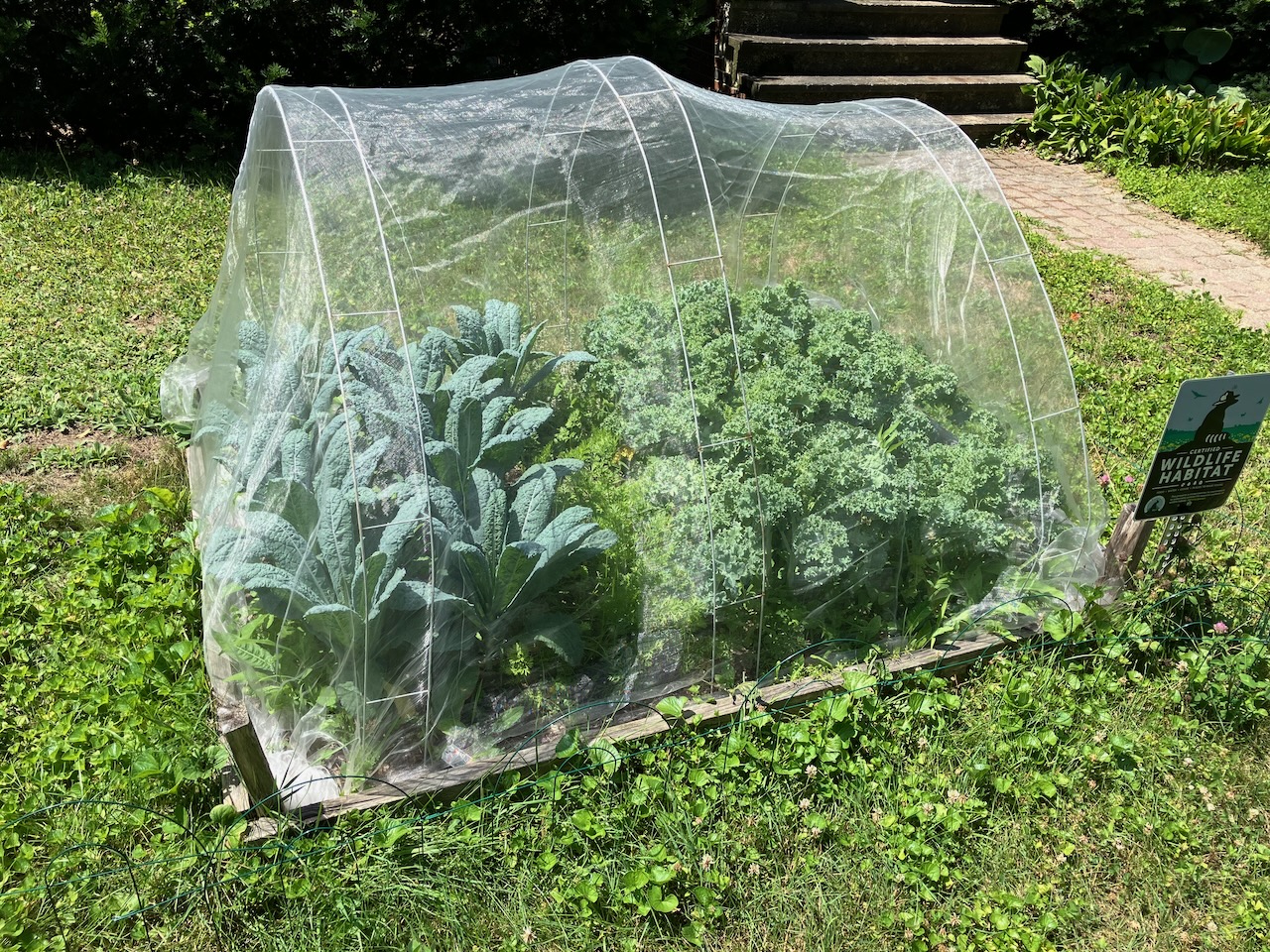
Rectangle garden bed filled with green kale of two kinds, covered over with a translucent net on white metal supports.

The robins never came back to their nest on our back porch after the babies had been attacked. Still so sad about that. We’ve had some lovely visits with human friends out by the pond. The pond water level went down with the drought, but this weekend’s rain helped, especially after adding water from the newly filled rain barrels. Still a few frogs, though I am not sure about the tadpoles. They hide under the lily pads, and it’s a lucky day to see them.

And… and… and… Gaza is still being attacked night and day, and starved by blockades. International resistance is growing but too slowly for the people killed each day. I keep bearing witness, and praying. It’s the same with the rising fascism of our country, and the attacks on immigrants both documented and undocumented, and citizens who are brown or black or speak Spanish. The only thing that gives me hope are the multiple levels of resistance from huge demonstrations to lawsuits to governors who slap back. Here we do the best we can to get by, day by day, accepting our situation as elders and those who are chronically ill. In the face of so much cruelty and hate, we add our little love to the mix, hoping to be part of the larger Love which is our only real hope.
Fighting with Squirrels (and Chipmunks)

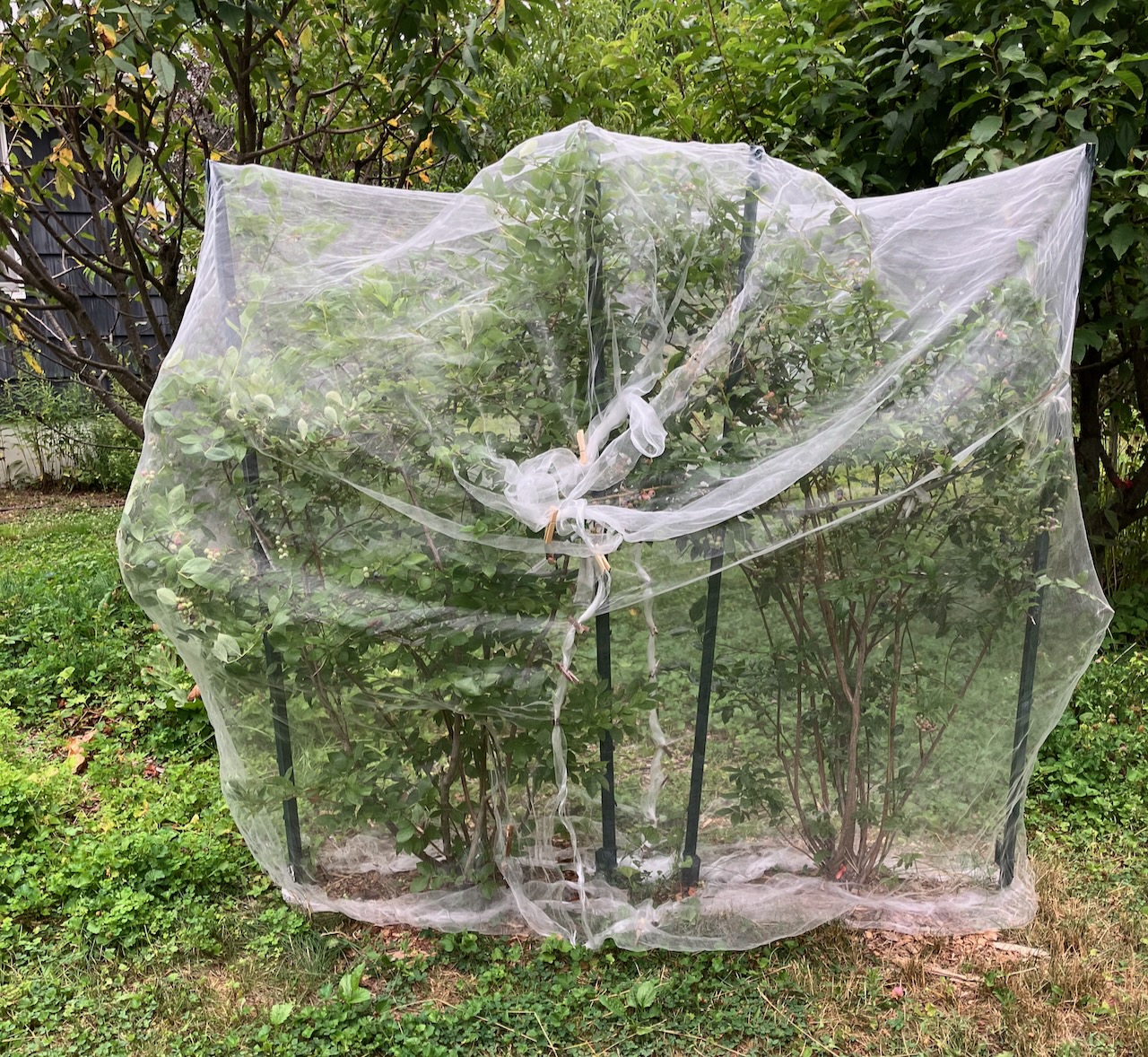
White netting draped over two blueberry bushes, using fence stakes

The intent of our permaculture gardening is to create a mutually beneficial relationship with the earth and all her creatures. But lately, it feels like a little backyard battle. The squirrels have literally eaten all of the green peaches off our peach tree. (Last year there seemed to be enough for all of us.) They have been also eating raspberries, hazelnuts (still green) and mulberries, but I sort of gave up on all of those. I have tried to protect these two blueberry bushes by covering them with netting, garden-stapled down, and using clothes pins to close the side opening. I have actually harvested some blueberries. But the last couple days, they’ve pushed their way through holes they make in the netting. When I see them, I run out yelling and clapping, and they dart around the edges to find their way out and run away.

To be fair, there is another variable this summer. I stopped filling the bird feeder some weeks back because the chipmunks would immediately climb up, fill their cheeks, climb down, and transport the seed to their underground lairs; and then repeat until all the seed was gone. The squirrels also took a fair amount. I wonder if the sunflower seeds were the tribute I had been paying to our little neighbors that ensured that they’d save us a few peaches? But yesterday, perhaps I upped the ante, because I installed a baffle on the feeder, and coated the pole with coconut oil. I really do want to feed the birds, not all the greedy chipmunks and squirrels. So here is the new set-up, (the bush is at least five feet away–I pruned it to make sure):

Green metal bird feeder with clear plastic baffle a few inches down, in front of a green bush background.

Margy and I have a little side bet going as to when they might be able to breach these new security measures. It has been up for twenty-four hours so far. No squirrels, chipmunks so far. But the birds haven’t come back yet either. The next few days will tell. And in case it isn’t easy to see, the original bird-feeder is also “squirrel-proof,” with a weight dependent bar that drops down to close the seed opening. But they figured that out long ago. They are so smart, and acrobatic. In many ways I love them. But I don’t love that they take all the fruit in our garden.

Anyway, I just needed to write about this other side of gardening. I am so impressed by the work farmers do! If we relied only on our own gardening skills, we would go hungry. But perhaps this is one of the lessons I am learning about how to be in a mutually beneficial relationship with the earth, and during climate warming too. We are all under a lot of stress, trying to survive. We don’t have complete systems in place, we don’t have our own ancestral knowledge, we are trying to recover from great imbalance. So we keep showing up, keep going outside, keep being grateful for the gifts of the earth.

And these days, I can’t write about anything food-related without also expressing rage at the intentional starvation of the Palestinians in Gaza by the state of Israel. They destroyed their farms and gardens, and destroyed access to water, and access to help from outside. How many more people will die before the world powers stop this genocide?

Robin survivor?

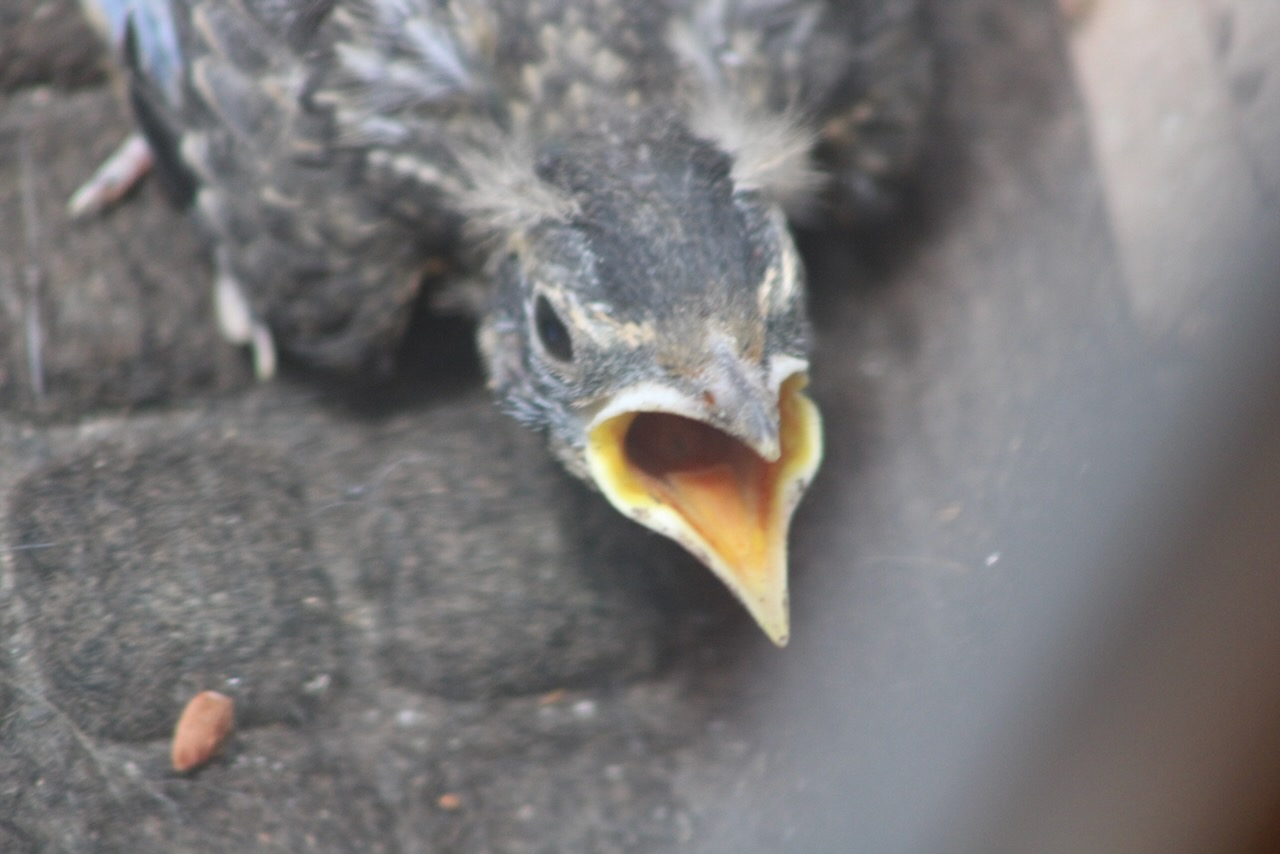
This morning there was more excitement concerning the sole surviving baby robin. It had walked out from the nest onto the nearby beam, even into the next section of beam. So it was alive! But the parents went back and forth calling several times. I was watching through the glass of the back door, hoping that they would find it and feed it. Then, finally, one of the parents brought the baby a big mouthful of worms–and just as it got them it its mouth, it fell down to the deck below. There it sat, seemingly stunned for a long time. I kept watch, not wanting it to be gotten by some predator, but also not knowing what to do. I even put in a call to Avian Haven, but it was before business hours. (8:30 a.m.) I wondered if it was injured.

Finally, I went outside, and went near to it, and it started to walk away. It seemed able to walk, but it never flapped its wings like it was trying to fly. Too young I think. Only 9 days old. So I gently picked it up and put it back up into the nest. And it seemed like that might work, and the parents came back and forth, and fed it up on the ledge, where it had once again walked on to. The parents were both very solicitous and sometimes called to the chick, and sometimes scolded at me. When Avian Haven called back (after I had put it back in the nest) they suggested that if the parents were still attending to the chick, it was best to leave it with them, and not take it away.

However, would you believe it? It once again fell or jumped from the beam and landed on the deck again. It was lying on its side but then righted itself quickly and literally walked over to our glass door and looked up at me. As if to say, “help, here I am on the deck again.” So fierce its little face!

Margy was here by now, and we knew a grocery delivery would be coming soon to the back porch, so there was that pressure. So finally I went out on the deck with a shoebox, thinking to put it in that for safety, but it quickly walked away along the wall and jumped off the deck (about 2 1/2 feet down maybe) and was in a little side corner near the steps with no way out. I thought I’d try to get it to jump in the box–but by now it was acting more lively. When my hand came over its head, though, it opened its beak as if I might feed it. I was able to shoo it toward the open box, but once in the box it did not like that at all, so I quickly brought it over to the other side of the porch steps and set it onto a patch of ground cover plants. Then it decided to walk under the deck, out of my sight.

The whole morning I was never sure what to do, to leave everything alone, or to help, and in what way. I don’t know why the parents kept calling to the chick. It reminded me of when they were trying to get their previous set of chicks to fledge, but this one was obviously too young to fly. I wondered if whatever trauma had happened the night before, that left two chicks dead, and one missing, might have freaked them out so they wanted to get their chick away from that nest. Or maybe they were giving protective warnings to whatever might have disturbed the nest before. (For example, the chipmunk that frequents the area.) As a human neighbor, is my presence helpful or harmful?

The parents have come back now and are calling repeatedly, but at least one of them was down on the ground, so maybe they’ve figured out that the chick is underneath the deck. I hope so. It is too dark under there for me to see. So I may never know the fate of the chick. But I do take comfort in how fierce it was in those last moments of our interaction. It probably only needs a few more days to grow before it would be ready to fly.

Robins building nests

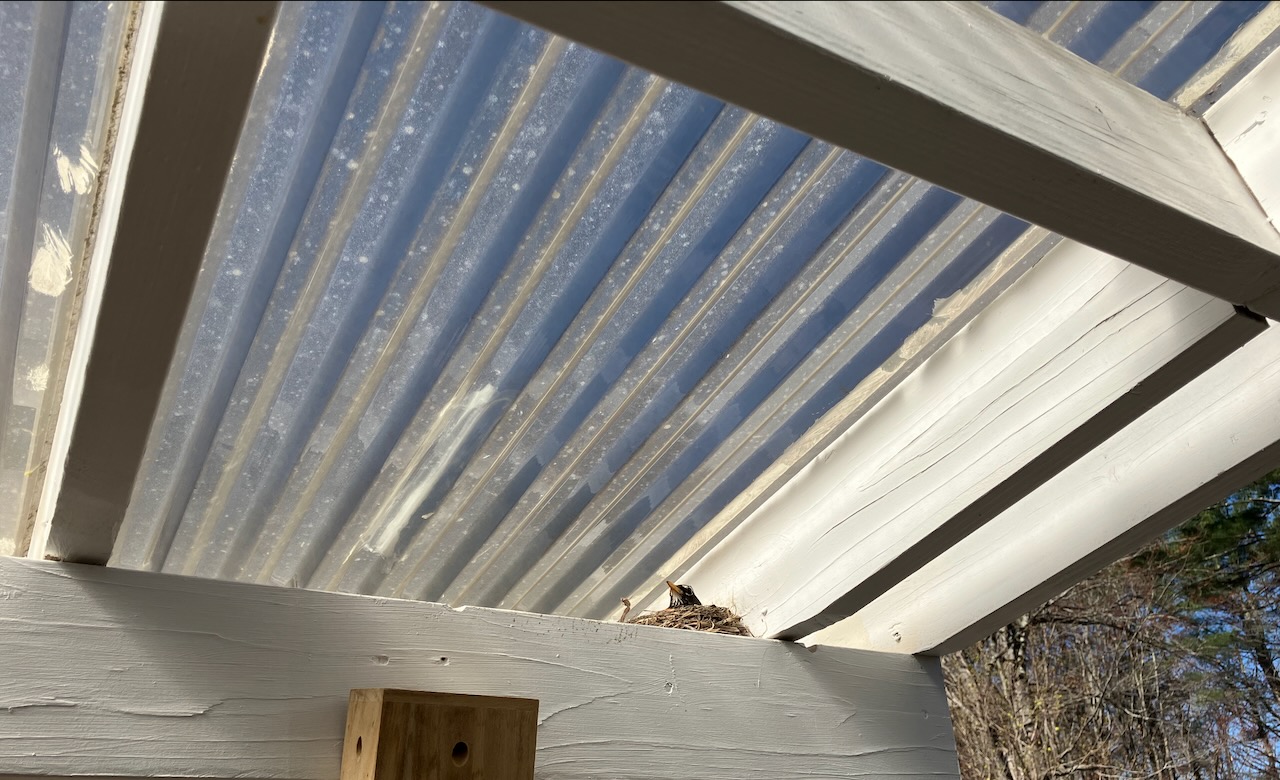
clear ceiling over deck beam with robin in nest on beam

We have robins nesting again in the beams of our deck! Two years ago, a pair of robins raised three broods of chicks over the course of the season. The year before that, in 2022, they had tried, but failed, and it seemed the clear ceiling raised the heat too much for the babies. So I created a shade from cloth to go over them. That worked for 2023. Last year, no nests on the deck. But this year, they were rooting around again on the beam. Imagine my chagrin when a robin starting building a nest in a different section of the beam, with no shade cloth. I could already see her with her beak open on a warm sunny day. One day when she was gone from the nest, I counted three blue eggs.

So I tried a different solution. It was a bit of a risk, but I went out with a ladder and painted the ceiling above the nest with some white primer/paint. She had flown off when I got close, but after I finished she came back, and I am happy to say has continued to sit on the nest every day. I hope this helps her babies to thrive, as I wish for all babies to thrive. I am thinking of the babies in Gaza who are being starved right now.

Robin in nest with shade from painted ceiling

Another joy is that there is also a robin nesting in the bush near our front door. You can just barely see her from our living room windows–she is so well camouflaged from above. But she too is still sitting.

Spring is bursting all over. The cherry trees have some blossoms and the peach tree is starting too. I just hope all this rain we are getting this week doesn’t prevent them from being pollinated. The rain is much needed because of drought, but I miss the sunny days we had last week. I did a holistic spray for the trees the week before. Our trees struggled last year so I am trying to be more attentive this season.

Cherry blossoms against blue sky

Being in the garden is so healing in light of all the devastating news each day from our country, and from the world. One more photo of beauty, daffodils Margy picked from the garden. May the beauty be a prayer for peace.

yellow and orange multi-layered daffodils

No smoke here right now…

purple and pale lavender spiderwort blossoms in spiky green leaves, with rain drops clinging to leaves
Spiderwort blossoms after rain

We’ve had two weeks of very cool rainy weather, and that counter-clockwise low pressure weather system has kept away the wildfire smoke from Canada, while folks to our south are facing orange skies and unsafe air. Still, we’ve paid attention, following the news, and thinking about what might happen if it does come our way. It is easy enough for Margy and I to stay inside, or wear our N95 masks outside.

But now that we are deeper in relationship with our land, I am anxious about how such bad air might affect the robins and frogs and squirrels and other critters who live here with us. They don’t have masks and can’t get inside. I wonder if the babies of these critters wouldn’t make it, so vulnerable in those first weeks of life. My heart is wide open to our little microcosm of earth life.

And yet it is the macrocosm that emerges most in this story, because the smoke is coming from far away in Quebec, from wildfires made more destructive by climate change. We aren’t alone in our microcosm, we are all connected by the winds that blow across the globe, undeterred by artificial boundaries. I have been somewhat removed from wildfire problems. I have seen them on the news in California, Alberta, Australia. This is the first time they have come close to where I live. But truly we are all more and more vulnerable. And of course, some much more vulnerable than others. I worry about people without houses, struggling just to survive, in a tent or with a tarp. They can’t get out of the bad air.

There is so little I can personally do about these large issues at this time in my life. That is some of my motivation for trying to tend our little garden–to love this small place of earth in hopes that more and more people can learn to love the larger earth, our great mother. To share the beauty of this earth in writings and photos on this blog, that beauty might inspire love. But love includes grief, and the more we love the earth, the more we grieve for the destruction that human beings are perpetrating.

Irises in bloom, purple, with hints of paler purple and yellow.
Irises in bloom

Certified Wildlife Habitat

Small sign saying Certified Wildlife Habitat on metal post, near raised bed, and steps to front door of house.

It’s official. We’ve been designated by the National Wildlife Federation as a Certified Wildlife Habitat. This means that our garden “provides natural sources of food, water, cover, and places to raise young, and is maintained in a sustainable way that incorporates native plants, conserves water and doesn’t rely on pesticides.” We posted our sign in our front yard. We are one of over 227,000 such gardens in the United States, and they are hoping to reach 300,000 this year.

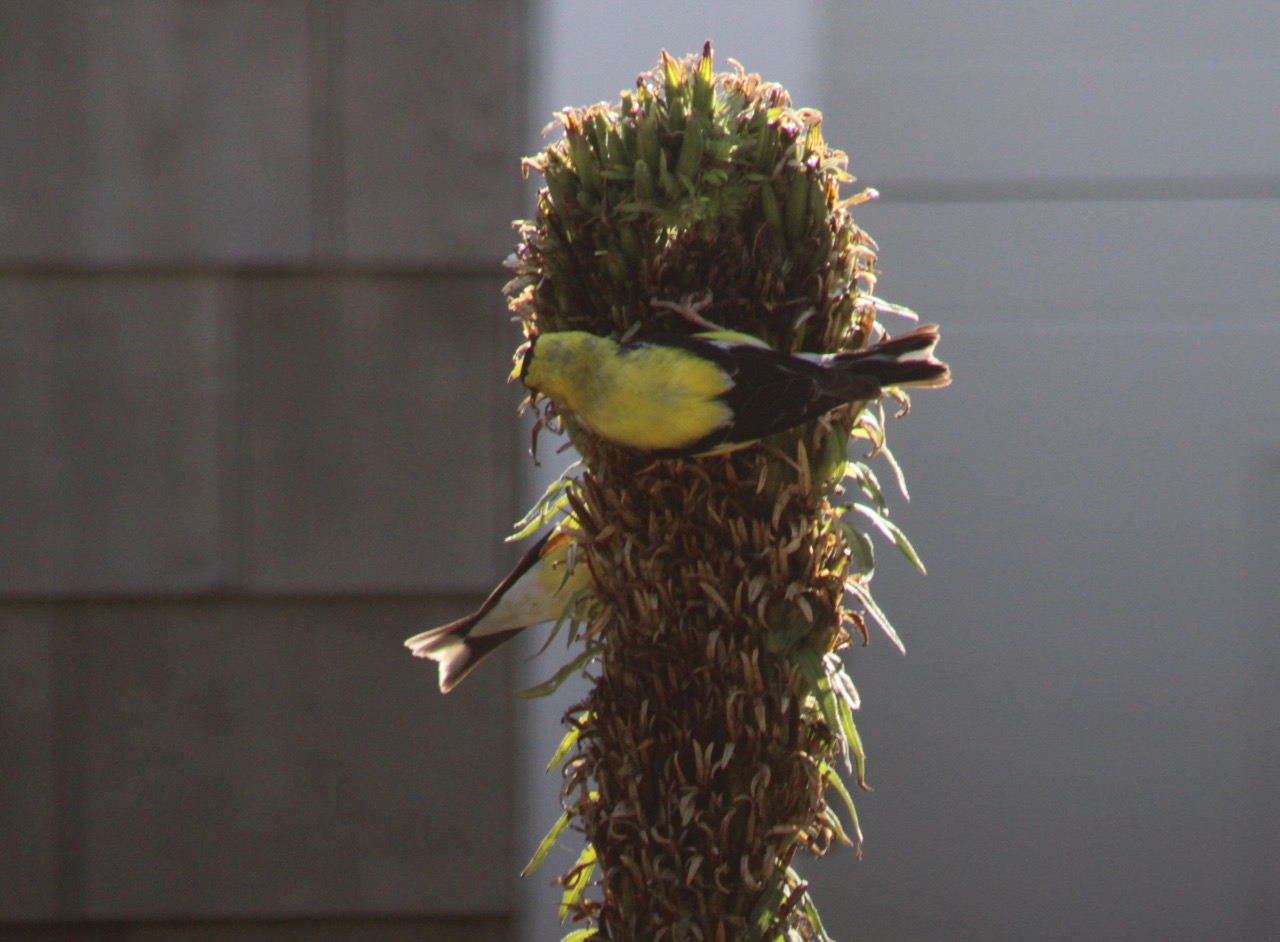
In order to be certified, you fill out a form at https://www.nwf.org/CertifiedWildlifeHabitat and give a donation to the organization. It’s on the honor system–you tell them the sources of habitat in your yard, in several categories. For food in our yard we have native plants, berry bushes, and fruit trees, as well as our bird feeder, and the pond. One of my favorites is evening primrose that grows wild. We keep several, only cutting in places that don’t work to have a tall plant–last year there were goldfinches all over this plant, and hopefully more this year.

Goldfinches eating seed on round plant head.

We provide water especially with the pond. The pond serves so many purposes–food, water, a place to raise young (the tadpoles!), cover for frogs. When I walk in the morning, I see birds bathing, bees taking a drink, frogs sunning and snatching flies. But any kind of water brings wildlife to a yard–small or large. We also have a bird bath near our patio, and see birds and squirrels getting drinks there.

Cover is used to protect from bad weather, hide from predators, or hunt prey. Around the edges of our yard there are trees and bushes, and piles of branches that provide cover for small critters, and places to raise young. Ever since the orchard trees and hazelnut bushes have grown up, birds are always perching there, sometimes on their way to the bird feeder, sometimes eating insects. I’ve posted about the robins raising young in a nest on our back porch. But we’ve also seen young squirrels in trees, and chipmunks coming from underground.

As for sustainable practices, we never use pesticides, and we compost our food waste and leaves. We conserve water with our rain barrels, and if the pond needs topping up, that comes from the rain barrels too. We try to incorporate native plants wherever we can–mostly by not pulling the weeds that emerge on their own: violets, pansies, daisies, wild strawberry, goldenrod among many others. I use an app to identify plants that come up. We do also have invasive plants that we are trying to get rid of.

The official designation and sign were a gift to ourselves, and to make our intentions more visible in the neighborhood. Most of the actual habitat is in the back and side yards. Have any of you participated in this program? Maybe you might like to check it out. There are little things that each of us can do to care for the earth community, and foster habitat for wildlife.

Roadside Garden

Roadside garden strip with green spikey leaves coming up, yellow flowered turkish rocket, and wood chips between plants, plus a broken wood log.

The last couple days I have been sprucing up the roadside strip in front of our house. I had left all the leaves and old dead plant droppings all spring, better for soil enrichment and habitat for insects. The hardy perennials have been greening up, and the turkish rocket is flowering now. I think of this as my no-work garden, and mostly just leave it alone. But two days ago I pulled up crabgrass, and then I have been adding fresh wood chips between plants and along the roadway. We just got a huge pile of wood chips from our favorite tree guy. Such an excellent and free resource!

I’ve also been watching the Chelsea Flower Show on Britbox, and maybe that inspired me to put some odd shaped logs in a few empty spaces between plants. An ornamental crabapple tree fell in a storm last winter, and our neighbor cut it up for us. Some of it can be seasoned for our wood stove, and I have been moving those to our wood pile. But some pieces are just the wrong size–but apparently they are perfect for garden decor. I can see this view above from our front living room window, and it makes me so happy!

Roadside garden with green spikey leaves, next to paved road, neighbors car in the background.

I also like that it now looks a bit prettier for the neighbors. I want folks to realize that wildlife friendly, organic, permaculture gardens can be beautiful too! In fact, someone walking by commented about how much they like our gardens. I hope we may be contributing to a trend. Our neighbors across the street just put in some raised beds in their front yard, and our neighbors to the side were getting heat pumps installed yesterday.

Finally, the other blooming plant right now is a blue mountain cornflower. I only wish I’d put it on the sidewalk side, because we can’t see it from the house. Maybe I’ll move it next year.

Mountain cornflower, or perennial bachelor button, with purplish blue flowers, green stems and leaves.

Breeding Tree Frogs and Robins

Tree frog with nobbly skin, perched on rocks with water of the pond visible on the left
Tree frog male, getting ready to sing his mating trill

Our first frog sighting in the pond yesterday, April 15! Much earlier than the last two years, when the first frogs came in June or July. It turned out to be a tree frog, rather than the green frogs that we’ve seen in prior years. We figured it out because in the afternoon, when my friend Francesca and I were sitting by the pond for a visit, suddenly, he sang the most amazing trilling sound, his white throat patch blowing out and in. And I remembered that Margy had heard that sound earlier in the day. Then, yesterday evening after dark, the night air was awash in these trilling calls, from all directions. A little internet searching identified those calls as tree frog mating calls.

Tree frogs live in trees, like their name suggests, and hunt on land most of the year, but they breed in water, in ponds and vernal pools. So maybe, just maybe, we’ll have some tadpoles to grow in our pond this spring. I learned that they eat algae, so that is another good, because our pond has got a bit too much algae in it. So exciting!

The other adventure of breeding is that of our robin pair. Even after three failed attempts to rear live young from eggs in a nest on the beam under the clear roof of our back porch, they were at it again, bringing nesting material to the same spot. That spot was just too hot in summer. It was so sad. So, first I tried telling them to go somewhere more suitable! Then I tried taking out the grasses to discourage them that way. But they kept at it. So then, I had a totally alternative idea. What about making something to shade that corner of the clear plastic roof? So it wouldn’t be so hot. This morning, I searched around and found some old cream-colored sturdy curtain material, and cut it to fit. Then I got up on a ladder and stapled it tightly to the wooden crossbeams.

I have already seen the robins return with more nesting material, so maybe they’ll put up with the changes to their location. After all, I had also painted the beams last fall. Now I am hoping that it will be enough–that the shade will keep the spot from getting too hot, that the robins can finally have a little family, in their chosen spot. And can I say that my heart is filled with joy after this little project? Some kind of ecstasy to help a fellow inhabitant of this place, to live together in mutual reciprocity.

A square of crossed beams, painted white, with a cream colored shade cloth over the top, and grassy nest material showing above the lower beam.
Robins’ nest beginnings under the shade cloth

When Trees Fall

The good part, for which I am grateful, is that our neighbor came to our door to talk to us. He asked whether we would mind if they took down trees in the area between our two properties. He wasn’t sure of its status, but I told him it was a “paper road” that likely would never be built. I told him we would NOT want those trees taken down, that they provide privacy between the two yards. The neighbors want to garden in the way back of their yard, but don’t get enough sun. I suggested that the boundary trees are to their north, so wouldn’t affect their sun. He said it was just as a way for the machinery to get into the back, but they could do it a different way and not take down those trees. He wanted to respect our wishes. So that is the good part. And I like that they want to garden.

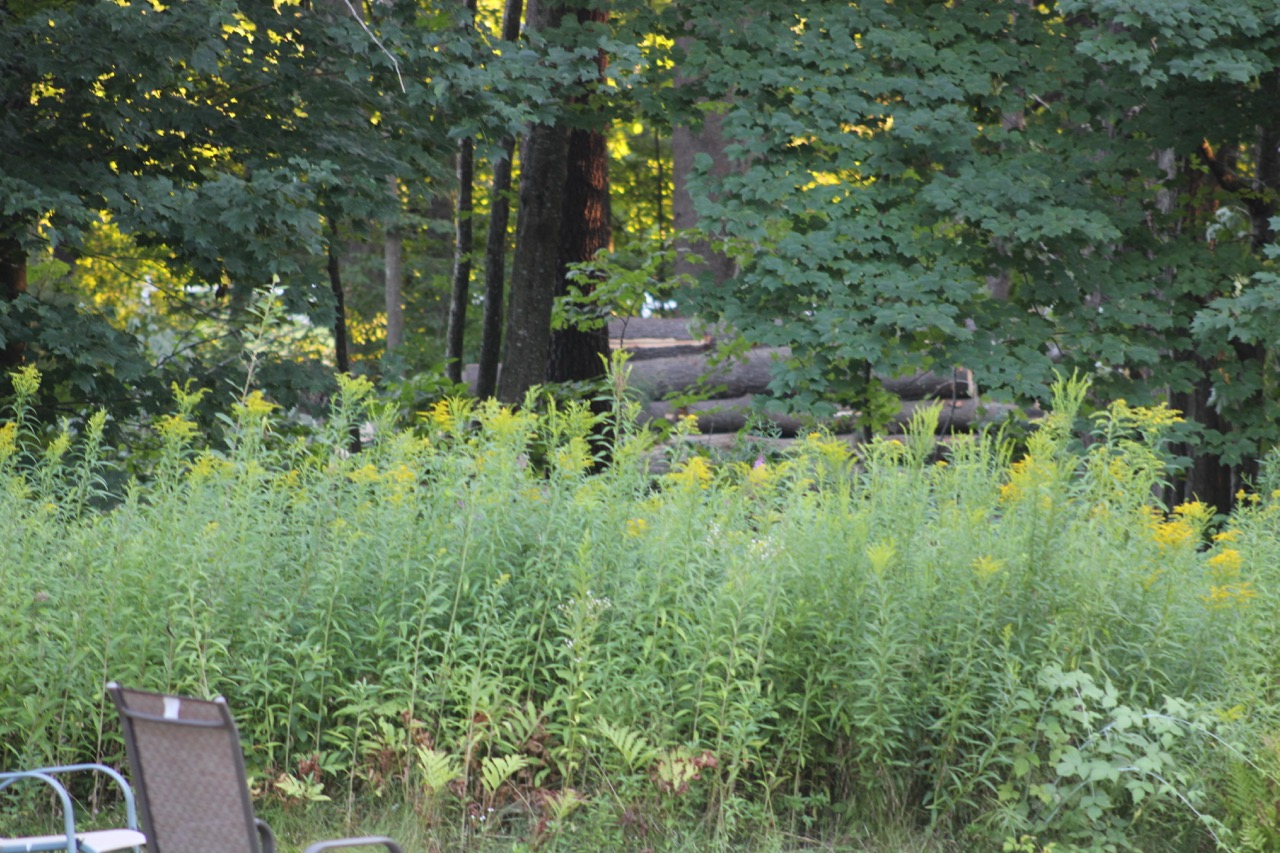
Felled pines behind our big pine, behind our back yard, with goldenrod in front.

But the rest is so bad. Loud machines have been working all day yesterday and today, felling tall pines, and chipping up branches. Sometimes we feel the ground shake in our house when the trees fall. Our thin strip of protected trees does not hide what they are doing, light comes through and all the visuals of machines, and trees being cut down. The cherished privacy of our back yard is no longer what it was. But most of all, I think about all that habitat lost and wonder how many birds’ nests have been destroyed. Many many birds yesterday were making alarm calls. Early this morning, a pungent skunk-spray smell came through my windows. I imagine that the skunk has been dislodged in some way, and perhaps came across our yard and encountered one of the little cats that hunt here. I think about how we love the wildlife that come through our yard, and how the trees and underbrush, on the so-called “undeveloped” land, have been a mini-wildlife corridor for deer, turkeys, skunks, groundhogs, sometimes even foxes.

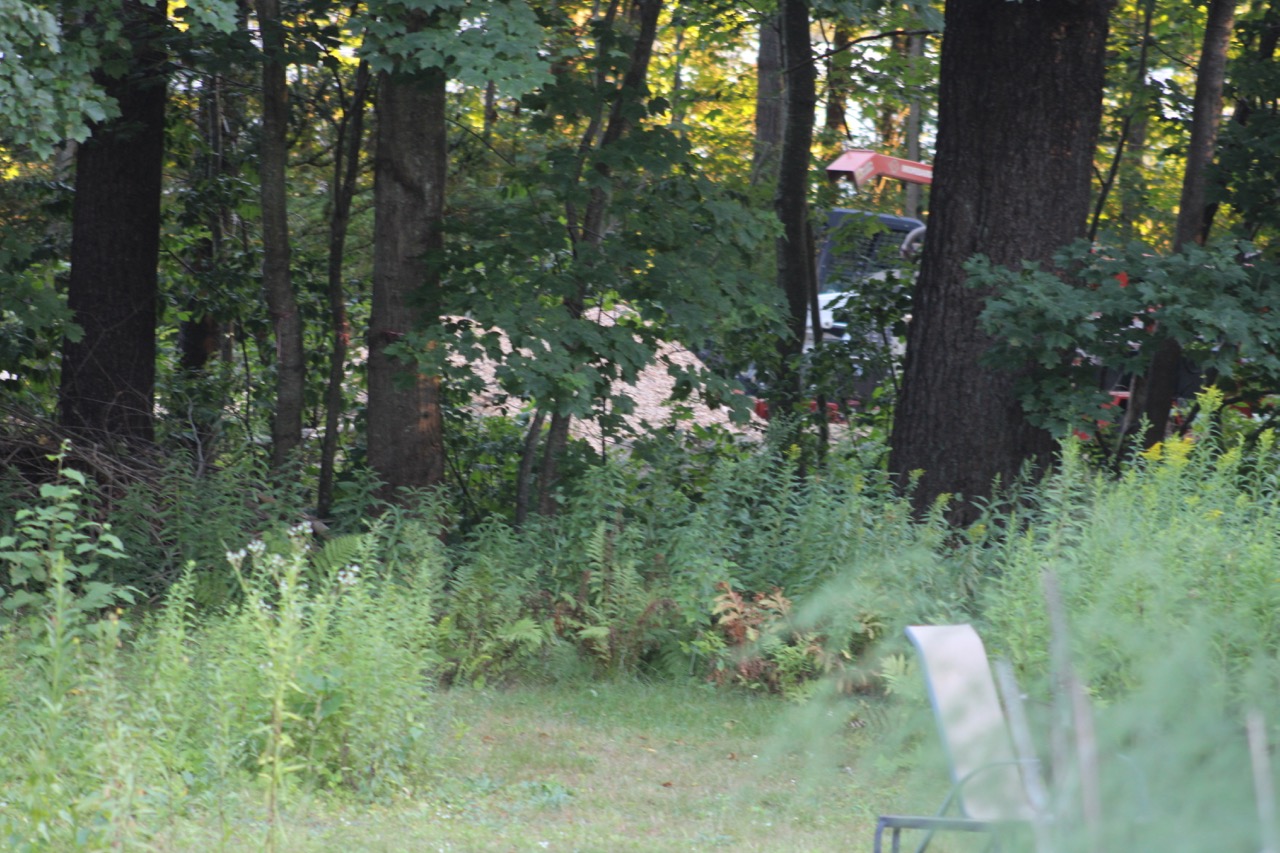
Through the trees, we can see the big machines, the pile of wood chips.

I try not to make the neighbor an enemy in my mind–after all, he wants to create a garden, so there is love for the earth there too. We live in the city, in a neighborhood near little brooks in sunken areas that continue to provide wildlife a refuge. But just in the six years we have lived here, acres of trees have been cut down in our neighborhood. Each tree down means more carbon in the atmosphere, more warming, more drought. I think about the long history of cutting the great forests of North America for settlers’ farms and gardens and cities.

And this is how the wider world feels to me right now as well. Slowly falling down around us, more and more “developed,” less and less room for wildlife and trees. I don’t even know how to feel this sadness. It is too deep, too fundamental. Even as Margy and I try to love this small piece of land, to learn from it how to live in mutuality with the earth, all around us the path of destruction seems to hold sway. I think about the great pine in our back yard on the paper road, the one that is over 100 years old, and how she must feel to sense the destruction of her family of trees nearby. I think the trees know. They know that we are destroying our only home, our only planet. And so we grieve together.