Experience the Present Moment

Snowy Abstract Sun DSC08841In order to enter this experience of the present moment, which is also the experience of eternity, we must move from our left brain awareness to our right brain awareness. Taylor says the way to do that is to quiet the chatter of the left brain, which speaks to us constantly in the story of our life. So that is what meditation teachers have been trying to tell us!

I am usually a very left brain sort of person. I like the way the left brain organizes everything and notices patterns. I like how it tells a story from the memories of my life, and tries to make meaning and find the purpose of things. I like how it can see the patterns of the planets and stars and moon, and create calendars. I like to listen and read and write and talk. One of my spiritual practices has been to journal, and I can see that this is a very left brain spiritual practice, a way to tell a story and make meaning about my life.

But with the insights of Taylor’s perspective, I also feel more comfortable with that other process, that process of stopping the left brain, to experience being. The process of letting go of the past and future to notice the abundance of the present moment. She says,

“The feeling of peace is something that happens in the present moment. It’s not something that we bring with us from the past or project into the future.”

The right brain has the capacity to appreciate the miracle of life right now: that we are here, that our cells work together to see and hear and taste and touch. The right brain has the capacity to experience the connection between ourselves and the larger whole of which we are a part. The right brain is inherently grateful and nonjudgmental, compassionate and curious, awake to beauty and joy. The right brain is aware of the dance of life, not attached to a separated small being, but joined to a flow of energy that is not divisible by time or space. William Blake has put it this way:

To see a world in a grain of sand
and a heaven in a wild flower,
Hold infinity in the palm of your hand,
and eternity in an hour.

Quote from Jill Bolte Taylor, My Stroke of Insight, p. 159.
First lines of the poem by William Blake, “Auguries of Innocence.”

Reblogged: Global Day of Prayer for the Water

I am reblogging this message from a Facebook event sponsored by Indigenous Peoples for December 21st:


Ocean Waves MD DSC07085

Photo by Margy Dowzer

Water is the one thing that all living beings require to survive. And, it is a resource that is rapidly disappearing. We have a fixed amount of water on this planet. Despite all of our technological advances, we haven’t figured out how to make more water. When it’s gone, it’s gone.

We have resorts in the desert and bottled water for sale. We have an industrial system that uses more water each day than it would take to support our entire civilization. Our waters have never been in greater danger. Practices like hydro-fracking and tar sands extraction pose the greatest threat to our water that our planet has ever seen. Our oceans are contaminated with waste, including the devastating amounts of radioactive materials that are being released by the Fukushima disaster.

We, as Indigenous peoples, have been speaking out against the destruction of our planet for decades. We have been working to address these issues spiritually, politically, legally and through direct action.

We now need the help of the global community to protect the continuation of life here on Earth. It is time for us all to come together to make a stand for the future generations. We need to use everything that we have to protect our waters, so that our children and grandchildren will have the ability to live. Today, we ask that you all stand with us.

We are asking everyone to invest in a day of prayer for the preservation and healing of the global waters and for a healing and elevation in the consciousness of those who are destroying our Mother, the Earth.

Please join us by organizing small groups in your local area to participate in this important event. If you can’t join a group then please take the time to add your prayers from wherever you are.

Here is what we are asking people to do: On December 21st, from sunup until sundown, please go to the ocean or to another major water source to pray, in whatever way is meaningful to you. Pray for the healing of the waters and for the healing of the hearts and minds of those who are destroying our water.

If you can’t gather at a water source then collect some water in containers and pray with it where you are, then choose someone to travel to a water source and pour the water that you have prayed with into that major water source. If you can’t reach the ocean or other large body of water then any body of water will do. If you can’t find a water source in your area then pour the water into the Earth at the end of your day of prayer.

We have a powerful ability to manifest change when we focus our energies. In order to create the type of change that is needed we must unite our prayers and energies and focus on healing the catastrophic destruction that humankind has created. We must shift the path that we are currently on, for the future of all life. Prayer is a powerful tool in creating that shift.

What we would like you to pray for:

1. Preservation and Healing of the global waters
2. Healing of the hearts and minds of those destroying our waters and an elevation in consciousness for all global leaders.

We ask that you keep your focus on these issues, so that we can keep the energy powerful.

Please share this with EVERYONE you know. We are all children of this Earth and we all have a responsibility to stand up and protect this vital source of our survival.

Looking forward to joining you all in prayer on December 21st!

Dancing Out of Time

Fireworks

Photo by Margy Dowzer

Individual consciousness is simultaneously familiar and mysterious. Rene DesCartes said, “I think, therefore I am.” Jill Bolte Taylor was a brain scientist who had a debilitating stroke at the age of thirty-seven. A blood vessel burst in the left side of her brain. Because of her training, she was able to observe her own mind deteriorate as she lost the capacity to think, talk, read, write, or recall any of her life.

But there was a surprise in this—as her left brain shut down, her right brain took over, and she experienced a different form of consciousness—an all-encompassing sense of bliss, a sense of timeless unity with the universe. Years later, after she recovered the skills of the left brain, she wrote the book, My Stroke of Insight, to describe her journey and what she learned. She said:

To the right mind, no time exists other than the present moment, and each moment is vibrant with sensation. Life or death occurs in the present moment. The experience of joy happens in the present moment. Our perception and experience of connection with something that is greater than ourselves occurs in the present moment. To our right mind, the moment of now is timeless and abundant.

During her stroke, Taylor lost the sense of herself as a separate being, she lost the memories that identified her self to her self, yet she gained an experience of herself as the whole universe—there were no boundaries that separated her from everything else. What she describes resonates with the Buddhist understanding of enlightenment, or Nirvana, a shift of consciousness from experiencing time, to experiencing “all is now,” from experiencing space, to experiencing “all is one.”

When I was growing up, eternity was described as what happened to us after we died. But Taylor speaks of eternity as something that can be experienced right now within our own minds. The experience of total peace and total connection is available at any moment. She writes:

The first thing I do to experience my inner peace is to remember that I am part of a greater structure, an eternal flow of energy and molecules from which I cannot be separated. Knowing that I am a part of the cosmic flow makes me feel innately safe and experience my life as heaven on earth. How can I feel vulnerable when I cannot be separated from the greater whole? My left mind thinks of me as a fragile individual capable of losing my life. My right mind realizes that the essence of my being has eternal life.

Since Taylor is a scientist, she brings a different perspective to what is usually perceived as the mystical. She can help our left brain understand and make sense out of the right brain. She can help us to rationally comprehend what the mystics speak of when they talk of being one with the universe, or finding eternity in the present moment. And so perhaps we must reshape our understanding of the spiritual journey. It may be not so much a journey through time, as a journey out of time, from one form of consciousness to another.

Quotes from Jill Bolte Taylor, My Stroke of Insight: A Brain Scientist’s Personal Journey, p. 30 &160.

Creatures of Time

Photo by Udo Kügel Wikimedia Commons

Photo by Udo Kügel Wikimedia Commons

The stars also form a pattern to our eyes in the night sky. They circle around the north star, so that when people take a time-lapse photo, you see the lines in circles around the north star. Of course, it is really the earth that is moving, spinning on its axis pointing toward our north star. Every spinning planet will have its own north star. The ancients used to tell time by the stars. If you were to track the big dipper, you could watch it move around the sky during the night, and if you watched it over many weeks, you’d see it was in a different place in the circle, each month of the year.

We are creatures of time. Our ancestors were watching all these patterns, learning them and tracking them so they might tell their children, marking them so we would know how to plant and harvest and hunt, and dance our own dance of time. They were much wiser than most of us at reading the natural signs of time, though our scientists have followed in their footsteps. And so we mark with our machines the minutes and the hours and the days and the seasons and the years. We look back and we look ahead.

Our relationship with past and future brings us the awareness of our own mortality—that for us, and for all living beings, someday, time will cease. Often, we feel pain about that. We feel broken-hearted when those we love are no longer with us, or when something threatens their lives. We can see that some animals grieve when their companions die, but they don’t seem to anticipate death like we do. Our ancestors also wondered about death, and passed on to us their questions about what happens when we die, and their speculations and beliefs about it.

Some ancestors believed that there was another dimension that opened up after time ended—they called it eternity. There were many theories about what eternity might be like, some of which included endless misery or endless joy, depending upon our actions during our time. Others spoke of a cyclical process of rebirth, that we end one lifetime and begin another, until we experience all that we need to experience. In our own era, all these beliefs survive, as well as more skeptical viewpoints that propose that as creatures of time, death is the end, that there is nothing of the individual consciousness that survives beyond time.

Sun and Moon

Campsite View

Morning View from our Campsite

One summer, I was sitting at our campsite at Winslow Park, watching the sun rise over the water. It was a day without a lot of plans, so I could sit and watch the sky and water for a long time. I noticed how fast the sun seemed to move up the sky. I heard somewhere that you can estimate the time by holding up your fist sideways, and counting each fist width from the horizon to the sun as an hour. In a simpler world, it was enough to tell time by noticing where the sun was in the sky.

Curious about this, I discovered that actually, if you took a picture of the sun at noon every day for a year, you’d find that it wasn’t in the same spot at all. Rather, you’d have a photo of an elliptical shape, like a lopsided figure eight. People call this path of the sun an analemma. It is formed from the fact that our orbit is not an exact circle, but an ellipse, and our planet is tilted relative to its orbit around the sun. So we have the seasons, and each day from June to December the sun rises a few minutes later, and a little bit further to the south, passing by due east on Equinox.

The natural world is full of these movements that follow their own intricate rhythms and orderly patterns. As I become aware of them, I begin to feel myself as a part of a vast dance with the sun, the earth, the moon, the stars. Our spiritual journey is such a dance—it too follows intricate rhythms and mysterious patterns. We may imagine that we are going forward, but perhaps we are dancing round and round like the moon.

Each day, the moon rises on average fifty minutes later than the previous day, and the high and low tides are changing at a similar pace. Winslow Park has a tidal beach, so we pay attention to the tides in the summer. You can only swim for about two hours before and after the high tide. One of our city friends didn’t understand about tides. We were planning to go swimming with her on a Wednesday. Two days before, she was visiting the beach and called us from there to make plans. “The sign at the beach house says high tide is at 2 p.m.,” she said, “Shall we meet at 2 on Wednesday?” We had to explain to her that the tide would be later in two days, closer to 3:40 p.m.; that it changes every day.

Once, years ago, I created a moon calendar for my stepdaughter Stephanie, who was six years old at the time. I was curious myself about why the moon was sometimes seen in the morning, and sometimes in the evening, and I thought it would be fun to learn about it and share it with her. So I tracked it, and began to understand its pattern.

The full moon rises at sunset and stays in the sky all night, setting at sunrise. Then, as the days go by, the moon begins to grow smaller, and it rises about fifty minutes later each day, until you can only see it in the morning just before and after dawn. About two weeks after the full moon, the moon rises unseen with the sun and sets invisibly with the sun. The night is dark. This is called the dark moon or the new moon. Then a day or two later, a thin waxing crescent appears in the western sky just after sunset and sets soon after. Each day it is seen in the evening for a little longer time until we come round to full moon again.

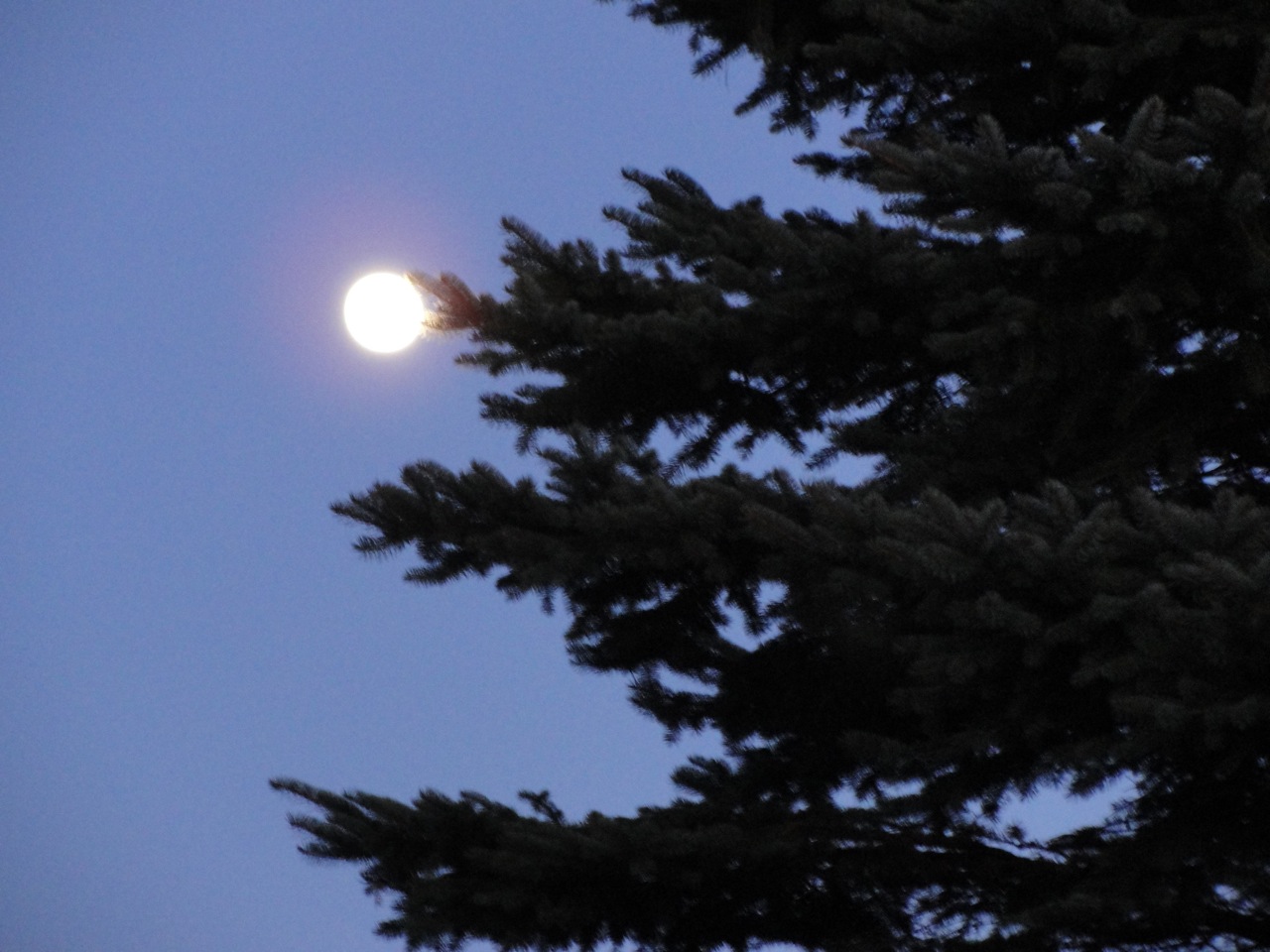
Full Moon

Life Moves In Cycles

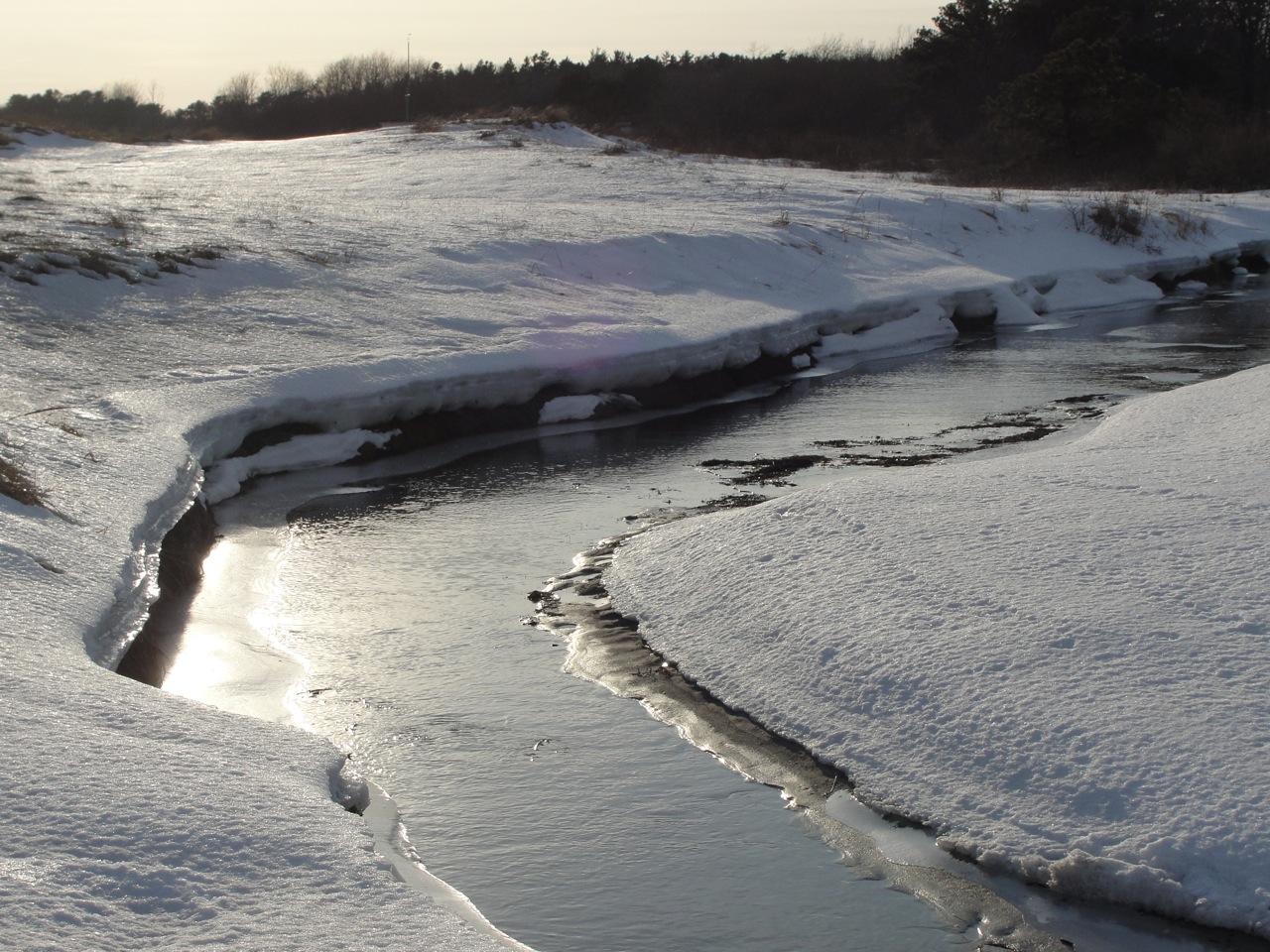
Curve of waterNothing moves in a straight line,
But in arcs, epicycles, spirals and gyres.
Nothing living grows in cubes, cones, or rhomboids,
But we take a little here and we give a little there,
And the wind blows right through us…
Marge Piercy

My colleague the Rabbi fell on some ice in the parking lot of her congregation in December of 2009. Several months later, she was diagnosed with a brain injury, and was unable to work any longer. In 2011, she started a beautiful blog called Brainstorm. In her blog, she described one of the curious ways that her brain is different now. She writes:

I didn’t notice that I no longer broke time up into chunks like minutes, hours, days. In, fact, I didn’t notice there was such a thing as time at all. I still don’t feel time. I don’t know what day it is. I have a watch that tells me and I am learning to memorize that information in rehab. If you and I meet and begin to talk, I will be totally present. I have attained Buddha-hood; there is no before or after — only now.2

Later, she asks, “How long is a year anyway? Is it before lunch or after? And is February leaves, snow, mud or sun? That is how I tell time. … We are either in leaves or mud right now. it is hard to tell.” “Soon we will stack logs for the wood stove. Put on socks and fleece, sit on the porch swing and drink tomato soup in the mugs the children made.  I do not feel months, days or dates, but I haven’t lost the seasons. I never knew how precious they were until I lost every other marker of time’s passage.”

We think that time moves relentlessly in a straight line, going from past to present to future. Similarly, we might imagine our spiritual journey as a going forward from one thing to another. But our relationship to time is mysterious, located in a spot in our brain which can be damaged or destroyed. If that happens, then linear time disappears. But the circular patterns of movement are still observable. All around us there is evidence that life moves in cycles: the earth spinning around its axis each day and night, planets spinning around the sun, tides going in and out, the stars circling round the night sky.

Some cycles are easier to notice than others. Here in Maine, the autumn comes with bright colors and the falling of leaves. Winter is cold and snowy, spring full of mud and new plants, summer warm and full of plentiful greens. These seasonal changes register in a deep layer of our minds.

Poem Excerpt from Marge Piercy, “I Saw Her Dancing,” in Available Light, p. 118.

Imaginal Buds

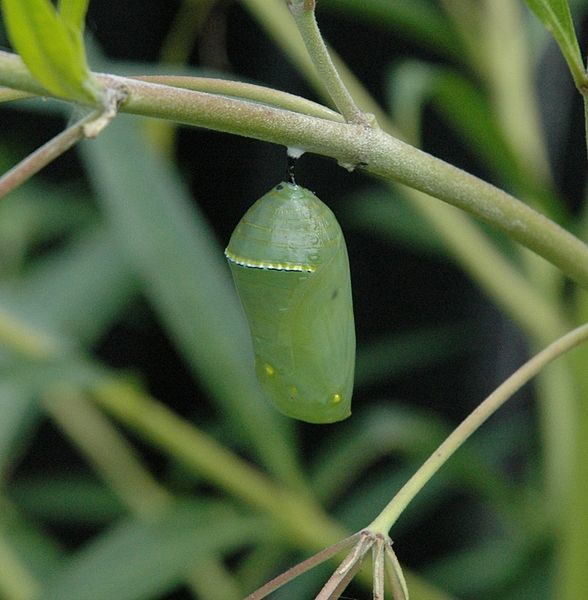
Change is already happening. There are millions of people and groups who are in some way involved in a new vision of community, and we can be a part of it. David Korten calls our attention to the familiar story of the caterpillar and butterfly. We all know the story. The caterpillar spends its days gorging itself on nature’s bounty. But then it attaches to a twig and forms a chrysalis around itself in order to become a butterfly. What we might not know is what’s happening inside the chrysalis to shape the butterfly.

Monarch Butterfly Chrysalis Photo by Armon, Licensed via Wikimedia Commons

Monarch Butterfly Chrysalis
Photo by Armon, Licensed via Wikimedia Commons

Korten, drawing on the work of evolution biologists writes:

The structures of its cellular tissue begin to dissolve into an organic soup. Yet, guided by some deep inner wisdom, a number of organizer cells begin to rush around gathering others cells to form imaginal buds, initially independent multicellular structures that begin to give form to the organs of a new creature. Correctly perceiving a threat to the old order, but misdiagnosing the source, the caterpillar’s still intact immune system attributes the threat to the imaginal buds and attacks them as alien intruders.

The imaginal buds prevail by linking up with one another in a cooperative effort that brings forth a new being of great beauty, wondrous possibilities, and little identifiable resemblance to its progenitor.

Korten sees our cultural transformation in a similar vein. Individuals wake up from the prevailing social systems, and begin to align their lives with the values of partnership and earth community. At first they experience a sense of isolation, but eventually they find others who share those values, and form what Parker Palmer calls “communities of congruence.” Those small beginnings attract others—they are like the imaginal buds of the new culture.

The old culture perceives them as a threat and often attacks their work. But as they network with others who share in the new cultural values, change begins to happen. Korten says that the cultural transformation we need is already in process—we can see the evidence of its beginnings in the great social change movements of the last half of the twentieth century—for civil rights, women’s equality, peace, environmental balance, and economic justice.

I saw a cartoon the other day. Four people were sitting in a boat that had tilted precariously and was filling with water at one end. The two people at that end were bailing furiously. The two people at the other end were sitting high and dry—and one said to the other, “It’s good that our end of the boat isn’t leaking.”

We are all in the same boat—this planet earth. The only real security we can create is a common security. When we finally realize that we are one family, one interconnected whole, essentially united with each other and with the earth, we will be able to find a way forward together. I believe we are already on the path. May we find the courage to take the next steps before us.

David Korten quotes from The Great Turning, p. 74-75, & 84-85.

The Work That Reconnects

Sunset Friends

Photo by Margy Dowzer

The Great Turning described by Joanna Macy is in essence a spiritual transformation. She has offered a process for people to work on that transformation together—The Work that Reconnects

It begins with the practice of gratitude. Macy says that gratitude is revolutionary in a world that tells us we are not enough, and we don’t have enough. Gratitude is a remedy for rampant consumerism. Gratitude is how we open our eyes to the beauty of what is now—the beauty of the shining sun and the nourishing rain. The gifts of creativity and relationship. The gifts of friendship and community, the food we eat, and the shelter over our heads. Gratitude can heal our souls, and give us strength to face the challenges of our time.

The second part of this spiritual work is to honor our pain for the world. When we open our eyes to the suffering being caused by the system as it is, we do feel incredible pain; we feel pain when we see how far we are from the future we can imagine. Macy reminds us that our pain comes from our sense of connection, and connection is what will save us. We hope to deepen our awareness of our connection with all people and all beings on this earth. And yet, as we deepen our awareness, we deepen our compassion, and we feel even more that pain of the world. We must choose not to run away from that, but to honor our pain as a signal of our connection.

That leads us directly into the third part of this spiritual work: to see with new eyes, to feel ourselves a part of the larger whole. We awaken to the reality that we are connected to all other human beings, that we belong to this earth, this beautiful living planet, and we have the power to make a difference on the earth.

The fourth part of the spiritual work is to go forth and use our gifts to participate in some way in the Great Turning. Macy identifies three areas of this work.

Tar Sands Protest

Tar Sands Protest
Photo by Margy Dowzer

There are what she calls “holding actions” like protests and lobbying on behalf of the environment, or against foreclosures. Some people need to be sitting in trees and marching in the streets.

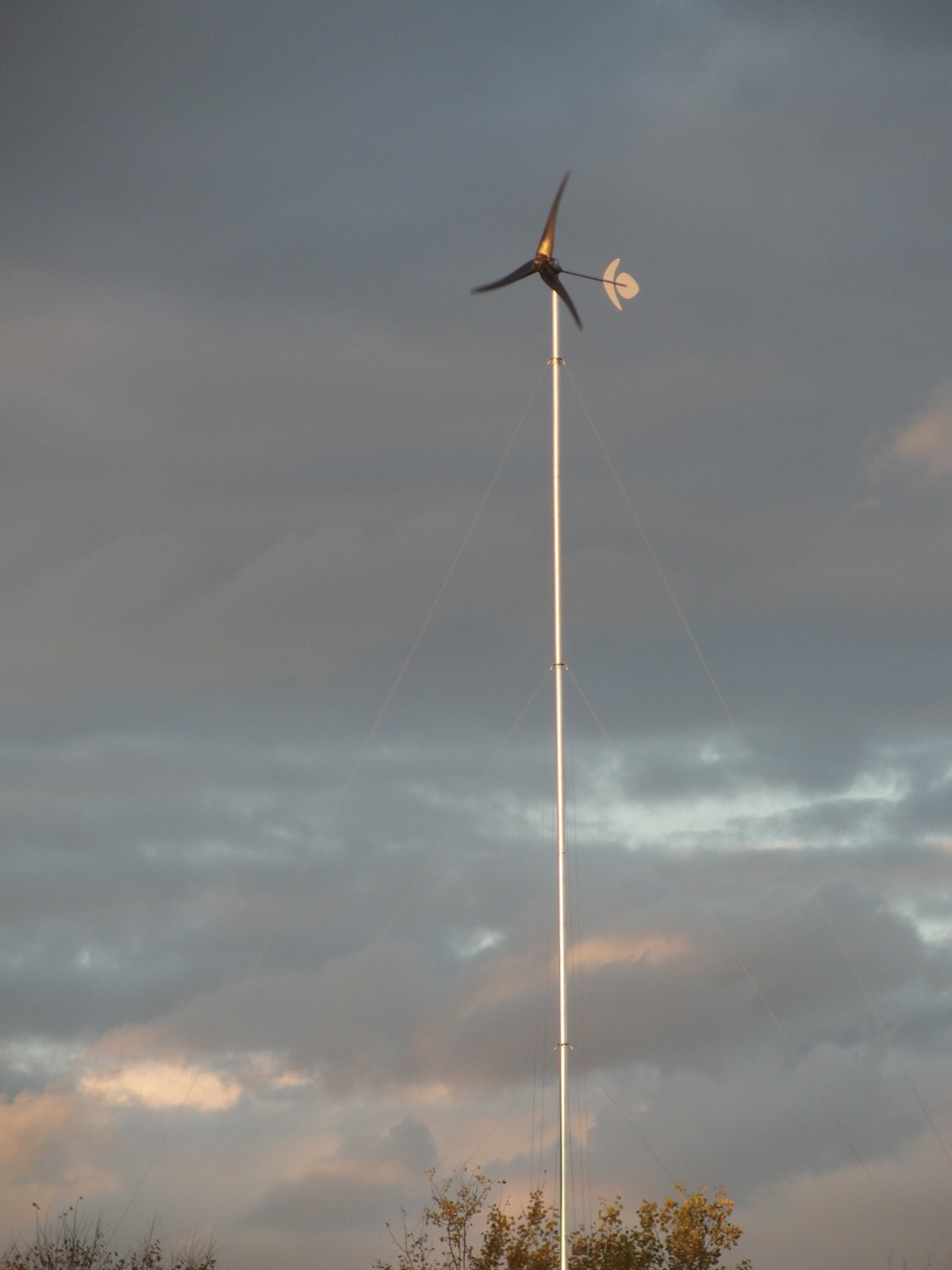
Wind Turbine

Wind Turbine

There are also experiments in what Macy calls, “Gaian structures,” new, or sometimes very old, ways to live that are sustainable and connected.  Some people need to be gardening, and building carbon neutral houses, and installing solar and wind power.

There is also the important work of shifting the consciousness of those around us. Some of us need to be writing books, and creating songs, and teaching young people about how to live as if we are a part of everything else.

Because there is so much to do, we can do that which most calls to us.

Resilience Circles

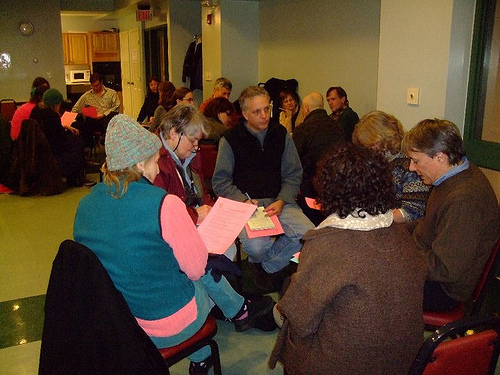
There are many people who are already hard at work building connections based on partnership and sustainability. In the fall of 2010 I had the opportunity to participate in a facilitator training for “Resilience Circles.” Resilience Circles are groups of ten to twenty people who gather together in regular meetings to support each other through economic and ecological changes.

Resilience Circle Training/ Licensed by Creative Commons

Resilience Circle Training/ Licensed by Creative Commons

Our trainer Chuck Collins wrote:

The dominant messages in the U.S. economy are “you are on your own” and “some people are going to be left behind.” Countering this isn’t easy. For many, talking about their economic anxiety and asking for help is difficult and shaming. But to survive the coming period of uncertainty, we must regain use of our mutual-aid muscles, many of which have atrophied from lack of use.

The three main functions of Resilience Circles are to increase our understanding of the larger economic forces on our lives, to open up opportunities for mutual aid and support for local economic challenges, and finally, to engage in social action to create changes that can bring about a more secure and sustainable future.

We explored questions like: Why is the economy in distress? What is our vision for a healthy, sustainable economy? What are the sources of real security in our lives? What can we do together to increase our economic security at the local level? How can we help our neighbors facing foreclosure or economic insecurity? What public policies would make our communities more secure?

Social scientists say that the stronger our social networks, the more resilient we will be in a crisis. When I was working in direct support of homeless people, I noticed how often someone became homeless because of isolation—they did not have a strong social support system, and so a crisis became a catastrophe.

There are many ways that working together can enhance our economic well-being. The Resilience Circles begin with small mutual aid projects. For example, one idea was a weatherization round robin—a team of five people agree to help each other get ready for the winter. Each host buys materials such as caulk and plastic sheeting, and then the group spends a few weekends getting all their homes ready. Another idea was a babysitting coop, where parents take turns watching each other’s children, keeping track with tokens for hours of childcare. Tool sharing, job swapping, meal exchanges, bartering—the resources we have among us are many, and the options are only limited by our collective creativity.

The underlying principle of Resilience Circles is that our greatest source of security and wealth is in our connection to each other, and our shared stewardship of the earth.

Turning Toward Partnership

A revolution is underway because people are realizing that our needs can be met without destroying our world. … Future generations, if there is a livable world for them, will look back at the epochal transition we are making to a life-sustaining society. And they may well call this the time of the Great Turning.   Joanna Macy


Planting the Seeds

Photo by Margy Dowzer

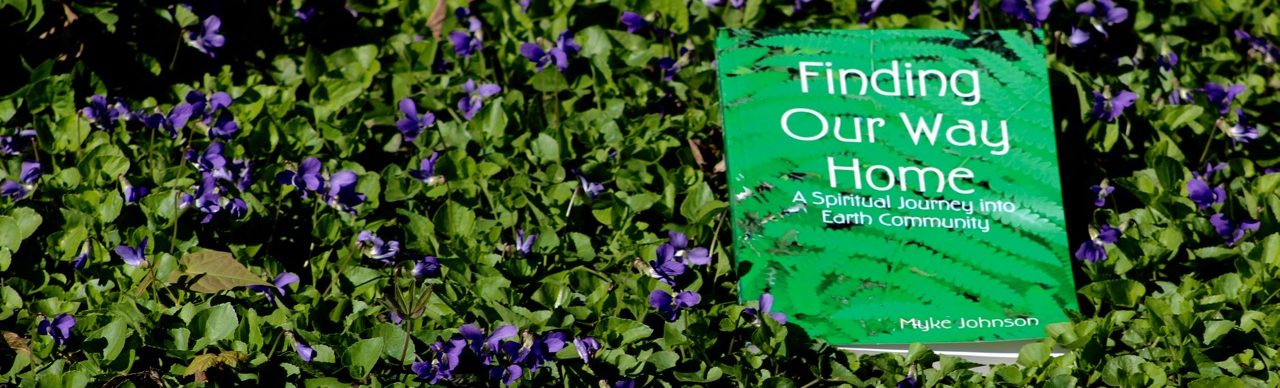
Joanna Macy believes that the essential adventure of our time is the shift from our industrial growth society to a life-sustaining civilization. She calls it the Great Turning. She says that “the ecological and social crises we face are inflamed by an economic system dependent on accelerating growth,” on “how fast materials can be extracted from Earth and turned into consumer products, weapons, and waste.” Based on this analysis, the mainstream arguments about how to revive the economy and the financial markets miss the point. Rather, the trouble in the markets is linked to a deeper trouble—a whole economic system based ultimately on the destruction of our environment.

In 2006, David Korten published a book, called The Great Turning, to further reflect on this transition that Macy had articulated. He describes our work in this time as a shift from the ways of Empire to the ways of Earth Community. He warns that even if we fail to change our ways, the world will change. But it will be known as the Great Unraveling, because “profligate consumption [will lead] to an accelerating wave of collapsing environmental systems, violent competition for what remain[s] of the planet’s resources, a dramatic dieback of the human population, and a fragmentation of those who remain into warring fiefdoms ruled by ruthless local lords.”

The other possibility, the Great Turning, involves unlearning the practices of empire, of systems based on hierarchy, competition, and domination, and adopting systems that support Earth Community: “a life-centered, egalitarian, sustainable way of ordering human society based on democratic principles of partnership.” If we recognize that we are all connected to each other and to the earth, we must embrace this sustainable, partnership path.