Choosing Community

So often when we hear that we should love one another, it sounds like hard work, like a task, like a moral imperative that would be good to follow, but not very pleasant. And I admit there is something difficult about loving one another. But somewhere in the middle of it, comes a surprise. There really is divinity within each person—and when we see it, it is beautiful, joyful, mysterious, and wonderful. It is like the diamond that Dorothy Day was so quick to give to the homeless woman. 

And not only that, when we risk opening our hearts to others, sometimes we experience the divinity that happens in the connections between us. We experience something of that ancient belonging for which we have been yearning. Ubuntu. We experience the oneness of all beings, our part in the family of all things. We realize that we are all gathered in a circle already, we are all part of one dreaming.

Those moments give me energy for the work of creating circles of love and faithfulness. Because we really do have to work at community. We have to make a choice for community. In our society, the bonds are frayed, and the mainstream is drifting toward isolation and competition. There are people who have no one with whom to share their real feelings. So dreaming in circles is about choosing connection, choosing love, joining hands with one other, and then another, finding the people with whom we can cast our lot, those who are similarly looking to manifest ubuntu in our lives.

When we choose community, when we practice loving a particular group of people, we are letting the reality of the universe enter our hearts—we are learning how to experience the reality that we truly are all part of one another. Of course we don’t usually get it right. Otherwise we wouldn’t need to practice. We are not here to try to fix everything in order to create some sort of perfect circle—we are the circle right now, trying to wake up together. Every person is sacred, and we are all one circle. Stone Circle

Active Love

In the great Russian novel The Brothers Karamazov, a wealthy woman comes to seek advice from a holy and renowned priest, Father Zossima. She is anxious about eternal life, and wants to know how she can be sure of it. Father Zossima tells her, there is no proving the existence of God or eternal life. But there is one way she may be convinced of it. “How?” she asks. “By the experience of active love.” he replies. “Strive to love your neighbor actively and indefatigably. In as far as you advance in love, you will grow surer of the reality of God and of the immortality of your soul.”

The woman goes on to tell him that she loves humanity, so much in fact, that she dreams sometimes of leaving her privileged status and becoming a sister of mercy. She would nurse the afflicted and bind up their wounds. She tells the elder, “I close my eyes and think and dream, and at that moment I feel full of strength to overcome all obstacles.” But then she worries that if the patients did not respond with gratitude, if they were rude or abusive, she would be incapable of continuing to love them. And so she is in despair about her quandary.

He replies,

I am sorry I can say nothing more consoling to you, for love in action is a harsh and dreadful thing compared with love in dreams. Love in dreams is greedy for immediate action, rapidly performed and in the sight of all. Men will even give their lives if only the ordeal does not last too long but is soon over, with all looking on and applauding as though on the stage. But active love is labor and fortitude, and for some people too, perhaps a complete science.Person in shadow

Dorothy Day would often repeat the pronouncement of Father Zossima, “Love in action is a harsh and dreadful thing compared to love in dreams.”

We are here to awaken to that kind of active loving, that vision of divinity within each person. I remember an experience that happened one time when I was flying on an airplane, returning home from an event in Washington, DC. I had settled into my window seat, and started to read a book. I can’t remember now what the Washington event was or what the book was, but something had inspired me to be pondering this connectedness of all beings, this divinity within all beings.

Then, two young men climbed into the seats next to me. The man in the middle leaned his head against the back of the seat and closed his eyes. A while into the flight, he started to be sick—his friend gave him a paper bag, and he vomited, mostly into the bag, but also splashing his friend. I was a little horrified, and imagined them with hangovers from some drinking and partying.

But then it struck me that if I truly believed in the connectedness of all beings, I would realize that these men were my brothers. They were part of me, living in another lifetime, another journey. Something shifted within my heart. Instead of judging them, I was able to feel compassion. We didn’t go on to have a long conversation or anything like that—I think I just asked, are you okay? I remember a flight attendant coming by to check, and asking me if I wanted to change seats. But I said no. I was experiencing something deeper, something taught to me by these unlikely teachers.

Quotes from Fyodor Dostoyevsky, The Brothers Karamazov, translated by Constance Garnett, (New York: MacMillan, 1922), pp. 59-61.

Every Person Is Sacred

Star in logOne purpose of spirituality is to restore our connection to each other, or rather, to wake up our awareness to the connection that already exists. We are always connected, but we forget, we lose hold of it, we suffer from the illusion that we are separate. Spirituality is our experience of being a part of the larger whole. Spirituality is restoring our awareness of our connection to the earth, to other people, and to the Mystery at the heart of our vast universe. All of it is one.

Every person is sacred, and we are all one family. The early Universalists said that everyone was getting into heaven. As that belief evolved over the years, they began to say that there was something of heaven, something of God, something of truth in all people and all religions. The circle kept expanding. Today, some of my beloved congregation members don’t even believe in heaven, but we all believe in the common circle of human beings. We profess that everyone is sacred and everyone is welcome.

I am reminded of one of my favorite stories about heaven. Everyone was gathered around the pearly gates, waiting for judgment day, when a rumor started going around.
Did you hear that God’s going to let everybody into heaven?”
You mean, whether or not you followed the commandments?”
That’s what I heard! Even murderers and heathens!”

Well, some people started griping.
I’ve worked hard to be good all my life! I don’t want to be thrown in with sinners!”
And others complained, “I can’t believe he’s going to let in the perverts and the terrorists!”

Finally, God showed up. And sure enough, everyone was welcomed into heaven. But a few proclaimed, “We’re not going in with sinners and heathens!” So they were the only ones who remained outside.

On this spiritual journey, we choose to open our hearts to all people. We learn to see that which is divine in all people. When I think of that kind of vision, I think of a story about Dorothy Day. She was the founder of the Catholic Worker movement, of which I was a part for seven years. Catholic Workers live in houses of hospitality to serve the homeless and poor, while working for peace and justice. One day a donor came into the Catholic Worker house and gave Dorothy Day a diamond ring. Dorothy thanked her for it and put it in her pocket. Later a rather demented homeless lady came in, one of the more irritating regulars at the house. Dorothy took the diamond ring out of her pocket and gave it to the woman.Diamond

Someone on the staff said to Dorothy, “Wouldn’t it have been better if we took the ring to the diamond exchange, sold it, and paid that woman’s rent for a year?” Dorothy replied that the woman had her dignity and could do what she liked with the ring. She could sell it for rent money or take a trip to the Bahamas. Or she could enjoy wearing a diamond ring on her hand like the woman who gave it away. “Do you suppose,” Dorothy asked, “that God created diamonds only for the rich?” Dorothy looked for the treasure in each person who came through the door.

Story recounted in the essay “A Harsh and Dreadful Love: Dorothy Day’s Witness to the Gospel” by Jim Forest

Born to Belonging

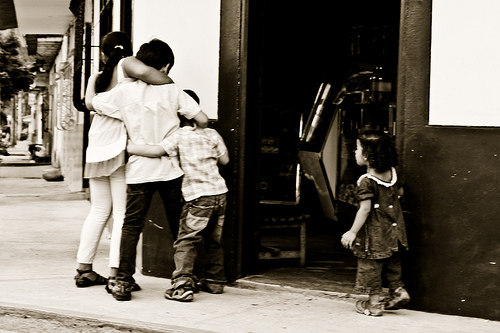
Excluded, Photo by Juan Ferr Alvarez, Flickr Creative Commons

Excluded, Photo by Juan Ferr Alvarez, Flickr Creative Commons

Have you ever felt on the outside of the circle? When I was in third grade, I went to a new school in the middle of the year. It was a Catholic school and when I arrived everyone was in church waiting for morning Mass. I went into the church but I had no clue what to do next. Everyone seemed to be sitting in groups by classes, but I didn’t know where I belonged.

I tentatively edged down into one pew, but the child next to me said, “This is for fifth graders, you don’t belong here.” I tried to move to another spot without being noticed. Again, the child near me looked askance: “You’re not a sixth grader!” I moved to yet another pew, with similar results. I was scared and embarrassed and out of place: I had no way to know where to go. Finally, one of the teachers noticed me, and brought me to where the third graders were supposed to sit.

It was a minor incident, yet a frightening moment of dislocation for a small child. Because my family moved frequently when I was young, that dislocation repeated itself often, and I was left with an unsettled feeling in my heart. I was left with perennial questions: How do we know if we belong or if we do not? What must we do to belong? Perhaps it was those moments of dislocation that made me aware just how important community is.

Activist and writer Mab Segrest wrote about a South African word that describes this essential need for community: ubuntu. “Ubuntu translates as ‘born to belonging.’” Ubuntu expresses the African idea that our human dignity and fulfillment is dependent upon our links to each other in community.

In contrast, our modern American society bases itself on the idea of individualism. John Locke formulated a theory of society as a contractual type of relationship freely entered into by individuals. Locke proposed that in the original state of nature, all humans were free and autonomous individuals, and from that state, they agreed to give up certain aspects of their independence, for mutual benefit and protection.

Today, this individualistic understanding is endemic. But Mab Segrest challenges individualism, and she begins her argument with the experience of motherhood. She writes,

It was after watching Barbara give birth to our daughter, Annie, …that it occurred to me the degree to which this Original Individual was a ridiculously transparent …fiction. None of us start out as individuals, but as fusions of sperm and egg, embedded and growing in the mother’s body for nine months. For months after birth, our consciousness is still merged with its environment, and a sense of the particular and separate self emerges only gradually.2

We start out in relationship, and our unique individuality grows out of that circle of relatedness. Not the other way around. We all need each other in order to flourish and to thrive in life.

To give Locke and others their due—the philosophy of individualism was created in rebellion against the authoritarian structures of an earlier age, the tyranny of church and monarch. To affirm relationship is not to deny the importance of human dignity and freedom. But we must recognize that relatedness comes first, and within that circle of relatedness, we find our inherent worth and dignity.

Quotes from Mab Segrest, Born to Belonging: Writings on Spirit and Justice, (Rutgers University Press, 2002) p. 2.

Dreaming In Circles

Red Moon

Photo by Margy Dowzer

It is said that if a group of people sleep arranged in a circle—heads at the center and feet out like spokes—they create a dream circle. Two or more people in the group may have the same dream at the same time. I tried this once with a group of friends, but I must confess, it didn’t really work for me. Mostly I just had a rather poor night’s sleep.

But I like the metaphor. The word dream is used to describe both our strange nighttime adventures and also our waking hopes and visions for our lives. For me, dreaming in circles is about sharing those waking dreams, entering into the magic that can happen when we join our visions together. We talk and we listen. We plan and we act. We are energized by each other, and we grow strong and bold. When we dream in circles, anything is possible. Margaret Mead has said,

Never doubt that a small group of thoughtful, committed citizens can change the world; indeed it’s the only thing that ever has.”

And here’s the important thing. When we dream in circles, the circle itself becomes the greatest magic of all. We wake up to the reality of our profound interconnection with all people and all beings. The circle is a symbol of this interconnection between people. In a circle, every person is linked to every other. Every person is equally valued and appreciated. Human beings cannot thrive as random individual strangers in a crowd; we are connected to one another at the deepest level, and we can only find wholeness through loving and mutual relationships. By sharing our dreams, we can come home to a community of love.