Peach Cobbler

This year, our peaches were extra fragile as they ripened, so we picked them and cut them up and froze them before they could go bad. The upside to this turn of events is that I discovered the joy of peach cobbler. I created/adapted a gluten-free recipe that we love. It also works for raspberries. I’ve turned into an obsessive cobbler baker for the cool fall days.

Gluten-Free Peach Cobbler

Preheat over to 375 degrees. Grease a 9 x 9 glass pan. Fill it about half full with frozen cut peaches, and sprinkle liberally with cinnamon.

Mix together 1 cup oat flour (made by blending gluten-free rolled oats), 1 cup almond flour, 2 teaspoons baking powder, and 1/2 teaspoon salt. Set aside.

Mix together 1 egg, 1/2 cup yogurt (we use whole milk organic greek yogurt), 1 teaspoon vanilla extract, 1 tablespoon honey, and 2 tablespoons soft butter. Beat together with a fork, and then add to dry ingredients, scraping the sides with a spatula to get it all. Mix together.

Then use the spatula to put the dough in clumps on top of the peaches, and gently spread out over the top of the peaches. Bake at 375 for 30-35 minutes. The cobbler should be golden brown, and the peaches bubbling; add some more minutes if it’s not quite brown enough. I’m not an expert, but as far as I can figure, with 9 servings, each serving has about 7 grams of protein and 14 grams of carbs.

I find that it actually tastes better after cooling off, because the juice from the peaches is absorbed into the cobbler. [If I make it with raspberries, I add 1/8 cup sugar to the raspberries to make them a little less tart.] It also tastes great with Greek yogurt on top, or ice cream.

The Lost Words

I haven’t had many words this autumn. Now, here we are in mid October. Leaves changing color, lovely cool days and cooler nights.

On the autumn equinox, we had a ritual with a few friends around our fire outside. I had gathered some acorns and we passed around a basket of them and each took out one acorn to express our thanks for some aspect of our lives, and then one for a wish or intention that we wanted for the next darker season. My intention was to bring back more music into my life. For whatever reason, I hadn’t been singing or playing my guitar for ages–I mean, years. So I put on new strings, and tuned the guitar, and then started singing a song here and there.

I found this hauntingly lovely song, Lost Words Blessing, originally shared by a colleague in a worship ritual. The song was inspired by a book The Lost Words created by by Robert Macfarlane and Jackie Morris. “The book began as a response to the removal of everyday nature words – among them “acorn”, “bluebell”, “kingfisher” and “wren” – from a widely used children’s dictionary, because those words were not being used enough by children to merit inclusion. But The Lost Words then grew to become a much broader protest at the loss of the natural world around us, as well as a celebration of the creatures and plants with which we share our lives, in all their wonderful, characterful glory.” [You can find out more about it on their website, and order books and albums there as well.]

One of my favorite things to do with songs is to figure out how I can sing and play them, and so I did with this one. And then, I found myself thinking about Passamaquoddy/Wolastoqey words, and how the language is in a fragile place, with original speakers growing older, and newer speakers trying to find their way into the language after long years thinking in English. How many of those words have been lost, or almost lost?

It has been a powerful gift for me to be learning the language with Roger Paul, via the University of Southern Maine during the last six years. Roger told us that the elders had given permission to share the language with outsiders, so that others might wake up to the world view hidden within. But I am always conscious that the language is filled with triggers of pain for all that was lost and taken by the violence of colonization.

There was something about the language that resonated for me with the song “The Lost Words Blessing.” So I decided to try to translate the song into Passamaquoddy–which I quickly found out isn’t really possible. It isn’t possible in part because the structure of English poetry is based on filling the lines with many words to evoke an experience, while the structure of Passamaquoddy, as well as I can understand it, is to use words that themselves are full of descriptive action. I learned a lot about how different the two languages are, by trying to create a version of the song in Passamaquoddy.

Still, I kept at it, not “translating” but pulling out words and sentences that created a similar experience in me, and also fit the phrasing of the music. While I am only an intermediate learner, I have learned how to research using the pmportal.org, to try to identify patterns and options and vocabulary. I couldn’t do it without that aid, and likely I made mistakes. I still don’t know if or when it might be respectful for me to sing this song. Can I, as a white woman, bring the language into this particular experience? When might it be appropriate to enter deeply into the language such that I can create a song with it? But to learn the language is, in a way, to fall in love with it. I want to honor Roger’s teaching by speaking as well as I can. Whether I ever sing the song for anyone but myself, I have learned so much by trying to create it.

Here is a sample, the first verse, with the original English, the Passamaquoddy, and then a more literal rendering of the Passamaquoddy into English. [Note: edited Dec 2024 with updated draft]

  • Enter the wild with care, my love
  • Kuli-nutahan elomahkiwik
  • In a good way, go out to the wilderness
  • And speak the things you see
  • on ktitomon keq nemihtuwon
  • and say what you see
  • Let new names take and root and thrive and grow
  • Piliwihtomun on kminuwiwihtomon
  • Name it/them newly and name it/them repeatedly
  • And even as you travel far from heather, crag and river  
  • Peci-te pihcehkomon nit sip weceyawiyin
  • Even when you go far from the river where you are from
  • May you like the little fisher, set the stream alight with glitter
  • Ansa pokomkehsis sipuhsis seskahtuweht
  • Like the little fisher make the stream sparkle brightly
  • May you enter now as otter without falter into water
  • Ansa kiwonik cupotomhat, kini-cupotomha
  • Like the otter slides into water, boldly slide into water

Inside the pain

There may be times when we are powerless to prevent injustice but there must never be a time when we fail to protest. Elie Wiesel

The last few weeks, I have been dealing with severe pain in my hip, such that it makes it difficult for me to walk or sleep. I am grateful that I now have physical therapy which is slowly helping. But as I was lying on the table getting treatment today, I kept thinking about people in Gaza, right now, who also were dealing with hip pain, or chronic illness, or who were giving birth–any of the myriad kinds of human conditions that render us deeply vulnerable, even in the best of situations.

And instead of finding help or treatment, those human beings are being forced out of their homes, bombed, shot, starved. How would I evacuate when I can barely walk? How would I sleep on the ground with no pillows to ease the pain? How would I manage my illness with no medicines? How would I give birth with no clean water? It is not as if those human frailties cease to exist because of war. Underneath the other horrors, the deaths, the woundings, the destruction of homes, schools, libraries, hospitals, there is each human story.

I find in my body a small metaphor for this hurting world. I find in my body a deep scream of pain for this hurting world. They say the hips are the foundation for the balance of the body. And the earth is out of balance in so many ways. We see it in the chaotic weather, we see it in wildfires, we see it in an ocean warming faster than expected, we see it in cruelty toward children who are “different,” we see it in pandemics, we see it in politics of fear and hate. Who knows what the future will bring, with such a painful present.

I found encouragement in these words of Elie Wiesel, who survived the holocaust and wrestled with its meanings and repercussions for the rest of his life:

“There may be times when we are powerless to prevent injustice, but there must never be a time when we fail to protest.”

https://www.nobelprize.org/prizes/peace/1986/wiesel/lecture/

I found this image and quote posted by a friend on Facebook–the image is the Ukraine sunflower, and Ukraine is another country full of people in pain that linger in my own heart. But the flower feels full of beauty and hope. [Update Note: I later heard from the creator of this poster. It can be found at https://www.redbubble.com/i/poster/Ukraine-sunflower-by-NestPaintbrush/103305139.LVTDI ]

Wiesel goes on to say:

“The Talmud tells us that by saving a single human being, man can save the world. We may be powerless to open all the jails and free all the prisoners, but by declaring our solidarity with one prisoner, we indict all jailers. None of us is in a position to eliminate war, but it is our obligation to denounce it and expose it in all its hideousness. War leaves no victors, only victims.”

1986 Nobel lecture

A Child in Gaza

I haven’t been able to write for a while. My heart is shattered by the continued assault on the people of Gaza by the government of Israel, supported by my own US government. If you follow this page, you know that I have chronic illnesses that keep me unable to go out to demonstrations or vigils or do much of anything. All I have been able to do is to bear witness, to keep looking for news, to keep posting on Facebook photos and stories of the devastation. Every day more devastation. Every day, bearing witness and sharing.

I want to tell you about Lama Jamous, a nine year old child in Gaza who is documenting and interviewing and posting on Instagram–she has become the youngest journalist in Gaza.

You can follow her here on Instagram. (I first found her on Facebook, but now I am not sure if that was a real account or a copycat account. Still, it led me to know about her.) In another post she writes:

My name is Lama Jamous and I was born on November 24, 2014. I have a sister Aya and two brothers Mohmmed and Kareem. I’m the youngest of the family. I am a great student in school and I have lots of friends. I enjoy working as a group with my classmates, participating in activities. My favorite subject is Arabic. Every weekend I would go visit my grandma in Khan Younes. Then we were going to see our farm by the beach. We were going on picnics too. Our apartment on the roofs in Gaza was magnificent.
Then came October 7, 2023 and our lives changed 180 degrees. No more school, no more education, no more picnic… Very difficult to live as situation. We went to Rafah to live in a tent. From now on, we have nothing of the basic of living well like no privacy for the toilet. My whole family live right beside us.
My aunt Sana was killed along with 14 yr old Malk, 11 yr old Brea, 16 yr old Malek and 10 yr old Salam. They were civilians, my friends, my family… I have suffered tremendously from this situation and being evacuated from one place to another. So I decided to be a journalist to show the world what’s happening.
We love our country very much and would like to stay but the reality is that we are facing genocide against civilians… Many witnesses told horrible things that happened or are happening. Media is not covering this.
It’s very expensive to evacuate a family… every person needs $5,000 to $7,000 but it depends. We hope to be safe soon and we will come back when the war is over. I want the war to stop so we can get back to normal life. So many of my friends and classmates are missing and we don’t know what happened to them… Everything has gotten worse than before. This war needs to be stopped.
Lama Jamous

https://www.instagram.com/reel/C3CTcxeM-bs/?utm_source=ig_web_copy_link&igsh=MzRlODBiNWFlZA==

Lama Jamous is a child, my friends. She is now in Rafah, which was to be the safe evacuation zone, but is under attack.

I first heard about Lama through the work of Motaz Azaiza, a photo journalist who has been documenting the atrocities. He was recently evacuated from Gaza, and was interviewed in the Guardian. He expresses it so eloquently:

“To be clear, this is not a war against Hamas,” says Azaiza. “This is and has always been a war against the Palestinian people. Israel’s plan is to bury us or push us out – as we have just seen with the Rafah bombing. There is literally nowhere else for us to go.”

Azaiza urges the world not to look away. “As humans, we all have a responsibility to bear witness to what is happening in Gaza,” he says. “I tried my best to show the world our reality, now the world needs to show where it stands. It is ordinary people, men and women, who have the power to save what remains of Palestine. Our plea is simple – we just want to live.”

https://www.theguardian.com/global-development/2024/feb/16/motaz-azaiza-interview-gaza-ghosts-photojournalist

Please bear witness with me. Please do whatever you can to stop this genocide.

Happy Solstice!

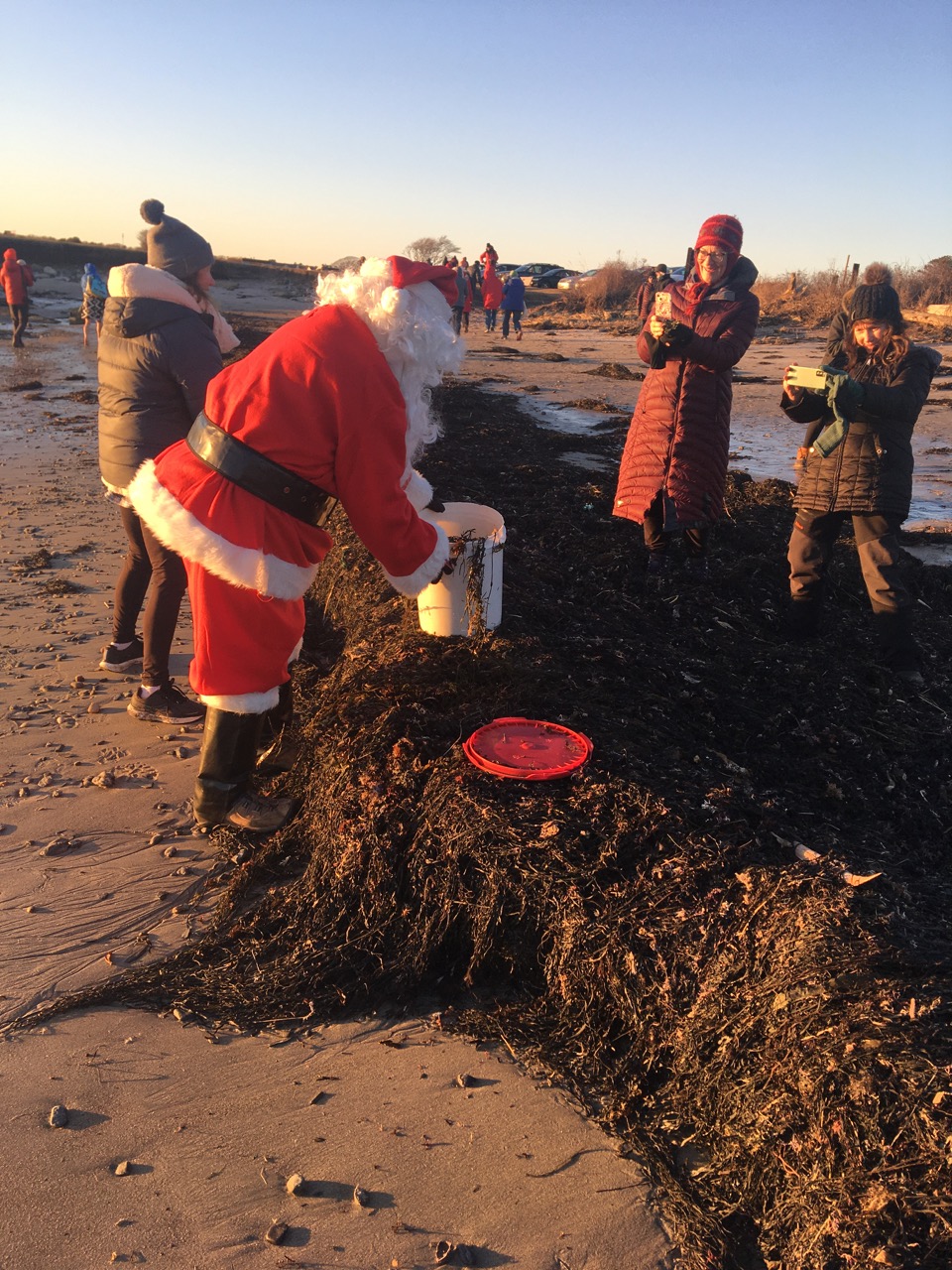
Santa at Kettle Cove Beach.

For a Solstice treat, Margy and I went to Kettle Cove beach a little before sunset. Santa was gathering seaweed for the garden. Now you might not think Santa would be out on Solstice, but the ancient European pagans laid claim to this gentle gift-giver from the north much before St. Nicholas. In fact, in the old old days, they say Santa was female. I think they might be right.

A group of hikers passed by and seaweed-gathering Santa was a big hit, with many photos taken. Job done, it was time for a little rest. Thankfully, there was a handy log nearby to sit on.

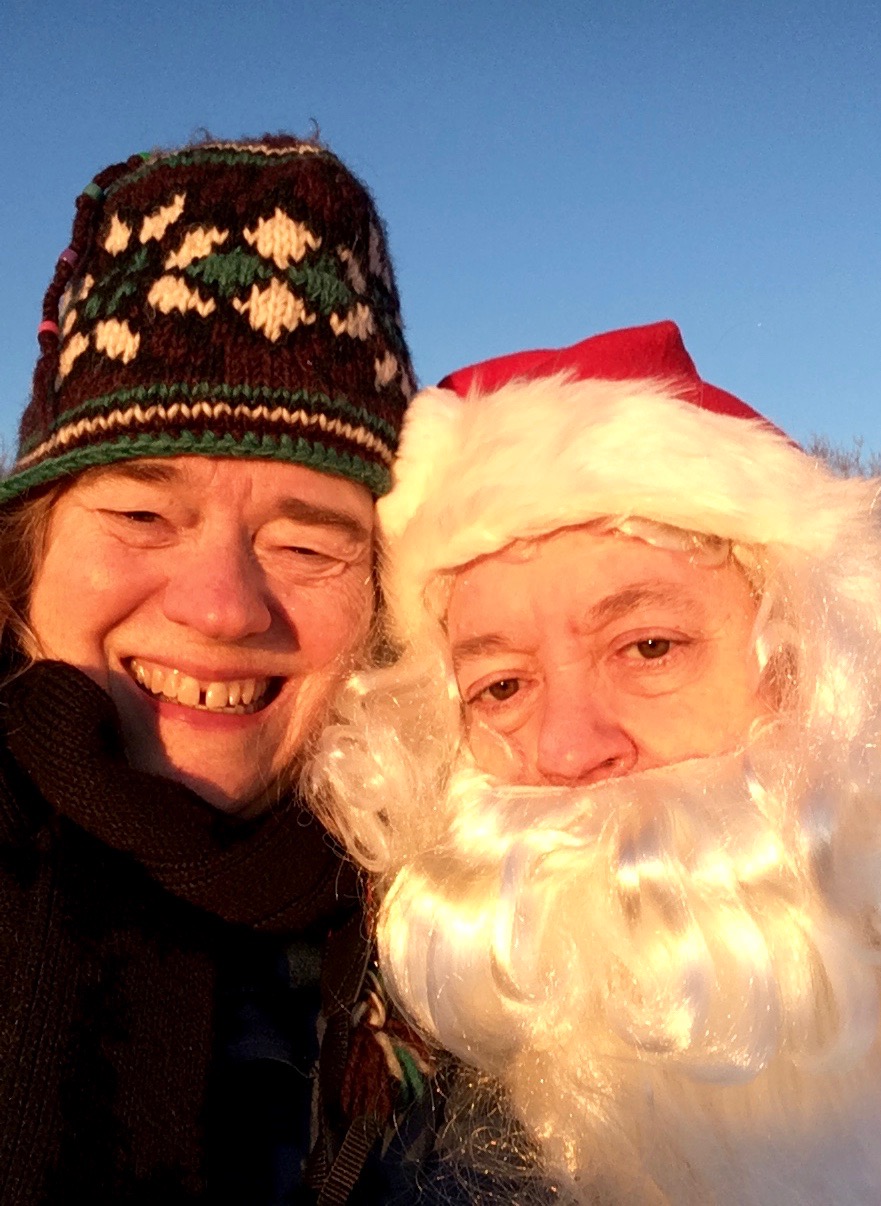
Oh look, who is that with Santa? It’s me! I was also sitting on that log. It’s a Santa selfie. The setting sun was bright upon our faces and we gave thanks for all the sun brings to us.

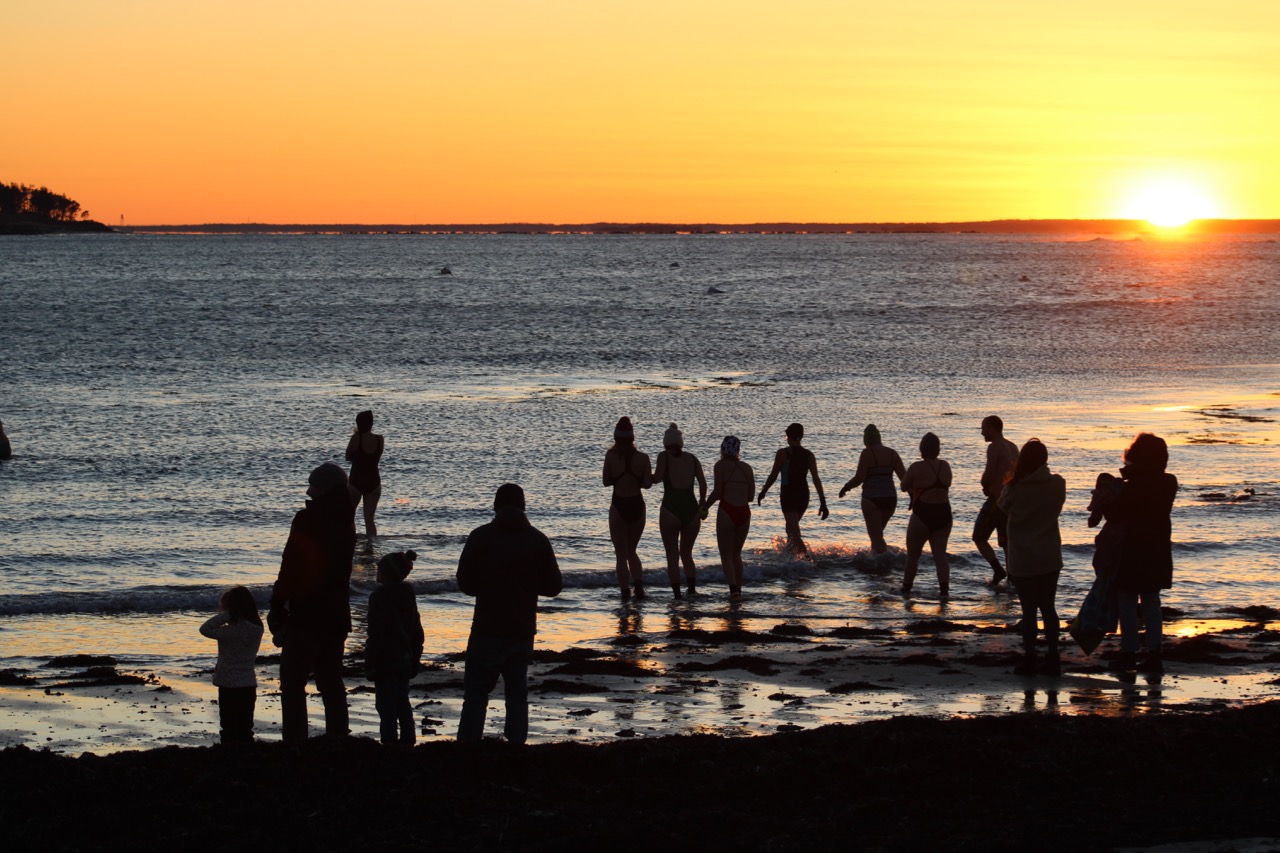
And then we had another surprise treat. The local mermaids came to the beach for a Solstice swim in the cold ocean. We did not join them but we had fun watching them brave the waves.

May all the blessings of this Solstice day be upon you! May the darkness be fruitful, and peace return with the lengthening days, peace upon Gaza, upon Ukraine, upon Sudan, and all the hidden sorrowful places.

First Snow, Gaza, Small Birds

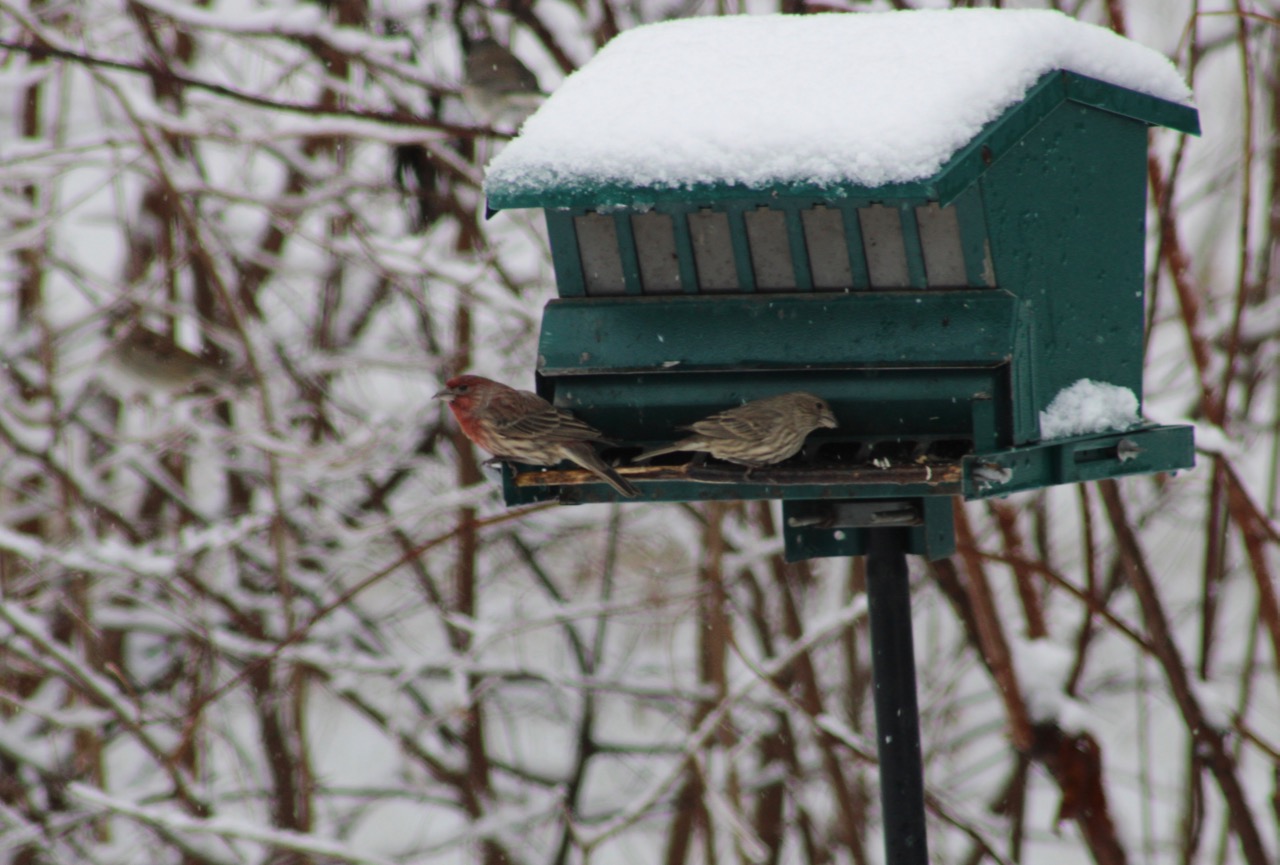
Green bird feeder in front of snow covered branches of hazelnut hedge.
Bird feeder near hazelnut hedge.

We have our first snow-covered morning here in our yard in Portland Maine. In places further from the shore they got several inches, but we had mostly rain until early morning. Now it feels like winter is really here. My internal clock has felt the shift, as the days grow shorter and darker. A few days ago, I started working again on sorting through my old documents–my winter project of the last few winters. This year, most of the documents are digital, though there is at least one box of paper files to go through in the basement. In prior winters, I looked back on all the years before we moved to Maine in 2005. This winter, I am looking through my time as minister of Allen Avenue Unitarian Universalist Church here in Portland, before I retired in 2018.

I started by reading all of the “annual reports” I wrote for the church to summarize the work of that year. It was a simple way to quickly turn the pages of thirteen years of ministry. I was astounded at the sheer number of times I marched in protests, or spoke at vigils in solidarity with issues of justice or worked on legislative change in support of human rights, usually along with other members of my congregation or other ministry colleagues. My life now is so much quieter and less intense, but also less connected. It was good to have that public voice, and to use my voice in service to all that I believe. I feel so far removed from that life and that work.

I suppose in some ways a blog is a kind of public voice, but much quieter and less visible. My life these days is much quieter and less visible. That is chronic illness, compounded by our continued COVID precautions in our household. I can’t put my body out on the line for love and justice. It takes most of my body’s energy just to manage our household tasks. It is like I am looking out a window at all that is happening in our world.

I was surprised to notice that I hadn’t blogged for a few weeks. Lately, all I can think about is Gaza and the way the people there are suffering and dying. In my files I found a sermon I preached in 2014 about Palestine and Israel. In many ways, the issues are all the same. In other ways, everything has gotten worse, much worse. So many deaths, so much destruction. I can’t even imagine the words I could say about it, and then I don’t have words for anything else. My heart is on the ground. My heart is on the ground.

And then, out the window I see a large flock of small birds visiting the hazelnut hedge and the bird feeder. They find their way to our yard each day, traveling together as a group. They usually arrive mid-day, but today they are early. Tufted titmice, chickadees, goldfinches in their winter garb, sparrows, juncos, finches, even a bluebird. (Maybe they come more than once a day, but you have to be looking out a window to see them so I am not sure.) Often a few chickadees even stop at our back porch pecking for stray seeds. It is not so easy to take a photo of a flock of small birds. They scatter themselves across the orchard. They come through and then they are gone again. Traveling all together on their mysterious rounds.

And my heart is lifted just a little, with their flight and their community.

Finches at feeder.
Junco on a branch.

Suffering and tending

Myke painting tree trunks in the orchard (Photo by Margy Dowzer).

When I feel devastated by the images of premature babies in al-Shifa hospital in Gaza, without incubators, without oxygen, placed together for warmth, but some dying, (and finally I hear that they are being evacuated today)… When I feel devastated that the initial violence and hostage-taking of Israeli citizens by Hamas has been multiplied by more violence and death by the Israeli government… When I feel devastated by bombs killing innocent civilians and journalists and children… When I feel devastated that I cannot stop the killing or bring food or water to the starving families… I cannot find the words to write…

And so I have been tending the only life I can tend. To get ready for winter, I sprayed the orchard trees with holistic spray (with Neem oil, Karanja oil, hydrolyzed fish, and probiotics in water). And then a few days later, I painted the trunks with my own combination of white milk paint and “Surround.” The white paint protects the trees from sunscald. When the sun warms the trunk by day, and the nights are cold, the extreme fluctuations of temperature can cause the bark to split.

Milk paint is a non-toxic biodegradable paint made from milk and lime. Surround is a natural clay product that protects trees from boring insects. It is also light colored, so I decided that to combine them would make sense. They both come in powdered form that is mixed with water. And so I knelt beneath these trees and tended them with love.

This is not enough to remedy even the suffering I feel in my own heart for all the suffering happening so far away. But somehow I must choose life, choose tending, choose care.

Already Broken

Broken measuring cup

Years ago I heard a Buddhist phrase–“The cup is already broken.” Its intent is for us to meditate on the transient nature of all of our reality. If we think of the cup as “already broken,” we can appreciate the cup now, and not be attached to keeping it in the future. At least, that is my brief paraphrase of what it means to me. Last night I knocked into a glass measuring cup and it fell to the floor, shattering into many pieces. Margy says she thinks that this measuring cup had originally belonged to her mother. But it was not really a sentimental piece, rather a long-lasting useful tool in our kitchen. Very long-lasting. Very useful. I locked the cats in the bedroom so they wouldn’t step on glass, and swept and vacuumed all the pieces from the floor into a paper bag to put into the trash. So it goes.

However, there is another version of “already broken” in modern American life–planned obsolescence. Manufacturers purposefully making products that are designed not to last, so that “consumers” will keep buying more products to replace them. This kind of “already broken” is so frustrating as we try to live in sustainable mutual relationship with the earth. We have these metal yard chairs whose weave has torn so that they are no longer useful, and not repairable. They were not long-lasting–maybe only a few years old. We’re likely going to call The Dump Guy, to come and pick up four of them plus a broken patio umbrella. It just makes me feel angry.

Broken yard chairs

Meanwhile, it seems to be an autumn full of broken mechanical things–but happily so far, most able to be repaired. The garage door was broken and then fixed a month later. A groundhog dug a tunnel under the garage that we needed to get filled, and a contractor worked on it. The clothes dryer stopped working and was able to be repaired. Now the heat pumps won’t work, and someone is coming on Tuesday. (We have a back-up oil boiler, so we are not cold.) I have felt burdened by all of this household decrepitude, yet also grateful–because we have been able to get repairs done, able to afford them, able to find repair people to tackle the jobs that are too big for us.

But I am also reminded of the larger brokenness all around us in our world. I always resonated with the Jewish concept of Tikkun Olam, “repairing the world.” I am not Jewish, but have learned so much from that tradition (and people from that tradition) about working for justice. So much of my life, I was involved in activism to end oppression and injustice. I dreamt of a world of freedom and equality and compassion. Now as I face the latest chapter of my life, with chronic illness, I don’t have the energy or ability to be so active. I feel discouraged about the backlash that has undone many of the hard won victories for the world that we dreamed about.

So I ask myself, what do we do when we cannot repair the world? What do we do when oppression and injustice and violence seem relentless. What do we do when the very earth we rely on is on a course for a mass extinction. What do we do when the world is “already broken?” I have been struggling over this writing for weeks now. I don’t have any answers, but it feels like a critical question for this time of my life. If I have attached my meaning, purpose, and value to improving the world, to repairing its brokenness, then who am I if that is not possible? Who am I if the world is already broken?

I still don’t really have an answer. I still am pondering the question, as I feel such sorrow and grief for those who are suffering right now in ways I cannot alleviate. I remember that many people have lived in times of great horror, have lived in situations which they did not have power to improve or repair. We are tangled in a web of broken relationship. We cannot escape. Yet in every situation, people have made choices to affirm their humanity and interconnection. What choices might I make during this next chapter?

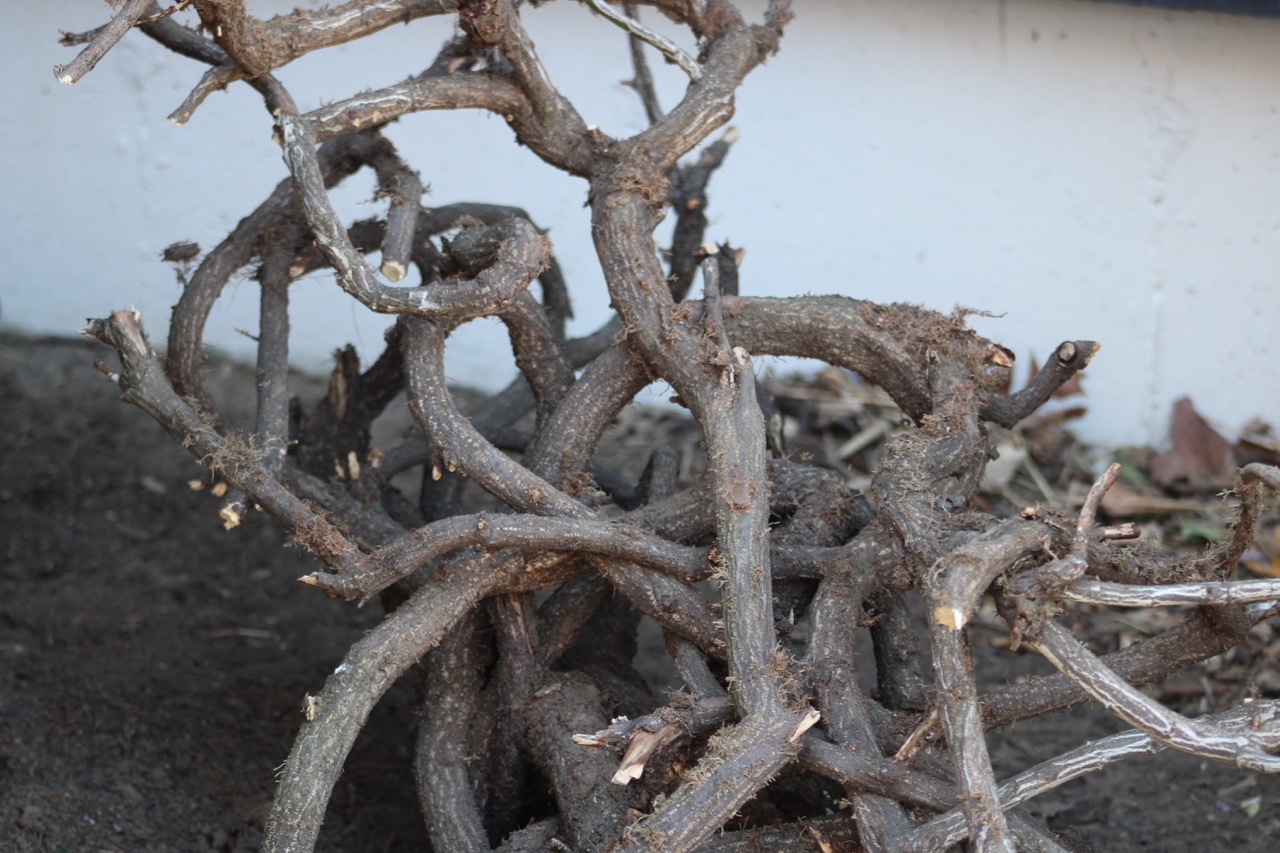
Tangled branches of cut “climbing spindle tree” (invasive in Maine)

Halloween Frost

Frost on flower

Today is Halloween, that wild holiday of ghosts and ancestors and gifts of sweets. Some say the veil between the worlds is thin during these days. Celtic Samhain, Mexican Dia de Muertos. The day midway between autumn equinox and winter solstice. This morning I woke to our first frost of the season. It is later than usual for Maine, but also earlier this week than I had expected. Still, it drew me out to walk in the dawn’s first light.

I harvested the last of the (now frozen) raspberries. We often don’t get any in the fall because they don’t get enough sun to ripen before the frosts. So we’ve been grateful for several little bonus treats over the last few weeks. I also cut some (frozen) chives, and quickly chopped them up small and put back into a frozen state for use during the winter.

On October 16th, I had dug up the licorice plant, to harvest the roots–they make my favorite herbal remedy–such an energy boost iced as tea with lemon in the summer garden work. I cut off several large roots near the main plant, and all the long extension roots to new plants. After that, I replanted the original plant, and mulched with wood chips all around. Then, and I haven’t yet finished, I wash them with a scrub brush, and cut into small pieces to dry in the herb dryer. It takes quite a bit of my energy, so I can only do small batches at a time. Here is the latest:

licorice root as dug
licorice root washed and cut

So the end of the harvesting is in sight. No more zucchini. Still more kale–that keeps going after the frost. Still some carrots in the front yard beds. Leaves are still falling. Margy did some final mowing and some not-final raking. Much of our back lawn is moss mixed with wild strawberry, clover, grass, and weeds. We love the moss. On more mechanical themes, our garage door was fixed today! (It has been broken since the end of September.) We’ve also had a broken clothes dryer. Appointment scheduled for Friday. I guess these are part of our preparations for winter.

But today, mostly I think about the ancestors, those I loved who have died, and those I never knew who are the roots in my family tree. I had a new thought about my mom’s father, whom we called “Papa.” He was born “Johann” in Austria in 1884, but was “John” in the United States. He left his country with a few friends, who all worked as waiters to pay their way traveling across France, England, Canada, and finally Detroit, Michigan. None of his family of origin were on this side of the Atlantic. He remained friends with those men to the end of his life. He died when I was a young teen, so I don’t have too many memories except of a very quiet, very short man. Even though he lived with our family for a while. But when I look at my own life, I too left the place of my family, and bonded with friends who have been like another family in my life. So maybe we have that in common.

Really, there is so much we don’t know about the lives of our ancestors. All we can do is wonder. During this past year, since last Halloween, my friend Estelle joined the company of the ancestors. She was a true spirit sister. So I honor her today along with those others in my life whom I loved, and who loved me. In that, I have much for which to be thankful.

Everyone needs water

If you look closely you can see 8 white-throated sparrows visiting the pond.

This week we’ve had a flock of dozens of white-throated sparrows in our back yard and the field and trees next to it. I love their little striped heads and loud chirping. They are drawn by the water of the pond, and I’ve seen them drinking and bathing there. It is such a blessing to feel the yard full of birds. If I am sitting right next to the pond, they are a bit timid, but yesterday I took the photo above from a little further away so as not to spook them. A few days before, one sparrow kept peering out from the nine-bark branches, but wouldn’t come any closer.

Then a couple days ago, when I sat quietly for a long while, a few began to venture near to drink even with my presence on the other side of the pond.

Every living being needs water. A human being can only survive for about 3 days without water. I am thinking about water in relation to the people in Gaza under siege, where Israel has cut off water and the electricity needed to pump and purify the water for drinking. The killing of innocents is always wrong, I believe that what Hamas did was wrong. But I also believe that the government of Israel is wrong to attack the civilians of Gaza, or cut off their access to water, food, and fuel. I am not unaware of the long history that is the context for these attacks. I have been following Jewish Voice for Peace for information and guidance in the midst of this deeply sad time. As someone who is neither Jewish nor Palestinian I can’t begin to grasp the depth and complexity of it all, but I trust the deep values of the Jewish Voice for Peace.

In the midst of this larger sadness, about which I can do nothing really, except to bear witness, I find peace with wild things gathering at the water. Everyone needs water. We are all relatives in this, whether large or small, near or far.

Chipmunk drinking water at the pond.