Tiny and partial

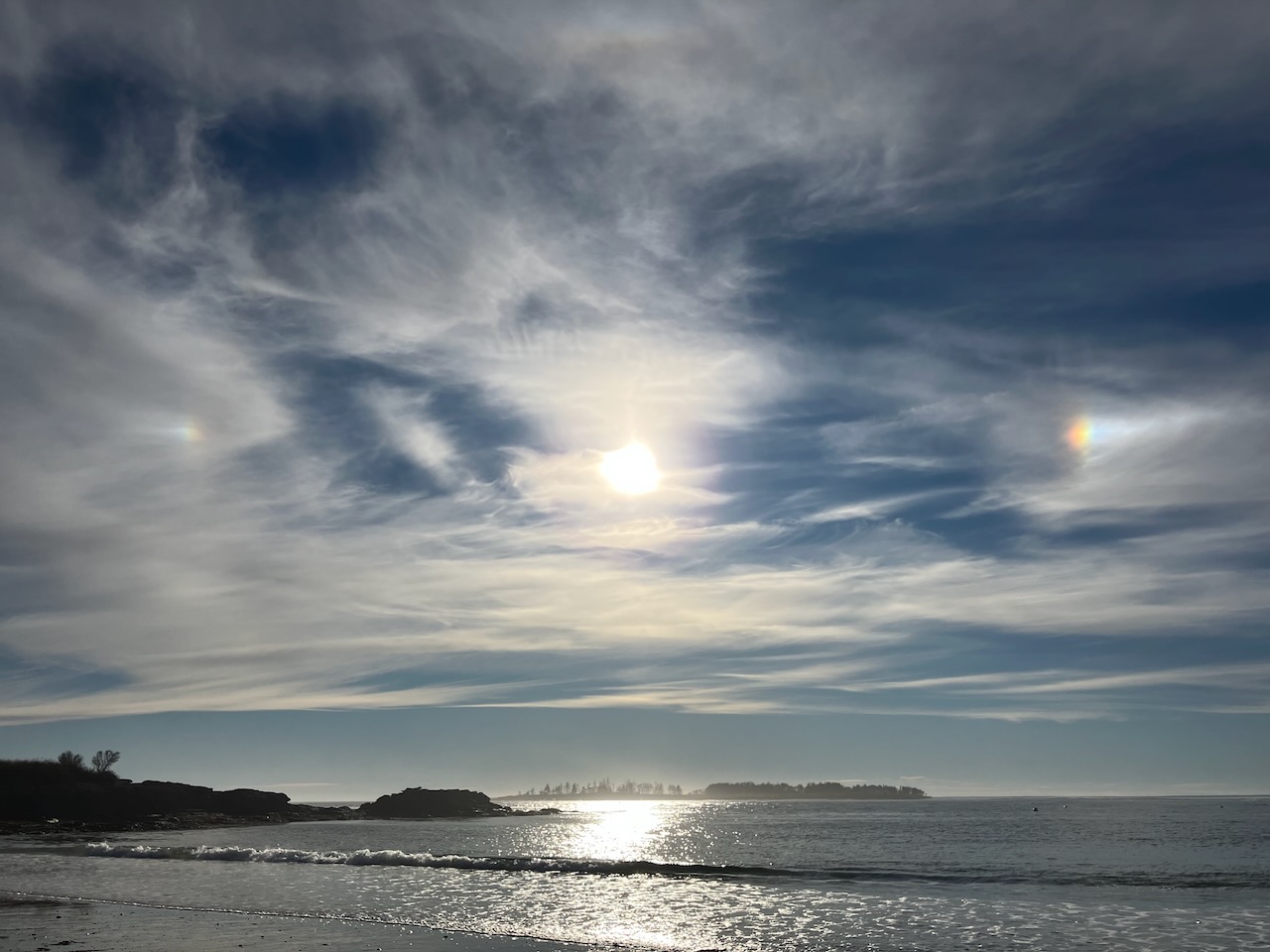
On the last day of 2024, Margy and I went to Kettle Cove beach. I saw this tiny partial sunbow in the sky, bursts of color hanging on either side of a bright sun. Tiny and partial are the words for today. There is so much suffering in the world, so much violence and evil. I can’t stop the devastation of Gaza, or the cruelty of the Israeli army continuing to kill scores of people even after a ceasefire has just been signed, to take affect on Sunday. Why not stop the killing today? All I can do is bear witness, share posts on Facebook. Tiny and partial.

What can we do to bring good to the world? I think about my visit to my friend at the nursing home yesterday. He was happy to see me–I went to wish him happy birthday and we had a good visit. But immediately afterward I felt a sense of guilt that I can’t visit more often than every months or so. What I can offer him is tiny and partial. But perhaps it is important, especially in the face of large and unrelenting troubles, to honor the tiny and partial acts of goodness we do? And what can he offer now, my old friend, after years of activism and kindness? Perhaps merely to receive with cheerfulness the help he now needs. We each bring goodness in the tiny and partial ways that we are able.

Each morning I take a walk. I have been able to take a little walk most days, after a message a year ago that “walking will be needed.” I have been able, ever so slowly, to increase my walk to about 20 minutes, no longer going directly to the brook and back, but making a little circle around the neighborhood, on my way there. It feeds my spirit, and reminds me to be in love with the earth, the sun, the water, the place where I live. It is a tiny walk as walks go, but by tiny increments, a little more.

Before I walk, I empty and refill the water that we have in a heated tray for the birds. Perhaps that is my tiny gift to the creatures who live here with us on this land. It feels like a prayer each morning. It reminds me of the importance of giving what we are able to this wider community of life. The other day I saw the crows laughing and jostling each other as they perched on the edge and dipped their beaks in.

We are living in very troubled times. Some will be called to wise analysis, and great acts of heroism, and energetically building the systems that honor our deepest values. But all of us, no matter how tiny, must still cling to kindness, cling to our interconnected earth community, and give what we can, no matter how partial. And I hope I remember to celebrate the brightness of the colors revealed in those gifts.

Be like the crows

Crow on the top of bare branches of a tree against a blue sky
[A crow is perched high in the bare branches of a tree outside my house. This photo is not from yesterday, but reminds me of the crow I saw yesterday in a similar perch.]

After blogging yesterday morning about Listening for Spirit, I bundled up in warm clothes to take a walk in the cold. As I stepped off the back porch, I heard the raucous calling of crows, and looked up to see a crow high in the branches of a tree. Then I saw two others, all of them agitated and calling. They flew over our back yard and kept calling and scolding.

I walked down the driveway, turned right onto the street, went past our neighbor’s house and then around the corner, on my usual route for a morning walk. I could still hear those crows! Then I saw the cause for the crows’ alarm–it looked like a huge hawk up in a tree near another neighbor’s house. I could see the white feathers of its belly as it perched and I crossed the street to confirm its identity. Then it suddenly flew off, obviously bothered by the relentless scolding of the crows. They didn’t stop, but kept after it until it was gone.

Then Spirit said, so clearly, “Be like the crows! Keep calling out to alert everyone to the presence of a huge predator! Keep calling out together.”

I was reminded of the line in a song that I have been singing and translating. “Even as the hour grows bleaker, be the singer and the speaker.” [from The Lost Words Blessing] In Passamaquoddy, verbs are more fundamental than nouns, so the end of that line became, “…ahtolint on ktahtolewestun” “…keep singing and keep speaking.”

I have watched people talking about facing encroaching fascism by deleting their public presence on social media, by using encrypted forms of communication like Signal, by using extreme caution about what is said and what is shared. And there are situations that definitely warrant those precautions. Definitely. But I believe that there are also reasons to keep speaking and keep sharing. Keep naming our values, keep claiming our experiences, keep identifying what we witness.

If we are called to that. And not alone, but in groups, even groups of three. Three crows can annoy a hawk enough to make it leave. I felt the presence of Spirit so strongly in those crows that it gave me courage to say, I can do that. I can keep speaking here, as long as I can.

Sustenance

Today I saw this gray goldfinch on a gray seed-head of evening primrose! Both the bird and the flower have let go of their bright yellow plumage as we enter the dark season. But still so beautiful in their subdued and subtle way. We haven’t cut down the “dead” plants because they are still such a source of sustenance and life to our little friends.

It is these small beauties that are sustaining me during these anxious days in the United States election season. It is terrifying to me that there is a close race between a mentally-unstable fascist who spreads hate wherever he goes, and a very qualified woman with whom I disagree on certain policies, but who will be president of all the people, and uphold the basic principles of democracy. My partner and I dropped off our absentee ballots last Monday, and gave Kamala Harris our votes.

It breaks my heart that some people I love seem to have been taken in by the lies of the MAGA propaganda machine. I don’t know how to ease that pain, except to pray that the fascists don’t win.

I haven’t forgotten the genocide that is being perpetrated by the Israeli government in Gaza, and expanding to Lebanon. I will continue to protest that killing in whatever ways that I can, small though they may be, every day. I have heard that some folks say they can’t vote for Harris because of her association with the Biden administration’s participation in the genocide. I don’t know what might happen under a Harris administration. But I know that the other side will be much worse, and would accelerate the destruction.

For me, voting is strategic. I have protested in some way every administration of our country–but there are better and worse administrations. For all of my adult life, I have been part of the movements to expand equality and democracy–to women, to people of color, to queer folks, to disabled people. I have protested the wars of empire and supported the raising of our awareness of the interconnected web of life, and the challenges of climate destruction. We keep pushing toward the hopes, and resisting those who would take all of that away in favor of hierarchical despotism.

In this season when the veil between the worlds of the dead and the living is thin, I think of my uncle Jim, who fought fascists in World War Two, and then grew marvelous gardens when I knew him. I think of my uncle Richard, whom I never knew because he died in that fight. May their spirits help us now. May all the spirits who cherish peace and liberation help us now.

Peach Cobbler

This year, our peaches were extra fragile as they ripened, so we picked them and cut them up and froze them before they could go bad. The upside to this turn of events is that I discovered the joy of peach cobbler. I created/adapted a gluten-free recipe that we love. It also works for raspberries. I’ve turned into an obsessive cobbler baker for the cool fall days.

Gluten-Free Peach Cobbler

Preheat over to 375 degrees. Grease a 9 x 9 glass pan. Fill it about half full with frozen cut peaches, and sprinkle liberally with cinnamon.

Mix together 1 cup oat flour (made by blending gluten-free rolled oats), 1 cup almond flour, 2 teaspoons baking powder, and 1/2 teaspoon salt. Set aside.

Mix together 1 egg, 1/2 cup yogurt (we use whole milk organic greek yogurt), 1 teaspoon vanilla extract, 1 tablespoon honey, and 2 tablespoons soft butter. Beat together with a fork, and then add to dry ingredients, scraping the sides with a spatula to get it all. Mix together.

Then use the spatula to put the dough in clumps on top of the peaches, and gently spread out over the top of the peaches. Bake at 375 for 30-35 minutes. The cobbler should be golden brown, and the peaches bubbling; add some more minutes if it’s not quite brown enough. I’m not an expert, but as far as I can figure, with 9 servings, each serving has about 7 grams of protein and 14 grams of carbs.

I find that it actually tastes better after cooling off, because the juice from the peaches is absorbed into the cobbler. [If I make it with raspberries, I add 1/8 cup sugar to the raspberries to make them a little less tart.] It also tastes great with Greek yogurt on top, or ice cream.

The Lost Words

I haven’t had many words this autumn. Now, here we are in mid October. Leaves changing color, lovely cool days and cooler nights.

On the autumn equinox, we had a ritual with a few friends around our fire outside. I had gathered some acorns and we passed around a basket of them and each took out one acorn to express our thanks for some aspect of our lives, and then one for a wish or intention that we wanted for the next darker season. My intention was to bring back more music into my life. For whatever reason, I hadn’t been singing or playing my guitar for ages–I mean, years. So I put on new strings, and tuned the guitar, and then started singing a song here and there.

I found this hauntingly lovely song, Lost Words Blessing, originally shared by a colleague in a worship ritual. The song was inspired by a book The Lost Words created by by Robert Macfarlane and Jackie Morris. “The book began as a response to the removal of everyday nature words – among them “acorn”, “bluebell”, “kingfisher” and “wren” – from a widely used children’s dictionary, because those words were not being used enough by children to merit inclusion. But The Lost Words then grew to become a much broader protest at the loss of the natural world around us, as well as a celebration of the creatures and plants with which we share our lives, in all their wonderful, characterful glory.” [You can find out more about it on their website, and order books and albums there as well.]

One of my favorite things to do with songs is to figure out how I can sing and play them, and so I did with this one. And then, I found myself thinking about Passamaquoddy/Wolastoqey words, and how the language is in a fragile place, with original speakers growing older, and newer speakers trying to find their way into the language after long years thinking in English. How many of those words have been lost, or almost lost?

It has been a powerful gift for me to be learning the language with Roger Paul, via the University of Southern Maine during the last six years. Roger told us that the elders had given permission to share the language with outsiders, so that others might wake up to the world view hidden within. But I am always conscious that the language is filled with triggers of pain for all that was lost and taken by the violence of colonization.

There was something about the language that resonated for me with the song “The Lost Words Blessing.” So I decided to try to translate the song into Passamaquoddy–which I quickly found out isn’t really possible. It isn’t possible in part because the structure of English poetry is based on filling the lines with many words to evoke an experience, while the structure of Passamaquoddy, as well as I can understand it, is to use words that themselves are full of descriptive action. I learned a lot about how different the two languages are, by trying to create a version of the song in Passamaquoddy.

Still, I kept at it, not “translating” but pulling out words and sentences that created a similar experience in me, and also fit the phrasing of the music. While I am only an intermediate learner, I have learned how to research using the pmportal.org, to try to identify patterns and options and vocabulary. I couldn’t do it without that aid, and likely I made mistakes. I still don’t know if or when it might be respectful for me to sing this song. Can I, as a white woman, bring the language into this particular experience? When might it be appropriate to enter deeply into the language such that I can create a song with it? But to learn the language is, in a way, to fall in love with it. I want to honor Roger’s teaching by speaking as well as I can. Whether I ever sing the song for anyone but myself, I have learned so much by trying to create it.

Here is a sample, the first verse, with the original English, the Passamaquoddy, and then a more literal rendering of the Passamaquoddy into English. [Note: edited Dec 2024 with updated draft]

  • Enter the wild with care, my love
  • Kuli-nutahan elomahkiwik
  • In a good way, go out to the wilderness
  • And speak the things you see
  • on ktitomon keq nemihtuwon
  • and say what you see
  • Let new names take and root and thrive and grow
  • Piliwihtomun on kminuwiwihtomon
  • Name it/them newly and name it/them repeatedly
  • And even as you travel far from heather, crag and river  
  • Peci-te pihcehkomon nit sip weceyawiyin
  • Even when you go far from the river where you are from
  • May you like the little fisher, set the stream alight with glitter
  • Ansa pokomkehsis sipuhsis seskahtuweht
  • Like the little fisher make the stream sparkle brightly
  • May you enter now as otter without falter into water
  • Ansa kiwonik cupotomhat, kini-cupotomha
  • Like the otter slides into water, boldly slide into water

Inside the pain

There may be times when we are powerless to prevent injustice but there must never be a time when we fail to protest. Elie Wiesel

The last few weeks, I have been dealing with severe pain in my hip, such that it makes it difficult for me to walk or sleep. I am grateful that I now have physical therapy which is slowly helping. But as I was lying on the table getting treatment today, I kept thinking about people in Gaza, right now, who also were dealing with hip pain, or chronic illness, or who were giving birth–any of the myriad kinds of human conditions that render us deeply vulnerable, even in the best of situations.

And instead of finding help or treatment, those human beings are being forced out of their homes, bombed, shot, starved. How would I evacuate when I can barely walk? How would I sleep on the ground with no pillows to ease the pain? How would I manage my illness with no medicines? How would I give birth with no clean water? It is not as if those human frailties cease to exist because of war. Underneath the other horrors, the deaths, the woundings, the destruction of homes, schools, libraries, hospitals, there is each human story.

I find in my body a small metaphor for this hurting world. I find in my body a deep scream of pain for this hurting world. They say the hips are the foundation for the balance of the body. And the earth is out of balance in so many ways. We see it in the chaotic weather, we see it in wildfires, we see it in an ocean warming faster than expected, we see it in cruelty toward children who are “different,” we see it in pandemics, we see it in politics of fear and hate. Who knows what the future will bring, with such a painful present.

I found encouragement in these words of Elie Wiesel, who survived the holocaust and wrestled with its meanings and repercussions for the rest of his life:

“There may be times when we are powerless to prevent injustice, but there must never be a time when we fail to protest.”

https://www.nobelprize.org/prizes/peace/1986/wiesel/lecture/

I found this image and quote posted by a friend on Facebook–the image is the Ukraine sunflower, and Ukraine is another country full of people in pain that linger in my own heart. But the flower feels full of beauty and hope. [Update Note: I later heard from the creator of this poster. It can be found at https://www.redbubble.com/i/poster/Ukraine-sunflower-by-NestPaintbrush/103305139.LVTDI ]

Wiesel goes on to say:

“The Talmud tells us that by saving a single human being, man can save the world. We may be powerless to open all the jails and free all the prisoners, but by declaring our solidarity with one prisoner, we indict all jailers. None of us is in a position to eliminate war, but it is our obligation to denounce it and expose it in all its hideousness. War leaves no victors, only victims.”

1986 Nobel lecture

A Child in Gaza

I haven’t been able to write for a while. My heart is shattered by the continued assault on the people of Gaza by the government of Israel, supported by my own US government. If you follow this page, you know that I have chronic illnesses that keep me unable to go out to demonstrations or vigils or do much of anything. All I have been able to do is to bear witness, to keep looking for news, to keep posting on Facebook photos and stories of the devastation. Every day more devastation. Every day, bearing witness and sharing.

I want to tell you about Lama Jamous, a nine year old child in Gaza who is documenting and interviewing and posting on Instagram–she has become the youngest journalist in Gaza.

You can follow her here on Instagram. (I first found her on Facebook, but now I am not sure if that was a real account or a copycat account. Still, it led me to know about her.) In another post she writes:

My name is Lama Jamous and I was born on November 24, 2014. I have a sister Aya and two brothers Mohmmed and Kareem. I’m the youngest of the family. I am a great student in school and I have lots of friends. I enjoy working as a group with my classmates, participating in activities. My favorite subject is Arabic. Every weekend I would go visit my grandma in Khan Younes. Then we were going to see our farm by the beach. We were going on picnics too. Our apartment on the roofs in Gaza was magnificent.
Then came October 7, 2023 and our lives changed 180 degrees. No more school, no more education, no more picnic… Very difficult to live as situation. We went to Rafah to live in a tent. From now on, we have nothing of the basic of living well like no privacy for the toilet. My whole family live right beside us.
My aunt Sana was killed along with 14 yr old Malk, 11 yr old Brea, 16 yr old Malek and 10 yr old Salam. They were civilians, my friends, my family… I have suffered tremendously from this situation and being evacuated from one place to another. So I decided to be a journalist to show the world what’s happening.
We love our country very much and would like to stay but the reality is that we are facing genocide against civilians… Many witnesses told horrible things that happened or are happening. Media is not covering this.
It’s very expensive to evacuate a family… every person needs $5,000 to $7,000 but it depends. We hope to be safe soon and we will come back when the war is over. I want the war to stop so we can get back to normal life. So many of my friends and classmates are missing and we don’t know what happened to them… Everything has gotten worse than before. This war needs to be stopped.
Lama Jamous

https://www.instagram.com/reel/C3CTcxeM-bs/?utm_source=ig_web_copy_link&igsh=MzRlODBiNWFlZA==

Lama Jamous is a child, my friends. She is now in Rafah, which was to be the safe evacuation zone, but is under attack.

I first heard about Lama through the work of Motaz Azaiza, a photo journalist who has been documenting the atrocities. He was recently evacuated from Gaza, and was interviewed in the Guardian. He expresses it so eloquently:

“To be clear, this is not a war against Hamas,” says Azaiza. “This is and has always been a war against the Palestinian people. Israel’s plan is to bury us or push us out – as we have just seen with the Rafah bombing. There is literally nowhere else for us to go.”

Azaiza urges the world not to look away. “As humans, we all have a responsibility to bear witness to what is happening in Gaza,” he says. “I tried my best to show the world our reality, now the world needs to show where it stands. It is ordinary people, men and women, who have the power to save what remains of Palestine. Our plea is simple – we just want to live.”

https://www.theguardian.com/global-development/2024/feb/16/motaz-azaiza-interview-gaza-ghosts-photojournalist

Please bear witness with me. Please do whatever you can to stop this genocide.

Happy Solstice!

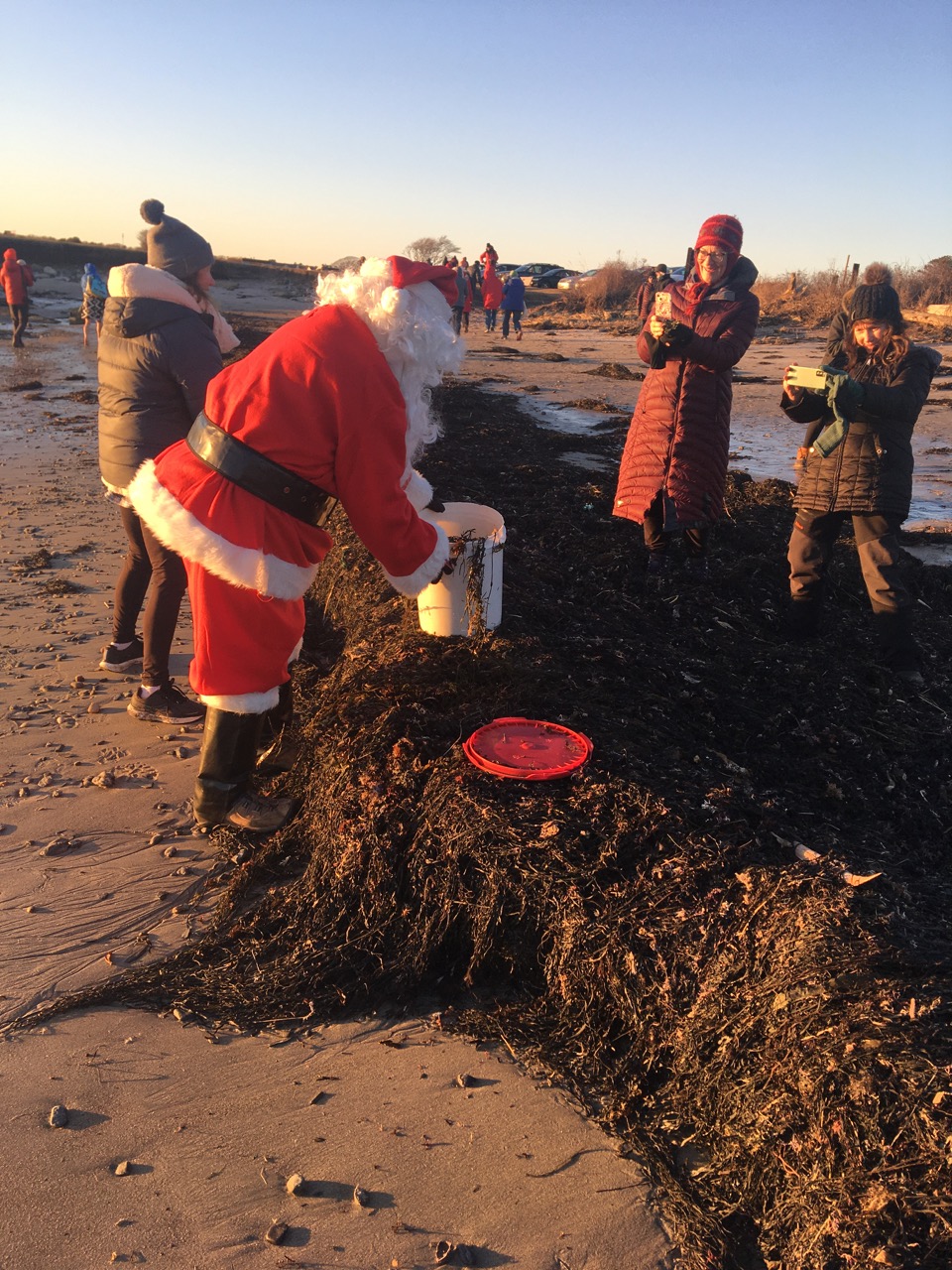
Santa at Kettle Cove Beach.

For a Solstice treat, Margy and I went to Kettle Cove beach a little before sunset. Santa was gathering seaweed for the garden. Now you might not think Santa would be out on Solstice, but the ancient European pagans laid claim to this gentle gift-giver from the north much before St. Nicholas. In fact, in the old old days, they say Santa was female. I think they might be right.

A group of hikers passed by and seaweed-gathering Santa was a big hit, with many photos taken. Job done, it was time for a little rest. Thankfully, there was a handy log nearby to sit on.

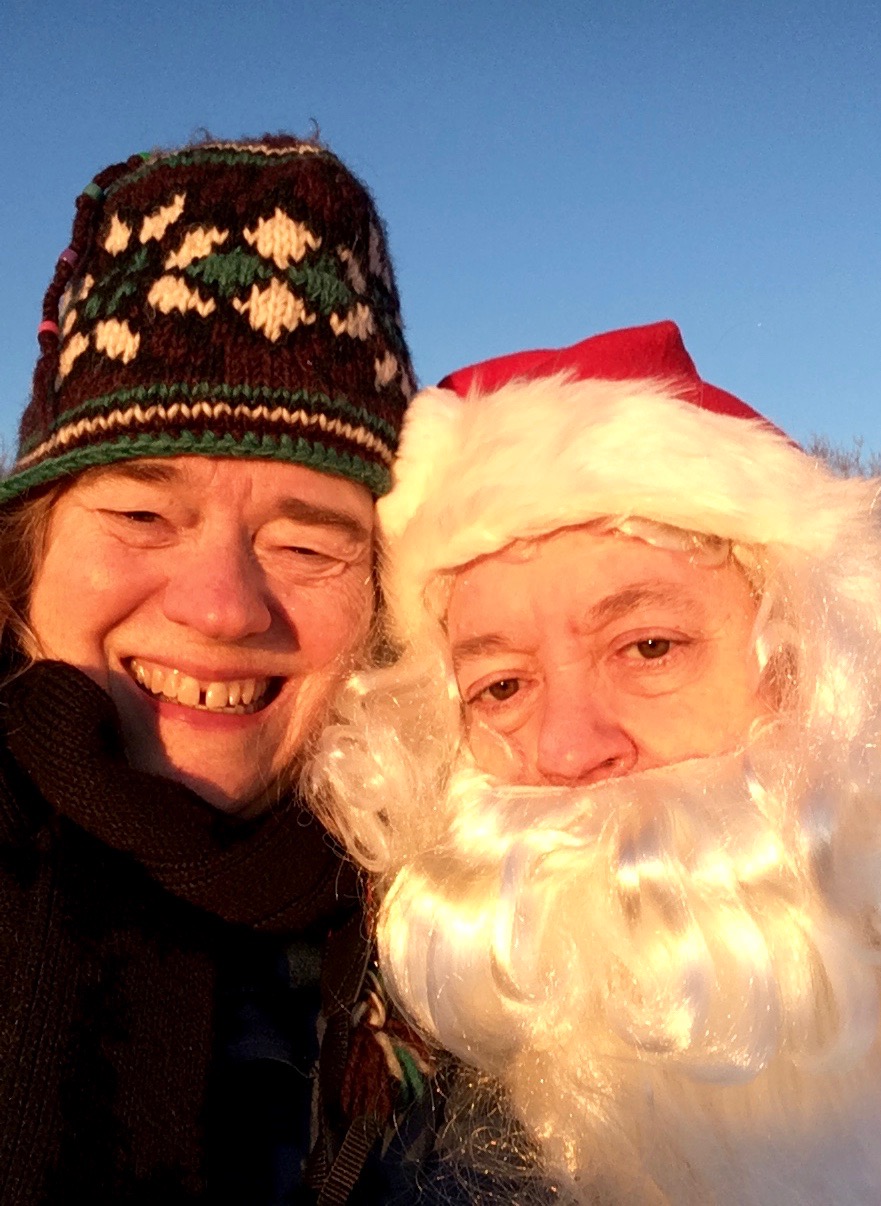
Oh look, who is that with Santa? It’s me! I was also sitting on that log. It’s a Santa selfie. The setting sun was bright upon our faces and we gave thanks for all the sun brings to us.

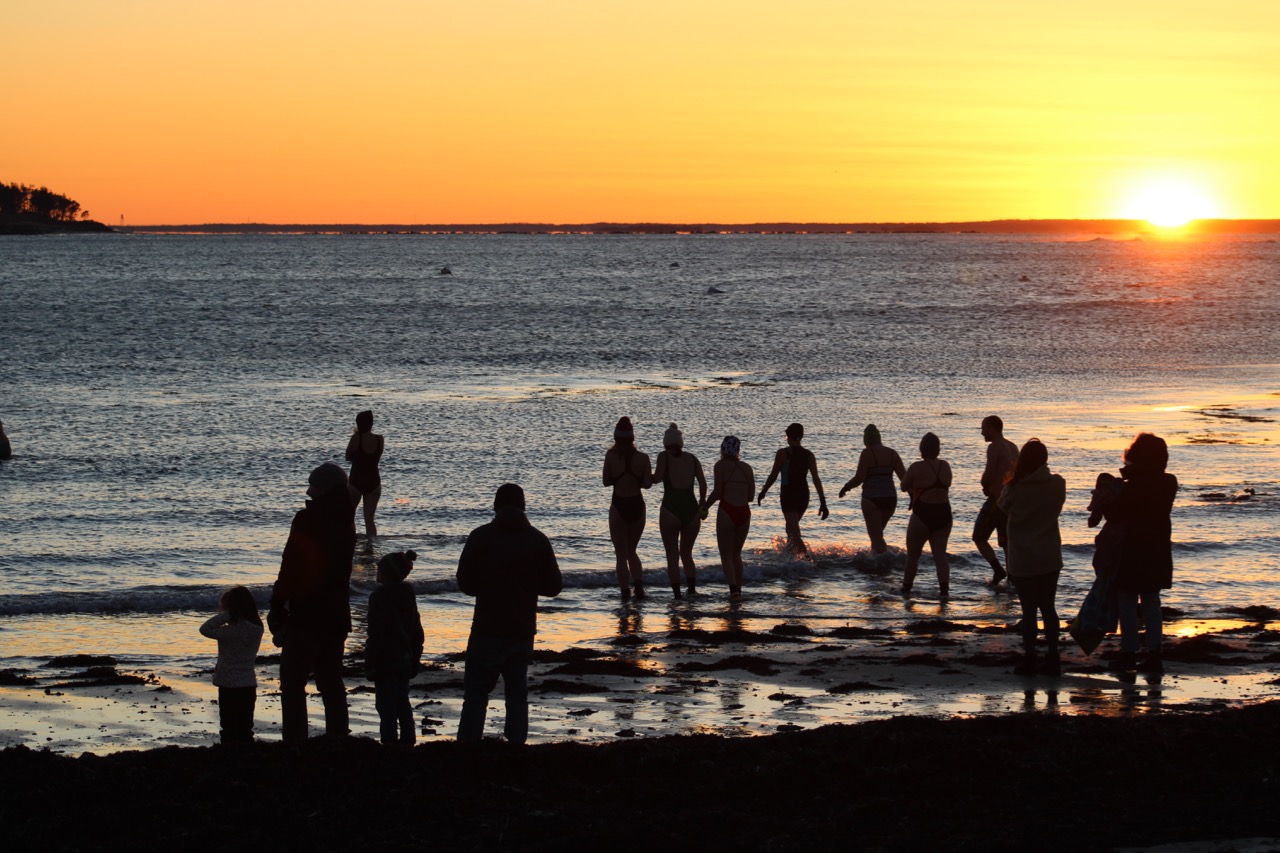
And then we had another surprise treat. The local mermaids came to the beach for a Solstice swim in the cold ocean. We did not join them but we had fun watching them brave the waves.

May all the blessings of this Solstice day be upon you! May the darkness be fruitful, and peace return with the lengthening days, peace upon Gaza, upon Ukraine, upon Sudan, and all the hidden sorrowful places.

First Snow, Gaza, Small Birds

Green bird feeder in front of snow covered branches of hazelnut hedge.
Bird feeder near hazelnut hedge.

We have our first snow-covered morning here in our yard in Portland Maine. In places further from the shore they got several inches, but we had mostly rain until early morning. Now it feels like winter is really here. My internal clock has felt the shift, as the days grow shorter and darker. A few days ago, I started working again on sorting through my old documents–my winter project of the last few winters. This year, most of the documents are digital, though there is at least one box of paper files to go through in the basement. In prior winters, I looked back on all the years before we moved to Maine in 2005. This winter, I am looking through my time as minister of Allen Avenue Unitarian Universalist Church here in Portland, before I retired in 2018.

I started by reading all of the “annual reports” I wrote for the church to summarize the work of that year. It was a simple way to quickly turn the pages of thirteen years of ministry. I was astounded at the sheer number of times I marched in protests, or spoke at vigils in solidarity with issues of justice or worked on legislative change in support of human rights, usually along with other members of my congregation or other ministry colleagues. My life now is so much quieter and less intense, but also less connected. It was good to have that public voice, and to use my voice in service to all that I believe. I feel so far removed from that life and that work.

I suppose in some ways a blog is a kind of public voice, but much quieter and less visible. My life these days is much quieter and less visible. That is chronic illness, compounded by our continued COVID precautions in our household. I can’t put my body out on the line for love and justice. It takes most of my body’s energy just to manage our household tasks. It is like I am looking out a window at all that is happening in our world.

I was surprised to notice that I hadn’t blogged for a few weeks. Lately, all I can think about is Gaza and the way the people there are suffering and dying. In my files I found a sermon I preached in 2014 about Palestine and Israel. In many ways, the issues are all the same. In other ways, everything has gotten worse, much worse. So many deaths, so much destruction. I can’t even imagine the words I could say about it, and then I don’t have words for anything else. My heart is on the ground. My heart is on the ground.

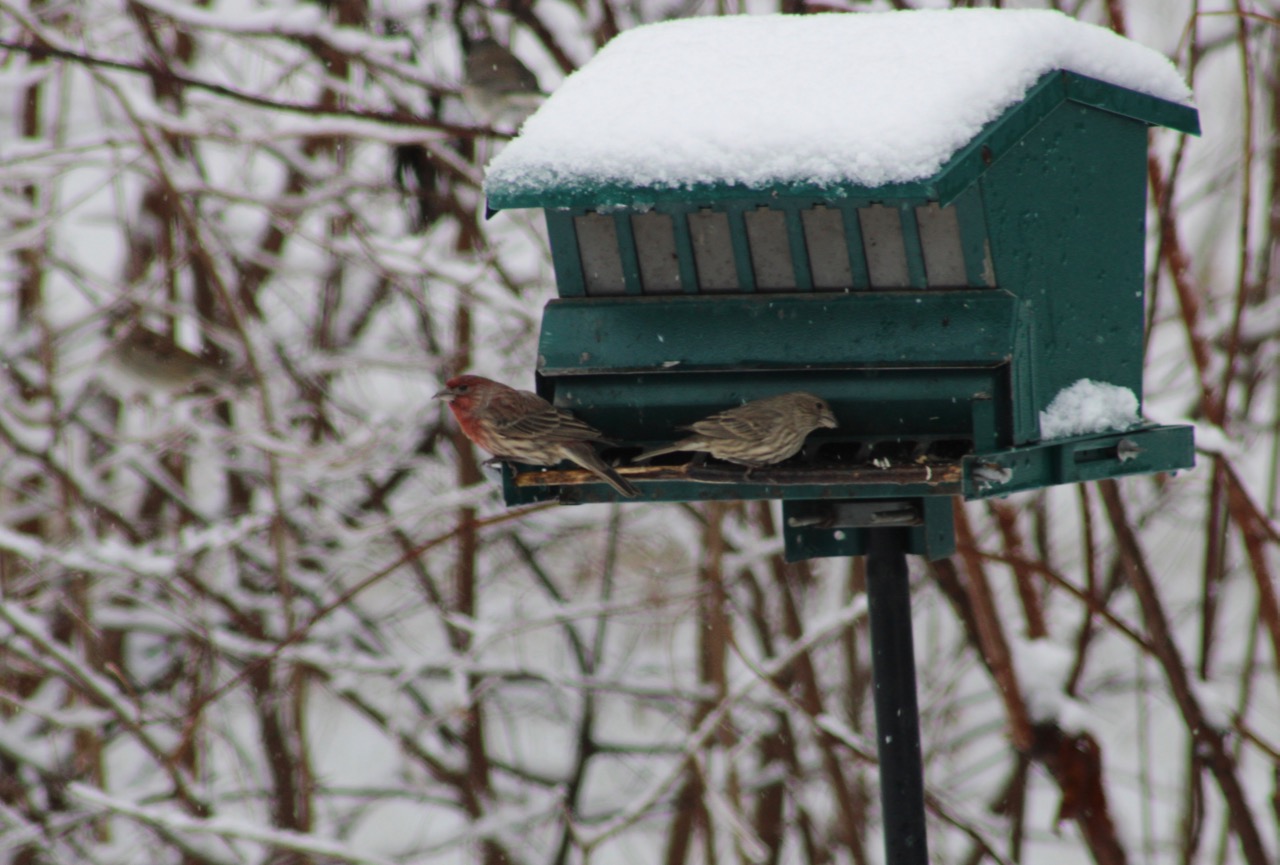
And then, out the window I see a large flock of small birds visiting the hazelnut hedge and the bird feeder. They find their way to our yard each day, traveling together as a group. They usually arrive mid-day, but today they are early. Tufted titmice, chickadees, goldfinches in their winter garb, sparrows, juncos, finches, even a bluebird. (Maybe they come more than once a day, but you have to be looking out a window to see them so I am not sure.) Often a few chickadees even stop at our back porch pecking for stray seeds. It is not so easy to take a photo of a flock of small birds. They scatter themselves across the orchard. They come through and then they are gone again. Traveling all together on their mysterious rounds.

And my heart is lifted just a little, with their flight and their community.

Finches at feeder.
Junco on a branch.

Suffering and tending

Myke painting tree trunks in the orchard (Photo by Margy Dowzer).

When I feel devastated by the images of premature babies in al-Shifa hospital in Gaza, without incubators, without oxygen, placed together for warmth, but some dying, (and finally I hear that they are being evacuated today)… When I feel devastated that the initial violence and hostage-taking of Israeli citizens by Hamas has been multiplied by more violence and death by the Israeli government… When I feel devastated by bombs killing innocent civilians and journalists and children… When I feel devastated that I cannot stop the killing or bring food or water to the starving families… I cannot find the words to write…

And so I have been tending the only life I can tend. To get ready for winter, I sprayed the orchard trees with holistic spray (with Neem oil, Karanja oil, hydrolyzed fish, and probiotics in water). And then a few days later, I painted the trunks with my own combination of white milk paint and “Surround.” The white paint protects the trees from sunscald. When the sun warms the trunk by day, and the nights are cold, the extreme fluctuations of temperature can cause the bark to split.

Milk paint is a non-toxic biodegradable paint made from milk and lime. Surround is a natural clay product that protects trees from boring insects. It is also light colored, so I decided that to combine them would make sense. They both come in powdered form that is mixed with water. And so I knelt beneath these trees and tended them with love.

This is not enough to remedy even the suffering I feel in my own heart for all the suffering happening so far away. But somehow I must choose life, choose tending, choose care.