We Are a Part of the Watershed

Photo by Margy Dowzer

Photo by Margy Dowzer

Analysts are predicting that water will be the number one political issue in the coming years. Just as wars are being fought over oil, so increasingly there are conflicts over access to water. The business solution is to introduce the “privatization” of water: the theory is that if water is a scarce resource, then the market should determine its price, and price will regulate its use. But citizen’s groups are fighting back to say that water cannot be commodified, because it is an absolute necessity for life. Rather, water must be recognized as a fundamental right and provided equitably to all.

The danger in the privatization of water is that it takes water out of its relationship to all living beings, and into the hands of a system which is set up to think only in terms of profit. Water is not something separate from us, something we have made, that we might think of it in terms of selling and buying. Water is in us and we are in water. We must think of ourselves as part of the watershed.

The water we drink passes through us, and is returned to the earth. When we open our hearts to the wonder of this cycle, we can begin to heal from the out-of-balance patterns we all have learned in our society. Weeping is a part of it too. The water of tears moves our grief, heals and cleanses, as water does, moves us on the journey. The cycles of water teach us that we are all related.

Each of us has a choice. Will we approach water as a commodity to be used, or as a blessing to be honored? If we acknowledge water as a blessing, we recognize its essential importance. Water is the mother of all life. There is no life without water. Whether we view it scientifically or spiritually, water is the womb from which all living beings have been born. We are made of water and we need the constant flowing through of water to remain alive in this world. When I made the conscious choice to regard water as a blessing, I decided to stop using plastic bottled water as much as I was able. I like to carry water with me, so now I carry tap water in a special reusable metal bottle. Anytime I drink water, I am reminded to offer thanks for the blessing.

All religious traditions have recognized the sacredness of water in some way. The old earth religions always revered a god or goddess of the waters—usually certain spirits were associated with salt water and others with fresh water. I learned about some of these water spirits from Mandaza, a healer from Zimbabwe who visited my previous congregation. According to Mandaza, the water spirits offer us healing and peacemaking. There are rituals for people to go into the water when they desire to be restored to wholeness or to find guidance for their spiritual journey.

According to my friend, gkisedtanamoogk, water is considered a Manito, a mysterious life force that has its own life. Water is also medicine, the most important medicine in Creation. The Wampanoag people know fresh water as Nipinapizek, and regard her as a grandmother. He wrote to me, “i think that we humans only exist because there is a significant number of people who remember to Give Thanks to all Those Ones who are the Keepers of Life, one of Those being, NIPINAPIZEK. May we continue to Give Thanks…..”

When I was growing up as a Catholic, we used to bless ourselves by touching our fingers in holy water. I associated it with purifying ourselves because we were in some way unclean. But now, the blessing of water feels more like remembering our heritage. We come from water. Since all water is holy, we are holy too. We are washed by water, we are restored by water, we are nourished by water. 

Water Is a Teacher

Water is a teacher. Water teaches us about the unity of all creation. All life comes from water, and needs water to survive. Water moves through the whole ecosystem, nurturing and transforming life as it moves. It rises from the ocean in evaporation, forming clouds in the sky, and, blown by the winds, it returns to the land in the form of rain. The rain falls into the soil, and gathers in streams and aquifers. In the midst of this journey, it also travels through the bodies of every living thing.

Margy and I have a bird bath outside our back door. Many kinds of birds come to drink the water we keep filled there, but we’ve also seen squirrels, chipmunks and bees. Every being needs water: insects, birds, mammals, fish, humans. Water rises up into the stems of plants and the trunks of tall trees.Chickadee at Bird Bath MJ DSC00964

Our bodies are 70% water—so it would be accurate to say that we ourselves are one form of water. But none of the water stays isolated from the rest—we drink it in, it moves through our blood, we sweat it out or pee it out. Sometimes we weep with wet salty tears. The water goes back to the earth and continues in streams and rivers on its way to the ocean.

When I was ten, my family went on vacation in the mountains of Wyoming. I remember coming upon a stream that had a little sign saying the water was drinkable. My sisters and I were very excited that we could drink right out of the stream. The water tasted funny to us, with its enhanced mineral content, but it was cool and refreshing none the less. Now, looking back on that event, I am saddened by our amazement at drinking water directly from the earth. For millennia, all people drank from rivers and streams, and animals still do. But in the memories of most of us, this no longer is a part of our expectations about water. We take for granted that pollution has made most water undrinkable unless it is purified.

It may seem as if there is an endless supply of water on the earth. But of all the water on the earth, only one percent is fresh water. More and more water is being polluted, or being diverted to industrial or agricultural use. We have now reached the stage where there is a global crisis looming as drinkable water becomes increasingly scarce.

Oren Lyons, Faithkeeper of the Turtle Clan of the Onandaga Nation, has said:

One of the Natural laws is that you’ve got to keep things pure. Especially the water. Keeping the water pure is one of the first laws of life. If you destroy the water, you destroy life. That’s what I mean about common sense. Anybody can see that. All life on Mother Earth depends on pure water, yet we spill every kind of dirt and filth and poison into it.

Human Beings Are Part of Nature

Many of the ecological problems we face are rooted in a foundational assumption of western culture that human beings are separate from nature. We see ourselves as distinct and superior to nature, and imagine that the earth is like a resource bank to exploit for our own use.

Starhawk, in The Earth Path, notes that some environmentalists go the opposite extreme. Because of the devastation that human actions have caused, they see human beings as a “blight on the planet,” and suppose that the earth would be better off without us. But, as she points out, “it’s hard to get people enthused about a movement that …envisions their extinction as a good.”

What we need to understand—emotionally, intellectually, physically, spiritually—is that we are not separate from nature at all. We are part of nature. She passes on a story from Allan Savory, about land management in Zambia and Zimbabwe in the 1950’s.

People had lived in those areas since time immemorial in clusters of huts away from the main rivers because of the mosquitoes and wet season flooding. Near their huts they kept gardens that they protected from elephants and other raiders by beating drums throughout much of the night… [T]he people hunted and trapped animals throughout the year as well.

The herds remained strong and the river banks lush …until the government removed the people in order to make national parks.” The parks set up rules to protect all the animals and vegetation from any sort of disturbance. Within a few decades, the vegetation had disappeared from miles of riverbanks. What they discovered was that the fear of human beings kept certain grazing animals on the move, and that prevented over-feeding that damaged soils and vegetation. With the removal of one species—the human farmers and hunters—the ecosystem had lost its balance.

Photo by Margy Dowzer

Photo by Margy Dowzer

This story illustrates the truth that human beings belong to this earth—we are a part of the ecosystem, for good or ill. We can be a part of the balance as well as a cause of the imbalance.

Some Indigenous stories of North America say that we are like a younger sibling on this earth. The other beings and species are more acclimated to their purpose and their relationship to the whole. And so, when we are feeling overwhelmed by these messes we have created, we might turn to our older relatives on the earth to find wisdom for our journey.

Ecological Connection and the Wall of Grief

Jon Young, founder of the Wilderness Awareness School, teaches young people the skills of wildlife tracking and plant identification, fostering an ecological connection to nature. Many skills and techniques are easy to learn, and there is a deepening sense of wonder and gratitude that grows along with their skills. But when the youth reach a certain stage in their learning, they hit what he calls the “wall of grief,” an experience of being overwhelmed with sorrow at the loss and degradation of the natural world around us. That grief is the most difficult challenge the young people face in all of the school’s programs.

Live-video-of-BP-oil-spil-004I felt such a wall of grief, during the spring and summer of 2010 watching millions of gallons of oil pouring into the Gulf of Mexico from the broken BP oil well. It seemed as if the earth itself was bleeding from this gaping human-made wound deep below the waters of the sea.

I believe that our spiritual growth depends on deepening our connection to the interdependent web of all existence, of which we are a part. The natural world is vital to our spiritual journey. We might say that the earth is our Bible, our Quran, our sacred revelation, and our paradise. We echo this principle in the mission statement of my own congregation, when we say, simply, that we walk with care on this earth.

But there are times when that careful walk awakens deep sorrow and anguish. We know so much more than human beings have known before. We know what is happening all over the globe. We see the melting of ancient glaciers, as the climate heats up from greenhouse gases. We know there is a vast soup of plastic refuse possibly twice the size of the continental United States floating in the Pacific Ocean. We know that the topsoil in which our food grows is being depleted, and the rain forests which renew the world’s oxygen are being cut down. We know that increasing numbers of species are threatened with extinction. We know that there are nuclear stockpiles that could destroy most life on earth many times over.

We know so much more than human beings have known before, but we don’t know the solutions to these problems that threaten our future. And that is a wall of grief that can stop us in our tracks as we seek to walk with care on this earth. How do we live with the painful questions that do not yet have answers?  

I learned the story of the Wall of Grief in Starhawk, The Earth Path

All the Water Is One Water

Earth_high_def_1024Earth is a water planet. …Between earth and earth’s atmosphere, the amount of water remains constant; there is never a drop more, never a drop less. This is a story of circular infinity, of a planet birthing itself.
                                                                                                   Linda Hogan

It is a tradition in my congregation that every September we gather ourselves together with a water ritual. We bring water from the places we love, the places we may have traveled, to pour into one container. At the end, each person takes some of the water, and we bring it home with us.

One summer, I attended a similar ritual with Starhawk, at the beginning of an Earth Activist Training. Starhawk began collecting water many years ago. She brought water back from her travels around the world, and asked her friends to bring back water when they went to far off places. They poured all these waters into one big container. Over time, people brought water from the sacred Ganges River in India, and from the great Nile River in Egypt; even melted ice from Antarctica. After a while, they had waters from every continent.

When you pour it in one container, all of the water mixes together, and every drop has some of the molecules of water from every place. So if you take a small bottle of water out, you have the waters from many places in one bottle. Each time you have a water ritual, you add some water from the bottle you saved from the previous ritual. In that way, each ritual, each small bottle, contain the waters from all over the world.

Why would we want to have a small bottle of waters from everywhere in the world? For me, it is a reminder that water is sacred–without water there would be no life at all. It is also a reminder that we need to take care of the waters of the world. All water is connected, and the same water recycles itself through the whole earth. All the waters on earth are really one water. So even if we get water from our kitchen tap, that water has been around the world on its journey

Linda Hogan reminds us,

It has lived beneath the lights of fireflies in bayous at night when mist laid itself around cypress trunks. It has held sea turtles in its rocking arms. …It reminds us that we are water people. Our salt bodies, like the great round of ocean, are pulled and held by the moon. We are creatures that belong here. This world is in our blood and bones, and our blood and bones are the earth.

Linda Hogan quotes are from Dwellings: A Spiritual History of the Living Worldpp. 99, 106, 108.

Creating the Beloved Community

When Jesus talked about the importance of loving our neighbor, someone asked him, “Who is my neighbor?” In response, Jesus told the story we now call the Parable of the Good Samaritan.

A traveler was walking on the road to Jericho, and was attacked by bandits who robbed him and beat him and left him on the side of the road. A priest was walking down the road, and saw the man and went over to the other side. A lawyer also ignored the wounded man. But a Samaritan traveling on the same road saw the man, and was moved to compassion. He bound his wounds, and brought the man to an inn, where he continued to care for him overnight, and then paid the innkeeper to care for him as he went on his travels. Then Jesus turned the question around—“Who do you think was neighbor to the man?” The one who showed him compassion.

This story is made compelling by its social context. In the time when Jesus told the story, Samaritans and Jews generally held each other in contempt. They were enemies. Maybe something like Republicans and Democrats these days, only worse. Jesus made the Samaritan the hero of the story, and that certainly must have ruffled feathers. The story was a challenge to the lawyers and priests and their narrow definition of the circle of compassion. The story was a challenge to be neighbors with the people we don’t like, the people on the other side. To treat those neighbors with compassion.

As Dr. Martin Luther King, Jr. said, “The end is reconciliation; the end is redemption; the end is the creation of the Beloved Community.” In the Beloved Community, poverty, hunger and homelessness will not be tolerated because international standards of human decency will not allow it. Racism and all forms of discrimination, bigotry and prejudice will be replaced by an all-inclusive spirit of sisterhood and brotherhood.

I want to acknowledge that in our age, it is easy to feel hopeless about this vision. It is easy to think of it as an idealistic dream of the sixties. Cynicism has risen, the right wing has fought back against the hopes so hard fought for by Dr. King and others. More and more we see a new individualism and polarization, an abandonment of the poor and vulnerable by those in power. The opposition has become more crafty and deceptive.

But, on some level, that makes no difference at all. The vision of nonviolence is not based on winning, though a victory for good fills us with joy. The vision of nonviolence is based on faithfulness and hope. As Dr. King said,

When our days become dreary with low-hovering clouds of despair, and when our nights become darker than a thousand midnights, let us remember that there is a creative force in this universe working to pull down the gigantic mountains of evil, a power that is able to make a way out of no way and transform dark yesterdays into bright tomorrows. Let us realize that the arc of the moral universe is long, but it bends toward justice.

And so, in the midst of the conflict and trouble of our age, may we find the strength and courage to be practitioners of love. In the midst of selfishness and greed, may we find generosity and vision. In the midst of rancor and division, may we remember that we are all one people. May we behold and believe in the possibility of Beloved Community, and work steadfastly to open the doors that all may enter there in. May we always remember, as Dr. King reminded us,

Darkness cannot drive out darkness; only light can do that.
Hate cannot drive out hate; only love can do that.

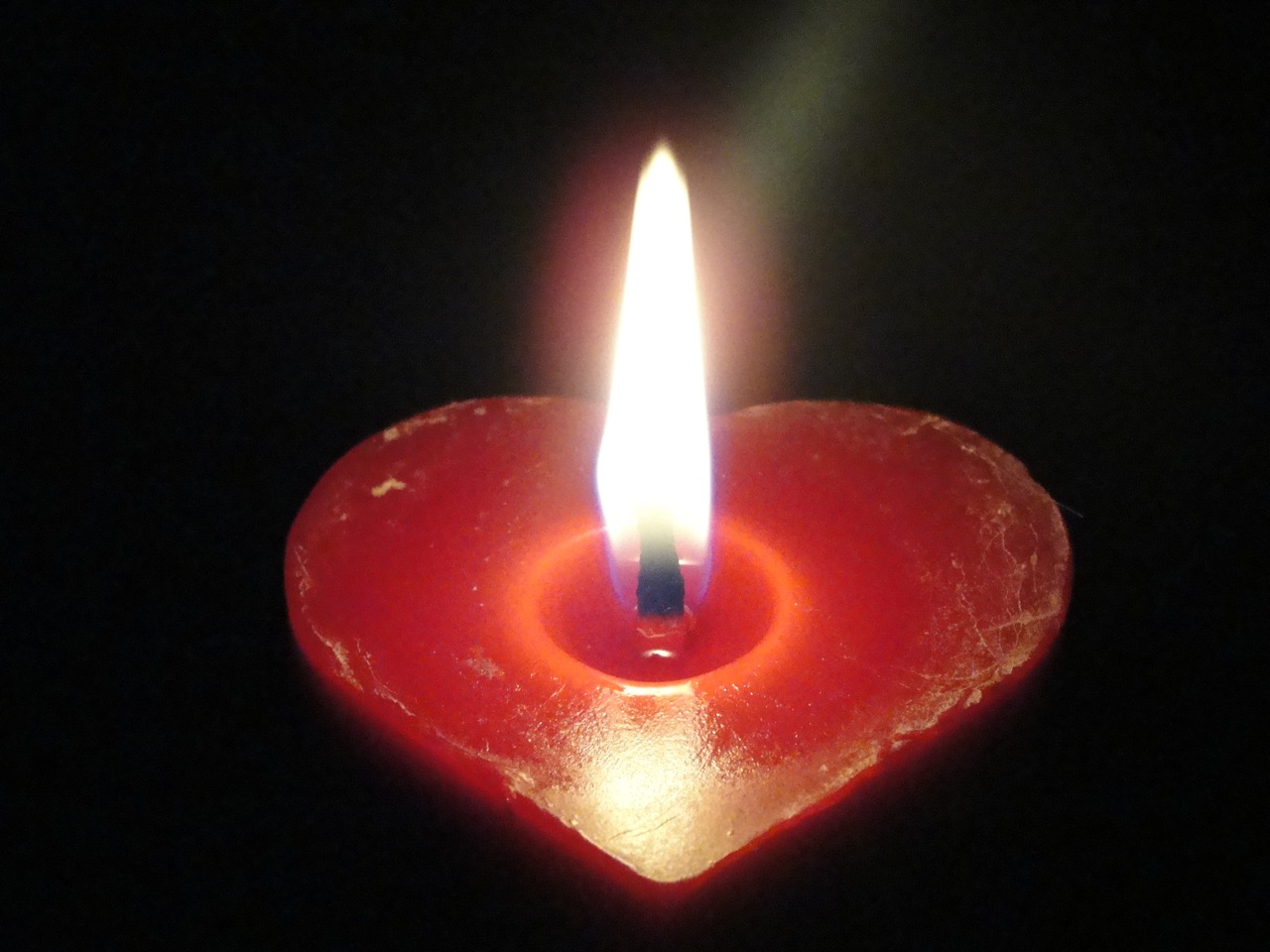
Heart Candle Flame DSC01573

Quotes from Dr. King from “Facing the Challenge of a New Age, December 1956, in A Testament of Hope, The Essential Writings and Speeches of Martin Luther King Jr. and “Where Do We Go From Here,” a 1967 Speech.

Practicing the Power of Love

Sometimes we learn best by seeing someone else—to watch someone practice love in the face of hostility can create a light in us as we observe it. Once, when I was in my twenties, I saw a young woman named Nelia arrested in an act of civil disobedience. She refused to walk, refused to give answers to questions on any forms, refused to cooperate with the police who were arresting her. But she radiated such kindness and love to each person who interacted with her. She smiled, and reached out her hand to shake theirs, and told them her name, and asked about theirs. She spoke of why nuclear submarines were not useful for human beings, and invited conversation.

I don’t think I had ever been able to imagine this combination of non-cooperation and love, until I saw her doing it. Yet once I saw it, it seemed so simple. She was practicing the power of love, and it discomfited and engaged all of us around her. Her tenderness was compelling. Her vulnerability was profound, because the other thing about Nelia was that she is blind.

Make no mistake—it wasn’t about being nice to everyone or pretending not to notice the painful realities that cause suffering in our world. Nelia was practicing her simple acts of tender engagement right on the front lines of the conflicts that seem so hard to confront. She showed me what courageous, creative people can do in the face of violence, what the power of love can do.

Marianne Williamson, in A Return to Love, asserts that whenever we encounter another person, we always have the choice to see them through the lens of fear, or through the lens of love.1 Our lives are meant to be a school for learning to let go of our fear, and to choose more and more the power of love. This is not an easy thing to do. It may take a whole lifetime to let go of fear, to learn how to live in the power of love.

And perhaps there is not such a big difference between loving our enemy and loving our neighbor. Each demands the same respect for self, and respect for the other. Each requires seeing the utmost dignity in our selves and in the other.

Clergy Testify in Favor of Equal Marriage 2009

Clergy Testify in Favor of Equal Marriage 2009

Loving Nonviolent Action Is Always a Force for Human Dignity

When African American students sat down at the segregated lunch counters, they were asserting their own dignity by refusing to obey a law that treated them with contempt. They were holding onto the dignity of their harassers by refusing to engage in violence or harm. They were harnessing the power of love to make a change in an unjust system. Dr. Martin Luther King, Jr., and all of the many heroic civil rights activists, used loving nonviolent action to restore the dignity of an oppressed people, and also to restore the soul of the oppressor.  

Loving nonviolent action is always a force for human dignity. Whether the political outcome is successful or not, a change has already taken place. The night before Dr. King was killed, he said, “I’ve been to the mountaintop. It doesn’t matter what happens to me now. I’ve seen the Promised Land.” I used to think this meant that in some mysterious way he had seen the future, and he had faith that black people would eventually win their rights.

But I saw it differently after I was involved in the struggle for equal marriage for same-sex couples in Massachusetts. I believe the mountaintop is less about the future, and more about the present. When lesbian and gay people began to imagine that they might get married, they had an inner experience of equality. It didn’t happen all at once. Two members of my congregation on Cape Cod were part of the  lawsuit for equal marriage. They told me how terrifying it was, in the days leading up to the lawsuit, to ask the town clerk for a marriage license when they knew the answer would be no. It was also terrifying for many others to carry a sign in public, or to have a conversation with their legislator or their neighbor.

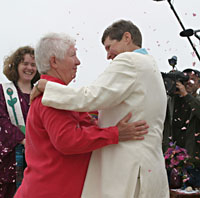
Wedding of Linda & Gloria Dewitt Photo 5/17/04

Wedding of Linda & Gloria
Dewitt Photo 5/17/04

But each new act in honor of love lessened their fear and strengthened their dignity. Same sex couples became aware of the burden they had been carrying, the hidden assumption that they were somehow less than the others. Once they felt a glimpse of equality, they couldn’t go back. They had put down the burden, and they were free. So even if there were opponents holding signs that said, “Homosexuals are demons,” it didn’t matter. A young lesbian woman carried another poster that said, “Your signs are mean but we love you anyway.” No matter what happens next, such love releases an inner power that is indestructible.

I think that is part of what Dr. King was talking about. It was visceral and immediate. By tapping the power of love through non-violent action, he felt first hand a new way of being in the world. He fully experienced his own dignity and the dignity of his people. After that, what else could matter? He had been to the mountaintop. As he said, “whenever men and women straighten their backs up, they are going somewhere.” He knew there was no turning back.

King quotes from “I See the Promised Land”, reprinted in A Testament of Hope, The Essential Writings and Speeches of Martin Luther King Jr.

Tea with the Enemy

Another example of the power of the nonviolent way is expressed in the Japanese story of the tea master. The tea master was traveling with his Lord to visit the Shogun, the military commander of all Japan. In order to enter the court to perform the tea ceremony, he was required to wear the swords of a samurai. So, although he had never used a sword, he was wearing them after he left the palace. As he was walking over a bridge, a ronin, a local mercenary, knocked him over and tried picked a fight with him. When he explained he was not a warrior, the mercenary claimed he was a coward for not fighting.

The tea master did not wish any dishonor to come to his Lord, so he felt obliged to face this ruffian. But he asked leave to do an errand first. The mercenary suspected he might be going for a bribe, so he let him go. The tea master went to the school of a renowned sword master, and asked for his advice on how to hold a sword, so that he might die with dignity. The sword master was astonished, and said, “Most people come to me to ask how to bring death to an enemy, not to face it themselves. You are the first! But before I teach you my art, would you show me yours?”

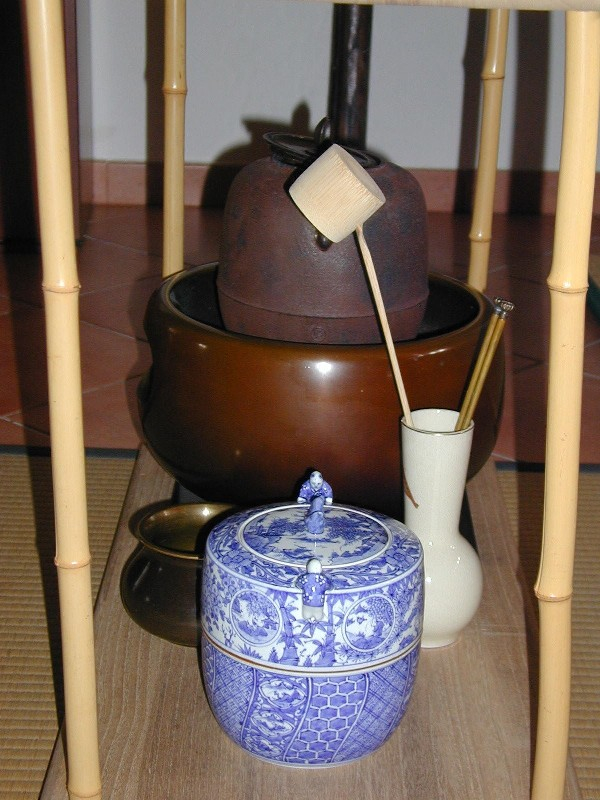
Tea Ceremony Tools Wiki Commons Photo

Tea Ceremony Tools
Wiki Commons Photo

Knowing this might be the last time he would practice his art, the tea master carefully assembled the elements and utensils of the tea ceremony: the tea, the water, the whisk, the tea scoop, the clay tea bowl, and the iron pot for holding the fire to heat the water. Then he prepared himself. When all was ready, with a peaceful spirit he prepared the tea and served it to the sword master.

The sword master observed the tea master carefully. After he had sipped from the bowl of tea, he said, “I can see you are already a master. I have nothing to teach you that you do not know. All I would say is to approach the mercenary as if he were an honored guest at a tea ceremony. Then, take off your jacket and fold it neatly, draw your sword and hold it up over your head, and let him know you are ready. Then close your eyes. When your opponent yells, bring the sword down.”

When the tea master returned to the bridge, he prepared himself all along the way, not as if for a fight, but for a tea ceremony. He let go of his fears and his hopes, and imagined the ruffian as an honored guest. When he reached the bridge, there was a crowd gathered. He did everything as the sword master had instructed. But after closing his eyes, he heard nothing. When he opened them, he was astonished to see that the ruffian had dropped his own sword and was running away. When the ruffian had looked at the face of the tea master, standing calmly in front of him, he lost his nerve. He did not know how to fight such an enemy.

The Tea Master is a traditional Japanese story.  I’ve adapted it here from the version by Dan Yashinsky, in Suddenly They Heard Footsteps

Love Your Enemy: What?

For much of my life I have been intrigued with the words of Jesus about loving our enemies. It is one thing to love those who are open to loving us. But it is a different challenge to love those who seek to harm us.

We read in the gospels of Matthew and Luke that Jesus said, “Don’t react violently against the one who is evil: when someone slaps you on the right cheek, turn the other as well…” and then “We once were told, ‘You are to love your neighbor’ and ‘You are to hate your enemy.’ But I tell you: Love your enemies.”

According to the Biblical scholars of the Jesus Seminar, these phrases are two of three passages that are the most likely to be the actual words of Jesus, rather than edited or added by a later commentator or preacher. They are at the very heart of his teachings. They are also among the most misunderstood.

The injunction to “turn the other cheek” has fostered a kind of doormat approach to conflict. Christian preachers have used this teaching to admonish those who were suffering to simply endure, rather than try to make a change. Until very recently, most ministers or priests would tell a battered woman that she should remain with her abuser, and suffer abuse as a Christian virtue.

But Biblical theologian Walter Wink says this is not what Jesus meant by loving your enemy.  He has offered a new insight into this passage by looking more closely at its cultural context. Jesus said, “If anyone strikes you on the right cheek, turn the other also.” As we hear it, this saying does seems to counsel surrender. But let’s try to hear it as his listeners might.

First century Palestine was a right-handed culture, even more than our own. A blow from the right hand would normally fall on the left cheek. So, if someone wants to strike me on the right cheek—as Jesus is referring to—he has to do it with the back of his right hand. This kind of blow was intended to humiliate, to put an inferior in his or her place. It was a blow that masters gave to slaves, husbands to wives, Romans to Jews.

Dr. Wink suggests that “By turning the other cheek, the person struck puts the striker in an untenable spot. He cannot repeat the backhand, because the other’s nose is now in the way.”

The only target is now the left cheek, which would have to be hit with a fist. But in that culture, only persons who were equals would fight with fists. “…By turning the other cheek, the oppressed person is saying that she refuses to submit to further humiliation. This is not submission, as the churches have insisted. It is defiance.”

Of course, this turning the other cheek was “no way to avoid trouble; the master might have the slave flogged to within an inch of her life. But the point has been irrevocably made: the ‘inferior’ is saying, in no uncertain terms, ‘I won’t take such treatment anymore. I am your equal. I am a child of God.’”

Jesus was not just giving people a new commandment. He was revealing a new option, a new tool. Our instinctive impulses are fight or flight, but he showed a third way to engage with an enemy that simultaneously offers and demands respect and equality. It is surprising, and it is creative. Don’t respond with violence, but don’t accept humiliation either. Don’t be a doormat, but choose equal human dignity for each person.

MLK March 2011

MLK March 2011

See also: Walter Wink, Jesus and Nonviolence: A Third Way