Missouri Germans in the Civil War

I felt an odd sense of relief and satisfaction to learn that my German Missouri ancestors were on the Union side of the Civil War.  While recovering from my latest gardening exploits, I was watching episodes of the Ken Burns documentary “The West.”  I was surprised by the series’ level of truth-telling in stories about colonization, about racism, about the violence endemic to the history of the United States. It has been quite an eye-opener about the “settlement” of the West, and I recommend it to all students of decolonization.

In the episode about the lead-up to the Civil War, I learned that Missouri and Kansas were the site of the heaviest civilian conflict and bloodshed before and during the war.  Earlier, in 1820, Missouri was admitted to the Union as a slave state, in conjunction with Maine being admitted as a free state, in the compromise to keep a balance between the free and slave states.  When the Kansas territory was “opened for settlement” in the 1850s it was decided to let the residents vote on whether they would be a slave state or free state.

[“Opened for settlement,” of course, meant the removal and theft of the land from the Arapaho, Comanche, Osage, Kansa, Kiowa, Missouri, Otoe, and Pawnee peoples, plus a dozen more eastern tribes who had been relocated to Kansas/Oklahoma in what was to be their land forever. But moving on for now to the slavery question…]

This new Kansas territory turned into a tinderbox of the national tensions between slavery vs. freedom for African-Americans–white Abolitionists from New England, and white pro-slavery Missourians (with their enslaved people with them) were among those who rushed to live in Kansas to influence the direction it would go.  Eventually, after much bloodshed, burning, looting, and turmoil, Kansas joined the Union in 1861 as a free state.

But my own curiosity shifted from Kansas over to what happened in Missouri, where my Heisler/Gerling ancestors had settled in the 1850s. I had thought they were on the side of the Union, so what were they doing in a slave state?  Ken Burns didn’t tell their story, but I went hunting on the internet to sort it out.  There I found the rather satisfying news that the German emigrants in Missouri were in fact opposed to slavery, and avid supporters of the Union.  They had emigrated after a failed revolution for democracy in 1848 in the German lands, and held dear the ideals of freedom and equality.  According to Patrick Young, in an article that was part of a series, The Immigrants’ Civil War,

[German Americans] saw parallels in the military coups in the German states in 1848 that ended the democratic dream in Europe. One of the exiled revolutionaries, August Willich, wrote after the attack on Fort Sumter that Germans needed to “protect their new republican homeland against the aristocracy of the South.”

Their influence was part of what kept Missouri in the Union.  According to another article by Patrick Young,

Missouri was a border state. That meant that it was a slave state lying between the Confederacy and the free states of the North. In the 1850s, Missouri had been the staging ground for pro-slavery terror raids against free soil towns in Kansas, but by 1861, the state’s wealthy slaveholding class was being challenged for power from an unlikely quarter.

German immigrants had moved into the state in large numbers in the 1850s. Most crowded into the fast growing industrial metropolis of St. Louis. Others started small German-speaking rural communities, [Note–that would include my ancestors] where they found themselves expected to defer to nearby slaveholders who expressed their worth in the number of humans they owned. The Germans had come to America for freedom, and they resented both slavery and the power it gave slaveholders over Missouri politics. When the Germans became citizens, they quickly formed the state’s most consistently anti-slavery electorate.

Thomas HeislerWhen I look at the lists of Union and Confederate soldiers from Missouri, none of my direct ancestors are included, though there were two Heisler men listed as Union soldiers. It’s possible that my great-great grandfather, Johann Heisler, was too old to enlist–he would have been 40 years old in 1860, with young children. My great grandfather, Thomas Heisler was born in 1857–only a toddler when the war began. Maybe they just tried to farm their land, and keep the peace with their neighbors.  One family story says the four Heisler brothers had left Germany to avoid being drafted into the military there. [Note: see addendum about another brother’s service in the Union Army.]

But it sounds like the war came to everyone’s land.  From the same article:

Even before the war, pro-slavery raiders had tried to drive German farmers out of rural Missouri. Now bringing about the submission or eradication of the Unionist German community became an imperative for Confederates.

Historian Ella Lonn wrote that after the Germans foiled the takeover [by the Missouri Confederates] of the [St. Louis] arsenal and fired into the mob:

“The hatred that Missouri Confederates felt for the Germans was frightful…German farmers were shot down, their fields laid waste, and their houses burned.” 9

German immigrants responded by supplying nearly half the soldiers raised by Missouri for the Union cause over the next four years.9 In that state, the war would take on the vicious character of a guerrilla struggle between Germans trying to make a place in a free America, and native-born Confederates trying to drive them out.

The Germans refused to leave.

So, in the midst of so much that is soul crushing about the history of this country, that’s a satisfying story to learn! There were many other stories about the Germans in Missouri of that time–too numerous to include, but check out the series, The Immigrants’ Civil War. I am inspired in my own work against racism to know they were carrying those values of equality and freedom from their homeland.

 

Sacred Trees and Resurrection

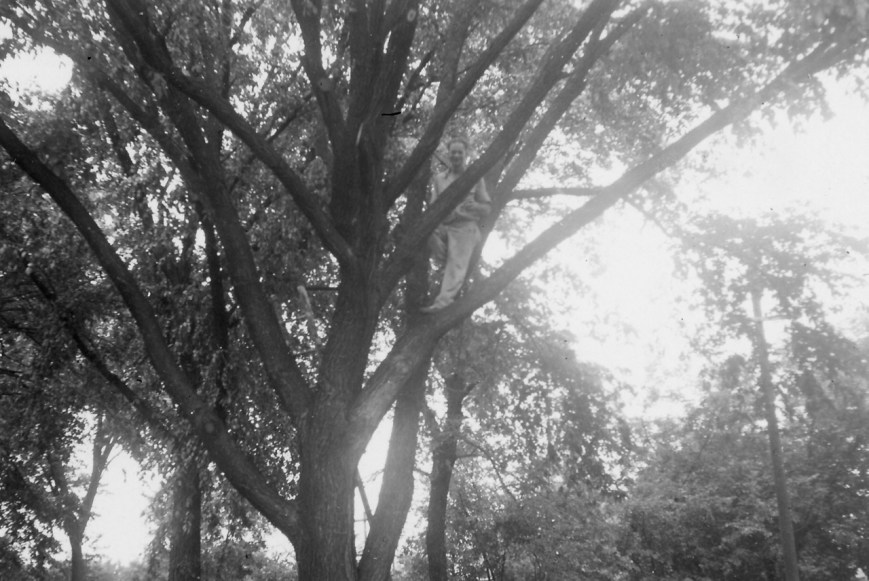
When I was looking through some old family photos, I wondered, what is this picture of a tree?  Then I saw my grandfather Heie Johnson almost hidden up in its branches.  I don’t know where it was taken, or by whom.  (Any Johnson relatives know the answer to that?)

Heie Johnson in a tree – Version 2

1930s

I’ve been doing a lot of research about my ancestors, trying to understand their legacy in me, trying to understand colonization and the possibilities for a different way of being. I came across a story concerning the missionary efforts of Christians in early pagan Germanic lands.  It said,

The favoured method of showing the supremacy of the Christian belief was the destruction of the holy trees of the Germans. These were trees, usually old oaks or elm trees, dedicated to the gods. Because the missionary was able to fell the tree without being slain by the god, his Christian god had to be stronger.

This is a sadly perfect example of the colonization forces of Christianity–that part of its history which is about domination, conquest, and empire.  But since today is Easter, I wanted to go back to something I learned from Rita Nakashima Brock and Rebecca Parker, in their book, Saving Paradiseabout another force in the history of Christianity, a force that moved against domination on behalf of equality and interconnection.

They researched the visual world of early Christian worship, and what they found were beautiful mosaics: a deep green meadow under a blue sky, flowers, a tree with four rivers flowing from its roots spreading out over the land. There were sheep in the meadow and a figure of a man who was the shepherd of the sheep, with a kind and radiant face turned toward the people. There were men and women, all with radiant faces, each one holding in their hands a laurel wreath crown.

Each week as part of worship, after the readings and hymns, after the sermon and prayers, there was a communal potluck feast for all the members of the church. As people sat down together, those of the upper class were sitting next to workers and servants. Special attention was given to widows and their children, and to all the elders. At this holy communion meal, all brought what they had to share, and partook of its bounty together.

According to Brock and Parker’s research, this would have been the experience of Christians in the early centuries of Christianity. Most people were unable to read, but the symbolism of the images around them would be immediately apparent: the Garden of Eden, the original Paradise. The tree in the meadow was the tree of life described in the book of Genesis.  At the center of this early Christian worship was a celebration of the resurrection of Jesus. He was the radiant man tending sheep, the Good Shepherd, a living presence in their midst. They believed that by his resurrection, he had restored the original paradise, and reestablished the presence of the divine spirit within the whole created earth.

The Christian community was meant to be the living embodiment of this resurrection paradise. In the midst of a world controlled by the harsh realities of the Roman Empire, they came together to celebrate a new earth, imbued with the beauty and grace of divine blessing. They were an oasis of care and connection. Their vision of radical equality undermined traditional social status, and they operated a vast social welfare program that offered livable options for the poor and enslaved. When someone became a Christian, they dedicated all of their material belongings to the community. Christians were not allowed to kill or become soldiers in the army. They were striving for life in Paradise.

One thing that Brock and Parker did not find, in the visual world of the early church, was any representation of Jesus being crucified on a cross. Early Christians acknowledged the crucifixion and death of Jesus. Many of them had probably seen actual crucifixions, since the Romans carried out this brutal form of execution in public places, to terrify the populace and reinforce their imperial control. But for the followers of Jesus, the church itself—their communal gathering—was not a place to be filled with images of torture and cruelty. It was the place to remember that love was stronger than empire, and that heaven was possible here on earth.

It was only much later—nine centuries later—that the church first created images of Jesus on the cross.  Brock and Parker asked, “Why did Christians turn from a vision of paradise in this life to a focus on the Crucifixion and final judgment?” In their book, they trace the complex changes—century by century—that could account for such a development. Their trail of clues led to the 8th century, when the Frankish King Charles the Great, better known as Charlemagne, attempted to conquer and annex the Saxon people’s lands along the Rhine River. (Some of my ancestors lived along the Rhine River.)

The Saxons had practiced a hybrid form of Christianity, a blending of the Christian story with their earlier pagan practices—Thor and Woden and Jesus were all acknowledged, and their worship was held in sacred groves of oak trees or around holy springs. The Franks justified their expansionist assaults by claiming that the Saxons were not true Christians. They cut down the sacred oaks, and deforested the whole countryside. They baptized the Saxons under threat of death. The Saxons kept rebelling decade after decade, but ultimately lost the wars. And, sadly, it was their descendants (also my ancestors) who eventually carved that first image of Jesus on a crucifix, and carried out the first pogrom against their Jewish neighbors.

Christianity, once offering hope for those persecuted by the empire, had become the official religion of empire.  By the middle ages, paradise had been relegated to the afterlife, and the communion feast had been turned into story of death and sacrifice and judgement. It was in the 11th century that Bishop Anselm of Canterbury created the “theology of atonement.” This interpretation of Christianity, still haunting us today, claimed that humanity’s sins had so offended the almighty God that it required the sacrifice of his son Jesus on a cross, to bear the punishment for all of our sins. (If you thought that this was what all Christians believe, did you realize it only started in the 11th century?)

Worship was no longer a communal gathering of peace and love, but became visually and ritually punishing, intended to stir up fears of future horrors. The priest at the communion table was said to be re-enacting the death of Jesus each time, and this sacrifice was an indictment of all humanity. This death-focused theology found its natural counterpart in the Crusades. While up to then, Christians had been forbidden to shed blood without doing penance, now the boundary line was drawn at the church doors. Soldiers were promised heaven if they died in battle killing Muslims, Jews, or heretics. And so the process of colonization continued.

Decolonization is about learning the stories of our history, and rejecting the beliefs and practices that involve domination, conquest, and subjugation.  But decolonization also includes uncovering the liberating threads we might find in the midst of the forces of domination.  The stories of the early Christians around a communal shared meal are stories that give me hope. The stories of the people of the Rhineland worshiping in groves of sacred trees give me hope.

And here’s a new question:  the Christian missionaries thought their god could conquer the old gods, because they weren’t immediately killed when they cut down the sacred trees. But maybe they just got the timeline wrong. Because now, after too many trees have been cut down over the last many centuries, we are all in danger of losing our lives.  The destruction of the forests threatens the whole planet. I think we need to bring back the sacred trees.

The picture of my grandfather in a tree gives me hope.  I think he knew that the divine was present with him in that tree.  And these days, my own worship includes planting young trees in this place I call home.

Read this book:  Rita Nakashima Brock and Rebecca Parker, Saving Paradise: How Christianity Traded Love of This World for Crucifixion and Empire, (Beacon Press, 2008), I quoted from pp. 263-271, and pp. 224ff.

East Frisian Teetied (Teatime)

The most identifiable tradition of my East Frisian ancestors is a tea ceremony.  In fact, East Friesland is the tea drinking capital of the world.  Since I am a tea drinker this delights me.  I don’t know if my great grandfather’s family brought this tradition with them to Illinois–it never made it into our family lore–but as I seek to reconnect with my East Frisian ancestors, the tea ceremony feels just right.

Tea first came to East Friesland from Asia in the 17th century, via the Dutch East India Company.  Many Frisians were sailors on those trading (and colonization) journeys.  Tea began to compete with beer as a beverage of choice.  By the 18th century, when most of the Dutch and Germans were choosing coffee, the East Frisians continued with tea. It was drunk a few times a day, morning, afternoon, and evening, and helped to warm you up in the cold rainy weathers of this land near the North Sea, as well as make a break in the working day.

There is a very specific way to make and serve East Frisian tea.  You start with the soft water of the area, and then a blend of particular dark tea leaves, mostly Assam, with several others blended in.  There are traditional porcelain pots and cups.  You heat the pot with hot water, then empty it, and put in one spoon of loose tea per cup, plus one for the pot. Then you pour water that has just boiled, but is not boiling, over the leaves, to let it steep for 3-5 minutes.  Then it is strained, and poured into cups into which a piece of kluntje, or rock sugar has already been placed.  Then, a small amount of heavy cream is gently poured into the sides of the cup, without stirring, and it forms a small cloud floating in the tea.

It is a communal event, a daily ceremony.  Someone pours the tea for everyone.  When drinking, the idea is to taste each layer separately–the creamy layer, the clear tea layer, and the sweetness of the final layer.  One site said that the creamy layer represents the (cloudy) sky, the clear tea represents the water, and the sugar represents the land.  It is customary to have (at least) three cups of tea, and you place your spoon into the cup to signify when you have had enough.

There is an East Frisian saying, “Opwachten un Tee drinken.” “Wait and see and drink some tea.”  I was able to find an East Frisian tea blend to buy online, and also some fairly similar kluntje–though not quite the same.  But when these arrive, I will have to try it myself, in honor of my great-grandfather and his family.  One last thought–I am curious that there is also a connection to tea on the other side of my ancestral tree–the tea doll of the Innu people.  Somewhere in the middle, I am sitting here right now with a mug of black tea.  I find myself wondering how all these peoples have come together in me, and whether I might learn from their wisdom and bring some healing to their brokenness.

“Remain in the land and nourish it”

One of my hopes in exploring the stories of my ancestors is to see what cultural wisdom I might reclaim from everything that got lost in translation, especially regarding their relationship to land.  Today I was diving deep into internet stories about East Friesland, the ancestral land of my great grandfather Henry Johnson. His parents and grandparents had traveled from East Friesland to Illinois via New Orleans in the 1850s.

His father, Heye Broer Janssen traveled to the U.S. on the ship “Fannie” with 16 total family members including his parents Broer Janssen Martens and Geske Alber Schoen, arriving in New Orleans October 28, 1851. (The name Martens was dropped in the U.S. and they were called Janssen and then Johnson. Previously in East Friesland, people took the first name of their father as their last name.)  Henry’s mother, Helena Hinrich Janssen arrived in New Orleans on November 8, 1854 with her parents Heinrich Johann H. Janssen and Esse Classen Beckman. Her parents died a few years later, and she and her brothers and sisters were cared for by relatives and neighbors. Heye and Helena (Lena) married in 1862, and Henry was born in 1865, the second of ten children.

I must offer thanks again to my cousin Jim Pattyn for all his work in exploring the genealogy of our common ancestors.  In my search for their relationship to their land, I found myself recording all the towns in which they had lived in East Friesland, in fact for many generations prior: Firrel, Grossoldendorf, Kleinsander, Kleinoldendorf, Hesel, Moordorf, Schwerindorf, Strackholt, Remel.  These small towns are all within about 30 miles of each other in the center of East Friesland, somewhat near the larger town of Aurich.

625px-Ostfriesland_Verkehr-de.svg

East Friesland Map: Photo by NordNordWest – own work, using Ostfriesland de.svg by Enricopedia., CC BY-SA 2.5, https://commons.wikimedia.org/w/index.php?curid=5273792

In a letter dated April 16, 1846, from Alton, Illinois, one of my distant relatives (Heie Keiser) encouraged his family back in East Friesland to come join him. He praised the opportunities in his new home.  I was struck by one of his closing statements. He wrote:

And also think not as the old wives used to say, “Remain in the land and nourish it.” We agree much more with the poet, when he says, “Hail to you Columbus, glory be to you, be highly honored forever.’ You have shown us the way out of hard servitude.”

The East Frisians had a deep love of independence and freedom, and they resonated with the “American dream.”  I appreciate their love of freedom, but in my study of the process of colonization, I cringe at their praise of Columbus–one can see that they jumped at the chance to be part of the settling of this land that was new to them. They were able to work hard and acquire their own land to farm and to cherish.

But as a feminist scholar, I also like to notice wisdom that is hidden by being contradicted.  I wonder, who were the “old wives” who had offered this different sort of wisdom that was being rejected:  “Remain in the land and nourish it.”  That is a heritage I want to claim today, the heritage of the old wives, the ones who stayed.  (I think it also filtered into the ones who came to the U.S., because from what I can gather, the East Frisians were careful farmers who took care of their land so that it might continue productive for long years.)

I also heard about another custom of German immigrants (not sure from which parts of Germany) who carried in their pockets across the ocean some of the soil from their homes, so that at least they might be buried with some of the soil of their own land.  In this exploration of the ancestors and their relationship to land, there is something to grieve and also something to be thankful for.  I think that what Margy and I are trying to do with our land here in Portland might fit into that old wives’ wisdom–remain in the land and nourish it.


Osage River Bend

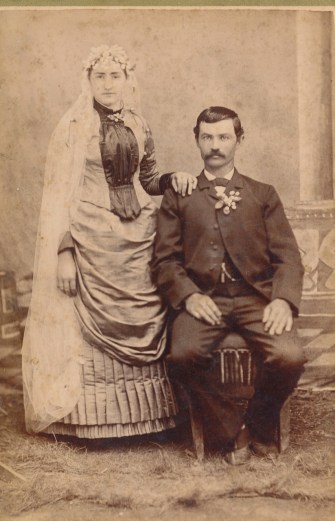
Thomas & Theresa Heisler wedding

[Thomas Heisler and Maria Theresia (Theresa) Gerling at their wedding 2/16/1886]

I am continuing my exploration of my own ancestors settling in America, and how they may have participated in the colonization of this land.  My dad’s mother, born Lucille Mary Heisler in 1897, was the daughter of Thomas and Theresa (Gerling) Heisler, originally of St. Thomas, in Cole County, Missouri.  Thomas’s father (and my great-great-grandfather) was Johann Heisler, who came to Missouri about 1850, where he lived in St. Thomas with his wife Elizabeth (Koetzner) and was a farmer. They became a “well-known” Cole County family.

The first post office in St. Thomas was dated 1855.  It was a small German Catholic farming community, named for St. Thomas the Apostle, which is also the name of their church.  It was one of several Catholic communities founded by the Belgian Jesuit priest, Ferdinand Helias, who was known as the father of mid-Missouri German Catholics.

According to Russel Gerlach, in “The German Presence in the Ozarks,”

Some Germans were attracted to the Ozarks seeking religious freedom. Osage County attracted several thousand German Catholics whose principal reason for emigrating from Germany was religious. Their spiritual leader, Father Helias, established a parish in Westphalia in 1834, and in subsequent years seventeen settlements, composed primarily of Rhinelanders, were established in Osage, Cole, Miller and Maries counties.

I read that because the immigrants from various regions in Germany carried those tensions with them to these lands, he helped to settle them in communities which were ethnically differentiated. By the way, it was eye-opening for me to learn that in the German ancestry of my dad’s family, at least four different cultural and linguistic communities were represented–the East Frisians, the Rhinelanders, the Swabians, and the Westphalians.  The Heislers were from the Swabian culture. (But more on that in another post.)

What about the Indigenous peoples who had lived in Cole County before?  Well, their name remains in the river that winds through the area–the Osage River.  St. Thomas was formed in a fertile bend of the Osage River.  It was Osage Nation land before the settlers came. According to the website of St. Thomas the Apostle church:

The Indian Territorial Government established Cole County in 1821, paving the way for eager settlers to purchase this fertile land.  Perched above the river bottom and close to today’s parish cemetery, German immigrants built a small log church for the families that lived in the area.  Fr. Ferdinand Helias, S.J. began ministering to the needs of Catholics in this area in the early part of the 19th century.  A larger frame church was built to support the Indian Bottom Settlement.  As the city of St. Thomas took shape further east of the river, Father Peter Eysvogles, S.J. persuaded the families of Indian Bottom to move the church to this growing community.

I was struck by how the names “Indian Bottom” and “Osage River” spoke to the history of the land, even after its people had been removed. My own ancestors came a full generation after that removal, but definitely were among the settlers eager to purchase this newly “available” land.  The Osage Indians had a wide ranging territory that included land now in the five U.S. states of Missouri, Illinois, Arkansas, Kansas, and Oklahoma.   The first Europeans to meet them were the French explorers Joliet and Marquette in 1673.Osage Ancestral TerritoryIn 1803, when the United States made the Louisiana Purchase agreement with France, they claimed ownership of Osage territory. According to educational materials of the Osage Culture Traveling Trunk,
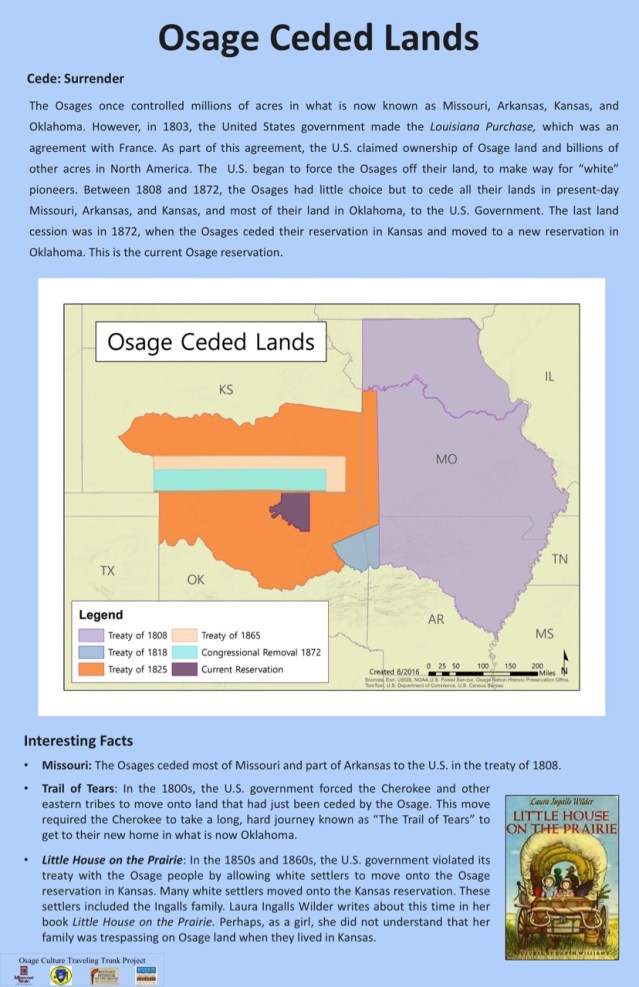
Between 1808 and 1872, the Osages had little choice but to cede all their lands in present-day Missouri, Arkansas, and Kansas, and most of their land in Oklahoma, to the U.S. Government. The last land cession was in 1872, when the Osages ceded their reservation in Kansas and moved to a new reservation in Oklahoma. This is the current Osage reservation.

You can find out much more information about the Osage on that website, which is dedicated to educating children in Missouri.  I want to include one more map from that program to emphasize the extent of these ceded lands. osage_ceded_lands_poster

Special thanks to my cousin Jim Pattyn for sharing his genealogical research into our Johnson family.


Ancestors and Whiteness

Can learning about our own ancestors help white people in undoing white supremacy and colonization? Or could it possibly be a distraction from the real work? When did our ancestors become “white” instead of German or Ukrainian or French or Irish? How did it happen? If our ancestors owned land, when and how did that happen, especially in relationship to the stealing of land from Indigenous peoples?

We were talking about these questions in my Maine-Wabanaki REACH group last night. It has been helpful to join in a small group with other white folks committed to the process of ending racism and colonization. We ponder the difficult questions together, in the context of the wider work of Maine-Wabanaki REACH which is in conversation and solidarity with Wabanaki people.

It seemed to us that understanding our families’ histories in the context of colonization, can help us to better understand colonization, and to make it visceral and real for us.  It is not just recounting the stories we may have heard in our families, or read about in research, but juxtaposing those stories with the history of colonization, land theft, and slavery, in the particular locations in which they lived.

I have already done a lot of exploring of the matrilineal side of my family.  Last night, after the meeting, I wondered how this might have played out on the other side of my family–my patrilineal ancestry.  My dad’s ancestors came to this country from Germany.  But more specifically, his great-grandfather and great-grandmother arrived in Illinois as children in 1851 and 1854 from East Friesland. East Friesland was actually a somewhat isolated culture on the North Sea with its own community and language, in some ways more closely related to Holland and old English than German.

Thousands of East Frisians came to the midwest during the middle of the 19th century, drawn by the promise of cheap fertile land and a long-standing love of freedom. Most of them worked for a few years, then were able to buy land, and become successful farmers, from what I can gather.  In America, they formed closely knit communities centered around their church, their family and their language.  But over the course of three generations, the young people had assimilated into the surrounding communities, and no longer spoke their parents’ language.

By the time the East Frisians arrived in Illinois, it had already been colonized for several generations.  But the name gives a clue.  On the Illinois State Museum website, I read about the Illinois peoples losing their lands.

In 1803, the Kaskaskia tribe signed a treaty giving up its land claims in the present State of Illinois in exchange for two small reservations on the Kaskaskia and Big Muddy rivers. The Peoria, in turn, ceded their Illinois claims in a separate treaty signed in 1818. Finally, in 1832, two years after President Andrew Jackson signed the Indian Removal Act, the Kaskaskia and Peoria tribes agreed to merge and moved west to a reservation in Kansas.

So I wonder if the German immigrants even knew about the history of the land they were so excited about farming?  More research surely to do about all that.

In the course of this research, I may have coincidentally solved a mystery that had recently emerged in my DNA reports.  According to my DNA analysis, 15.3% of my ancestors came from the British Isles.  But from my genealogy research, I thought that number should be just 3% (my Scottish ancestry).  I didn’t think I had any other British or Irish ancestry.  So what was that other 12%? Was there some family secret I hadn’t heard about?  Well, I learned online that East Frisian DNA is indistinguishable from that of the British Isles.  So rather than a secret in the family tree, I think this 12% might be my great-grandfather Henry Johnson (also known as Heinrich Jansen), who was 100% East Frisian.

And when did they become white?  Well, I’ve got to stop for today, but I’ll come back to it. In the meantime, a 1920 census with Henry Johnson listed–see between the blurred out parts.  And the “W” next to his name.

Henry Johnson 1920 census section

Innu Tea Doll

Innu Tea Doll Angela Andrew – Version 2

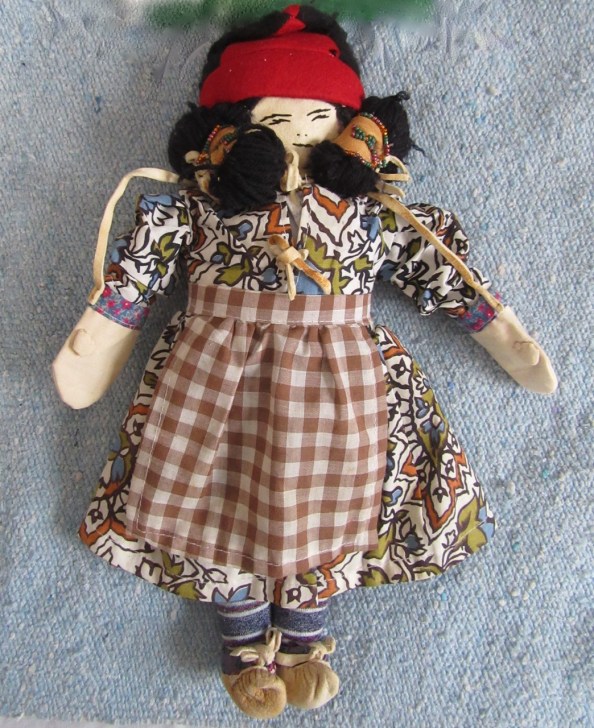
My friend Wells Staley-Mays gave me this Innu Tea Doll, knowing of my love for my distant Innu ancestors.  The story is this–when the Innu would travel to the interior of Nitassinan during winter, to hunt the caribou, they had to carry whatever they needed for the journey.  Children carried their share by bringing along a doll that was stuffed with tea leaves.  When the other stores of tea were depleted, a cut was made in the seam of the doll to remove and use the tea leaves.  The doll could be restuffed with grasses or leaves and resown.

I am reminded that the principles we find in permaculture are not new–but were often embedded in the lifeways of Indigenous peoples around the world. One such principle is “stacking functions”–creating elements of our garden (or our lives) that can fulfill more than one function at a time.  So the tea doll was both a storage container for tea, and also a toy to delight a child.  It also has had a further function more recently, to keep alive traditions of the Innu and serve as a source of income for those who sew them.

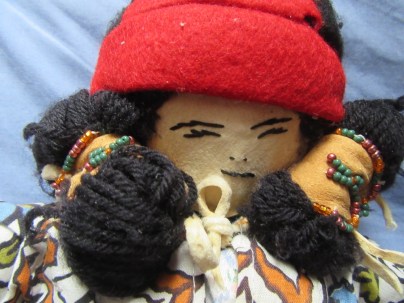
Innu Doll DetailThis doll was created by Angela Andrew, an Innu elder from the Innu Nation in what is now called Labrador. It is hard to show in photos, but the doll is made of cloth, except her face and moccasins are smoke-tanned caribou skin.  Each layer of clothing is distinct and can be taken off and on.  She has a flannel shift and long pants, with knitted socks, underneath the broadcloth dress and apron.  Her hair is black yarn, and fastened in place with beaded leather ties.  Her hat is a traditional Innu head covering. The clothes are tied with little strips of leather, and her mittens are held in place by a long leather string going behind her neck. Does anyone else remember when our mittens were held in place with a long string like that as children?
Wells and I originally met when we were working against hydrodams being built on Cree, Inuit, and Innu territorial rivers. He had the chance to travel into the bush with the Innu on a trip to Canada many years ago. So this doll is full of those memories and good feelings from our work together. Thank you Wells!

“Part Indian”

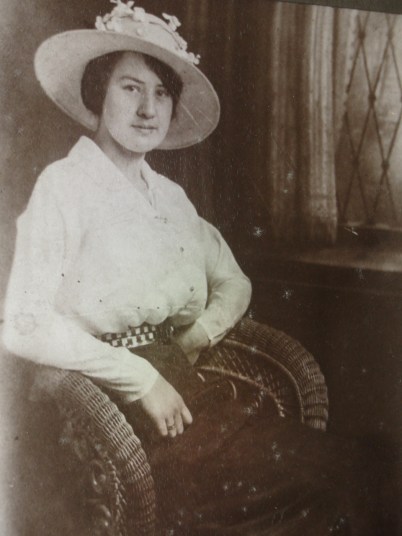
Yvonne DSC01872I don’t know the whole story about Elizabeth Warren’s claim to have Native ancestry.  I have heard her mocked by being called “Pocahontas.”  That mockery is wrong on so many counts, not the least of which is the tragic story of the actual Pocahontas that has been obscured and romanticized by American culture and cinema.  But what I want to explore today is the sometimes confusing experience of those of us who are white but have some Native ancestry.

I know enough now to know that having Native ancestry does not make one a Native American.  But I didn’t know that when I was young.  It was through trying to understand what my Native ancestry meant that I grew to understand what it meant to be white.

When my siblings and I were growing up, all we really knew was our family stories.  Our mom told us she was part Indian.  She didn’t know what tribe.  It was through her mother’s family, my grandmother Yvonne who came from Quebec to Detroit.  (That is Yvonne’s picture I have included above–taken on the day she crossed the border from Canada to her new life in America with my grandfather.) My mom was proud of being part Indian.  My dad had worked as a cowboy, so we used to joke about our parents being the cowboy and the Indian.

Our family stories opened in my heart a curiosity toward Indigenous peoples. As a young adult I learned more about American Indian political struggles, and began to take what action I could in solidarity.  But I also learned that white people who claimed to have Native ancestry were often joked about, considered Wannabes, and especially tasteless was to claim a great-grandmother who was a Cherokee Indian princess.

Perhaps that was why I was relieved to discover that we were not part Cherokee.  I was the one who researched our family history and learned that we were related to the Innu people, who are indigenous to the land now called Quebec and Labrador. The French settlers called them Montagnais. I learned that the Innu know their land as Nitasinnan, which means “our land.”  Later, in the midst of my activist work, I had a chance to meet Innu activists, working against the hydrodams that Quebec was trying to build on their rivers.

Gradually, I learned more about the Indigenous experience in America, and was able to better understand my own position as a white woman.  But in between my childhood and my better understanding, it was confusing to me.  There were a few occasions that I said I was Native American, many other occasions I kept silent.  My sister once took an art class that she got into because she was 1/16th Indian (we thought).  For a short while, I said I was Metis–mixed–because that was a word used in a book in French that spoke about some of my ancestors.  Not being in Canada, I didn’t know about the actual meaning of that word in English to describe another distinct group.  It took a long time to sort out that it was more accurate and respectful to say that I was white.

This is why I have some sympathy for Elizabeth Warren right now.  With only family stories to guide us, it is hard to sort out the dynamics of race and privilege from cherished ancestral connections.  And the stories of my grandmothers are also meaningful to me still.  I say grandmothers, because it was my matrilineal descent that originated in Nitasinnan.  My Innu great-great-great-grandmother was Marie-Madeleine, who married a Scottish trapper near Chicoutimi, Quebec.  Her daughter was Angele, whose daughter was Claudia, my great-grandmother, and Yvonne’s mother.  When we were kids, we thought we were 1/16 Indian, but it turned out to be 1/32.  Much later, a DNA test confirmed that matrilineal descent.

These grandmothers were gradually–or perhaps quickly–assimilated into the white community, first in Quebec, and then in the United States.  I learned that assimilation itself was part of the long campaign to divide Indigenous people from their land and their history.  When an Indian woman in Canada married a white man, she lost her legal status as an Indian.  So, on the census records for Angele, for example, she was referred to as Scottish like her father.  The mother disappears, through a combination of sexism and racism.  I don’t think the assimilation was without difficulty.  I don’t know the early stories, but my mom mentioned once that her mom and her aunts didn’t go in the sun, because they didn’t want their skin to darken and people to think that they were Indians.

Their lingering shame says something to me about the difficulties of the assimilation process.  And yet–they told the stories–they didn’t forget their ancestry.  And that means something to me as well.  The Innu word for “my grandmother” is Nukum.  Even though I am now very clear about being white, I pray to Nukum for guidance in my life, and she has helped me on my journey.

Summer Lessons to Remember

Screen TentMaybe this land on which we newly live can become a sacred center of learning earth spirituality, with a fire circle, a water pond, bird songs in the air.
Your journey on this small piece of land is valuable, not for some other purpose, but for this purpose–to restore your broken off heart to the land.

You have all the time you need.

This spiritual work is your work–writing about it, yes, teaching it, yes, but doing it, most important of all. Even if you do nothing else in your life, do this work.

Each step of the journey is holy. Remember the deer who appeared in the yard. Come outside. Dawn is the best time. “Vacation” really means “spiritual restoration” time.

Your calling now is to do the spiritual journey into Earth Community. That partially corresponds to your ministry at your congregation, and partially lies outside of that. (All congregations must go through transitions in this time.)  

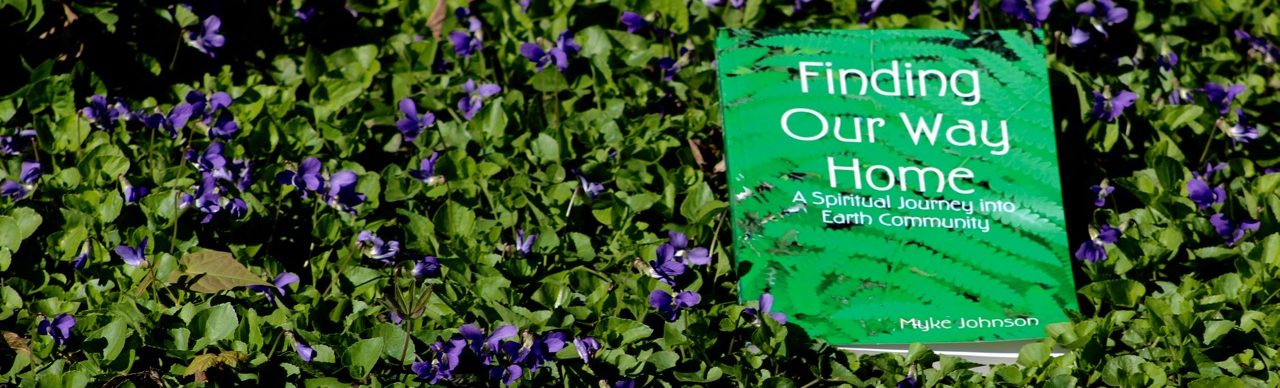
Teach a class this year on the Spiritual Journey Into Earth Community, based on the latest version of the book (Finding Our Way Home: A Spiritual Journey Into Earth Community).

Begin to explore self-publishing the book.

For health–rest, dance, walk, water, herbs, be outside.

Come outside, come outside, come outside.

There is no rush at all, just love, follow your deep passions.

The spirits are with you. Brokenness hurts–turn to the cardinals, the sun, weeping, diving into water.

Enjoy the beauty of each day. It is not all about goals and purpose and accomplishments–even green ones. See the beauty now. Feel the connections now. Be still.

Listen to your body.

You can find your joy and beauty when you sit outside in the morning and write–you know how to move into Presence. Write this down.

There is still more transformation that is possible. Your heart is in the universe and the universe is in your heart. I put my hand on your heart.

Think of how you get up each day in a world that is broken and anguished and live in a society that is divided and hurting. Think of how you feel the new sun and the songs of the birds.  You are learning to feel the land slowly, so the grief doesn’t overwhelm you, so you can find the source of strength, the many ancestors.

Keep dancing.

Today is a day, not a preparation for something else–a beautiful, painful, blessing-laden day. Let your heart’s pain be awash in this day.  

You are not an orphan. You are in the land where ancestor relatives were buried, the dawn places. Don’t panic. Don’t try to take the pain to someone else. Everyone is broken. Remember gratitude. Remember to honor the pain. Remember to see with new eyes.

Remember the magic. Breathe. Remember that a day may bring a beautiful surprise. Follow the Spirits’ lead. Flow with the River of Life.

The Ancients

Knowth spiral MD DSC09032

Photo by Margy Dowzer

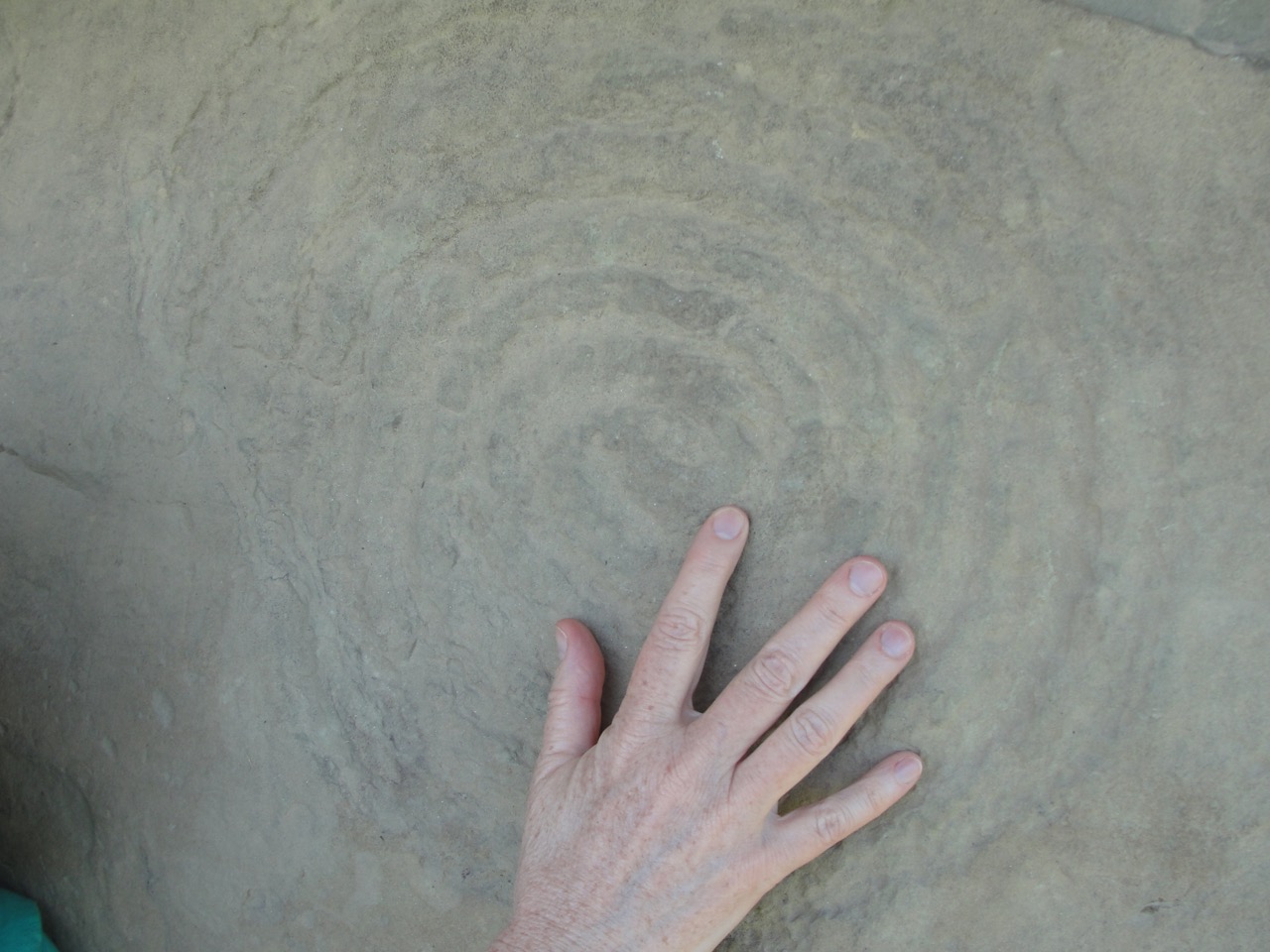
Thursday, Margy and I went to the ancient sites of Knowth and Newgrange.  Built by neolithic stone age peoples about 5200 years ago, they were burial mounds and ritual centers, aligned with the sun at certain points of the year.  We had heard about Newgrange, where the light from the sun at dawn enters the burial chamber on the Winter Solstice.  But we were even more impressed by Knowth, where tourists are not able to go into the burial chambers–too dangerous–but can walk up to the top of the mound.  There are huge boulders that surround and support the mound, called curb stones, and most of them are covered in geometric images–spirals, triangles, undulating serpent like forms.  We could photograph and touch this art created before the pyramids were built in Egypt.  It is a UNESCO world heritage site because of this high concentration of neolithic art. What an astonishing feeling to trace a spiral that was carved so many generations ago by the ancients!  Our guide said that similar stone carved art with the same kinds of geometric patterns can be found all around the world–America and Australia, for example.  Until fifty years ago or so, all these stones at Knowth were buried under soil–the mounds looked like an extension of the hills.  Then, archaeologists began to excavate and discovered the careful construction and design of the burial passages and chambers, were able to carbon date the remains, and restored the mounds to their neolithic era appearance.  All of the stones are original, and the guides reminded us of the sacred and beloved nature of the site. After this visit I got to thinking about ancient mounds in the United States.  I barely knew anything about them, except that they were built by early indigenous peoples of this land, and that many have been destroyed or are even now being threatened with destruction.  Most recently, I heard about a new football stadium being planned in St. Louis that would destroy the remains, now underground, of a burial site and city.  Since no federal money is involved, there are no laws demanding that they even do archeological investigation. I wonder why our country doesn’t take care of these precious artifacts from the ancients on this land?  In a time when there is international outcry over destruction of ancient sites in Syria, where is the outcry over destruction of ancient sites in America?  I suppose it is directly related to our society’s general insistence on forgetting that these lands once belonged to another people.  As to the mounds that do still exist, I have read that there was much early resistance to thinking that Native peoples would have the expertise to build such structures.  Racism then, must surely underly this disregard, and perhaps the overarching allegiance to the gods of money and profit.  And the brokenness of our times, the forgetting that the land is full of sacredness in her essence and in her history.