September Musings

Four huge turkeys in the shade of some green grass, behind leaves of zucchini in the front corner of the photo

The summer garden had some successes and some fails. And it is sometimes hard to tell which is which. This turkey family visited the yard many days, and walked through the garden beds in the back. They mostly left the veggies alone, except they liked to eat the tops off the bean plants. We still got a few beans even so. And they left alone the zucchinis, which did well, the cucumbers which did fair, and the broccoli, also fair. We appreciated their visits–we want to support wildlife after all.

However, we tried to lessen our support for the chipmunks and squirrels that became such little rogues. Despite netting over the blueberries, once they figured out they could squeeze holes into it, they got the rest of the blueberries, though we did get a bunch before that. I am happy to say that the baffle on the bird feeder totally worked. They never got up to the feeder after the baffle was installed. So I am hoping that without all that extra food to stash, the population won’t explode like it did this year. The long game. And the birds keep coming back to the feeder.

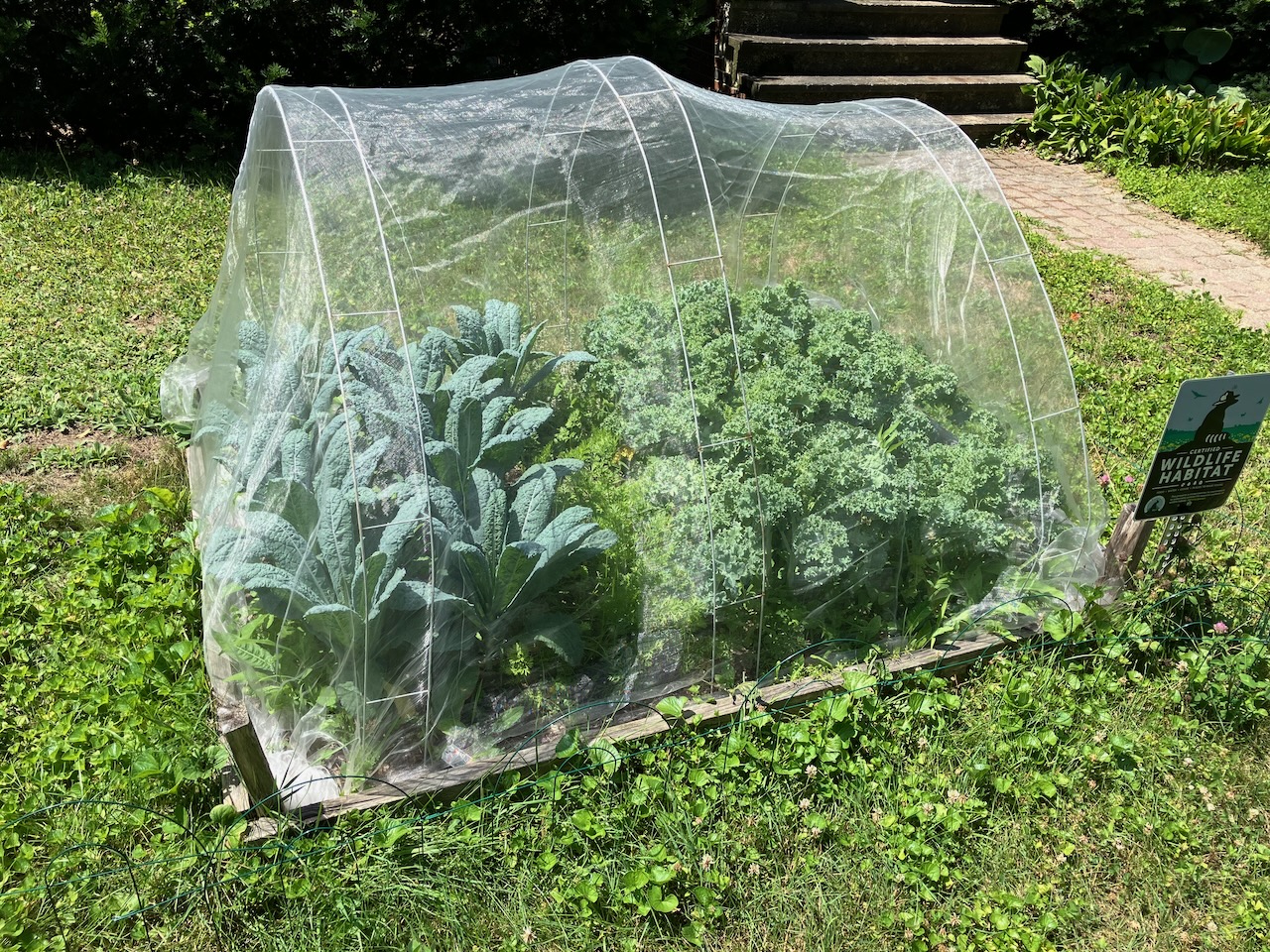
In the front yard, we never had monarchs lay eggs on our milkweed plants, despite their visit. Maybe next year? The netting on our kale and carrot bed was a great success. It protected the kale from cabbage moths, and no one tried to get into it. We have a ton of kale harvested and still to harvest.

Rectangle garden bed filled with green kale of two kinds, covered over with a translucent net on white metal supports.

The robins never came back to their nest on our back porch after the babies had been attacked. Still so sad about that. We’ve had some lovely visits with human friends out by the pond. The pond water level went down with the drought, but this weekend’s rain helped, especially after adding water from the newly filled rain barrels. Still a few frogs, though I am not sure about the tadpoles. They hide under the lily pads, and it’s a lucky day to see them.

And… and… and… Gaza is still being attacked night and day, and starved by blockades. International resistance is growing but too slowly for the people killed each day. I keep bearing witness, and praying. It’s the same with the rising fascism of our country, and the attacks on immigrants both documented and undocumented, and citizens who are brown or black or speak Spanish. The only thing that gives me hope are the multiple levels of resistance from huge demonstrations to lawsuits to governors who slap back. Here we do the best we can to get by, day by day, accepting our situation as elders and those who are chronically ill. In the face of so much cruelty and hate, we add our little love to the mix, hoping to be part of the larger Love which is our only real hope.

Living lying down

mussed up light blue sheet with two cat paws peeking out, black and white fur

I’ve been trying to figure out what it all means. I mean my life these days. What does it mean to be ill, to be mostly fatigued, to be compelled to rest most of the hours of my days? I wasn’t sure what photo could go with this question, and then I happened to see this photo of Billie from five years ago, her body hidden under a sheet on the bed, just her little paws sticking out. Somehow that fits. These days I am mostly hidden, lying down somewhere, sometimes under a sheet, and just a tiny part of me emerging into the world now and then.

I used to admire the elders who were out on the picket lines into their eighties and nineties. It makes me sad, but I don’t think that can be me. I still care about the things I used to care about. I hunger for justice, for human rights, for kindness, for peace. I still rage against cruelty, oppression, violence, and genocide. I scroll on Facebook and try to bear witness to all that is happening out there. I share posts that document the atrocities, in the hope that bearing witness is better than silence. I share posts that document the resistance, in order to foster hope in the face of so much despair. But is that diminished activism what my life now is meant to be about? Is it what it means?

Spoon theory is a method of managing energy for many people with disabilities and/or chronic illness–if we only have so many spoonfuls of energy, we have to ration our activities to match the spoons we have. Lately I am always running out of spoons before I can finish the tasks of daily living. I am lucky if I can keep up with the dishes in the kitchen sink, keep up with cleaning out the litter box for the cats, keep up with watering the vegetables I was so bold to plant. Are these tasks of daily living what my life means now? Do I need to cultivate that Zen approach to being fully present in each moment, however mundane?

Meanwhile, I spend many hours lying on the couch watching tv shows on Roku. Sometimes I have to manage my energy for that too. I can’t handle too much drama. British mysteries are about right, especially if I have seen them before and they are well done. Nature shows are usually okay, unless there is too much about how we are destroying it. Sometimes I nap during the shows. Lately, I’ve been watching “Would I lie to you?” on Britbox for laughs. It all feels rather pathetic actually, but this is the unvarnished truth.

I don’t have the answers to my questions. I don’t know what it all means. But I feel like I have to wrestle with this reality I am living in, wrestle with the meaning, because that is also still who I am, a wrestler-with-meaning. I can look out on the world, but I must also look into this intimate space under the covers. I believe that each human being has inherent dignity, each life has ultimate value. I believe that we are all connected. So how do I find the ultimate value in this life of mine, right now, not based on what I have done or who I have been, but right now. Still able to write sometimes, but about to lie down for the rest of the day.

Listening for Spirit

Dawn colors and clouds, pink and blue over trees and shadow of a house

Our house isn’t best situated for seeing the beauty of sunrise or sunset. Too many trees and buildings. But the other morning, when I opened the blinds in my room, I saw this outside my window. Dawn magic.

Yesterday I was so sleepy and almost napping on the couch when I happened upon a documentary on PBS about Howard Thurman, Backs Against the Wall. I knew of Dr. Thurman but I don’t remember if I knew so much about him as was shared in this film. African American theologian, author, and teacher, he was deeply spiritual, became dedicated to nonviolent activism, and was the mentor to Dr. Martin Luther King, Jr. and other civil rights leaders. The film stirred something in my soul.

First of all, I found myself feeling a bit of envy–my old sin. I always wanted to “be somebody.” You know, one of those people you heard about, a saint, a well-loved thinker and author, an influential leader, recognized by the world. And I wasn’t that, except, to be fair, in the most local context. I was, for a while, a local spiritual leader. I saw something in Dr. Thurman that reminded me of myself, except writ large.

Most importantly, he reminded me of my own mysticism, my own deep connection to spirit. And I asked myself, am I listening to the voice of the spirit within me, am I paying attention to what the spirit is telling me right now, in this time? The truth is, illness dampens the energy of the body, but it also dampens the energy of the soul. It has been harder to hear the voice of spirit since my retirement due to chronic illness. I remember at first, spirit said, Rest and Joy, let that be your guide. And I did rest, and chose activities that linked to joy in me.

But I still wrestle with questions all the time. What is this chapter of my life all about? What can I do in the face of the brokenness of our world, in the face of war and oppression? If I can’t resist by marching in the streets, how can I resist such evils as the genocide in Gaza, the rising hatred toward immigrants in our own country, the demonization of trans and queer people by those coming into power?

At different times in my life, I was guided by an evolving sense of purpose. When I was in college, my friends and I would ask, “How would Jesus live in our times?” A few years later, I found the Catholic Worker movement, and to live and serve in houses of hospitality for people without homes–that felt like the embodiment of that purpose. When I woke up to the oppression of women in the church and in society, when I began to form community with other women waking up, I voiced this desire, this intention: “We mean to incarnate the goddess!” When I came out as a lesbian, I felt a deep sense of purpose in loving and affirming all of our beauty as women, as lesbians, to find the goddess in ourselves and each other.

There was always this pattern for me, listening and following the spirit as I was led into new understandings and new ways of living a purpose in the world. Following the distant voice of my ancestors into solidarity work with Indigenous peoples. Finding a home in Unitarian Universalist ministry, and serving in congregations as I was called, bringing together wider understandings of spirituality, and commitment to the work of justice activism in community. Coming to a deeper understanding of interconnection with all of life, and permaculture gardening, and a spiritual journey into earth community.

I see how lucky I have been, to be able to follow an inner stirring, to live and work from a sense of calling and purpose. Whether known or unknown. But I am still wrestling with questions now. What is my calling now? Can I hear the voice of spirit to guide me now? Here is something Dr. Thurman wrote about all this:

“How good it is to center down!
To sit quietly and see one’s self pass by!
The streets of our minds seethe with endless traffic;
Our spirits resound with clashings, with noisy silences,
While something deep within hungers and thirsts for the still
moment and the resting lull.…
The questions persist: what are we doing with our lives?—
what are the motives that order our days?
What is the end of our doings? Where are we trying to go?…
Over and over the questions beat in upon the waiting moment.
As we listen, floating up through all the jangling echoes
of our turbulence, there is a sound of another kind—
A deeper note which only the stillness of the heart
makes clear.
It moves directly to the core of our being. Our questions are
answered,
Our spirits refreshed, and we move back into the traffic of
our daily round
With the peace of the Eternal in our step.
How good it is to center down!”

I guess that is what I am trying to do, even now, to center down, to hear the deeper note. To let the questions come into that stillness. Even when it feels empty and dark, before the dawn has come.
Inside the pain

There may be times when we are powerless to prevent injustice but there must never be a time when we fail to protest. Elie Wiesel

The last few weeks, I have been dealing with severe pain in my hip, such that it makes it difficult for me to walk or sleep. I am grateful that I now have physical therapy which is slowly helping. But as I was lying on the table getting treatment today, I kept thinking about people in Gaza, right now, who also were dealing with hip pain, or chronic illness, or who were giving birth–any of the myriad kinds of human conditions that render us deeply vulnerable, even in the best of situations.

And instead of finding help or treatment, those human beings are being forced out of their homes, bombed, shot, starved. How would I evacuate when I can barely walk? How would I sleep on the ground with no pillows to ease the pain? How would I manage my illness with no medicines? How would I give birth with no clean water? It is not as if those human frailties cease to exist because of war. Underneath the other horrors, the deaths, the woundings, the destruction of homes, schools, libraries, hospitals, there is each human story.

I find in my body a small metaphor for this hurting world. I find in my body a deep scream of pain for this hurting world. They say the hips are the foundation for the balance of the body. And the earth is out of balance in so many ways. We see it in the chaotic weather, we see it in wildfires, we see it in an ocean warming faster than expected, we see it in cruelty toward children who are “different,” we see it in pandemics, we see it in politics of fear and hate. Who knows what the future will bring, with such a painful present.

I found encouragement in these words of Elie Wiesel, who survived the holocaust and wrestled with its meanings and repercussions for the rest of his life:

“There may be times when we are powerless to prevent injustice, but there must never be a time when we fail to protest.”

https://www.nobelprize.org/prizes/peace/1986/wiesel/lecture/

I found this image and quote posted by a friend on Facebook–the image is the Ukraine sunflower, and Ukraine is another country full of people in pain that linger in my own heart. But the flower feels full of beauty and hope. Wiesel goes on to say:

“The Talmud tells us that by saving a single human being, man can save the world. We may be powerless to open all the jails and free all the prisoners, but by declaring our solidarity with one prisoner, we indict all jailers. None of us is in a position to eliminate war, but it is our obligation to denounce it and expose it in all its hideousness. War leaves no victors, only victims.”

1986 Nobel lecture

First Snow, Gaza, Small Birds

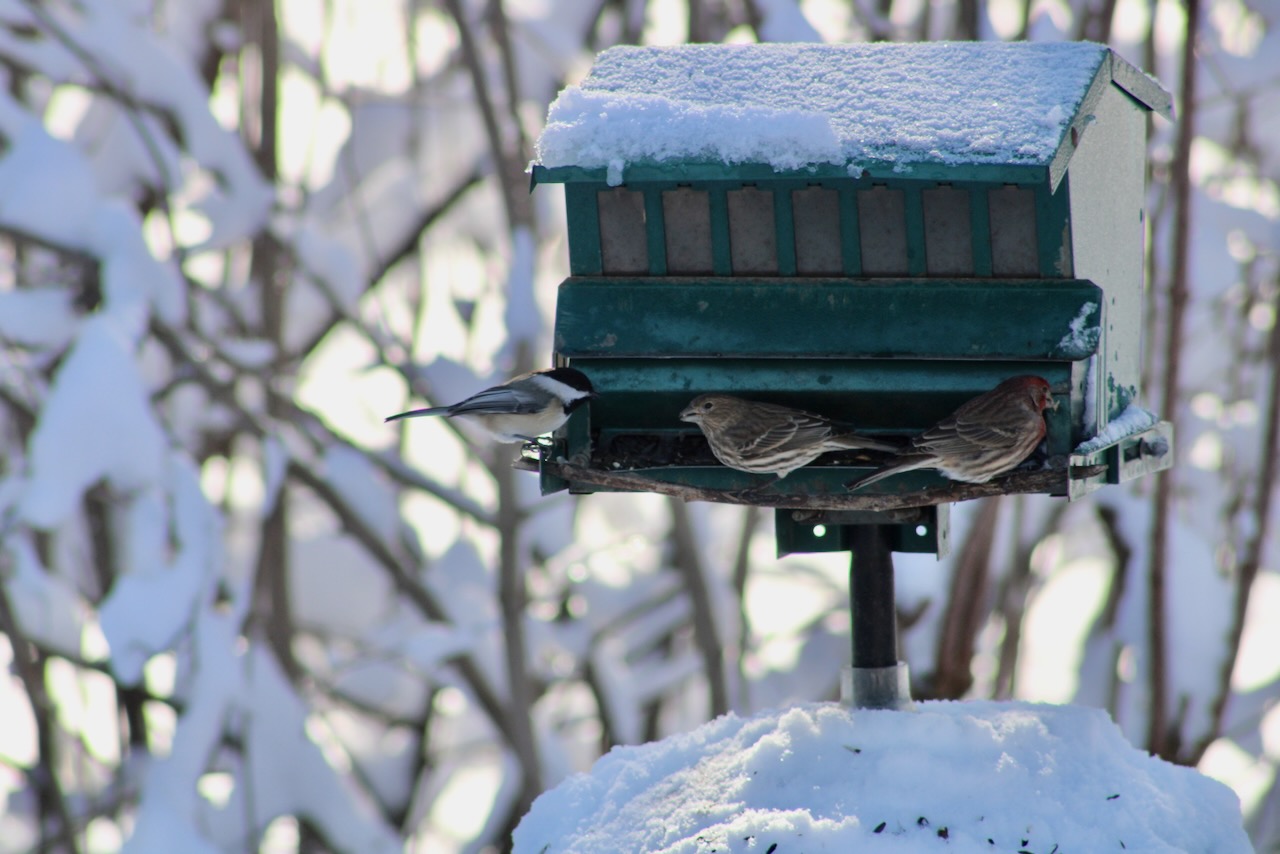
Green bird feeder in front of snow covered branches of hazelnut hedge.
Bird feeder near hazelnut hedge.

We have our first snow-covered morning here in our yard in Portland Maine. In places further from the shore they got several inches, but we had mostly rain until early morning. Now it feels like winter is really here. My internal clock has felt the shift, as the days grow shorter and darker. A few days ago, I started working again on sorting through my old documents–my winter project of the last few winters. This year, most of the documents are digital, though there is at least one box of paper files to go through in the basement. In prior winters, I looked back on all the years before we moved to Maine in 2005. This winter, I am looking through my time as minister of Allen Avenue Unitarian Universalist Church here in Portland, before I retired in 2018.

I started by reading all of the “annual reports” I wrote for the church to summarize the work of that year. It was a simple way to quickly turn the pages of thirteen years of ministry. I was astounded at the sheer number of times I marched in protests, or spoke at vigils in solidarity with issues of justice or worked on legislative change in support of human rights, usually along with other members of my congregation or other ministry colleagues. My life now is so much quieter and less intense, but also less connected. It was good to have that public voice, and to use my voice in service to all that I believe. I feel so far removed from that life and that work.

I suppose in some ways a blog is a kind of public voice, but much quieter and less visible. My life these days is much quieter and less visible. That is chronic illness, compounded by our continued COVID precautions in our household. I can’t put my body out on the line for love and justice. It takes most of my body’s energy just to manage our household tasks. It is like I am looking out a window at all that is happening in our world.

I was surprised to notice that I hadn’t blogged for a few weeks. Lately, all I can think about is Gaza and the way the people there are suffering and dying. In my files I found a sermon I preached in 2014 about Palestine and Israel. In many ways, the issues are all the same. In other ways, everything has gotten worse, much worse. So many deaths, so much destruction. I can’t even imagine the words I could say about it, and then I don’t have words for anything else. My heart is on the ground. My heart is on the ground.

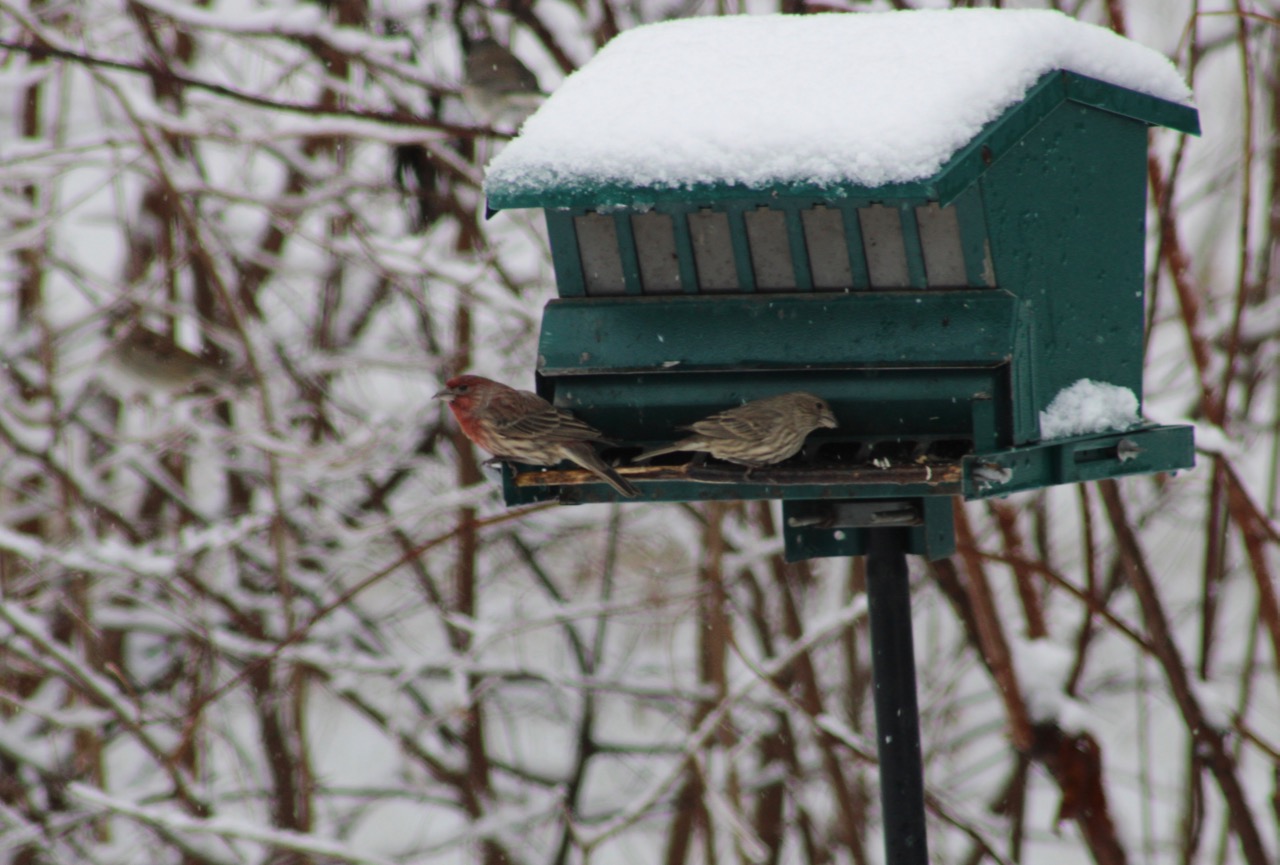
And then, out the window I see a large flock of small birds visiting the hazelnut hedge and the bird feeder. They find their way to our yard each day, traveling together as a group. They usually arrive mid-day, but today they are early. Tufted titmice, chickadees, goldfinches in their winter garb, sparrows, juncos, finches, even a bluebird. (Maybe they come more than once a day, but you have to be looking out a window to see them so I am not sure.) Often a few chickadees even stop at our back porch pecking for stray seeds. It is not so easy to take a photo of a flock of small birds. They scatter themselves across the orchard. They come through and then they are gone again. Traveling all together on their mysterious rounds.

And my heart is lifted just a little, with their flight and their community.

Finches at feeder.
Junco on a branch.

Already Broken

Broken measuring cup

Years ago I heard a Buddhist phrase–“The cup is already broken.” Its intent is for us to meditate on the transient nature of all of our reality. If we think of the cup as “already broken,” we can appreciate the cup now, and not be attached to keeping it in the future. At least, that is my brief paraphrase of what it means to me. Last night I knocked into a glass measuring cup and it fell to the floor, shattering into many pieces. Margy says she thinks that this measuring cup had originally belonged to her mother. But it was not really a sentimental piece, rather a long-lasting useful tool in our kitchen. Very long-lasting. Very useful. I locked the cats in the bedroom so they wouldn’t step on glass, and swept and vacuumed all the pieces from the floor into a paper bag to put into the trash. So it goes.

However, there is another version of “already broken” in modern American life–planned obsolescence. Manufacturers purposefully making products that are designed not to last, so that “consumers” will keep buying more products to replace them. This kind of “already broken” is so frustrating as we try to live in sustainable mutual relationship with the earth. We have these metal yard chairs whose weave has torn so that they are no longer useful, and not repairable. They were not long-lasting–maybe only a few years old. We’re likely going to call The Dump Guy, to come and pick up four of them plus a broken patio umbrella. It just makes me feel angry.

Broken yard chairs

Meanwhile, it seems to be an autumn full of broken mechanical things–but happily so far, most able to be repaired. The garage door was broken and then fixed a month later. A groundhog dug a tunnel under the garage that we needed to get filled, and a contractor worked on it. The clothes dryer stopped working and was able to be repaired. Now the heat pumps won’t work, and someone is coming on Tuesday. (We have a back-up oil boiler, so we are not cold.) I have felt burdened by all of this household decrepitude, yet also grateful–because we have been able to get repairs done, able to afford them, able to find repair people to tackle the jobs that are too big for us.

But I am also reminded of the larger brokenness all around us in our world. I always resonated with the Jewish concept of Tikkun Olam, “repairing the world.” I am not Jewish, but have learned so much from that tradition (and people from that tradition) about working for justice. So much of my life, I was involved in activism to end oppression and injustice. I dreamt of a world of freedom and equality and compassion. Now as I face the latest chapter of my life, with chronic illness, I don’t have the energy or ability to be so active. I feel discouraged about the backlash that has undone many of the hard won victories for the world that we dreamed about.

So I ask myself, what do we do when we cannot repair the world? What do we do when oppression and injustice and violence seem relentless. What do we do when the very earth we rely on is on a course for a mass extinction. What do we do when the world is “already broken?” I have been struggling over this writing for weeks now. I don’t have any answers, but it feels like a critical question for this time of my life. If I have attached my meaning, purpose, and value to improving the world, to repairing its brokenness, then who am I if that is not possible? Who am I if the world is already broken?

I still don’t really have an answer. I still am pondering the question, as I feel such sorrow and grief for those who are suffering right now in ways I cannot alleviate. I remember that many people have lived in times of great horror, have lived in situations which they did not have power to improve or repair. We are tangled in a web of broken relationship. We cannot escape. Yet in every situation, people have made choices to affirm their humanity and interconnection. What choices might I make during this next chapter?

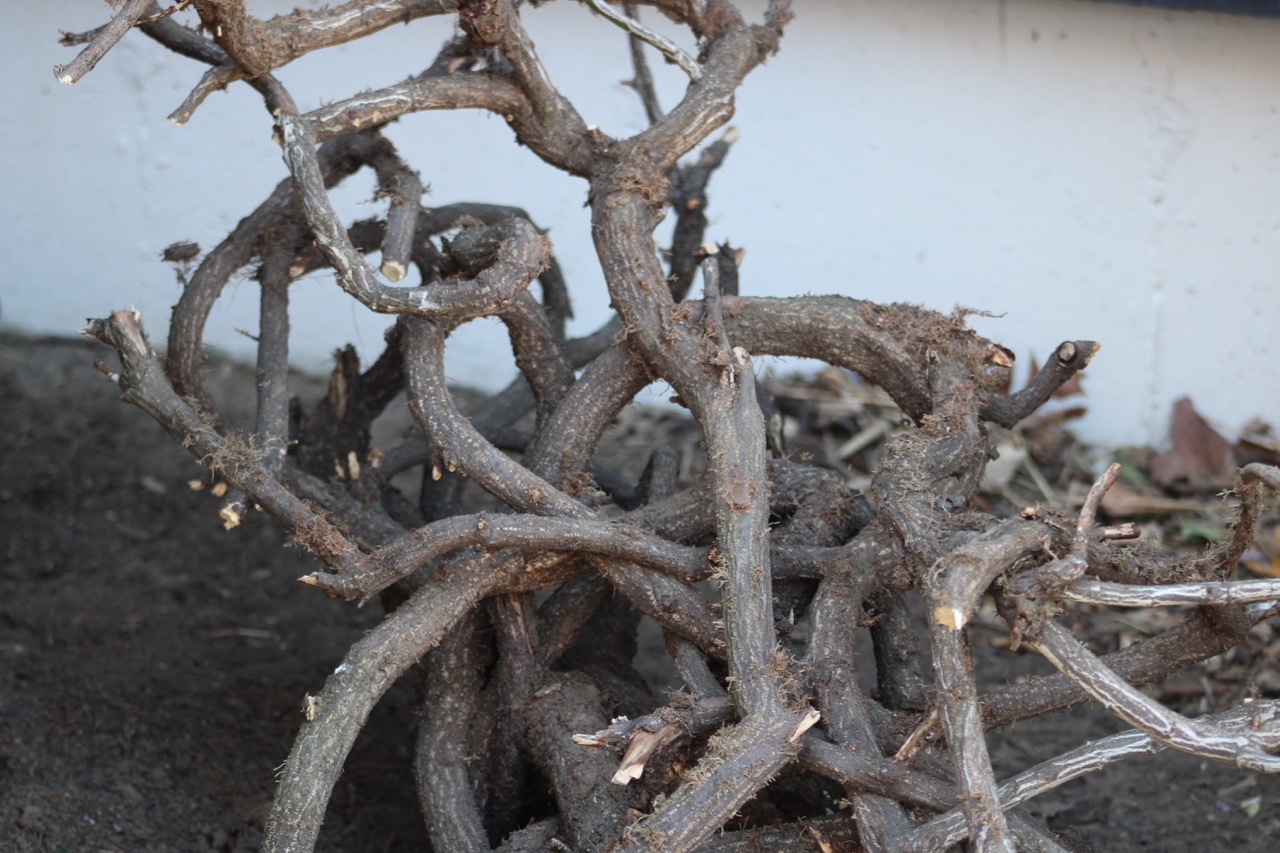
Tangled branches of cut “climbing spindle tree” (invasive in Maine)

There are things we cannot control

Green shoots emerging in brown leaves and old stems
Going through old files, I found this reflection poem from 2014. It feels even more fitting for today, especially living as I do in the "realm" of chronic illness. I cannot control how much energy I will have each day, and rarely can I take action that might have an influence in the world outside our home. But this morning I was reminded that I can still choose to love in all of my hours, and be grateful.

There are things we cannot control.
It is a long list.  The weather, the seasons, 
the coming of day and night.
Another person's joy and sorrow, or love and grief.
We cannot control anything 
	about another person, most of the time.
The things we cannot control 
       are more numerous than the things we can.
The economy.  The price of milk.  
The coming of storms or the blooming 
       of lady slippers.
The return of the hummingbirds,
       or the death of poets.
If you are like me, you sometimes imagine 
you have more power than you really have.  
You try to control what you can, 
and even what you cannot.  You worry.
You want your children to be happy and fulfilled.
You want your parents to be healthy and content.
You want your partner to be a good match, and loving.
You may want the members of your community
	to be enthusiastic and generous,
and your staff to be talented and never to move away.
Big things or small things, no matter.
There are long lists of things we cannot control.
We want for all children to be safe, and girls who are lost to come home again.
We want angry young men to work out at the gym 
        and never to buy large amounts of guns and ammunition. 
We want politicians to be dedicated to the common good,
        and news media to the truth.
We cannot control anything about another person,
        most of the time.
We cannot control another person's joy and sorrow, loss and grief.
We cannot control the ways that joy and sorrow come into our own life.

But there are a few things we can control.
We can choose the values we want to follow in our own lives.
We can choose to speak up and act 
	in ways that share our values with the world.
We can choose to greet a stranger
	and listen to a friend.
We can choose kindness. No matter what.
We can choose to love.
	(and love ourselves too)
May you find the places of choice in your life, 
      and be at peace about all that is out of our control.

The Delicate Adventure

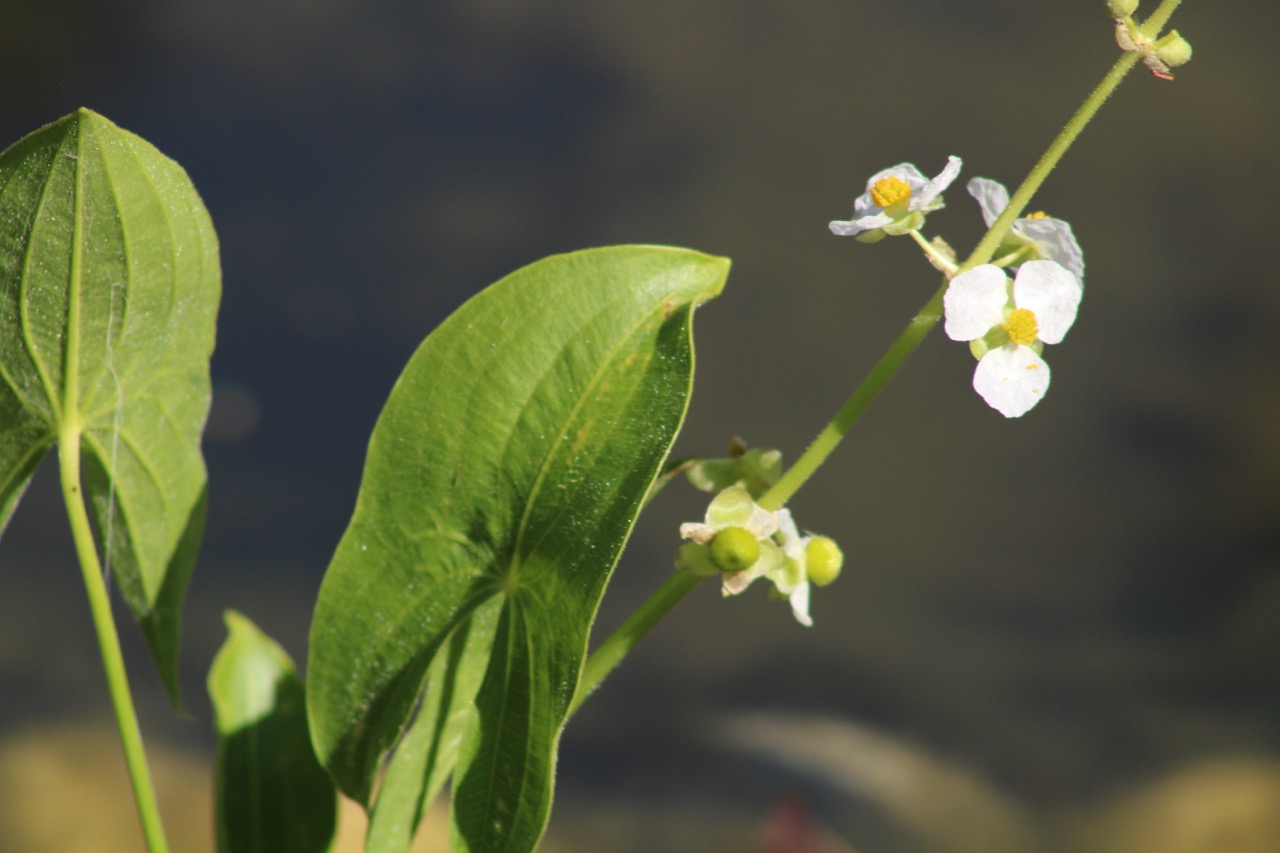
Arrowhead flowers and leaves and seeds, a pond plant

I am happy to be starting a new experimental adventure. After four years away following my retirement, I am venturing back into involvement with my former congregation, Allen Avenue Unitarian Universalist Church. In our faith community, a retiring minister traditionally stays away for a few years, to make room for a new minister to bond with the congregation, and to make real the fact that I am no longer their minister. If or when we return, we create a covenant with the current minister to clarify our relationship and offer our mutual support. I have done that with Rev. Tara Humphries who is now serving the congregation.

But it is still a delicate balance to negotiate. When I go back, I am not their minister, but I am also not just any other member of the church. I am still their Minister Emerita, an honorary designation expressing our mutual affection and connection. But with or without that designation, I still carry those thirteen years of affection and connection, and it gives me an influence different from other members. So for me, the experiment is measuring whether and how I might be a member of this community in that in-between zone. I am drawn back by a desire for the kind of community that church offers, I am drawn to that little village of care and support. Is it possible? Will it work for me, and for them?

Some parts of this feel very clear-cut. Dealing with chronic illness has made it impossible for me to carry out many ministry functions, like weddings, memorials, and leading worship, so I won’t even be tempted to be doing any of those. Another aspect clarified in our covenant recognizes that “since my position still carries some weight, I will decline to participate in the governance of the congregation, or take sides on any issue.” And both Tara and I will “decline to participate in, and will remove ourselves from, any conversations with church constituents which might try to evaluate each other’s ministries or contributions to church life.” All of that feels very down-to-earth and solid.

But more experimental are the personal interactions and connections. The first event I attended was an in-person, outdoor celebration of our 200th anniversary on September 10th. I am still being super cautious about COVID, so I wore a mask even though we were outside, though most others did not. This was the largest event to which I have gone at all since COVID. I would have loved to hug everyone, but I did air-hugs instead. It was wonderful to see people I knew, and meet a few I did not know. Heart-warming. It was also rather exhausting, and I had to rest afterward. Is that my chronic illness, or introversion, or somehow feeling once again all those threads of connection?

Worship services are now hybrid on Sundays–some people attend in person and others on Zoom, so I have attended a couple via Zoom, but I haven’t yet stayed for “zoom coffee-time.”

I went to the monthly “Elder Salon” and that felt really good. The structure made it easy for me to participate as others did, with a few minutes of check-in for each person, and a discussion following that. I like the reciprocity I felt in that group. The topics of concern to elders match many of the topics of concern in my own life right now. So it feels like I can join in as any other member might join in, and benefit from the collective wisdom in the group. I guess I am learning to be an elder. I like it.

All in all, I am taking it slow, and observing what comes up for me.

To Be of Use

Chipmunk drinking at the pond

Yesterday morning, I was sitting next to the pond, writing in my journal. After I’d been there, and quiet for a long time, this chipmunk approached the other side of the pond, climbed down the rocks and took long drinks of water. After a couple minutes, it quickly climbed back up the rocks and ran back into the field behind.

If you’ve been following my posts recently, you know that I’ve been dealing with chronic illness causing me to have much less energy this summer. So my relationship with the garden has changed. It has been less purposeful and project oriented, and more, “Let’s see what the yard wants to do this season.” To listen more, to do less, to observe more, to try less–and I’ve learned so much, actually.

It’s true that we had already done a lot to shape the yard–we planted many fruit trees and bushes, let wildflowers grow, planted perennials, pulled invasives, and created the pond last year. Some of the plants that were in the pond didn’t survive the winter, and I did add a few more this spring. But it wasn’t enough to prevent algae from flourishing. So periodically, I get inspired to pull out as much as I can. But I’ve also noticed that bees love to perch on the algae, to get a drink of water presumably. (There is always enough algae left for them.) It gives me gratitude to know that this pond, imperfect though it is, has been of use to these creatures in a drought-burdened summer.

Bees on green algae

Lately, my old nemesis the squirrel has come back to start eating peaches. But since I was doing so much less to nurture the peach tree–less holistic sprays, less thinning of peaches, and so on–and since I had somewhat resigned myself to having no peaches after last year, I haven’t been stressed out about that. And the squirrel or squirrels seem more mellow as well. The peaches are actually very crowded together, and every couple days, I twist off a few tightly squeezed ones, even though they are not ripe yet, to make room for the others to grow bigger. I’ve put a few on window sills in the house to see if they will ripen. I tell myself the squirrel is also thinning the peaches. We are collaborators, rather than enemies. Who knows, maybe there will be enough for all of us?

Squirrel sitting on a branch in the peach tree nibbling on a green peach.

In a world with so many horrors that I can do nothing to stop, or even to protest, I am grateful to be of use to these small companions who share our back yard with us.

[And thanks to Marge Piercy‘s poem, To Be of Use, for its evocative and helpful title.]

Ocean Visit

Sun halo seen at Kettle Cove on Wednesday

We finally made it to the ocean on Wednesday! Between Margy’s knee surgery and physical therapy, and my general fatigue, we just couldn’t do it before, despite it being our favorite summer outing. But Wednesday afternoon, we drove to Kettle Cove. We stopped for ice cream at the nearby stand first, coffee ice cream with hot fudge for me, and a strawberry hot fudge sundae for Margy. Then we negotiated road repairs, and finally parked the car near the beach. Kettle Cove was our choice because the path between the car and the beach was not too long for Margy to negotiate with her cane. Plus we love this little beach and cove. We sat in our beach chairs for a while, and that was when I noticed the sun halo in the sky, and took this photo.

Then I went into the water and swam a little bit. It was just lovely. I can’t even describe how happy it made me feel. Then, afterwards, I sat with the sun’s warmth on my skin, a slight breeze blowing, and that felt like heaven. It has been harder to visit the ocean since being chronically ill. Not only the effort to drive there, but the coldness of the water sometimes triggers me into not being able to get warm again. But this time, I felt deliciously cool in the water, and deliciously warm afterwards in the sun. However, full disclosure, after we got home, I took a shower and then collapsed, exhausted over my whole body. It seems I can’t write much lately without writing about chronic illness, and how it has re-shaped my days.

Sometimes I feel envious of the adventures that friends post on Facebook. I have to shift my heart around and remember to be thankful for the blessings in our life here, even though it might be small in scope. To have food, a home, a garden–I am so grateful for those, and I don’t take them for granted. To have love in my life–that my partner stretches her energy to visit the beach with me, and stays longer than comfortable for her, so I got to experience my little heaven. And my love for her too, to leave sooner than I might have wanted, so she can get home and rest. I am so grateful for our love for each other.

A sun halo is said to be a good omen, that might predict rain (or snow in winter). We did get a much needed, drenching thunderstorm last night. Our garden is so grateful for that. And I am grateful for the ocean, challenging to my body, but still a ceremony of healing for my spirit.