The chipmunks woke up from their hibernation earlier this week. Peeking out from their warrens beneath the garage. It’s a good thing we don’t have bears. My friend who lives in the woods had a bear arrive in the night to break apart their bird feeders this past week. Our chipmunks merely climb the pole and share in the bounty. The wake-up seems early this year, and probably is. The winter was too warm and too short. But here we are, in a climate changed world, loving the earth as well as we can.
Today is the Spring Equinox! Equal parts night and day. I want to take a moment, in the midst of the vast troubles of the world, to express delight at the turning of the seasons. Small bits of green emerging from the perennial plants. And I am grateful that after five sessions of physical therapy I am beginning to get some relief from my hip pain. My PT person uses Integrative Manual Therapy, and it is a miracle worker. There are still many sessions to go, and I am hopeful that healing will happen. I took a very short walk each of the last three days–my five minute walk to the end of the block–which actually takes ten minutes with my current walking status. It feels good to be outside.
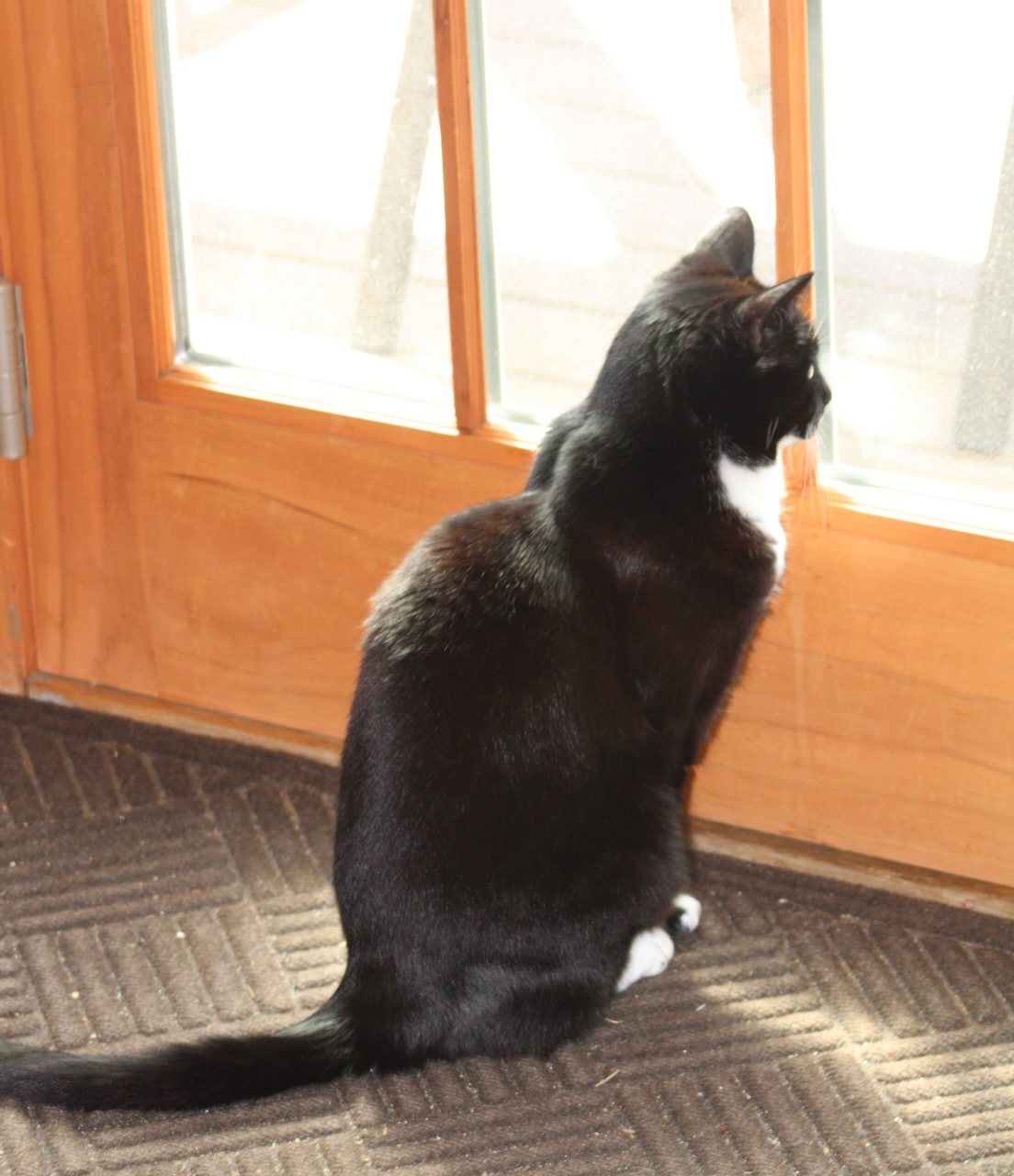
Meanwhile, the cats have new critters to watch through the windows. (They are indoor cats only.) Here is Billie looking out the back door.
I think about vulnerability. What it means for me to be 70 years old. I didn’t hurt my hip by falling or anything like that. I woke up one morning and there it was. It is a reminder to me to cherish the joys of each day. Who knows what tomorrow will bring? I can be prone to anxiety, and feel deeply the troubles of the world. I will keep bearing witness. But I will also find joy in these simple moments, these earth awakenings.
A little magic has emerged in my life. For a long time, I didn’t have the energy to go on walks, except for a minimal 5-minute walk to the end of our street. But somehow my energy has lifted a little, and for the last several days I have been able to walk to Capisic Brook, where it goes under the walkway to the elementary school, about 15 minutes total. It started January 2nd when, as I entered my driveway, I felt the presence of the Marie Madeleines, my ancestors from Îlets-Jérémie. “We are still with you.” They would have spent so much time walking in their lives. So I felt them walking with me in the early morning, greeting the dawn.
I heard the message from these ancestors: “You need new boots. Walking will be needed.” It was true that my boots were quite old and my feet were feeling it. So when I got back home, I did some online research, and then called a local store. After arranging it, I went in with a mask on, tried them on and bought myself some new boots. (The ones I wanted were on sale!) When I am lucky enough to hear a clear directive, I find it is so beneficial to follow it. And so I have kept walking almost every morning before breakfast. Even in the snowstorm, even in the first rainstorm. Yesterday I couldn’t get myself out there, but today the sun helped.
All these storms have been a challenge. We expect snow in winter in Maine. I like snow. But we’ve only had one snowstorm. There have been at least three huge rain and wind storms–first, when the spruce tree fell into the orchard, another January 9th into the 10th, and then yesterday which mostly caused damage at the shore during high tide. I took this photo of the brook at flood level on the 10th–because the branches of Capisic Brook flow through deep ravines, it doesn’t come onto roads in our neighborhood.
After the rainstorm, January 10
I can’t help but wonder what these weather changes mean for the future. Will rain and wind be the new winter, alternating with snow and cold? Someone posted (on Facebook-but no attribution) this little diagram that showed how climate warming destabilizes the polar vortex causing the extreme colds and unusual warms we are seeing right now. My sister in Montana reported -34 degrees, and Texas at 40 degrees, while we were up to 50 degrees.
While often I am most inclined to grieve or be afraid of all of this, I am also hearing the message that we must find a way to keep loving our changing earth mother, keep loving through the ups and downs. Perhaps it is also about the magic of walking–keep walking through the storms. I don’t know the answers but I am so grateful for the moments of connection and care.
My favorite part of gardening is when native plants show up and bloom all on their own! Asters are all around the edges of our yard, and in so many other Maine yards in our neighborhood right now. Different varieties, all beloved by pollinators, tiny beautiful blossoms when you look closely.
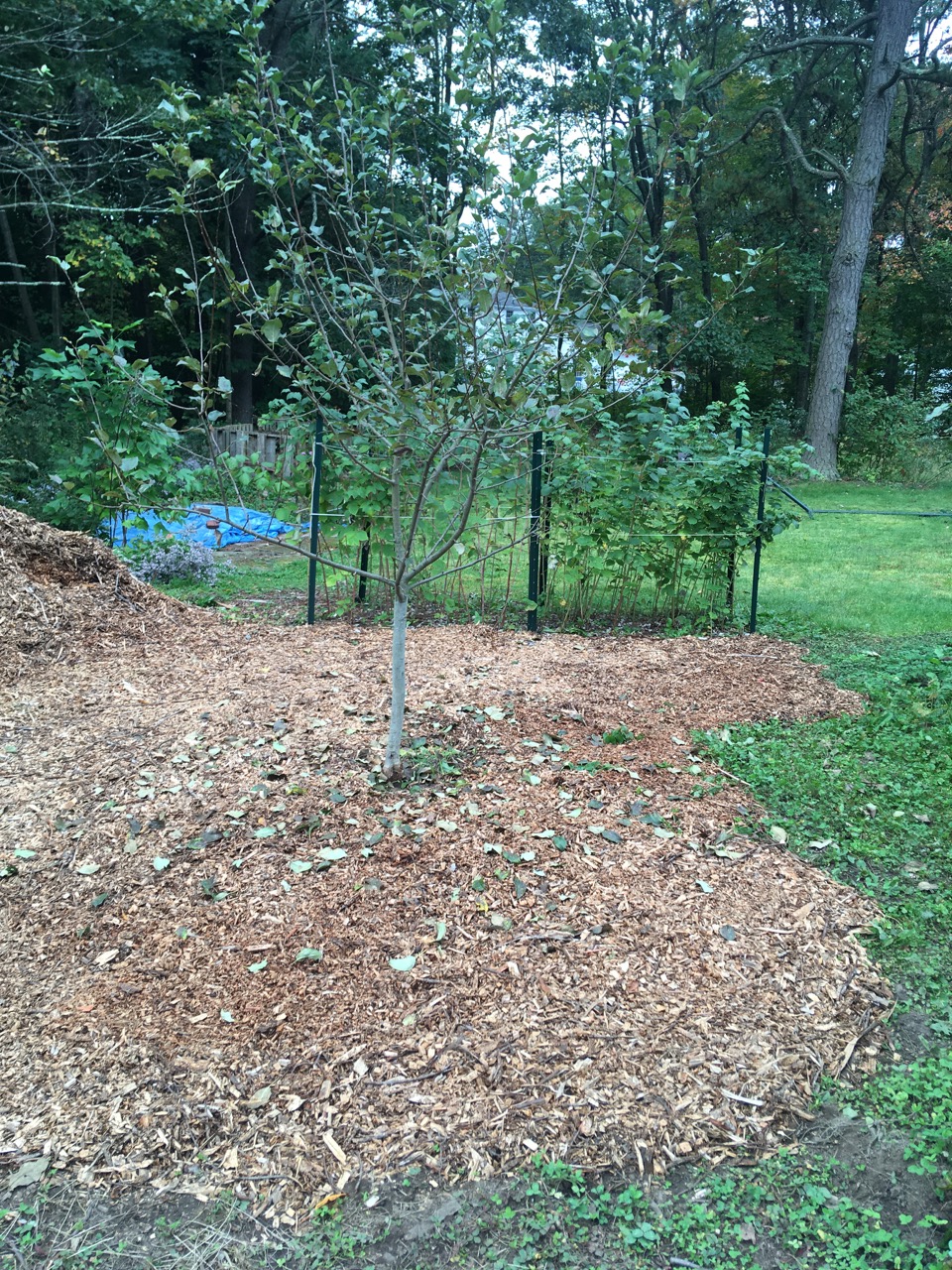
My least favorite part of gardening is wrestling with the invasive species that show up on their own. For the last three weeks I’ve been pulling buttercupplants that spread all over under the honeycrisp apple tree, and were also just starting to infiltrate the raspberry patch. So first I pulled up all the plants I could, in sections, then I set down cardboard over the area, watered it, and spread a thick layer of wood chips on the cardboard. Handily, the tree is right next to our pile of wood chips. The hope is that the cardboard and wood chips will smother the rest of the buttercup roots that I am not able to eradicate.
Halfway done pulling buttercup plants and layering cardboard.
While I was at it, I also pulled up all the oregano under that tree–my other nemesis, though it has its uses as an herb. It was intermixed with the buttercup. I was sad that I had to cover other ground plants like wild strawberry, and I hope they will spread again over the wood chips once things settle down. But finally, it was finished. (For now–I imagine I will have to be on the lookout next season for sneaky little survivors.)
Completed!
Meanwhile, the other least favorite thing about gardening is watching how climate change is disrupting the patterns that nature usually unfolds in each season. Yesterday, I discovered that there were open blossoms on the cherry trees–just a few–but this is October in Maine! Last winter’s unseasonable warming and freezing killed all the blossoms that should have come out in the spring. We have yet to harvest any cherries from these trees beyond one or two. And now this. I have heard that other people are noticing weird blooming out of season on other plants too. I don’t know if the cherry trees will survive. I hope they will. I tend them as well as I can, but there are forces far beyond the little garden here in our yard.
Meanwhile, I try to be grateful for the gifts that still emerge, the asters and goldenrods, the frogs and birds, and that I am able to go outside to watch and learn.
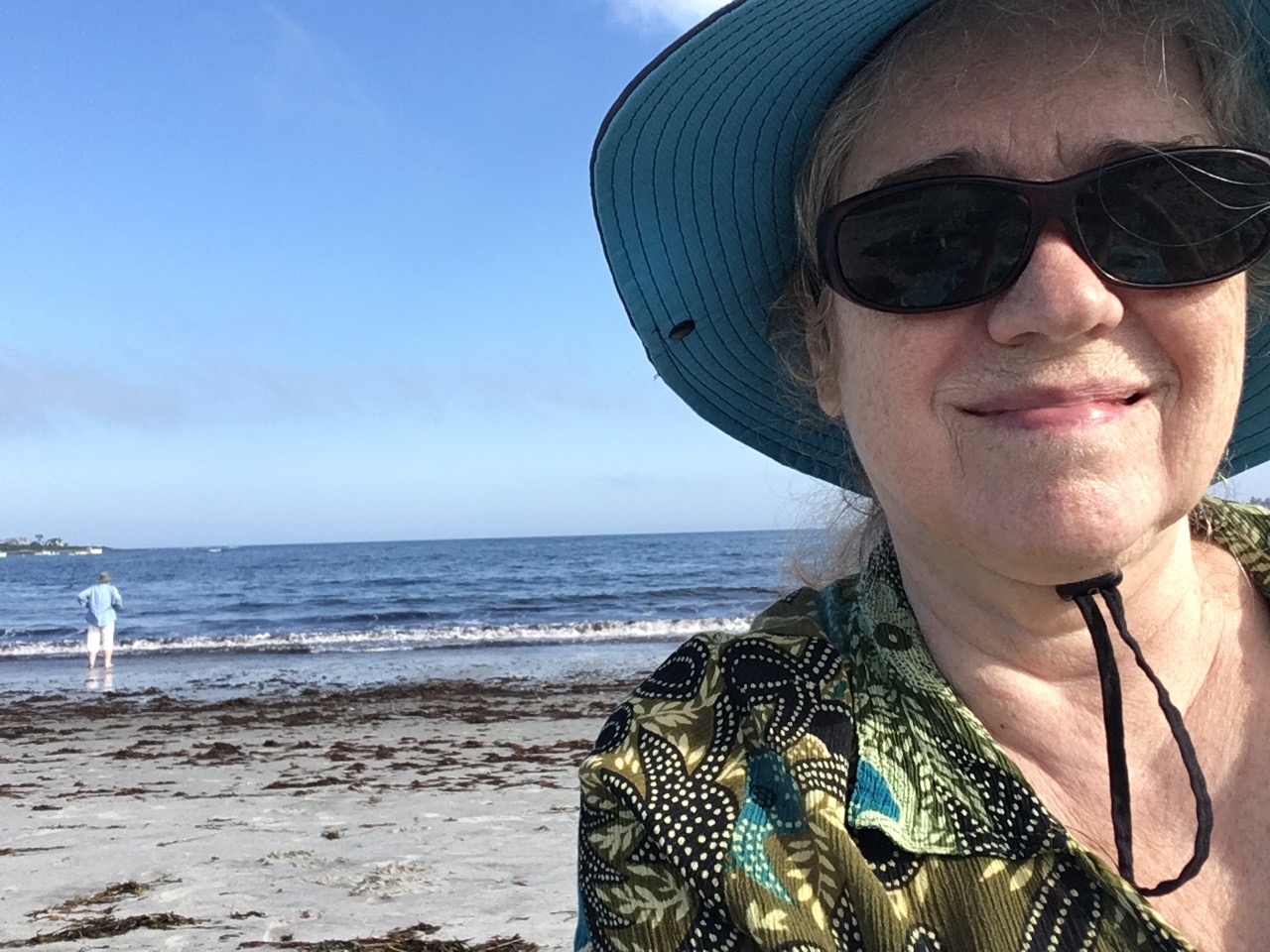
A week ago we finally made it to the beach. We’ve had so many rainy days this summer, alternating with a few very hot muggy days. That day was hot and muggy, but less so at Crescent Beach, so we got ourselves over there. The water was totally full of seaweed, and somehow that dampened my enthusiasm for swimming, but the wading was lovely, and lying on a blanket in the sand. I’m smiling in the selfie, but this post is more about the challenges of this summer.
It feels like a summer in which it is very hard to love the earth, or to feel loved by the earth. It is hard to even go outside! According to the weather report for Maine, June had only 7 days without rain. And July the rainy patterns have continued. But what makes it worse is that the days without rain have gone to the opposite extreme of muggy and hot. I don’t think we’ve had even one dry, sunny, moderately warm day. The other challenge has been air quality–many days of smoke particles making their way from Canada–not to an extreme, but enough to bump the meter from “good” to “moderate”.
And I have to acknowledge that we’ve been lucky here. No flash flooding of town centers, like in Vermont this week. No over-100-degree heat for days on end like in Arizona. No forest fires on our doorstep. But still…
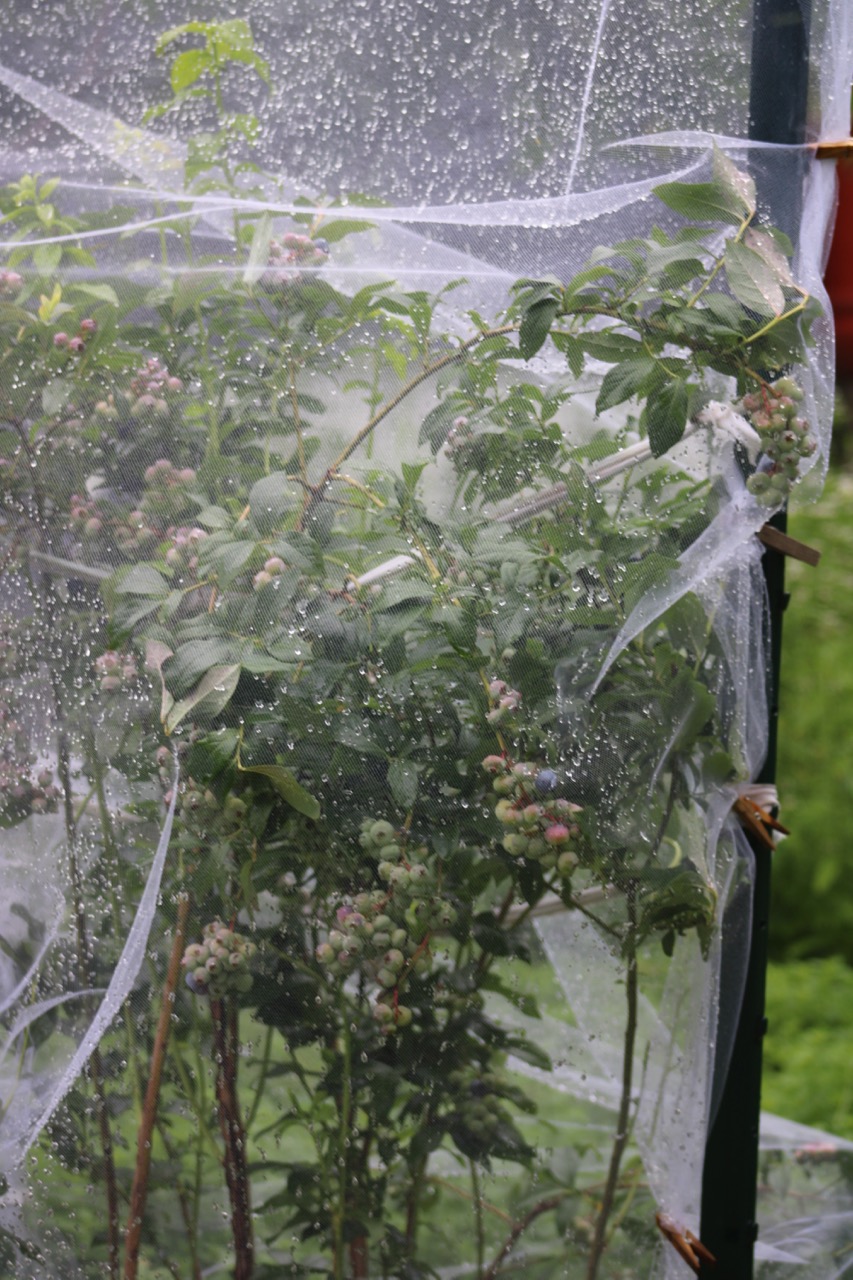
I’ve been feeling like a failure in my deep intention to build relationship with the earth. It’s not that the garden is doing so badly (except for maybe the cherry tree). It is just that I feel unable to tend to it, unable to even sit outside and appreciate it. (The cherry tree needs some attention because of, perhaps, black cherry aphids and sooty mold.) If I manage to do one small garden thing in a day, I count that as gain. For example, the other day, I put some tulle netting over the ripening blueberry plants.
I do try to walk around for ten minutes in the morning if I can. But none of it feels like the nurture that the garden had been for me during the last several years. Instead I feel a vague sense of overwhelm, I feel uncomfortable in my body, I feel grief and deep weariness.
And the truth is, because of climate change, because of the destructiveness of our larger society, we are all facing unimaginable loss, we are all facing a time of unknowable earth transformation that may lead to our doom. With this looming around us, no wonder these small weather challenges feel so overwhelming.
So today I am making space for that overwhelm, for grief, for rest. But even in the midst of those feelings, there are parts of the garden that still seemed determined to bring beauty to my eyes. I look out the front window, and the roadside garden is now awash in yellow heliopsis flowers and day lilies. They brighten even a gray day.
We’ve had two weeks of very cool rainy weather, and that counter-clockwise low pressure weather system has kept away the wildfire smoke from Canada, while folks to our south are facing orange skies and unsafe air. Still, we’ve paid attention, following the news, and thinking about what might happen if it does come our way. It is easy enough for Margy and I to stay inside, or wear our N95 masks outside.
But now that we are deeper in relationship with our land, I am anxious about how such bad air might affect the robins and frogs and squirrels and other critters who live here with us. They don’t have masks and can’t get inside. I wonder if the babies of these critters wouldn’t make it, so vulnerable in those first weeks of life. My heart is wide open to our little microcosm of earth life.
And yet it is the macrocosm that emerges most in this story, because the smoke is coming from far away in Quebec, from wildfires made more destructive by climate change. We aren’t alone in our microcosm, we are all connected by the winds that blow across the globe, undeterred by artificial boundaries. I have been somewhat removed from wildfire problems. I have seen them on the news in California, Alberta, Australia. This is the first time they have come close to where I live. But truly we are all more and more vulnerable. And of course, some much more vulnerable than others. I worry about people without houses, struggling just to survive, in a tent or with a tarp. They can’t get out of the bad air.
There is so little I can personally do about these large issues at this time in my life. That is some of my motivation for trying to tend our little garden–to love this small place of earth in hopes that more and more people can learn to love the larger earth, our great mother. To share the beauty of this earth in writings and photos on this blog, that beauty might inspire love. But love includes grief, and the more we love the earth, the more we grieve for the destruction that human beings are perpetrating.
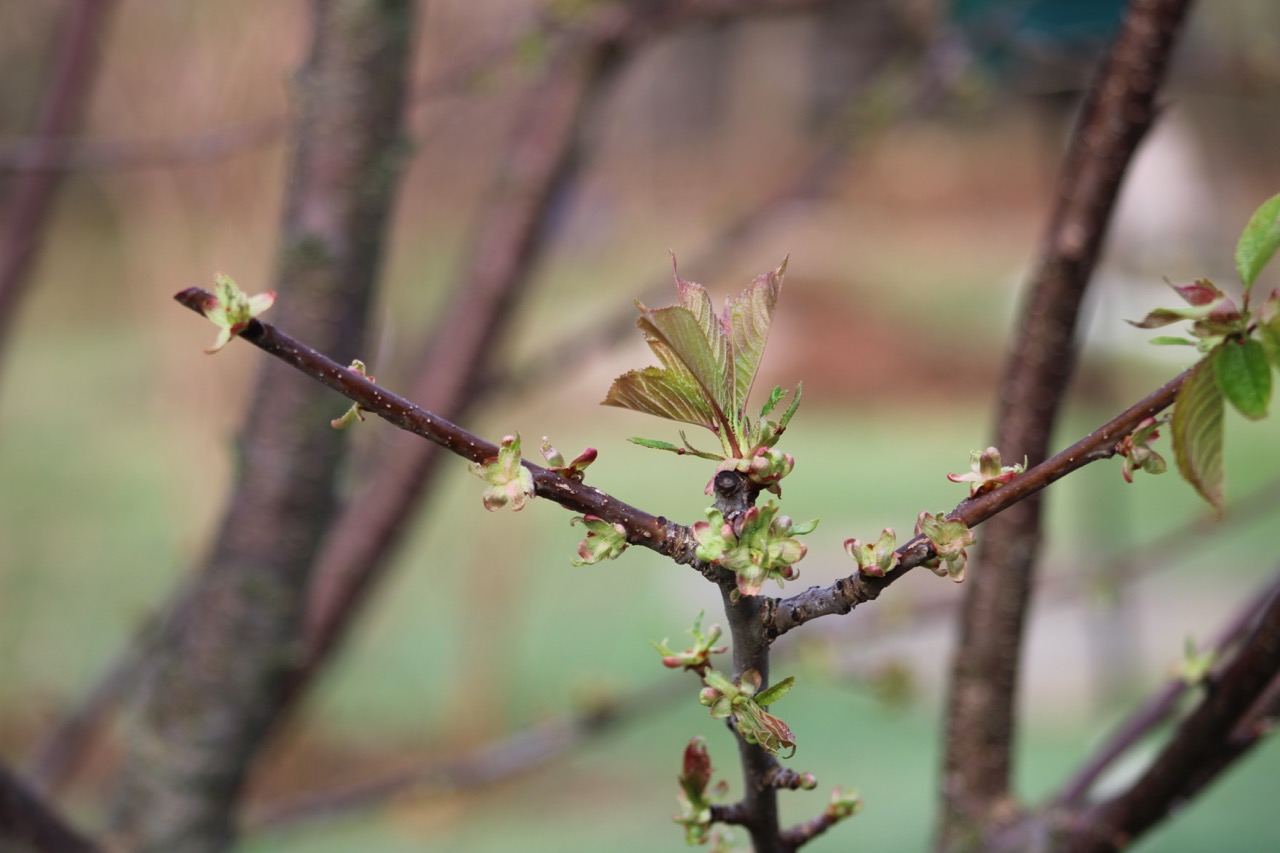
The cherry trees and peach tree have no blossoms on them at all. The cherry trees had the buds that should open into blossoms, but when they opened, they were empty. At first I worried that I’d done something wrong. But on connecting with other gardeners in Maine I learned that many people are facing this problem with all their stone fruits. Apparently, the most likely cause is the weird weather over the winter, with mild times alternating with a deep freeze. They didn’t stand a chance.
I feel sad about it–there were really so many buds on the cherry trees this year. In prior years we just had a very few blossoms, and I was hopeful that this year we’d see our first real fruiting. I also feel glad that the leaves are opening–I heard that some people’s trees actually died. I am glad ours are alive. But this is a lesson about climate change. Global warming increases the unpredictability of the weather, and the temperature swings are part of that. What food we can grow becomes more unpredictable.
We don’t rely on our little garden for our food–we are really just learners in this process. When we get a harvest, it is exciting–and thankfully, we still have peaches from last year’s abundance in our freezer. It looks like the blueberries and raspberries will be fine. I’ve already eaten sea kale and some asparagus. But I can feel the vulnerability of what it means to face a shifting climate, even in these small ways. How many larger ways are unfolding all over our planet? Severe heat and drought in many places, floods in other regions. For too many people actual starvation is real. I feel so powerless in the face of these huge problems.
When we first moved to this place, our hope was to form a deeper connection to the earth and all her creatures, through our connection to this small piece of land. I have to say it isn’t easy. We know so little, and we are surrounded by challenges larger than we are. For just one example, Margy spends hours pulling and cutting invasive plants around the borders of our land–Asian bittersweet, multiflora rose, Norway maples. The way it is with invasives, that job will never be over. Plants have their own personalities, and some are very aggressive even if they are native plants or desired plants, so there is the endless pulling and pruning to keep things in some sort of balance. (Oregano and wood anemone, I’m looking at you! Everywhere!)
But maybe these are the lessons we are learning about making a deeper connection to the earth. Plant by plant is the only way we get to know them. Whole Indigenous communities were needed to foster the balance of all beings, and we are just two old non-Indigenous humans. Some of our neighbors seem to be in a similar venture to ours, and others seem just the opposite.
Still, I have to hope that the love we offer to this place can be a small seed of healing, maybe even its own “aggressive” form of healing, spreading into the broken places. I draw hope from the birds who seem to multiply and who enjoy the yard so much. I draw hope from the violets blooming everywhere they want to bloom. I draw hope from the turkey who visited the other day and made a dust bath in the patchy lawn. There is something so wonderful about a community of creatures who share one place.
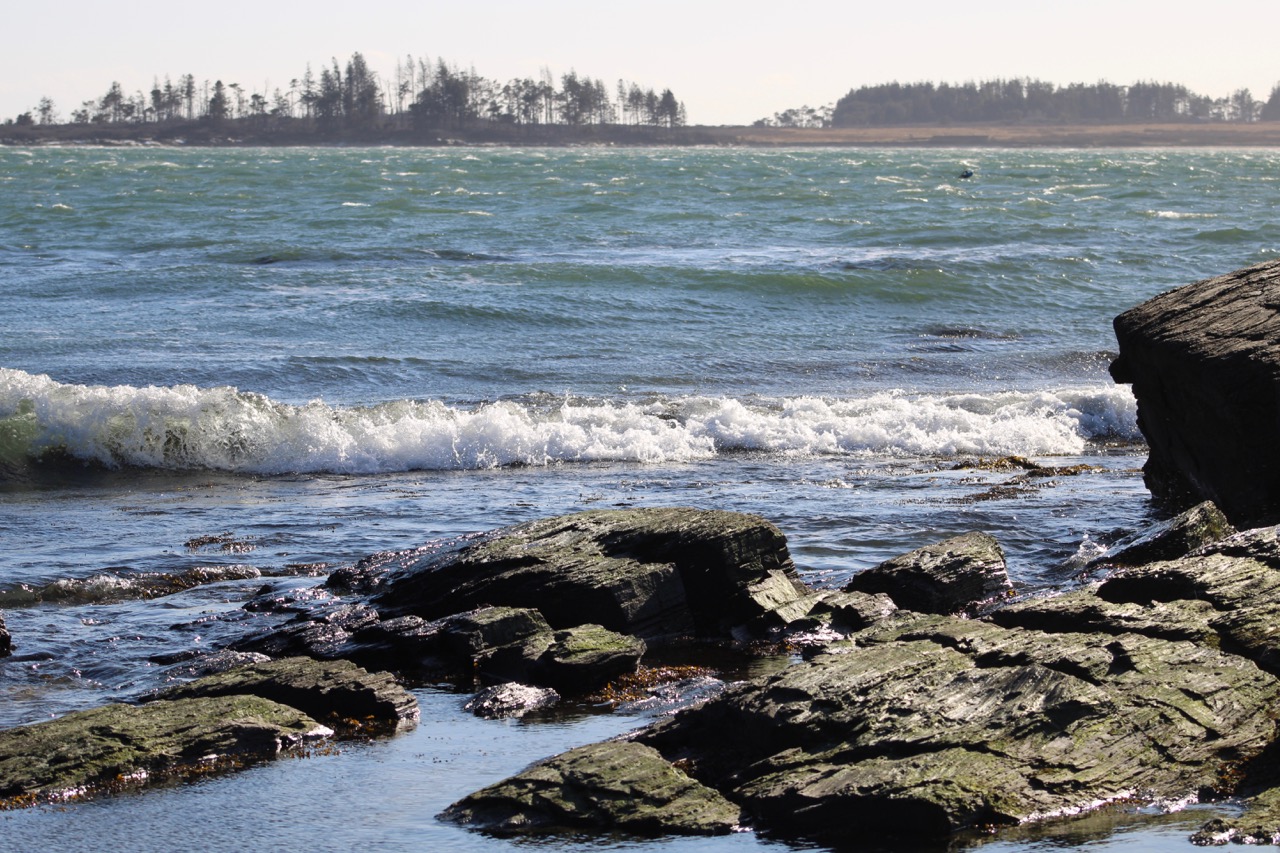
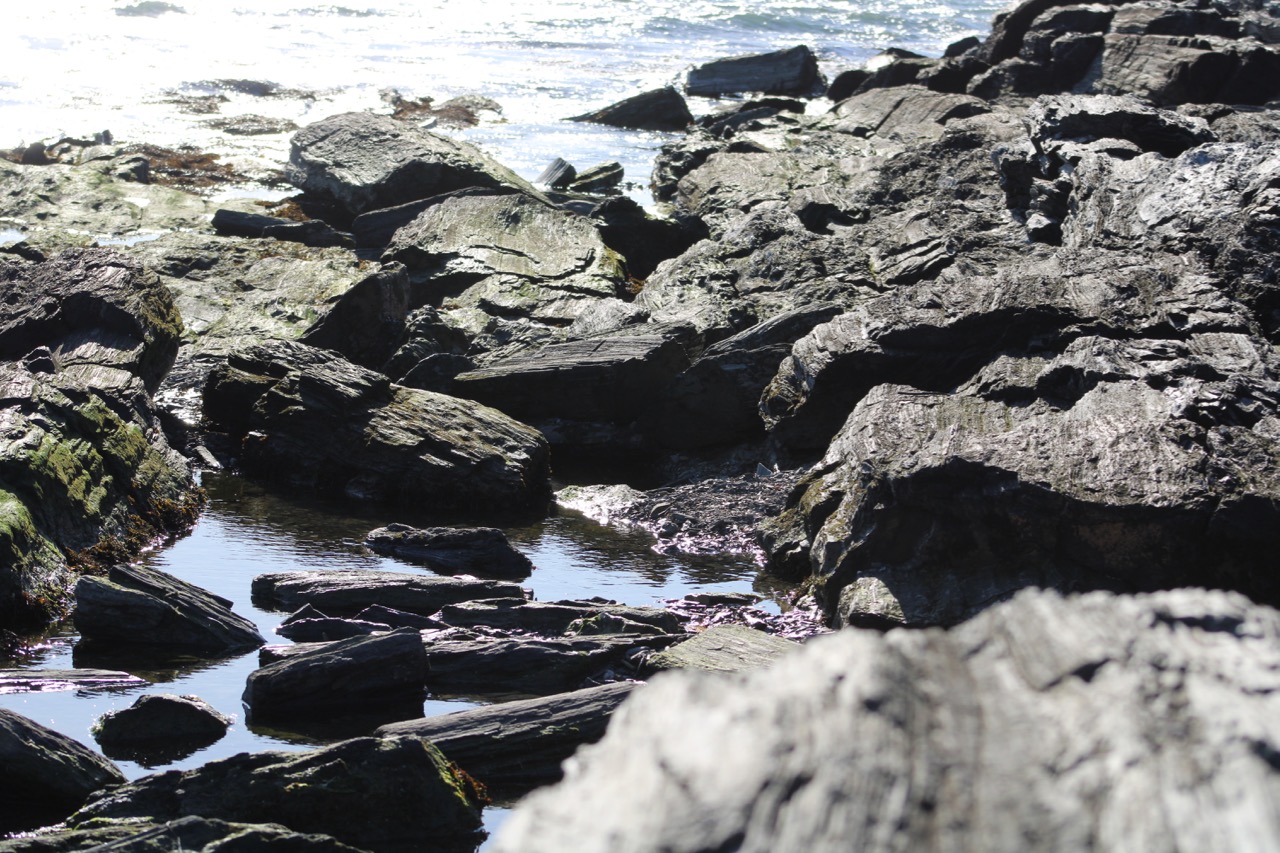
Photo: Kettle Cove: blue-green sea, white breaking waves, rocks near me, island trees at the back
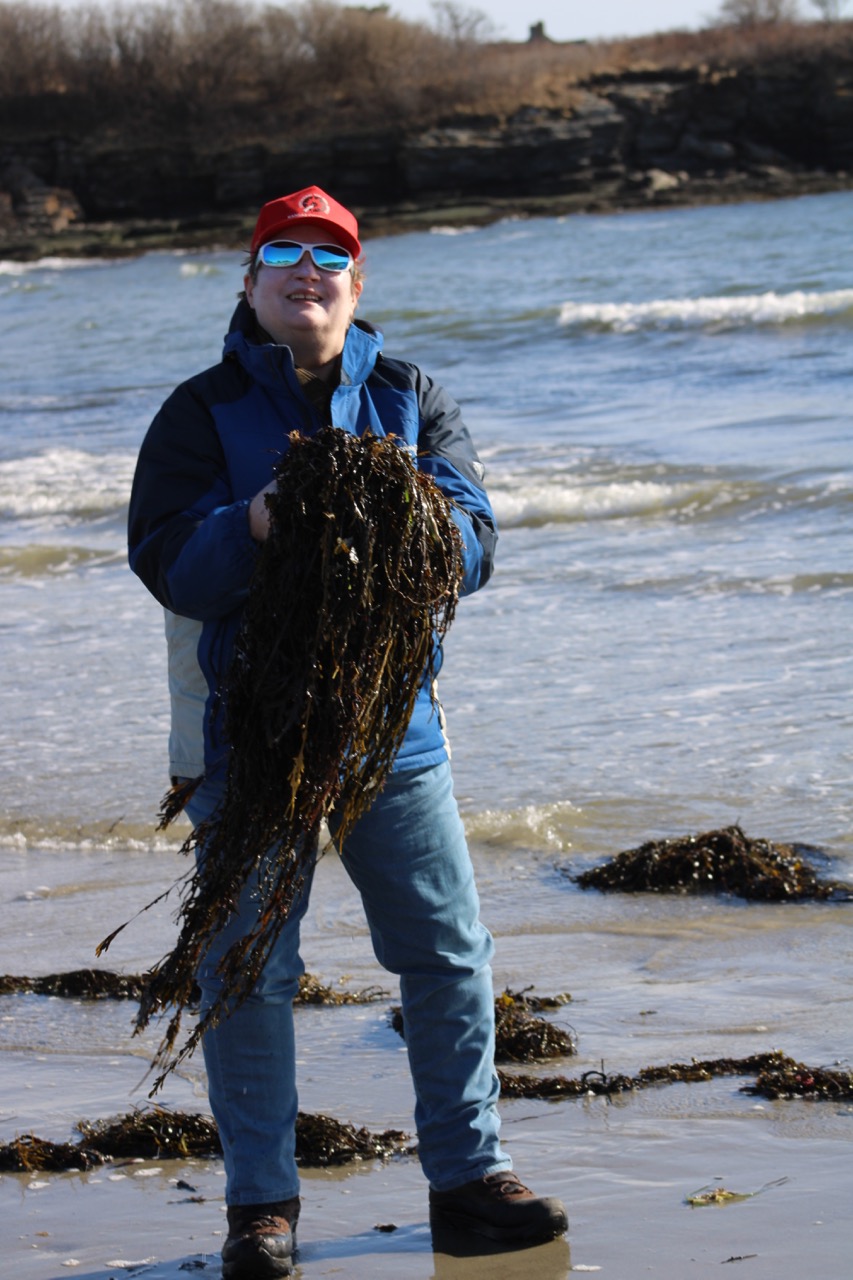
February in Maine, and it is 60 degree weather today. It isn’t really supposed to be like this. We went to Kettle Cove, where dozens of people were out at the beach. A few even went into the water in their swim suits–but not us. Margy was inspired to collect some seaweed for the garden. I decided to sit on a lovely rock, and take photos of the waves and rocks.
Margy holding seaweed at the beach.
Rocks to sit on, with tide pool.
It was so restorative–wind, sun, rocks, water–all the elements. And the sound of the waves calming the spirit like a deeper kind of silence.
I was thinking about climate change and how the weather has become so chaotic. Tomorrow we’re back in the freezing zone, between the teens and twenties, and Friday a snowstorm is on the way. But the message I felt from the sea was not about worry. It was to love the earth just as she is in this moment, to love the weather as it comes–not to always think on how it is supposed to be different, but to embrace the changes as they emerge, to embrace every amazing aspect of this beautiful planet.
I don’t fully understand this message, the activist that I am. So often I grieve for what is happening to the earth because of the greed and destruction of some human beings, all of us trapped in this pattern. And I still grieve. But the other side of that grief is this love.
The message was that we must never cease to love the earth in all of her mysterious flowerings, her beauty everywhere, even when we cannot perceive it. So what a joy when we can feel that beauty all around us. It was that kind of day, that kind of visit to the ocean.
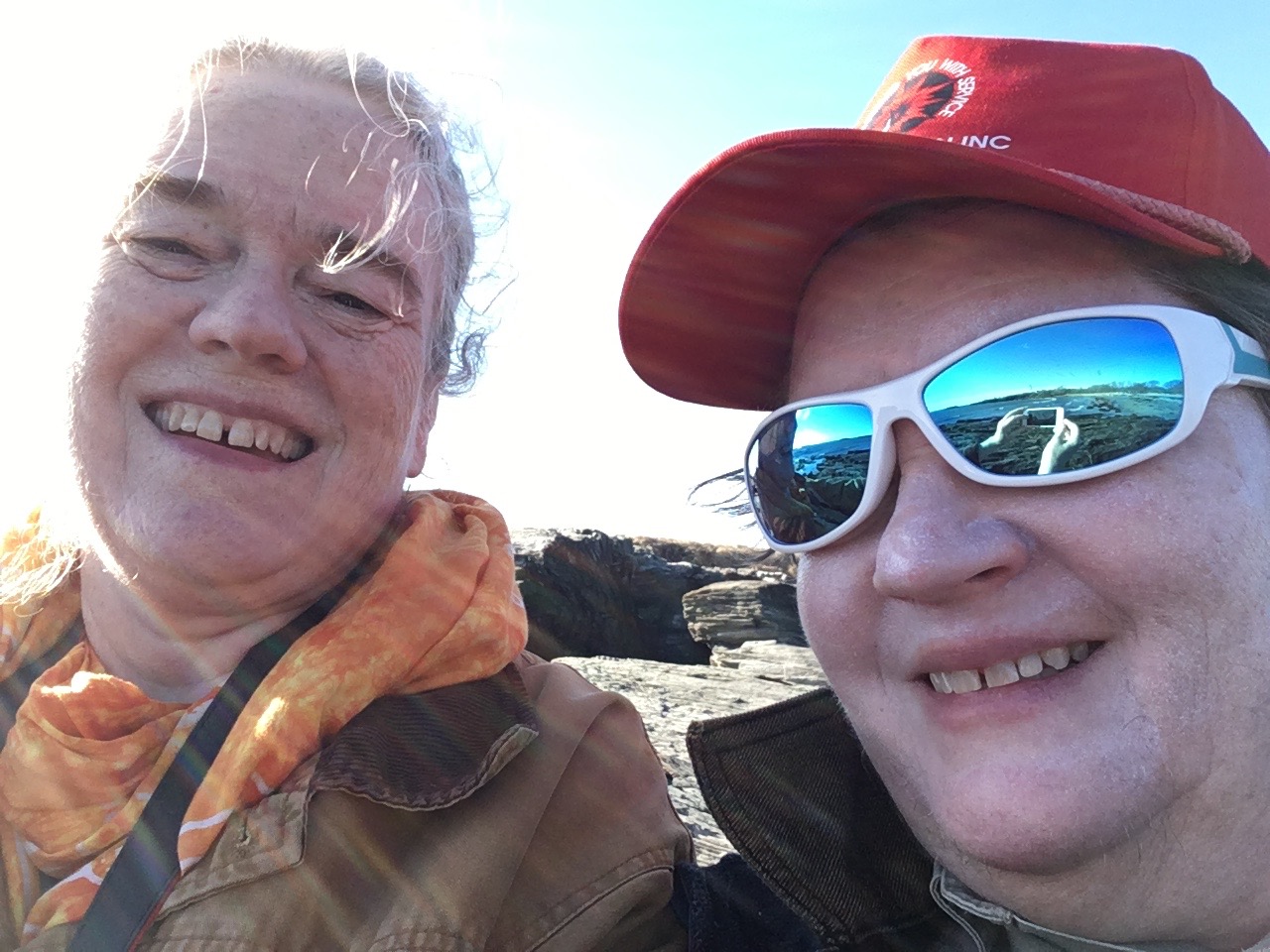
Myke & Margy smiling, with rocks behind us, and the ocean reflected in Margy’s sunglasses.
If you’ve been following my work on digging the pond, I will mention that I took a little break, first to find out what to do about the water that has seeped into the bottom, and then because I twisted my ankle on Friday while I was digging. So annoying! My ankle is not so bad–after a couple days of rest, I can hobble around now, and I will be digging again soon.
In the meantime I wanted to share this photo of the flowering peach and cherry trees in our food forest. They flowered a bit earlier this year than last. In the photo, the peach blossoms are pink, and it is hard to see the white cherry blossoms amid their green leaves in the photo. But they are so beautiful! There are more cherry blossoms this year than last, when we got just a few.
However, I’ve been concerned about pollination. Our neighbor keeps honey bee hives, and usually we have lots of her bees visiting over here, drinking nectar and drinking water from our bird baths. But this year, it has been very sparse for bees. I found out that our neighbor’s hives died in a cold snap earlier in the spring and she hasn’t replenished them yet with new bees.
One day, I did see bees of all sizes in the Lapins cherry tree (on the right in the photo), but I didn’t see them in the peach tree. (Not that I sit and stare all day.) But I’ve been doing so much TLC with the trees this year, with Kaolin clay, and holistic foliar sprays. It would be a shame if we didn’t get fruit because of pollination problems. It is too late now to try to hand-pollinate. The other potential glitch is that while the Lapins cherry is self-fertile, the Black Tartarian cherry needs the Lapins to cross-pollinate. They are both sort of blooming now, but the Lapins had peak blooms earlier, and the Black Tartarian has new blooms that just came out yesterday. So we wait and see.
It reminds me of the sad danger to pollinators everywhere because of climate change, environmental pollutants, pesticides, and development. All of our human food is dependent on these little creatures who pollinate the plants. If the bees die, so do the humans.
Today I pray for the pollinators, with gratitude and humility. Part of this prayer is offering to the bees so many other plants in our food forest: daffodils, dandelions, and violets are blooming now; soon we will also have chives, oregano, clover, thyme, and many more. All of us can do more to provide food for bees and other pollinators throughout the season. Only then can they also provide food for us. May this circle of life be blessed.
No matter how many years I have lived, I am still brought to utter delight by the icy beauty of plants in the sunshine, after a freezing rain. There is nothing so bright, so crystalline, so shimmering!
I have lived most of my life in Northern areas of the United States (except for 6 months in Texas when I was seven.) So we here are accustomed to all sorts of wintery weather. But today I am also thinking of my relatives in Texas who are in their own icy cold, so rare in that place that they are dealing with burst water pipes, lack of heat, lack of electricity. I wish for them and all their neighbors warmth, help, and support to face the challenges.
These are the among the dangers we face more and more from climate change, or as some say so accurately, climate catastrophe. I wish we could come together as one earth community to begin to live differently, to live as if our lives are totally dependent on our mother Earth and all of her beings. Because we are. And even working together we will face difficult days ahead. So much has already been lost and altered. And still, we must also be so compassionate during these difficult times, because unless we love, we can never come together as one earth community. And we must keep hold of joy and beauty, or we will lose hope altogether.
So I am sharing these photos from around our yard for beauty. May the beauty of nature help us in all of our troubling times!
Today I felt filled with an enormous dread, watching the attempted coup by a president who won’t acknowledge the results of a valid election, watching the followers who enable him to keep undermining the vote. I had felt relieved after the votes were counted. Perhaps we were back to more ordinary times and struggles–certainly the struggles were not over, but some semblance of a social order were on track to be restored.
But then I read an account by someone who had lived through a coup in their own country, Sri Lanka, who said that America is already having one right now, and I sank into a kind of terror. I won’t repeat their story here–you can read it via the link. Just to say that undermining faith in the results of an election can disrupt the very fabric of a fragile democracy, and is an invitation to ongoing chaos.
In my dread, I went outside–into a cloudy warm day–perhaps the last of these summer-like days–where Margy was working in the yard. She got in the hammock with me and I could just feel all the feelings of terror, but with the comfort of love, the comfort of the earth and sky. I certainly don’t have the answers for what we can do, what anyone can do, about this coup. I hope someone who might have the power and the answers is talking about it somewhere.
The other thing that, ironically, has relieved my anxieties about the election and the coup is a novel I have been reading about climate change. It is the latest work by Kim Stanley Robinson, The Ministry for the Future. Set in the very near future, the title refers to an international agency that is formed to be a voice for future generations in the international arena. It’s a fragmented sort of novel, with each chapter a small piece in a larger fabric, and only a few on-going characters to help keep the thread going. Like in some of his other works, Robinson’s characters are trying out all sorts of ideas to turn around or mitigate the catastrophes of climate warming. Perhaps it will get more hopeful as I keep reading, but for now, it is sobering. So the terrors of a coup are replaced by the terrors of climate catastrophe–but those terrors are more familiar to me.
In the meantime, Margy and I seize the opportunity of our own strange weather to replenish the soil in our little part of the earth–another visit to the beach to get more seaweed, more sifting of compost (to get the roots and stones out) to put near the fruit trees, raspberries, bushes in the back of the yard. As much compost as I can sift, I put it somewhere. As much seaweed as we can collect, we put it somewhere.
For the fruit trees, also, a few weeks ago I painted their trunks white. There is a whole story to this. I had read about painting the trunks of trees white to protect them from sun damage in the winter, to protect from insects burrowing. But when I first read about it, people were talking about using latex paint, and that didn’t feel true to the spirit of organic permaculture.
Then, this fall, searching the web for another project–looking for food safe paints–I came across milk paint. This is the old-fashioned white wash that Tom Sawyer used, that most people used before the modern age. It’s made of natural ingredients: milk proteins, lime, and pigments. It has no VOCs to emit, no scents to be allergic to. It came in a powder that I mixed with water, in the amount I needed for the trees. The powder will last a long time, but the mixed paint only a couple weeks. So I painted the tree trunks. You can use it for lots of things, not just trees. Finding resources that cause no harm to the earth–that help the earth–these are like little miracles that never cease to delight me.









 Finding Our Way Home