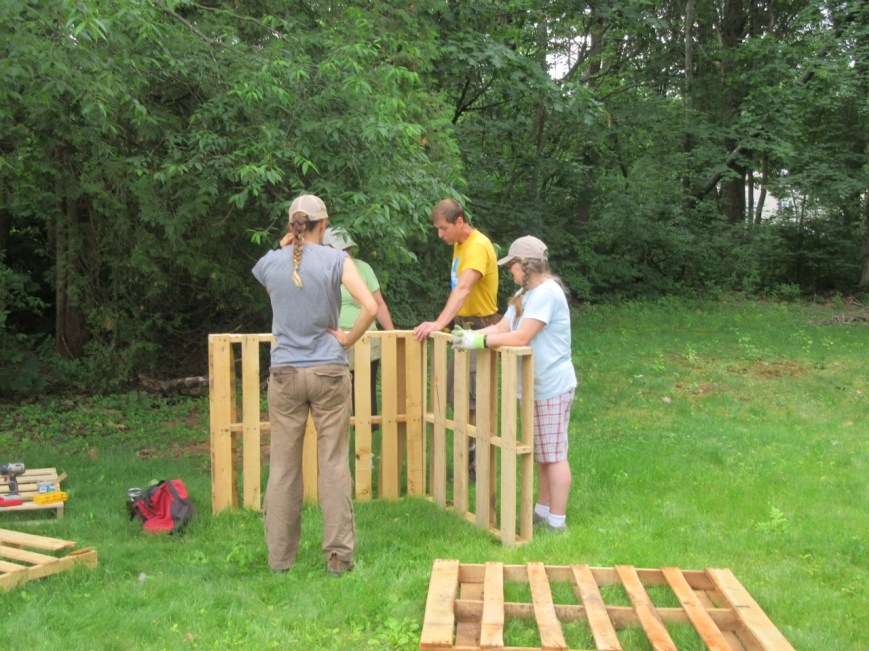
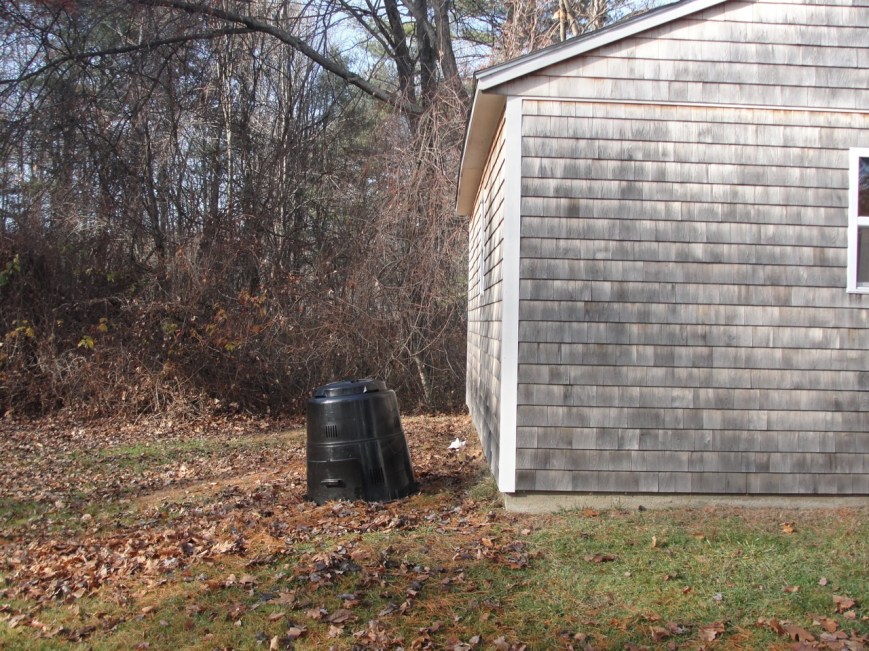
 One more post about the Permablitz! We had a team of folks who created a composting system from recovered pallets. We have been using a container system for our kitchen waste, but these will enable us to compost more yard waste. One of the principles of permaculture comes from the fact that in nature there there is no such thing as “waste”–the “surplus” from any process is shared to be used by another process. So too in the community of our yard–leaves, grass clippings, weeds, can all be repurposed to create great soil. And it is a further repurposing to use surplus pallets for the construction!
These use deck screws to attach them together. And by the way, if you want to make your own, it is important to find Heat Treated pallets, rather than chemically treated–so that your compost isn’t contaminated by arsenic or other metals. Heat treated pallets are marked with an HT on the wood. Heather found these lovely-looking pallets for us. Margy and I had been finding them here and there, but most of ours were pretty banged up.
When you first establish a permaculture garden, you often have to import soil amendments and wood chips and such, but ultimately, you want a garden that is self-contained, that creates its own mulch and compost and good soil. We imported 4 cubic yards of compost for our garden bed project, (and just the other day purchased more for the blueberry beds) but hopefully at some point in the future, we won’t have to import compost any more, because the yard itself will making enough of it.
What might our world be like if we eliminated the whole idea of “waste” from our communities? If every surplus was shared for another process or function? If nothing and no one was ever thrown away?
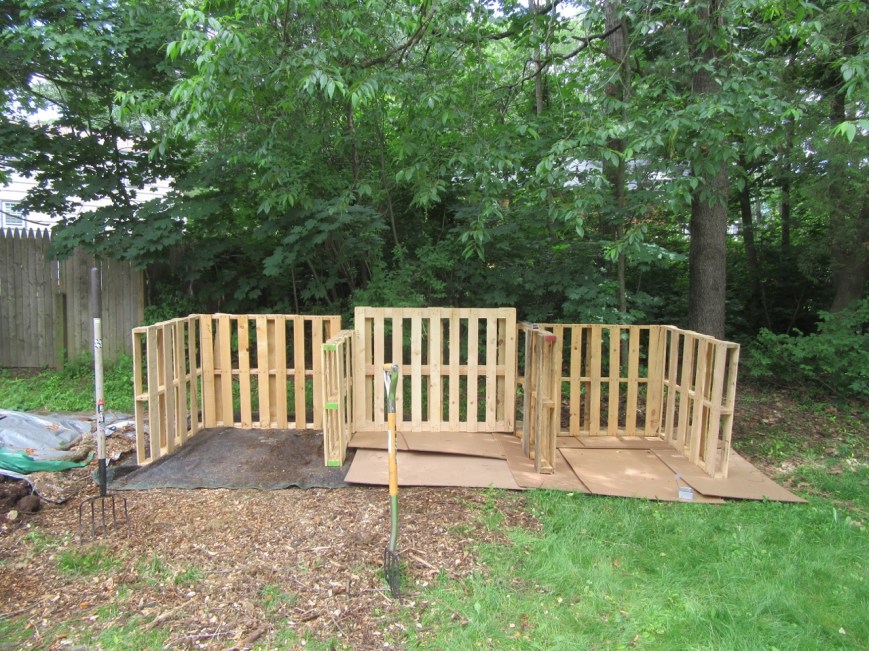
Finished! By the way, you don’t have to put cardboard or tarps on the bottom–we did because of the bittersweet in our yard–to discourage it from growing into the compost bins.
 The last few days I have been working on a garden bed for two future high bush blueberry plants. This was the toughest project so far, in terms of physical stamina. I was following the guideline of Michael Phillips in the Holistic Orchard. His first step is to dig a bed one foot deep and 3-4 feet in diameter per plant, (so for me that meant about 7-8 feet long and 3-4 feet wide).
 Once I had dug the hole, I came upon bittersweet roots, so then spent some time strategizing about what to do for that. I eventually decided to clip them off where they emerged, and then line the sides of the hole with cardboard. Since I was also making paths around the bed, I bent the cardboard so that it covered the path as well.
 And it is a lot of work to dig out a hole, then fill it with other stuff, and then “stir” it around, which really means turn the soil over and over. I am glad I only have to do it once. So I would do what digging I could, and then stop and rest for most of the day, and return to it in the evening if I could. After the peat moss, soil, & compost mix was in, I added 2 cups elemental sulfur, 4 cups green sand, and 2 cups rock phosphate, all organic nutrients. This whole mix is meant to create the type of soil that blueberries love, with an acid leaning ph, and the nutrients they need. (You may notice that I purchased more composted manure, because we used up our big pile.)
 Today was a day for food forests! My friend Mihku and I went to a tour of
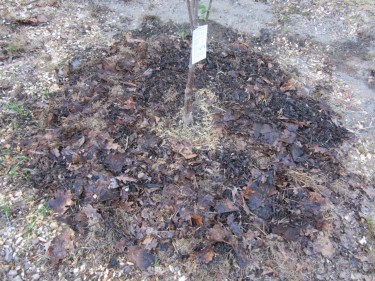 So the very next day, I went out and moved that evergreen mulch away, and dug up some of the starting-to-decompose deciduous wood & leaves mulch, piling it up in a six-foot diameter circle around each tree, careful to leave open space around the trunks themselves. Next time, Margy can ask our wood chip supplier to save us some of the ramial chips.


 Finding Our Way Home