Despair

Almost every day I walk down to Capisic Brook, and most days, all through the winter, I saw a pair of ducks who lived in the water there. I saw them today too. My whole body felt heavy as I walked this morning, and I almost turned back before I reached the brook. I feel such a crushing sense of sadness and despair. I feel for the people who are suffering and dying in a genocide in Gaza. I feel for the foreign students and others who have been detained without warning or due process. I feel for the thousands hurt by the dismantling of government programs that feed people, and in conjunct with that, support farmers. And so much more. So much more is being broken and destroyed by the regime in Washington.

To be an activist has been an empowering thread throughout my life. I followed the advice of Audre Lorde: “Use what power you have to work for what you believe in.” When I feel powerless, I still search around for some small work I might do for what I believe in. And yet, the destruction continues.

As I cast about for some hope to cling to, some antidote to this despair, I find myself remembering the life of Jesus. He lived in a time and place under oppression by an empire that cared little for his life and the lives of any of the people around him. He had no power to change that evil regime, (or if he did, he did not use it–that was one of the temptations he rejected, as described in the gospels). Somehow, he lived his entire prophetic life in the shadow of this evil empire, and taught and healed nonetheless, usually with the most marginalized and the outsiders.

I get especially angry by the people who promote “Christian nationalism.” Jesus preached the opposite of nationalism. He often contrasted the divine “kingdom” with earthly kingdoms. Perhaps there is no story with more clarity about this than the story of the final judgment at the end of the world. According to the book of Matthew, (chapter 25) the divine king said to those judged as righteous: 35 “for I was hungry and you gave me food, I was thirsty and you gave me drink, I was a stranger and you welcomed me, 36 I was naked and you clothed me, I was sick and you visited me, I was in prison and you came to me.’ 37 Then the righteous will answer him, ‘…when did we see thee hungry and feed thee, or thirsty and give thee drink? 38 And when did we see thee a stranger and welcome thee, or naked and clothe thee? 39 And when did we see thee sick or in prison and visit thee?’ 40 And He will answer them, ‘Truly, I say to you, as you did it to one of the least of these my brethren, you did it to me.’”

The divine is with the least of these. And what this means to me is that the divine is in the torture prison in El Salvador with the gay Venezuelan barber. The divine is under the rubble with the emergency medical workers in Gaza. The divine is with the HIV patients in Africa who longer have medicine. The divine is lined up at the food bank. The divine is waiting with the woman miscarrying in Texas unable to receive medical help. The divine is with the sick person feeling isolated at home.

And maybe sometimes that is me, too, feeling the isolation and powerlessness of chronic illness, maybe the divine is here with me in my despair for the world.


What the garden does with us

Monarch caterpillar on milkweed

While on my morning walk, I suddenly saw a monarch caterpillar on a milkweed that had planted itself in our roadside strip. The next day (today), I saw three more. All we did with the milkweed was let it keep growing where it showed up on its own. There are two plants by the road, and three or four more in a patch out back near the pond. But the monarchs found them all the same.

I have been feeling discouraged lately about my ability to garden. First of all there is the challenge of chronic fatigue that limits my energy such that even one small project outside in the morning can wipe me out for the rest of the day. But then there is the limitation of my own knowledge about the green growing beings. Right now, it is the cherry trees that are struggling with some disease. I am thankful to Aaron Parker of Edgewood Nursery who suggested, after seeing photos, that they are most likely dealing with Cherry Leaf Spot.

The possible answer is to clean up all the infected leaves on the ground and on the tree, and use an organic probiotic “Monterey complete disease control.” But even so, it might not work. Another website suggests natural remedies such as neem oil, potassium bicarbonate, and copper fungicides, which can be used to manage fungal infections like leaf spot. This season, I hadn’t done any holistic sprays because the sprayer takes a lot of personal energy to use. So I feel sad about the cherry trees, and even though I ordered some of the Monterey remedy, I feel discouraged about how much more work I’ve made for myself. Will it even help?

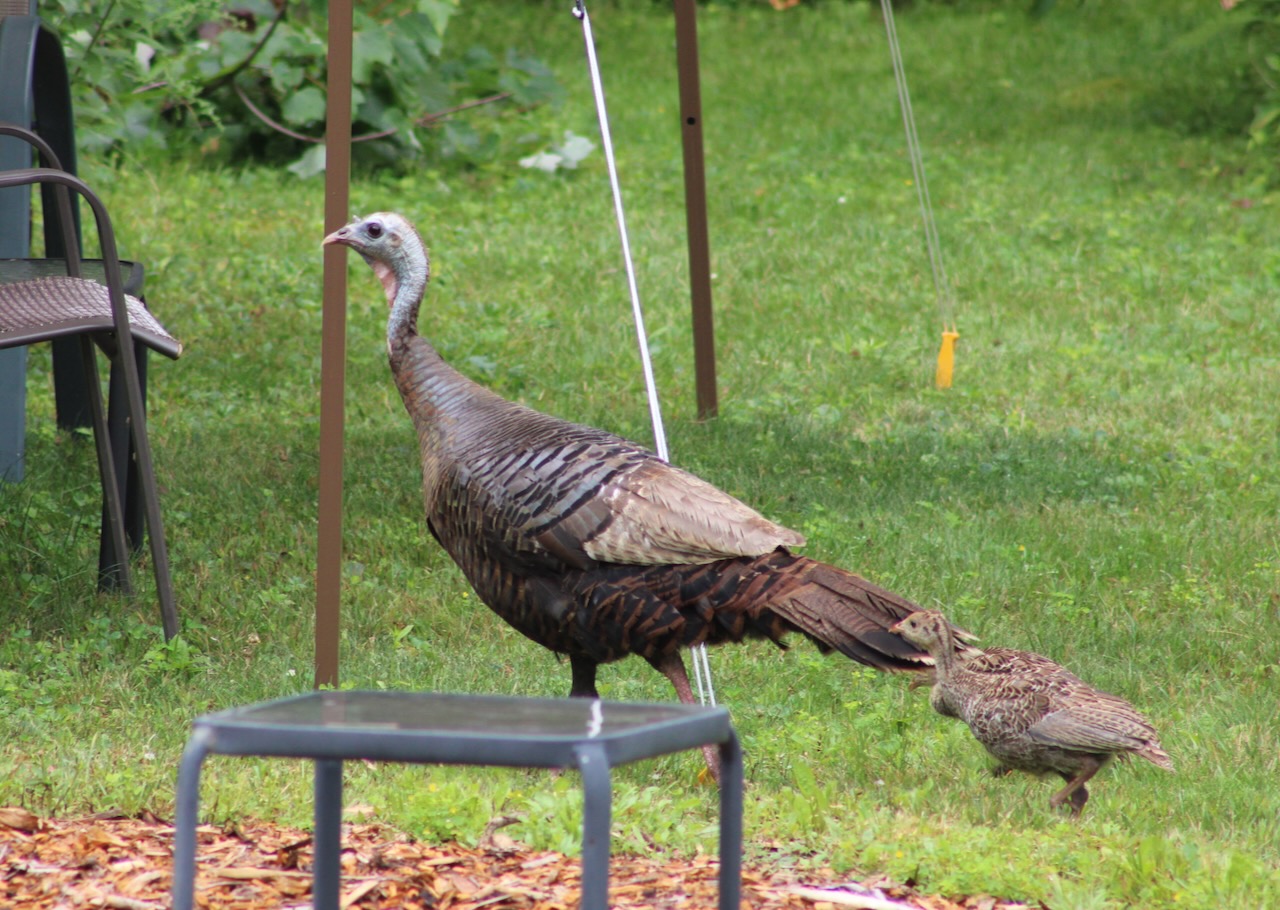
But in the midst of this discouragement, the caterpillars showed up on their own. And meanwhile, a turkey mom and her three babies have wandered through the yard a few times. Here we see them scooting under our canopy where we sit outside in some shade.

Meanwhile, the front raised bed that we didn’t plant decided to grow evening primrose on its own, and today I saw a gold finch happily checking out the yellow flowers. He was too quick to get into the photo. So I guess as a wildlife habitat, we are doing okay!

Then I saw this quote on Facebook this morning, posted by a colleague, and it was a good reminder that it isn’t really about how well we can garden. Something more magical is going on, and I must remember that.

“There was one thing I suddenly knew with absolute certainty: magic is not just something you do or make, it is something the universe does with you. It is our relationship to the Divine. There is nothing more magical than the presence of the sacred in one’s life. It changes everything. … It isn’t something one does to the universe; it’s what a living universe does with us once we have awakened to its Divinity.” Phyllis Curott in Book of Shadows

And maybe, it’s what the garden does with us once we have awakened to its Divinity.

The Power of the Story

Today I am concluding my series of blogs about Dr. Martin Luther King, Jr., in honor of the anniversary of his death, April 4th. I have been exploring what his life can teach us about the experience of the Divine Mystery.

I don’t understand the mechanics of experiencing the divine presence. I wonder if, as for Dr. Martin Luther King, Jr., it has something to do with the commitment to give oneself to a sacred calling, or to do the work of justice. I don’t know why some people call for help, and never seem to hear an answer. There is no formula that I can teach you, except to say that trouble can sometimes be a doorway, too, if we knock.

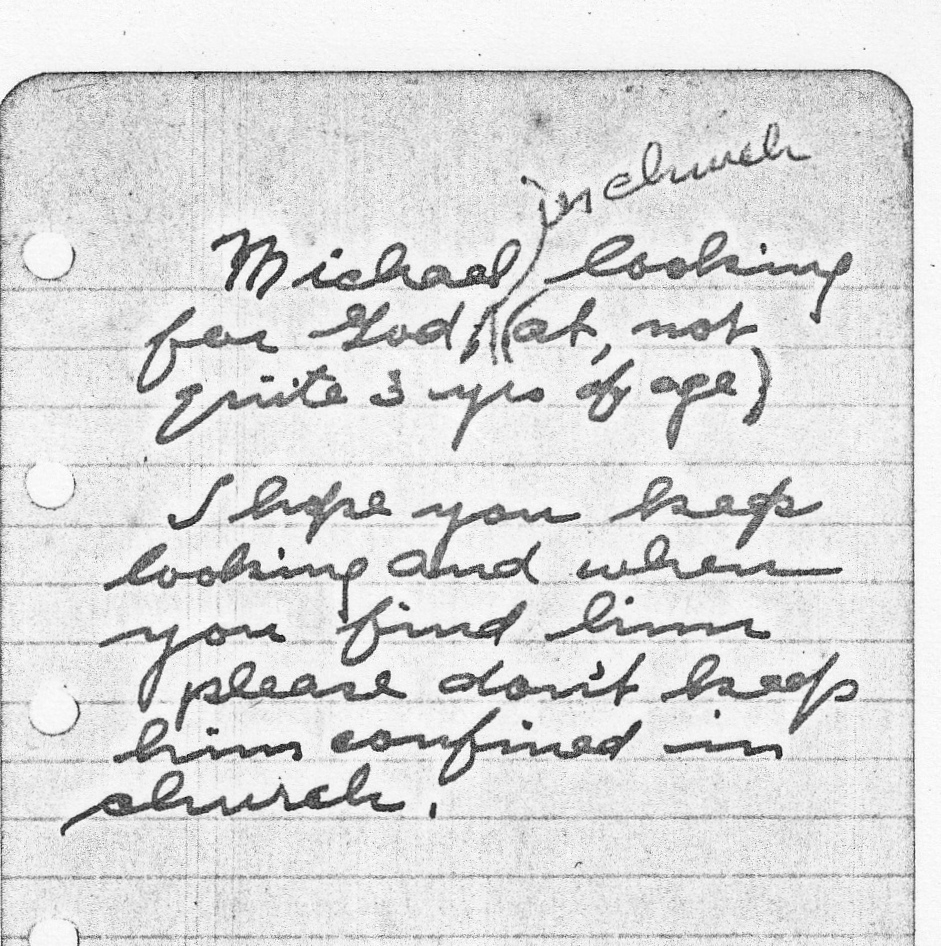
It makes me think about something my grandfather wrote in a little black notebook that disappeared for many years. April 4th, the anniversary of King’s death, is also the anniversary of the death of my grandfathers, one in 1964, and one in 1967. My grandpa Johnson died when I was not quite 11 years old. He was not a Catholic, which was a big deal in my family. But I am told he had been a spiritual man, and had even considered a call to ministry as a Unitarian or a Lutheran. The story I remembered from the notebook was this: My grandfather said that my young cousin Michael at the age of three had gone into a church building and was looking for God. My grandfather commented, “If you can’t find God outside of the church, you will never find him inside the church.”

But just before Easter a few years ago, while my uncle was dying, another cousin sent me a message on Facebook, about going through papers of her father, and finding a copy of Grandpa’s note. It turned out the actual quote was slightly different than I remembered. He had written, “I hope you keep looking. And when you find him don’t keep him confined in church.” But it speaks to the same impulse—that God is beyond what happens in church.

Grandpa's Notebook

Grandpa’s Notebook

Even without a formula, even without a sure way to find this God who helps the lowly, I believe the stories of such a God can give us hope and courage. I am reminded of an old Jewish legend recounted by Elie Wiesel. Whether it is true or not, I do not know. But that is the thing about stories. The truth to be found in stories is not about whether or not they are factual. Some of the most helpful stories happen only in fiction.

This is a story about a Jewish community who had a very wise and powerful Rabbi. When the people were in trouble, their Rabbi used to go into the woods, to a special place, where he prayed a very special prayer, with ritual and song, and the people would be helped. But eventually the rabbi died, and his successor did not know the full ritual with all its songs. So when the people were in trouble, he went into the woods, and prayed the special prayer, and it was enough, and the people were helped.

Eventually, he too died, and the next Rabbi who came to them did not know the place in the woods. But he did know the special prayer, and so when the people were in trouble, he prayed the prayer, and it was enough, and the people were helped. Finally, he too died, and the next Rabbi didn’t know the rituals or the songs, he didn’t know the place in the woods, or even the special prayer. But he knew the story. And it was enough. And the people were helped.

Leslie Marmon Silko writes, in her novel Ceremony:

I will tell you something about stories,…
They aren’t just entertainment.
Don’t be fooled.
They are all we have, you see,
All we have to fight off
illness and death

You don’t have anything
if you don’t have the stories.

I found God in myself and I loved Her fiercely

I am continuing in my series of blogs about Dr. Martin Luther King, Jr., in honor of the anniversary of his death, April 4th. I am exploring what his life can teach us about the experience of the Divine Mystery.

I want to acknowledge that there are many people who do the work of justice, without relating to a God of justice. Their work comes out of a belief in human dignity and connection, and God has nothing to do with it, for them. And that is really fine with me. When we have experienced the connection we share with other human beings, I believe it naturally leads to a concern about justice and equality.

But for some of us, there have been moments when we were in despair about injustice, or afraid of what our truth was revealing to us, or ready to give up, like Dr. King had been in his moment of despair. And in those moments, we also felt a divine presence, a presence of courage and hope and strength, empowering us into transformation. This God may not have intervened to take away a difficult challenge, but rather enabled us to find wholeness and self-worth in the meeting of it.

For me, the divine presence gave me the courage to leave the church of my childhood, and leap into the unknown, to find myself as a woman, as a whole and equal person. When all around me the church was saying that women had their place, and it was not in the priesthood or the leadership, when I was hearing that women were weak and vulnerable and needed men to guide and protect them, something enabled me to reject that characterization, and claim fullness. Something I barely even had a name for—but it was a sacred power nonetheless.

Photo by Rick Kimball

Photo by Rick Kimball

For me, the risk involved imagining that God might be a woman, a Goddess. That I might be created in the image of that Goddess. And even though there was nothing in the Bible that described this Goddess, yet it was still the stories of the God of justice that led me out of those old male-dominant images and into new possibilities. As Ntozake Shange put it, “I found God in myself and I loved her fiercely.”

This experience in my own life became a window to understand, at least in part, the kind of transformation the slaves had experienced. How miraculous and lonely it could be, how long the journey, and how frightening the desert. But yet, something unmistakable like a fire to guide the way. It taught me that the divine is a power beyond institutions, beyond containers, yet able to be present in our lives—especially in those moments of transformation, when “the mighty are cast down from their thrones, and the lowly are lifted up.”

I do not ask that anyone believe in the God of my own transformation. It doesn’t work like that. But I do offer it to you as an option of hope. If you are going through a hard time, if you are discouraged, if you are seeking to follow the truth of your heart, if you are sore oppressed. If you are having trouble believing in your own worth and dignity. I invite you to call on that God, and see whether there might be a presence that can help you through.

When you are standing up for righteousness, God will be at your side

Today I am continuing in my series of blogs about Dr. Martin Luther King, Jr., in honor of  the anniversary of his death, April 4th. I am exploring what his life can teach us about the experience of the Divine Mystery.

There was a time shortly after the beginning of the Montgomery bus boycott, when Dr. King was seriously doubting whether to continue his involvement in the movement. He had been receiving threatening phone calls and letters at his home, and while at first he took them in stride, after a while, he began to grow afraid. After a particularly strenuous day, late at night, already in bed, he got a phone call with yet another angry threat. He got up and began to pace the floor and then went into the kitchen.

He wrote about this moment:

I was ready to give up. I tried to think of a way to move out of the picture without appearing to be a coward. In this state of exhaustion, when my courage had almost gone, I determined to take my problems to God. My head in my hands, I bowed over the kitchen table and prayed aloud. “I am here taking a stand for what I believe is right. But now I am afraid. The people are looking to me for leadership, and if I stand before them without strength and courage, they too will falter. I am at the end of my powers. I have nothing left. I’ve come to the point where I can’t face it alone.”

He goes on to say,

At that moment I experienced the presence of the Divine as I had never before experienced him. It seemed as though I could hear the quiet assurance of an inner voice, saying, “Stand up for righteousness, stand up for truth, God will be at your side forever.” Almost at once, my fears began to pass from me. My uncertainty disappeared. I was ready to face anything. The outer situation remained the same, but God had given me inner calm.

Three nights later, his home was bombed, but he was able to deal with it calmly. His experience of the presence of God had given him a whole new strength.

As in the story of the Israelites leaving the slavery of Egypt, Dr. King experienced a divine Mystery that is involved in the struggles of human beings to achieve dignity, equality, and justice. As I said before, there is no way to prove that such a God exists. At least, there is no proof outside of the experience of it. But there is a power in the experience that enabled Dr. King to go on to lead his people with courage and truth. And there is a power in the story, just the experience of hearing that story about Dr. King, that inspires me in my own search for strength in the work for transformation.

220px-Martin_Luther_King_Jr_NYWTSTo look closely at the story of Dr. King is to see its deep resonance with the story of Moses. God didn’t speak to Moses to give Moses a comfortable life. When Moses heard the voice of God, in the story of the burning bush, it was a voice calling him to free his people. And just so, Dr. King wasn’t praying about material wealth or success in his career, or even protection for his family. He was praying about standing up for what he believed was right—the struggle of black people to be treated with dignity and equality. He was praying for the courage to bear witness to justice. And the answer he received was linked to that justice work—that inner voice said, “when you are standing up for righteousness, God will be at your side.”

Dr. King went on to lead the movement with courage and strength. There were other threats and many troubles that came his way. His God didn’t protect him from all those troubles, but King felt God at his side. And the story of Moses continued to be a constant source of his inspiration.

Quote from Martin Luther King, Jr. is from The Strength to Love, Chapter 13, reprinted in A Testament of Hope, The Essential Writings and Speeches of Martin Luther King Jr.

Community as a Spiritual Practice

Here is how it works when we choose community. There will be people in any community who inspire us. And there will be people in any community who rub us the wrong way. Those irritating people are the ones who are the biggest blessings for us. There is a story about a rabbi who was the leader of a spiritual community. There was one member who always gave the rabbi a hard time. The other members of the community hated it.

After many years, this person died. And many people were secretly relieved that they wouldn’t have to put up with him any more. But the rabbi wept at the funeral. When they asked, he said, “That man was the only friend I had. Here I am surrounded by people who revere me. He was the only one who challenged me. I fear that with him gone, I shall stop growing.”

To choose community does not mean to accept abuse, or to let people walk all over us. It does not mean always agreeing with someone, or refraining from speaking our own truths. Community includes challenging each other, arguing with each other, and sometimes saying no. But we don’t write each other off, we don’t speak disparagingly of one another, we don’t give up on each other. We treat each other as if we were treasures to each other. Because that is what we are.

To choose community means to be glad that each other person is here, to assume that they belong here, and to revere them as a part of our family. To choose community means to hold ever ready an attitude of curiosity and respect. To choose community means to look for the insights that the other might offer to expand our own limited viewpoint. To choose community means to assume that even when someone is acting badly, they are doing the best they can do at the moment. When we can practice getting past the irritations that arise in us, we have a chance to discover the magic.

Choosing community is a form of spiritual practice because it opens us to that which is divine within our neighbor. What has been hidden is revealed by the light of love. We come to realize that we are not alone. We are surrounded by family. The divine light is shining in the threads between us, and deep within each person. Dostoyevsky said: “If you love everything you will perceive the Divine Mystery in all things.”

Sunset

Photo by Margy Dowzer

Quotes from Anthony De Mello, in The Heart of the Enlightened: A Book of Story Meditations, (New York: Image/Doubleday, 1991, 1989) p. 79. and Fyodor Dostoyevsky, The Brothers Karamazov, translated by Constance Garnett, (New York: MacMillan, 1922), p. 339.