Beauty of the Roadside Border

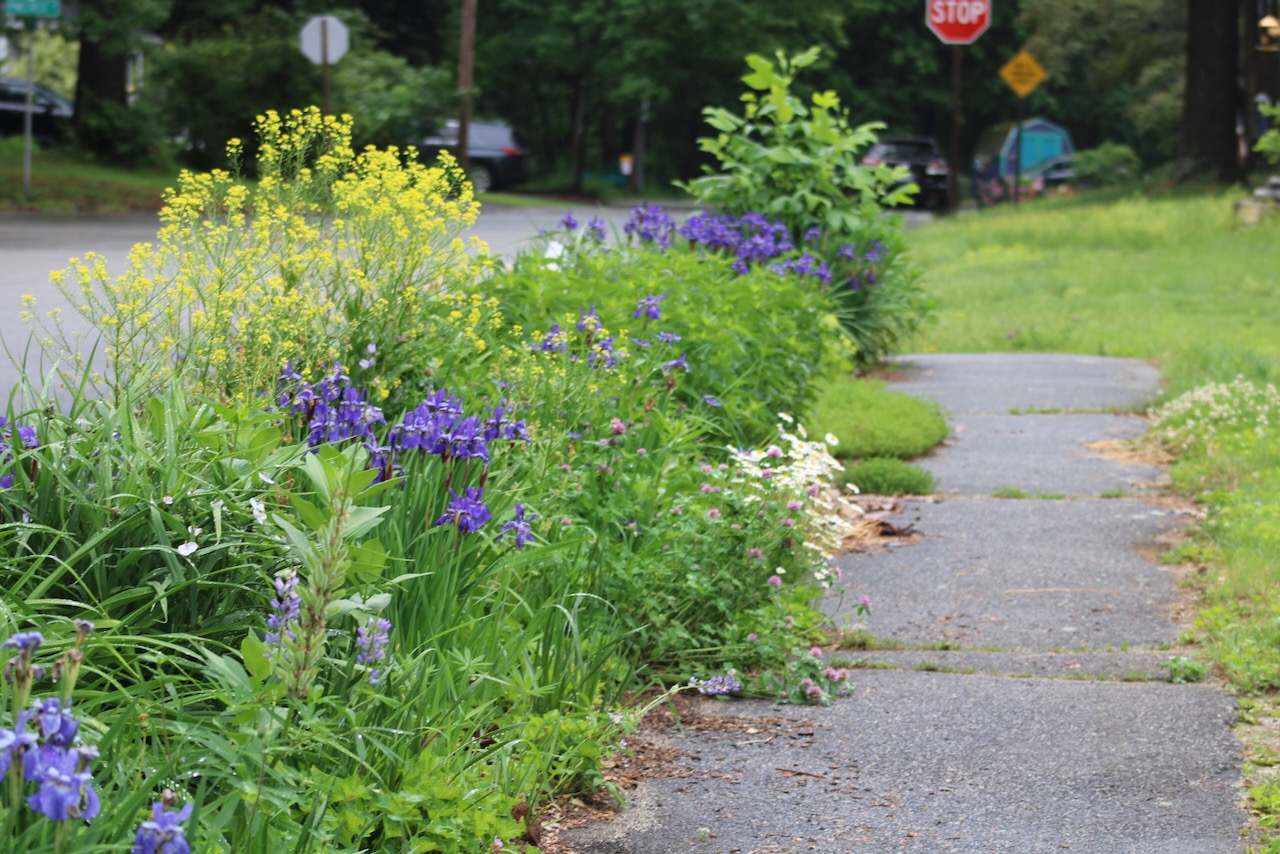
Roadside flower bed with purple siberian irises blooming, and yellow turkish rocket, and many other plants crowded together next to a sidewalk.

The border I created next to the road is perhaps the most beautiful it has ever been. Right now, Siberian Irises are blooming in their blue-purple glory, set off by the cloud of yellow of the Turkish rocket, volunteer white daisies and a patch of white irises, along with the green of other perennial leaves filling in the gaps. The purple is reflected in 3 patches of Bachelor Buttons/perennial blue cornflowers, and 3 patches of Spiderwort. I just love looking out our front window and seeing this flourishing of my favorite color. Later, there will be a lot of yellow flowers. That was the original theme–yellow and blue/purple hardy perennials. We also encouraged milkweed to seed itself in the in between spaces, hopefully offering nurseries for monarch butterflies.

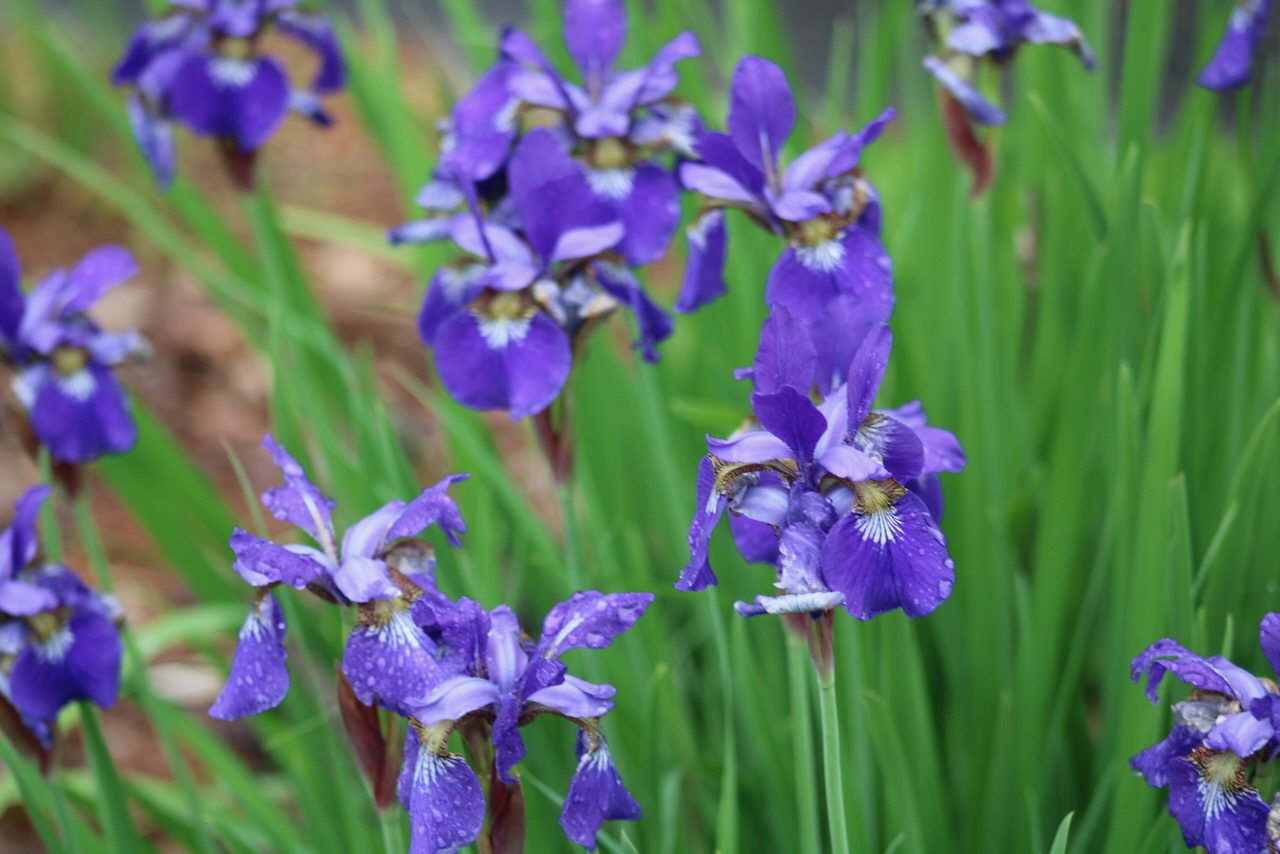
close up of purple Siberian Irises.

I’ve been trying to garden this spring, bit by bit, with what energy I can muster. For the roadside border, that just meant some weeding of crabgrass this year. I appreciate plants that take care of themselves and give so much! We also harvested sea kale earlier on, and chives, and asparagus. But something about the state of the world inspired me to plant more vegetables from seed, so now we have kale and carrots in one raised bed, broccoli and beets seedlings in the hugelmound, snap peas and zucchini in one raised bed in the front yard, and beans and yellow zucchini in the other. We also have potato plants in a grow bag on the patio, and cucumbers in a pot on the deck.

What has been harder to plant, I am not sure why, has been the seeds of ideas for writing in this blog. But this week I have been reading a book by Leah Lakshmi Piepzna-Samarasinha, “Care Work: Dreaming Disability Justice.” Perhaps it is her stories of trying to write as a chronically ill queer femme of color, her openness about the ups and downs of activism, creativity, and survival. Perhaps it is the feeling of a community of writers that once upon a time I felt connected to. It is a great book for so many reasons other than those. The kind of book that sparks one to think differently about disability and justice and care. Please do check it out. But for whatever reason, each day when I read a section, I find wisdom for living the life I am living right now.

There is so much that is horrific happening in our world these days. It all feels overwhelming to me. I don’t have the capacity to write about all of that. Perhaps that is part of why I haven’t been able to write here. I can bear witness, I can pray. But it is so overwhelming. Or perhaps I can’t write because of the further diminishment of energy in this chronic but always variable illness that surrounds my living. It seems to rob me of motivation and the urge to create. Perhaps I am not sure of the connection between illness and “the spiritual journey to earth community,” which I defined as the guiding topic of this blog site. Leah Lakshmi’s voice somehow affirms the validity of illness as a topic for writing, for activism, for imagining.

So who knows if I will be able to blog some more, but for some reason, today, between the beauty of the roadside border and the beauty of Care Work, I found some inspiration, and I am grateful for that.

Garden Blue

My favorite color in the garden is this blue/purple of the Siberian iris. They’ve multiplied in the roadside garden bed, and blossomed all along the way. And now they are gone. So we had maybe a week to enjoy their beauty. I feel the time rushing by with all these spring and early summer flowers. Nothing goes on and on. With photos we try to capture the moment and make it last a little longer, but nothing really lasts in that way. If we don’t pay attention to the moment, we miss it.

It is easy for me to get caught up in what needs to be done, the projects, the planting and watering, the weeding, the holistic sprays for the orchard. But probably what is most important is to walk around the yard noticing the flowers and plants and critters, noticing the birds and frogs and tadpoles. When we came to this yard, our hope was to nurture our relationship with the land, with all of the wisdom it had to teach us, with all of the tending that it asked of us. It was the tangible finding our way home that my spirit was hungry for.

We’ve been tending this particular small place for about nine years, and we feel such a bond with it. In these times of wars and rumors of wars, walking through the yard restores my soul. What must it be like to live for generations in a place? I can only begin to imagine. One of the crimes of the destruction of Gaza, along with the horrific killing of human beings, is the destruction of the land, the olive trees, the plants, the gardens. All those homes. It makes me weep.

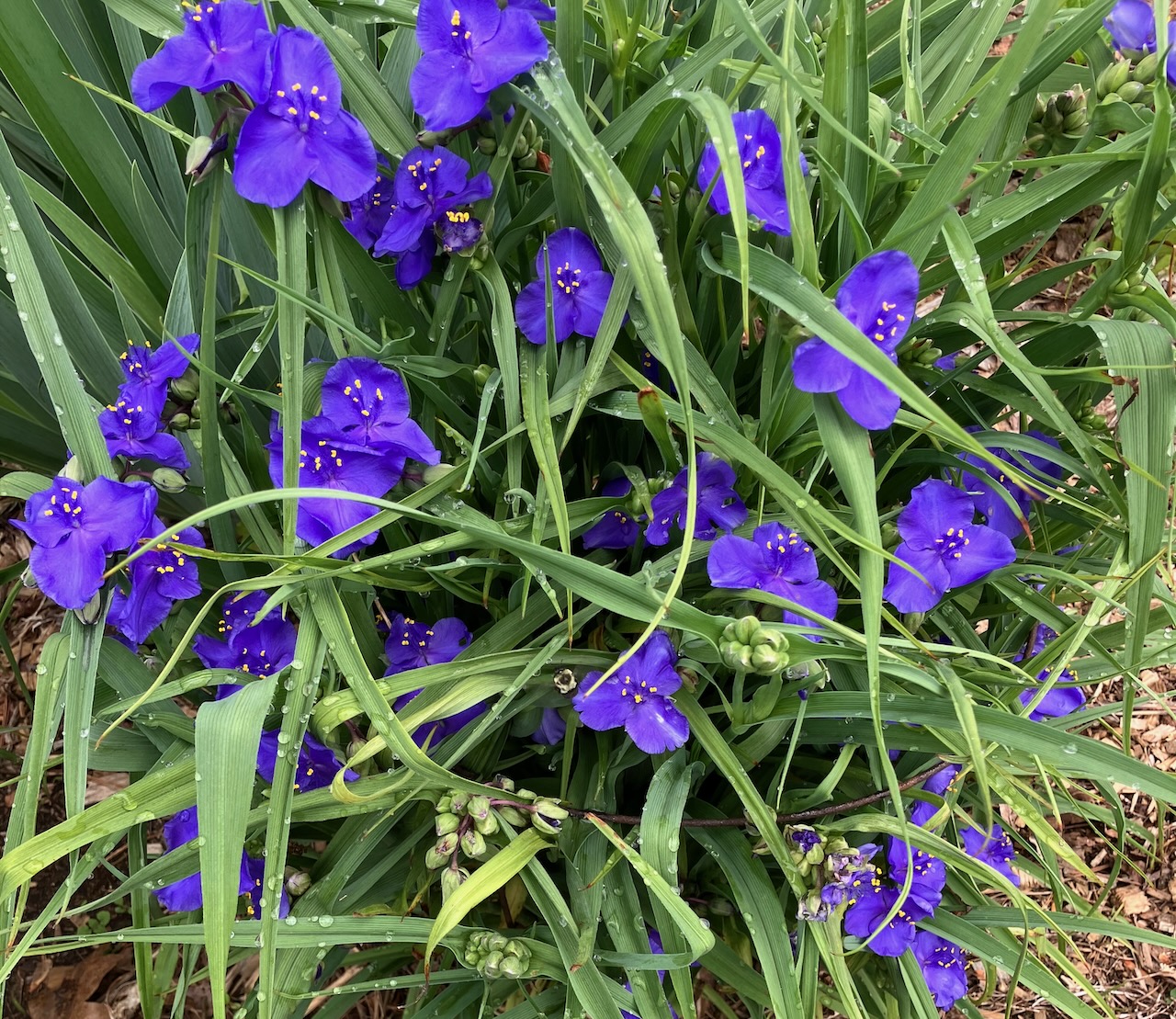
I walk around the garden in the mornings, and I pray. I give thanks for another day of living. Not just my life, but the life all around me, of which I am a part. I am happy to see that the spiderwort plants are blooming, another in that shade of blue/purple. This seems to be the very favorite flower of the bees, and it lasts for a long time, with multiple little buds on each stalk, taking their turn to shine. It is the very diversity and multiplicity of the plants that bring abundance to life in the garden.

Balance in the Garden

Raised bed with wooden sides, on left are pea plants on string and bamboo, middle is broccoli seedlings surrounded by pine cones, wire fencing around edge.

This earth love is a balancing act. We love critters in the yard, after all, they live here too, and have the right to be here. They bring so much joy to us. But we want to grow food too. The last time we bought organic broccoli at Hannafords, it was $8 for one crown. These twelve broccoli plants in this raised bed will be very valuable food for us. I’ve also planted cucumber seeds here. So we try to use gentle methods to discourage the critters from eating the plants we want for our food.

Margy saw a groundhog poke its head up out of a hole in the grass, over near the fence. There was a burrow underneath where a spruce tree fell before, and after it was removed there was still a mound of old roots and dirt. Groundhogs can be the worst for eating garden food, despite how cute they are. At times, we’ve used human pee to mark a line around the beds. Last year, we covered that bed with an old screen tent to protect the kale–and it did. All of it is a kind of communication, with respect.

This year, I am trying out a new method for deterring critters from the garden bed–putting pine cones in between the plants as mulch. (I saw it on Facebook.) Apparently many critters do not like the prickly feel of the pine cones under their feet–and these pine cones are very prickly. They come from our pitch pine, and we have tons of them everywhere. Margy had a bag full of them in the garage, so I used those first, and then started twisting them off fallen branches under the pitch pine. I had to wear gloves to do it, that’s how prickly they are. I’m putting them in the hugel mound as well.

We’ll see how it works.

In the meantime, in critter news, a few days ago we saw a mother turkey walk through the yard with about ten baby turkeys. Ducks stop in to take a dip in the pond. The frogs hang out there, and the tadpoles are getting big. They like to linger under the lily pads. The robin has four new eggs she is incubating. The chipmunks fill up on sunflower seeds at the bird feeder, but are also eating the maple seeds that blew all over the yard.

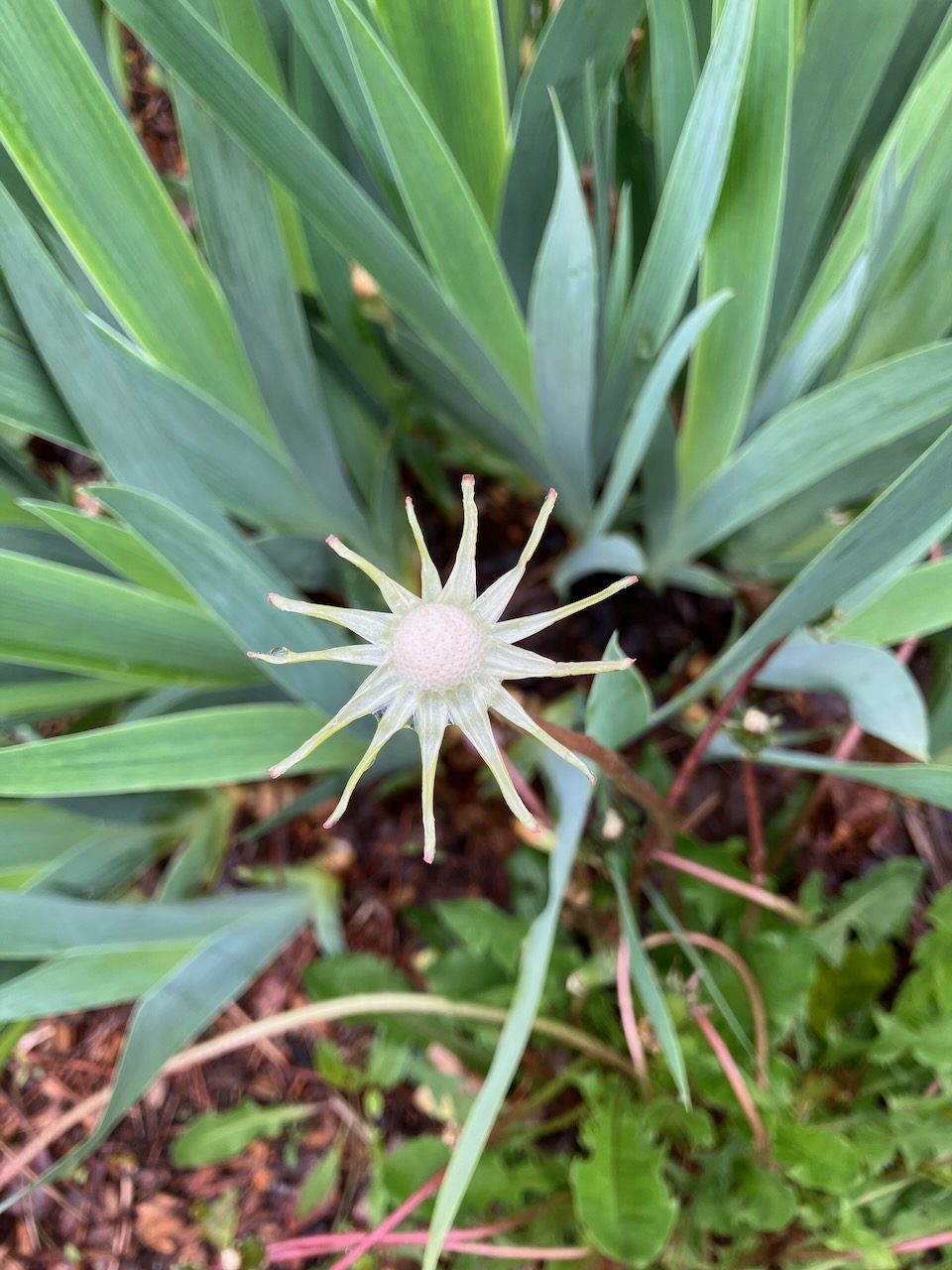
And sometimes, beauty emerges in unlikely ways–this is a dandelion after the rain washed away all the fluffy seeds. A perfect star.

a white star shape of a dandelion plant, surround by angular green iris leaves.

What the garden does with us

Monarch caterpillar on milkweed

While on my morning walk, I suddenly saw a monarch caterpillar on a milkweed that had planted itself in our roadside strip. The next day (today), I saw three more. All we did with the milkweed was let it keep growing where it showed up on its own. There are two plants by the road, and three or four more in a patch out back near the pond. But the monarchs found them all the same.

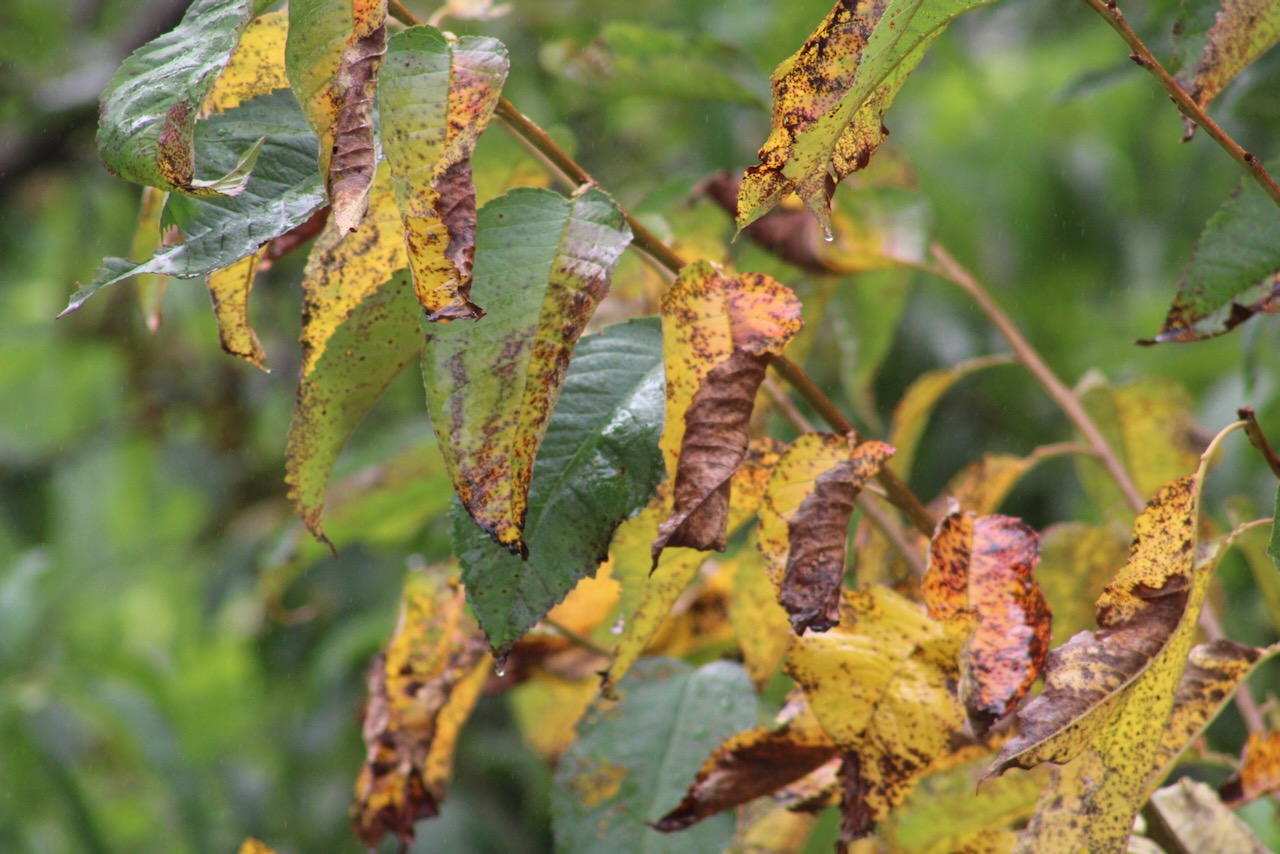
I have been feeling discouraged lately about my ability to garden. First of all there is the challenge of chronic fatigue that limits my energy such that even one small project outside in the morning can wipe me out for the rest of the day. But then there is the limitation of my own knowledge about the green growing beings. Right now, it is the cherry trees that are struggling with some disease. I am thankful to Aaron Parker of Edgewood Nursery who suggested, after seeing photos, that they are most likely dealing with Cherry Leaf Spot.

The possible answer is to clean up all the infected leaves on the ground and on the tree, and use an organic probiotic “Monterey complete disease control.” But even so, it might not work. Another website suggests natural remedies such as neem oil, potassium bicarbonate, and copper fungicides, which can be used to manage fungal infections like leaf spot. This season, I hadn’t done any holistic sprays because the sprayer takes a lot of personal energy to use. So I feel sad about the cherry trees, and even though I ordered some of the Monterey remedy, I feel discouraged about how much more work I’ve made for myself. Will it even help?

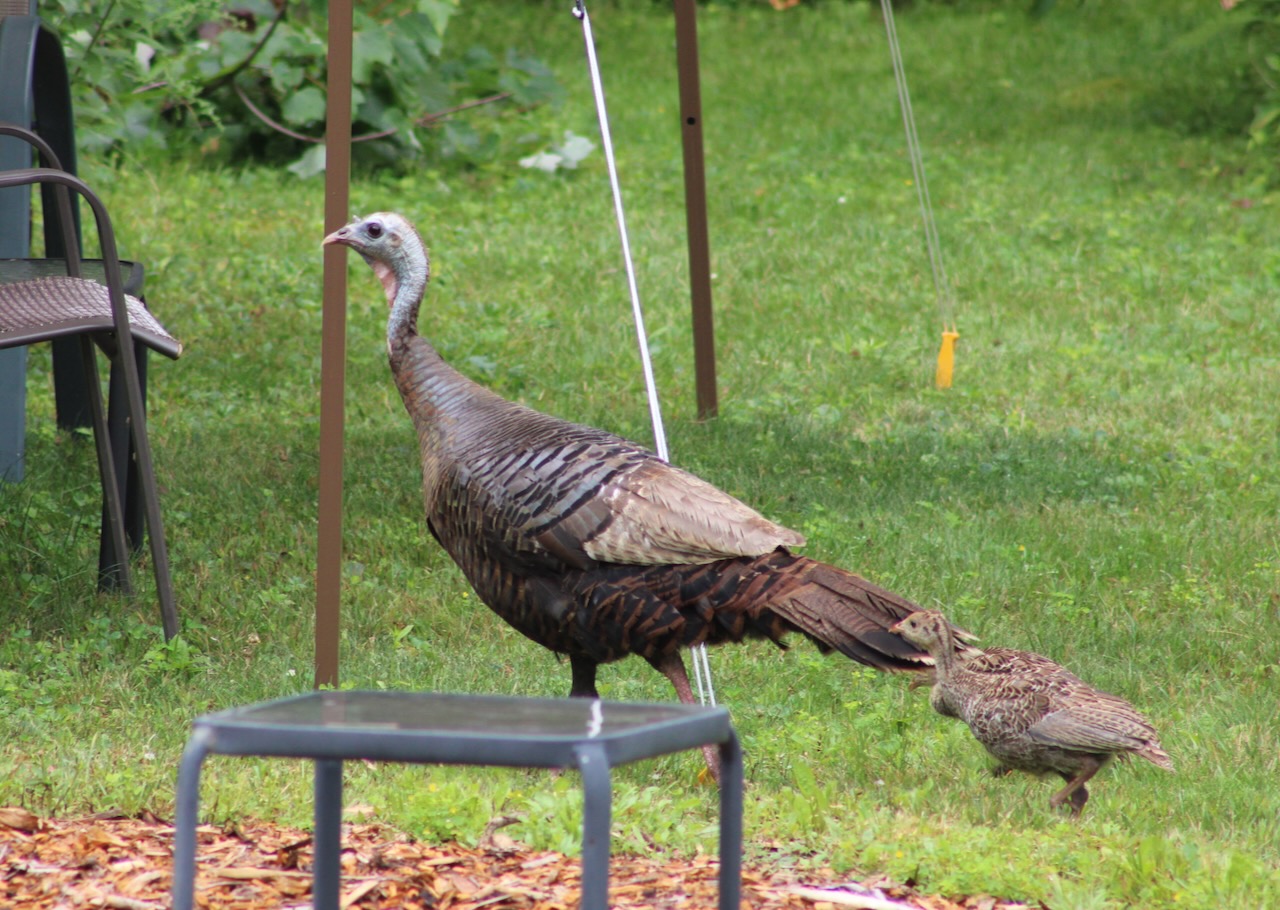
But in the midst of this discouragement, the caterpillars showed up on their own. And meanwhile, a turkey mom and her three babies have wandered through the yard a few times. Here we see them scooting under our canopy where we sit outside in some shade.

Meanwhile, the front raised bed that we didn’t plant decided to grow evening primrose on its own, and today I saw a gold finch happily checking out the yellow flowers. He was too quick to get into the photo. So I guess as a wildlife habitat, we are doing okay!

Then I saw this quote on Facebook this morning, posted by a colleague, and it was a good reminder that it isn’t really about how well we can garden. Something more magical is going on, and I must remember that.

“There was one thing I suddenly knew with absolute certainty: magic is not just something you do or make, it is something the universe does with you. It is our relationship to the Divine. There is nothing more magical than the presence of the sacred in one’s life. It changes everything. … It isn’t something one does to the universe; it’s what a living universe does with us once we have awakened to its Divinity.” Phyllis Curott in Book of Shadows

And maybe, it’s what the garden does with us once we have awakened to its Divinity.