Sustenance

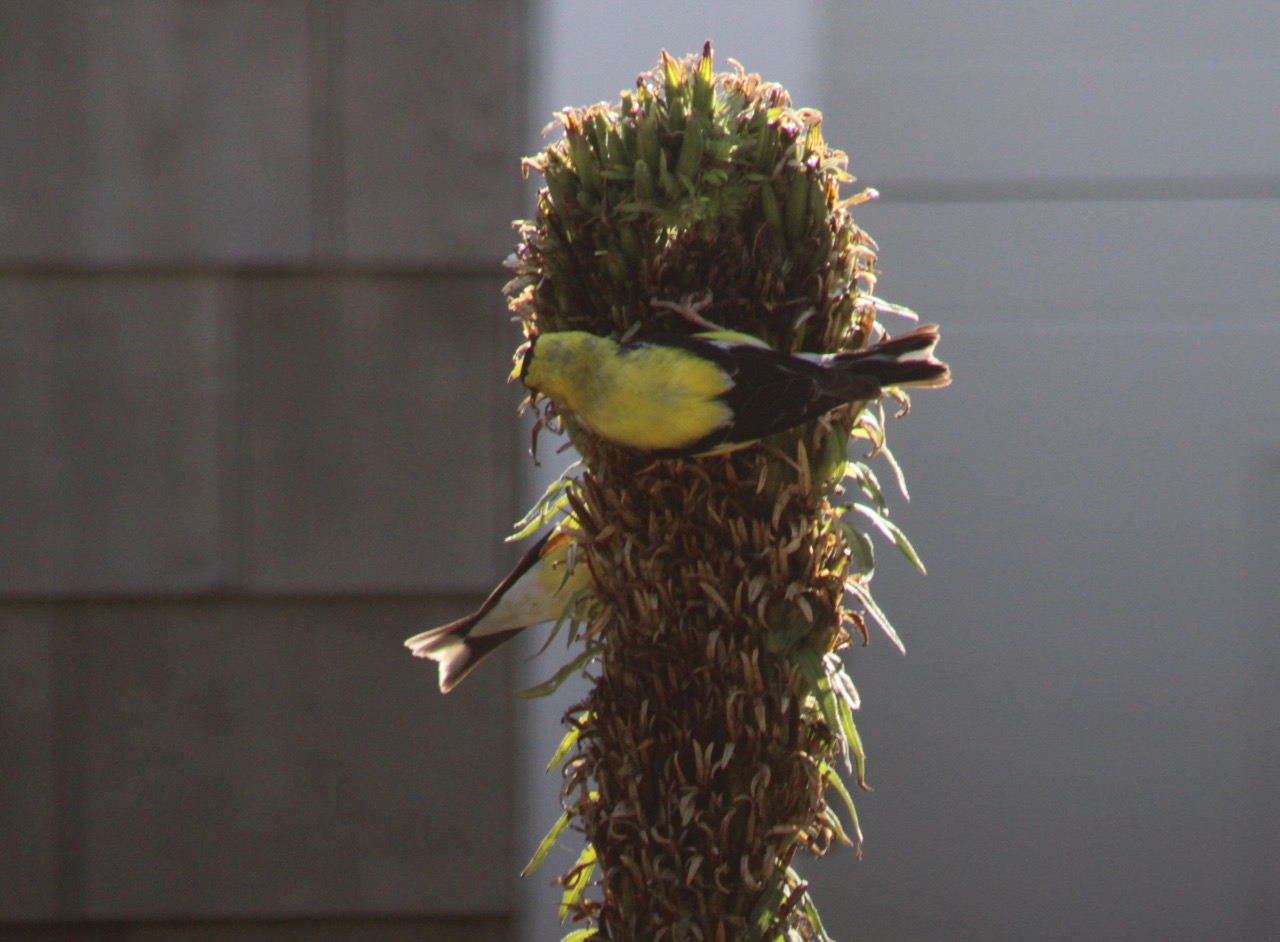
Today I saw this gray goldfinch on a gray seed-head of evening primrose! Both the bird and the flower have let go of their bright yellow plumage as we enter the dark season. But still so beautiful in their subdued and subtle way. We haven’t cut down the “dead” plants because they are still such a source of sustenance and life to our little friends.

It is these small beauties that are sustaining me during these anxious days in the United States election season. It is terrifying to me that there is a close race between a mentally-unstable fascist who spreads hate wherever he goes, and a very qualified woman with whom I disagree on certain policies, but who will be president of all the people, and uphold the basic principles of democracy. My partner and I dropped off our absentee ballots last Monday, and gave Kamala Harris our votes.

It breaks my heart that some people I love seem to have been taken in by the lies of the MAGA propaganda machine. I don’t know how to ease that pain, except to pray that the fascists don’t win.

I haven’t forgotten the genocide that is being perpetrated by the Israeli government in Gaza, and expanding to Lebanon. I will continue to protest that killing in whatever ways that I can, small though they may be, every day. I have heard that some folks say they can’t vote for Harris because of her association with the Biden administration’s participation in the genocide. I don’t know what might happen under a Harris administration. But I know that the other side will be much worse, and would accelerate the destruction.

For me, voting is strategic. I have protested in some way every administration of our country–but there are better and worse administrations. For all of my adult life, I have been part of the movements to expand equality and democracy–to women, to people of color, to queer folks, to disabled people. I have protested the wars of empire and supported the raising of our awareness of the interconnected web of life, and the challenges of climate destruction. We keep pushing toward the hopes, and resisting those who would take all of that away in favor of hierarchical despotism.

In this season when the veil between the worlds of the dead and the living is thin, I think of my uncle Jim, who fought fascists in World War Two, and then grew marvelous gardens when I knew him. I think of my uncle Richard, whom I never knew because he died in that fight. May their spirits help us now. May all the spirits who cherish peace and liberation help us now.

Food for Wildlife

Three goldfinches were perched on this volunteer sunflower!

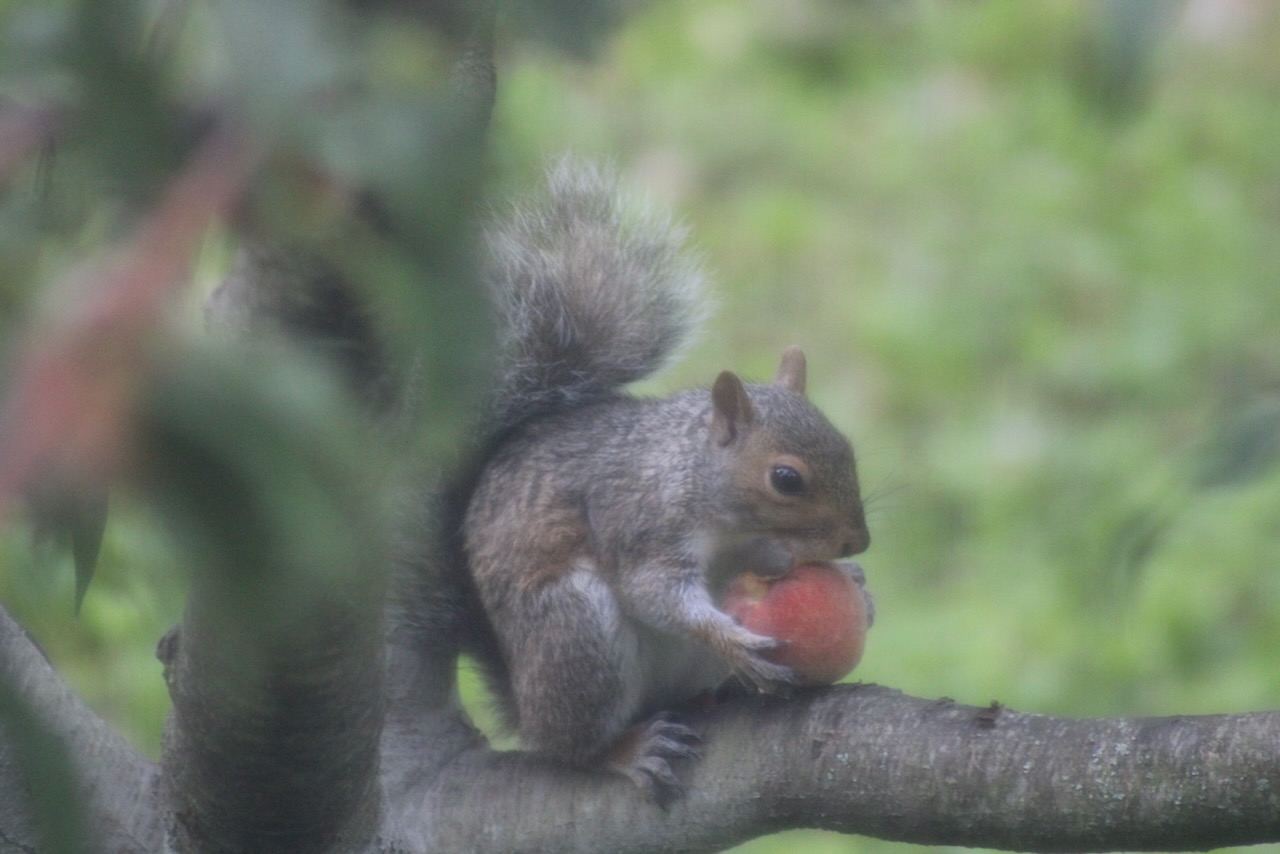
We haven’t been that successful in growing food for ourselves in the garden. (Yes, the experiment with the kale worked well. And we harvested blueberries and raspberries.) But right now the peaches are getting mold on them just as they ripen. Another fungal issue. I’ve started harvesting some that are not yet quite ripe, and just cutting them up to put in the freezer. But in the meantime, the squirrels and a groundhog are happily coming to the tree each morning to eat a peach. The squirrel climbs up the branches to pick her own, but the groundhog takes one that has dropped off.

The squirrels are always fairly bold, but the groundhog is shy and runs away as soon as she sees us on the back porch. So this photo was from a back window.

The more I try to garden, the more I realize what I don’t know. But it makes me happy that critters feel at home with us here. Unfortunately, the groundhog has dug a few holes to get under our garage–we don’t want her to feel that at home, such that she undermines the foundation. So I refill the holes any time I see them, and then pour some human urine on the area, hoping it will discourage her from more digging. Marking our territory, so to speak. We’ll see if that keeps working.

Meanwhile, the birds are relishing the volunteer sunflowers and evening primroses that are blooming and going to seed in lots of places. Also the elderberry bush. They seem to like everything about our yard. That makes me really happy.

What the garden does with us

Monarch caterpillar on milkweed

While on my morning walk, I suddenly saw a monarch caterpillar on a milkweed that had planted itself in our roadside strip. The next day (today), I saw three more. All we did with the milkweed was let it keep growing where it showed up on its own. There are two plants by the road, and three or four more in a patch out back near the pond. But the monarchs found them all the same.

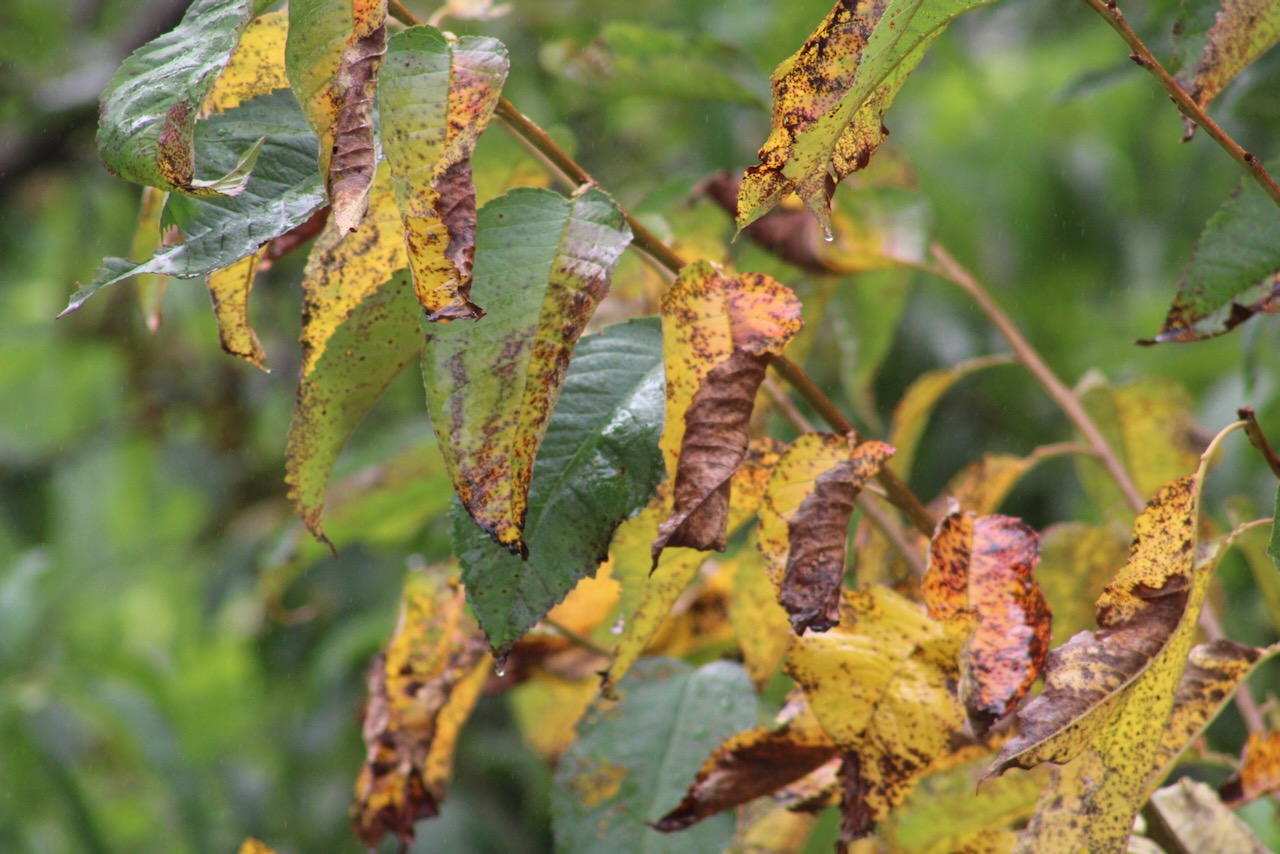
I have been feeling discouraged lately about my ability to garden. First of all there is the challenge of chronic fatigue that limits my energy such that even one small project outside in the morning can wipe me out for the rest of the day. But then there is the limitation of my own knowledge about the green growing beings. Right now, it is the cherry trees that are struggling with some disease. I am thankful to Aaron Parker of Edgewood Nursery who suggested, after seeing photos, that they are most likely dealing with Cherry Leaf Spot.

The possible answer is to clean up all the infected leaves on the ground and on the tree, and use an organic probiotic “Monterey complete disease control.” But even so, it might not work. Another website suggests natural remedies such as neem oil, potassium bicarbonate, and copper fungicides, which can be used to manage fungal infections like leaf spot. This season, I hadn’t done any holistic sprays because the sprayer takes a lot of personal energy to use. So I feel sad about the cherry trees, and even though I ordered some of the Monterey remedy, I feel discouraged about how much more work I’ve made for myself. Will it even help?

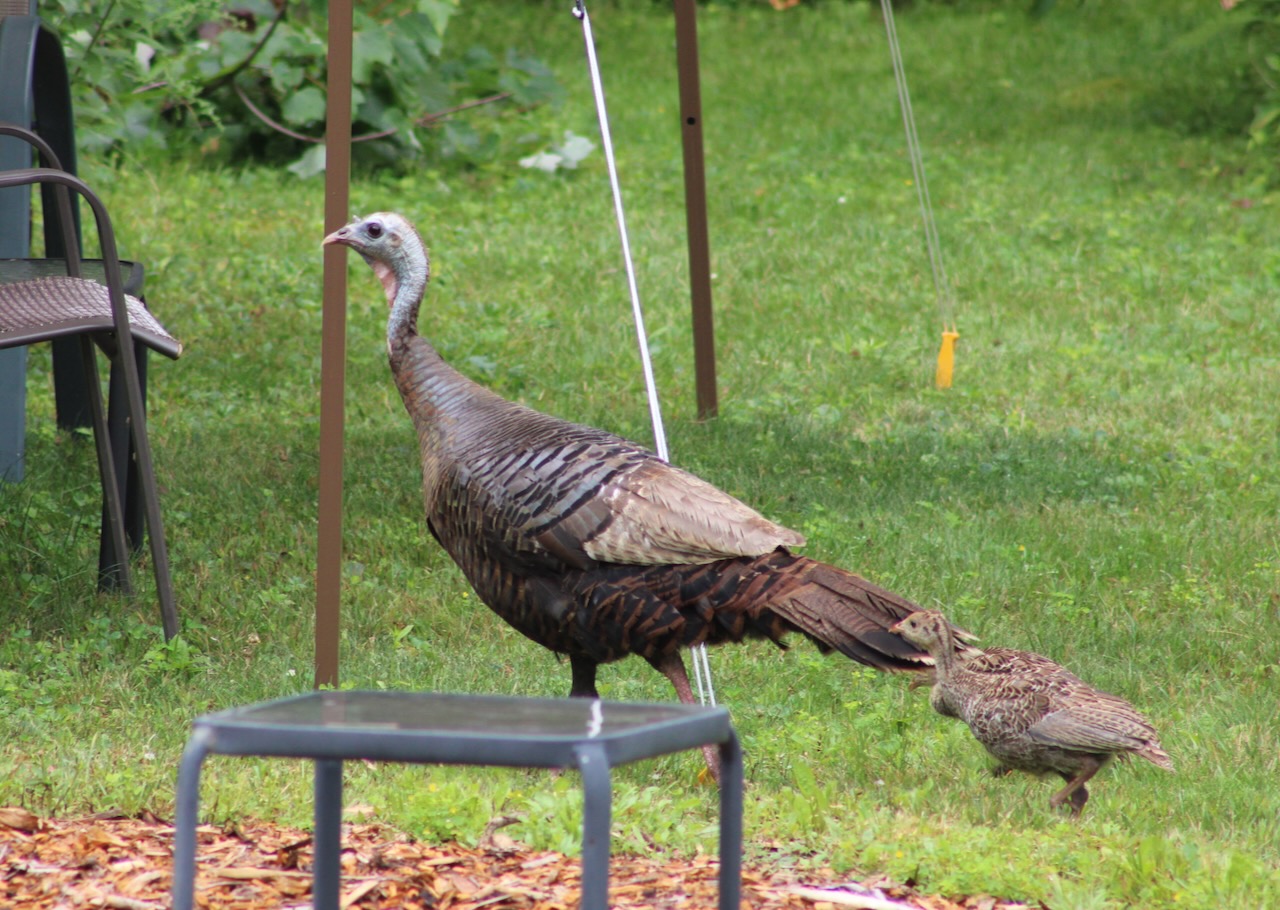
But in the midst of this discouragement, the caterpillars showed up on their own. And meanwhile, a turkey mom and her three babies have wandered through the yard a few times. Here we see them scooting under our canopy where we sit outside in some shade.

Meanwhile, the front raised bed that we didn’t plant decided to grow evening primrose on its own, and today I saw a gold finch happily checking out the yellow flowers. He was too quick to get into the photo. So I guess as a wildlife habitat, we are doing okay!

Then I saw this quote on Facebook this morning, posted by a colleague, and it was a good reminder that it isn’t really about how well we can garden. Something more magical is going on, and I must remember that.

“There was one thing I suddenly knew with absolute certainty: magic is not just something you do or make, it is something the universe does with you. It is our relationship to the Divine. There is nothing more magical than the presence of the sacred in one’s life. It changes everything. … It isn’t something one does to the universe; it’s what a living universe does with us once we have awakened to its Divinity.” Phyllis Curott in Book of Shadows

And maybe, it’s what the garden does with us once we have awakened to its Divinity.

Native wild flowers

glowing yellow goldenrod flowers on tall stalks, with dark green background
Goldenrod flowers are in bloom.

We have now lived in our home in Portland for 7 years, and are gradually getting to know the plants around us. We have our share of invasive plants, but today I want to highlight a few of the beautiful native wildflowers that are blooming right now in our yard. They come up on their own, and Margy has encouraged them by pulling invasive species, and leaving certain areas alone as she mows paths around the back yard.

I believe our goldenrod might possibly be the solidago sempervirens, or seaside goldenrod, native to eastern North America. This identification fits with our sandy pine forest soil, and photos online look similar. But it is very difficult to distinguish between species of solidago. Solidago is considered a keystone species, and has been called the single most important plant for North American pollinator biodiversity. They are very loved by many bee and butterfly and moth species. We love them too.

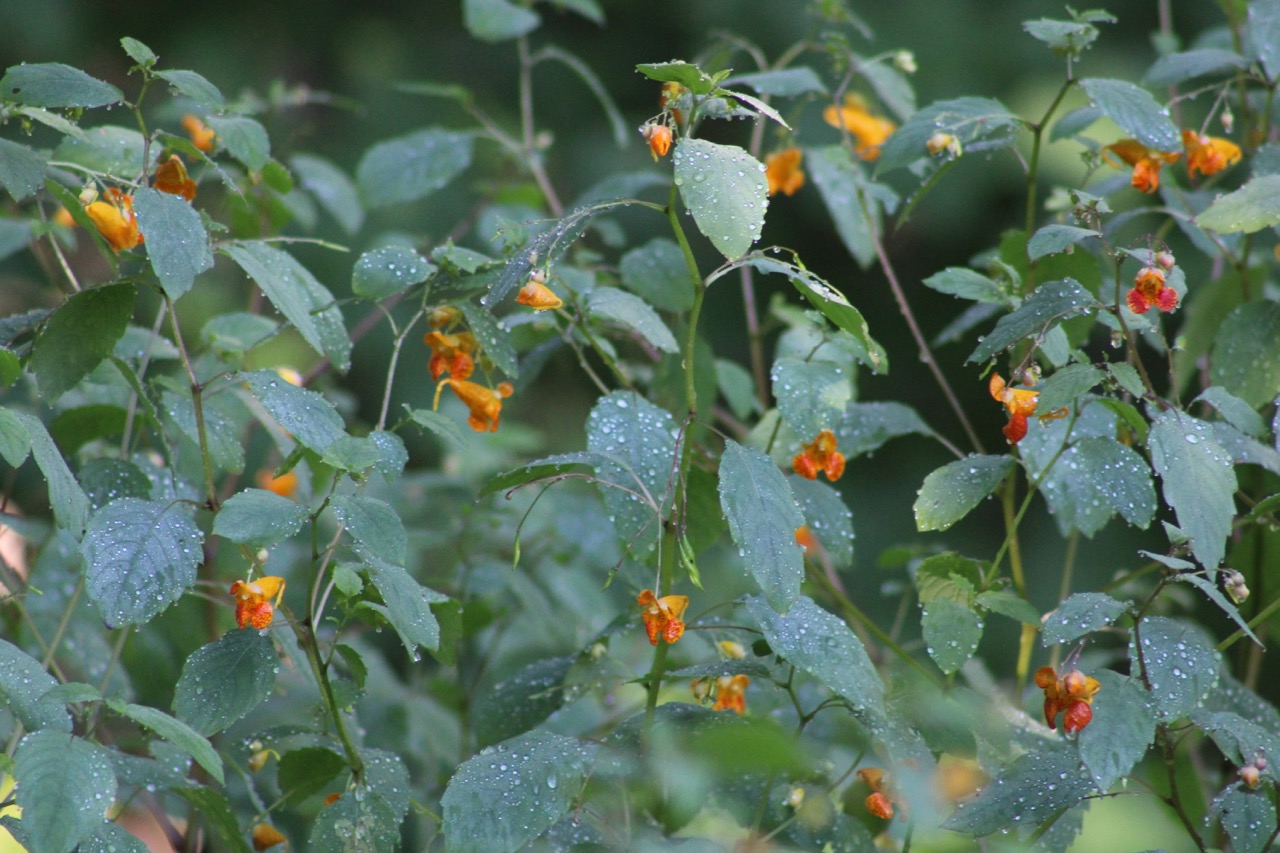
Tiny orange flowers on thin stems with oval serated leaves, droplets of water on the leaves.
Jewelweed after a rain.

Jewelweed grows profusely at the back and sides of our yard. Impatiens capensis is also called touch-me-not, because of the way the ripe seeds pop open when touched. It often grows near poison ivy (which we don’t have) and has traditionally been used as a remedy to prevent the rash caused by exposure to poison ivy. This year it has gone a little crazy all around our old white pine, and in Margy’s mound bed nearby. Hummingbirds and bumble bees are their major pollinators.

tall stems with small yellow flowers at the tips, many plants in 1/2 wine cask planter, on patio near deck railing.
Evening primrose in an old half wine cask container.

I got to know evening primrose last year, when it was the favorite plant for goldfinches after it had gone to seed. This year, it has self-propagated into two containers, as well as all around the patio and orchard. Oenothera biennis is a biennial plant, forming a small rosette the first year, and then in the second year shooting up to great height before blooming. It is native to eastern and central North America. Evening primrose oil is considered medicinal for a variety of conditions, though we haven’t tried harvesting it for such.

evening primrose closer
Evening primrose, closer look at the blooms.

What I love about these three species is that they grew on their own. We didn’t plant them, we just began to notice them and appreciate their presence. True gifts from the earth. There are many others we have begun to notice as well. It takes a while to learn about them and to identify them. It feels like such an important part of finding our way into earth community.

Certified Wildlife Habitat

Small sign saying Certified Wildlife Habitat on metal post, near raised bed, and steps to front door of house.

It’s official. We’ve been designated by the National Wildlife Federation as a Certified Wildlife Habitat. This means that our garden “provides natural sources of food, water, cover, and places to raise young, and is maintained in a sustainable way that incorporates native plants, conserves water and doesn’t rely on pesticides.” We posted our sign in our front yard. We are one of over 227,000 such gardens in the United States, and they are hoping to reach 300,000 this year.

In order to be certified, you fill out a form at https://www.nwf.org/CertifiedWildlifeHabitat and give a donation to the organization. It’s on the honor system–you tell them the sources of habitat in your yard, in several categories. For food in our yard we have native plants, berry bushes, and fruit trees, as well as our bird feeder, and the pond. One of my favorites is evening primrose that grows wild. We keep several, only cutting in places that don’t work to have a tall plant–last year there were goldfinches all over this plant, and hopefully more this year.

Goldfinches eating seed on round plant head.

We provide water especially with the pond. The pond serves so many purposes–food, water, a place to raise young (the tadpoles!), cover for frogs. When I walk in the morning, I see birds bathing, bees taking a drink, frogs sunning and snatching flies. But any kind of water brings wildlife to a yard–small or large. We also have a bird bath near our patio, and see birds and squirrels getting drinks there.

Cover is used to protect from bad weather, hide from predators, or hunt prey. Around the edges of our yard there are trees and bushes, and piles of branches that provide cover for small critters, and places to raise young. Ever since the orchard trees and hazelnut bushes have grown up, birds are always perching there, sometimes on their way to the bird feeder, sometimes eating insects. I’ve posted about the robins raising young in a nest on our back porch. But we’ve also seen young squirrels in trees, and chipmunks coming from underground.

As for sustainable practices, we never use pesticides, and we compost our food waste and leaves. We conserve water with our rain barrels, and if the pond needs topping up, that comes from the rain barrels too. We try to incorporate native plants wherever we can–mostly by not pulling the weeds that emerge on their own: violets, pansies, daisies, wild strawberry, goldenrod among many others. I use an app to identify plants that come up. We do also have invasive plants that we are trying to get rid of.

The official designation and sign were a gift to ourselves, and to make our intentions more visible in the neighborhood. Most of the actual habitat is in the back and side yards. Have any of you participated in this program? Maybe you might like to check it out. There are little things that each of us can do to care for the earth community, and foster habitat for wildlife.

So Many Small Birds!

Two goldfinches on an evening primrose stalk

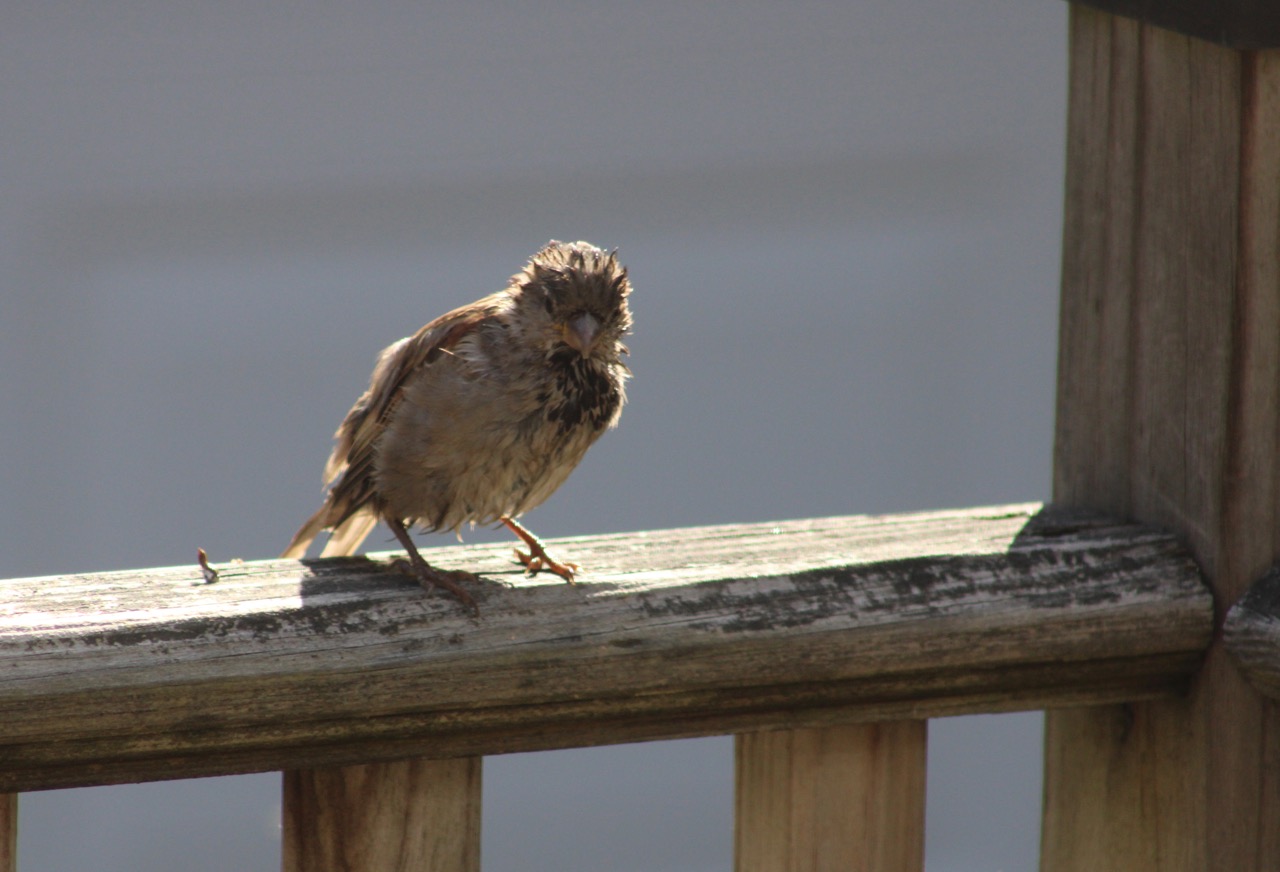
I feel such delight in all the small birds that love to be in our yard. Yesterday morning, the gold finches were all over the evening primrose stalks, eating seeds. Native self-seeded wildflowers for the win! Then I saw a few little brown ones–maybe sparrows–taking a bath in a puddle in the driveway, after the good rain we had the day before. Here is one drying off afterwards.

Sparrow after a bath, sitting on the deck rail.

He turned around while I was looking from the back door. So cute I had to share both photos!

Sparrow after a bath, on the deck rail, facing me.

The little birds just love our garden, our trees and bushes, our wildflowers, and we love them. If I had to pick just one sort of critter, birds are my folks! It makes me so happy that they are happy here!

One more bit of good news. The mama turkey has come back a couple times with her baby, after the horrible incident in our yard where her other baby was killed by a neighbor cat. We’re glad to see they are doing well.

Mama and baby turkey in the grass.

The Gifts of Birds and Berries

Blueberries and raspberries from our garden

Right now the garden is happy with berries: the raspberries are loaded with fruit, and this is the first year for a blueberry harvest. We planted these blueberry bushes in 2017. This year, I put up some fence posts and draped the berry bushes with gauzy fabric after the berries started to form. (Tried it first without the posts, but the weight bent the bushes over when it rained.) This is to keep the birds from eating all the berries. But we have three younger plants in the back that I left open. And the raspberries do fine on their own. So every other day, I go out and pick a bowlful of ripe berries.

Blueberry bushes wrapped with tulle fabric

The fabric barrier is a bit ironic really. I don’t mean to discourage the birds at all. But expert gardener’s advice says that they will eat all the blueberries before we can. I think of myself as a very novice gardener. Our garden only provides us with a very modest harvest. Last year the squirrels took all the peaches, and cabbage moths are now eating a lot of the kale. I have given up on the idea of creating a food forest that will provide all our needs. This year, I haven’t had the energy to give any of it much attention at all.

But somehow, in the midst of it all, the garden keeps giving back to us in unexpected ways. The orchard has become a bird heaven. We now regularly see cardinals, a robin couple (who, after two failed attempts, are again playing with the nest on our porch), gold finches, house finches, sparrows, chickadees, catbirds, starling visitors, not to mention the turkey mom and her two babies that keep coming through, and so many more. The small birds love perching in the fruit trees–and I love seeing them there. They ate the few cherries, which I didn’t try to protect. I think they are also eating a lot of bugs. They even love perching on top of the stakes in the zucchini bed. We provide sunflower seeds in the bird feeder, and they planted sunflowers all around it with the droppings. So we are gifted with all this beauty.

Sunflowers in bloom around a green bird feeder with a small sparrow on it.

This has been a summer of much gifted beauty. Another example is the wild evening primrose. I pulled all of the primrose plants that had sprouted up in the orchard, because I knew they would be too tall and block the paths. But I purposely left the ones on the other side of our back porch, this one in front of irises that bloomed earlier. And now they sparkle a bit like a Christmas tree in July.

Tall evening primrose in bloom

Each year I do learn a bit more about how to garden. This year, it seems that what I am learning most of all is how much the earth gifts to us and to all her creatures, how generous and abundant she is, when we merely open to her and open to other creatures, and stop trying so hard to make something specific happen. I am feeling the interconnected family of beings, and especially the joy of birds who now find a home in our yard. It’s amazing! Finally, I just want to also express gratitude for a monarch butterfly who came to visit a few days ago.

Monarch perched on volunteer elecampane flowers