Life continues to be abundant in the yard. We’ve had visits by a duck couple, who land on the pond, sometimes walk around the yard looking for food, and then take off again. When I was cleaning up old plants from the pond, I discovered strings of toad spawn, and now we have toad tadpoles swimming around.
I am suspicious that the three bullfrogs who’ve taken up residence might be eating them sometimes, but so far the tadpoles continue to survive. We’ll see.
I don’t seem to have much energy this year, so projects in the yard are moving slow. We finished stacking our firewood, and I cleaned up weeds and refreshed the wood chips around the fire circle. I resonated with something that was mentioned on television at the Chelsea flower show in Britain–gardening is often a lesson in failures. The cherry tree has some problem that causes spots on the leaves and cherries and I don’t think we’ll get any cherries despite our earlier blossoms. Probably the black cherry aphids, but I don’t have the energy to sort it out. So I am appreciating the plants that seem to take care of themselves.
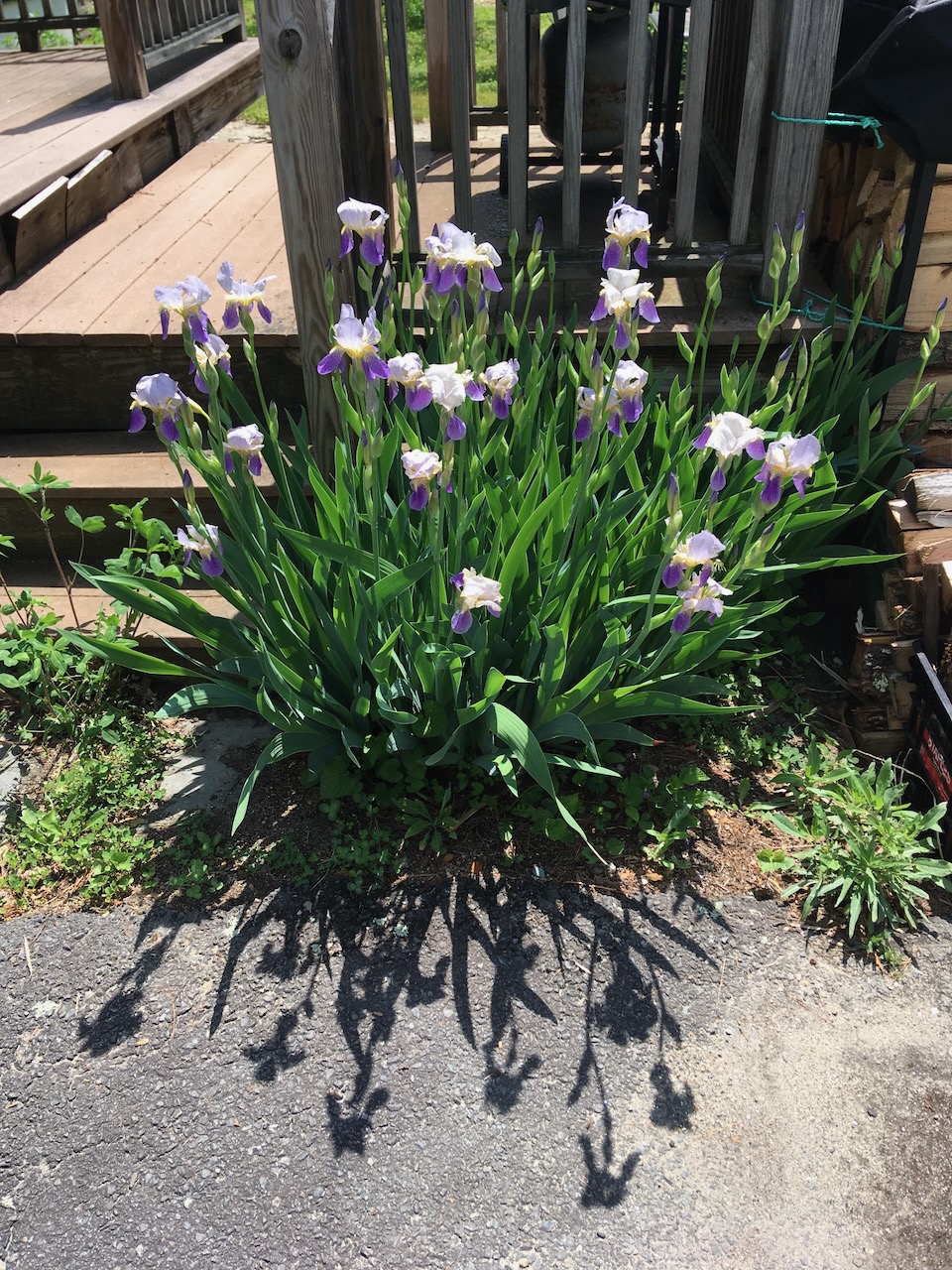
The irises by our deck are thriving this year, so happy and abundant. That sort of makes up for the lack of blue Siberian irises in our front patch–hardly any at all this year. The plants seem to move around, and I am not sure why the blue ones are not doing well. Happily, our neighbor’s are doing great, and I see them out our kitchen window.
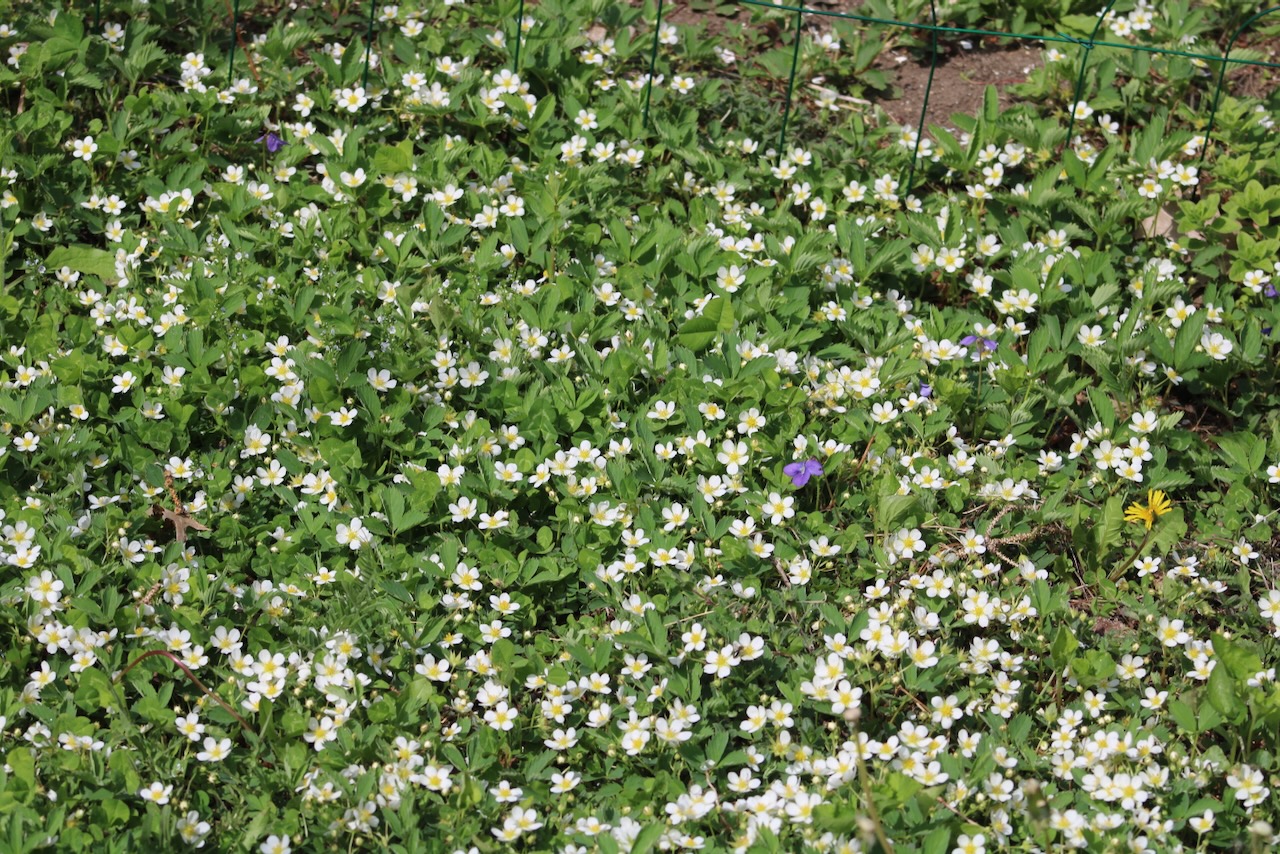
Meanwhile, the wild strawberries were blossoming and spreading everywhere, which is great–good food for birds and bugs. It is an excellent native ground cover. That makes me happy.
Overgrown oregano all around the rain barrels and heat pump.
I love sharing photos of beauty in the yard. But it is harder to know how to share the challenges and failures. I actually feel like a failed gardener right now. Yes, there are little harvests, yes there are elements of beauty. But there is so much that is overwhelming. I don’t enjoy “weeding” which seems to be what real gardeners often talk about enjoying. A weed is merely a wrong plant in the wrong place. We make further distinctions to talk about invasive plants that are harmful to the local ecosystem. And there are also native plants that are aggressive in the ecosystem.
One of my overwhelming senses of failure comes from the oregano that is spreading all over the orchard. When I originally planted some donated oregano as a companion plant to the orchard trees, I had no idea how it would take over. Oregano is a tasty herb, not native, but useful, and the bees love the flowers; I’ve dried some of the plant for seasoning. Last year as it spread, I thought, okay, just let it go where it wants. This year I tried taking out a tiny patch using a garden fork. Its roots form a thick mat under the soil. Even a tiny patch was challenging to remove. I’ve lately taken the mower through the orchard a few times. With the rain and heat inhibiting our outdoor time this summer, I can’t imagine how to get it under control. I hate the feeling of needing to get a plant under control.
Everything in the yard is ragged and overwhelming. For each native plant I newly discover and appreciate (like the evening primrose that the goldfinches adore), there is another tall unknown plant that I have no idea about. The orchard trees have to be pruned each year, and face challenges from mysterious pests and diseases. Will the Lapins cherry survive its challenges?
Perhaps in all of this, I discover that I don’t enjoy tending and caring for this patch of earth the way I thought I would? I am not good at gardening? I’ll never be good at harvesting much food? I want to give up sometimes, but how can I? Everything is right outside my door. I acknowledge that it is much more difficult for all gardeners because of the climate catastrophe of our times. I realize that I don’t have teachers to show me how–mostly just books really, and the internet. I don’t think gardening was meant to be so all alone.
But I have made this commitment to a spiritual journey into earth community. These overwhelming challenges are part of that journey too. So what can I do? This morning, I took myself out to our new screen tent, placed a blanket on the ground, and sat on the ground. It has been a while since I have done that. At our old yard, I used to sit on the ground in a screen tent almost every day. Lately, instead, I have been walking around looking at things that need tending. Today, I sat on the ground and let the ground tend to me. I turned to each of the four directions, to honor the powers of east, south, west, and north–and the powers of the earth below, the sky above, the spirit within.
The sun shining through in the eastern sky, from within the screen tent.
It reminds me that I am small, and these powers are large. Spirit is large. They are my teachers and carers. I hear the cardinal singing from the tall trees. Truthfully, I am not really the one who tends the earth, the earth is the one who tends to me.
I am remembering a chant song I learned from a friend in English, and then heard later in Wolastoqey; As far as I can discern, it originated from Wolastoq people, and has since been performed by other indigenous people as well. My friends and I sang it something like this, in several verses substituting the word “creator” with all manner of beings, such as trees, ancestors, water, stars, dragonflies, children–all the creatures around us.
We've got to humble ourselves in the eyes of the creator, we've got to bend down low.
We've got to humble ourselves in the eyes of the creator, we've got to know what they know.
We can raise each other up, higher and higher. We can raise each other up.
Perhaps the failures are also teachers, a reminder of our ultimate dependence, an opening into something more mysterious and powerful in whose eyes we are seen and held.




 Finding Our Way Home