Orchard Learning

Mottled red apples in green leaves and branches
Our first Honeycrisp apples are almost ready to pick!

Our semi-dwarf apple tree is bearing fruit for the first time this year, and we are excited for the dozen or so apples that will be ripe soon.

How naive I was when I first decided to plant an orchard in our back yard. We started with two dwarf cherry trees in 2017, of the varieties Lapins & Black Tartarian. The next spring we planted a Contender peach tree, the Honeycrisp apple, two blueberry bushes, some raspberries, and three hazelnut bushes. In 2019 I grafted two other apple trees, Black Oxford and Blue Pearmain, this last just transplanted to its new bed this year. (Not to mention our mulberry tree further back in the yard, and three more blueberries planted later.)

I think I imagined that one would put in a lot of effort at the beginning, with preparing the ground, planting the seedlings, adding companion plants, tending, and so forth, then the work would ease and the fruit would be there for the picking in the years to come. Maybe that was some of what attracted me to permaculture and a food forest. Little did I realize that an orchard requires even more tending as the seasons go on.

And there are the ups and downs–the first peach harvest went entirely to the squirrels-we were so sad. Then we had an amazing crop last year, that we ate fresh, shared with the neighbors, and froze, some packages of which are still in the freezer. This season, no peaches at all. We have yet to have a cherry harvest. This would have been the year, I think, but the abundant flower buds were empty from the deep winter freeze. On the other hand, the raspberries are very reliable, and the blueberries have begun to come into their own. And the number of birds have multiplied in our yard, whether or not there is any fruit on the trees. They love the orchard.

All that preamble to say, I did some more pruning this past week! After watching a whole bunch of Youtube videos about summer pruning, I gained the courage to go and cut off a whole lot of branches that were vigorously seeking the sky on the peach tree and the Black Tartarian cherry. (I had already done some pruning on the Lapins because of its black cherry aphid problems.) When I post the “after” pictures below, you might not believe how many branches were piled up on the patio waiting for me to take them to the compost. The trees still look flush with abundance green, though I think their tops might be about three feet lower than before.
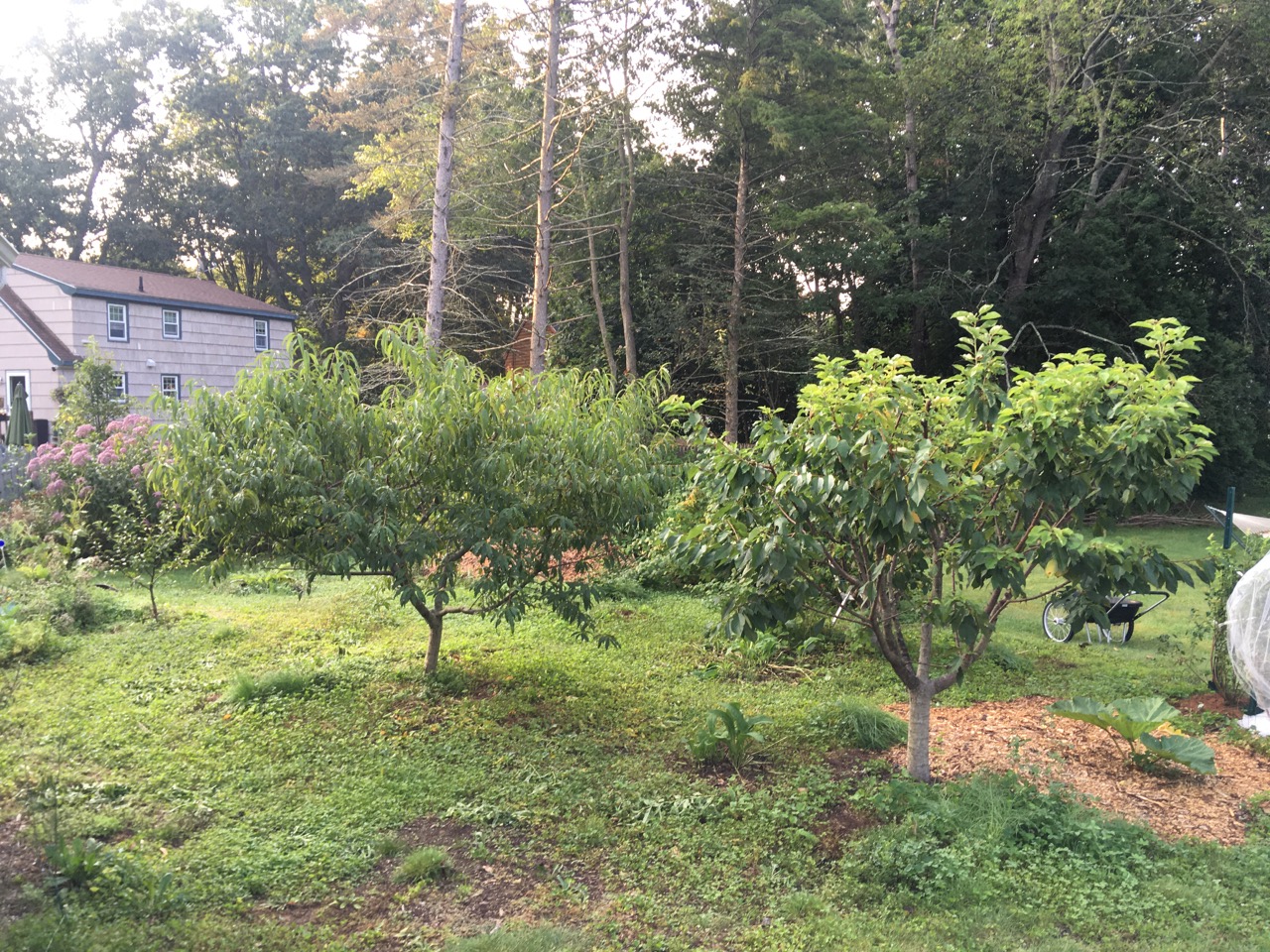
Peach tree and Lapins cherry after pruning.

I also discovered a lot of small curled leaves on the Black Tartarian, without any evidence of aphids. After some research I learned that there is a fungal disease, cherry leaf curl, similar to the peach leaf curl that I dealt with by picking off the affected leaves. I can’t be certain what it is, but I went back around and pruned off any branch ends with those curled leaves on both cherries. All the pruned cherry branches I cut up and put into garbage bags to go out with the trash–three bags full–so they wouldn’t spread the problem.

You might notice from the photo that the companion planting under the trees is now very low to the ground. I have taken to mowing most of it, including the oregano that spreads everywhere, and I put the cuttings in the compost to bring back later. The mowing doesn’t seem to bother anything, it all comes back. Under the Lapins cherry tree, I actually put down some cardboard to inhibit the oregano and then covered it with wood chips. It is an experiment.

Pruned Black Tartarian cherry tree.

This is not to say that the trees won’t also need winter pruning. That is the thing. They will always need lots of pruning, summer and winter. The work is never done. I might do less of it or more of it, depending on my own energy levels. But there is always more work that I could do to tend to their care. Even with my trying-to-be-minimalist approach. (I have read that there are people who secretly plant fruit trees in random places, to great environmentalist applause; but I wonder about who will do the tending.) So while I often wax eloquent about permaculture and gardening, please be warned about the other side: this relationship with garden trees requires a lot of work, more than I ever expected.

I should end this post with a caveat: I consider myself a learning gardener, and none of these reflections should be taken as advice. I have no idea what I am doing at least 50 percent of the time. My intention is creating a mutual relationship with the earth and the plants, and reflecting on that process. As always, I am humbled by it all.

Native wild flowers

glowing yellow goldenrod flowers on tall stalks, with dark green background
Goldenrod flowers are in bloom.

We have now lived in our home in Portland for 7 years, and are gradually getting to know the plants around us. We have our share of invasive plants, but today I want to highlight a few of the beautiful native wildflowers that are blooming right now in our yard. They come up on their own, and Margy has encouraged them by pulling invasive species, and leaving certain areas alone as she mows paths around the back yard.

I believe our goldenrod might possibly be the solidago sempervirens, or seaside goldenrod, native to eastern North America. This identification fits with our sandy pine forest soil, and photos online look similar. But it is very difficult to distinguish between species of solidago. Solidago is considered a keystone species, and has been called the single most important plant for North American pollinator biodiversity. They are very loved by many bee and butterfly and moth species. We love them too.

Tiny orange flowers on thin stems with oval serated leaves, droplets of water on the leaves.
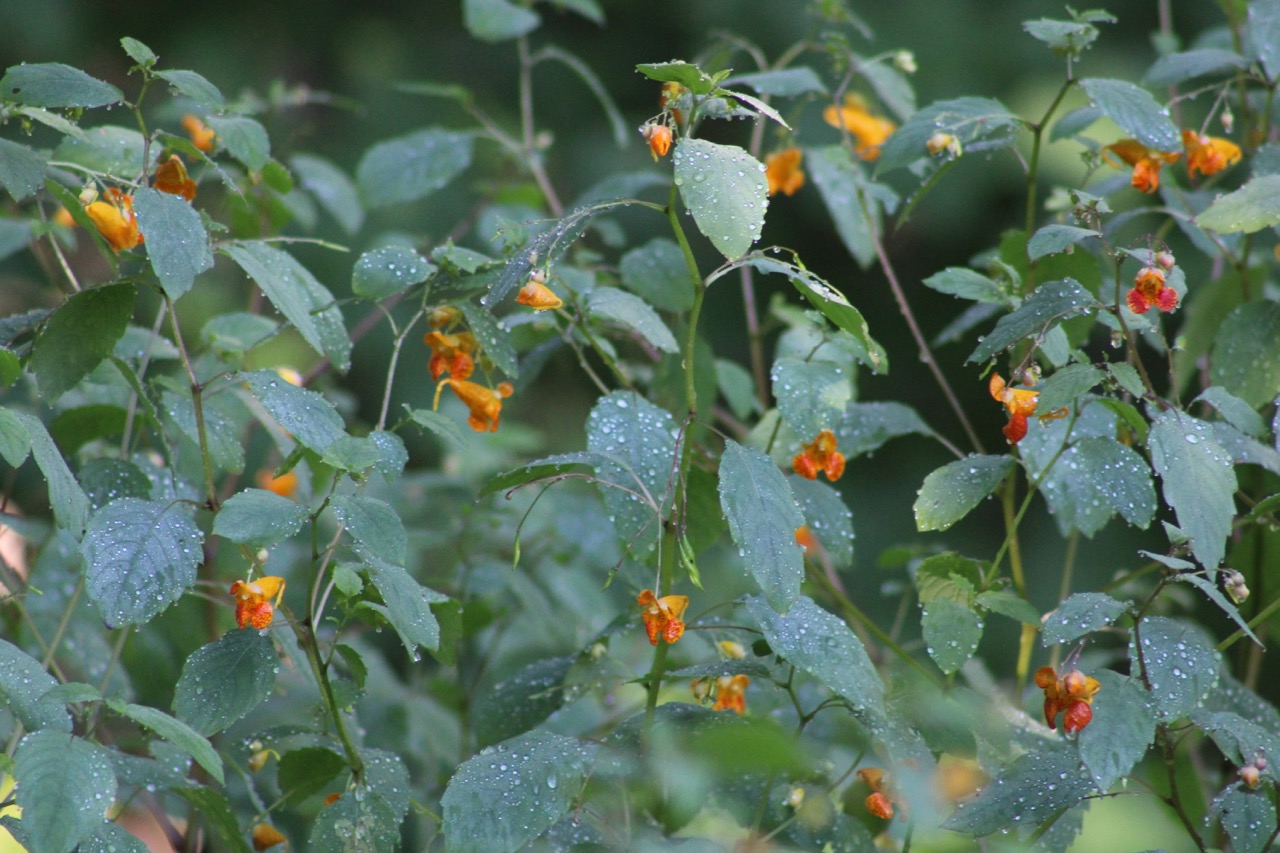
Jewelweed after a rain.

Jewelweed grows profusely at the back and sides of our yard. Impatiens capensis is also called touch-me-not, because of the way the ripe seeds pop open when touched. It often grows near poison ivy (which we don’t have) and has traditionally been used as a remedy to prevent the rash caused by exposure to poison ivy. This year it has gone a little crazy all around our old white pine, and in Margy’s mound bed nearby. Hummingbirds and bumble bees are their major pollinators.

tall stems with small yellow flowers at the tips, many plants in 1/2 wine cask planter, on patio near deck railing.
Evening primrose in an old half wine cask container.

I got to know evening primrose last year, when it was the favorite plant for goldfinches after it had gone to seed. This year, it has self-propagated into two containers, as well as all around the patio and orchard. Oenothera biennis is a biennial plant, forming a small rosette the first year, and then in the second year shooting up to great height before blooming. It is native to eastern and central North America. Evening primrose oil is considered medicinal for a variety of conditions, though we haven’t tried harvesting it for such.

evening primrose closer
Evening primrose, closer look at the blooms.

What I love about these three species is that they grew on their own. We didn’t plant them, we just began to notice them and appreciate their presence. True gifts from the earth. There are many others we have begun to notice as well. It takes a while to learn about them and to identify them. It feels like such an important part of finding our way into earth community.

Robins at Lammas

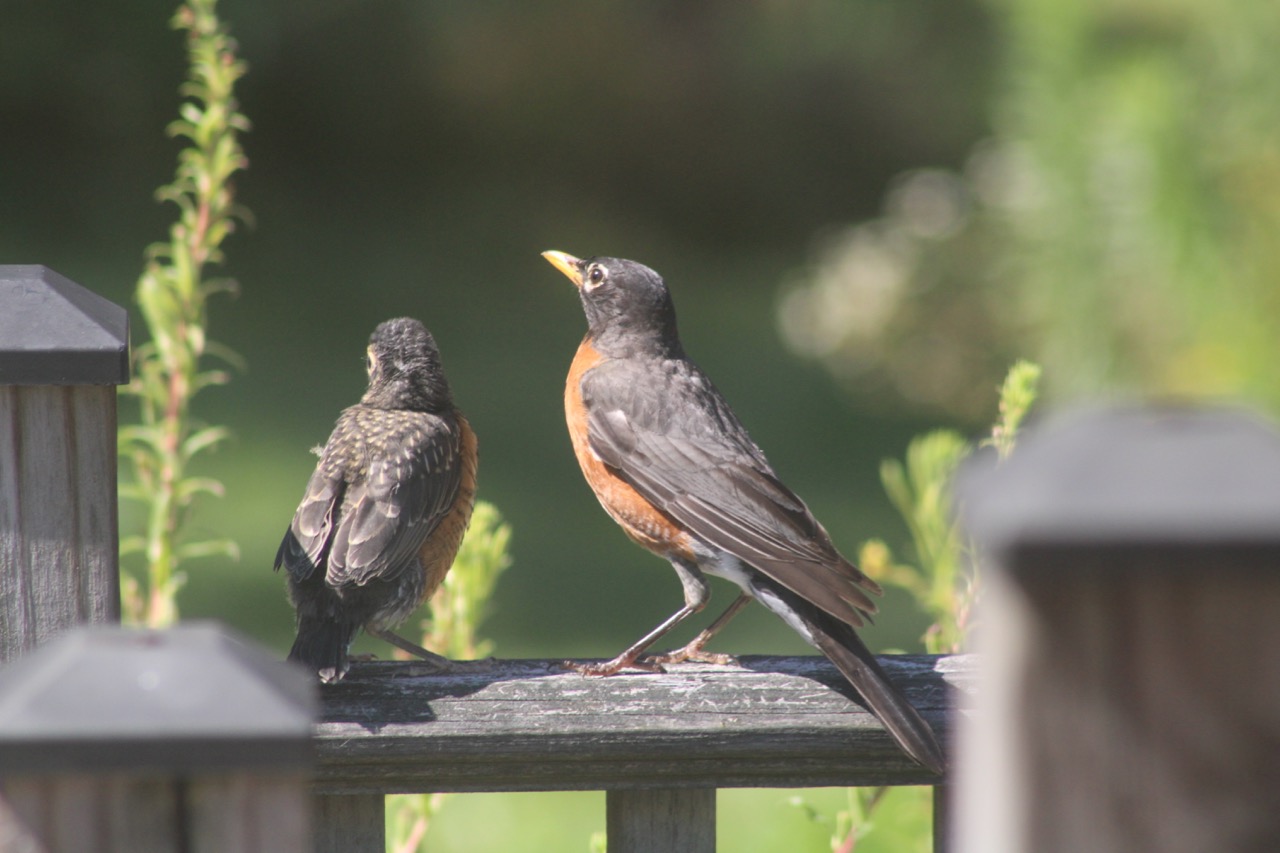
Fledgling robin looking at mother robin who is looking back, perched on gray wooden railing, greenery behind.
Fledgling robin with mom on the deck railing.

Our Lammas harvest festival blessing was being able to watch the fledging of the robins’ third brood of three chicks. (That makes nine chicks all together!) They had been getting active the last couple days so we were expecting it. But what a nice surprise to look out the window and see the first fledgling perched all alone on the deck railing, looking around at the big wide world for the first time.

Fledgling robin alone on gray deck railing looking out to greener beyond.

They probably saw their mother hopping on the ground further in the back yard. (We did too.) Then the mother flew up next to it on the railing for encouragement. (That was photo number one). After looking at each other, they each looked out beyond, and then the mother flew off, and the baby soon followed, alighting high in the hazelnut bushes.

Fledgling and mother robin on gray wooden deck railing looking away from camera toward greenery beyond.

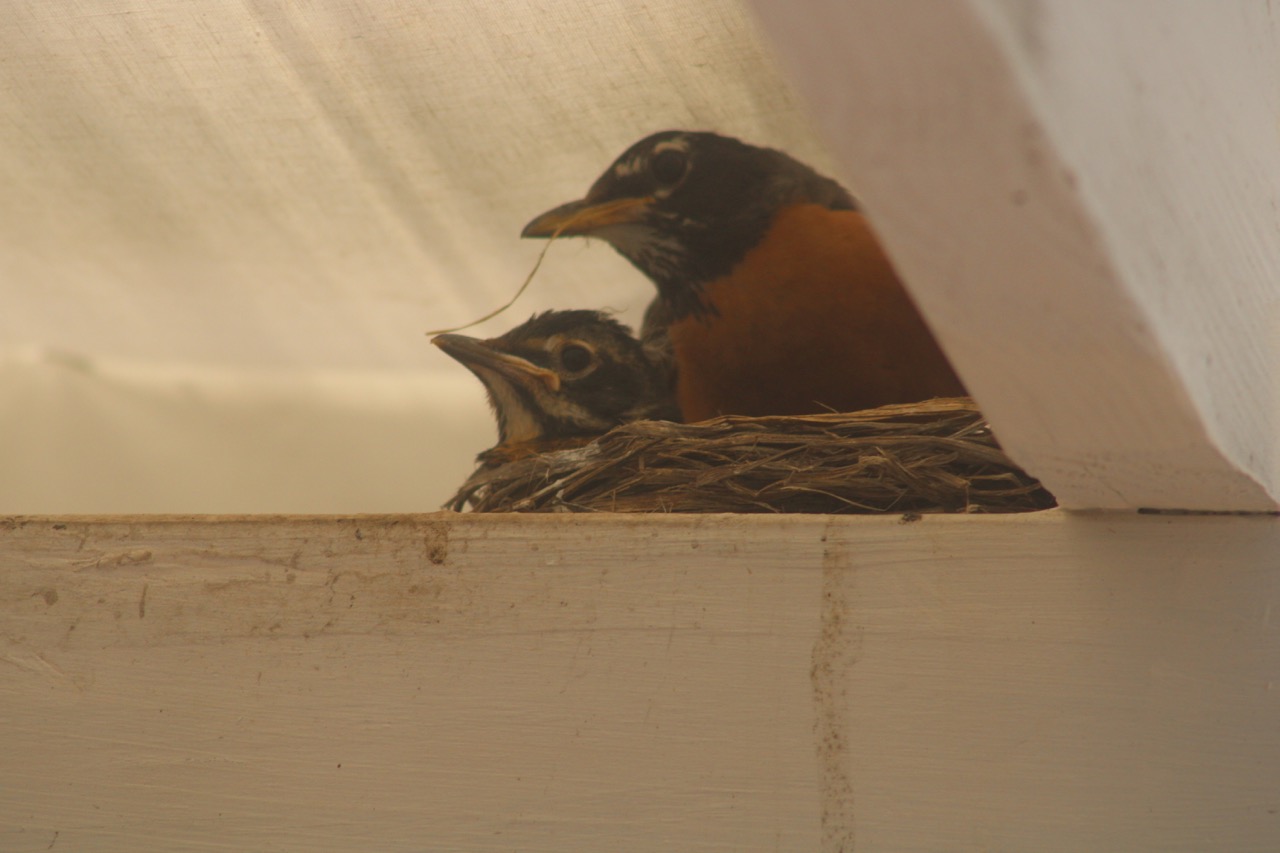
The other two remained in the nest for a little while, but soon the second one flew out toward the orchard. Finally there was just one left. I wandered around outside, but the parents were chirping at me, their warning calls. I saw the parent robins also diving and shrieking at squirrels in the pitch pine tree branches, and angrily calling at a cardinal who came into the cherry tree–too close as far as the robins were concerned. Back inside for a while, I saw the dad robin come to the nest–with a piece of grass in his beak, but I didn’t see food. He sat with the third baby for a while, so tender. After he left, the baby shrunk down into the nest, only its beak visible. Hiding mode.

Baby robin, just head showing above brown grassy nest, with dad robin above and behind in nest, between white painted beams underneath and on side.

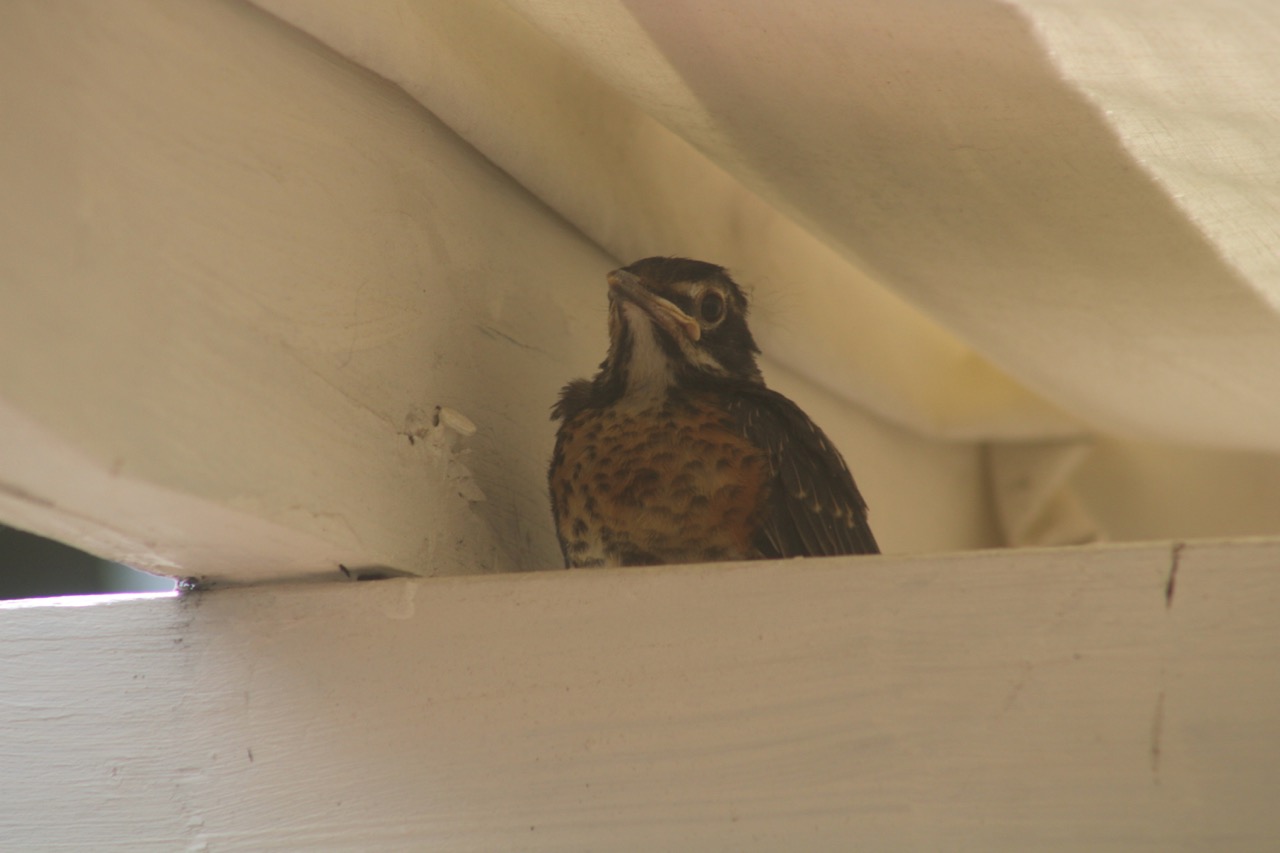
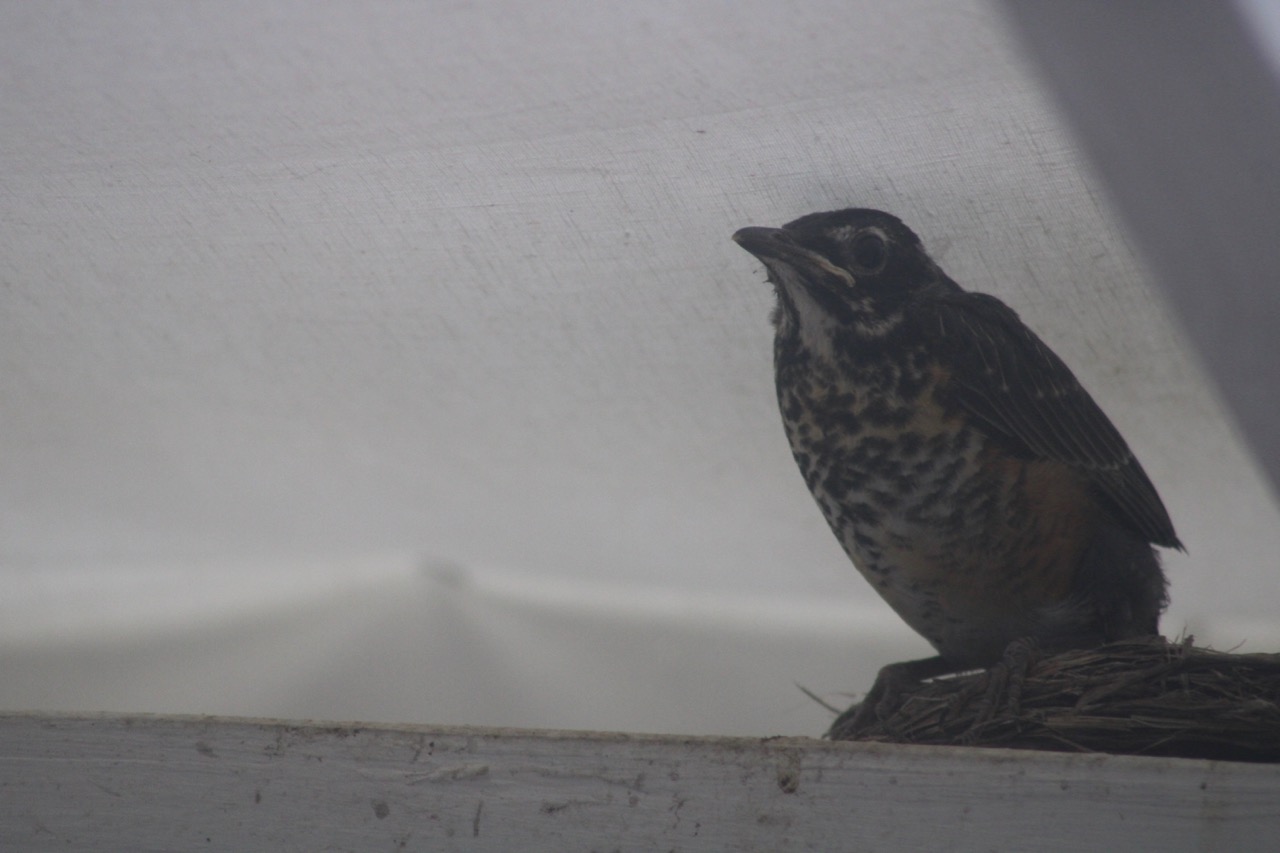
I had to go out in the orchard to do some mulching, and then I sat at the patio table. I could hear number three chirping every so often from the nest, their head visible again, and then I’d hear another chirp from the direction of the hazelnut bushes. When I came back inside, I kept an eye on them through the windows. They got out of the nest finally, and hopped along the beam to the other side. While the first fledgling had seem so confident and proud of itself, this one seemed quite scared about jumping from its safe little home. But everybody had left. It huddled up next to the opposite side beam.

Baby robin visible from belly up, on white beam, next to side beam, looking toward the camera.

Finally, the little one started to stretch their legs, and move their wings a tiny bit. They moved up to the very edge of the beam. They hovered there for quite a while. One of the parents came back to the deck railing down below and behind the nest. I also saw a female gold finch perched on the railing in front of the nest. Not sure what that was about. A chipmunk was scurrying below on the patio. I stood still next to the back windows and just watched–I didn’t take any more photos. The gold finch left, the parent left, the chipmunk left. The little one perched on the edge. Then they bravely jumped off.

I heard a flutter of wings against the screen window of our music room, just to the left of the deck out of my sight. I went out the door to observe, and saw that the baby was hanging by one claw stuck in the screen, and flapping their wings against it. I walked to the edge of the deck, reached over and cupped my hands gently around the baby, careful to contain their wings, lifted them to release the claw. I let go and they flew down to the lemon balm patch. Be still my heart. They slowly hopped out onto the patio, hopped over some garden hoses, making their way over to the mulched area under the cherry tree. They hopped into the grass behind, and finally they flew up over the grass into the trees.

And then the nest was empty. They say that robins raise two or three broods a season, and if that is true, they may be done with the nest for now. They’ll feed the babies for a few more weeks out in the bushes and trees. I wonder how all nine of their children are doing? Did they all survive? I hope they are thriving. We don’t see them once they leave the nest, so we never know.

I feel a sense of joy, and a sense of loss, all at the same time. I feel grateful for the privilege to observe the robin family, and for the moments I was able to capture in photos. I feel sad to look out the window and see them gone. I am also grateful that I was able to give them a little shade from the sun, and maybe that helped.

Humble

Red rain barrel in front of house, heat pump seen on upper right, behind oregano plants all over the place, green with white flowers
Overgrown oregano all around the rain barrels and heat pump.

I love sharing photos of beauty in the yard. But it is harder to know how to share the challenges and failures. I actually feel like a failed gardener right now. Yes, there are little harvests, yes there are elements of beauty. But there is so much that is overwhelming. I don’t enjoy “weeding” which seems to be what real gardeners often talk about enjoying. A weed is merely a wrong plant in the wrong place. We make further distinctions to talk about invasive plants that are harmful to the local ecosystem. And there are also native plants that are aggressive in the ecosystem.

One of my overwhelming senses of failure comes from the oregano that is spreading all over the orchard. When I originally planted some donated oregano as a companion plant to the orchard trees, I had no idea how it would take over. Oregano is a tasty herb, not native, but useful, and the bees love the flowers; I’ve dried some of the plant for seasoning. Last year as it spread, I thought, okay, just let it go where it wants. This year I tried taking out a tiny patch using a garden fork. Its roots form a thick mat under the soil. Even a tiny patch was challenging to remove. I’ve lately taken the mower through the orchard a few times. With the rain and heat inhibiting our outdoor time this summer, I can’t imagine how to get it under control. I hate the feeling of needing to get a plant under control.

Everything in the yard is ragged and overwhelming. For each native plant I newly discover and appreciate (like the evening primrose that the goldfinches adore), there is another tall unknown plant that I have no idea about. The orchard trees have to be pruned each year, and face challenges from mysterious pests and diseases. Will the Lapins cherry survive its challenges?

Perhaps in all of this, I discover that I don’t enjoy tending and caring for this patch of earth the way I thought I would? I am not good at gardening? I’ll never be good at harvesting much food? I want to give up sometimes, but how can I? Everything is right outside my door. I acknowledge that it is much more difficult for all gardeners because of the climate catastrophe of our times. I realize that I don’t have teachers to show me how–mostly just books really, and the internet. I don’t think gardening was meant to be so all alone.

But I have made this commitment to a spiritual journey into earth community. These overwhelming challenges are part of that journey too. So what can I do? This morning, I took myself out to our new screen tent, placed a blanket on the ground, and sat on the ground. It has been a while since I have done that. At our old yard, I used to sit on the ground in a screen tent almost every day. Lately, instead, I have been walking around looking at things that need tending. Today, I sat on the ground and let the ground tend to me. I turned to each of the four directions, to honor the powers of east, south, west, and north–and the powers of the earth below, the sky above, the spirit within.

The sun shining through in the eastern sky, from within the screen tent.

It reminds me that I am small, and these powers are large. Spirit is large. They are my teachers and carers. I hear the cardinal singing from the tall trees. Truthfully, I am not really the one who tends the earth, the earth is the one who tends to me.

I am remembering a chant song I learned from a friend in English, and then heard later in Wolastoqey; As far as I can discern, it originated from Wolastoq people, and has since been performed by other indigenous people as well. My friends and I sang it something like this, in several verses substituting the word “creator” with all manner of beings, such as trees, ancestors, water, stars, dragonflies, children–all the creatures around us.

We've got to humble ourselves in the eyes of the creator, we've got to bend down low.
We've got to humble ourselves in the eyes of the creator, we've got to know what they know.
We can raise each other up, higher and higher. We can raise each other up.

Perhaps the failures are also teachers, a reminder of our ultimate dependence, an opening into something more mysterious and powerful in whose eyes we are seen and held.

Weather Report

Close-up of white woman smiling into camera, with blue sun hat, sun glasses, and backdrop of ocean beach, with small figure looking out to sea.
Crescent Beach, Myke, with Margy in background.

A week ago we finally made it to the beach. We’ve had so many rainy days this summer, alternating with a few very hot muggy days. That day was hot and muggy, but less so at Crescent Beach, so we got ourselves over there. The water was totally full of seaweed, and somehow that dampened my enthusiasm for swimming, but the wading was lovely, and lying on a blanket in the sand. I’m smiling in the selfie, but this post is more about the challenges of this summer.

It feels like a summer in which it is very hard to love the earth, or to feel loved by the earth. It is hard to even go outside! According to the weather report for Maine, June had only 7 days without rain. And July the rainy patterns have continued. But what makes it worse is that the days without rain have gone to the opposite extreme of muggy and hot. I don’t think we’ve had even one dry, sunny, moderately warm day. The other challenge has been air quality–many days of smoke particles making their way from Canada–not to an extreme, but enough to bump the meter from “good” to “moderate”.

And I have to acknowledge that we’ve been lucky here. No flash flooding of town centers, like in Vermont this week. No over-100-degree heat for days on end like in Arizona. No forest fires on our doorstep. But still…

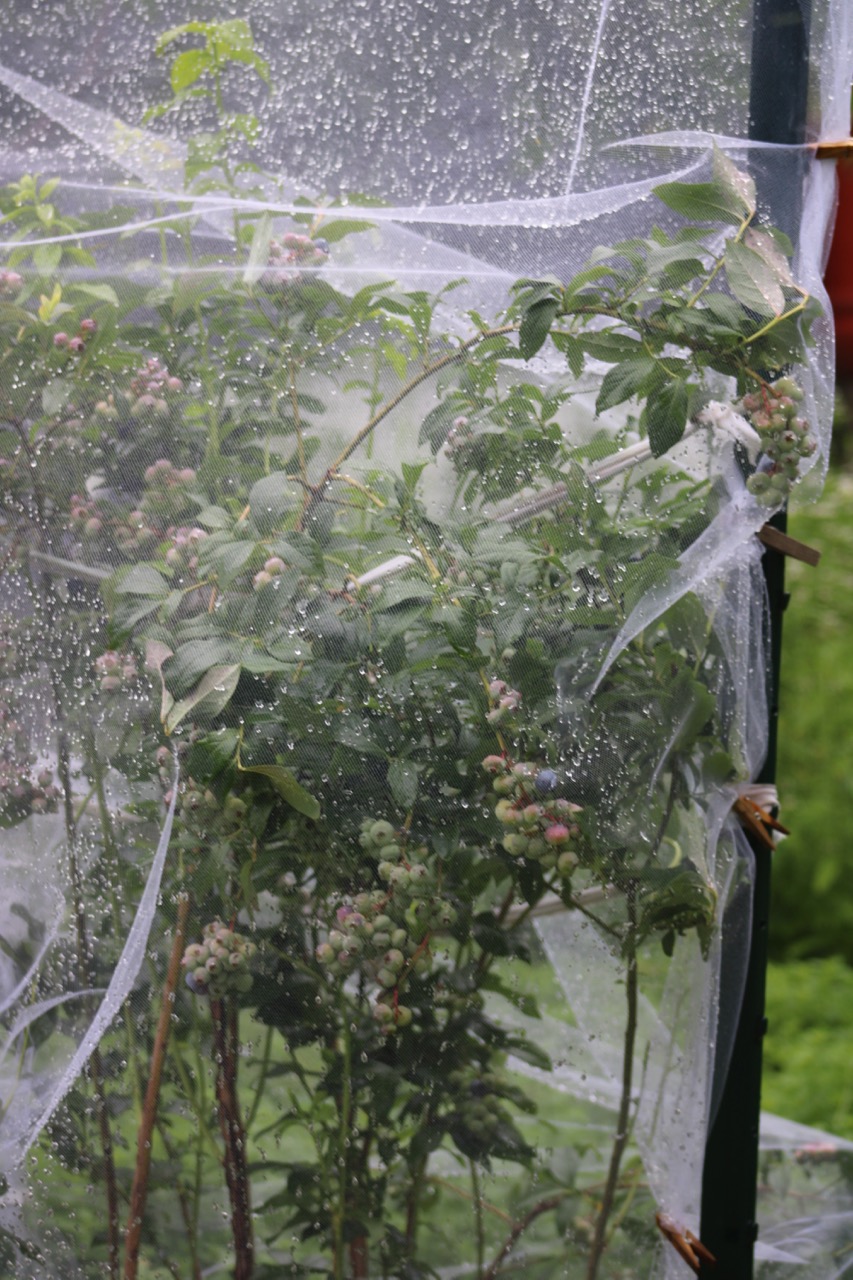
I’ve been feeling like a failure in my deep intention to build relationship with the earth. It’s not that the garden is doing so badly (except for maybe the cherry tree). It is just that I feel unable to tend to it, unable to even sit outside and appreciate it. (The cherry tree needs some attention because of, perhaps, black cherry aphids and sooty mold.) If I manage to do one small garden thing in a day, I count that as gain. For example, the other day, I put some tulle netting over the ripening blueberry plants.

Tulle fabric spread over blueberry bush, with raindrops, berries starting to ripen.

I do try to walk around for ten minutes in the morning if I can. But none of it feels like the nurture that the garden had been for me during the last several years. Instead I feel a vague sense of overwhelm, I feel uncomfortable in my body, I feel grief and deep weariness.

And the truth is, because of climate change, because of the destructiveness of our larger society, we are all facing unimaginable loss, we are all facing a time of unknowable earth transformation that may lead to our doom. With this looming around us, no wonder these small weather challenges feel so overwhelming.

So today I am making space for that overwhelm, for grief, for rest. But even in the midst of those feelings, there are parts of the garden that still seemed determined to bring beauty to my eyes. I look out the front window, and the roadside garden is now awash in yellow heliopsis flowers and day lilies. They brighten even a gray day.

Yellow heliopsis flowers all over the roadside garden.

30 Years!

Margy & Myke selfies, two old white lesbians sitting close on a quilted background loveseat.
Margy & Myke cuddling on our new loveseat recliner 2023.

July 4th is the 30th anniversary of Margy and I being together as lovers! We have many different anniversaries actually–for example, it was six years before we moved into a household together, when we moved from Boston to Cape Cod in 1999. Perhaps that was our first truly big commitment, buying a house together in a new place. We never did the legal marriage thing, even as we fought for it to become available to same-sex couples, partly because Margy has been disabled since we’ve known each other, and she would have lost her health care coverage, and partly because legal marriage just didn’t matter to us personally, radical dykes that we were.

Our Love Is Holy poster carried by Margy and Myke at state house in Massachusetts surrounded by other rally goers.
Mar 11 2004 rally at the state house in Massachusetts, constitutional convention about equal marriage

We were something of a case of opposites attract, and we often found ourselves surprised to be together. Our values and commitments were solidly aligned, but our personalities and relationship styles were different. Still, we adapted to each other’s needs, we cared for each other, and we are still learning how to do that. I love Margy for her passion, for her humor, for her curiosity, for her tenderness. Also for being such a sweet butch. Music, dancing, activism, the ocean–they were all parts of our love story. These days, I love that she goes out beyond the yard to get rid of invasive plants; that when she mows, she mows around native plants like goldenrod and ferns so they can flourish.

Margy surrounded by green trees and vines, pulling on multiflora rose shoots.

I love that she encourages my pond building and orchard planting. I love that we both love critters like birds and frogs. That each of us cherishes solitude as well as togetherness. As we come into our elderhood, many things keep changing. We face new challenges, but our love is like the ground, a living foundation in which to keep planting and tending the seasons of our daily life. I am so grateful that we found each other, and that we have journeyed together for these thirty years!

White pond lily with yellow center, on greenish pond water, with reflection, and two leaves floating behind.
Pond lily blossoming!

Fledging Day!

Robin chick perched in nest, under cream colored covering.
The last robin chick in the nest. The others have left in the night.

Today all the robin babies fledged from the nest. When I woke, there was just this one left. Its parent came by to check on it, not bringing food, but flying up to the nest and then back down, as if to say, here is what you do now.

Robin perched on wooden deck railing near post.

Shortly after, I saw it take its first flight, flopping over to the screen window of our house, where it tried to grab hold but then fell down to a soft patch of lemon balm below the window. (Now I am wondering about a sound I heard last night, of something bouncing on the screens in my room. Might that have been earlier chicks making their first flights?) A bit later, I went down to the patio, and something flew by from a perch on the chairs, then to the grass on the other side of the orchard. All the while the parent robins were chirping loudly and continuously, whether to warn me away, or to reassure the chick, I don’t know.

Robin fledgling in grass.

I was wondering what would happen next for the fledglings, and learned via research that the parents will keep feeding and teaching them for the next few weeks, while they hide on the ground or in bushes, trying to avoid predators and learning to find their own food. I am so glad that there are no more neighborhood cats roaming in our yard. The mother might start another brood soon, but the father will keep watching out for these fledglings during this time. All the chicks will stay in this territory for about 4 months or so.

I wandered around the orchard and the yard trying to see what I could see, while the parents chirped at me, and I spotted this chick on the pallets that form our yard waste bins, with a parent nearby perched on the same bin.

Robin fledgling with mottled feathers perched on wooden slats of bin.

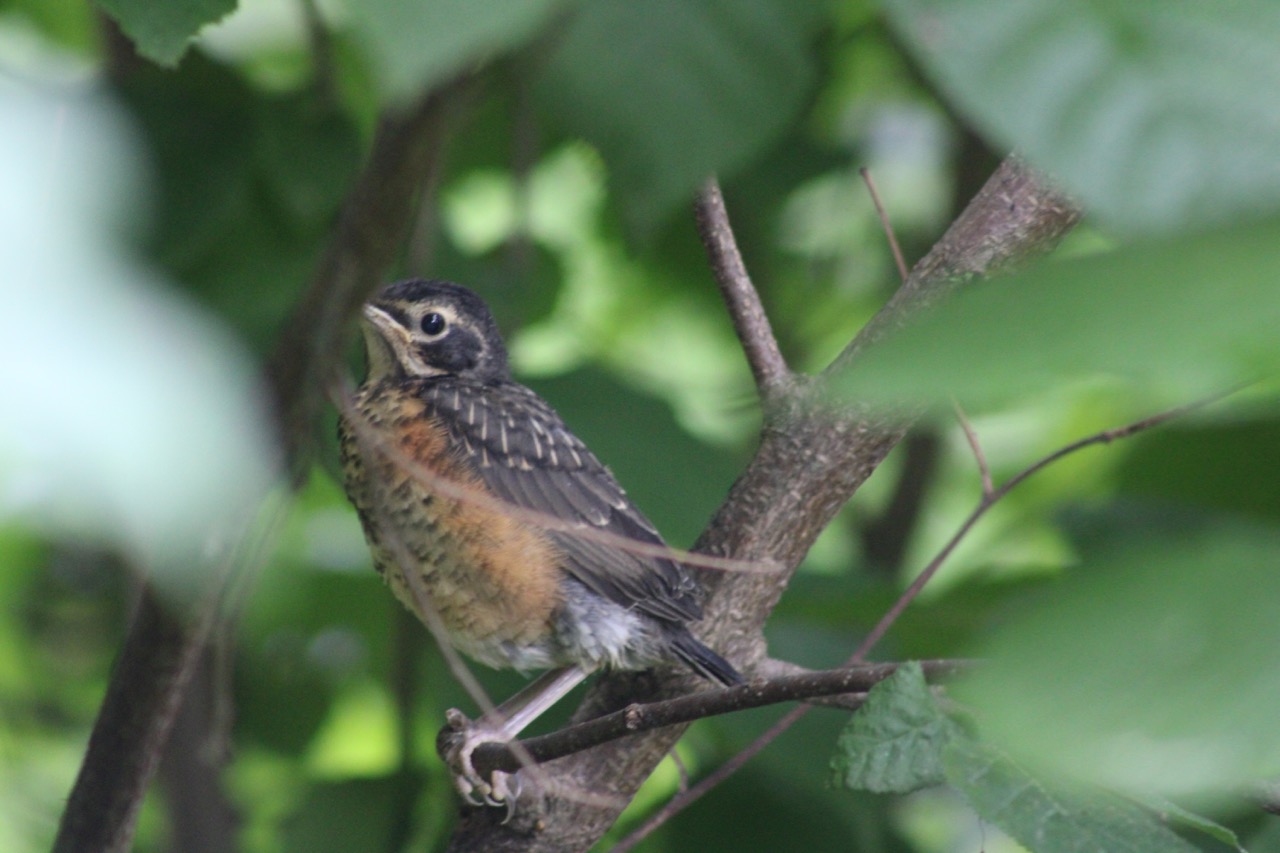
Finally, I was heading back to the house and suddenly saw another chick perched quietly in the hazelnut bush.

Robin fledgling on branch surrounded by green leaves.

I had to go inside then to eat my own breakfast, and download the photos. As I have been writing this, outside on the patio, I’ve seen the parent robins go into that bush with food, so it must still be there–it is a great hiding spot. I am torn by competing desires: to observe and photograph the young ones, or to just go inside and ease the parents alarm. They should know by now that I won’t hurt their babies. Actually, they don’t seem to mind me when I am sitting at the patio table, not walking about.

In the meantime, I am glad we have lots of tall plants and bushes and trees that make good spaces for the next phase of their young lives. It all happens so quickly–less than four weeks from the eggs in the nest to the small birds out and about. I wish them all the best!

No smoke here right now…

purple and pale lavender spiderwort blossoms in spiky green leaves, with rain drops clinging to leaves
Spiderwort blossoms after rain

We’ve had two weeks of very cool rainy weather, and that counter-clockwise low pressure weather system has kept away the wildfire smoke from Canada, while folks to our south are facing orange skies and unsafe air. Still, we’ve paid attention, following the news, and thinking about what might happen if it does come our way. It is easy enough for Margy and I to stay inside, or wear our N95 masks outside.

But now that we are deeper in relationship with our land, I am anxious about how such bad air might affect the robins and frogs and squirrels and other critters who live here with us. They don’t have masks and can’t get inside. I wonder if the babies of these critters wouldn’t make it, so vulnerable in those first weeks of life. My heart is wide open to our little microcosm of earth life.

And yet it is the macrocosm that emerges most in this story, because the smoke is coming from far away in Quebec, from wildfires made more destructive by climate change. We aren’t alone in our microcosm, we are all connected by the winds that blow across the globe, undeterred by artificial boundaries. I have been somewhat removed from wildfire problems. I have seen them on the news in California, Alberta, Australia. This is the first time they have come close to where I live. But truly we are all more and more vulnerable. And of course, some much more vulnerable than others. I worry about people without houses, struggling just to survive, in a tent or with a tarp. They can’t get out of the bad air.

There is so little I can personally do about these large issues at this time in my life. That is some of my motivation for trying to tend our little garden–to love this small place of earth in hopes that more and more people can learn to love the larger earth, our great mother. To share the beauty of this earth in writings and photos on this blog, that beauty might inspire love. But love includes grief, and the more we love the earth, the more we grieve for the destruction that human beings are perpetrating.

Irises in bloom, purple, with hints of paler purple and yellow.
Irises in bloom

Roadside Garden Flowers

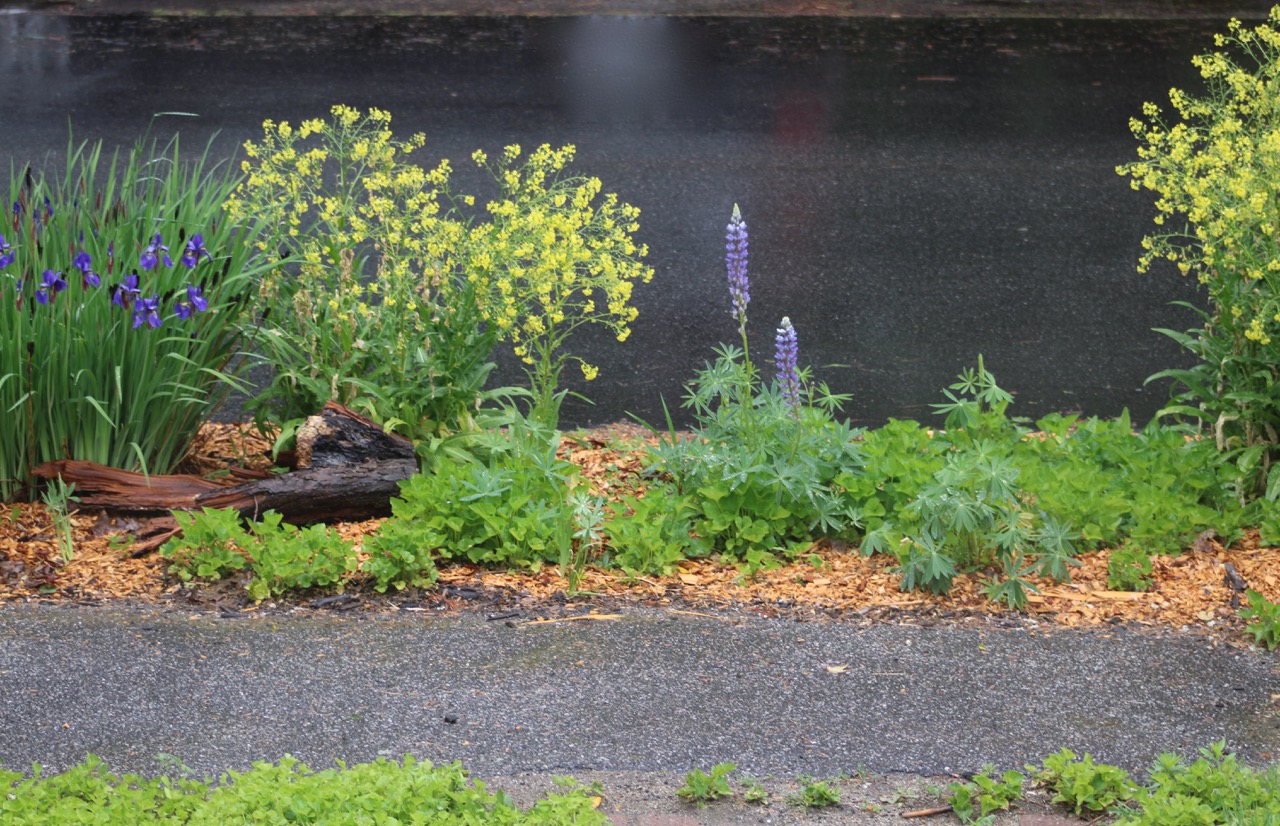
Roadside garden with siberian iris purple flowers, turkish rocket yellow flowers, lupine purple flowers.
Siberian iris, turkish rocket, lupines in bloom.

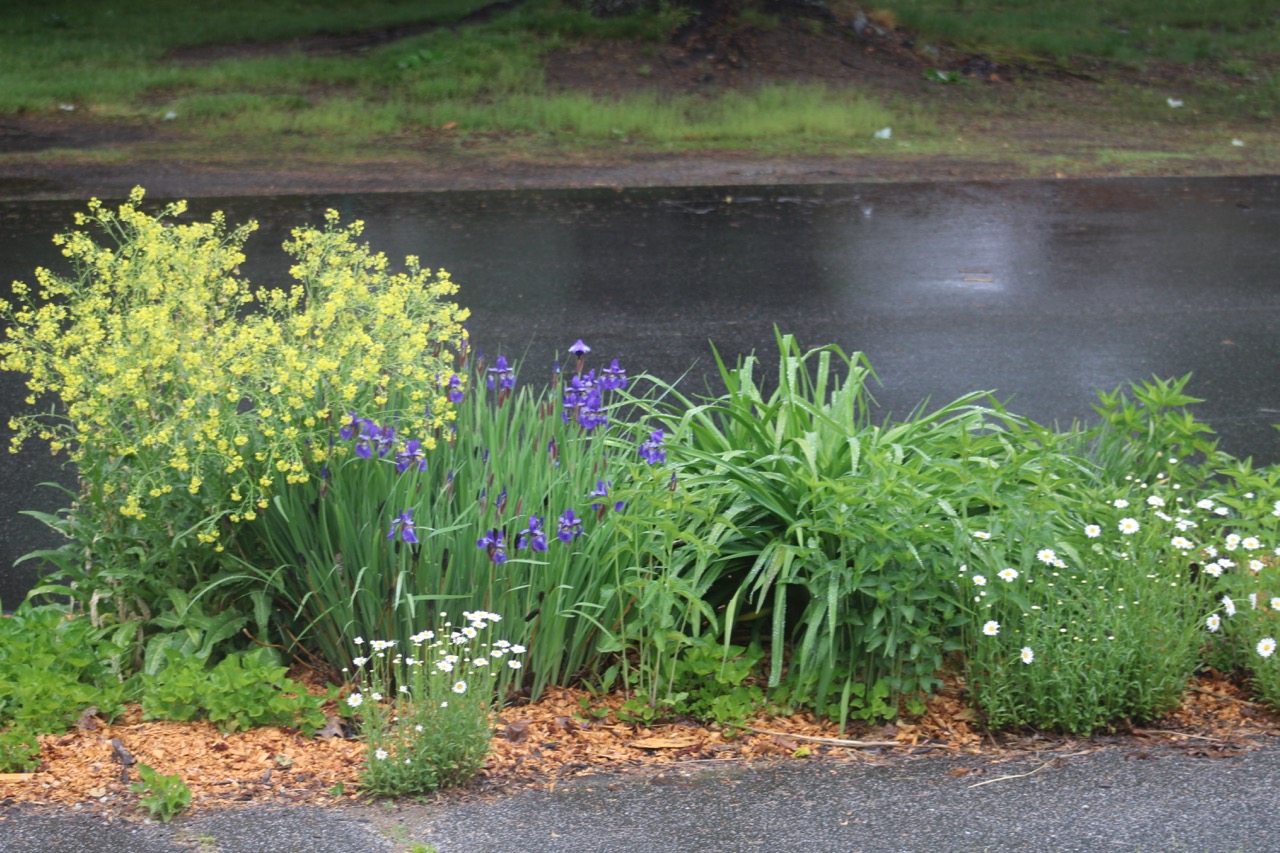
This is my favorite time of year for the roadside garden. The flowers are in contrasting colors of bright yellow, purple/blue, and white, with lovely green leaves of all shapes and sizes. Despite the cold and rain of the past week, it seems to send off a glow into the gloom. It was a garden formed originally from gifted hardy perennials, and others have naturalized to find their own places, like the white daisies.

Yellow flowers of turkish rocket, purple Siberian irises, daisies, in front of rain slicked pavement road.
Turkish rocket, Siberian iris, wild daisies in bloom.

Before the rain, we planted random and unknown flower seeds in one of the garden beds in the front, and carrot seeds in the other (next to broccoli seedlings). I had also planted zucchini and cucumber seeds in the hugelkultur mound. I hope the rain waters them gently and they sprout. Most of our seeds are from prior years, so it is a gamble. But it did seem like good timing.

And for those who have been following this blog, you might be delighted to learn that after the robins fledged, the parents are now starting a second batch of eggs. Once again, she laid one egg per day, but this time, there are four!

Four blue robin's eggs in nest

Pond lily surfacing

Pond, with stone edges, ninebark bush in back, spiky green blue flag leaves in front, and on surface of pond, two round red leaves of a pond lily.
The pond lily leaves have reached the surface of the water.

Last fall, I moved my pond lily plant, pot and all, to the bottom of the pond, from where it had been positioned on a step about 18 inches down. This was to help it survive freezing temperatures in winter. I wasn’t sure what would happen, but I was delighted to see red leaves starting to form around April 22, when I took the following blurry photo through the water.

blurry all over, through water, faint sign of red leaves forming in pot.
Red pond leaves seen through the water.

Thursday, the first leaf reached the surface on a tall thin stem, and others are following. They are red and round, but I imagine that they will turn green as the sun shines on them, since last year they were green. In the up and down world of gardening, it is thrilling when the perennial plants thrive on their own.

Red round leaves on surface of water.

The sweet flags I planted this year are also doing well–you can see them in the top photo near the stones. The blue flag irises are also coming back strong–their leaves are in the foreground. Meanwhile, the green frogs are happy–I’ve seen three so far. The bees are happy, and the tadpoles are still around. The maple trees scattered their seeds all over the yard, and many fell into the pond, but I didn’t scoop them out.

Green frog with stripey green and brown body sitting in water, with honey bee nearby on rock, drinking, and small tadpoles swimming.
Green frog, bee, and tadpoles in the pond.