Abundant Love

According to Rev. Gordon McKeeman, the Universalists introduced the belief in a God who loved so abundantly that he would drag “the last unrepentant sinner, kicking & screaming, into heaven.”

Wow! A God who loves so much, who wants joy and blessing for all people, even if we have to be dragged into it against our will. It is such a gospel of hope, in contrast with the harsh and judgmental gospel of Calvinism.

One of the questions another of my colleagues, Rev. Mark Morrison-Reed, asks is why didn’t Universalism spread all over this country? Who could resist a religion with no hell?  Why was it so much harder to believe in a God of overwhelming love than in doctrines like the virgin birth or the resurrection? He answers his own question like this:

What we yearn for is unconditional love but it is contradicted by our experience. Instead, the principle message each of us received over and over again was this: behave and be loved, behave and be loved. The implication is: those who are good and compliant are loved, all others not. Universalism calls this “partialism.” In other words, people have taken their own experience of conditional, judgmental, imperfect human love and ascribed it to God.

What does it mean to believe that God is love? The phrase may have become so familiar that we almost don’t hear it anymore. One of the letters in the Bible says it, “God is love, and those who abide in love, abide in God, and God in them.” We can get derailed if we imagine God as an all powerful ruler sitting on a throne granting favors. Then, if something tragic happens to us, we feel that God must not love us. But if God is love, then the image of favor-granting dictator doesn’t work. God is more like the Sun, shining on everything and giving life to everything, no matter what, enabling all things to unfold in the way that they will by being alive.

Sun Shining on People

Photo by Margy Dowzer

Quote from Mark Morrison-Reed from “Dragged Kicking and Screaming into Heaven

God is not an angry judge

The God of judgement has been a prevalent theme throughout the course of American history because of the influence of John Calvin. He lived from 1509-1564, and was an important figure in the Protestant Reformation in Europe; he was heavily influenced himself by the earlier work of St. Augustine. Calvin’s teachings became known as Calvinism. He is important to our American story because the Pilgrims and the Puritans who came to America were Calvinists.

Calvin preached the total depravity of human beings. Because of original sin, he said, all human beings were born evil, and had no capacity to goodness or to connection to God. However, according to Calvin, God chose to unleash his anger on Jesus, who willingly died so that some people could be granted salvation. The people who were saved were called the “elect,” or the chosen. These people were predestined to holiness, and all other people were doomed to bear the anger of God for their sins, and to suffer in hell. It did not matter whether you tried to be good—that wasn’t enough to get you into heaven.

This was the preaching of the earliest New England pastors, and it was revitalized in a religious movement known as the Great Awakening in the early 1700’s. The Great Awakening was marked by an appeal to emotion, rather than intellect, and the goal was to provoke emotional conversion experiences. If you had one of these conversion experiences, it was considered a sign that you might be among the elect. Again, these were “fire and brimstone” sermons—lifting up the torments of sin and hell, and the likelihood of damnation if one didn’t find salvation.Firey Furnace MJ DSC02606_2

But some preachers found a different inspiration. They asked, “If God is our father, then how can a father condemn his children?” People knew how much they loved their own children. If as human beings they only wanted the best for their children, wouldn’t a heavenly father be even more loving than we could be. Wouldn’t a father want to save all of his children from the torments of hell?

A man named John Murray had asked these questions in England, and been branded a heretic. He came to America in 1770 to try to get away from all that. There is a wonderful story about him being shipwrecked off the coast of New Jersey, right where a farmer named Thomas Potter had built a chapel, waiting for someone who would preach about universal salvation. And so John Murray did.

This was the beginning of the religious movement in American called Universalism: a deep devotion to the idea that God is love, and that God’s love reached everyone, and there was no such thing as hell. This was quite a radical notion in 18th century America. The most influential of the early Universalist preachers was the Rev. Hosea Ballou. He and others went around the countryside, spreading their message among the working people and farmers, and many Universalist churches were started. When the preacher Rev. Thomas Barnes came to Maine in 1799, that was the start of Universalism in Portland, and the beginnings of my own congregation.

People used to argue with Hosea Ballou—they would say, “if there is no threat of hell, why would anyone be good, or obey the law.” Ballou used to respond, “what kind of goodness is it, if you are only doing it to avoid hell? I don’t need the threat of hell to practice goodness.”

Guilt or Love?

Steeple MJ DSC01914One of my hopes in this blog has been to expand our understanding of what God might be, what Mystery and Spirit might be, because so many people have been wounded by the false Gods of our culture. I want to take a closer look at one of those false Gods that I believe has hurt many people. If you have rejected the idea of God, perhaps you’ll recognize the one I am talking about. So I invite you to persevere with me as we explore it a little bit.

I think we can identify two approaches that people have taken to our relationship with the powers greater than ourselves. In one, the powers, the Gods, the Spirits were dangerous forces, and religious ritual was enlisted to appease these forces, and make the people safe from them. In the other, the Gods, the Spirits were benevolent forces, and religious ritual was enlisted to call upon the forces for help in dealing with the challenges of living. I am simplifying it of course, but still, there have been particular times in history when this battle between dangerous or fearful forces and kind and loving forces was in full blaze, and sometimes within the same religion.

When I was a child, I learned about one such conflict between a judging fearful God and a loving God. As a Catholic, I used to read about the lives of the saints, and one saint I liked a lot was Margaret Mary Alacoque. She lived during the 17th century in France. Just before her time, there had been a theologian named Cornelius Jansen who emphasized the idea of original sin. He believed that people were unworthy and evil, and only a few would be saved. Jansen discouraged people from participating in the communion ritual that happened every Sunday, saying it was reserved for only the very holy.

Sacred Heart

But Margaret Mary began to have visions—in her visions she saw Jesus, and she saw his heart, as if it were outside of his body, burning with love. He told her that God was full of love for people, and that God wanted to help people. Now, for those of you who have been Catholic, you may remember seeing pictures of the Sacred Heart of Jesus. It became an important devotion in Catholic life.

For me, this story was a gift—first of all, I thought it was cool that she had visions, and could talk to Jesus. But more importantly, this story told me that I was loved by God. All Catholic children learn a lot of guilt, and lessons about original sin, and mortal and venial sins, can weigh heavily upon us. But this story shifted the balance for me—it helped me to know deep in my heart that God was love, and that God loved me.

Now, I am guessing that very few people have ever heard of Cornelius Jansen or Margaret Mary, but perhaps you have your own memories of a church in which you felt guilt and shame, in which you learned that you were a sinner, or unworthy. Those ideas are just as pervasive today as in former centuries. The God of judgement has been a prevalent theme throughout the course of American history because of the teachings of someone much more famous that Jansen. More on that tomorrow.

What kind of God do you believe in?

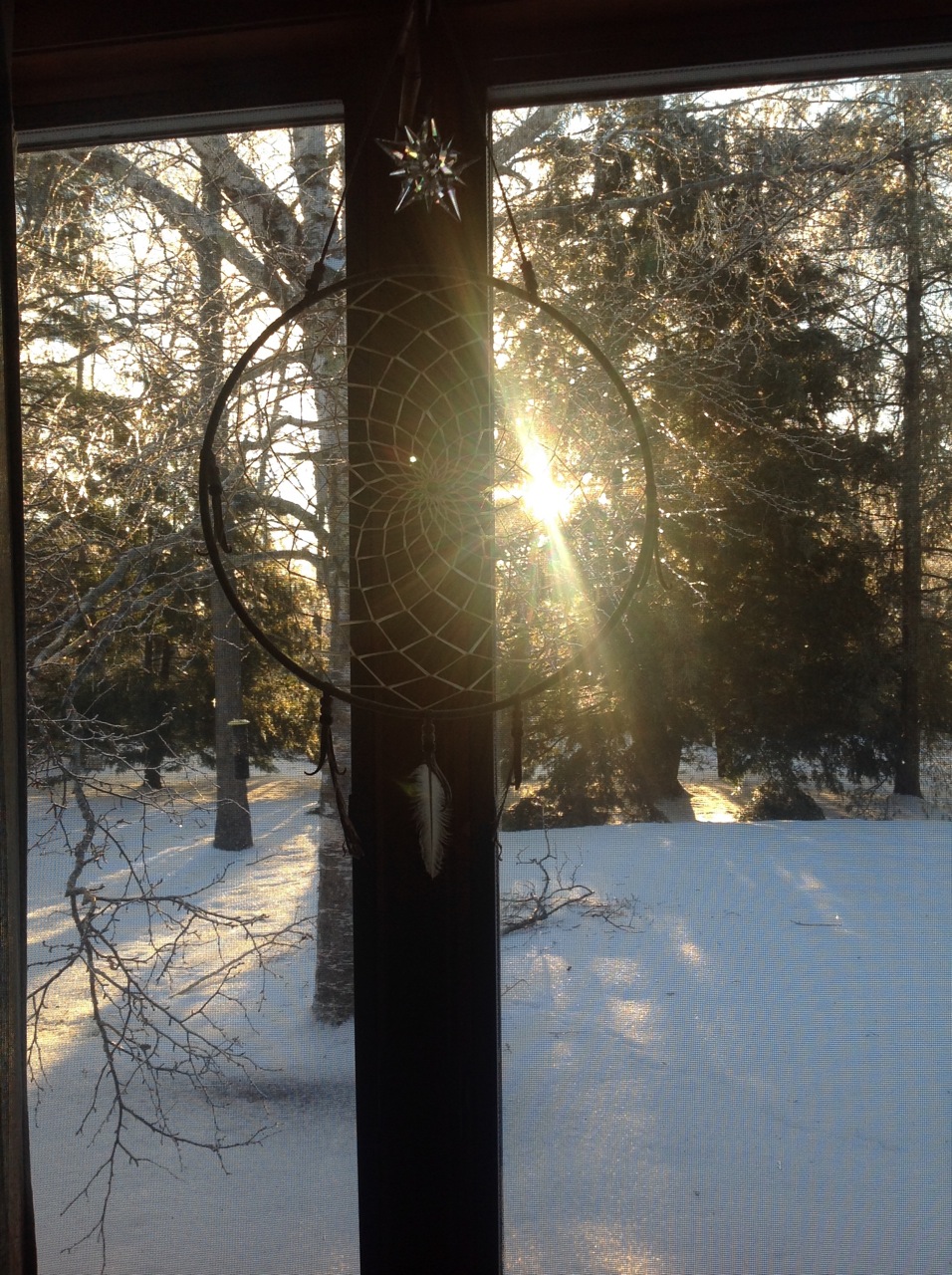
Winter Sun DSC09206

I have never believed in God. Not in your God anyway; the one who looks down onto his chessboard and moves the pieces according to his pleasure, occasionally glancing up at the face of his Adversary with the smile of the one who already knows the outcome. It seems to me that there must be something horribly flawed in a Creator who persists in testing his creatures to destruction, in providing a world well stocked with pleasures only to announce that all pleasure is sin, in creating mankind imperfect, then expecting us to aspire to perfection. …There must be something else, I told myself repeatedly; something beyond sin and solemnity, dust and devotion; something that loved life as indiscriminately as I did.
                                                                Joanne Harris from Holy Fools, p. 32-33.

Throughout history, people have wrestled with the mystery of powers greater than themselves. There are many ways that people have understood these powers—some peoples believed in a pantheon of Gods and Goddesses who ruled various aspects of life; others claimed that there was only one Supreme Being, while still others espoused a belief in natural processes that have unfolded to create the universe as we know it today. We often hear the question now framed simply as: “Do you believe in God?”

Many of us, as children, are presented with one idea of God, framed as if it were the only possible idea of God. If that idea doesn’t work for us, or even hurts our spirits, we may reject the whole notion of God, without further reflection. But there is not just one idea of God, there have been many. People imagine God in one form or another, and it is important to realize that our images of God are not what God really is.

God is a name that some give to the mysterious forces that sustain and uphold the larger reality of which we are a part. These forces are beyond our capacity to actually know or define. We understand them through the use of symbol and analogy. We say God is like this, or God is like that. So, rather than ask, “Do you believe in God,” I think it is much more important to ask “What kind of God do you believe in?” or perhaps even, “What kind of God do you not believe in?” 

In the tree I am held by God

Beech Tree Leaves 133650004There was one more communication I experienced with the four directions tree which was not about writing or speaking or even thinking. Sometimes I merely sat, my body balanced between the sturdiness of the main branches, my eyes resting in the translucent green softening the sunlight.

Even then, the tree and I were involved in a sacred exchange. When I breathed, the tree was my intimate partner. The tree breathed out the oxygen that I needed to be alive, and I breathed out the carbon dioxide that it used for nourishment. Our physical bodies are designed to need each other. We give and receive the very substance of our lives. We have been giving and receiving this way for millennia.

We and the trees are neighbors on this planet, but more than that, we are sacred partners, we are kin. We are genetically and spiritually related to each other. If we are open to respecting the trees, if we value the inherent worth and dignity of the trees, it then becomes possible for us to experience in the trees the presence of the divine Mystery.

Breathing and writing, dreaming and remembering, in the sacred arms of the beech tree, I knew I what it felt like to be held by God and to be one with God. The trees teach us that all of us are related; their quiet language sings the song of the marvelous interweaving unity of life on Earth. Remember this, the next time you walk by the trees near where you live. Listen. And then remember to say thanks.

Blessed Illusion!

Flowing Water MJ DSC02210The Spanish poet Antonio Machado wrote,

Last night when I was sleeping,
I dreamed—blessed illusion!—
there was a fountain flowing
deep within my heart.
Water, tell me by what hidden
channel you come to me,
with a source of new life
I never drank from before.

Last night when I was sleeping,
I dreamed—blessed illusion!—
I had a beehive
deep within my heart;
and the golden bees
were using old
bitterness to produce
white wax and sweet honey.

Last night when I was sleeping,
I dreamed—blessed illusion!—
a blazing sun was shining
deep within my heart.
It burned because it gave off
heat like a red hearth;
it was a sun that illumined
and also made me cry.

Last night when I was sleeping
I dreamed—blessed illusion!—
it was God that I felt
deep within my heart.
                                                                          Translation by Armand F. Baker.

As I have explored in earlier posts, the word God can be a confusing word. God is hard to talk about—whatever we can say about God, that is not really what God is. Machado’s poem uses these stories and images, these dream illusions to describe a movement of mystery within his heart.  Robert Bly, in a more well known translation, calls the original spanish “¡bendita ilusión!” a “Marvelous Error.”

I believe that Machado knows that words can’t really describe what he has found inside his heart.  Only “illusion”–he calls it a blessed illusion–can begin to point to it.  And yet, what we say about God reflects what we worship in the temple in our hearts. What we say about God matters.  And saying this word God is a good reminder to choose something big enough to worship. Saying the word God is a good reminder not to give our devotion to anything which is not worthy of us.

Raymond Baughan, said,

What is required of us…
Is that we go down
Into uncertainty
Where what is new is old as every morning
And what is well known is not known as well…

What is worthy of our worship? What can lead us into the largest reality of which we are a part? What can open our being to the essential Mystery? What will keep expanding, and never be smaller than what we have already known? It is a process never finished.

“What is Required of Us,” by Raymond Baughan,author of The Sound of Silence: a Book of Meditations, 1965, Unitarian Universalist Association.

Reclaiming Our Temple

Sadly, people often fill up their hearts with things that aren’t so good to worship. The temple of our hearts can get messed up and overrun with garbage, or taken over by invaders. When we are too attached to something too small, we call it idolatry or addiction. When we are addicted to something, it has captured the temple of our heart, just like the story we hear at Hanukkah about the Syrians who captured the temple in ancient Jerusalem.

I remember a friend who got caught like that. This was back when we were in high school, and she had gone to see the movie, Bonnie and Clyde, about the two famous gangsters. Somehow that movie became the most important thing in her life. She started dressing like a gangster, and smoking marijuana, and drinking beer; she stopped paying attention to school, and started hanging out with kids who were skipping school and going to stores to shoplift. She became a different person, who didn’t care about anything or anyone anymore. I don’t know what happened to her after I left school. I hope she found a way to clean all the junk out of her heart.

But each of us at some point in our lives has been taken over by something unworthy. How could we not be? We are surrounded by advertising, by greed, by competition, by individualism, by dogmatism, by ideology. Just to survive we make compromises; we learn to align ourselves with a group or a product. We divide into red and blue states. We worship a good thing until it becomes an idol for us. There are many ways to be too small.

Stained Glass Circle DSC05480When our heart has been taken over by something unworthy, it is a battle to win it back. It can be the hardest thing we’ve ever done in our lives. Like the Maccabees who won back the temple in Jerusalem, we may need to dedicate all of our strength to reclaiming our own temple again. We may need to gather others together to help us. But this is important. This is the temple. This is the heart of our life.

The feast of Hanukkah is known as a celebration of miracles. It reminds us that the dedication of the temple is not a simple thing—that there will always be battles over what is in the temple. That we must always re-dedicate ourselves to the worship of what is worthy of us. When I reflect on the old story, I ask myself, again, what is in my temple today? To what is it dedicated? Does it need to be purified? The miracle of Hanukkah was first of all believing that change was possible. Even when all seems hopeless, if we take the first step, if we light the first candle, the way will open up. We take the second step, and light the second candle.

If you had a temple in the secret spaces of your heart, what would you worship there? We can make a choice to worship that which has true worth for us. Rumi advised:

Let yourself be silently drawn
by the strange pull of what you really love.
It will not lead you astray.

Itsy-bitsy Statues

When we give our lives to a larger purpose, whether we name it God, or kindness, or the earth, or Mystery, we can find meaning and transformation and spiritual growth. To worship something too small can distort and cheapen our lives. Even spiritual or religious things can be too small. Thomas Merton, who was a Trappist monk as well as a writer, said, “there is always a temptation to diddle around in the contemplative life, making itsy-bitsy statues.”

Yard Statues DSC09950

When we get attached to our ideas, or images, or even our ways of praying, we can forget the largeness of what it’s all about. We can forget that spirituality is meant to awaken us to the larger whole of reality, of which we are a part. Rumi, the Sufi poet, put it this way: “Don’t be a cat toying with a mouse. Go after the love lion.”

Writer Annie Dillard, reflecting on Merton, said:

There is always an enormous temptation in all of life to diddle around making itsy-bitsy friends and meals and journeys for itsy-bitsy years on end. It is all so self conscious, so apparently moral, simply to step aside from the gaps where the creeks and winds pour down… I won’t have it. The world is wilder than that in all directions, more dangerous and bitter, more extravagant and bright.

Reality is bigger and more mysterious than the things we do, or the ideas we think, or the stuff we buy. If we get too attached to any small thing—wearing the right clothes, or going to the right parties, or having the latest gadget, or even going to the right church—we are filling up our temple with junk. If we fill up our temple with junk, we will miss the “gaps,” the wild places where the “winds pour down.” We will miss the magic.

Thomas Merton was quoted by Annie Dillard in Pilgrim at Tinker Creek
Rumi quote is from Coleman Barks, The Soul of Rumi

What is worthy of our worship?

If you had a temple in the secret spaces of your heart, what would you worship there?

The Buddhist teacher, the Dalai Lama, has said, “My religion is very simple. My religion is Kindness.” In the temple of his heart, he has chosen kindness to value, he has chosen kindness to which to commit his life. He has tried to live with kindness, even when the Chinese government took over his homeland of Tibet, and he went to live in exile. When he could no longer go to the beautiful temples of his childhood, he opened the temple of his heart, and chose kindness and compassion for all people.

People worship different things within the temple of their hearts. It is a very personal choice, to find what is worthy of your worship.

The pagan writer and teacher, Starhawk, calls herself a dirt-worshiper. She points to the soil beneath our feet, and reminds us that all of our food comes from that soil. The soil is the place of Life. So it becomes the most valuable thing in the temple of her heart. She gardens in the soil, and replenishes it with compost. She creates ritual to worship the earth, and celebrate all the seasons of the earth—fall, winter, spring and summer. She tries to stop the companies that are damaging the soil by using too much fertilizer or cutting down the forests. Sometimes she even goes to jail. She is really committed to the earth and to the soil. It is at the center of her heart and her life.

Photo by Margy Dowzer

Photo by Margy Dowzer

Take some time to ponder it.

What do you hold in the center of your heart?
What would you be willing to fight for, to die for?
Is your heart filled with junk?
Or something worthy of your commitment?
When you clean up everything, what stays in the room?
What is the thing you would never throw away?
What helps you keep your balance when trouble comes or storms rock your world?
What helps you connect with the larger reality of which we are a part?

What do you worship?

Window MJ IMG_0066If you had a temple in the secret spaces of your heart,
What would you worship there?
What would you bring to sacrifice?
What would be behind the curtain in the holy of holies?
Go there now.
                                        Tom Barrett

In ancient times, the temple was the center of the Jewish religion. It was the most beautiful building in all Judea. I wonder what it might be like to have one place in your country where people could journey to experience the mystery of God. It would have to be very beautiful and light, and full of music, or perhaps silence. The Jews had such a building. They believed that God was close to them in the temple. Only the priests could go deep inside to the very center room—they called it the holy of holies. But just being in the building gave people a sense of hope and wonder and mystery.

The poet Tom Barrett asks,

“If you had a temple in the secret spaces of your heart,
What would you worship there?”

Twentieth century theologian James Luther Adams said that every person worships something. The word “worship” comes from worth—to worship means to honor the thing that is worth the most to us. To what will we give our devotion, our loyalty, our sacrifices? Whatever we give our deepest allegiance to—that is what we worship, that is our God. Even if we think we do not believe in any God, we will give our allegiance to something.

What we worship, what our God is, has implications for how we live our lives, and what we value in all parts of our lives. Should our attitude toward reality be one of caution, or thankfulness? Obedience, or exploration? Aggression, or compassion? Who or what is revered by us? Warriors dying in battle, or mothers giving birth? Those who are tough and tenacious, or those who are thoughtful and kind? It is not enough to ask, do you believe in God? Rather, we must ask, what kind of God is worthy of our belief? James Luther Adams said it is important to choose something worthy of our allegiance.

Tom Barrett, “What’s In The Temple?” is from Keeping in Touch, 1993.
For more from James Luther Adams, see “A Faith for the Free,” in The Essential James Luther Adams, edited by George Kimmich Beach (Boston: Skinner House, 1998).