Fighting with Squirrels (and Chipmunks)

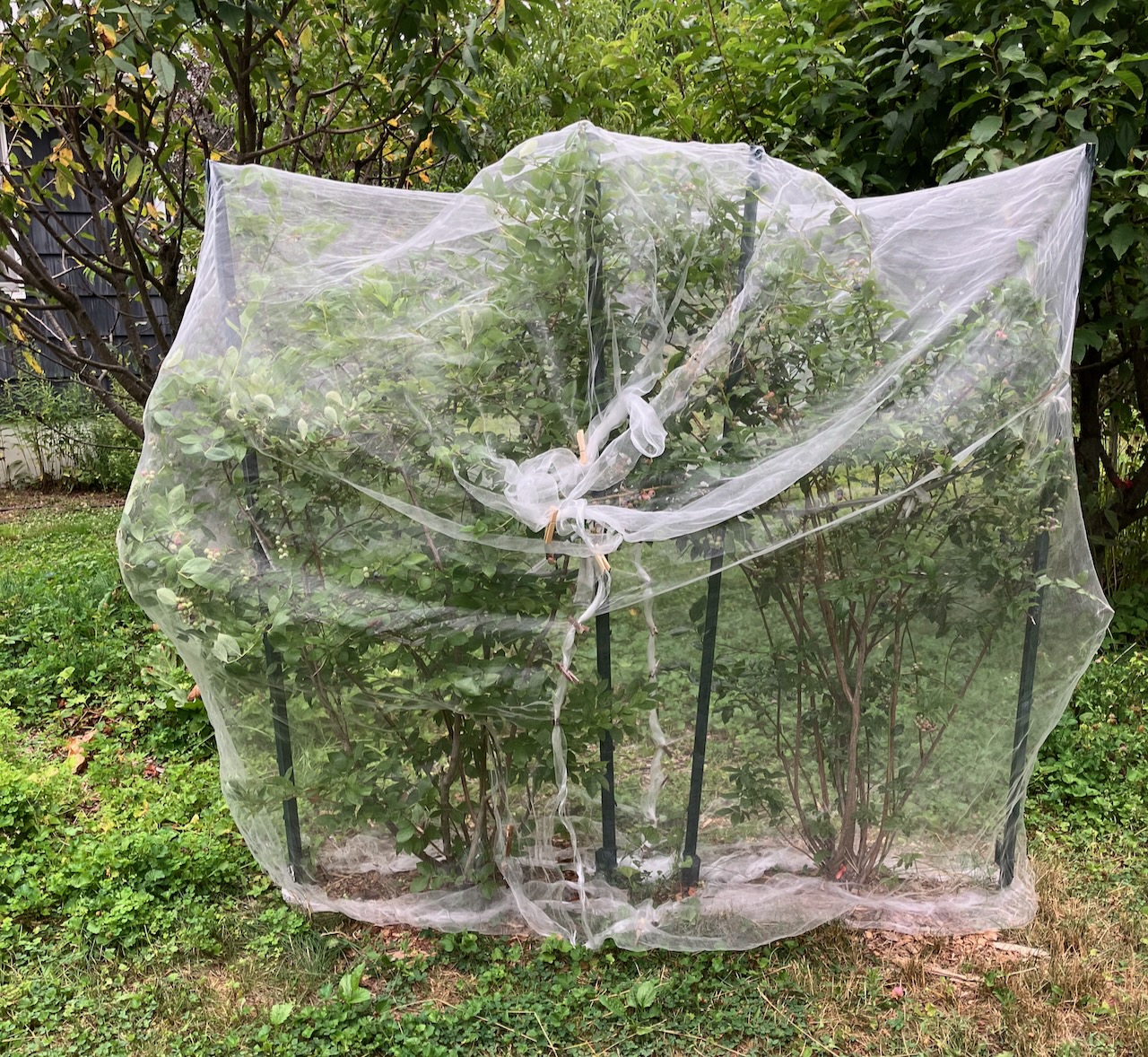
White netting draped over two blueberry bushes, using fence stakes

The intent of our permaculture gardening is to create a mutually beneficial relationship with the earth and all her creatures. But lately, it feels like a little backyard battle. The squirrels have literally eaten all of the green peaches off our peach tree. (Last year there seemed to be enough for all of us.) They have been also eating raspberries, hazelnuts (still green) and mulberries, but I sort of gave up on all of those. I have tried to protect these two blueberry bushes by covering them with netting, garden-stapled down, and using clothes pins to close the side opening. I have actually harvested some blueberries. But the last couple days, they’ve pushed their way through holes they make in the netting. When I see them, I run out yelling and clapping, and they dart around the edges to find their way out and run away.

To be fair, there is another variable this summer. I stopped filling the bird feeder some weeks back because the chipmunks would immediately climb up, fill their cheeks, climb down, and transport the seed to their underground lairs; and then repeat until all the seed was gone. The squirrels also took a fair amount. I wonder if the sunflower seeds were the tribute I had been paying to our little neighbors that ensured that they’d save us a few peaches? But yesterday, perhaps I upped the ante, because I installed a baffle on the feeder, and coated the pole with coconut oil. I really do want to feed the birds, not all the greedy chipmunks and squirrels. So here is the new set-up, (the bush is at least five feet away–I pruned it to make sure):

Green metal bird feeder with clear plastic baffle a few inches down, in front of a green bush background.

Margy and I have a little side bet going as to when they might be able to breach these new security measures. It has been up for twenty-four hours so far. No squirrels, chipmunks so far. But the birds haven’t come back yet either. The next few days will tell. And in case it isn’t easy to see, the original bird-feeder is also “squirrel-proof,” with a weight dependent bar that drops down to close the seed opening. But they figured that out long ago. They are so smart, and acrobatic. In many ways I love them. But I don’t love that they take all the fruit in our garden.

Anyway, I just needed to write about this other side of gardening. I am so impressed by the work farmers do! If we relied only on our own gardening skills, we would go hungry. But perhaps this is one of the lessons I am learning about how to be in a mutually beneficial relationship with the earth, and during climate warming too. We are all under a lot of stress, trying to survive. We don’t have complete systems in place, we don’t have our own ancestral knowledge, we are trying to recover from great imbalance. So we keep showing up, keep going outside, keep being grateful for the gifts of the earth.

And these days, I can’t write about anything food-related without also expressing rage at the intentional starvation of the Palestinians in Gaza by the state of Israel. They destroyed their farms and gardens, and destroyed access to water, and access to help from outside. How many more people will die before the world powers stop this genocide?

First Snow, Gaza, Small Birds

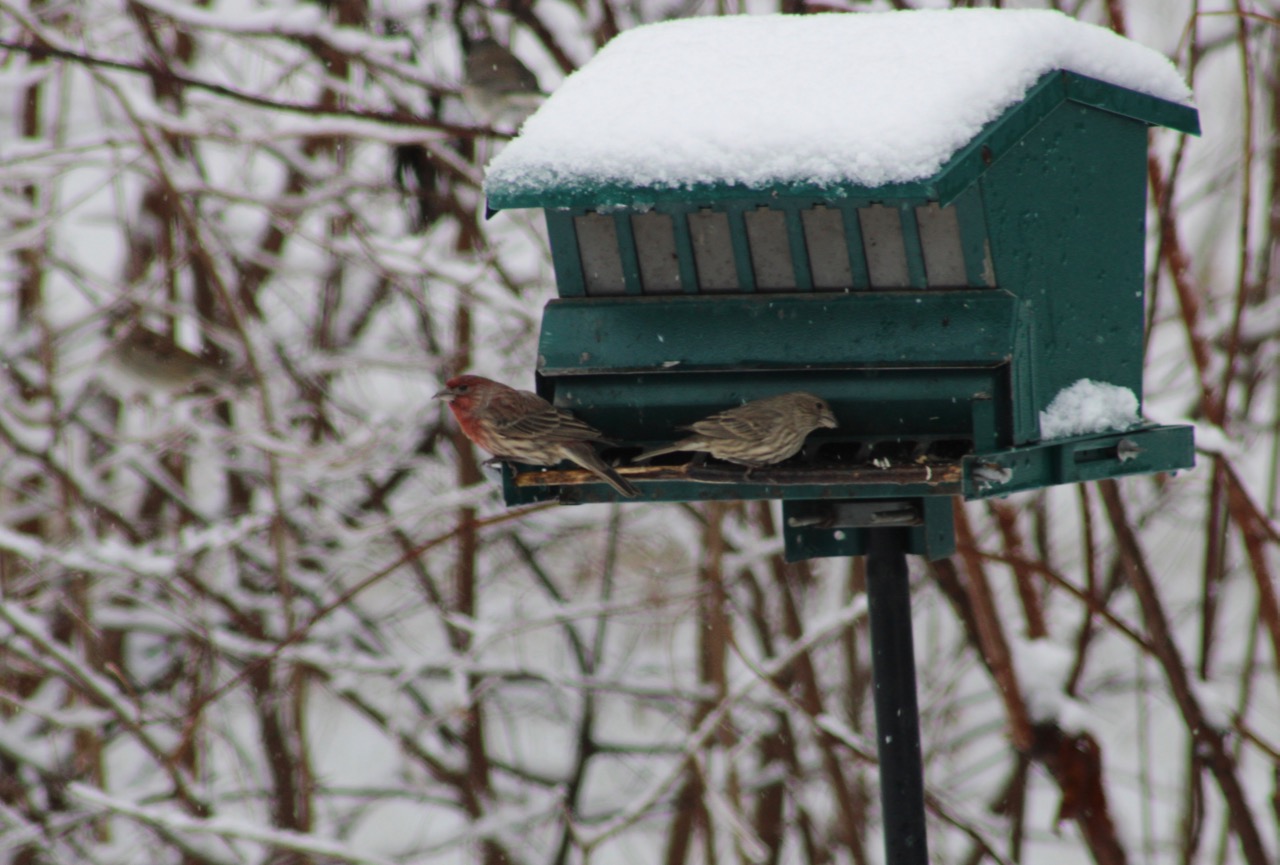
Green bird feeder in front of snow covered branches of hazelnut hedge.
Bird feeder near hazelnut hedge.

We have our first snow-covered morning here in our yard in Portland Maine. In places further from the shore they got several inches, but we had mostly rain until early morning. Now it feels like winter is really here. My internal clock has felt the shift, as the days grow shorter and darker. A few days ago, I started working again on sorting through my old documents–my winter project of the last few winters. This year, most of the documents are digital, though there is at least one box of paper files to go through in the basement. In prior winters, I looked back on all the years before we moved to Maine in 2005. This winter, I am looking through my time as minister of Allen Avenue Unitarian Universalist Church here in Portland, before I retired in 2018.

I started by reading all of the “annual reports” I wrote for the church to summarize the work of that year. It was a simple way to quickly turn the pages of thirteen years of ministry. I was astounded at the sheer number of times I marched in protests, or spoke at vigils in solidarity with issues of justice or worked on legislative change in support of human rights, usually along with other members of my congregation or other ministry colleagues. My life now is so much quieter and less intense, but also less connected. It was good to have that public voice, and to use my voice in service to all that I believe. I feel so far removed from that life and that work.

I suppose in some ways a blog is a kind of public voice, but much quieter and less visible. My life these days is much quieter and less visible. That is chronic illness, compounded by our continued COVID precautions in our household. I can’t put my body out on the line for love and justice. It takes most of my body’s energy just to manage our household tasks. It is like I am looking out a window at all that is happening in our world.

I was surprised to notice that I hadn’t blogged for a few weeks. Lately, all I can think about is Gaza and the way the people there are suffering and dying. In my files I found a sermon I preached in 2014 about Palestine and Israel. In many ways, the issues are all the same. In other ways, everything has gotten worse, much worse. So many deaths, so much destruction. I can’t even imagine the words I could say about it, and then I don’t have words for anything else. My heart is on the ground. My heart is on the ground.

And then, out the window I see a large flock of small birds visiting the hazelnut hedge and the bird feeder. They find their way to our yard each day, traveling together as a group. They usually arrive mid-day, but today they are early. Tufted titmice, chickadees, goldfinches in their winter garb, sparrows, juncos, finches, even a bluebird. (Maybe they come more than once a day, but you have to be looking out a window to see them so I am not sure.) Often a few chickadees even stop at our back porch pecking for stray seeds. It is not so easy to take a photo of a flock of small birds. They scatter themselves across the orchard. They come through and then they are gone again. Traveling all together on their mysterious rounds.

And my heart is lifted just a little, with their flight and their community.

Finches at feeder.
Junco on a branch.

Fledging Day!

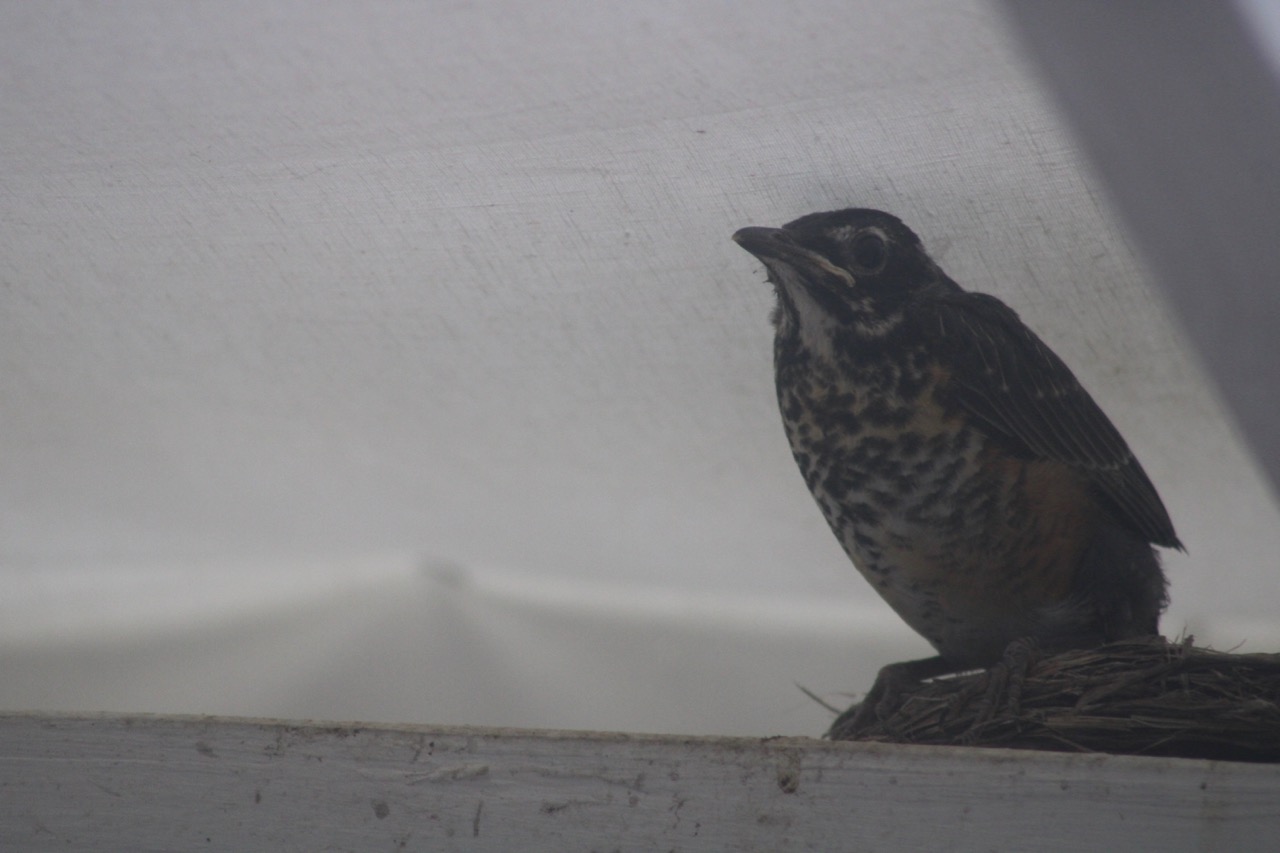
Robin chick perched in nest, under cream colored covering.
The last robin chick in the nest. The others have left in the night.

Today all the robin babies fledged from the nest. When I woke, there was just this one left. Its parent came by to check on it, not bringing food, but flying up to the nest and then back down, as if to say, here is what you do now.

Robin perched on wooden deck railing near post.

Shortly after, I saw it take its first flight, flopping over to the screen window of our house, where it tried to grab hold but then fell down to a soft patch of lemon balm below the window. (Now I am wondering about a sound I heard last night, of something bouncing on the screens in my room. Might that have been earlier chicks making their first flights?) A bit later, I went down to the patio, and something flew by from a perch on the chairs, then to the grass on the other side of the orchard. All the while the parent robins were chirping loudly and continuously, whether to warn me away, or to reassure the chick, I don’t know.

Robin fledgling in grass.

I was wondering what would happen next for the fledglings, and learned via research that the parents will keep feeding and teaching them for the next few weeks, while they hide on the ground or in bushes, trying to avoid predators and learning to find their own food. I am so glad that there are no more neighborhood cats roaming in our yard. The mother might start another brood soon, but the father will keep watching out for these fledglings during this time. All the chicks will stay in this territory for about 4 months or so.

I wandered around the orchard and the yard trying to see what I could see, while the parents chirped at me, and I spotted this chick on the pallets that form our yard waste bins, with a parent nearby perched on the same bin.

Robin fledgling with mottled feathers perched on wooden slats of bin.

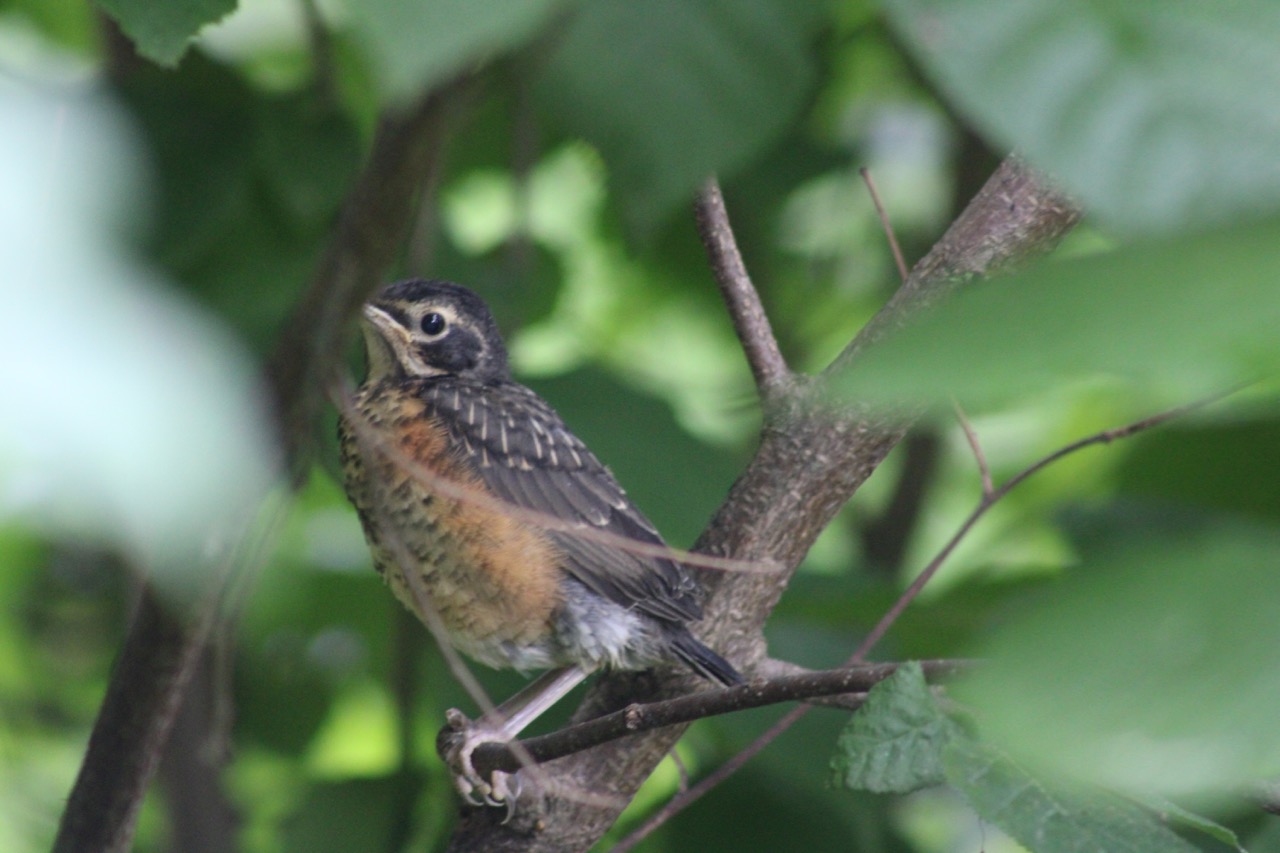
Finally, I was heading back to the house and suddenly saw another chick perched quietly in the hazelnut bush.

Robin fledgling on branch surrounded by green leaves.

I had to go inside then to eat my own breakfast, and download the photos. As I have been writing this, outside on the patio, I’ve seen the parent robins go into that bush with food, so it must still be there–it is a great hiding spot. I am torn by competing desires: to observe and photograph the young ones, or to just go inside and ease the parents alarm. They should know by now that I won’t hurt their babies. Actually, they don’t seem to mind me when I am sitting at the patio table, not walking about.

In the meantime, I am glad we have lots of tall plants and bushes and trees that make good spaces for the next phase of their young lives. It all happens so quickly–less than four weeks from the eggs in the nest to the small birds out and about. I wish them all the best!

Humbled

Photo: Future Peaches?

I have been having a few days in the garden that humble me to my core. This process of finding our way home to earth community is so difficult. Trying to care for fruit trees involves learning about so many insect pests and disease processes. Observing the trees carefully every day. Yesterday and today I was thinning the tiny peaches leaving only one every 6 inches, so that the branches can support them to grow. Often I am trying to figure out which organic solution goes with which problem. And yesterday morning, I saw one of our squirrel neighbors climbing the peach tree–a whole other issue. Will we get to eat any peaches, or will the squirrels take a bite out of each one? Or will birds peck holes in them? Or some other insect pest eat them from the inside?

I hate how gardening sets me at odds with the other critters on this land–figuring out which are “beneficial” (to us) and which are “enemies” (to us.) I remember that when I first had a little garden, many years ago now, I was surprised that so much of it was about killing–pulling weeds, drowning slugs in beer, and so forth. And now that I am caring for an orchard, a permaculture food forest, it’s the same thing. A constant battle. So how is that teaching me how to live in a mutually beneficial relationship with this land?

I start to wonder if human beings should ever have shifted from hunting/gathering to agriculture. Hunting and gathering certainly included the taking of animal life, but it seems like it was more in balance, it was received with gratitude, it was a kind of partnership. I am thinking about the different role of the groundhog in the lives of different cultures. The bane of many gardeners’ lives, groundhogs are incredibly inventive and persistent garden eaters. It was amazing to me that here on our land, the groundhog whose den was next door seemed to respect the orchard as our place, while the garden bed behind the garage she claimed for her own. But I have a friend who built a fence deep into the ground around her entire garden, and still the groundhog family dug a tunnel and emerged right in the center of the garden to eat her vegetables.

However, the groundhog played a different role in Wabanaki cultures, in tribes that were traditionally hunting and gathering. I only know a few of the stories about the legendary figure for good, Koluskap (Glooscap), the creator of human beings. But I learned that his grandmother was the groundhog, Munimqehs, and she guided him and taught him the wisdom he needed. What a different perspective! She taught him that people and animals relied on each other, that hunting was necessary for the people to be strong, but that taking more than was needed was destructive to both.

Photo: The groundhog who used to live near our yard.

Likewise, deer might be a blessing for hunters, but destructive to trees and gardens. We see about one deer each year passing through the back of our yard. We used to have a gang of turkeys that roamed the streets of our neighborhood. They are gone now. Eventually, the groundhog disappeared too–I think a neighbor had something to do with that. Now, it seems, along with birds, we only have squirrels and a little star-nosed mole that tunnels under our wood chip paths, and an occasional chipmunk. But the squirrels are very adept at causing trouble to our garden. All winter long, for example, they climbed up our hazelnut bushes, eating the catkins that would pollinate the flowers in spring. After, they would act drunk and run around wildly in circles. Eventually I put some nets over the two smaller shrubs, to try to protect them. Maybe it worked? The smallest shrub now for the first time has some “future hazelnuts” forming on the end of its branches. I don’t know why the larger two do not.

Photo: Future hazelnut?

Sometimes I am amazed at what grows, what we can harvest. I just cut a whole bunch of soft thyme to dry, and I’ve been finding wine cap mushrooms hiding under clover to add to meals. The sea kale was delicious, and now its flowers smell like honey. There are green berries on the blueberry plants. I got the advice to buy some fake rubber snakes and hang them in the trees to scare off the squirrels–as long as I move them every few days. Last night, Margy and I sat in the back of the yard and watched fireflies signaling to each other in the tall grasses and weeds. In this garden, I am bewildered, sometimes discouraged, often exhausted, and always humbled by how little I know, and how difficult it is. What are you trying to teach me, little squirrels?

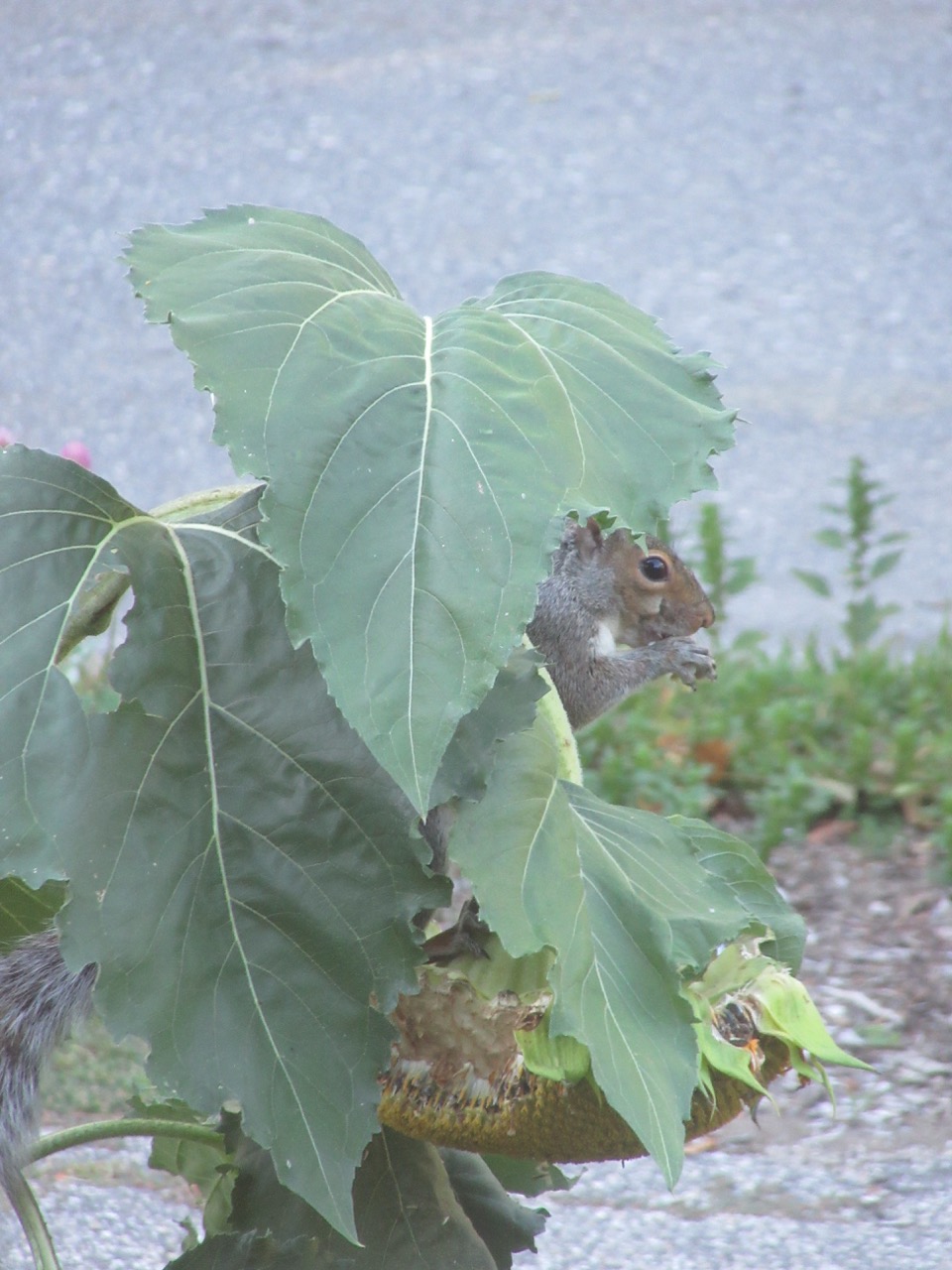
Photo by Margy Dowzer: Squirrel sitting, eating, on a sunflower last fall

Lessons from Other Beings

I feel a deep calling to learn from the other beings who share this earth with us. I was reminded of this calling by a new book I just started reading, Undrowned: Black Feminist Lessons from Marine Mammals, by Alexis Pauline Gumbs. She is observing dolphins, whales, and other mammals who live in the sea, and learning the wisdom they might have for human beings–especially for black women, but also for all of us. “They are queer, fierce, protective of each other, complex, shaped by conflict, and struggling to survive the extractive and militarized conditions humans impose on the ocean.” It is a beautiful and meditative book and I am so grateful. Reading a chapter each night has fed my soul, as well as helped me remember how key it has been in my own path to listen for the wisdom of other creatures–though the ones I learn from are usually closer to home than the sea.

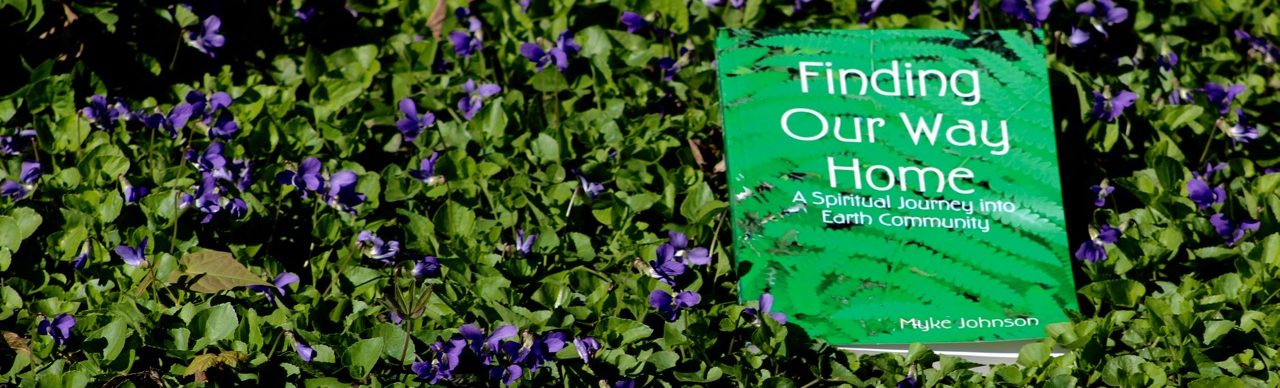
Yesterday morning, inspired, I began to read again my own book, Finding Our Way Home: A Spiritual Journey into Earth Community, remembering. I was remembering the many quiet moments I spent in my former back yard, listening to cardinals, watching slugs crawl through the grass, paying attention to trees, to stars, to the red light of dawn. It was a yard with many mature trees, a long row of huge lilac bushes, incredible privacy, and many critters who were our neighbors–turkeys, deer, birds, squirrels, chipmunks, and occasionally skunks. I was remembering how much those creatures taught me, when I was quiet enough to listen to them.

In our current back yard–we’ve lived here five years now–we can get caught up with work: pruning, planting, soil improvement, garden permaculture projects. It is land more in need of attention from us, ragged, more depleted, invasive vines and bushes clamoring around the edges and in the soil, imbedded in city life, though still surprisingly private once the trees on the edges leaf out. There is more room for gardening–the old place was too shaded by all those mature trees. So we have planted a little food forest, herbs and perennial vegetables, made room for hugelkultur and raised beds and even shared with our friends room to grow herbs and veggies.

But it is easy to get caught up in the work of it–a lot of work. It is easy to forget that other part–the listening to the land itself and the other creatures here, the plants and animals. I remember when we first found this place, feeling from it an unmistakable message: that through making relationship with this small piece of earth, I might learn more about what it means to be in relationship to earth and all her creatures. It was time to think small–right here I could find home, I could find earth community. The work is part of it–we are here to learn to be beneficial members of this tiny ecosystem. It has weathered much neglect and abuse from human beings in its history. But the work is not the only part of it–the listening is the most important part. Sitting quietly, watching, waiting. As spring makes it easier to be outside again, I am ready. I am ready to take my lead from what the land asks, what the land teaches.

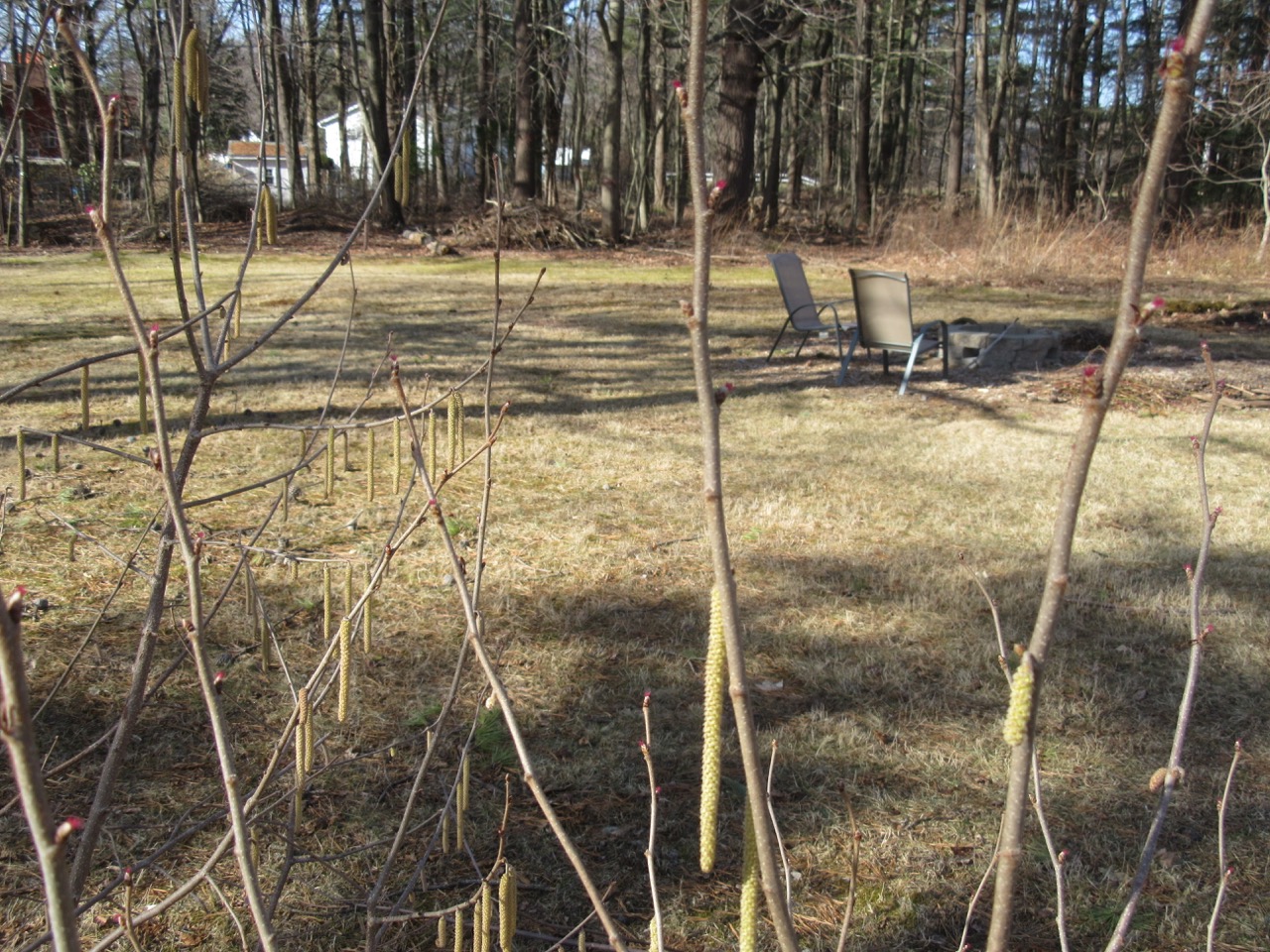
View of the back yard through hazelnut bushes with catkins.

Garden Updates

Elderberries ripeThis week there were a few exciting new developments in the garden. We harvested our very first elderberries—maybe a whole half cup of them! Earlier in the summer, I was worried about whether something was wrong with the elder flowers, and perhaps there was, but eventually they created a spotty bunch of green berries. I must admit, I hadn’t gone by the bush for several days, but when I went out the other day, they were purple. I ate one that was quite sweet, but Margy tasted a sour one, not as ripe. Elderberry harvest 2019Not enough to make elderberry syrup, or really much of anything, but enough to be enthused about future possibilities. Margy and I will have to celebrate with a berry eating ritual.

Another new development: I saw a few catkins on our hazelnut bushes! I hadn’t known to expect them, but when I  looked it up, I learned that these are the male part of the plant’s reproductive system. They will stay on the plant through the fall and winter, and then in very early spring they start lengthening and unfurling.  When the female flowers open at the tips of branches, they pollenate. Hazelnut catkinsThere are only a few catkins right now, but they are a harbinger of future crops of hazelnuts. In my last batch of pesto, I used hazelnuts from the Food Coop to add to basil, parsley, chives and garlic from the garden, plus olive oil and lemon of course. So we can’t quite do it only from our garden, but maybe more and more.

I also processed oregano and thyme that had been drying in the basement herb dryer for longer than they needed to be, and did another batch of frozen chives, and frozen kale for the winter. Our harvest is limited more by my own energy than by the earth energy.

If anyone local would like oregano or thyme or chives, please let me know—they are flourishing in the garden still, and I’d be happy to share—also lemon balm, comfrey, and dill. They have all been very enthusiastic.

Planting the Orchard

Peach Tree

[Contender Peach]

The new trees are here!  Once the frost was off the morning, I went out and started planting.  I took the eight bare root trees out of the box first and letting their roots soak in fish/seaweed solution, while I started digging in the beds we’d already prepared last June.

I had a fright before I went outside–I thought to take a look at planting suggestions in the Holistic Orchard book, and he suggests putting Rock Phosphate and Wood Ash in the holes–I hadn’t been thinking of that.  But then I found a bag of Rock Phosphate in the garage from last year, and we have a can of wood ashes, so we were all set.  These help the roots to get a good start.

I started with the “Contender” Peach tree, since it seemed to have the biggest roots.  It was a job to get all of them spread out and under the soil.  I feel my age when I am digging and kneeling in the dirt moving things around, and then getting up again.  I was happy to use water from our rain barrels to give it a good soaking.  This is a self-fertile tree, so one will do fine by itself.

Myke & Jersey Blueberry

[Myke & the Blueberry, Photo by Margy Dowzer]

After a short rest, I decided to plant the two blueberry bushes next–because they were little and easy.  We got one “Blueray,” and one “Jersey.”  Then I moved on to the “Honeycrisp” Apple.  The apple needs another tree for fertilization, but we’ve got a lot of wild crabapples around so that should do.

Finally, I planted three Hazelnut bushes. We decided to get an experimental hybrid hazelnut, Corylus Cross.  These shrubs are produced from crosses of three hazelnut species: American hazelnut, Corylus americana; beaked hazelnut, C. cornuta; and European hazelnut, C. avellana.  The nuts from these shrubs will likely be larger than American hazelnuts, because they are crossed with the European variety–(which is the kind that we usually can find in the store–small enough as it is.)

Margy diggingMeanwhile, Margy came out, and we talked again about where to position the “Illinois Everbearing” Mulberry tree.  We decided to get the mulberry because birds love them, and they can draw birds away from the other fruit. Plus the fruit is good for people too.  But we didn’t have a bed ready, and we decided to put this one further back in the yard–partly because it is a standard size and we don’t want it to shade the solar panels. Our other fruit trees are dwarf or semi-dwarf.  Margy took on this project and is still working on it.  After planting 7 trees or bushes, I am taking a break!  We still have the small plants to do, but I can hardly lift my arms.

Permablitz

Permablitz

Photo by Julie, one of our organizers for the day

Yesterday, I helped build a rock wall at a Permablitz in Portland.  Permablitzes are groups of 15-30 people who show up to help one of our neighbors implement a permaculture design for their yard.  Organized by the Resilience Hub & Portland Maine Permaculture, they also provide an opportunity for learning more about permaculture options, connecting with others who share a love for the earth, and having a lot of fun doing a lot of hard work. By helping others, we also can put our names in the ring for future help with our own permaculture designs.

Yesterday was also Maine Permaculture Day, with statewide open houses and events.  I visited one yard nearby because they had fruit trees and hazelnuts, and I wanted to get a sense of what that might be like, since we’d like to do something like that for our yard.  They had peach, apple, pear and cherry trees.  They also had planted a row of hazelnut shrubs, hoping the row would eventually create a privacy wall as well as produce hazelnuts. You can learn so much more by seeing plants as they are being grown, than by reading about them. I look forward to the time when we start on our own gardens.

In the meantime, on Friday, we had gutters installed on our house.  We plan to add rain barrels but decided to wait until next year for that, since it will be a lot of work to build bases for them, and we won’t need them until we do more with a garden anyway.