ARMY CORPS DECISION: WHAT DOES IT MEAN?

Reposting from Andy Pearson on Facebook.

On Sunday afternoon, the U.S. Army Corps of Engineers denied the easement for the Dakota Access Pipeline to cross under the Missouri River at Lake Oahe, just north of the encampments at Standing Rock. This is amazing, virtually unprecedented, and a movement victory — and the water protectors who have led the fight are right to claim it as such. It’s also likely temporary and by no means the end of this fight. Here’s some context and paths forward as best I understand right now.

WHAT HAPPENED: The Corps denied the easement and ordered an Environmental Impact Statement, which is a formal study which will compare various route alternatives. Denying the easement was a stepping stone to getting to an EIS here for the Corps, and doesn’t mean that the pipeline won’t be built in its current alignment near Standing Rock eventually. The Corps is essentially hitting the pause button and initiating further study.

HOW DOES AN EIS GO? There are usually three phases to conducting an EIS: Scoping, Draft, and Final. The public can generally comment during each phase. The purpose of scoping is to identify what should be studied in the EIS — the scope. Then the Corps and their EIS contractor prepare and release a draft, which the public is invited to comment on. They then rework the draft in light of public input and release a final version, which the public can generally also comment on. The process usually takes several months, and can last for years depending on the project’s complexity. A generic timeline would be about nine months, but we don’t have any actual guidance yet on the timeline for this particular EIS.

WILL THIS ACTUALLY STOP CONSTRUCTION? Debatable. It would be illegal for Energy Transfer Partners to drill under the Missouri, but that’s not to say they won’t do it and opt to pay whatever legal penalties they incur. That would be a fairly shocking move on their part but they’ve hinted they may be open to doing it. It’s easy to imagine that an incoming Trump administration would do their best to make the penalties as minimal as possible.

WHY IS IT IMPORTANT FOR ETP TO DRILL RIGHT NOW? Contracts with oil shippers. These contracts, called take-or-pay contracts, obligate shippers to pay money to the pipeline company over a long, committed period of time regardless of whether they have oil to actually send or not. It’s a great deal for DAPL but not so good for the oil shippers, especially now that the Bakken oil boom isn’t so hot. These contracts expire if the pipeline isn’t substantially complete by January 1, and there’s somewhat of a chance that some shippers will choose to drop out at that point due to changing economics in the industry if the pipeline isn’t complete. Sunday’s decision by the Corps means that the pipeline won’t be complete by January 1 unless ETP breaks the law and drills anyway.

WHAT ABOUT TRUMP? Oh, you had to ask. He’s a problem here. Once he’s president, he’ll be able to stack the deck at the Army Corps so that the EIS is weak or biased in favor of DAPL, and he might be able to stop the EIS process altogether and reinstate the permit, though I don’t know the legal specifics here yet. It’s very doubtful that we’ll see a full and robust EIS with him taking office. The upshot of Sunday’s decision as I see it, assuming that ETP chooses to follow the law, is that it delays approval of the line until after Trump takes office, giving time for the contracts to expire and letting the worst of winter slide by without the need for full forces at the encampments.

WHAT CAN WE DO IN THE MEANTIME? We can continue the work we’ve been doing, because it’s all still relevant and helpful, and will become quite urgent again in at most a few months. We can go after the banks harder than ever to cut off funding to DAPL. We can continue to spread information, lobby elected officials, lobby the Corps, hold events, train for direct action. We can engage in the EIS process once it begins. This isn’t the end of the fight by a long shot, but it’s a brief respite between battles and a sign of how far we’ve come thanks to the indigenous leadership and water protectors at Standing Rock. Let’s celebrate and reflect and keep fighting. #NoDAPL
The Power of the Story

Today I am concluding my series of blogs about Dr. Martin Luther King, Jr., in honor of the anniversary of his death, April 4th. I have been exploring what his life can teach us about the experience of the Divine Mystery.

I don’t understand the mechanics of experiencing the divine presence. I wonder if, as for Dr. Martin Luther King, Jr., it has something to do with the commitment to give oneself to a sacred calling, or to do the work of justice. I don’t know why some people call for help, and never seem to hear an answer. There is no formula that I can teach you, except to say that trouble can sometimes be a doorway, too, if we knock.

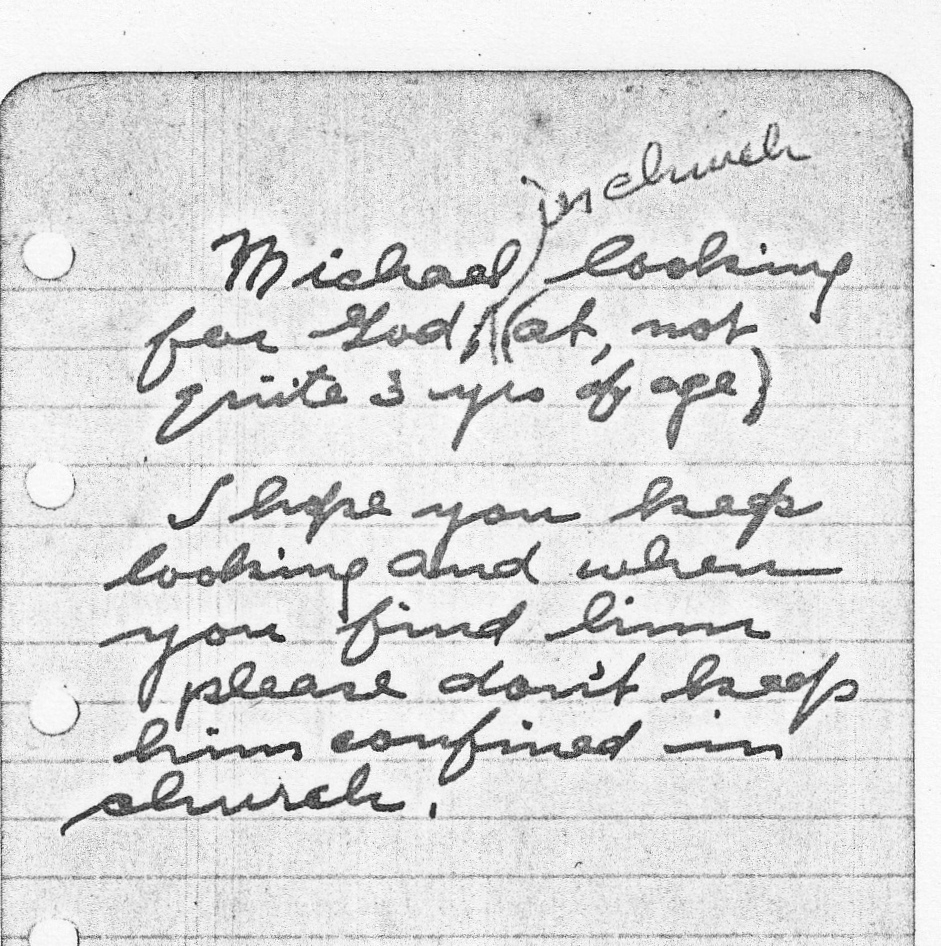
It makes me think about something my grandfather wrote in a little black notebook that disappeared for many years. April 4th, the anniversary of King’s death, is also the anniversary of the death of my grandfathers, one in 1964, and one in 1967. My grandpa Johnson died when I was not quite 11 years old. He was not a Catholic, which was a big deal in my family. But I am told he had been a spiritual man, and had even considered a call to ministry as a Unitarian or a Lutheran. The story I remembered from the notebook was this: My grandfather said that my young cousin Michael at the age of three had gone into a church building and was looking for God. My grandfather commented, “If you can’t find God outside of the church, you will never find him inside the church.”

But just before Easter a few years ago, while my uncle was dying, another cousin sent me a message on Facebook, about going through papers of her father, and finding a copy of Grandpa’s note. It turned out the actual quote was slightly different than I remembered. He had written, “I hope you keep looking. And when you find him don’t keep him confined in church.” But it speaks to the same impulse—that God is beyond what happens in church.

Grandpa's Notebook

Grandpa’s Notebook

Even without a formula, even without a sure way to find this God who helps the lowly, I believe the stories of such a God can give us hope and courage. I am reminded of an old Jewish legend recounted by Elie Wiesel. Whether it is true or not, I do not know. But that is the thing about stories. The truth to be found in stories is not about whether or not they are factual. Some of the most helpful stories happen only in fiction.

This is a story about a Jewish community who had a very wise and powerful Rabbi. When the people were in trouble, their Rabbi used to go into the woods, to a special place, where he prayed a very special prayer, with ritual and song, and the people would be helped. But eventually the rabbi died, and his successor did not know the full ritual with all its songs. So when the people were in trouble, he went into the woods, and prayed the special prayer, and it was enough, and the people were helped.

Eventually, he too died, and the next Rabbi who came to them did not know the place in the woods. But he did know the special prayer, and so when the people were in trouble, he prayed the prayer, and it was enough, and the people were helped. Finally, he too died, and the next Rabbi didn’t know the rituals or the songs, he didn’t know the place in the woods, or even the special prayer. But he knew the story. And it was enough. And the people were helped.

Leslie Marmon Silko writes, in her novel Ceremony:

I will tell you something about stories,…
They aren’t just entertainment.
Don’t be fooled.
They are all we have, you see,
All we have to fight off
illness and death

You don’t have anything
if you don’t have the stories.

I found God in myself and I loved Her fiercely

I am continuing in my series of blogs about Dr. Martin Luther King, Jr., in honor of the anniversary of his death, April 4th. I am exploring what his life can teach us about the experience of the Divine Mystery.

I want to acknowledge that there are many people who do the work of justice, without relating to a God of justice. Their work comes out of a belief in human dignity and connection, and God has nothing to do with it, for them. And that is really fine with me. When we have experienced the connection we share with other human beings, I believe it naturally leads to a concern about justice and equality.

But for some of us, there have been moments when we were in despair about injustice, or afraid of what our truth was revealing to us, or ready to give up, like Dr. King had been in his moment of despair. And in those moments, we also felt a divine presence, a presence of courage and hope and strength, empowering us into transformation. This God may not have intervened to take away a difficult challenge, but rather enabled us to find wholeness and self-worth in the meeting of it.

For me, the divine presence gave me the courage to leave the church of my childhood, and leap into the unknown, to find myself as a woman, as a whole and equal person. When all around me the church was saying that women had their place, and it was not in the priesthood or the leadership, when I was hearing that women were weak and vulnerable and needed men to guide and protect them, something enabled me to reject that characterization, and claim fullness. Something I barely even had a name for—but it was a sacred power nonetheless.

Photo by Rick Kimball

Photo by Rick Kimball

For me, the risk involved imagining that God might be a woman, a Goddess. That I might be created in the image of that Goddess. And even though there was nothing in the Bible that described this Goddess, yet it was still the stories of the God of justice that led me out of those old male-dominant images and into new possibilities. As Ntozake Shange put it, “I found God in myself and I loved her fiercely.”

This experience in my own life became a window to understand, at least in part, the kind of transformation the slaves had experienced. How miraculous and lonely it could be, how long the journey, and how frightening the desert. But yet, something unmistakable like a fire to guide the way. It taught me that the divine is a power beyond institutions, beyond containers, yet able to be present in our lives—especially in those moments of transformation, when “the mighty are cast down from their thrones, and the lowly are lifted up.”

I do not ask that anyone believe in the God of my own transformation. It doesn’t work like that. But I do offer it to you as an option of hope. If you are going through a hard time, if you are discouraged, if you are seeking to follow the truth of your heart, if you are sore oppressed. If you are having trouble believing in your own worth and dignity. I invite you to call on that God, and see whether there might be a presence that can help you through.

The God of the Bible is the God of Justice

I am continuing in my series of blogs about Dr. Martin Luther King, Jr., in honor of the anniversary of his death, April 4th. I am exploring what his life can teach us about the experience of the Divine Mystery.

mlkmemphisspeech1968On April 3rd, 1968, the night before he was killed, Dr. King delivered a speech in Memphis, Tennessee, where he had come to support the sanitation workers’ strike. There had been threats against King related to this trip to Memphis; he mentioned the threats in his speech. He mentioned earlier dangers, too, including the time he was stabbed by a deranged woman in New York City. But he talks more about his gladness. He speaks about his gratitude for being alive to witness the sit-ins, and the bus boycott, and all the other ways that black people had aroused the conscience of the nation and stood up for freedom. He encourages the striking workers not to be afraid, and talks about all the practical necessities of their current struggle.

He ended his speech in words that his listeners would have known were an echo of the story of Moses. As the Hebrew people were close to entering the promised land, God brought Moses up on a mountain, where he could see the promised land, even though he would not be allowed to enter it with them. It was on that mountain that Moses died.

Here is what Dr. King said:

Well, I don’t know what will happen now. We’ve got some difficult days ahead. But it doesn’t matter with me now. Because I’ve been to the mountaintop. And I don’t mind. Like anybody, I would like to live a long life. Longevity has its place. But I’m not concerned about that now. I just want to do God’s will. And He’s allowed me to go up to the mountain. And I’ve looked over. And I’ve seen the promised land. I may not get there with you. But I want you to know tonight, that we, as a people, will get to the promised land. And I’m happy, tonight. I’m not worried about anything. I’m not fearing any man. Mine eyes have seen the glory of the coming of the Lord.

There is power in a story. For Dr. King, the story of Moses was a doorway into the power of God to lift up the lowly. King said that preachers should draw on the prophet Amos to say, “Let justice roll down like waters and righteousness like a mighty stream.” He said that preachers should say with Jesus, who himself was quoting the prophet Isaiah, “The spirit of the Lord is upon me, because he hath anointed me to deal with the problems of the poor.” Dr. King took the stories of the prophets and wove them into new words of hope and liberation, words that gave people the power to make a change.

There are still many people who try to argue against this justice-loving God of the Bible. Four years ago, just a few weeks before the anniversary of Dr. King’s death, Fox News commentator and radio personality Glenn Beck attacked churches that preach a gospel of social and economic justice. Glenn Beck said if your church preaches that, you should “run as fast as you can.” According to Beck, social and economic justice are code words for communism and Nazism.

Rev. Jim Wallis, founder of the progressive Christian group Sojourners, responded to Beck on his own videoblog. He said,

When I was in seminary, we did a study of the Bible and we found 2000 verses in the Bible about the poor, about God’s concerns for the left out, the left behind, the vulnerable and God’s call for justice. One of my classmates took an old Bible, and cut out every single reference to the poor, to social justice, to economic justice, and when we were done, the Bible was just in shreds. If I were ever to talk to Glenn Beck, I would like to hand him that old Bible from seminary and say, Glenn, this would have to be your Bible. …The God of the Bible is the God of justice.

When you are standing up for righteousness, God will be at your side

Today I am continuing in my series of blogs about Dr. Martin Luther King, Jr., in honor of  the anniversary of his death, April 4th. I am exploring what his life can teach us about the experience of the Divine Mystery.

There was a time shortly after the beginning of the Montgomery bus boycott, when Dr. King was seriously doubting whether to continue his involvement in the movement. He had been receiving threatening phone calls and letters at his home, and while at first he took them in stride, after a while, he began to grow afraid. After a particularly strenuous day, late at night, already in bed, he got a phone call with yet another angry threat. He got up and began to pace the floor and then went into the kitchen.

He wrote about this moment:

I was ready to give up. I tried to think of a way to move out of the picture without appearing to be a coward. In this state of exhaustion, when my courage had almost gone, I determined to take my problems to God. My head in my hands, I bowed over the kitchen table and prayed aloud. “I am here taking a stand for what I believe is right. But now I am afraid. The people are looking to me for leadership, and if I stand before them without strength and courage, they too will falter. I am at the end of my powers. I have nothing left. I’ve come to the point where I can’t face it alone.”

He goes on to say,

At that moment I experienced the presence of the Divine as I had never before experienced him. It seemed as though I could hear the quiet assurance of an inner voice, saying, “Stand up for righteousness, stand up for truth, God will be at your side forever.” Almost at once, my fears began to pass from me. My uncertainty disappeared. I was ready to face anything. The outer situation remained the same, but God had given me inner calm.

Three nights later, his home was bombed, but he was able to deal with it calmly. His experience of the presence of God had given him a whole new strength.

As in the story of the Israelites leaving the slavery of Egypt, Dr. King experienced a divine Mystery that is involved in the struggles of human beings to achieve dignity, equality, and justice. As I said before, there is no way to prove that such a God exists. At least, there is no proof outside of the experience of it. But there is a power in the experience that enabled Dr. King to go on to lead his people with courage and truth. And there is a power in the story, just the experience of hearing that story about Dr. King, that inspires me in my own search for strength in the work for transformation.

220px-Martin_Luther_King_Jr_NYWTSTo look closely at the story of Dr. King is to see its deep resonance with the story of Moses. God didn’t speak to Moses to give Moses a comfortable life. When Moses heard the voice of God, in the story of the burning bush, it was a voice calling him to free his people. And just so, Dr. King wasn’t praying about material wealth or success in his career, or even protection for his family. He was praying about standing up for what he believed was right—the struggle of black people to be treated with dignity and equality. He was praying for the courage to bear witness to justice. And the answer he received was linked to that justice work—that inner voice said, “when you are standing up for righteousness, God will be at your side.”

Dr. King went on to lead the movement with courage and strength. There were other threats and many troubles that came his way. His God didn’t protect him from all those troubles, but King felt God at his side. And the story of Moses continued to be a constant source of his inspiration.

Quote from Martin Luther King, Jr. is from The Strength to Love, Chapter 13, reprinted in A Testament of Hope, The Essential Writings and Speeches of Martin Luther King Jr.

A Moment of Healing on a Broken Land

In November of 2006, eight people from my congregation gathered in Orono, Maine with about seventy other people for a celebration of the Giving Winds Capital Campaign. The invitation had mentioned hors d’oeuvres, but it was more truly a feast. We had corn chowder and salmon patties, bacon-wrapped scallops and stuffed mushrooms, veggies and corn fritters, and blueberry cake and fry bread. We listened to drumming by two young girls’ drumming groups, and heard the thanks of several of the leaders of the Penobscot, Passamaquoddy, and Maliseet tribes. We left with gifts of sweetgrass and traditionally made herbal insect repellent, and beadwork pins.drumming

We heard the story of how the Giving Winds campaign came about. It began in brokenness. The Maine Council of Churches had decided a few years before to oppose a referendum that would have allowed the tribes to pursue casino gambling as a means to economic development. Representatives of the tribes had come to a council meeting to urge them to reconsider, and to speak about the difficult financial issues faced by their communities. But many members of the council had ethical principles against gambling, and they voted to go ahead with their opposition.

It was another painful moment in Indian relations with the non-Indian community here in Maine. But Tom Ewell, then director of the Council of Churches, did not want it to end there. He did some research and discovered the Four Directions Development Corporation that was just getting started. It was seeking to provide home loans and small business loans to Wabanaki people from the four tribes in Maine. Indian people had difficulty gaining credit, because if their homes were on Indian land, they could not be used as collateral for traditional mortgages or home improvement loans from a bank. Four Directions hoped to fill this gap, and to provide financial education and support for start-up businesses.

And so the Maine Council of Churches partnered with Four Directions to create the Giving Winds Capital Campaign. Congregations and individuals across Maine donated money and made low- or no-interest loans that were matched by the Federal Government. The campaign worked to build trust and connection between Indian and non-Indian people in Maine. When we ate with each other at the celebration in Orono, it was a moment of healing on a broken land.

I wanted to share this story because all too often, people feel it must be impossible to heal from five hundred years on a broken land. But I don’t believe it is impossible. Difficult yes, but there are simple steps we can take that move us in the direction toward wholeness. If we can learn to share the pain and share the struggles of Indian peoples, then we also will find ourselves sharing in the celebrations. Sweetgrass

The Theft of the Land and the Stories that Obscure It

As I wrote in my last post, European peoples are new to the land we call North America. Our history includes the theft of this land from its original people. We have tried to obscure that history through many stories, perhaps most notably our Thanksgiving myths, the stories of the Pilgrims and the Indians.Turkey DSC09718_2

The story tells us when the Pilgrims landed at Plymouth, they were welcomed by the Indian Samoset. He introduced them to Massasoit, chief of the local Indians, the Wampanoag, and to Squanto, who helped the Pilgrims to plant corn, to hunt and fish in their new home, and to survive the first hard year. In the fall, Indians and Pilgrims together celebrated a Thanksgiving for the harvest.

The story of this celebration hides other stories. It hides the plague that wiped out the village of Patuxet, and 90% of the people living on the Northeast Coast. Squanto, whose name was actually Tisquantum, was a survivor because he had been earlier carried off as a slave to England. Did you ever wonder why he could speak English to the Pilgrims? The story hides his capture as a slave, his years in Europe and his attempts to come home, only to find his people gone. But most of all, this story hides the next four hundred years, which were filled with betrayal and enmity and war.

The Pilgrims did not share the Indigenous belief in the sacredness of all beings and places. They saw their own society and ways as superior, as a progress which must be forced on other so-called “inferior” beings. This is the spirit of colonization, from which we haven’t yet recovered. From the Indian side, the colonization of North America has been a long saga of unbearable loss and grief. What irony, then, to watch as non-Indians each year have a holiday celebrating the bond between the Pilgrims and the Indians. Many Native peoples think of Thanksgiving as a Day of Mourning.

Now, the first reaction European Americans sometimes feel when we hear about this loss and grief is defensiveness. After all, we think, it wasn’t me who stole Indian land, or caused disease among the people, or killed anyone. Perhaps the second reaction that comes is a feeling of guilt, because of what our ancestors have done. But neither defensiveness nor guilt is really very helpful. We must go deeper than that. How do we acknowledge and heal the brokenness? How do we restore wholeness to this broken land and all of its people? 

Choosing the Honorable and the Just

…To those of our bodies given
without pity to be burned, I know
there is no answer
but loving one another,
even our enemies, and this is hard.
Wendell Berry

Rev. Bill Schulz, former executive director of Amnesty International, wrote eloquently about the power of human resistance to evil. I want to share his words:

In every situation of incomprehensible terror there are always a few people who have cast their lot with the Honorable and the Just… Such people need not be well-educated or sophisticated or even successful in their witness; they simply need to be those who, in the face of sorrow, choose honor and blessing and life. And when they do, they redeem if not humanity, then at least their generation. …For if even only one person in a generation or a country or a culture chooses honor and blessing and life—even only one—then it means that anyone could have made that choice; it means that the Radiant had not completely died in those days; it means that Glory has not been silenced.

We are challenged to respond to the horrible situations of our time with a courageous endeavor—to remember that we are connected. There might be occasions when remembering this connection demands great heroism. The sufferings of the world are so big, and we feel so small. It is frightening to contemplate. But most of the time we are responding to smaller divisions; we must practice finding relationship in the everyday world of conflict and difference—the neighbor whose dog barks too much, the family member whose religious beliefs are contrary to our own, the person whose culture we do not understand, the child who is asserting her own independence.

The promise is that whenever we stand up for human dignity and connection, we bring the power of Grace into the world, we bring the power of God into the world. Whenever we choose mutual respect instead of violence, we strengthen the possibility of Goodness. Whenever we reach out to one who is suffering, we keep alive the Radiant for one more day.

Sunset Winslow DSC02433

Bill Schulz quote from his sermon, “Too Swift to Stop, Too Sweet to Lose”
Wendell Berry quote from “To My Granddaughters,” in A Timbered Choir

Loving Nonviolent Action Is Always a Force for Human Dignity

When African American students sat down at the segregated lunch counters, they were asserting their own dignity by refusing to obey a law that treated them with contempt. They were holding onto the dignity of their harassers by refusing to engage in violence or harm. They were harnessing the power of love to make a change in an unjust system. Dr. Martin Luther King, Jr., and all of the many heroic civil rights activists, used loving nonviolent action to restore the dignity of an oppressed people, and also to restore the soul of the oppressor.  

Loving nonviolent action is always a force for human dignity. Whether the political outcome is successful or not, a change has already taken place. The night before Dr. King was killed, he said, “I’ve been to the mountaintop. It doesn’t matter what happens to me now. I’ve seen the Promised Land.” I used to think this meant that in some mysterious way he had seen the future, and he had faith that black people would eventually win their rights.

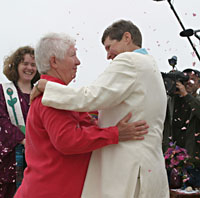
But I saw it differently after I was involved in the struggle for equal marriage for same-sex couples in Massachusetts. I believe the mountaintop is less about the future, and more about the present. When lesbian and gay people began to imagine that they might get married, they had an inner experience of equality. It didn’t happen all at once. Two members of my congregation on Cape Cod were part of the  lawsuit for equal marriage. They told me how terrifying it was, in the days leading up to the lawsuit, to ask the town clerk for a marriage license when they knew the answer would be no. It was also terrifying for many others to carry a sign in public, or to have a conversation with their legislator or their neighbor.

Wedding of Linda & Gloria Dewitt Photo 5/17/04

Wedding of Linda & Gloria
Dewitt Photo 5/17/04

But each new act in honor of love lessened their fear and strengthened their dignity. Same sex couples became aware of the burden they had been carrying, the hidden assumption that they were somehow less than the others. Once they felt a glimpse of equality, they couldn’t go back. They had put down the burden, and they were free. So even if there were opponents holding signs that said, “Homosexuals are demons,” it didn’t matter. A young lesbian woman carried another poster that said, “Your signs are mean but we love you anyway.” No matter what happens next, such love releases an inner power that is indestructible.

I think that is part of what Dr. King was talking about. It was visceral and immediate. By tapping the power of love through non-violent action, he felt first hand a new way of being in the world. He fully experienced his own dignity and the dignity of his people. After that, what else could matter? He had been to the mountaintop. As he said, “whenever men and women straighten their backs up, they are going somewhere.” He knew there was no turning back.

King quotes from “I See the Promised Land”, reprinted in A Testament of Hope, The Essential Writings and Speeches of Martin Luther King Jr.