Helpers for Finding Our Way Home

Cardinal

Margy Dowzer Photo

There are beings all around us who want to be called upon, who want to help us in this work of returning to wholeness, this work of finding our way home. I have shared stories of a few of the beings who have helped me. The bright red cardinal singing its beautiful song. The four directions beech tree. The waters of lakes and streams. The ground, the very ground we walk upon, that holds me when all around me everything is falling apart.

Now that I know about the mycelial network, the ground feels more alive to me. But it was always true that something happened when I sat down upon the ground. If I sleep on the ground for a longer period of days, there is a glow that surrounds my body. I remember this from my time at the Women’s Peace Camp, where I was living in a tent for four months. I felt alive in some new way that I began to miss when I went back inside an apartment in Chicago. I forget it easily, but I feel more alive when I am outside.

Jesus has been such a helping presence too. First in my childhood and youth, when he was the one who loved me and who called me to the path of love. But even later, when I was leaving Christianity to follow the path of the Goddess, Jesus was a guide and a friend. If we can experience the divine within every being around us, the theological questions about Jesus seem less of a quandary. People have been asking, over the centuries, Was Jesus a man or a God? I would answer, Aren’t all of us both human and divine?

When Winifred Gallagher wrote about her quest for a spiritual home, she described the essential spiritual practice of the Christian tradition as the practice of love for everyone. She commented that it seemed a lot easier to meditate for an hour every day, than to have to practice love for everyone—it was not an easy alternative. It has been a deep tragedy that Christianity has been used to foster hate and oppression. Jesus stays in my life as the teacher of love, the human example of what divine love looks like.

I want you to know that we are not alone. In this time of great challenges and transitions, there are a host of beings who love life and want to help us find another way to live. As we reach out to them, they are reaching out to us. I understand that every person will have their own ways of connecting to earth, to each other, to Mystery. The mycelial network might not be the thing that helps you to experience the connection between all beings. You might not resonate with Jesus or with trees. But I encourage you to find out what it is that does help you. In these times we need critical thinking and activism and also mysticism.

Just as we can now sit in front of a plastic and metal panel and communicate with people across the world, so there are technologies to communicate across species and across dimensions. The threads of life weave us together in ways we have barely begun to imagine. But I know this: we belong here together and we need each other now more than ever. Poet Barbara Deming wrote:

Our own pulse beats in every stranger’s throat,
and also there within the flowered ground beneath our feet.
Teach us to listen:
We can hear it in water, in wood, and even in stone.
We are earth of this earth, and we are bone of its bone.
This is the prayer I sing.


Green Back Yard DSC05265

Choosing the Honorable and the Just

…To those of our bodies given
without pity to be burned, I know
there is no answer
but loving one another,
even our enemies, and this is hard.
Wendell Berry

Rev. Bill Schulz, former executive director of Amnesty International, wrote eloquently about the power of human resistance to evil. I want to share his words:

In every situation of incomprehensible terror there are always a few people who have cast their lot with the Honorable and the Just… Such people need not be well-educated or sophisticated or even successful in their witness; they simply need to be those who, in the face of sorrow, choose honor and blessing and life. And when they do, they redeem if not humanity, then at least their generation. …For if even only one person in a generation or a country or a culture chooses honor and blessing and life—even only one—then it means that anyone could have made that choice; it means that the Radiant had not completely died in those days; it means that Glory has not been silenced.

We are challenged to respond to the horrible situations of our time with a courageous endeavor—to remember that we are connected. There might be occasions when remembering this connection demands great heroism. The sufferings of the world are so big, and we feel so small. It is frightening to contemplate. But most of the time we are responding to smaller divisions; we must practice finding relationship in the everyday world of conflict and difference—the neighbor whose dog barks too much, the family member whose religious beliefs are contrary to our own, the person whose culture we do not understand, the child who is asserting her own independence.

The promise is that whenever we stand up for human dignity and connection, we bring the power of Grace into the world, we bring the power of God into the world. Whenever we choose mutual respect instead of violence, we strengthen the possibility of Goodness. Whenever we reach out to one who is suffering, we keep alive the Radiant for one more day.

Sunset Winslow DSC02433

Bill Schulz quote from his sermon, “Too Swift to Stop, Too Sweet to Lose”
Wendell Berry quote from “To My Granddaughters,” in A Timbered Choir

A God Who Is Not All Powerful?

A while back I picked up a book by Andrew Greeley called God Game. His premise intrigued me. A man is asked to test a new computer game. In this game, he interacts with characters who are people in a computer generated world. He types in commands which the characters perceive as an inner voice coming from their God. He uses this influence to shape the direction of the story in progress. In a process similar to writing a novel, he can create a tragedy, a comedy, a romance. He can use commands to influence the weather, or physical objects.

When our narrator begins the game he discovers the people are fighting a war, and likely to soon destroy each other. Being a benevolent author, he begins to direct them to make peace with their enemies. But soon it is apparent that the game is more complicated than that.

First of all, he learns that he can command the characters to take certain actions, but sometimes they choose to ignore his direction. The programmers have included freedom as one of the parameters of the program. He must work with the characters that are open to his leading, and use the actual abilities written into their personalities. Then to top it off, sometimes trouble arrives in the form of random events. Eventually, he become totally immersed in the game and finds he loves the people under his care. He agonizes over how to help the peace succeed.

The book explores the premise of a loving God who is not all powerful. I found myself feeling sympathy for such a God who might feel frustrated, and worried, and angry sometimes. He wants the story to come out well. He wants the characters to live happily ever after. But all he can do is offer assistance and inspiration as they face the problems of their world: he was not able to eradicate evil in one fell swoop.

In contrast, I grew up with the idea of a God who was supposed to be in charge of everything. All-powerful, all knowing, and all good. Whatever happened, it must fit into the will of God, and therefore be for the good. Even when bad things happened, we were to accept it as a part of God’s mysterious plan. But Elie Wiesel challenged such a view with his unrelenting questions: How could anyone accept a God who could ordain such an evil as the Holocaust? How could anyone trust a God who would stand by and let it happen?

Photo Source Unknown

Photo Source Unknown

Episcopal theologian, Carter Heyward, was deeply influenced by the questions of Elie Wiesel. For Heyward, as for Wiesel, the Holocaust was an indictment of the churches’ understanding of God as a supreme power who dominates the world. It was an indictment of the idea of obedience as morally desirable. Likewise, it found unacceptable a God who is merely an observer, a spectator in the face of such horrors. If God is indifferent to human suffering, then there is no use to us for such a God.

Heyward writes that for Elie Wiesel nothing is of more fundamental value than mutual relationship. The only ethical God must be found in loving relationships between people. In the camps, the opposite happened: the Jews were treated as if they no longer existed. The camps were a systematic assault on every element of personhood: numbers instead of names, meaningless hard labor, separation from family, arbitrary selection for extermination. The only ethical response to such evil would be to make a connection with those who suffer, to resist evil’s capacity to destroy the power of relationship.

Irving Greenberg put it like this: “…to talk of love and of a God who cares in the presence of the burning children is obscene and incredible; to leap in and pull a child out of a pit, to clean its face and heal its body, is to make the only statement that counts.” In other words, to face the problem of evil, we must resist violence and dehumanization by acts of connection and relationship.

Why Is There So Much Evil and Suffering?

Bars DSC00601_2To my granddaughters who visited the Holocaust
Museum on the day of the burial of Yitzhak Rabin

 Now you know the worst
we humans have to know
about ourselves, and I am sorry,
for I know that you will be afraid.
                                                                         Wendell Berry

If we are paying attention, we have to notice that life holds not only beauty, but tragedy. It holds not only goodness, but greed and hate and oppression. It holds unspeakable acts that human beings commit against each other and against the earth. Some people ask, if there is a God, especially a God of Love, why is there so much evil and suffering in the world?  I want to explore this question over the next several blog posts.

Every once in a while I have a dream in which there is a dangerous person lurking about outside of my house, and I am frantically trying to lock the doors. But in this dream I keep finding openings to the outside that don’t lock. Here in America, we associate locked doors with a sense of safety from evil. We think of evil as something that has to be kept out.

It makes me think about walls. There is a wall being built in Palestine, purportedly to keep terrorists out of Israel. Some sections of the wall go right between a family and their own olive grove. There is a plan to extend a wall across our entire border with Mexico, as part of Homeland Security. That doesn’t make any sense to me at all. I mean, even if a wall could protect us from terrorists, I have never heard of a Mexican crossing the border to blow up a building in the U.S. But the thing with keeping evil out is that you’ve got to blame somebody. Immigrants have often born the brunt of our feelings of insecurity.

Since September 11th, 2001, many previously safe Americans have felt as if evil has gotten through the doors, and we must frantically try to find a way to feel safe again. Terrorism has become the new face of evil.

Wendell Berry quote is from “To My Granddaughters” in A Timbered Choir: The Sabbath Poems 1979-97

Creating the Beloved Community

When Jesus talked about the importance of loving our neighbor, someone asked him, “Who is my neighbor?” In response, Jesus told the story we now call the Parable of the Good Samaritan.

A traveler was walking on the road to Jericho, and was attacked by bandits who robbed him and beat him and left him on the side of the road. A priest was walking down the road, and saw the man and went over to the other side. A lawyer also ignored the wounded man. But a Samaritan traveling on the same road saw the man, and was moved to compassion. He bound his wounds, and brought the man to an inn, where he continued to care for him overnight, and then paid the innkeeper to care for him as he went on his travels. Then Jesus turned the question around—“Who do you think was neighbor to the man?” The one who showed him compassion.

This story is made compelling by its social context. In the time when Jesus told the story, Samaritans and Jews generally held each other in contempt. They were enemies. Maybe something like Republicans and Democrats these days, only worse. Jesus made the Samaritan the hero of the story, and that certainly must have ruffled feathers. The story was a challenge to the lawyers and priests and their narrow definition of the circle of compassion. The story was a challenge to be neighbors with the people we don’t like, the people on the other side. To treat those neighbors with compassion.

As Dr. Martin Luther King, Jr. said, “The end is reconciliation; the end is redemption; the end is the creation of the Beloved Community.” In the Beloved Community, poverty, hunger and homelessness will not be tolerated because international standards of human decency will not allow it. Racism and all forms of discrimination, bigotry and prejudice will be replaced by an all-inclusive spirit of sisterhood and brotherhood.

I want to acknowledge that in our age, it is easy to feel hopeless about this vision. It is easy to think of it as an idealistic dream of the sixties. Cynicism has risen, the right wing has fought back against the hopes so hard fought for by Dr. King and others. More and more we see a new individualism and polarization, an abandonment of the poor and vulnerable by those in power. The opposition has become more crafty and deceptive.

But, on some level, that makes no difference at all. The vision of nonviolence is not based on winning, though a victory for good fills us with joy. The vision of nonviolence is based on faithfulness and hope. As Dr. King said,

When our days become dreary with low-hovering clouds of despair, and when our nights become darker than a thousand midnights, let us remember that there is a creative force in this universe working to pull down the gigantic mountains of evil, a power that is able to make a way out of no way and transform dark yesterdays into bright tomorrows. Let us realize that the arc of the moral universe is long, but it bends toward justice.

And so, in the midst of the conflict and trouble of our age, may we find the strength and courage to be practitioners of love. In the midst of selfishness and greed, may we find generosity and vision. In the midst of rancor and division, may we remember that we are all one people. May we behold and believe in the possibility of Beloved Community, and work steadfastly to open the doors that all may enter there in. May we always remember, as Dr. King reminded us,

Darkness cannot drive out darkness; only light can do that.
Hate cannot drive out hate; only love can do that.

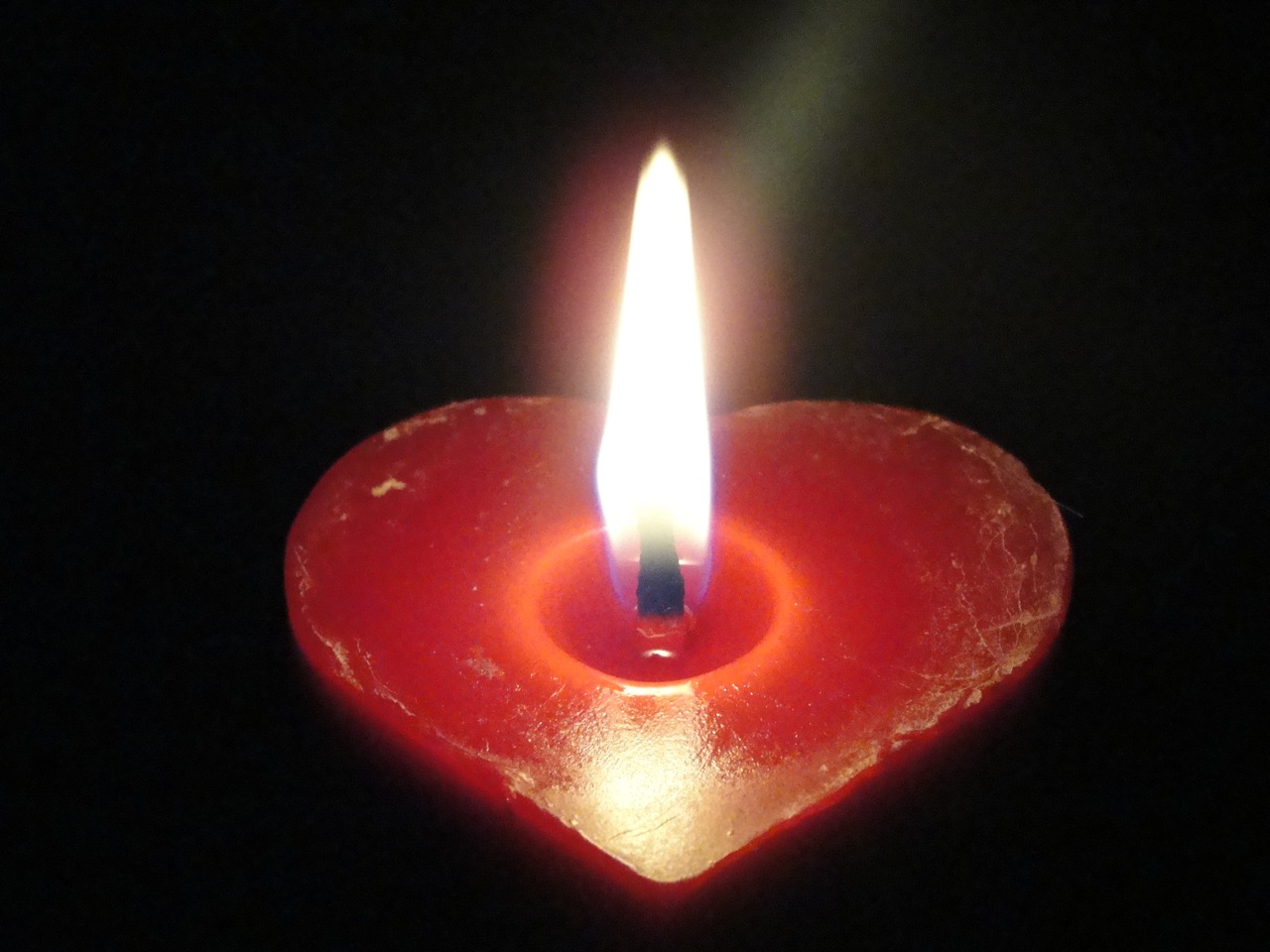
Heart Candle Flame DSC01573

Quotes from Dr. King from “Facing the Challenge of a New Age, December 1956, in A Testament of Hope, The Essential Writings and Speeches of Martin Luther King Jr. and “Where Do We Go From Here,” a 1967 Speech.

Practicing the Power of Love

Sometimes we learn best by seeing someone else—to watch someone practice love in the face of hostility can create a light in us as we observe it. Once, when I was in my twenties, I saw a young woman named Nelia arrested in an act of civil disobedience. She refused to walk, refused to give answers to questions on any forms, refused to cooperate with the police who were arresting her. But she radiated such kindness and love to each person who interacted with her. She smiled, and reached out her hand to shake theirs, and told them her name, and asked about theirs. She spoke of why nuclear submarines were not useful for human beings, and invited conversation.

I don’t think I had ever been able to imagine this combination of non-cooperation and love, until I saw her doing it. Yet once I saw it, it seemed so simple. She was practicing the power of love, and it discomfited and engaged all of us around her. Her tenderness was compelling. Her vulnerability was profound, because the other thing about Nelia was that she is blind.

Make no mistake—it wasn’t about being nice to everyone or pretending not to notice the painful realities that cause suffering in our world. Nelia was practicing her simple acts of tender engagement right on the front lines of the conflicts that seem so hard to confront. She showed me what courageous, creative people can do in the face of violence, what the power of love can do.

Marianne Williamson, in A Return to Love, asserts that whenever we encounter another person, we always have the choice to see them through the lens of fear, or through the lens of love.1 Our lives are meant to be a school for learning to let go of our fear, and to choose more and more the power of love. This is not an easy thing to do. It may take a whole lifetime to let go of fear, to learn how to live in the power of love.

And perhaps there is not such a big difference between loving our enemy and loving our neighbor. Each demands the same respect for self, and respect for the other. Each requires seeing the utmost dignity in our selves and in the other.

Clergy Testify in Favor of Equal Marriage 2009

Clergy Testify in Favor of Equal Marriage 2009

Loving Nonviolent Action Is Always a Force for Human Dignity

When African American students sat down at the segregated lunch counters, they were asserting their own dignity by refusing to obey a law that treated them with contempt. They were holding onto the dignity of their harassers by refusing to engage in violence or harm. They were harnessing the power of love to make a change in an unjust system. Dr. Martin Luther King, Jr., and all of the many heroic civil rights activists, used loving nonviolent action to restore the dignity of an oppressed people, and also to restore the soul of the oppressor.  

Loving nonviolent action is always a force for human dignity. Whether the political outcome is successful or not, a change has already taken place. The night before Dr. King was killed, he said, “I’ve been to the mountaintop. It doesn’t matter what happens to me now. I’ve seen the Promised Land.” I used to think this meant that in some mysterious way he had seen the future, and he had faith that black people would eventually win their rights.

But I saw it differently after I was involved in the struggle for equal marriage for same-sex couples in Massachusetts. I believe the mountaintop is less about the future, and more about the present. When lesbian and gay people began to imagine that they might get married, they had an inner experience of equality. It didn’t happen all at once. Two members of my congregation on Cape Cod were part of the  lawsuit for equal marriage. They told me how terrifying it was, in the days leading up to the lawsuit, to ask the town clerk for a marriage license when they knew the answer would be no. It was also terrifying for many others to carry a sign in public, or to have a conversation with their legislator or their neighbor.

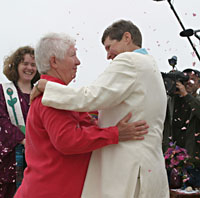
Wedding of Linda & Gloria Dewitt Photo 5/17/04

Wedding of Linda & Gloria
Dewitt Photo 5/17/04

But each new act in honor of love lessened their fear and strengthened their dignity. Same sex couples became aware of the burden they had been carrying, the hidden assumption that they were somehow less than the others. Once they felt a glimpse of equality, they couldn’t go back. They had put down the burden, and they were free. So even if there were opponents holding signs that said, “Homosexuals are demons,” it didn’t matter. A young lesbian woman carried another poster that said, “Your signs are mean but we love you anyway.” No matter what happens next, such love releases an inner power that is indestructible.

I think that is part of what Dr. King was talking about. It was visceral and immediate. By tapping the power of love through non-violent action, he felt first hand a new way of being in the world. He fully experienced his own dignity and the dignity of his people. After that, what else could matter? He had been to the mountaintop. As he said, “whenever men and women straighten their backs up, they are going somewhere.” He knew there was no turning back.

King quotes from “I See the Promised Land”, reprinted in A Testament of Hope, The Essential Writings and Speeches of Martin Luther King Jr.

Tea with the Enemy

Another example of the power of the nonviolent way is expressed in the Japanese story of the tea master. The tea master was traveling with his Lord to visit the Shogun, the military commander of all Japan. In order to enter the court to perform the tea ceremony, he was required to wear the swords of a samurai. So, although he had never used a sword, he was wearing them after he left the palace. As he was walking over a bridge, a ronin, a local mercenary, knocked him over and tried picked a fight with him. When he explained he was not a warrior, the mercenary claimed he was a coward for not fighting.

The tea master did not wish any dishonor to come to his Lord, so he felt obliged to face this ruffian. But he asked leave to do an errand first. The mercenary suspected he might be going for a bribe, so he let him go. The tea master went to the school of a renowned sword master, and asked for his advice on how to hold a sword, so that he might die with dignity. The sword master was astonished, and said, “Most people come to me to ask how to bring death to an enemy, not to face it themselves. You are the first! But before I teach you my art, would you show me yours?”

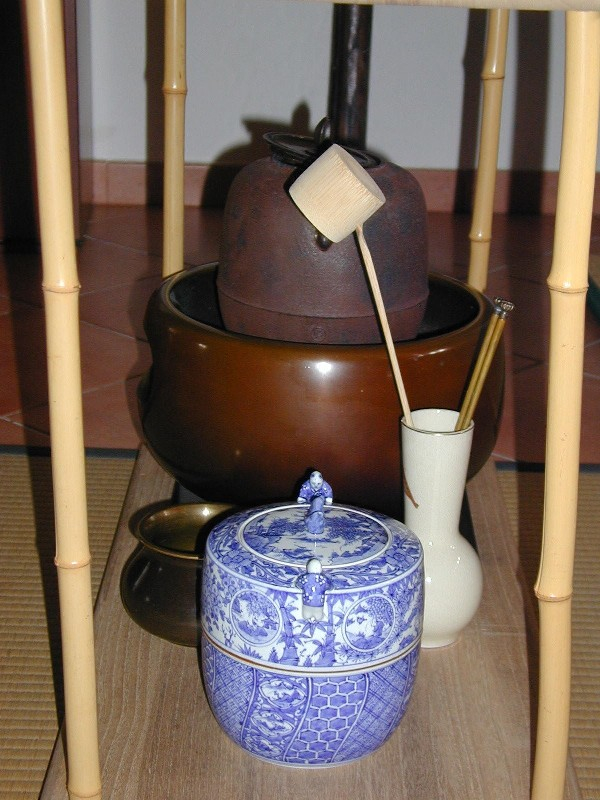
Tea Ceremony Tools Wiki Commons Photo

Tea Ceremony Tools
Wiki Commons Photo

Knowing this might be the last time he would practice his art, the tea master carefully assembled the elements and utensils of the tea ceremony: the tea, the water, the whisk, the tea scoop, the clay tea bowl, and the iron pot for holding the fire to heat the water. Then he prepared himself. When all was ready, with a peaceful spirit he prepared the tea and served it to the sword master.

The sword master observed the tea master carefully. After he had sipped from the bowl of tea, he said, “I can see you are already a master. I have nothing to teach you that you do not know. All I would say is to approach the mercenary as if he were an honored guest at a tea ceremony. Then, take off your jacket and fold it neatly, draw your sword and hold it up over your head, and let him know you are ready. Then close your eyes. When your opponent yells, bring the sword down.”

When the tea master returned to the bridge, he prepared himself all along the way, not as if for a fight, but for a tea ceremony. He let go of his fears and his hopes, and imagined the ruffian as an honored guest. When he reached the bridge, there was a crowd gathered. He did everything as the sword master had instructed. But after closing his eyes, he heard nothing. When he opened them, he was astonished to see that the ruffian had dropped his own sword and was running away. When the ruffian had looked at the face of the tea master, standing calmly in front of him, he lost his nerve. He did not know how to fight such an enemy.

The Tea Master is a traditional Japanese story.  I’ve adapted it here from the version by Dan Yashinsky, in Suddenly They Heard Footsteps

Love Your Enemy: What?

For much of my life I have been intrigued with the words of Jesus about loving our enemies. It is one thing to love those who are open to loving us. But it is a different challenge to love those who seek to harm us.

We read in the gospels of Matthew and Luke that Jesus said, “Don’t react violently against the one who is evil: when someone slaps you on the right cheek, turn the other as well…” and then “We once were told, ‘You are to love your neighbor’ and ‘You are to hate your enemy.’ But I tell you: Love your enemies.”

According to the Biblical scholars of the Jesus Seminar, these phrases are two of three passages that are the most likely to be the actual words of Jesus, rather than edited or added by a later commentator or preacher. They are at the very heart of his teachings. They are also among the most misunderstood.

The injunction to “turn the other cheek” has fostered a kind of doormat approach to conflict. Christian preachers have used this teaching to admonish those who were suffering to simply endure, rather than try to make a change. Until very recently, most ministers or priests would tell a battered woman that she should remain with her abuser, and suffer abuse as a Christian virtue.

But Biblical theologian Walter Wink says this is not what Jesus meant by loving your enemy.  He has offered a new insight into this passage by looking more closely at its cultural context. Jesus said, “If anyone strikes you on the right cheek, turn the other also.” As we hear it, this saying does seems to counsel surrender. But let’s try to hear it as his listeners might.

First century Palestine was a right-handed culture, even more than our own. A blow from the right hand would normally fall on the left cheek. So, if someone wants to strike me on the right cheek—as Jesus is referring to—he has to do it with the back of his right hand. This kind of blow was intended to humiliate, to put an inferior in his or her place. It was a blow that masters gave to slaves, husbands to wives, Romans to Jews.

Dr. Wink suggests that “By turning the other cheek, the person struck puts the striker in an untenable spot. He cannot repeat the backhand, because the other’s nose is now in the way.”

The only target is now the left cheek, which would have to be hit with a fist. But in that culture, only persons who were equals would fight with fists. “…By turning the other cheek, the oppressed person is saying that she refuses to submit to further humiliation. This is not submission, as the churches have insisted. It is defiance.”

Of course, this turning the other cheek was “no way to avoid trouble; the master might have the slave flogged to within an inch of her life. But the point has been irrevocably made: the ‘inferior’ is saying, in no uncertain terms, ‘I won’t take such treatment anymore. I am your equal. I am a child of God.’”

Jesus was not just giving people a new commandment. He was revealing a new option, a new tool. Our instinctive impulses are fight or flight, but he showed a third way to engage with an enemy that simultaneously offers and demands respect and equality. It is surprising, and it is creative. Don’t respond with violence, but don’t accept humiliation either. Don’t be a doormat, but choose equal human dignity for each person.

MLK March 2011

MLK March 2011

See also: Walter Wink, Jesus and Nonviolence: A Third Way

Martin Luther King, Jr. and the Power of Nonviolence

Martin Luther King Jr.Today, we celebrate the birthday of Dr. Martin Luther King, Jr. I appreciate this holiday for many reasons, but especially because it gives us a chance to consider the power of nonviolent action to bring justice to our society. There are times when it seems like oppressive powers are taking over, when greed and hate are overwhelming. It helps my soul to recall those courageous people who came before us, who, even facing insurmountable oppression, were able to harness the power of love to make change. Dr. King is one of the greatest witnesses in our country to such fearless and powerful love.

Nonviolence has often been misunderstood, stereotyped as passive, or weak, or a tool for those who were afraid of violence. But this could not be further from reality. Dr. King described the fundamental principles of nonviolence in an article in Christian Century magazine, in 1957. He challenged that stereotype, and asserted that nonviolence is not for cowards, but requires strong courage. It is an active resistance to injustice, and the nonviolent resister is just as firmly opposed to injustice as one who might use violence. The method is passive physically, but active mentally and emotionally and spiritually.

A defining characteristic of nonviolence is that it does not seek to defeat or humiliate the opponent, but to win his or her friendship and understanding. King wrote, “The aftermath of violence is bitterness. The aftermath of nonviolence is reconciliation and the creation of a beloved community. …The end is redemption.” Nonviolent action is directed against evil, not against the persons who are caught in the forces of evil. He said, “..the basic tension is not between races. …The tension is at bottom between justice and injustice.”

Nonviolence is based on the conviction that the universe itself is on the side of justice. For Dr. King, this faith was rooted in his religious conviction that all people are the children of one God, and loved by God. But he also pointed out that this trust in the power of justice did not require a belief in a personal God. It might also arise out of a heartfelt awareness of the unity of all people, or the interconnected web of all existence. Faith that the universe is on our side gives strength to the nonviolent resister to accept suffering without retaliation, and continue in the struggle through the dark times before the victory is assured.

Nonviolence avoids not only external violence, but also internal violence of spirit. It is based on the principle of love. “To retaliate with hate and bitterness would do nothing but intensify the hate in the world,” King wrote. “Along the way of life, someone must have sense enough and morality enough to cut off the chain of hate. This can only be done by projecting the ethics of love to the center of our lives.” He goes on to explain that he is not talking about romantic or affectionate love, but agape love—a redeeming spirit of good will toward all.

Perhaps the most challenging part of nonviolence is this requirement that we love our opponent, that we love our enemy. Someone once said to me, “We shouldn’t even use that word, enemy. We are all one family.” And we are all one family. When we know that each person is part of us, we don’t want to think of anyone as an enemy.

The dictionary defines enemy as “a person who feels hatred for, or fosters harmful designs against another.” By that definition, my enemy is someone who hates me, or who seeks to harm me. We live in a world where, however much we love, others still will hate us or seek to do us harm. So for me, it feels more honest to acknowledge that internal tension—that tension between love and harm—when we say that nonviolence demands that we love our enemy.

Quotes from “Nonviolence and Racial Justice” and “The Power of Nonviolence,” reprinted in A Testament of Hope, The Essential Writings and Speeches of Martin Luther King Jr.