First Snow, Gaza, Small Birds

Green bird feeder in front of snow covered branches of hazelnut hedge.
Bird feeder near hazelnut hedge.

We have our first snow-covered morning here in our yard in Portland Maine. In places further from the shore they got several inches, but we had mostly rain until early morning. Now it feels like winter is really here. My internal clock has felt the shift, as the days grow shorter and darker. A few days ago, I started working again on sorting through my old documents–my winter project of the last few winters. This year, most of the documents are digital, though there is at least one box of paper files to go through in the basement. In prior winters, I looked back on all the years before we moved to Maine in 2005. This winter, I am looking through my time as minister of Allen Avenue Unitarian Universalist Church here in Portland, before I retired in 2018.

I started by reading all of the “annual reports” I wrote for the church to summarize the work of that year. It was a simple way to quickly turn the pages of thirteen years of ministry. I was astounded at the sheer number of times I marched in protests, or spoke at vigils in solidarity with issues of justice or worked on legislative change in support of human rights, usually along with other members of my congregation or other ministry colleagues. My life now is so much quieter and less intense, but also less connected. It was good to have that public voice, and to use my voice in service to all that I believe. I feel so far removed from that life and that work.

I suppose in some ways a blog is a kind of public voice, but much quieter and less visible. My life these days is much quieter and less visible. That is chronic illness, compounded by our continued COVID precautions in our household. I can’t put my body out on the line for love and justice. It takes most of my body’s energy just to manage our household tasks. It is like I am looking out a window at all that is happening in our world.

I was surprised to notice that I hadn’t blogged for a few weeks. Lately, all I can think about is Gaza and the way the people there are suffering and dying. In my files I found a sermon I preached in 2014 about Palestine and Israel. In many ways, the issues are all the same. In other ways, everything has gotten worse, much worse. So many deaths, so much destruction. I can’t even imagine the words I could say about it, and then I don’t have words for anything else. My heart is on the ground. My heart is on the ground.

And then, out the window I see a large flock of small birds visiting the hazelnut hedge and the bird feeder. They find their way to our yard each day, traveling together as a group. They usually arrive mid-day, but today they are early. Tufted titmice, chickadees, goldfinches in their winter garb, sparrows, juncos, finches, even a bluebird. (Maybe they come more than once a day, but you have to be looking out a window to see them so I am not sure.) Often a few chickadees even stop at our back porch pecking for stray seeds. It is not so easy to take a photo of a flock of small birds. They scatter themselves across the orchard. They come through and then they are gone again. Traveling all together on their mysterious rounds.

And my heart is lifted just a little, with their flight and their community.
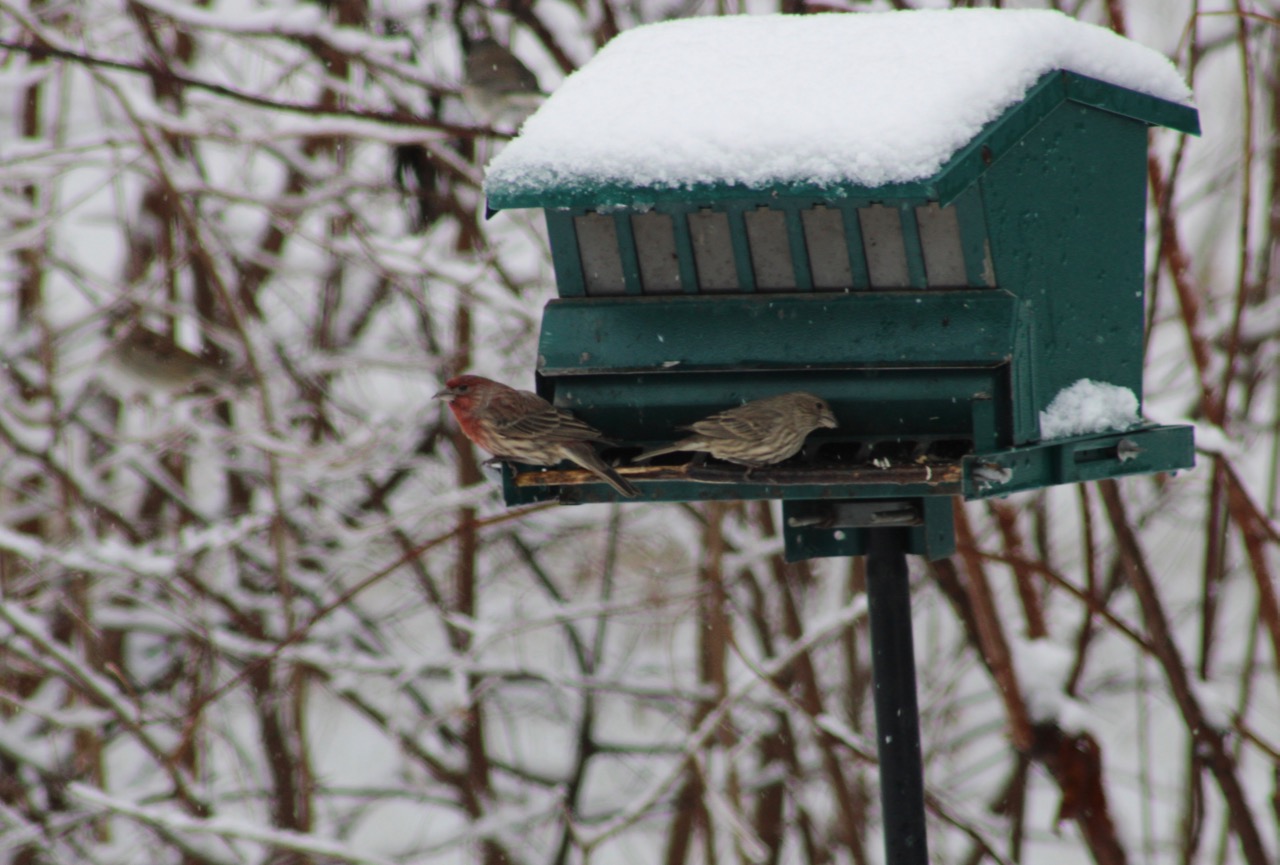
Finches at feeder.
Junco on a branch.

Belonging

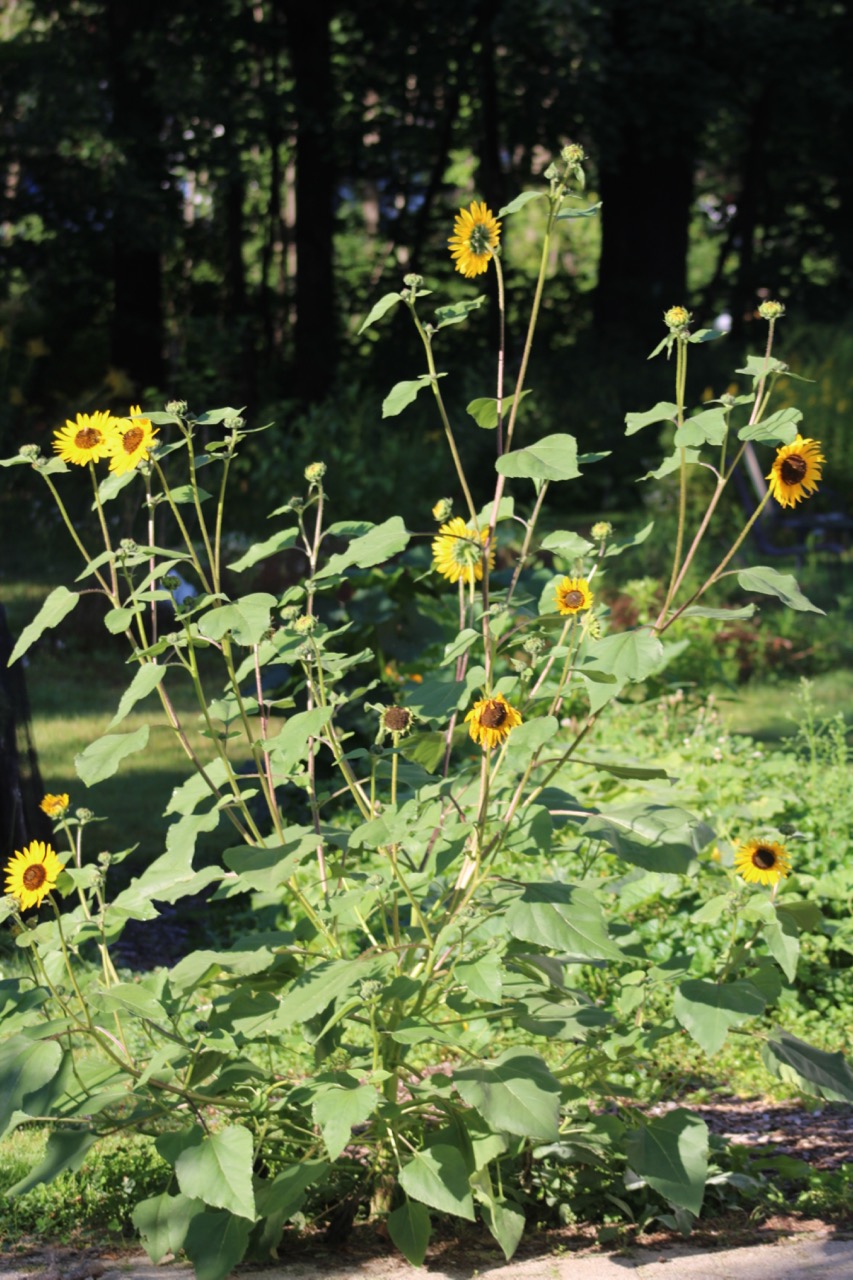
Multi-branched sunflower with many yellow flowers, tall with green leaves.
One sunflower plant has all these blooms!

This year one volunteer sunflower plant came up next to the patio, starting small. Now it has expanded into this multi-branched extravagantly flowering giant! Doing a little research, it seems to be a native wild sunflower, because of its branching habit and the size of its flowers, and its continuing blooms. It is still one plant though, a community of flowers that is connected at the root, and much loved by all sorts of bees, other insects, and birds. It is easy to see how they belong to this place and to each other.

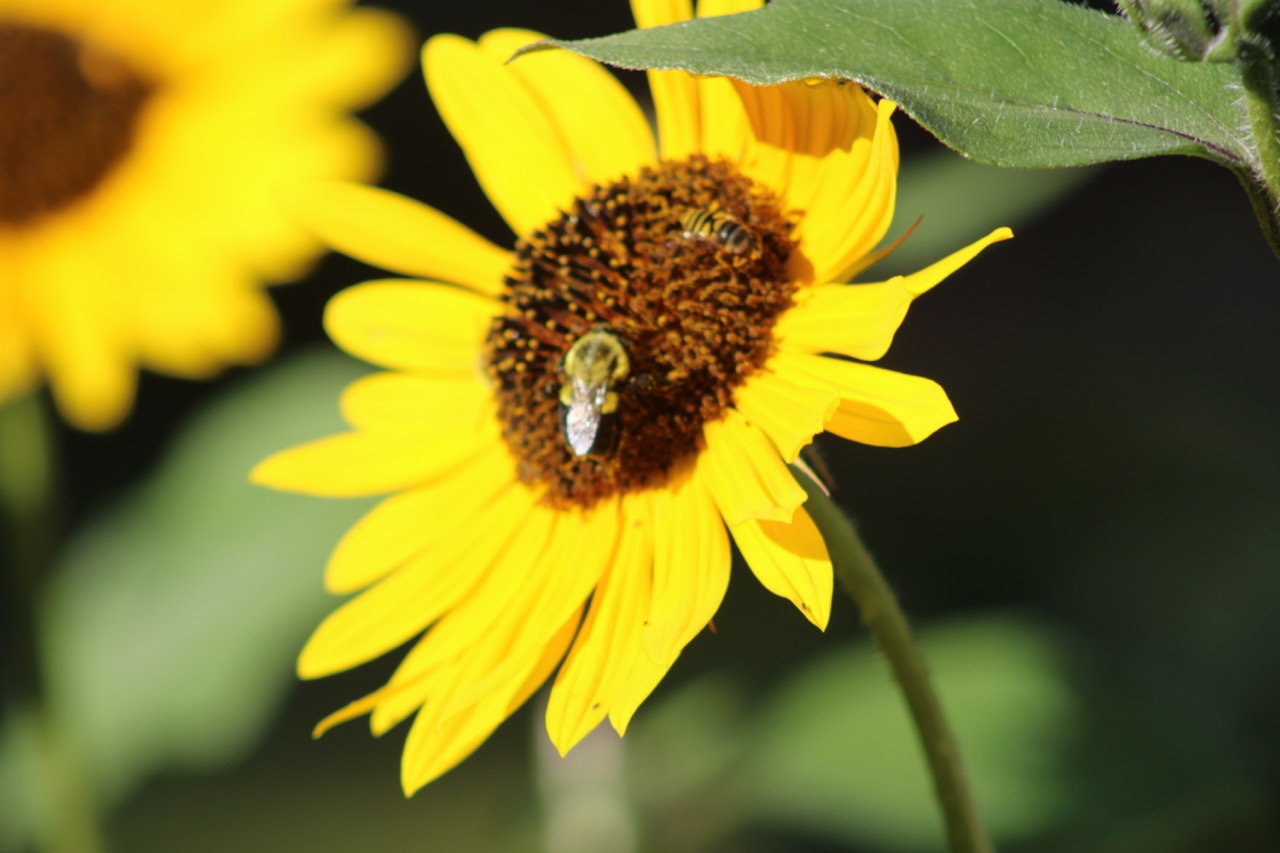
bumblebee and honey bee perched on center of yellow sunflower
Bumblebee and honey bee on center of the sunflower.

What does belonging mean? It is easy for me to get caught in a “not-belonging” wound, the scar of a childhood moving from place to place, always starting on the outside, trying to find my way in, feeling invisible and unconnected. It is not that I haven’t had some times of belonging–there was the group of friends at college, the group of activists at the Catholic Worker or the women’s peace camp, the lesbian community in Boston. Changing perspective sometimes took me away from earlier forms of belonging, sometimes into new communities–sometimes not. In some ways I belong to my family of origin, but my lesbian identity and feminist politics created a deep barrier.

On this personal journey, becoming a UU minister created an avenue for me to nurture community, to bring other people into a sense of belonging. And in that ministry, I had a form of belonging, too, right at the center of community, but also always a bit set apart in my role. And it also meant moving once again. Even though I have retired, I am still a bit set apart because of the role of a minister. Reflecting on it, I’ve also experienced a form of belonging in my connections with ministry colleagues. But the wound continues to shape the ways I navigate the current chapter of my life. I continue to wonder, “Where do I belong?”

As I explore various facets of belonging, the feeling remains elusive. Do I belong to this place like the sunflower and the bees? I am not indigenous to this land, it is Wabanaki land. When I reach back to my own ancestors, language is a barrier between us–I don’t speak the German of my father’s ancestors. I don’t speak French (even if I understand a little), the language of my Quebec ancestors, and even of my distant Innu relatives in these times. I don’t belong to Nitassinan (which would be my matrilineal homeland) or Quebec or Austria or Germany. I don’t belong to an ethnic community. What does belonging mean in white America, especially for those of us who reject the racism of its founding?

All these thoughts are coming round in a scattered fashion. When the feelings come up in me of “not-belonging,” it helps me to remember these childhood wounds, these societal wounds. I can acknowledge and honor those feelings but then make a choice to open my heart to new possibilities of interconnection. I am becoming interconnected to this land, as I tend the trees, appreciate the wildflowers, make habitat for birds and frogs, eat the blueberries that grow. There is a reciprocity that is developing between us. I must choose to open my heart to new people as well–not dwelling in the old fear that there will be no room for me, but being curious about the ways that we might be interconnected already, or the ways that we might find to connect right now.

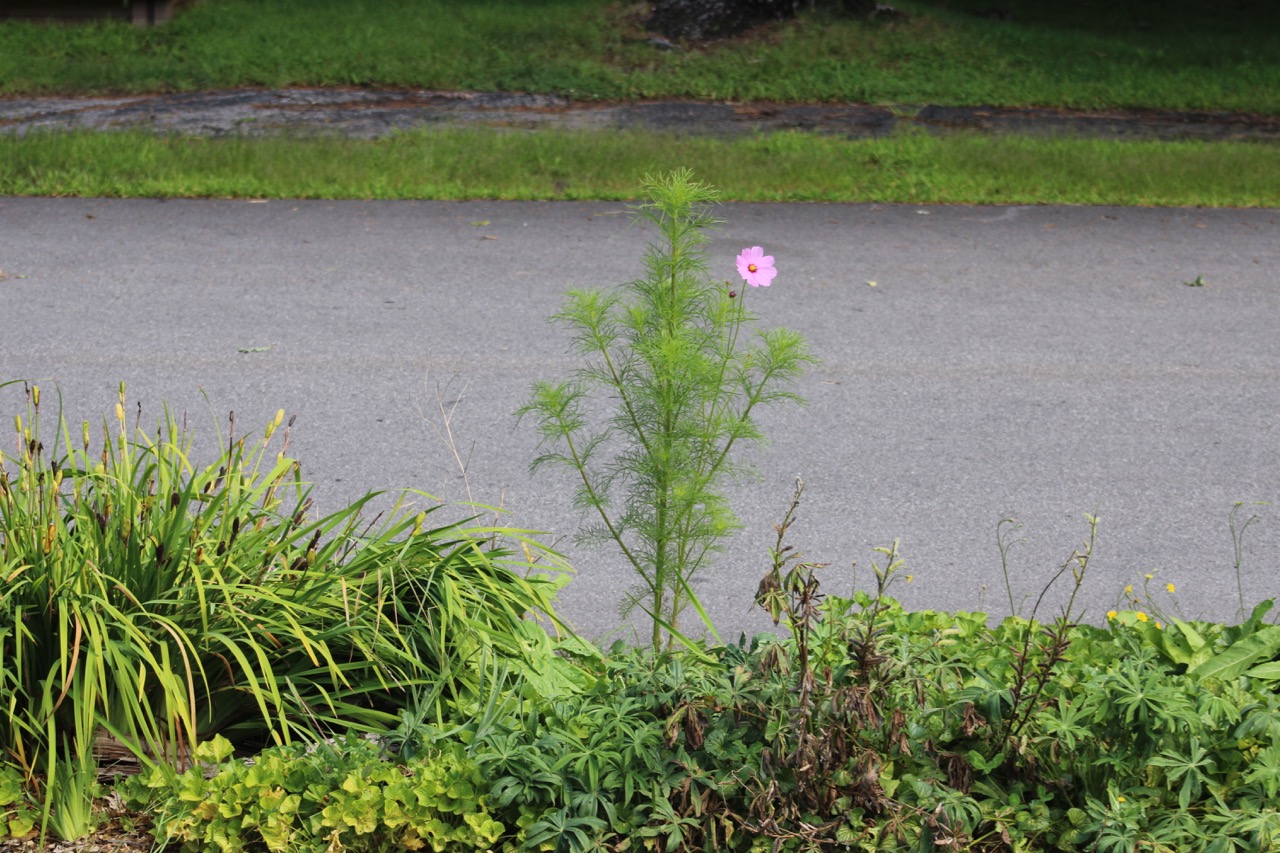
Today I see one more lesson about belonging in a tall pink cosmos flower that we didn’t choose or plant, but somehow it rooted itself next to the road we live on. It is now blooming on its own after the rest of the plants have faded. It is not in the “color scheme” of the roadside garden bed. I guess its motto is a variation of the old adage: “Bloom where you are planted.” Bloom wherever your seed happens to land.

One pink cosmos flower on tall stem with feathery leaves, next to road, near greenery.

Our Love Is Holy

Mar 11 2004 Margy and Myke at a rally at the state house in Massachusetts, for the constitutional convention trying to take away equal marriage, holding a poster that says Our Love Is Holy
March 11 2004 Margy and Myke at a rally at the state house in Massachusetts, in support of equal marriage

This week in my basement archives I revisited my life in Massachusetts in 2003 and 2004, during the time when its Supreme Judicial Court declared that to deny civil marriage to same sex couples was unconstitutional. In the six months following their declaration, state legislators were arguing over trying to stop it from happening, or support it to happen, and we were at the state house too, lobbying, and rallying. I had forgotten many of the details of those months, but I had not forgotten the strange mix of joy and fear as we anticipated this unimaginable possibility. It is hard to believe that was only 19 years ago. Now marriage is accessible to same sex couples across the land, but it is still under threat. I found my remarks from a forum we held on Cape Cod that spring, and they still seem relevant today.

This was Civil Rights, Civil Marriage: A Forum on Equal Marriage Rights for Lesbian and Gay Couples, Cape Cod Community College, May 3rd, 2004, where I was part of a panel presentation. At that time I was a minister at First Parish Brewster, Unitarian Universalist. Linda Davies and Gloria Bailey were members of our church, and one of the plaintiff couples in the lawsuit. They also had just spoken at the event.

“I want to start by saying how much I am looking forward to signing the marriage license of Linda and Gloria on May 17th. When I sign that license, I won’t be acting merely on my own behalf, but representing the whole community of First Parish Brewster. I believe I speak for all of us when I say how grateful we are to Linda and Gloria for taking a risk with their lives to end discrimination against gay and lesbian couples, and what a joy it has been to join them at the front lines of this historic civil rights effort. I know that your courage and your transparent love for each other have touched people’s hearts and opened their minds.

“Our struggle is far from over. Many of our opponents use the teachings of Christianity to claim that gay and lesbian couples should be excluded from marriage. I think Jesus would be horrified to see how his message has been twisted.

“Someone once said that even the devil can quote the Bible. Every religious community that draws inspiration from the Bible has the challenge of interpreting a collection of documents that were written and gathered over 1800 years ago in languages and cultures not our own. Some people will tell you that they take the Bible literally word for word. I will tell you, following Karl Barth, that I take the Bible far too seriously to take it literally. As even my Catholic professors used to say, the Bible is ‘the word of God written in the words of men.’ It is full of contradictions and its heroes are entangled mixtures of good and evil. The Bible tells the stories of a community’s experience of the Holy in their midst. If we are to be true to its message, we must also pay attention to the working of the Holy within our midst.

“You know, Jesus actually said very little about marriage, and nothing about homosexuality. He wasn’t so concerned with family arrangements. He was concerned about love. He was concerned about how we care for each other, and especially, about how we care for those who are—what he called—’the least’ among us. He called on his followers to welcome the stranger, to take in the outcast; to bear witness to the kingdom of God within each person. He said, when we live in love, God is in our midst.

“I am a minister and I am a lesbian. So this moment in history is meaningful to me in two ways. I want to say that I respect how difficult this issue is for those who are religious. It was difficult for me when I was a young Catholic woman. It was easy to imagine that everyone could just follow the rules if they tried. It wasn’t until I became friends with a gay man in college that this ‘issue’ took on a human face—the face of a brother who was in deep pain because of the contradictions between the teachings of his religious tradition, and the inner truth of his own body and soul.

“When we risk honoring the truth in our own soul, we are entering dangerous ground. What if we are deluding ourselves? Some would say we are. But on the other hand, what if the truth in our souls is the voice of the Holy in our midst?

“The God of the prophets was always leading them beyond the comfort of the familiar in the direction of greater love. I believe that we are living in a prophetic moment. Something holy and miraculous is going on here. It has always been the Holy who has lifted up the downtrodden. It has always been the Holy who has filled the hearts of people with compassion. It has been the Holy who made strong the faint of heart, and transformed the lowly.

“Equal marriage is a civil rights issue, a legal issue, an issue of respect for diversity. But for my part, I want to take off my shoes, for I believe we are standing on holy ground.”

Gloria Bailey, left, and Linda Davies of Orleans rejoice moments after being pronounced married by First Parish Brewster Unitarian Universalist minister Rev. Dr. Mykel Johnson, left, on Nauset Beach during a 1:00 ceremony on Nauset Beach Monday. The couple, who have been together three decades, were married in front of a group of about 40-50 friends and press. Monday is the first day of legalized same-sex marriage in Massachusetts and the US. A dinner party is planned at a friends house to celebrate the event. (Dewitt photo 5/17/04)

Women’s Herstory

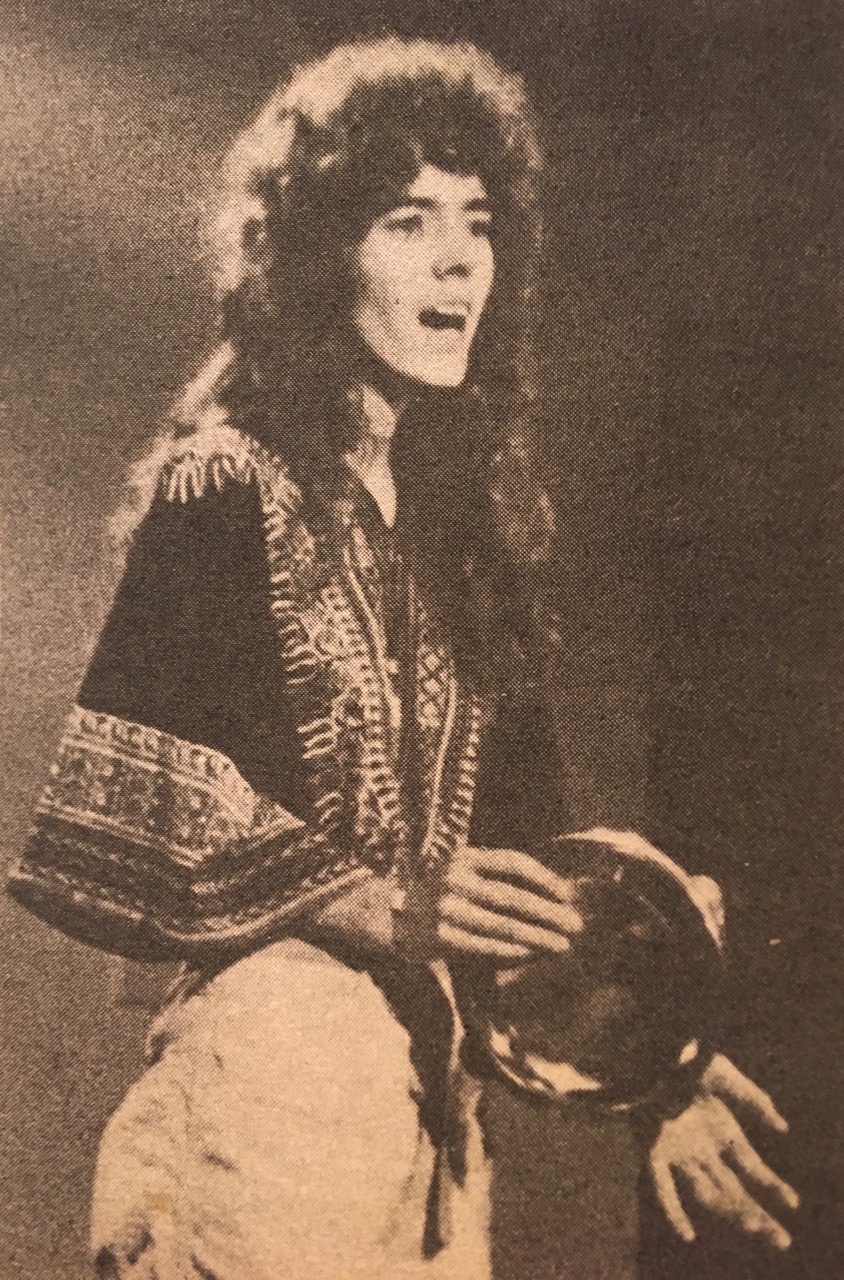
Tall thin woman with big curly hair, in old newsprint photo, singing open-mouthed holding a tambourine.
Me at 29, singing and holding a tambourine

I’ve been going through old boxes from my past, and am currently working on the time I lived in Grand Rapids, Michigan, from 1979 to 1983. It was such a different time–not many photos, for example. But I found this one in a clipping from a women’s periodical, attached to an article I wrote about how women’s history is not just reading about women from the past, but an imperative for us to make history in the present–herstory. I still believe that!

My partner at the time, Gary, and I were trying to make history/herstory through non-violent activism, and through running a Catholic Worker hospitality house. We called it Grimke Community, named after Angelina and Sarah Grimke, white southern women who worked for the abolition of slavery in the early 1800s. We opened our house to a person or family in need of emergency shelter, often in cooperation with the local battered women’s organization. The house was in a kind of land trust, and we lived there rent-free. We could pay the bills if one of us had some sort of half-time job at minimum wage.

I held various jobs during those years, from being a maternity aide for a home-birth midwifery group, to visiting women in the local jail, to cleaning houses, to being a library “page.” I was also doing a lot of music those days, and performing in any local venue I could arrange, from nursing homes to social justice rallies. It is funny to look back at my big naturally-curly hair, my extremely thin torso, and my wide-open mouth. I was learning to use my voice!

In early 1983, when this picture was taken, I was trying to make sense of how to follow my calling. It was something like a call to ministry, but still being Catholic, and being a woman, I felt like I had to invent something totally new. Eventually, I was able to take the next steps by going to Chicago to attend the Chicago Theological Seminary, where I was lucky to receive a full fellowship. Gary and I moved to Chicago to take over also, serendipitously, the leadership of St. Elizabeth Catholic Worker House. Those were years of profound transformations. And after seminary, I did invent something new for myself–a ministry which was a combination of activism, offering feminist therapy for women, and leading feminist ritual and community education. (This was years before I eventually was ordained as a Unitarian Universalist minister.)

Now, looking back at my own herstory, I can feel the continuity between the me of now and the me of back then. But I feel some sadness that the changes for which I struggled, while meeting some success, have also faced incredible backlash and new challenges. Still, I don’t regret any of it.

The Delicate Adventure

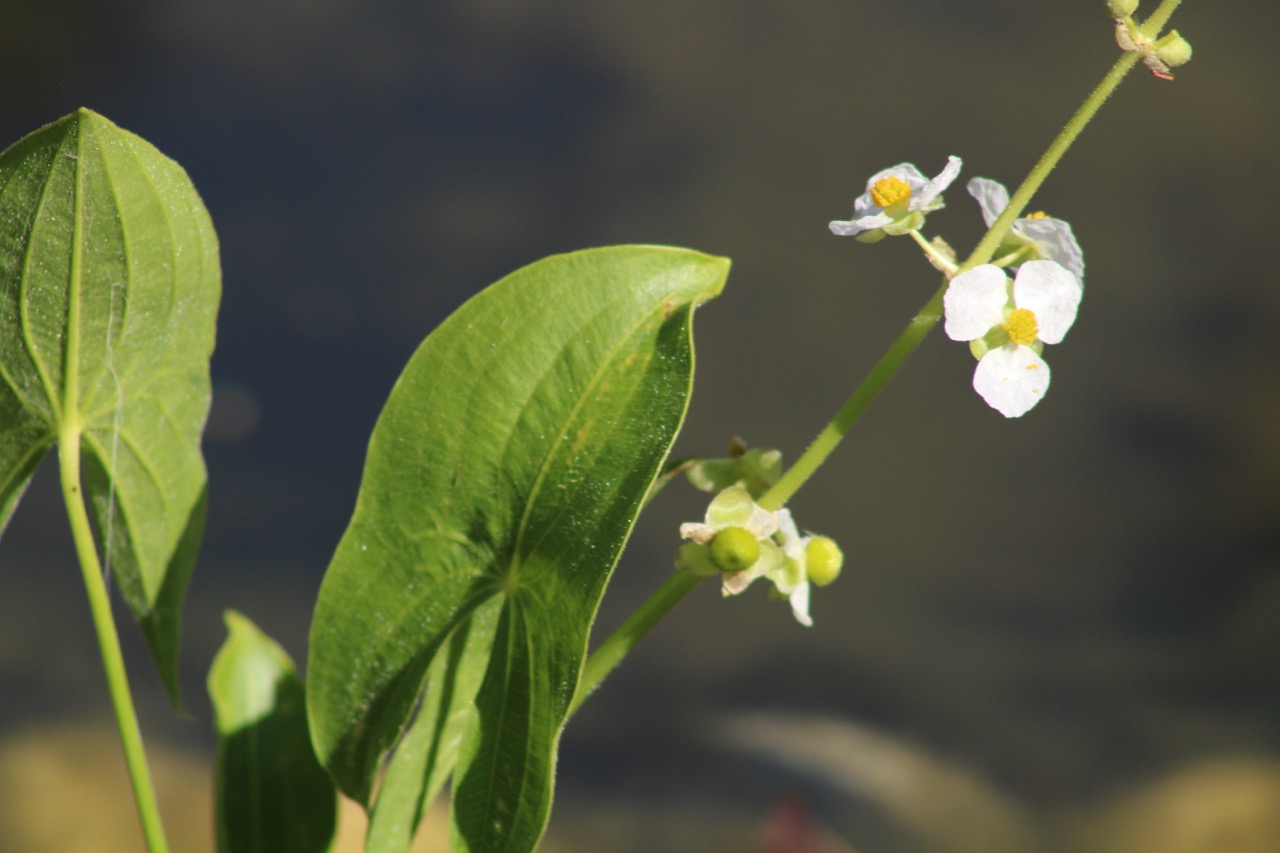
Arrowhead flowers and leaves and seeds, a pond plant

I am happy to be starting a new experimental adventure. After four years away following my retirement, I am venturing back into involvement with my former congregation, Allen Avenue Unitarian Universalist Church. In our faith community, a retiring minister traditionally stays away for a few years, to make room for a new minister to bond with the congregation, and to make real the fact that I am no longer their minister. If or when we return, we create a covenant with the current minister to clarify our relationship and offer our mutual support. I have done that with Rev. Tara Humphries who is now serving the congregation.

But it is still a delicate balance to negotiate. When I go back, I am not their minister, but I am also not just any other member of the church. I am still their Minister Emerita, an honorary designation expressing our mutual affection and connection. But with or without that designation, I still carry those thirteen years of affection and connection, and it gives me an influence different from other members. So for me, the experiment is measuring whether and how I might be a member of this community in that in-between zone. I am drawn back by a desire for the kind of community that church offers, I am drawn to that little village of care and support. Is it possible? Will it work for me, and for them?

Some parts of this feel very clear-cut. Dealing with chronic illness has made it impossible for me to carry out many ministry functions, like weddings, memorials, and leading worship, so I won’t even be tempted to be doing any of those. Another aspect clarified in our covenant recognizes that “since my position still carries some weight, I will decline to participate in the governance of the congregation, or take sides on any issue.” And both Tara and I will “decline to participate in, and will remove ourselves from, any conversations with church constituents which might try to evaluate each other’s ministries or contributions to church life.” All of that feels very down-to-earth and solid.

But more experimental are the personal interactions and connections. The first event I attended was an in-person, outdoor celebration of our 200th anniversary on September 10th. I am still being super cautious about COVID, so I wore a mask even though we were outside, though most others did not. This was the largest event to which I have gone at all since COVID. I would have loved to hug everyone, but I did air-hugs instead. It was wonderful to see people I knew, and meet a few I did not know. Heart-warming. It was also rather exhausting, and I had to rest afterward. Is that my chronic illness, or introversion, or somehow feeling once again all those threads of connection?

Worship services are now hybrid on Sundays–some people attend in person and others on Zoom, so I have attended a couple via Zoom, but I haven’t yet stayed for “zoom coffee-time.”

I went to the monthly “Elder Salon” and that felt really good. The structure made it easy for me to participate as others did, with a few minutes of check-in for each person, and a discussion following that. I like the reciprocity I felt in that group. The topics of concern to elders match many of the topics of concern in my own life right now. So it feels like I can join in as any other member might join in, and benefit from the collective wisdom in the group. I guess I am learning to be an elder. I like it.

All in all, I am taking it slow, and observing what comes up for me.

Dandelion Spirit

One of the boxes from Boston: “Political Groups/Resources/Issues/Conferences”

So, after sorting and winnowing all winter, I have finally finished with the boxes from my years living in Boston. I managed to go from 11 file-drawer-size boxes down to 4! The four that remain include, loosely: 1. lesbian theology and creative writing, 2. GLBT & social justice activism, 3. Native solidarity activism, and 4. files from my non-profit, RESPECT, Inc. (Responsible Ethics for Spirituality: Project to End Cultural Theft.). There are more boxes in the basement still, but it feels good to reach the end of this large section, the years from 1986-1996 or so.

I am also in the process of archiving blog posts from this site to my laptop, and I happened upon the photo of the Boston box above, which I took during our move from North Yarmouth to Portland six years ago. At that time, I was asking myself whether or not to toss all this paper–just get rid of it, unopened. But ultimately I decided to pack up all the boxes to sort later. I think that was a good decision. I am enjoying revisiting these times of my life as I have gone through each folder. I was optimistically calling it my winter project, but I still have seven more boxes to go, from years prior to Boston, and subsequent.

I actually still have one more box with Boston stuff, related to my journey into UU ministry, but that seemed to fit better with later years. It was a big shift in my life, to go from being a free-lance activist, with a “community ministry,” into my more formal association with Unitarian Universalism and ordained ministry. I loved those years in Boston, but it was incredibly difficult to translate my passions into work that could also support my basic needs. All of it was ministry! But later, as a formally ordained minister, I became able to devote myself to the work, without also doing other part-time labor to pay the bills.

One of my attempts to translate those passions I called “Dandelion Spirit.” I hoped to combine feminist therapy, spiritual and justice consulting, workshop leadership, and ritual, into the work I could offer the community. It was a little bit sad to see the files in which I had worked on that, when I knew that it never really made if off the ground officially. On the other hand, my life in Boston really was in the spirit of the dandelion–who knows how many seeds I might have scattered? A workshop here, a ritual there, an article in some lesbian periodical, all small actions, but with hope and intent to transform the world. I can still resonate with a dandelion spirit.

Dandelion blooming in our back yard.

Poem for Disappearing

Robin hidden behind berries
It has now been eighteen months since I retired from church leadership, and when I began that new chapter of my life I was not sure what to expect. I was surprised by experiencing an insistent pull toward quietude. I was surprised by how comfortable it felt to be “disappearing,” from a very public role as a minister.
This morning, I stumbled upon this poem by Naomi Shihab Nye.  Perhaps it jumped out at me because I had the privilege yesterday of attending a beautiful ordination ceremony for someone who is entering the start of their ministry.  Perhaps because, at that ceremony, I had a chance to see briefly many people who were in my former church community.  I still feel such tenderness and love for them.
But I don’t have regrets about the decision to retire. As Nye says so well, “It’s not that you don’t love them anymore. You’re trying to remember something too important to forget.” Sometimes I am baffled by this time and by how to decide what to do in it.  This poem speaks to that bafflement.

The Art of Disappearing

When they say Don’t I know you?
say no.

When they invite you to the party
remember what parties are like
before answering.
Someone telling you in a loud voice
they once wrote a poem.
Greasy sausage balls on a paper plate.
Then reply.

If they say We should get together
say why?

It’s not that you don’t love them anymore.
You’re trying to remember something
too important to forget.
Trees. The monastery bell at twilight.
Tell them you have a new project.
It will never be finished.

When someone recognizes you in a grocery store
nod briefly and become a cabbage.
When someone you haven’t seen in ten years
appears at the door,
don’t start singing him all your new songs.
You will never catch up.

Walk around feeling like a leaf.
Know you could tumble any second.
Then decide what to do with your time.

From Words Under the Words: Selected Poems by Naomi Shihab Nye, published by Far Corner Books, 1995.

Composting the Ministry

shredded paper for compost

It is January, and I am finally feeling the urge to clean up files and books in my basement office.  It took a while.  Many of these I had brought home after cleaning up my office at the church when I retired last summer, but even most of what was already here is from my work as a minister. Cleaning up the files is one way to make space as I discern who I am in this next chapter of my life.

I got a big boost in motivation when I learned that shredded white paper can be composted.  That’s right! I don’t even have to send it to recycling, I can add it to our composting right here. Composting works with a mixture of nitrogen sources (“green” for short) and carbon sources (“brown” for short.) Paper counts as a carbon source (brown), like the dead leaves or coffee chaff that we are already using.  Each time we bring out kitchen waste (green) to the outdoor compost bin, we also cover it with a pile of carbon sources (brown.)  (Usually, you want more volume of brown sources to green source, maybe about 3 to 1, but the exact ratio isn’t something to worry about.)

I don’t like the idea of throwing things “away,” which just clogs up landfills–since there really is no “away.”  So it makes a big difference that I can compost paper.  Somehow it seems so fitting to compost the remnants of my life as a minister into substances that can rejuvenate the earth. Not that I’ve stopped being a minister–but I will be a different sort of minister from the minister who led a congregation.

As it happens, on the same day I decided to start in on the basement, Netflix released a season of Marie Kondo’s Tidying Up show.  I like her guidance to hold each item, and if it “sparks joy” keep it, and if not, thank it and move it along.  What a beautiful idea, to thank the things that have served us in the past!  I think she also mentions asking, “Do you want to bring this into the future with you?”  (Please don’t quote me on the details–I haven’t read her book.)  Watching the shows provide another boost of motivation.  For me, the process of tidying up my files and books in the basement is about imagining what I will need for the future, what I want to “archive” from the past, and what I no longer need to keep.

(And if by any chance you are worried that I would compost the books–no, no, no–most likely, I will donate books I no longer need to the library, or to friends and colleagues that might want them.)

By tidying up and reorganizing my papers and books, I hope that a spaciousness will be created in which the future has room to be born.  May it be so.


Surrender

They say that life endings and transitions are in some ways a preparation for that greatest of transitions, dying.  So I am noticing some things about the ending of my ministry.  I have not been able to do everything I would have wished to do, or imagined I would do.  For example, I wanted to have more final visits with people, more moments of personal gratitude and farewell.  I wanted to give gifts, I wanted to express more appreciation.  I wanted to pass along more details of how things work at my church–why do I know so many details? Who will they ask when I am no longer there?

Is that how it might be with dying, as well?  That we finally come to realize we can’t finish anything?  That we can’t express enough appreciation?  That we can’t pass along enough of the knowledge we so carefully gathered?

Meanwhile, I am trudging along with the sheer volume of work to do to clean out my office.  I am asking, What should be saved to pass along, and what should be recycled or shredded?  I am remembering meaningful activities, caught in old file folders, that I had forgotten we had done together.  I am asking, What do I want to keep for this unknown future life called retirement?  Right now, I don’t feel connected to the magic, to the flow of the River.  I feel as if I am in the dark about what the future might hold and where I am going.

Is that how it is with dying, as well?  That we feel overwhelmed with the minutiae of our daily existence?  That we are too weary to feel the magic?  That we are fully in the dark about the mystery beyond death?

Meanwhile, our country is descending deeper and deeper into fascism.  Social support systems are being gutted, even as I am wading through the bureaucracy of signing up for Medicare, Parts A, and B, and D, and supplemental.  Migrant children are being detained in cages, while their parents suffer, also caged, not knowing where they are.  Discriminatory exclusions are ruled legal.  Courageous people are protesting in the streets, making a loud noise, saying don’t go gentle into that dark night.  And I am at home in this liminal space, unable to participate in resistance, exhausted and weary, and all I can do is pray, and that, not very well.

So I come to this morning, this morning of my birthday of all things, and I finally write in my journal after several days neglect.  I set it all down, by setting it in words on paper. And that is my prayer, setting it all down, while I sit outside in the backyard.  I feel as if I am in labor, but to what purpose?  Someday, too, I will enter the labor of dying, and what will be the purpose of that?

Finally, I realize, we cannot finish everything that needs doing. All we can do is surrender into the Mystery.  And so I do.  I surrender to you, dear Creator, dear Goddess, dear Mystery. I surrender to you, dear River, dear Ocean, dear Love.  You have been my source and strength since before I was born, you have led me through dark valleys into transformation.  So I trust you, and I surrender once again, into the Unknown, into the Mystery.  Have mercy on us all.

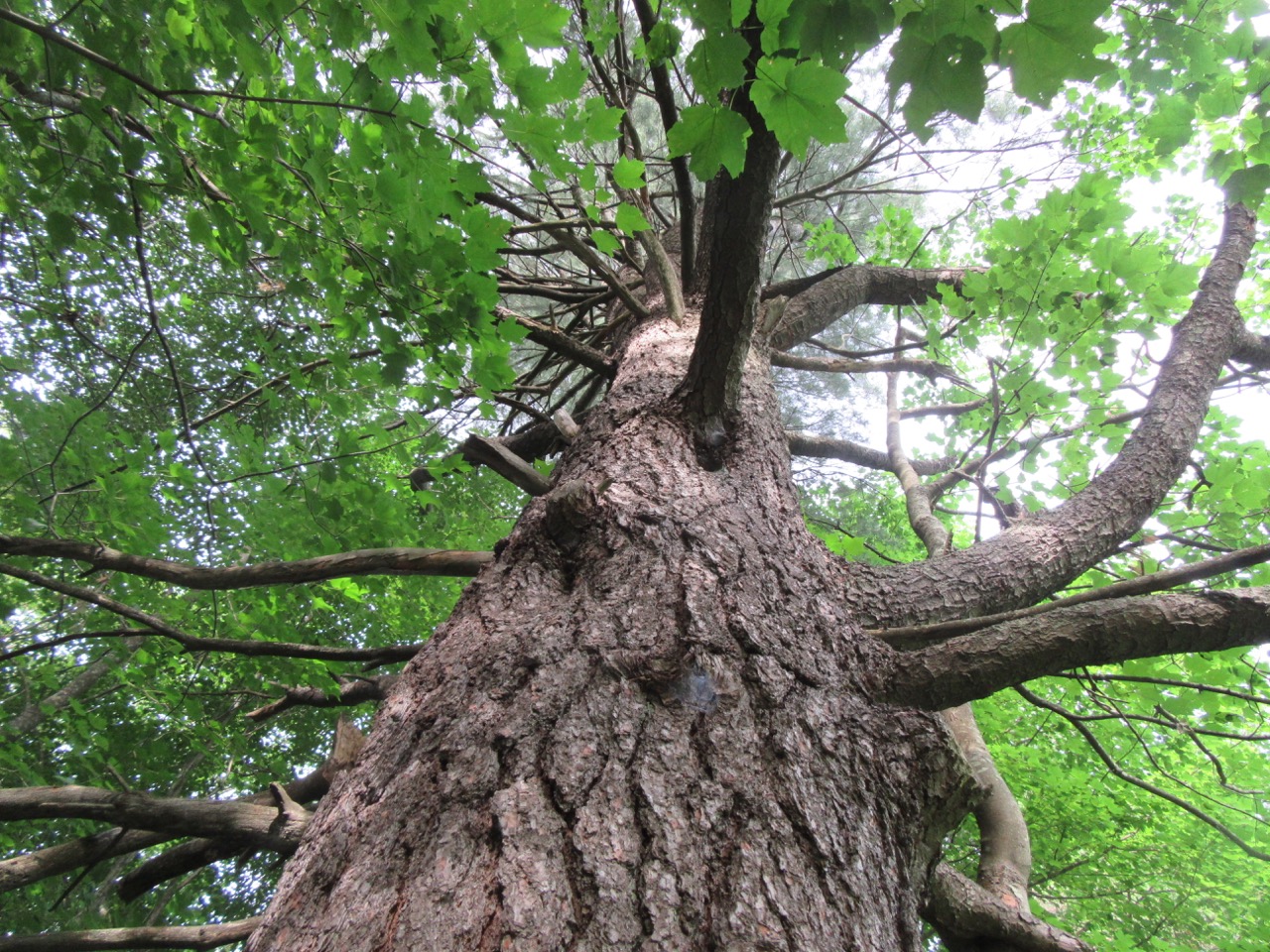
White Pine in summer

Celebrating Ministry

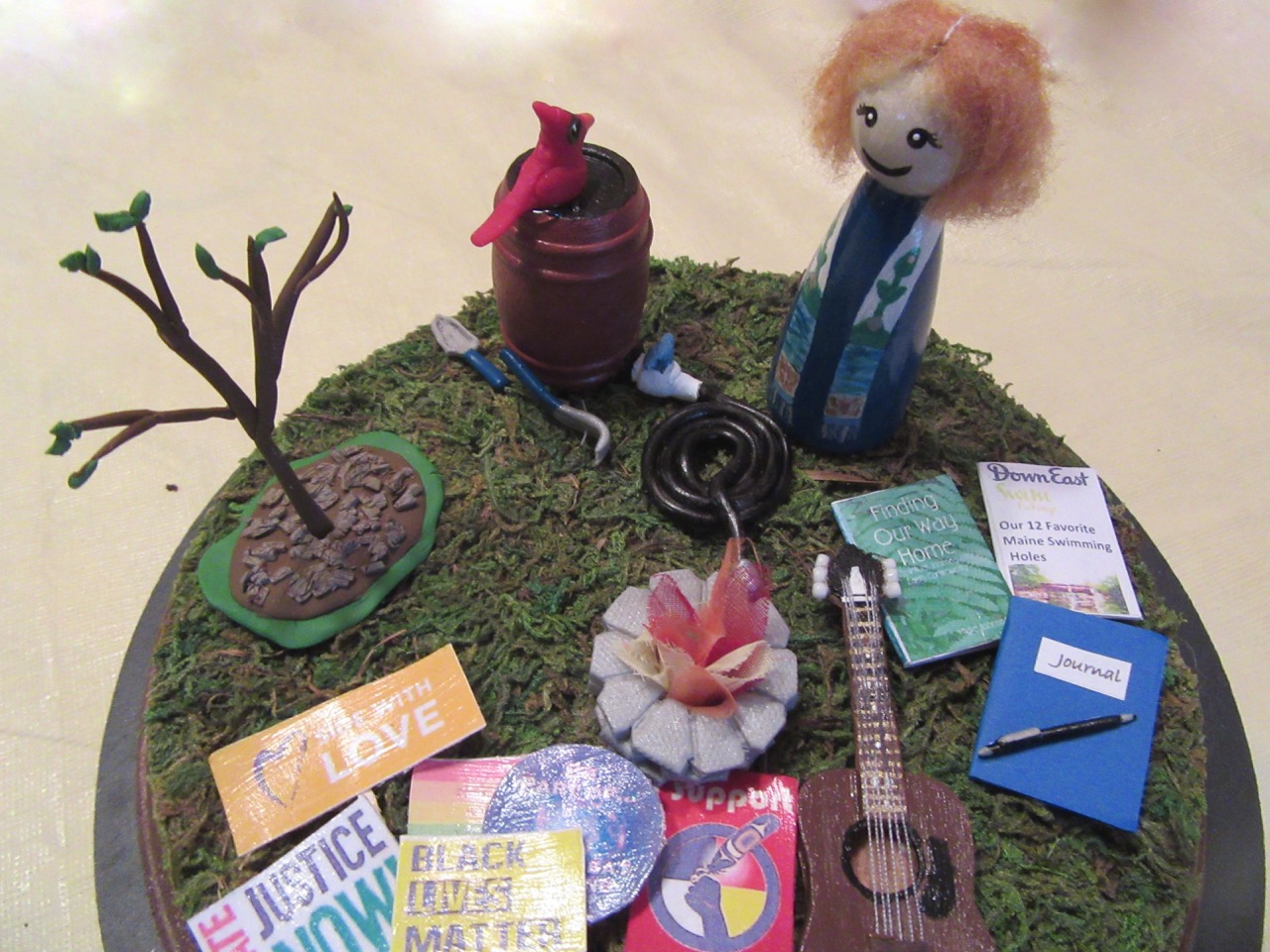
Diarama of Myke – Version 2

On Sunday, June 17, my congregation celebrated my ministry of thirteen years, upon the occasion of my retirement.  (I will still be working behind the scenes in June and on-call through July, but that was my last Sunday service.)  I was overwhelmed with their expressions of love and appreciation.  I will miss everyone so much.

There were so many amazing touches to the celebration, including this tiny (6 inches across) diorama of my life created by Kathy N. with details including my guitar, a stole I wear when I preach, tiny protest signs, the cover of my actual book, our fire circle, cherry tree, rain barrel and garden tools.  The celebration included a reflection from me and testimonials from a few church members, and a poem and a funny song created for me, and more.  There was a gorgeous rendition of Jeremy Geffen’s song “Mystery,” done by the choir and instrumentalists, along with other beautiful music.  They also honored me with the designation of Minister Emerita, and gave me beautiful gifts.  There was a photo slideshow of moments from my ministry.  We danced around the dawn redwood tree.  And ate delicious food, and I received so many hugs, including from the children.

The ministry relationship is so very deep in a particular way.  Not the same as friendship, but filled with intimacy.  During conversations with people during the meal, I kept remembering the significant moments I had shared with them. I remembered their loved ones who had died during my ministry.  I remembered the joyful weddings, and the painful separations.  I remembered our work together in the community that I helped to hold and cherish.  I felt the blessing of our relationships.

In retirement, I am leaving those relationships behind.  That will be the hardest part.  I am relieved to let go of the work.  My body just can’t do it any longer.  This year has been hard with many auto-immune flare-ups, days of exhaustion, and just barely keeping up with everything.  I am ready to lay that down.  But I will miss the people.  Not that I will never see them again.  I will be in the same city, and our paths will likely cross occasionally.  But in our tradition, the retiring minister disappears for a while, to give people a chance to form a ministry relationship with someone new.  The Interim Minister has already been chosen, and will arrive August 1st.

Meanwhile, I am cleaning out my office, and saying goodbye to staff members, and taking care of transitional details.  But I feel absolutely full of gratitude and amazement for these wonderful people, that I was lucky enough to serve and to love during these past thirteen years.  Just wow!