Fighting with Squirrels (and Chipmunks)

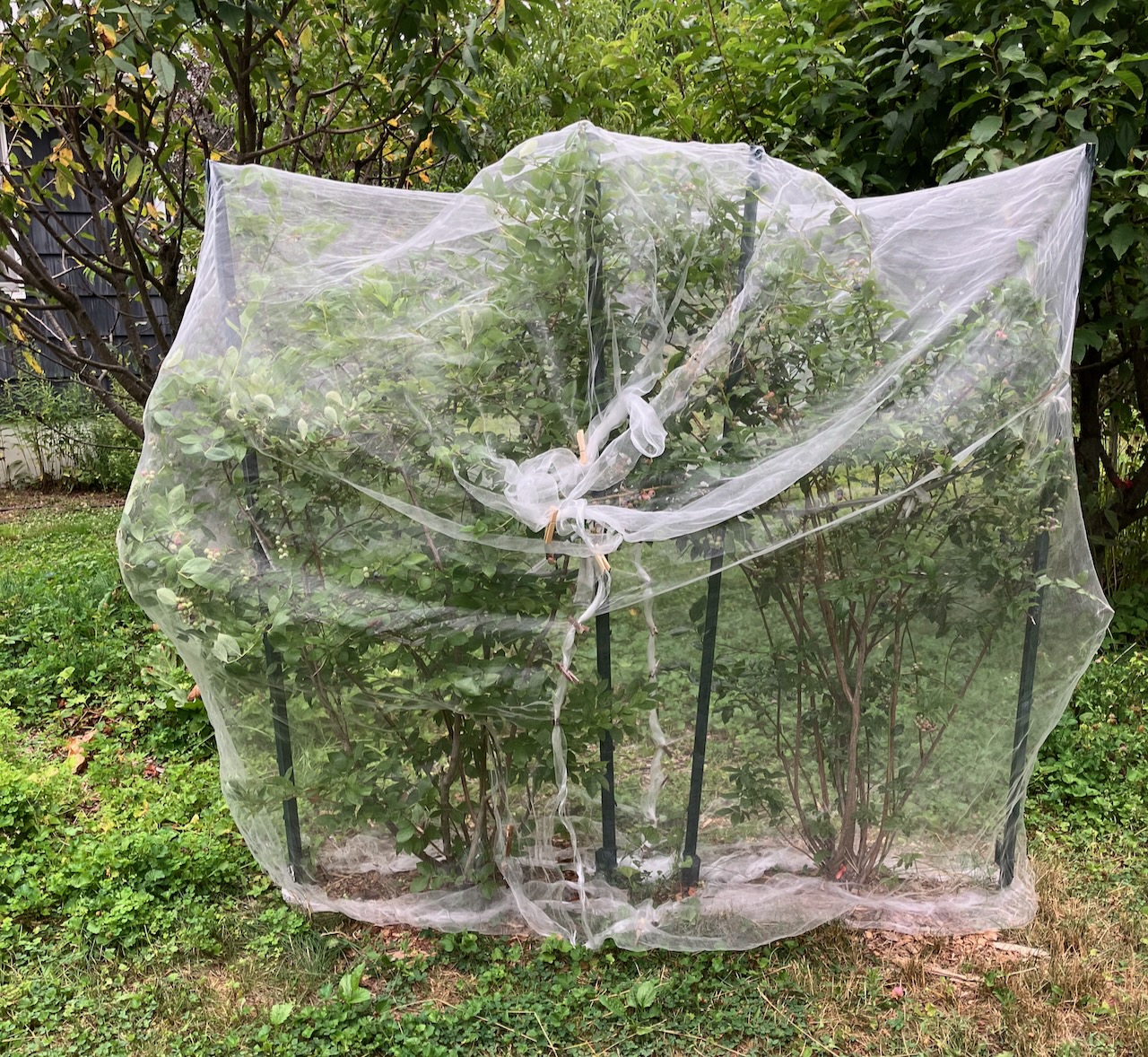
White netting draped over two blueberry bushes, using fence stakes

The intent of our permaculture gardening is to create a mutually beneficial relationship with the earth and all her creatures. But lately, it feels like a little backyard battle. The squirrels have literally eaten all of the green peaches off our peach tree. (Last year there seemed to be enough for all of us.) They have been also eating raspberries, hazelnuts (still green) and mulberries, but I sort of gave up on all of those. I have tried to protect these two blueberry bushes by covering them with netting, garden-stapled down, and using clothes pins to close the side opening. I have actually harvested some blueberries. But the last couple days, they’ve pushed their way through holes they make in the netting. When I see them, I run out yelling and clapping, and they dart around the edges to find their way out and run away.

To be fair, there is another variable this summer. I stopped filling the bird feeder some weeks back because the chipmunks would immediately climb up, fill their cheeks, climb down, and transport the seed to their underground lairs; and then repeat until all the seed was gone. The squirrels also took a fair amount. I wonder if the sunflower seeds were the tribute I had been paying to our little neighbors that ensured that they’d save us a few peaches? But yesterday, perhaps I upped the ante, because I installed a baffle on the feeder, and coated the pole with coconut oil. I really do want to feed the birds, not all the greedy chipmunks and squirrels. So here is the new set-up, (the bush is at least five feet away–I pruned it to make sure):

Green metal bird feeder with clear plastic baffle a few inches down, in front of a green bush background.

Margy and I have a little side bet going as to when they might be able to breach these new security measures. It has been up for twenty-four hours so far. No squirrels, chipmunks so far. But the birds haven’t come back yet either. The next few days will tell. And in case it isn’t easy to see, the original bird-feeder is also “squirrel-proof,” with a weight dependent bar that drops down to close the seed opening. But they figured that out long ago. They are so smart, and acrobatic. In many ways I love them. But I don’t love that they take all the fruit in our garden.

Anyway, I just needed to write about this other side of gardening. I am so impressed by the work farmers do! If we relied only on our own gardening skills, we would go hungry. But perhaps this is one of the lessons I am learning about how to be in a mutually beneficial relationship with the earth, and during climate warming too. We are all under a lot of stress, trying to survive. We don’t have complete systems in place, we don’t have our own ancestral knowledge, we are trying to recover from great imbalance. So we keep showing up, keep going outside, keep being grateful for the gifts of the earth.

And these days, I can’t write about anything food-related without also expressing rage at the intentional starvation of the Palestinians in Gaza by the state of Israel. They destroyed their farms and gardens, and destroyed access to water, and access to help from outside. How many more people will die before the world powers stop this genocide?

Boundaries & Buttercups

Green buttercup leaves in a mat/
Buttercup leaves forming a mat.

Earlier this summer, I discovered a few lovely yellow buttercup flowers under the Honeycrisp apple tree. I didn’t think too much about it. They were so pretty. Later, when I was mowing the orchard undergrowth, I mowed those flowers along with everything else. But more recently, I realized that the buttercups had spread all over the ground near that tree, and were crowding out any other plants. So once again, I did some research and discovered that Ranunculus repens, creeping buttercup, is considered invasive in Maine.

I don’t know how it got here. And it is likely that I won’t be able to get rid of it entirely–each plant puts out horizontal stems that take root at its nodes and form new plants at each node. But I have to try. Further research suggested that using a garden fork to loosen the soil and lift up the plants was a good way to pull the plants with their roots. Also, it prefers acidic soil, so adding lime to make the soil less acidic can discourage them. I started pulling them yesterday, and did some more this morning before the rain came.

Small tree with a few apples on its branches, at the ground we see green  all over, except in one area where soil is visible, and a garden fork in the lower right.
Here you can see the section I pulled and the other huge section covered with buttercup plants.

I was complaining about all this to Margy, and she reminded me that a large part of our gardening is removing problematic plants in order to encourage beneficial plants. So while I delight in the violets that spread everywhere, and the wild strawberries–both native ground covers that have flourished in the orchard, I also have to reckon with these invaders that come in from who knows where.

Invasive plants don’t have good boundaries! Now, there are also some native plants that are quite aggressive growers too. One example is Canada anemone, or anemone canadensis, which Sylvia planted in the herb garden. The difference is that native plants have more benefits for the local ecosystem. But I pulled hundreds of these plants to make room for the littlest apple tree. I put down cardboard boundaries around the circle, and over the circle, then covered it with wood chips. I may also use that method for the buttercup areas to see if that helps.

Very small tree in a circle of wood chips, with lush green plants at the back of the circle.
Small Blue Pearmain apple tree, with a ring of Canada Anemone around the back.

So once again, lessons can be learned from plants and the process of tending them in the garden. Plants have many different relationships with each other. Can aggressive or invasive plants eventually find some sort of balance? Some non-native plants find a useful niche and honor the boundaries of plants around them. We might also ask ourselves, How are we in our own relationships with others? Are we aggressively pushing out others to claim all the space and goods for ourselves? Or are we good at sharing space and goods with our neighbors? Are we also careful with our own boundaries, not letting others treat us aggressively?

And I can’t even consider these questions without thinking about the early colonization of this continent by Europeans–they certainly fit the definition of an “invasive species,” destroying so much in their spread across the continent. Yet here we are now. Can we learn to live in harmony with all beings around us?

When Trees Fall

The good part, for which I am grateful, is that our neighbor came to our door to talk to us. He asked whether we would mind if they took down trees in the area between our two properties. He wasn’t sure of its status, but I told him it was a “paper road” that likely would never be built. I told him we would NOT want those trees taken down, that they provide privacy between the two yards. The neighbors want to garden in the way back of their yard, but don’t get enough sun. I suggested that the boundary trees are to their north, so wouldn’t affect their sun. He said it was just as a way for the machinery to get into the back, but they could do it a different way and not take down those trees. He wanted to respect our wishes. So that is the good part. And I like that they want to garden.

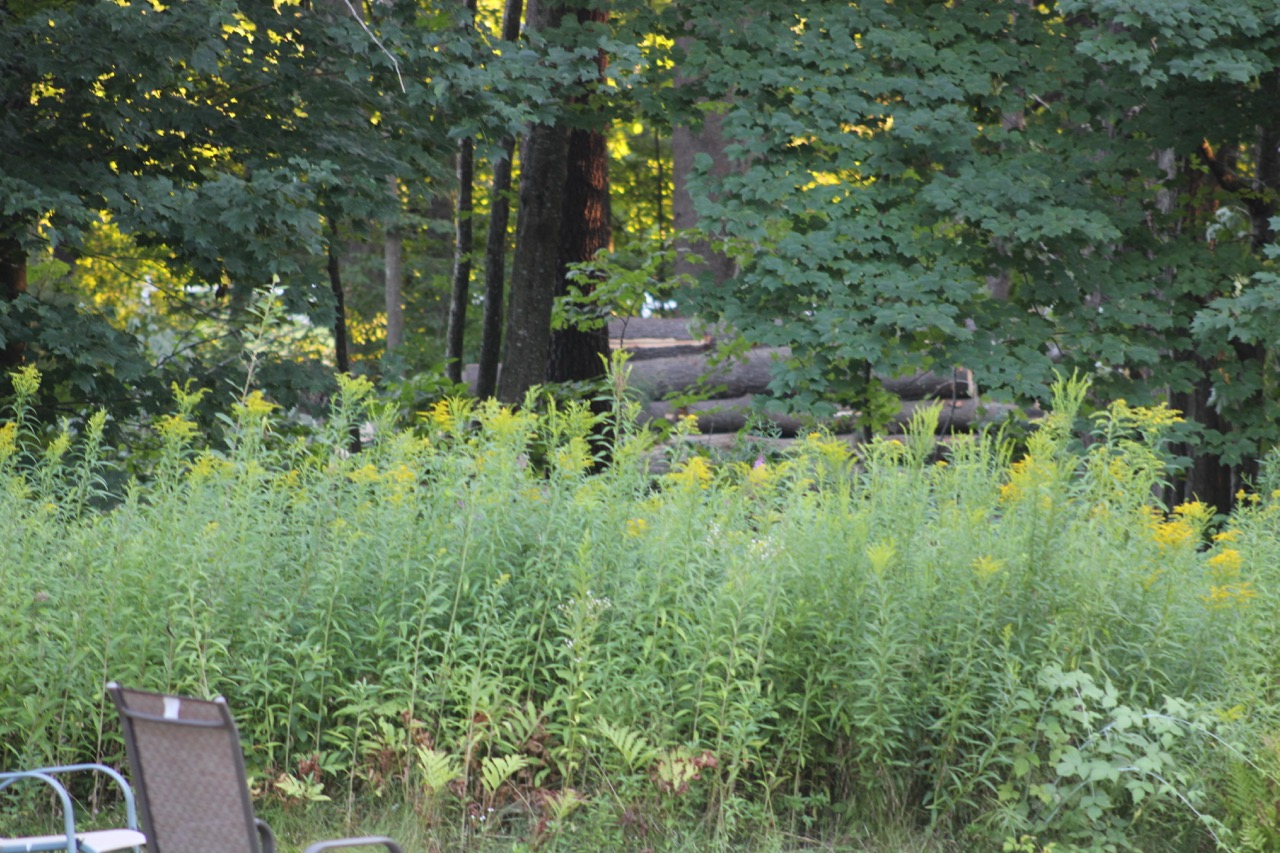
Felled pines behind our big pine, behind our back yard, with goldenrod in front.

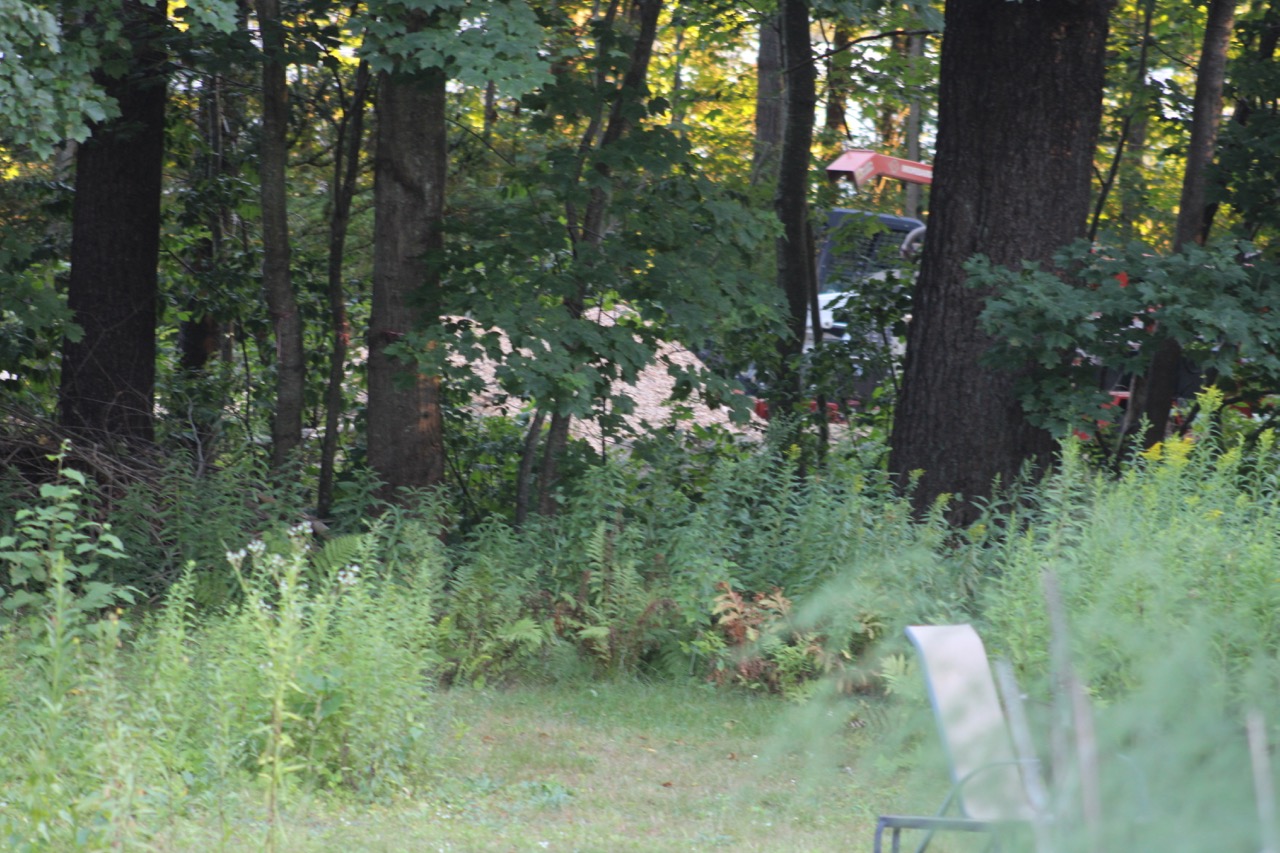
But the rest is so bad. Loud machines have been working all day yesterday and today, felling tall pines, and chipping up branches. Sometimes we feel the ground shake in our house when the trees fall. Our thin strip of protected trees does not hide what they are doing, light comes through and all the visuals of machines, and trees being cut down. The cherished privacy of our back yard is no longer what it was. But most of all, I think about all that habitat lost and wonder how many birds’ nests have been destroyed. Many many birds yesterday were making alarm calls. Early this morning, a pungent skunk-spray smell came through my windows. I imagine that the skunk has been dislodged in some way, and perhaps came across our yard and encountered one of the little cats that hunt here. I think about how we love the wildlife that come through our yard, and how the trees and underbrush, on the so-called “undeveloped” land, have been a mini-wildlife corridor for deer, turkeys, skunks, groundhogs, sometimes even foxes.

Through the trees, we can see the big machines, the pile of wood chips.

I try not to make the neighbor an enemy in my mind–after all, he wants to create a garden, so there is love for the earth there too. We live in the city, in a neighborhood near little brooks in sunken areas that continue to provide wildlife a refuge. But just in the six years we have lived here, acres of trees have been cut down in our neighborhood. Each tree down means more carbon in the atmosphere, more warming, more drought. I think about the long history of cutting the great forests of North America for settlers’ farms and gardens and cities.

And this is how the wider world feels to me right now as well. Slowly falling down around us, more and more “developed,” less and less room for wildlife and trees. I don’t even know how to feel this sadness. It is too deep, too fundamental. Even as Margy and I try to love this small piece of land, to learn from it how to live in mutuality with the earth, all around us the path of destruction seems to hold sway. I think about the great pine in our back yard on the paper road, the one that is over 100 years old, and how she must feel to sense the destruction of her family of trees nearby. I think the trees know. They know that we are destroying our only home, our only planet. And so we grieve together.

River Otters at Evergreen Ponds

River otter eating a fish, within a small rock enclosure in the small pond.

Our area of Maine loves nature news. So when we heard in the news that there were visiting river otters in the ponds at Evergreen Cemetery, we joined many other Portland residents to go to the cemetery to see if we could see them. And we did! We saw this one in one of the small upper ponds, diving under the water to fish, and then emerging in this little rock cave to eat. We also saw one in the big pond, walking on the iced areas in between diving beneath the open water to fish.

River otter on the ice near a thawed opening in the water.

It has been a while since we’ve been to the cemetery. I used to walk over to these ponds frequently, but haven’t had the energy for an hour-long walk lately, so we drove over this time. Sometimes it is wonderful to be alone in the natural world, to see the secrets of plants and animals revealed to a quiet human visitor. But sometimes it is just as wonderful to be with other humans who love these secrets, and can’t resist our animal relatives. There is a sense of kinship with each other, we chat about the sightings, we notice how skilled the otters are at catching fish, we share our tales with new arrivals. There are children and elders, and every age in between. Outside with each other.

Finally, when the otters had hidden behind the back of a little island, I took a walk around the big pond, carefully making my way over tree roots. I couldn’t resist also taking photos of this lovely blue heron–much easier to catch than otters, since it likes nothing better than standing still on its perch on the log.

Great blue heron standing on one foot, perched on a dead log in the pond.

When we first arrived, before we saw the otters, I also happened to catch her scratching her head. Maybe wondering about the sudden abundance of humans wandering around her pond. But not letting that disturb her equanimity and perfect balance.

Blue heron scratching her head, while standing on a log in the pond.

May our animal relatives find all they need to thrive that they may live long upon the earth. May we human animals wake up to our interconnection with all beings, that we may find a way to turn from destruction to mutuality.

Grounding

Range Pond October 1

A shift has happened in my spirit, and I feel grounded in a way I haven’t felt for several weeks. I’m not sure why, but a few things have happened this week that might be related.

Three days ago, after windy rain, the power went out about 9:30 in the morning. Happily, I’d already eaten breakfast and installed a new shop light in the garage. (As a friend framed it on Facebook one day, it was a project that took two months and fifteen minutes.) So I took a short walk and discovered a few blocks away that a tree had fallen on some wires. It might be a while. I had an appointment to pick up groceries from the store, but also happily, when I called, they said it would be okay to wait until our power was back on.

Waiting for the next several hours, I noticed that my mind was in a kind of tormented withdrawal from its usual access to constant stimulation. No social media (saving my phone battery for more important things), no book to read (saving my phone, etc.), no television shows. Not enough energy to do a project. A really uncomfortable stillness. Margy and I ate lunch on the patio, and I noticed it was much easier to deal with my mind outside, so after lunch I pruned out some raspberry canes. Finally, the electricity came back–and then it was groceries to pick up and process.

Two days ago, in the morning I facilitated a very productive meeting of our Decolonizing Faith Project. We are moving toward completion of a Zoom version of our workshop for faith communities. That felt good.

Later that day, Margy and I decided to go on a rare outing. We took a drive to search for beautiful autumn color, and found our way out to Range Pond, about forty minutes from where we live. (And by the way, for those who aren’t from around here, I don’t know why but Range Pond is pronounced Rang Pond.) I took my shoes off and waded in the still warm water, delighted to watch the sun ripple off the sand. Sun, water, trees: a healing balm for our souls.

Yesterday morning, after a long night’s sleep, I woke quite early and was writing in my journal, surprised at how peaceful and grounded I felt. I remembered–and this is key I think–I remembered that throughout my adult life there has never been a time I did not hate the atrocities committed by our government. (Wars, empire, ravaging the earth for profit, oppression of people of color, you know the list.) Yes, lately, those atrocities have intensified. But I had protested every administration, and realistically, felt little power to stop those atrocities.

I also remembered that when I was part of the Catholic Worker movement, I learned that resistance can take the form of personalism: we attempt to live out our values personally, and in community–we fed the hungry, housed the homeless, welcomed the “stranger.” We treated all people with respect, and practiced peaceful ways to resolve conflicts. We also protested, not merely to try to change the government, but also to keep clarity in the values we affirmed.

And I remembered that that has always been my own best path of resistance. (That’s why Margy and I chose to green our own living situation, to plant a garden, to learn to more deeply love the land we are living on.) When I was active as the minister of a congregation for many years, I needed to widen my perspective, to hold and affirm many ways of living our values. But now that I am retired, now that I am chronically ill, I am coming back to the core of my own journey. And it is okay to do what I can, and not to be tormented by what I have no power to change.

So all of that was grounding my spirit as the sun was rising yesterday.

And then, later, I did check Facebook, and saw everyone posting about the president getting a positive test for COVID19, and speculating about whether it was true, and what it might mean. And I really do honor the angst that people are feeling about the state of our country, and the election coming up, and the possible undermining of democracy, and so much more. But this time, I didn’t lose my balance. I didn’t get hooked into the chaos. I remembered that I don’t have to loudly condemn every atrocity or agonize over all the pain that I cannot alleviate. It is not a moral necessity to be panicked and despairing over all the evil in the world.

I remembered my own path, my own calling, the small ways that I can live into a vision of mutuality, of respect, of healing. I am writing to help myself remember, for those times that I forget again and again. And perhaps to help you remember your own calling, if you have forgotten in the midst of these strange times. May our many small actions be joined together by the great Mystery into the beauty that is possible.