Fallen Spruce

It is raining here in the northeast and the wind is blowing mightily, with gusts past 50 miles per hour. This healthy spruce tree suddenly fell down from its very roots. I was inside and heard something, but didn’t realize what had happened until I poked my nose out the door. Thankfully, it just missed our deck! And our house! 

I found this little squirrel within the branches, perched on a cherry tree branch, probably wondering what the heck just happened! And also eating a seed. The spruces are like squirrel highways over here.

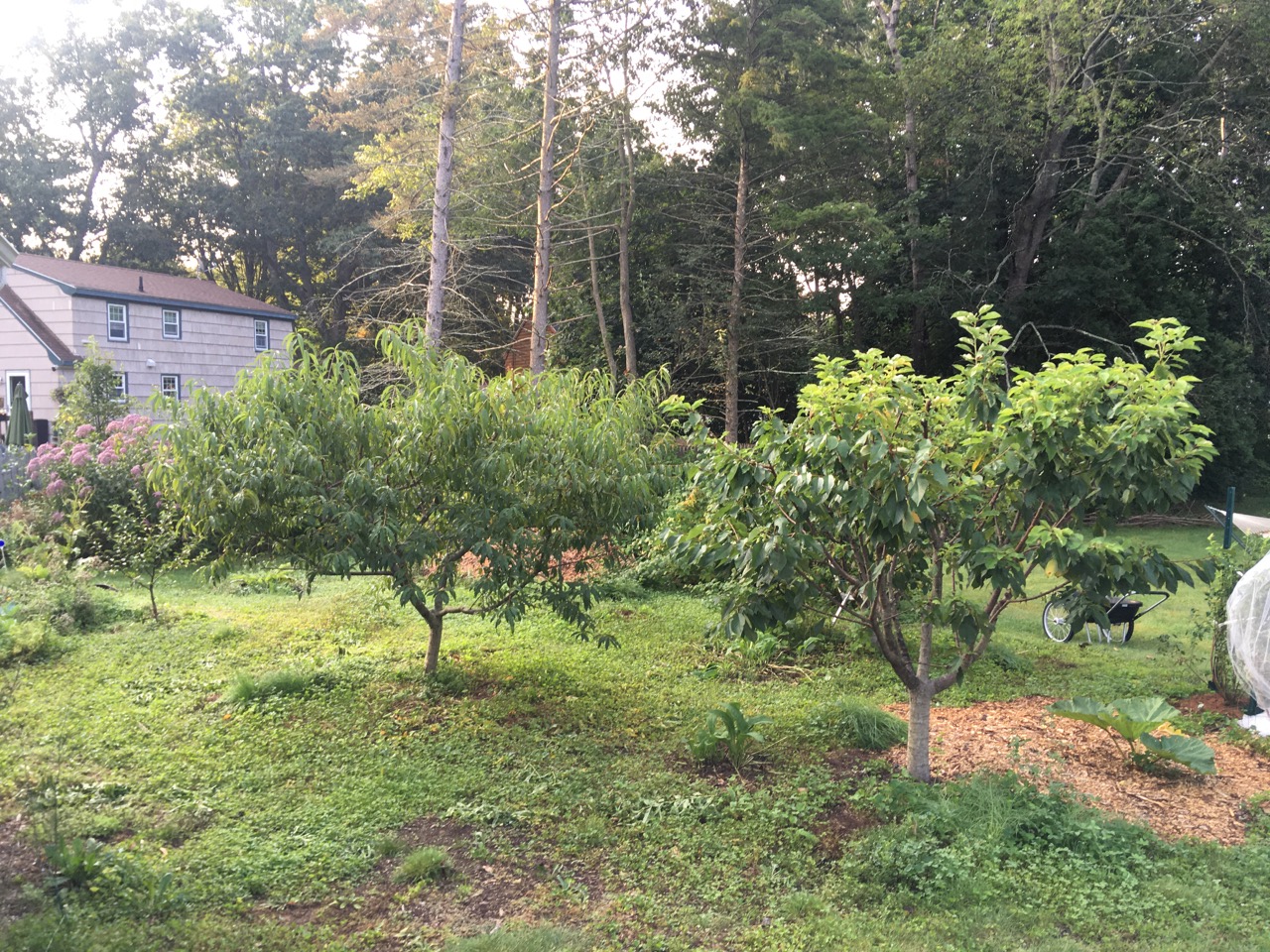
I went fully outside into the rain to survey the damage and was amazed by how we lucked out. The spruce landed in the orchard, tucked neatly between the trees. Some orchard tree branches are bent or broken, but not the trunks. Also, it could have hit our house if it had fallen in a different direction, but it did not.

Earlier, I had been worrying about an entirely different spruce–a dead one with a squirrels nest. That one is still standing so far, but this one took me by surprise. The whole root ball had come out of the ground. This photo is from that root, from the bottom of the tree, looking to the top, where you can see how it landed between the white painted trunks of apple and peach. The patterns of the branches are so beautiful, even in its dying.

I don’t know how much damage the orchard trees suffered. When Margy got home from an appointment, she went out in the rain immediately to begin cutting spruce branches that were interfering with orchard tree branches. I guess that is something else that I love about her. Going outside in all sorts of weather, and caring about trees. I think if the branches can be freed from where they are bent, they might have a better chance of recovering.
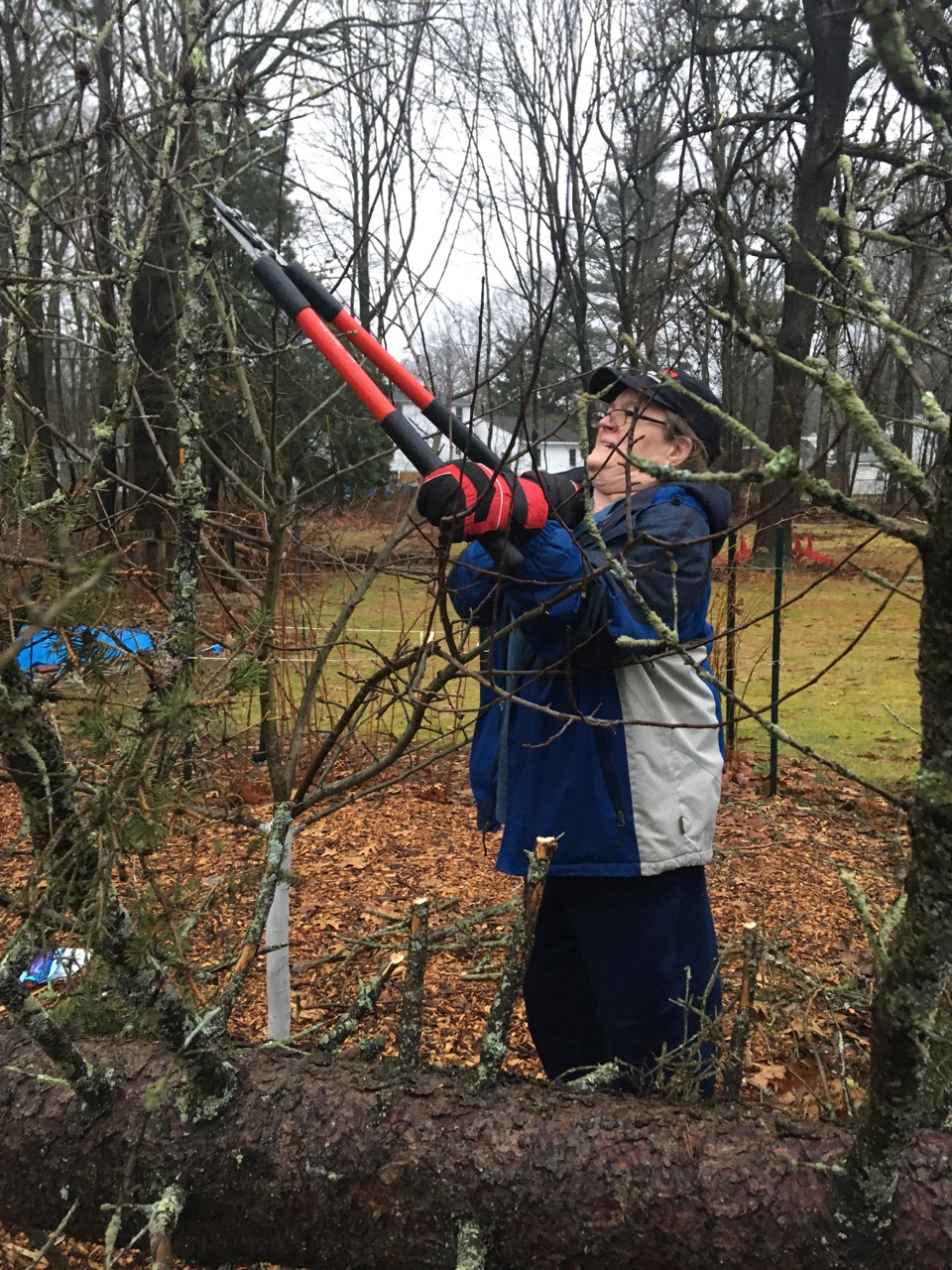
Meanwhile, I am inside thinking about how vulnerable we all are to the wind and weather. How even with so much care put into this orchard, it could be wiped out with a storm. Or a tree could fall on our house. I tend to worry, to imagining worst case scenarios. Yet, I have been so blessed in so many ways, protected from harm by what magic? I can’t put it on “being blessed,” because I don’t think people who face tragedy or catastrophe do so because of not “being blessed.” (I don’t think people being killed in Gaza are outside of the view of that Mystery who blesses all, and who is especially with those who are suffering.)

Luck? Fate? I am reminded of the Chinese story about a farmer whose horse escaped into the hills. When his neighbors came by to sympathize with the old man over his bad luck, the farmer replied, “Bad luck? Good luck? Who knows?” The next day, the horse returned with a beautiful wild stallion. This time the neighbors congratulated the farmer on his good luck. His reply was, “Good luck? Bad luck? Who knows?” Then, when the farmer’s son was attempting to tame the stallion, he fell off its back and broke his leg. Everyone thought this very bad luck. But the farmer again replied, “Bad luck? Good luck? Who knows?”

Some weeks later, the army marched into the village and conscripted every able-bodied youth they found there. When they saw the farmer’s son with his broken leg, they let him off. Now was that good luck or bad luck? Who knows?

When a tree falls I am reminded that the world we live in is much bigger than we can understand or imagine. 

Suffering and tending

Myke painting tree trunks in the orchard (Photo by Margy Dowzer).

When I feel devastated by the images of premature babies in al-Shifa hospital in Gaza, without incubators, without oxygen, placed together for warmth, but some dying, (and finally I hear that they are being evacuated today)… When I feel devastated that the initial violence and hostage-taking of Israeli citizens by Hamas has been multiplied by more violence and death by the Israeli government… When I feel devastated by bombs killing innocent civilians and journalists and children… When I feel devastated that I cannot stop the killing or bring food or water to the starving families… I cannot find the words to write…

And so I have been tending the only life I can tend. To get ready for winter, I sprayed the orchard trees with holistic spray (with Neem oil, Karanja oil, hydrolyzed fish, and probiotics in water). And then a few days later, I painted the trunks with my own combination of white milk paint and “Surround.” The white paint protects the trees from sunscald. When the sun warms the trunk by day, and the nights are cold, the extreme fluctuations of temperature can cause the bark to split.

Milk paint is a non-toxic biodegradable paint made from milk and lime. Surround is a natural clay product that protects trees from boring insects. It is also light colored, so I decided that to combine them would make sense. They both come in powdered form that is mixed with water. And so I knelt beneath these trees and tended them with love.

This is not enough to remedy even the suffering I feel in my own heart for all the suffering happening so far away. But somehow I must choose life, choose tending, choose care.

Orchard Learning

Mottled red apples in green leaves and branches
Our first Honeycrisp apples are almost ready to pick!

Our semi-dwarf apple tree is bearing fruit for the first time this year, and we are excited for the dozen or so apples that will be ripe soon.

How naive I was when I first decided to plant an orchard in our back yard. We started with two dwarf cherry trees in 2017, of the varieties Lapins & Black Tartarian. The next spring we planted a Contender peach tree, the Honeycrisp apple, two blueberry bushes, some raspberries, and three hazelnut bushes. In 2019 I grafted two other apple trees, Black Oxford and Blue Pearmain, this last just transplanted to its new bed this year. (Not to mention our mulberry tree further back in the yard, and three more blueberries planted later.)

I think I imagined that one would put in a lot of effort at the beginning, with preparing the ground, planting the seedlings, adding companion plants, tending, and so forth, then the work would ease and the fruit would be there for the picking in the years to come. Maybe that was some of what attracted me to permaculture and a food forest. Little did I realize that an orchard requires even more tending as the seasons go on.

And there are the ups and downs–the first peach harvest went entirely to the squirrels-we were so sad. Then we had an amazing crop last year, that we ate fresh, shared with the neighbors, and froze, some packages of which are still in the freezer. This season, no peaches at all. We have yet to have a cherry harvest. This would have been the year, I think, but the abundant flower buds were empty from the deep winter freeze. On the other hand, the raspberries are very reliable, and the blueberries have begun to come into their own. And the number of birds have multiplied in our yard, whether or not there is any fruit on the trees. They love the orchard.

All that preamble to say, I did some more pruning this past week! After watching a whole bunch of Youtube videos about summer pruning, I gained the courage to go and cut off a whole lot of branches that were vigorously seeking the sky on the peach tree and the Black Tartarian cherry. (I had already done some pruning on the Lapins because of its black cherry aphid problems.) When I post the “after” pictures below, you might not believe how many branches were piled up on the patio waiting for me to take them to the compost. The trees still look flush with abundance green, though I think their tops might be about three feet lower than before.

Peach tree and Lapins cherry after pruning.

I also discovered a lot of small curled leaves on the Black Tartarian, without any evidence of aphids. After some research I learned that there is a fungal disease, cherry leaf curl, similar to the peach leaf curl that I dealt with by picking off the affected leaves. I can’t be certain what it is, but I went back around and pruned off any branch ends with those curled leaves on both cherries. All the pruned cherry branches I cut up and put into garbage bags to go out with the trash–three bags full–so they wouldn’t spread the problem.

You might notice from the photo that the companion planting under the trees is now very low to the ground. I have taken to mowing most of it, including the oregano that spreads everywhere, and I put the cuttings in the compost to bring back later. The mowing doesn’t seem to bother anything, it all comes back. Under the Lapins cherry tree, I actually put down some cardboard to inhibit the oregano and then covered it with wood chips. It is an experiment.

Pruned Black Tartarian cherry tree.

This is not to say that the trees won’t also need winter pruning. That is the thing. They will always need lots of pruning, summer and winter. The work is never done. I might do less of it or more of it, depending on my own energy levels. But there is always more work that I could do to tend to their care. Even with my trying-to-be-minimalist approach. (I have read that there are people who secretly plant fruit trees in random places, to great environmentalist applause; but I wonder about who will do the tending.) So while I often wax eloquent about permaculture and gardening, please be warned about the other side: this relationship with garden trees requires a lot of work, more than I ever expected.

I should end this post with a caveat: I consider myself a learning gardener, and none of these reflections should be taken as advice. I have no idea what I am doing at least 50 percent of the time. My intention is creating a mutual relationship with the earth and the plants, and reflecting on that process. As always, I am humbled by it all.

Robins at Lammas

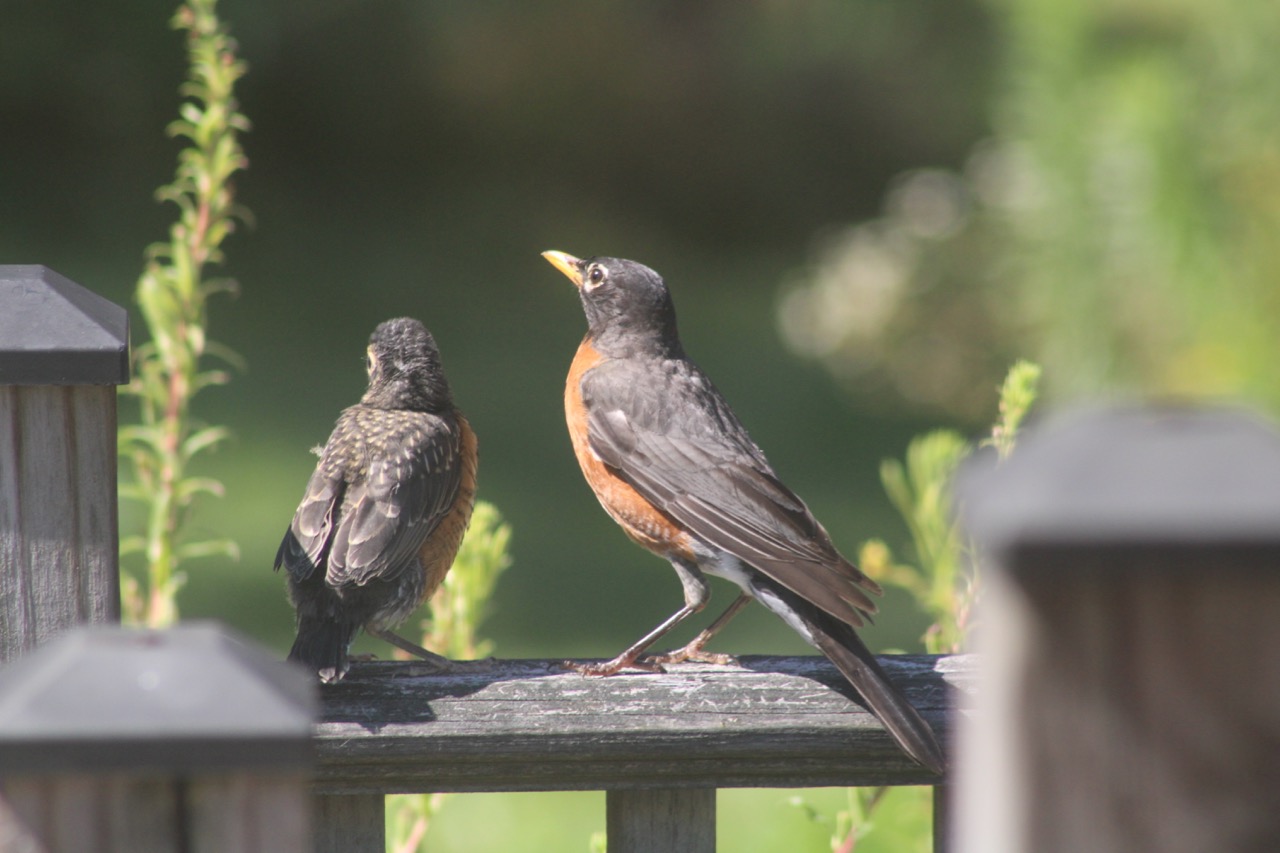
Fledgling robin looking at mother robin who is looking back, perched on gray wooden railing, greenery behind.
Fledgling robin with mom on the deck railing.

Our Lammas harvest festival blessing was being able to watch the fledging of the robins’ third brood of three chicks. (That makes nine chicks all together!) They had been getting active the last couple days so we were expecting it. But what a nice surprise to look out the window and see the first fledgling perched all alone on the deck railing, looking around at the big wide world for the first time.

Fledgling robin alone on gray deck railing looking out to greener beyond.

They probably saw their mother hopping on the ground further in the back yard. (We did too.) Then the mother flew up next to it on the railing for encouragement. (That was photo number one). After looking at each other, they each looked out beyond, and then the mother flew off, and the baby soon followed, alighting high in the hazelnut bushes.

Fledgling and mother robin on gray wooden deck railing looking away from camera toward greenery beyond.

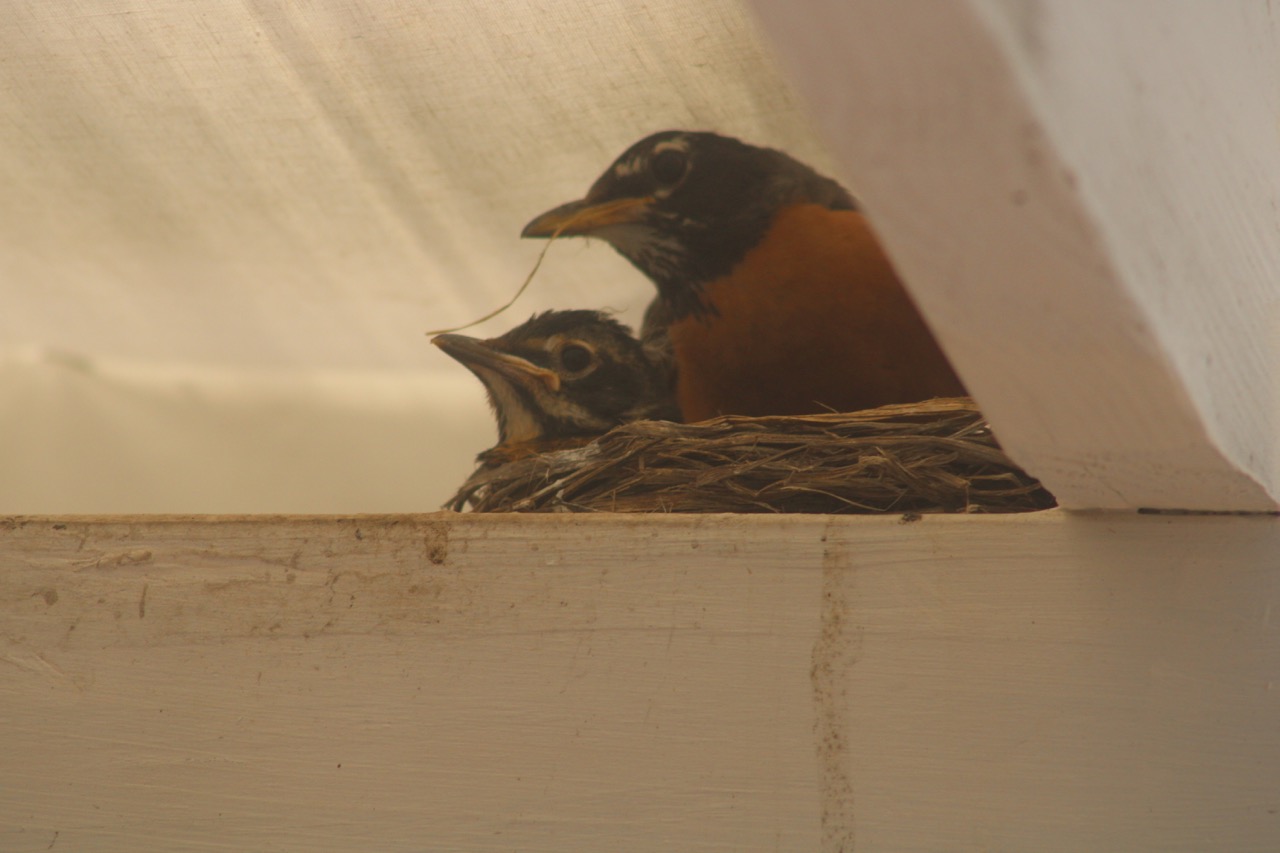
The other two remained in the nest for a little while, but soon the second one flew out toward the orchard. Finally there was just one left. I wandered around outside, but the parents were chirping at me, their warning calls. I saw the parent robins also diving and shrieking at squirrels in the pitch pine tree branches, and angrily calling at a cardinal who came into the cherry tree–too close as far as the robins were concerned. Back inside for a while, I saw the dad robin come to the nest–with a piece of grass in his beak, but I didn’t see food. He sat with the third baby for a while, so tender. After he left, the baby shrunk down into the nest, only its beak visible. Hiding mode.

Baby robin, just head showing above brown grassy nest, with dad robin above and behind in nest, between white painted beams underneath and on side.

I had to go out in the orchard to do some mulching, and then I sat at the patio table. I could hear number three chirping every so often from the nest, their head visible again, and then I’d hear another chirp from the direction of the hazelnut bushes. When I came back inside, I kept an eye on them through the windows. They got out of the nest finally, and hopped along the beam to the other side. While the first fledgling had seem so confident and proud of itself, this one seemed quite scared about jumping from its safe little home. But everybody had left. It huddled up next to the opposite side beam.

Baby robin visible from belly up, on white beam, next to side beam, looking toward the camera.

Finally, the little one started to stretch their legs, and move their wings a tiny bit. They moved up to the very edge of the beam. They hovered there for quite a while. One of the parents came back to the deck railing down below and behind the nest. I also saw a female gold finch perched on the railing in front of the nest. Not sure what that was about. A chipmunk was scurrying below on the patio. I stood still next to the back windows and just watched–I didn’t take any more photos. The gold finch left, the parent left, the chipmunk left. The little one perched on the edge. Then they bravely jumped off.

I heard a flutter of wings against the screen window of our music room, just to the left of the deck out of my sight. I went out the door to observe, and saw that the baby was hanging by one claw stuck in the screen, and flapping their wings against it. I walked to the edge of the deck, reached over and cupped my hands gently around the baby, careful to contain their wings, lifted them to release the claw. I let go and they flew down to the lemon balm patch. Be still my heart. They slowly hopped out onto the patio, hopped over some garden hoses, making their way over to the mulched area under the cherry tree. They hopped into the grass behind, and finally they flew up over the grass into the trees.

And then the nest was empty. They say that robins raise two or three broods a season, and if that is true, they may be done with the nest for now. They’ll feed the babies for a few more weeks out in the bushes and trees. I wonder how all nine of their children are doing? Did they all survive? I hope they are thriving. We don’t see them once they leave the nest, so we never know.

I feel a sense of joy, and a sense of loss, all at the same time. I feel grateful for the privilege to observe the robin family, and for the moments I was able to capture in photos. I feel sad to look out the window and see them gone. I am also grateful that I was able to give them a little shade from the sun, and maybe that helped.

Fledging Day!

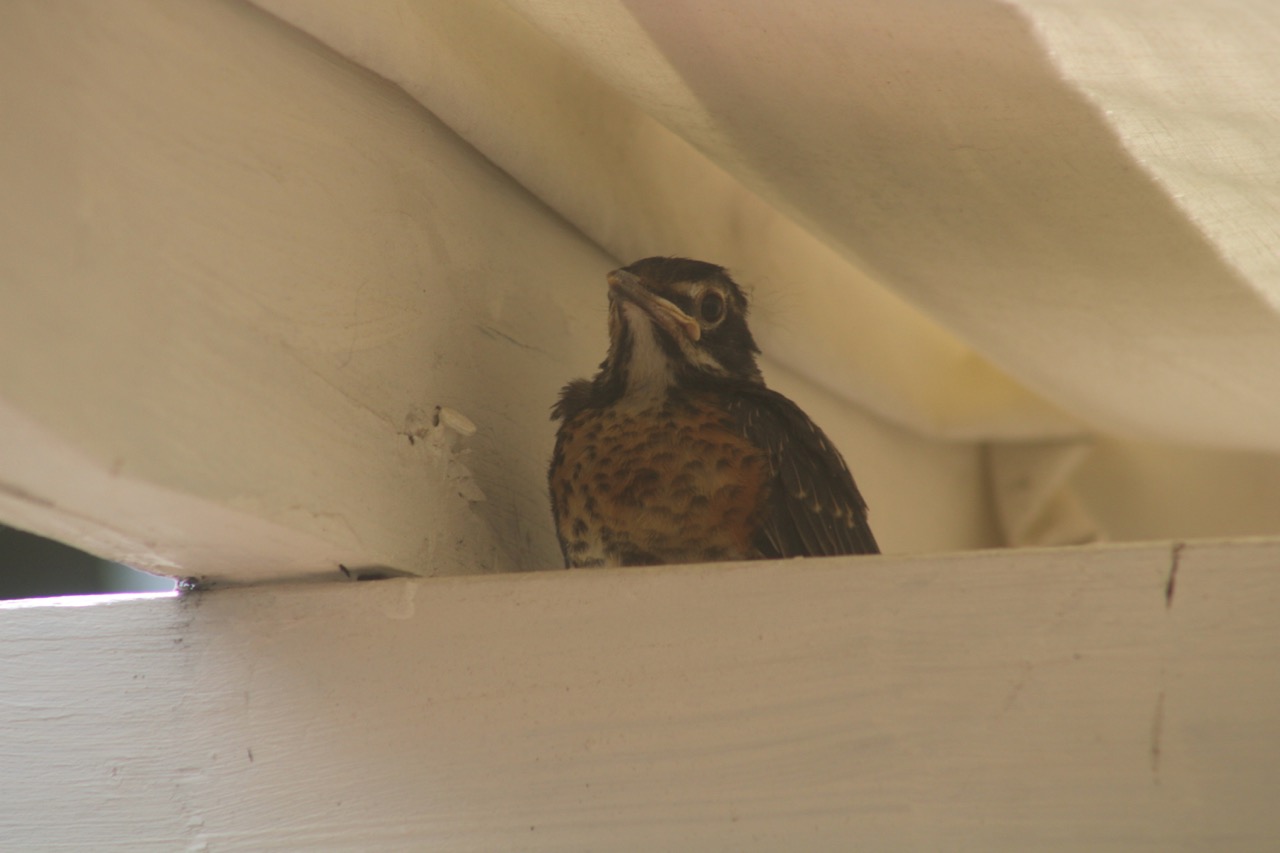
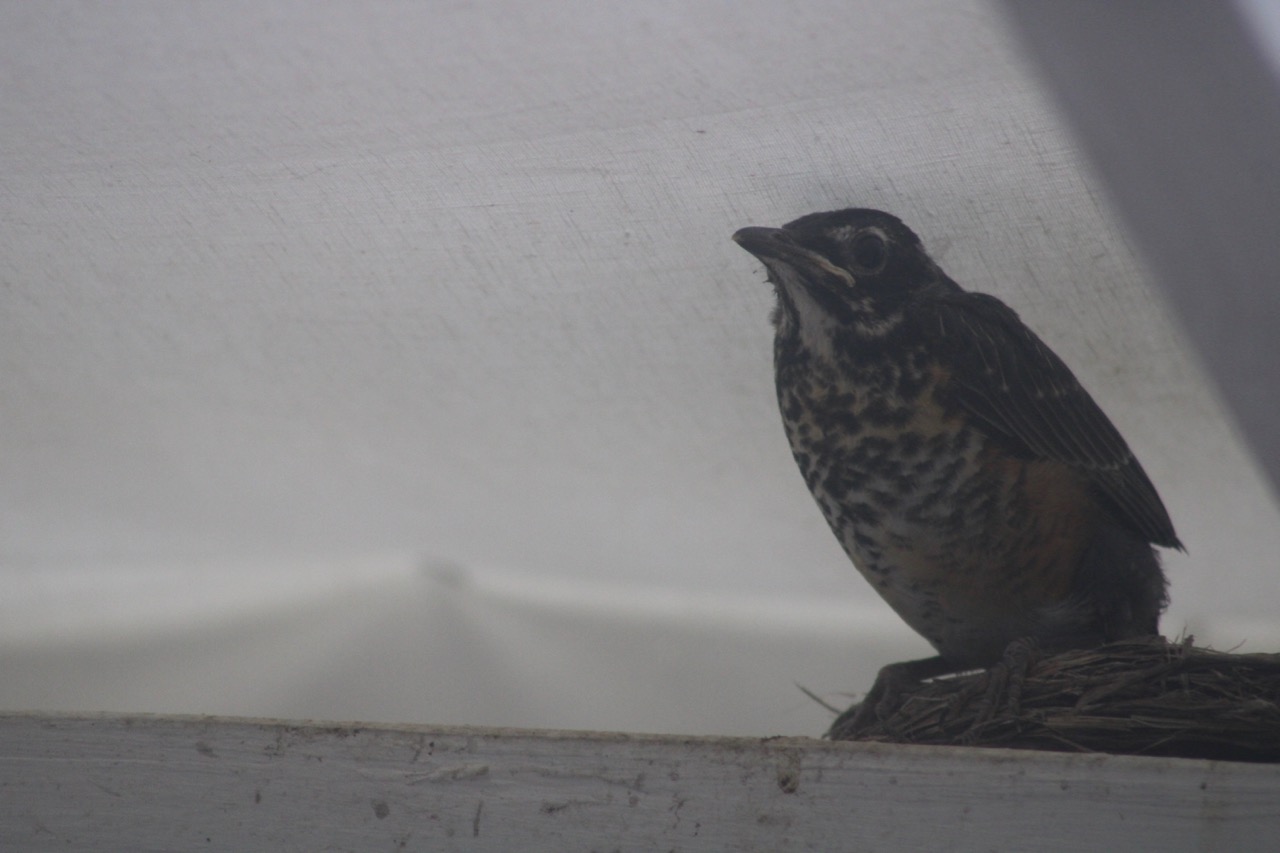
Robin chick perched in nest, under cream colored covering.
The last robin chick in the nest. The others have left in the night.

Today all the robin babies fledged from the nest. When I woke, there was just this one left. Its parent came by to check on it, not bringing food, but flying up to the nest and then back down, as if to say, here is what you do now.

Robin perched on wooden deck railing near post.

Shortly after, I saw it take its first flight, flopping over to the screen window of our house, where it tried to grab hold but then fell down to a soft patch of lemon balm below the window. (Now I am wondering about a sound I heard last night, of something bouncing on the screens in my room. Might that have been earlier chicks making their first flights?) A bit later, I went down to the patio, and something flew by from a perch on the chairs, then to the grass on the other side of the orchard. All the while the parent robins were chirping loudly and continuously, whether to warn me away, or to reassure the chick, I don’t know.

Robin fledgling in grass.

I was wondering what would happen next for the fledglings, and learned via research that the parents will keep feeding and teaching them for the next few weeks, while they hide on the ground or in bushes, trying to avoid predators and learning to find their own food. I am so glad that there are no more neighborhood cats roaming in our yard. The mother might start another brood soon, but the father will keep watching out for these fledglings during this time. All the chicks will stay in this territory for about 4 months or so.

I wandered around the orchard and the yard trying to see what I could see, while the parents chirped at me, and I spotted this chick on the pallets that form our yard waste bins, with a parent nearby perched on the same bin.

Robin fledgling with mottled feathers perched on wooden slats of bin.

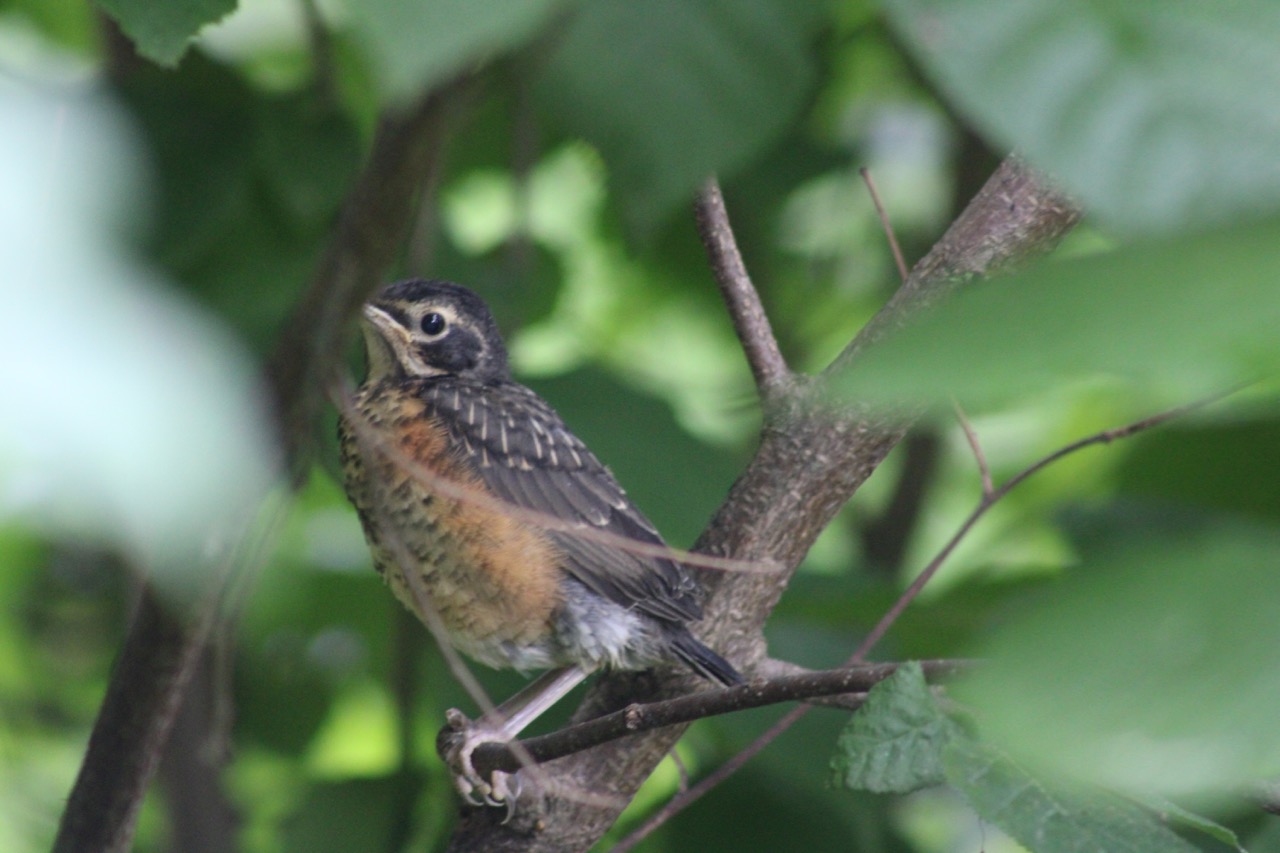
Finally, I was heading back to the house and suddenly saw another chick perched quietly in the hazelnut bush.

Robin fledgling on branch surrounded by green leaves.

I had to go inside then to eat my own breakfast, and download the photos. As I have been writing this, outside on the patio, I’ve seen the parent robins go into that bush with food, so it must still be there–it is a great hiding spot. I am torn by competing desires: to observe and photograph the young ones, or to just go inside and ease the parents alarm. They should know by now that I won’t hurt their babies. Actually, they don’t seem to mind me when I am sitting at the patio table, not walking about.

In the meantime, I am glad we have lots of tall plants and bushes and trees that make good spaces for the next phase of their young lives. It all happens so quickly–less than four weeks from the eggs in the nest to the small birds out and about. I wish them all the best!

So Much Beauty

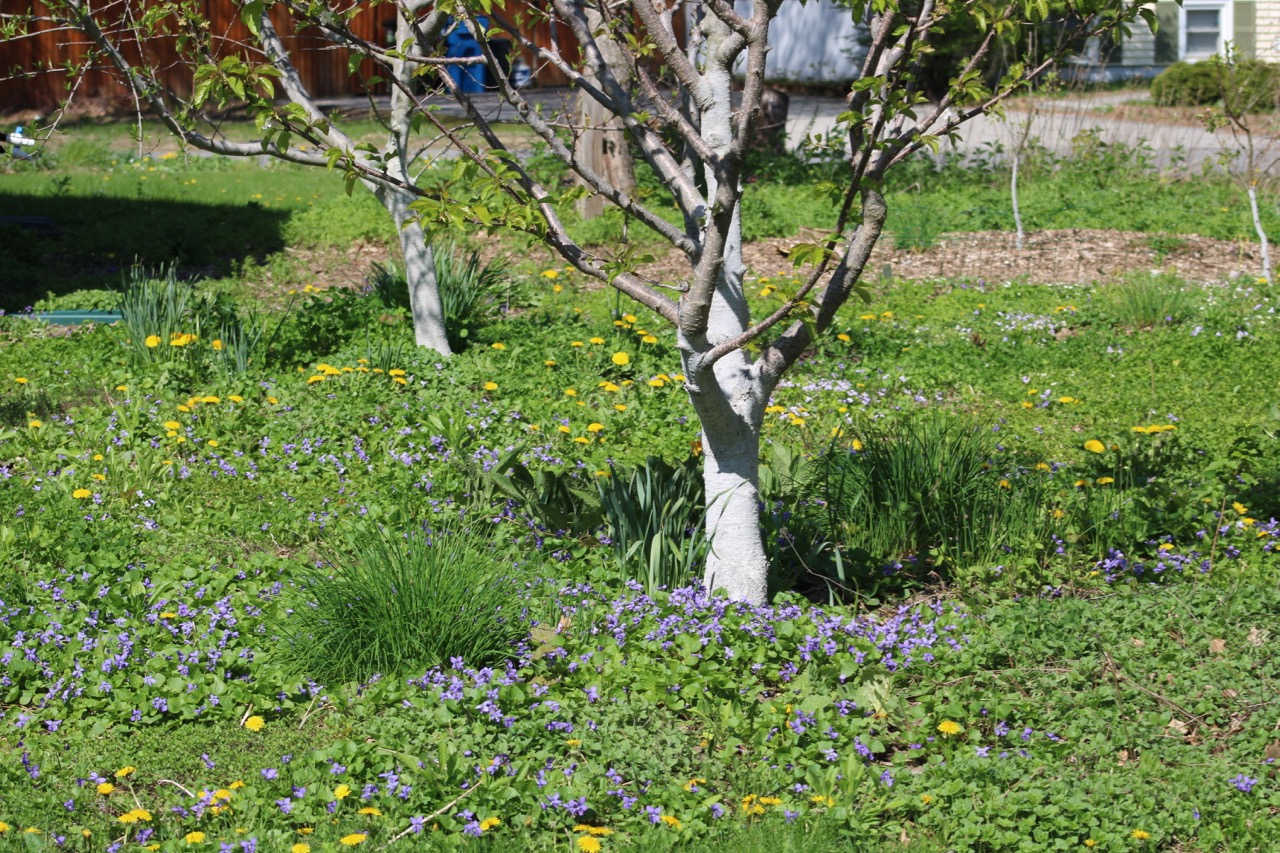
Orchard scene with tree trunks and branches painted white, surrounded by ground cover of violets, dandelions, and chives

I walk through the orchard and marvel at the beauty of violets which have naturalized all over the ground. Dandelions offer a scatter of yellow along with a few daffodils, and clover has spread over the beds and paths in a swath of green. Chives and oregano and thyme are coming up in their clumps. I can’t capture it in a photo, but perhaps the one above hints at how lovely it has grown, mostly all on its own.

The cherry trees actually now have a few blossoms–maybe a dozen new buds have opened after initially all of the buds were empty. Not enough really for a fruit crop, but I wanted to note it. However, our Honeycrisp apple tree is covered with buds, for the first time. Maybe this will be the year of our first apple harvest?

I haven’t tried to do any veggie planting yet. Mostly I just walk around enjoying how the wild flowers shine in the sun. Yesterday I lay in the hammock reading for a while, and we had a lovely visit with a friend by the pond. We haven’t seen any tree frog eggs there, despite the repeated singing in the night. It is all a process of discovery–will they choose our pond or not? Meanwhile, the marsh marigolds have bloomed! My favorite flower colors are yellow, blue, and violet, so right now I am in paradise!

Marsh marigolds have yellow buttercup style flowers on tall stems, with round green leaves. the background is pond water with out of focus reflections of trees.
Marsh marigolds in the pond.

Apple Tree Transplant

Blue Pearmain Apple small tree with wood chips on ground around it, and a garden hose lying nearby.
Blue Pearmain Apple transplanted into new spot

Four years ago I attended an apple grafting workshop, and created four grafted plants to bring home. I planted them in a “nursery” bed in the orchard, a Black Oxford variety in the center to remain there, and the others to later transplant. The root stock was called M111, a semi-dwarf variety. But I wasn’t sure where to put them, so it has taken until now before I transplanted any. Two didn’t survive, but today I move this Blue Pearmain variety about 12 feet over to a new bed.

Both of these are heirloom varieties for New England. According to Fedco, Blue Pearmain is a fall/winter apple, “our favorite for baked apples—it was made to be stuffed. Moderately juicy flesh, firm, dense and slightly crisp, sweet with a bit of a tart background flavor. Incredibly beautiful medium to very large fruit is streaked and splashed with purplish red, mottled with russet and covered with a distinct dusty blue bloom. In a pie, it has just enough firmness and a good balance of sweet and tart with hints of pear. Tart coarse yellow sauce cooks up in a couple minutes. Tasty eaten out of hand. One of New England’s most famous varieties. Mentioned by Henry David Thoreau as a favorite in his wonderful essay “Wild Apples.” Grown throughout much of Maine for well over 200 years. Massive trees still found here and there. Keeps in the root cellar until midwinter. Blooms midseason.”

Black Oxford was created from Hunt Russet x Blue Pearmain, in Paris, Oxford County, Maine, about 1790. A winter apple, “this outstanding apple, a favorite long ago around much of Maine, has made a huge comeback. Medium-sized round fruit, deep purple with a blackish bloom. From a distance you might think you’d discovered a huge plum tree. Excellent pies, superb late cider. Leave the skins on for a delightful pink sauce. Best eating late December to March, but we’ve eaten them in July and they were still quite firm and tasty. They get sweeter and sweeter as the months go by. Good cooking until early summer. Some insect and disease resistance. Unusual light pink blooms early to midseason.”

According to the Holistic Orchard, Black Oxford is “A rare treat reminiscent of an exotic tropical fruit; exceptional sauce apple, stunning drying apple.” It is slow to come into bearing, but resistant to insect problems. It can tend toward biennial bearing. Ripens in late October into November.

Even though they are four years old from grafting, they still seem like baby trees to me. I still need to do some pruning to help them find good shapes. But I am excited that I was able to get the Blue Pearmain to a spot it can remain. This past winter, one of our old ornamental crabapples fell in a storm. The one that is left leans heavily toward the road, and we’re imagining that it might not survive for long either. So this Blue Pearmain is positioned about half way between the Black Oxford and the crabapple. As it gets larger, eventually the crabapple might not be there. But in the meantime, it won’t cast any shade and they should both do fine. I still need to do some weeding and probably use cardboard to keep unwanted plants from growing too close to the tree. It had been on the edge of our friend’s herb bed that she is not using so much anymore.

It feels so good to be outside, to be tending to plants, to be celebrating the spring!

Two small apple trees growing close together with other trees in the background, and light green beginning to cover the ground.
Before: Black Oxford (left) and Blue Pearmain where they were growing close together before I transplanted the Blue Pearmain. There is a Honeycrisp tree exactly behind the Black Oxford, a little bigger.

Pruning

Cherry tree with empty branches on brown ground with some snow patches, and a green step ladder nearby.
Sweet “Lapins” Cherry tree and ladder for pruning

Yesterday I finally got outside and pruned one of the cherry trees in our little orchard. Pruning has always baffled me. My trees never look like the trees in the pruning guides, and though they are dwarf trees, they grow quickly long and gangly. I wish I didn’t have to prune, but experts say it is part of the work of caring for fruit trees. There are differences of opinion about the best time to prune, but for me it was partly based on actually being able to get close to the tree–the snow cover has kept me away before now.

But this post is not a how-to guide, nor meant to offer any wisdom about pruning. It is about risk and relationship. Sometimes we have to risk doing it all wrong, to do anything at all. Yesterday I took that risk, and in doing so, I realized that pruning is also about relationship. I had to get up close to the tree, stand on a ladder and notice all of its branches, all of its patterns, all of the pre-buds starting to form. I talked to the tree while I worked, asking for advice or forgiveness or something like that. I had to acknowledge that I am not the wisest or best caregiver for the tree, but here I am–I am your person and you are my tree. We are here on this land together. In the task of pruning, I become closer to the tree.

Pruning is odd to me, yet it is a welcome phenomenon for many plants. They thrive with cutting back, they are energized by it, it sets their hormones racing and can spark new growth. There are many principles which vary between species, and which are hard for me to translate into action for particular trees. But I think the only way I can really learn is by doing it, taking the risk with these trees, and doing the best I can. Letting the tree be imperfect, and letting myself be imperfect in my relationship to the tree.

I guess my winter project has been a sort of pruning too, going through old papers and recycling a bunch of them, organizing the rest. I had to get close to those papers too, sifting through each document in each file folder. I had hoped to be further along with it all, as we’ve turned the corner on Spring, and the sun and warmth begin to call me outside. I am mostly all done with papers from before I moved to Maine in 2005. But I am just beginning to sort through my work in ministry at the Allen Avenue Unitarian Universalist Church and in Portland. More of these “papers” are actually documents on my laptop, rather than in boxes in the basement. (I guess I could sit outside with my laptop for that kind of pruning!) I wonder. By pruning away these “branches” from the past, might I find more energy for living in these days and moments of the present? Do I need the pruning as much as the trees do?

Gratitude for the Ordinary

Goldenrod gone to seed.
Goldenrod gone to seed

The last few weeks have been full of ordinary tasks around the house and yard. Sometimes we forget to be grateful for these very ordinary things. I think about people whose lives have been disrupted by war, by floods, by fire, by despots. Margy and I are able to do our ordinary tasks and ordinary meals and ordinary rest, undisrupted, and for that I am grateful.

A couple weeks ago, I painted the trunks of the orchard trees, to protect against winter sunburn and insects. This time I used a half and half mix of white milk paint and “Surround”–both powders that are mixed in water. I don’t know if it is really necessary–certainly I see fruit trees around the neighborhood without anything on them. But one morning, I had the energy and decided to try out the mixture. Surround is a kind of porcelain clay organic product that can disrupt certain insects. Last summer, I sprayed the fruit trees with it, and they remained light colored all winter. This summer I didn’t do any sprays like that, but why not try it as a winter paint? So that was one little project.

Peach tree with white paint on trunk.

I’ve been using the skimmer to clear leaves off the pond, and then I also have been cutting off the dead stalks of pond plants. I got into the pond one day, placing my feet very carefully down to the second step in, and lifted the pond lily pot, then dropped it down to the deepest part of the pond. The deepest part is 2 1/2 feet, so I am hoping that the hardy lily might survive the winter this way. And maybe in the spring it will need to be lifted back out, or maybe it will just reach its leaves up to the surface from there. I asked Margy to watch with me, just in case I slipped. But I didn’t! A few frogs are still hanging out, since the weather has been unseasonably warm still.

Since we had an extra weekend of warm weather, I finally painted the upper beam of the roof on our deck. Some of the wood had been left bare when a friend put in the roof, a few years ago, so protecting it has been on the long-term to-do list. Happily, there was some primer in our basement that I could use, leftover from the prior owners. It took three days, and each day after working on it for only a couple hours I was dead exhausted. But it is done today!

Deck beam half painted and half still undone bare wood, with a ladder underneath.
Deck beam half painted and half still undone bare wood.

Meanwhile, we’ve been filling in our absentee ballots, and researching the details of 13 referenda questions for our city of Portland, as well as the candidates running for office. I am grateful for democracy, as flawed as it might be practiced, and pray that we’ll still be able to have a democracy going forward. Rising fascism in our country has been alarming and discouraging, as well as the attack on the bodily autonomy of women, and the threats to such importance common goods as Social Security and Medicare. So much of my life’s work has been about expanding the benefits of democracy to those who have been excluded, fighting for equality and justice and liberation for myself as well as others. My work has included criticism of the way that our democracy has been incomplete, flawed, and unjust. But I think of voting as harm reduction–I may criticize candidates and policies, but I will vote for those who will do the least damage. Right now, with the Republican party being taken over by fascists, that means voting for Democrats across the board. So I am extra appreciative these days of the ordinary benefits we can take for granted, and pray that many many people will be moved to vote to keep those benefits.

Peach Abundance

Peaches are ripening, bright red and yellow, crowded together on the branches.

Those of you who perhaps followed my peach tree saga last year might remember that after hours and hours of tending–including several organic sprays, thinning the small green peaches, putting little mesh bags on the remaining ones–the squirrels ran off with every single green peach, or knocked them off the branches as they tried to get into the bags. We got zero peaches to eat.

Well this year, I didn’t have the heart or energy to do all that tending. I did one holistic spray early in the season. I felt very non-attached to any outcome, since one might assume that squirrels would eat them all again. But that didn’t happen. A few weeks ago, I started picking a few small random peaches, so that others would have more room to grow, and the branches wouldn’t break under their weight–but only a few at a time, not systemically. I put them in paper bags, which is the actual way to help them ripen. (Not on window sills as I had previously thought.) A few weeks ago, the squirrels started eating some peaches too, sitting in the tree, or taking ones with broken spots that I left on the patio table. I found their leavings on the deck railing. It was fun.

Broken peach bits on the deck railing.

But they didn’t take all the peaches. And the peaches started to really ripen. Now they are bright red and yellow, crowded though they are on the branches. Now, we are processing all the bags of ripening peaches in the house, as well as gathering peaches literally dropping from the tree. I have cut them in slices to freeze–first on a tray, and then put into freezer bags. Yesterday I made a gluten free peach cobbler. We have invited friends and neighbors over to share in the abundance. More people are coming by this weekend. This morning, I saw this little bird pecking for its delicious breakfast. There is plenty to share!

Bird eating a peach on the tree.

I feel grateful and humbled by this turn of events. Sometimes gardening feels like a battle between the gardener and the “pests.” I didn’t have the heart to try too hard to fight this battle this season. (And our cucumbers and zucchinis are succumbing to bugs-so it goes.) I was surprised that the peaches thrived so well without my efforts. I was surprised that the squirrels took some, and it seems they felt okay about sharing. Maybe they sensed that we were not enemies this time. Margy and I feel so good to be able to give them away to others. The garden is such a great mystery! I continue to feel humble and grateful by all it teaches us.

Oh, and here is the recipe for gluten-free peach cobbler. I searched the internet, and then adapted this one from several I had seen:

Peach Cobbler: preheat oven to 375 degrees

Slice peaches and place in a lightly buttered 9 x 13 pan. Basically use enough to cover the bottom well, or more if you like. Sprinkle with cinnamon, and a tiny bit of ground cloves.

Whisk together 1 & 3/4 cup almond flour, 1/2 teaspoon salt, and 2 teaspoons baking powder. Blend together 1 large egg, 1 teaspoon vanilla, 1 tablespoon honey, 1/4 cup Greek whole milk yogurt, and 2 tablespoons softened butter. Add that to the flour mixture and blend, and then spoon over the peaches–it won’t cover them completely, but spread it around as you can. Bake 25-30 minutes or until golden and bubbling. Remove and let cool a bit so you don’t burn your tongue. You can serve as is, or with cream, whipped cream, or ice cream.

Peach cobbler in a glass pan, with some pieces removed.