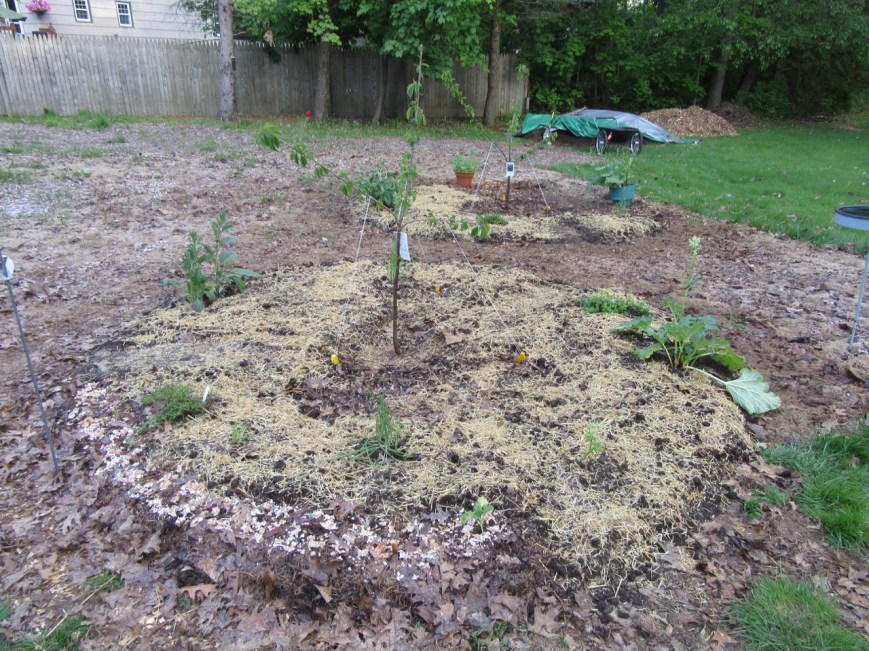
 Today I almost finished soil work and guild plantings around each of the cherry trees–still 1/3 to do around the second tree. First I aerated the soil with our garden fork to a five foot radius around the tree. (The soil was already covered with mulch from last fall-wood chips, cut grass, sea weed, and dead leaves.) Then I put down newspaper or cardboard along the outer half of each circle, and covered it with compost. I planted the companion plants for each cherry tree guild. Guilds are plants that work together so that each does better than if they were planted alone. In this case, the primary focus is the health of the cherry tree.
The plants I used and their functions:
- Comfrey is a nutrient accumulator–its roots go deep and bring up calcium and other vital nutrients, and then the leaves can be cut several times a season, and used as mulch. It also attracts pollinators and other beneficial insects. It can be used in herbal medicine. It was recommended to plant it at least four feet from the trunk.
- Chives accumulate nutrients, deter pests, are anti-fungal and attract pollinators… They bloom at the same time as the cherry will, and are also a culinary herb. I had enough to do two per tree.
- Oregano is an aromatic pest confuser, is anti-fungal, can take some foot traffic, and of course is a culinary herb.
- Thyme is another insect pest repellant and culinary herb (my favorite.)
- Chamomile accumulates nutrients, is anti-fungal, and attracts beneficial insects..
- Rhubarb is another perennial food, and can be cut in place for mulch.
- At the outer edge of the circle around the Lapins Cherry, I also planted a row of annual kale. The cherry tree won’t reach that far for a couple years, so it works okay. I mulched them with egg shells, which I understand will deter kale eating pests.
- That guild also got one Sweet Cicely plant, which attracts beneficial insect predators to kill insect pests. Plus I hear it tastes like licorice/anise.
- The other tree guild also got Lemon Balm, and maybe a Bee Balm plant–I haven’t planted it yet and I’m deciding if it will get too big–if so, maybe it will go nearby. The Lemon Balm was from the plant swap, and attracts pollinators and repels ants and flies. I just read that it will spread. Bee Balm attracts pollinators.
- Between all the other plants, I planted Red Clover seeds–they are a nitrogen fixer, and this variety is best for a fungally dominant soil. It is a good ground cover to keep weeds away, easy to walk on too. I put some straw mulch on the seeds to get them started, but I think I will add wood chips over it all.
Later in the fall, I plan to add daffodils in a ring about 2 feet from the trunk, to deter munching pests. I also ended up designating two paths into the tree for each circle–so I can get to the center easily. Once again, I end the day with sore muscles, but so happy.
 Today was a day for food forests! My friend Mihku and I went to a tour of
 This is a section of our evolving Permaculture Design for our yard. (It didn’t really work to try to put the whole design into one photo, so this is of the half of the yard nearest the house.) I had started this design by measuring everything in our yard and putting them on grid paper–the grids equate to 3 feet square. Then we had lots more input with our
  On Friday the 21st, Margy, our friend Mihku, and I went to Broadway Gardens and picked out two sweet cherry trees. Mihku is a master gardener and her help was invaluable–in fact, the sales person suggested she should have a job sitting with their trees and telling people about them.
 On March 11 and 25th, Margy and I hosted two sessions of an “Intro to Permaculture Design” course, through the
 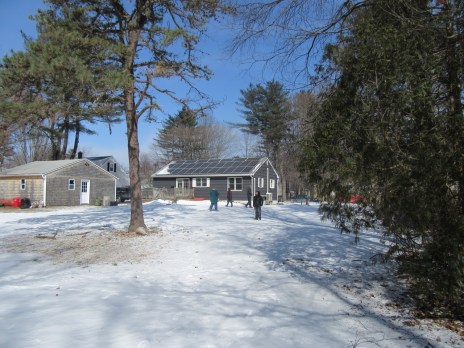 One of the first aspects of Permaculture Design is observation, and so Margy and I have spent the first year of our residence here mostly in observation–trying to learn everything we can about the land, before we begin gardening. Having another group of eyes was marvelous!
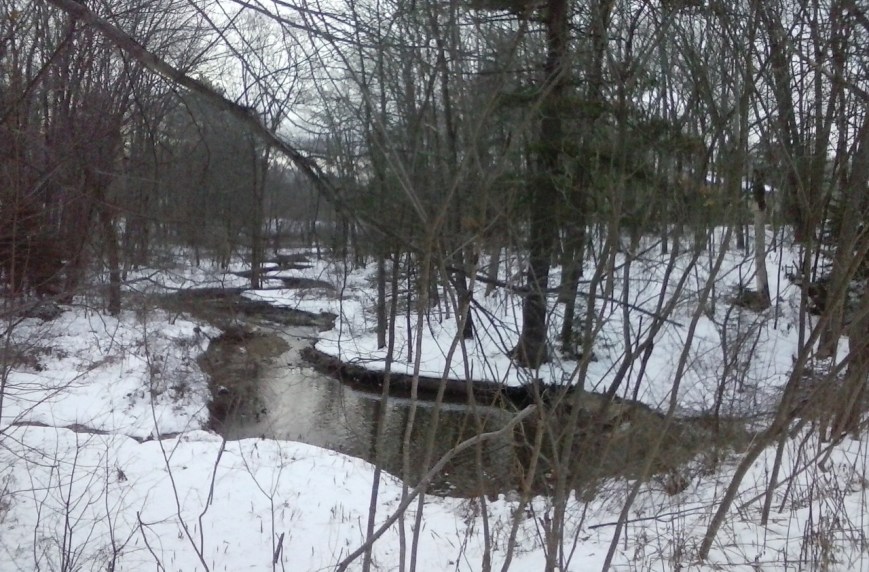 The path forward will not be a straight line. I find hope in that. A river or stream meanders on its way to the sea. [Thank you Starhawk for teaching me about this!] Because of the friction of the river bed, the water on the bottom of the river moves more slowly than the water on the top. So it creates a spiraling current that wears down one bank and deposits sediment on the other, and then vice versa, as it moves around and around in sweeping curves. Just so, our journey into a new relationship with all life on earth will meander—I imagine in this case, there is more movement at the bottom of our culture, while the top is going much slower. But since we are all connected, movement in any segment has a ripple effect on the whole.
 One summer several years ago, I attended a two-week Earth Activist Training, which combined a Permaculture Design Course with practice in magical and political work on behalf of the earth. We began with a water ritual. We brought water from the places we lived or the places we may have traveled to pour into one container. At the end, each person took some of the water, and we brought it home with us. One of the teachers for the training was feminist witch and eco-activist Starhawk, whose writings had been important for me earlier in my spiritual journey. She had begun collecting water in this way many years ago. She brought water back from her travels around the world, and asked her friends to bring back water when they went to far off places. They brought water from the sacred Ganges River in India, and from the great Nile River in Egypt; they even brought melted ice from Antarctica. After a while, they had water from every continent.
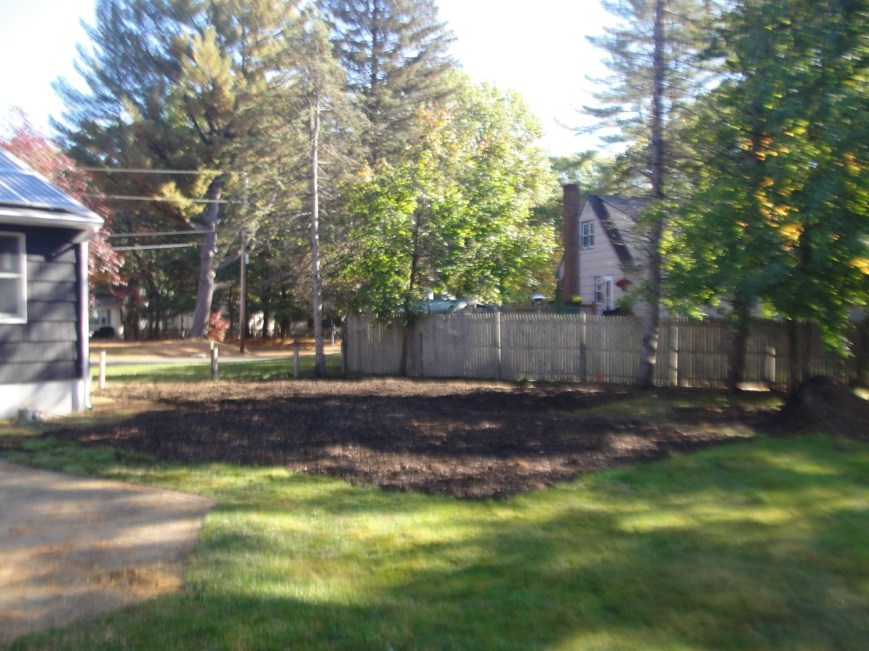
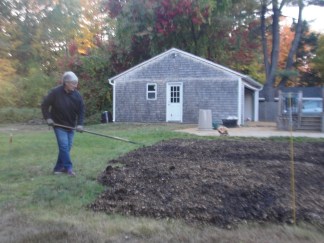 Thanks to help from Margy’s sister Liz and brother-in-law, Jack, we were able to spread wood chips over a part of our yard that we are envisioning for future fruit trees. The soil in the yard is quite compacted, and we have a big pile of wood chips from the old maple tree that was cut down last year. Lisa Fernandes of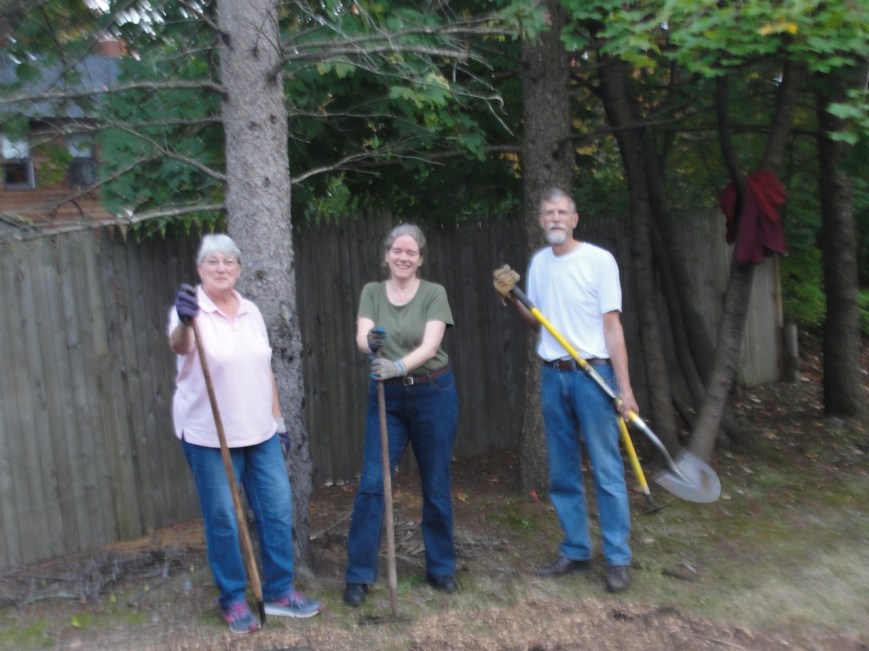
 Finding Our Way Home