Native wild flowers

glowing yellow goldenrod flowers on tall stalks, with dark green background
Goldenrod flowers are in bloom.

We have now lived in our home in Portland for 7 years, and are gradually getting to know the plants around us. We have our share of invasive plants, but today I want to highlight a few of the beautiful native wildflowers that are blooming right now in our yard. They come up on their own, and Margy has encouraged them by pulling invasive species, and leaving certain areas alone as she mows paths around the back yard.

I believe our goldenrod might possibly be the solidago sempervirens, or seaside goldenrod, native to eastern North America. This identification fits with our sandy pine forest soil, and photos online look similar. But it is very difficult to distinguish between species of solidago. Solidago is considered a keystone species, and has been called the single most important plant for North American pollinator biodiversity. They are very loved by many bee and butterfly and moth species. We love them too.
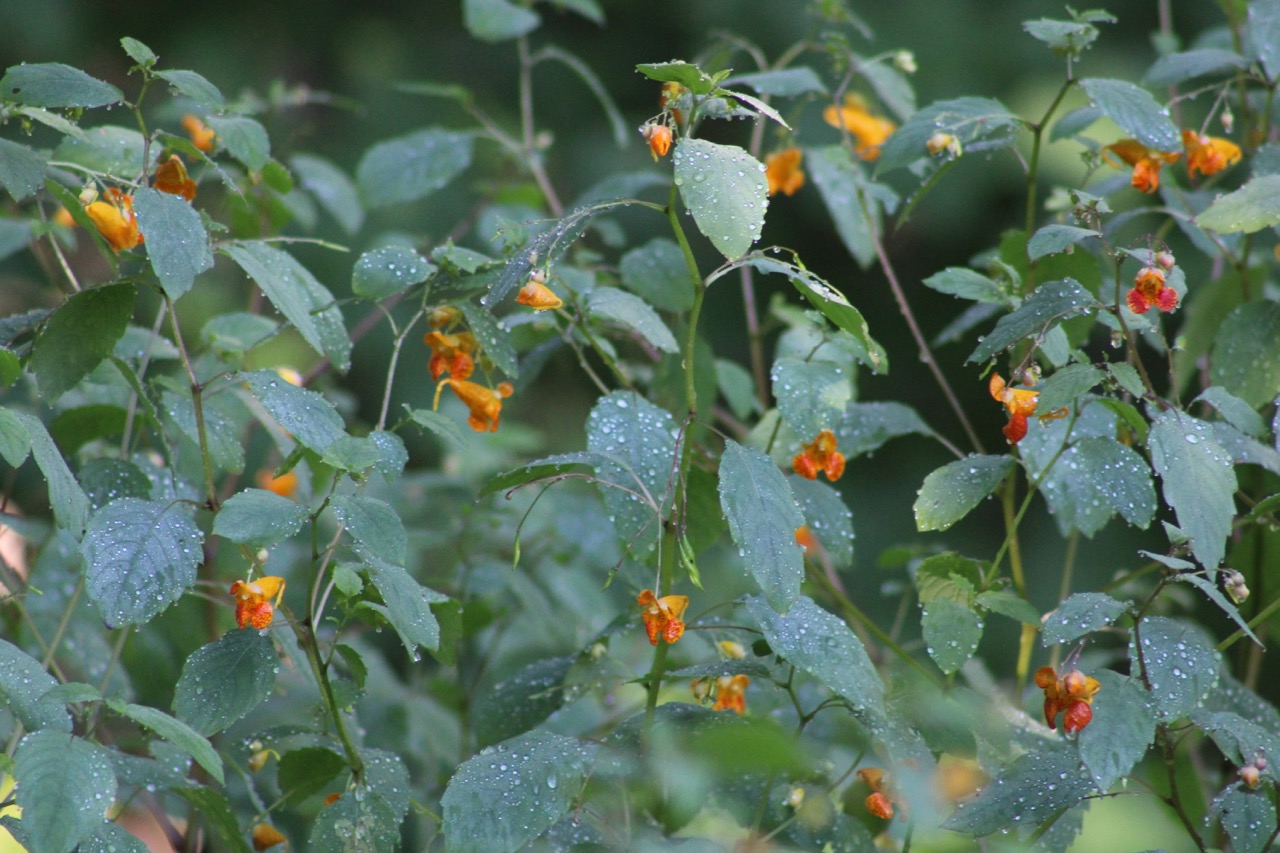
Tiny orange flowers on thin stems with oval serated leaves, droplets of water on the leaves.
Jewelweed after a rain.

Jewelweed grows profusely at the back and sides of our yard. Impatiens capensis is also called touch-me-not, because of the way the ripe seeds pop open when touched. It often grows near poison ivy (which we don’t have) and has traditionally been used as a remedy to prevent the rash caused by exposure to poison ivy. This year it has gone a little crazy all around our old white pine, and in Margy’s mound bed nearby. Hummingbirds and bumble bees are their major pollinators.

tall stems with small yellow flowers at the tips, many plants in 1/2 wine cask planter, on patio near deck railing.
Evening primrose in an old half wine cask container.

I got to know evening primrose last year, when it was the favorite plant for goldfinches after it had gone to seed. This year, it has self-propagated into two containers, as well as all around the patio and orchard. Oenothera biennis is a biennial plant, forming a small rosette the first year, and then in the second year shooting up to great height before blooming. It is native to eastern and central North America. Evening primrose oil is considered medicinal for a variety of conditions, though we haven’t tried harvesting it for such.

evening primrose closer
Evening primrose, closer look at the blooms.

What I love about these three species is that they grew on their own. We didn’t plant them, we just began to notice them and appreciate their presence. True gifts from the earth. There are many others we have begun to notice as well. It takes a while to learn about them and to identify them. It feels like such an important part of finding our way into earth community.

Prayer for Pollinators

Peach and two cherry trees

If you’ve been following my work on digging the pond, I will mention that I took a little break, first to find out what to do about the water that has seeped into the bottom, and then because I twisted my ankle on Friday while I was digging. So annoying! My ankle is not so bad–after a couple days of rest, I can hobble around now, and I will be digging again soon.

In the meantime I wanted to share this photo of the flowering peach and cherry trees in our food forest. They flowered a bit earlier this year than last. In the photo, the peach blossoms are pink, and it is hard to see the white cherry blossoms amid their green leaves in the photo. But they are so beautiful! There are more cherry blossoms this year than last, when we got just a few.

However, I’ve been concerned about pollination. Our neighbor keeps honey bee hives, and usually we have lots of her bees visiting over here, drinking nectar and drinking water from our bird baths. But this year, it has been very sparse for bees. I found out that our neighbor’s hives died in a cold snap earlier in the spring and she hasn’t replenished them yet with new bees.

One day, I did see bees of all sizes in the Lapins cherry tree (on the right in the photo), but I didn’t see them in the peach tree. (Not that I sit and stare all day.) But I’ve been doing so much TLC with the trees this year, with Kaolin clay, and holistic foliar sprays. It would be a shame if we didn’t get fruit because of pollination problems. It is too late now to try to hand-pollinate. The other potential glitch is that while the Lapins cherry is self-fertile, the Black Tartarian cherry needs the Lapins to cross-pollinate. They are both sort of blooming now, but the Lapins had peak blooms earlier, and the Black Tartarian has new blooms that just came out yesterday. So we wait and see.

It reminds me of the sad danger to pollinators everywhere because of climate change, environmental pollutants, pesticides, and development. All of our human food is dependent on these little creatures who pollinate the plants. If the bees die, so do the humans.

Today I pray for the pollinators, with gratitude and humility. Part of this prayer is offering to the bees so many other plants in our food forest: daffodils, dandelions, and violets are blooming now; soon we will also have chives, oregano, clover, thyme, and many more. All of us can do more to provide food for bees and other pollinators throughout the season. Only then can they also provide food for us. May this circle of life be blessed.

Splendid Strip in Progress

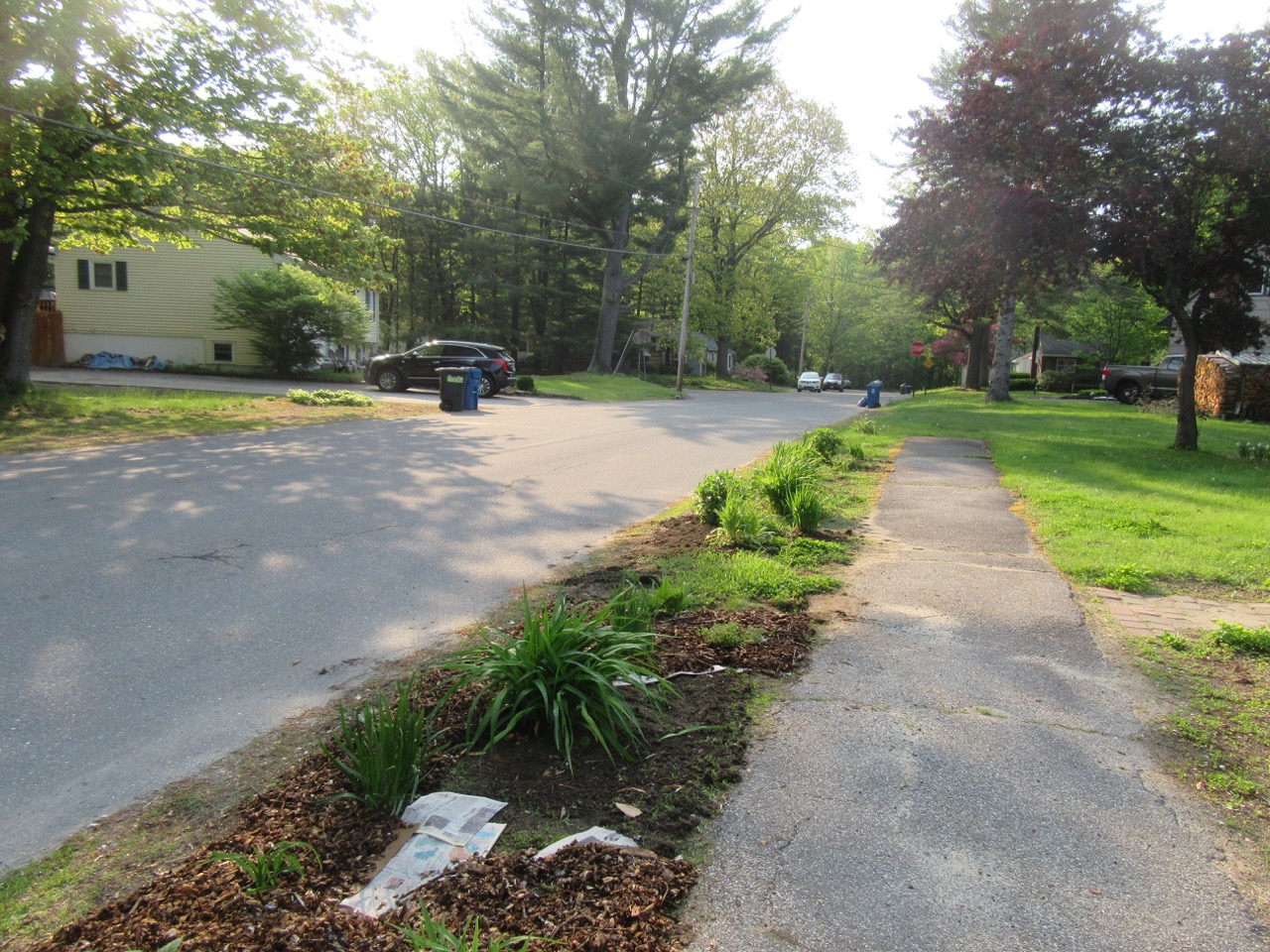
Last year, in an attempt to outcompete the crabgrass on the strip between the sidewalk and the street, I transplanted two dozen hardy perennials that were given to us for the digging.  (See the prior post for more details on that, and some great “before” pictures.) This spring, most of the transplants were re-emerging with abundance!  I love hardy perennials!  Time for step two.Strip 2019 1

I went back over my plant list to see what survived: Day lilies (yellow), Allium (lavender-colored), Goat’s Beard (leafy), Siberian Iris (blue), Turkish Rocket (yellow), Blue Cornflower, Heliopsis (yellow), Anise Hyssop (purple), White Ruffled Iris, Spiderwort (blue), Lady’s Mantle (yellow-green) and Astilbe (purple-pink).  The color theme as you may have noticed is blue/violet & yellow, with a few others mixed in, (and several repeated). I still hope to add even more Siberian Irises.

But in the meantime, I filled in a couple empty spots with mystery pots (Siberian Iris and/or Day Lilies), two patches of Thyme taken from an overabundant patch in the orchard, and some Lemon Balm for the tough spot closest to the driveway, still leaving room for our trash and recycling bins.  And then, I started laying down cardboard and/or folded newspaper between all the plants, and covering that with wood chips.  I’ve just made a small start at one end, but the project can keep going bit by bit.  All that hauling of wood chips takes it out of me.

I also made a small bed to try and grow a dozen Lupine flowers from seed.  I know–that wasn’t the original plan–to go to all the effort to grow seeds.  But when I was down east last weekend, they were selling the seed packets in a little cafe, and it was an impulse buy.  Lupines are the queen of Maine wildflowers. So I soaked them overnight (well, two nights actually).  I made a little soil bed between some of the other plants: first laying down a very light double layer of newspaper, then some sifted out compost from our pile, mixed with soil.  After I planted the seeds, I used straw as a light mulch over the seeds, and filled in the edges with the wood chips.  I also put a little fence around it, to protect it from unsuspecting dogs and children who might happen to wander down the sidewalk.  I feel happy to look at it.  More later.Strip 2019 Lupine bed


Hell Strip to Esplanade

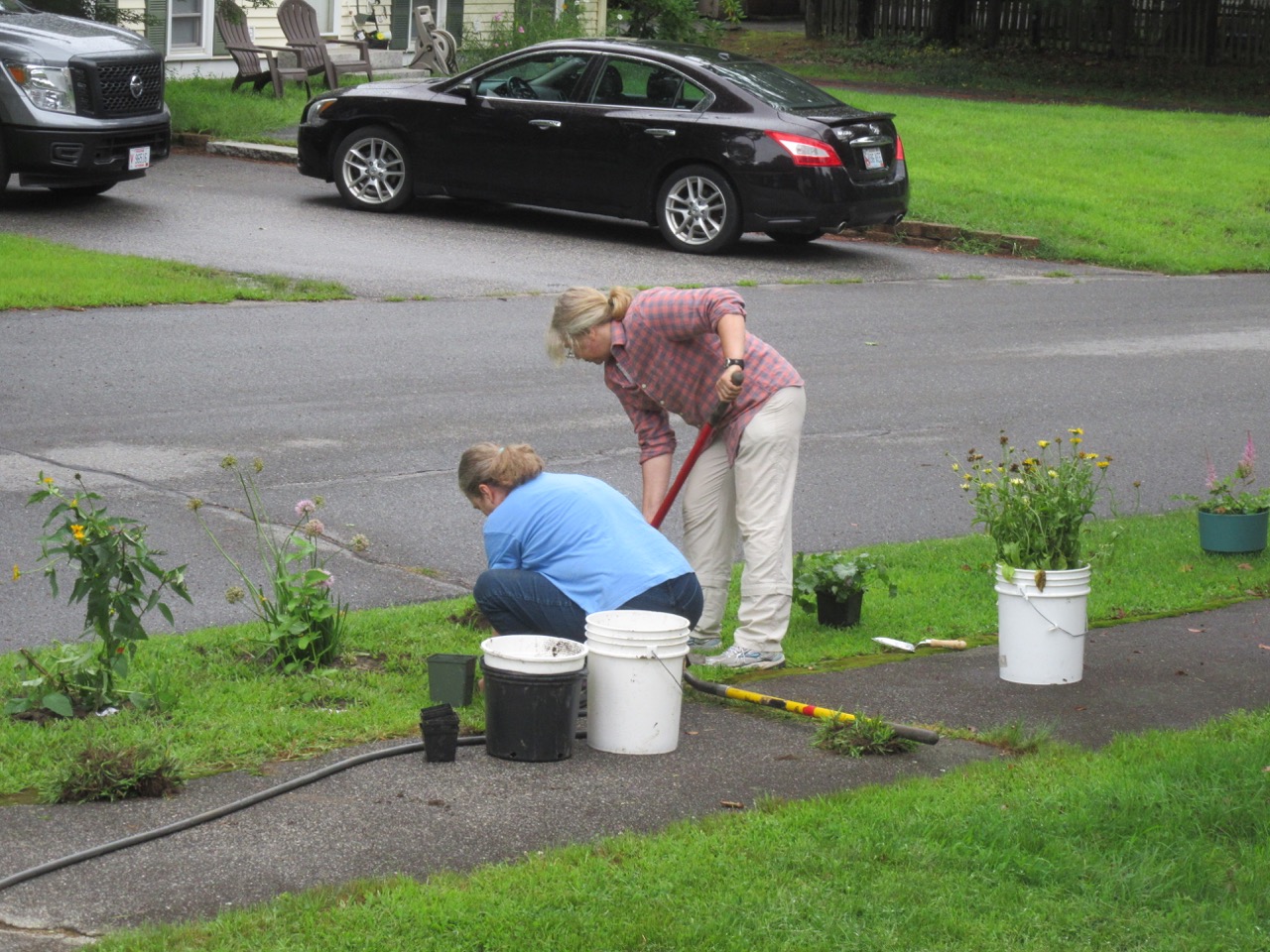
Planting the roadside strip

Lisa & Myke at work, photo by Margy Dowzer

Last month, Margy and I were talking about the crabgrass that has overrun the lawn in so many places, including the strip between the sidewalk and the street. This strip seems to be referred to by many names–from “hell strip” to “esplanade.”  She is working on other strategies for other places, but I had the idea (after some internet research and an appreciation of what someone in our neighborhood had done to theirs) to see if hardy perennials might eventually outcompete the crabgrass and solve the problem. Then it truly would be shifting from a hell strip to an esplanade!

I started off by moving some turkish rocket from our backyard garden to the front. Turkish rocket is a fast growing perennial vegetable with beautiful yellow flowers. I had planted some last year, excited to try it, but this spring discovered that I didn’t really like the taste of the greens–they were too sharp and bitter for me.  But the flowers were amazing.  So I decided that I’d move it from the food forest to the strip.  Another friend came by and transplanted some yellow day lilies and blue cornflower that needed a new home!

I put out a call on our permaculture meet-up, and was gratified when another member, Sandi, responded by saying she had a lot of perennials that needed dividing and we could have them. That’s the thing–so many wonderful perennial flowers multiply of their own accord and expand out of the area they are originally planted.  So why not use that spreading habit to achieve a better use of the roadside space–for pollinators and for beauty. So I went out to her house and we dug up a whole bunch of plants.

That weekend, our friend Lisa was visiting, and she jumped in to help me with the transplanting effort.  And it was a big effort!  In the end, we had 24 new plants along the strip, mostly with blue or yellow flowers, which we tended to alternate.  Several patches of Siberian iris and several patches of allium; anise hyssop, heliopsis, calendula, white ruffled iris, goats beard, astilbe, mallow, and lady’s mantle.  The other day, I added some catnip–another plant that can spread, but hey, maybe it will outcompete the crabgrass, and we’ll also have catnip for the cats.  The whole thing doesn’t look like much yet–a bunch of scraggly transplants, only a few with any flowers right now–but we’ll see how it goes next summer.  If we can get a load of wood chips, we may put down some cardboard and wood chips between the plants.  But that can happen later too.  I will let you know how it goes.

IMG_7917