September Musings

Four huge turkeys in the shade of some green grass, behind leaves of zucchini in the front corner of the photo

The summer garden had some successes and some fails. And it is sometimes hard to tell which is which. This turkey family visited the yard many days, and walked through the garden beds in the back. They mostly left the veggies alone, except they liked to eat the tops off the bean plants. We still got a few beans even so. And they left alone the zucchinis, which did well, the cucumbers which did fair, and the broccoli, also fair. We appreciated their visits–we want to support wildlife after all.

However, we tried to lessen our support for the chipmunks and squirrels that became such little rogues. Despite netting over the blueberries, once they figured out they could squeeze holes into it, they got the rest of the blueberries, though we did get a bunch before that. I am happy to say that the baffle on the bird feeder totally worked. They never got up to the feeder after the baffle was installed. So I am hoping that without all that extra food to stash, the population won’t explode like it did this year. The long game. And the birds keep coming back to the feeder.

In the front yard, we never had monarchs lay eggs on our milkweed plants, despite their visit. Maybe next year? The netting on our kale and carrot bed was a great success. It protected the kale from cabbage moths, and no one tried to get into it. We have a ton of kale harvested and still to harvest.
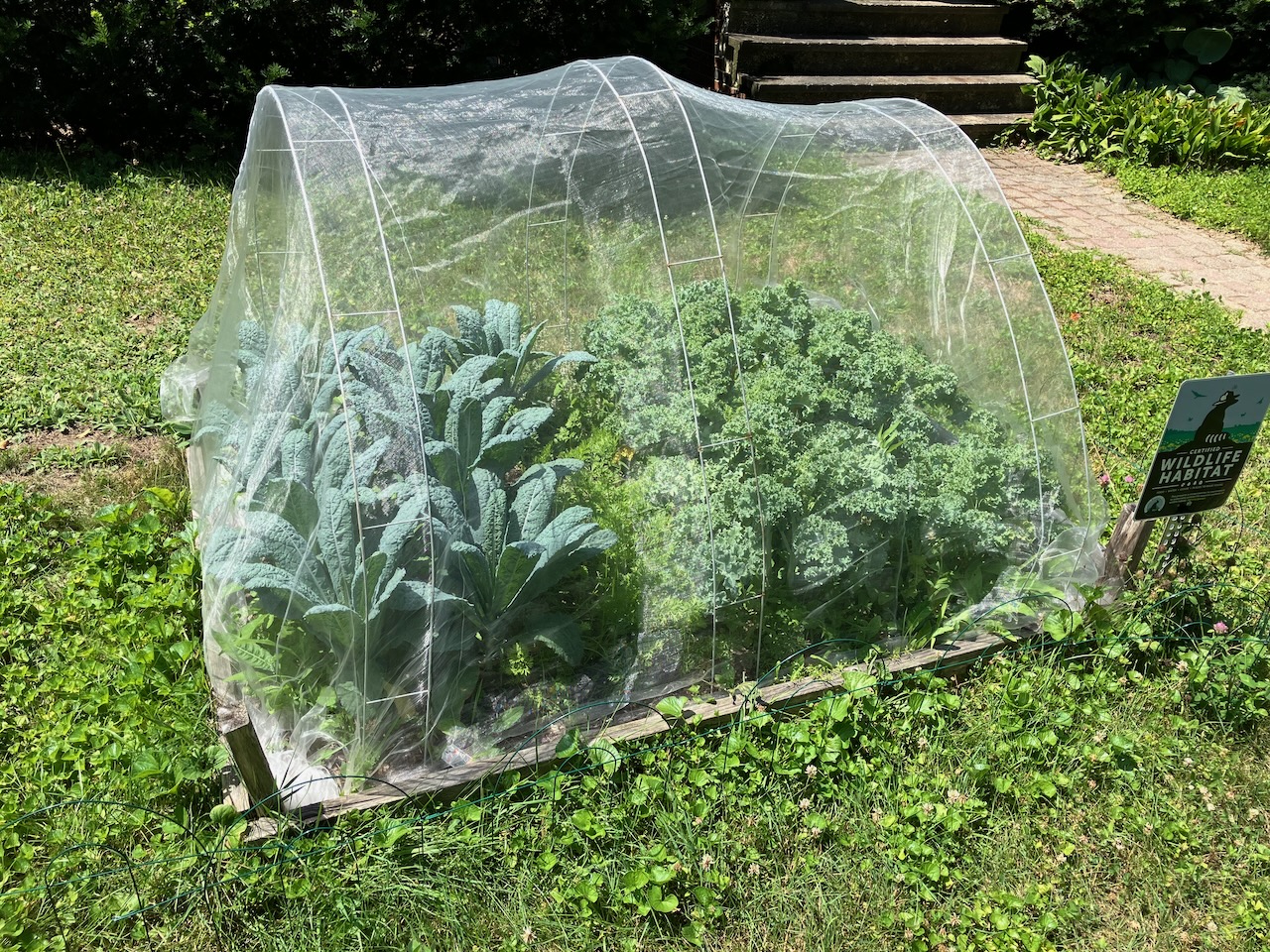
Rectangle garden bed filled with green kale of two kinds, covered over with a translucent net on white metal supports.

The robins never came back to their nest on our back porch after the babies had been attacked. Still so sad about that. We’ve had some lovely visits with human friends out by the pond. The pond water level went down with the drought, but this weekend’s rain helped, especially after adding water from the newly filled rain barrels. Still a few frogs, though I am not sure about the tadpoles. They hide under the lily pads, and it’s a lucky day to see them.

And… and… and… Gaza is still being attacked night and day, and starved by blockades. International resistance is growing but too slowly for the people killed each day. I keep bearing witness, and praying. It’s the same with the rising fascism of our country, and the attacks on immigrants both documented and undocumented, and citizens who are brown or black or speak Spanish. The only thing that gives me hope are the multiple levels of resistance from huge demonstrations to lawsuits to governors who slap back. Here we do the best we can to get by, day by day, accepting our situation as elders and those who are chronically ill. In the face of so much cruelty and hate, we add our little love to the mix, hoping to be part of the larger Love which is our only real hope.
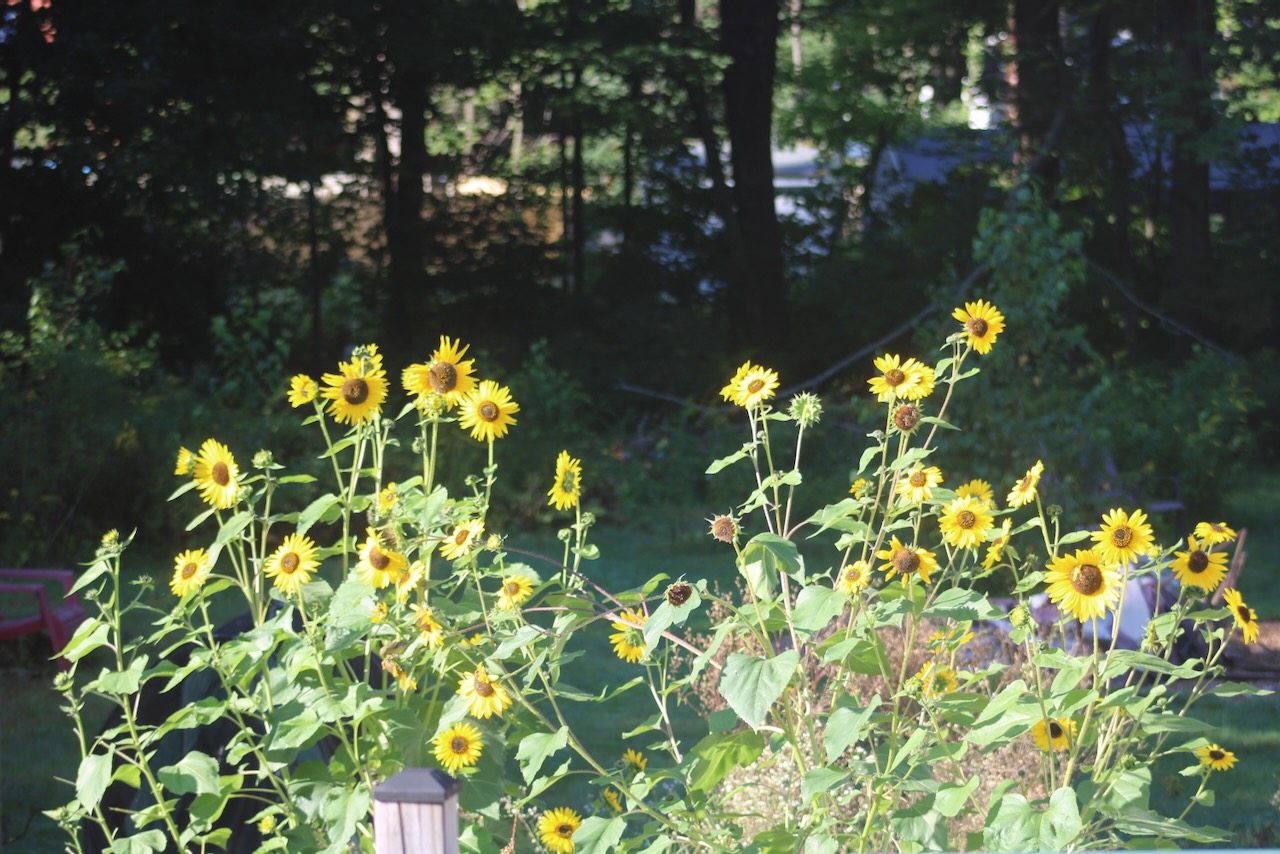
Sunflowers & Pond Lilies

This is the view outside our back windows. We didn’t plant these sunflowers, they came up on their own, with help from squirrels and the bird feeder. These are the ones that goldfinches and bees love so much. Even a photo can’t capture the brightness of the flowers. They glow! They make me so happy each time I see them. I also always think of a dear friend who loves sunflowers, and that makes me happy too.

Another source of joy are the pond lilies, that have also multiplied. In other years, we’ve had many one bloom the whole summer, or maybe one bloom at a time. So in the morning, I see these sunflowers out my window. Then I take a little walk back to the pond, and see the blooms, and the little frogs. I hope they will bring a smile to you as well.

Three new little frogs

We’ve had a string of very hot weather and then lots of rain, and I hadn’t seen our three bullfrogs in the pond for a while. I wondered what that might indicate? Today, I went out and a pond lily was blooming, and there were three new tiny green frogs sitting on lily pads. Who knows where they came from?

I woke this morning feeling heavy and sad with all the problems in the world, with isolation, with a lack of direction or purpose. So I brought myself outside and this little surprise happened and it lifted my spirits. I am grateful for that.

More dragonflies

Yesterday, I went over to the pond in the morning, and saw nine or ten dragonfly nymphs who had climbed up onto leaves. I didn’t see them climbing, but they were holding on to the leaves, and slowly emerging from the husk of their nymph bodies. They were on the sweet flag, the blue flag iris, and the arrowhead plants. They say that nymphs live for two years in the water, so perhaps these were deposited as eggs in the pond two years ago and survived over winters, and now were coming of age all together. Sometimes, the leaf stalks they were clinging to would shake a little, not from the wind, but from the effort of their struggle. Is the photo from later exactly the same, or did it progress a little bit more? Truthfully, I can’t tell.

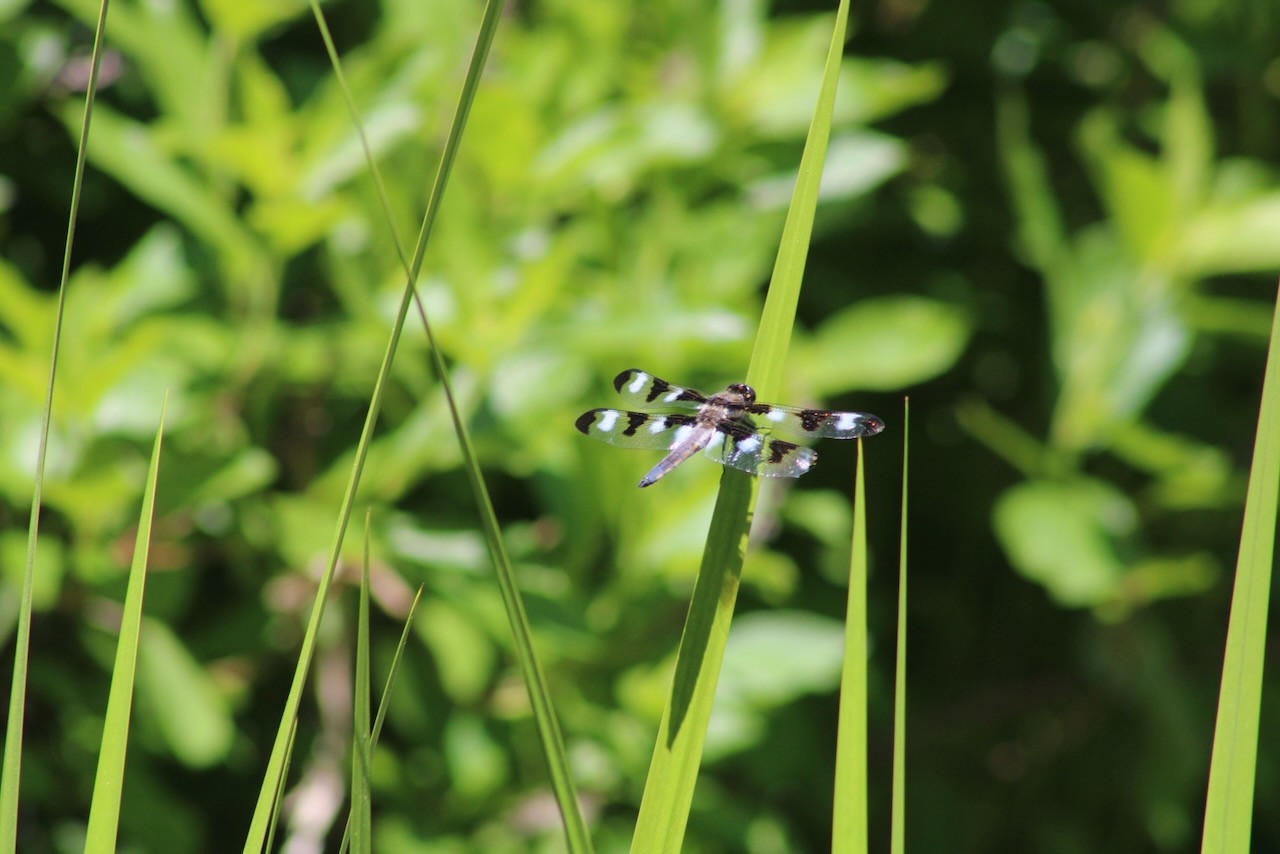
There was an adult dragonfly hovering around close by, it could have been the same one I had seen earlier in the summer. I wondered if it was watching over the nymphs protectively, or perhaps threatened by them, or interested in mating with them? It did stay close. A beautiful creature with black and white spots on its wings and a mostly gray body with black eyes.

I wasn’t able to watch all day, and then we had some rain in the evening. This morning, when I went back, it seemed like all of the creatures on the leaves were just husks of nymph bodies, and there was a new dragonfly at the pond. Turquoise eyes, mostly clear wings, white tail with a black end.

All of it felt quite magical, and also mysterious. An accident that I saw it at all, and yet amazing that I saw some of the process. In Passamaquoddy, the word for dragonfly is “apuciqaha.” According to my teacher, “apuci” means inside out, and “iqaha” refers to the way they fly in any direction. Seeing the adults emerge from inside of the bodies of the nymphs gave me a new sense of the meaning of “inside out.”

Once again, I see how the pond is home to all sorts of life that lives by its own rhythms, and what a privilege to witness some small aspect of that ongoing life.

Dragonflies

Black and white dragonfly on green stalk of iris

I’ve seen dragonflies flying around the pond, mating above the pond, and dipping their tales into the water to lay eggs. I’ve seen dragonfly larvae in the pond swimming around. But until this week, I never knew if any of the larvae had lived long enough to transform into adult dragonflies. During the last few days I saw what I thought might be some sort of insect perched near the bottom of an iris stalk. But with a little research, I now realize that it is an empty husk from which a dragonfly larva has molted.

Dragonfly husk on a green iris stalk over pond.

The pond never ceases to delight with the cycles of life of so many creatures. This month also saw these toads clasped in their mating posture, the male on the back of the larger female. I don’t know if any of the tadpoles from before have survived–just because I don’t see them doesn’t mean that they aren’t hiding somewhere. But they are low on the food chain, eaten by frogs, and also by dragonfly larvae. However, with more eggs in long strings, maybe more tadpoles are on the way.

Male toad clasped to back of larger female toad, in murky pond water.

The heavy rains of the last several days have delighted the tree frogs who are singing in the night. I haven’t seen any of them in the pond this year. Each year it seems that different species choose to inhabit this little pool of water. Thankfully, even on days when I don’t have the energy to tend to the many plants in the garden that would love some attention, I can sit by the pond and appreciate all that it holds.

Ephemeral

Trout lilies are blooming near the brook.

There is so much beauty in the spring, but it all seems to be moving so fast. I can’t keep up. Mayday has come and gone. Already this season is half over. After two months of physical therapy for my hip and lower back, I am able to walk fifteen minutes and more again. The other day I walked to Capisic brook and onto the path nearby, and saw the trout lilies that usually grow there, a lovely spring ephemeral. American Heritage Dictionary defines ephemeral:

  1. Lasting for a markedly brief time.
  2. Having a short lifespan or a short annual period of aboveground growth. Used especially of plants.

Spring itself and all its beauty feels markedly brief. Is my love of photos a way of trying to hold on to all that is ephemeral? Is my need to write an attempt to halt the relentless flow of time?

I have been drawn outside more and more each day, excited to see daffodils and violets and green shoots coming up everywhere. And, happily, the peach tree is now covered with pink blossoms, and the cherry trees have many blossoms too. Last year, because of the weather, there were none–so these beauties seem fragile and extra special because of that vulnerability.

Peach blossoms on a foggy day.

There are many projects in the yard to attend to. Many branches fell from trees in the storms of winter and early spring. Margy has been cutting them up and hauling them around. Some of these we’re using to make a brush pile in the back corner for wildlife habitat. The other day, I cleared that space of invasive plants. I also set up our eight rain barrels again. We are going to get an new order of firewood, after using up our last old logs in the storms. So we are working on the space for the firewood, and purchased a rack to keep them off the ground.

Yesterday, I added two more pond lilies to the plants in the little pond, and as I was tidying up old dead shoots from other plants, I found strings of toad eggs attached to the old ferns. (So of course I left those.) We haven’t had toad eggs in the pond before. But there are a few frogs beginning to make an appearance–shy ones who have been diving under when they hear me approach.

The robins did not come back to the nest on our back porch that they had used for two years. Maybe that pair are no longer living. I read that their average life span in the wild may be just two years. I also read that they often don’t reuse nest sites–so we were lucky to have them in that spot for two years. Another ephemeral.

Then we discovered a nest in the yew bush near our front door–able to be partly seen from our living room window. So new robins are raising young nearby again. Maybe one of them fledged from the back porch.

Blue robins egg barely visible behind branches.

Is my love of photos a way of trying to hold on to all that is ephemeral? Is my need to write an attempt to halt the relentless flow of time?

I was cuddling with my cat Billie on the couch and suddenly felt a deep sense of our own impermanence. She is 13, I am 70. Senior cat, senior human. How much more time do we have? Someday, I won’t be able to feel her warm little body, with its soft fur and sweet smell, curling up on the pillow near my face. Someday, she will be gone; someday, I will be gone. We too are ephemeral. I want to hold on, but life seems to be about movement, about letting go into the next moment.

Everyone needs water

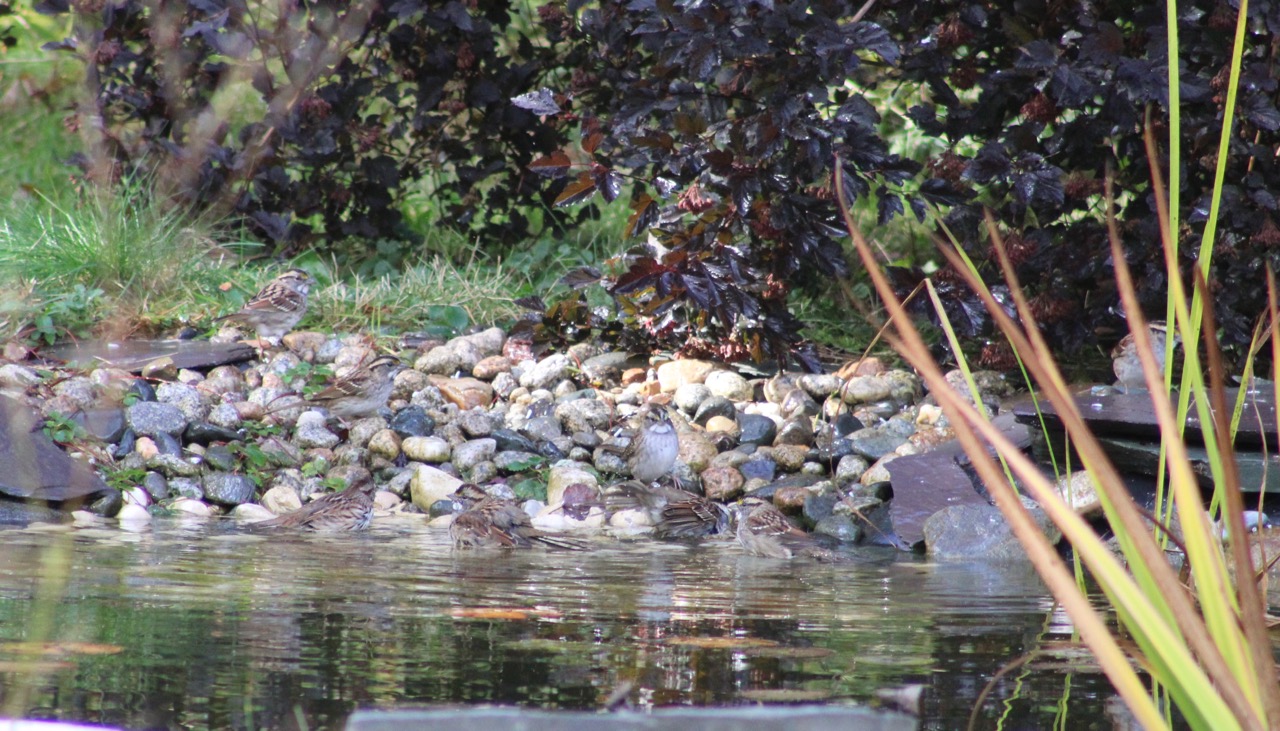
If you look closely you can see 8 white-throated sparrows visiting the pond.

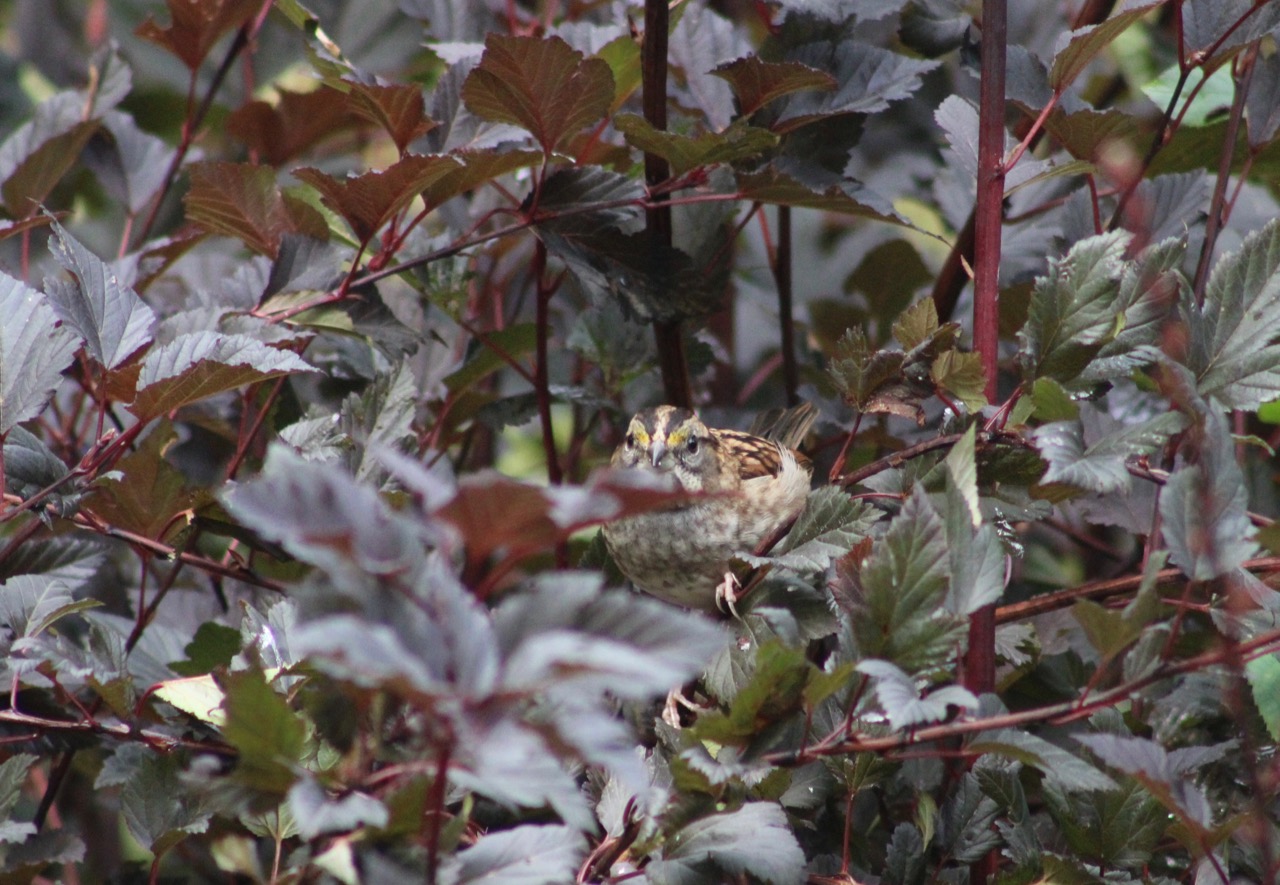
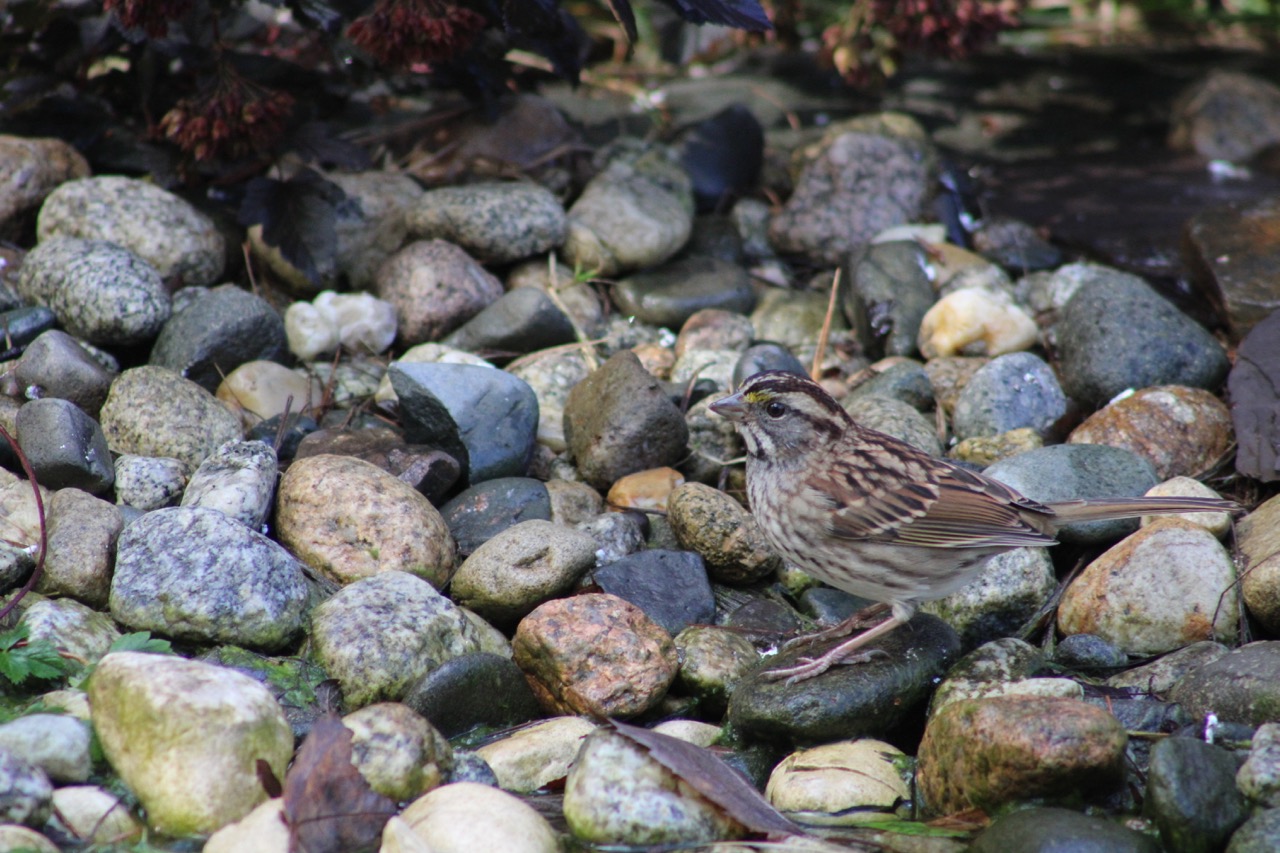
This week we’ve had a flock of dozens of white-throated sparrows in our back yard and the field and trees next to it. I love their little striped heads and loud chirping. They are drawn by the water of the pond, and I’ve seen them drinking and bathing there. It is such a blessing to feel the yard full of birds. If I am sitting right next to the pond, they are a bit timid, but yesterday I took the photo above from a little further away so as not to spook them. A few days before, one sparrow kept peering out from the nine-bark branches, but wouldn’t come any closer.

Then a couple days ago, when I sat quietly for a long while, a few began to venture near to drink even with my presence on the other side of the pond.

Every living being needs water. A human being can only survive for about 3 days without water. I am thinking about water in relation to the people in Gaza under siege, where Israel has cut off water and the electricity needed to pump and purify the water for drinking. The killing of innocents is always wrong, I believe that what Hamas did was wrong. But I also believe that the government of Israel is wrong to attack the civilians of Gaza, or cut off their access to water, food, and fuel. I am not unaware of the long history that is the context for these attacks. I have been following Jewish Voice for Peace for information and guidance in the midst of this deeply sad time. As someone who is neither Jewish nor Palestinian I can’t begin to grasp the depth and complexity of it all, but I trust the deep values of the Jewish Voice for Peace.

In the midst of this larger sadness, about which I can do nothing really, except to bear witness, I find peace with wild things gathering at the water. Everyone needs water. We are all relatives in this, whether large or small, near or far.

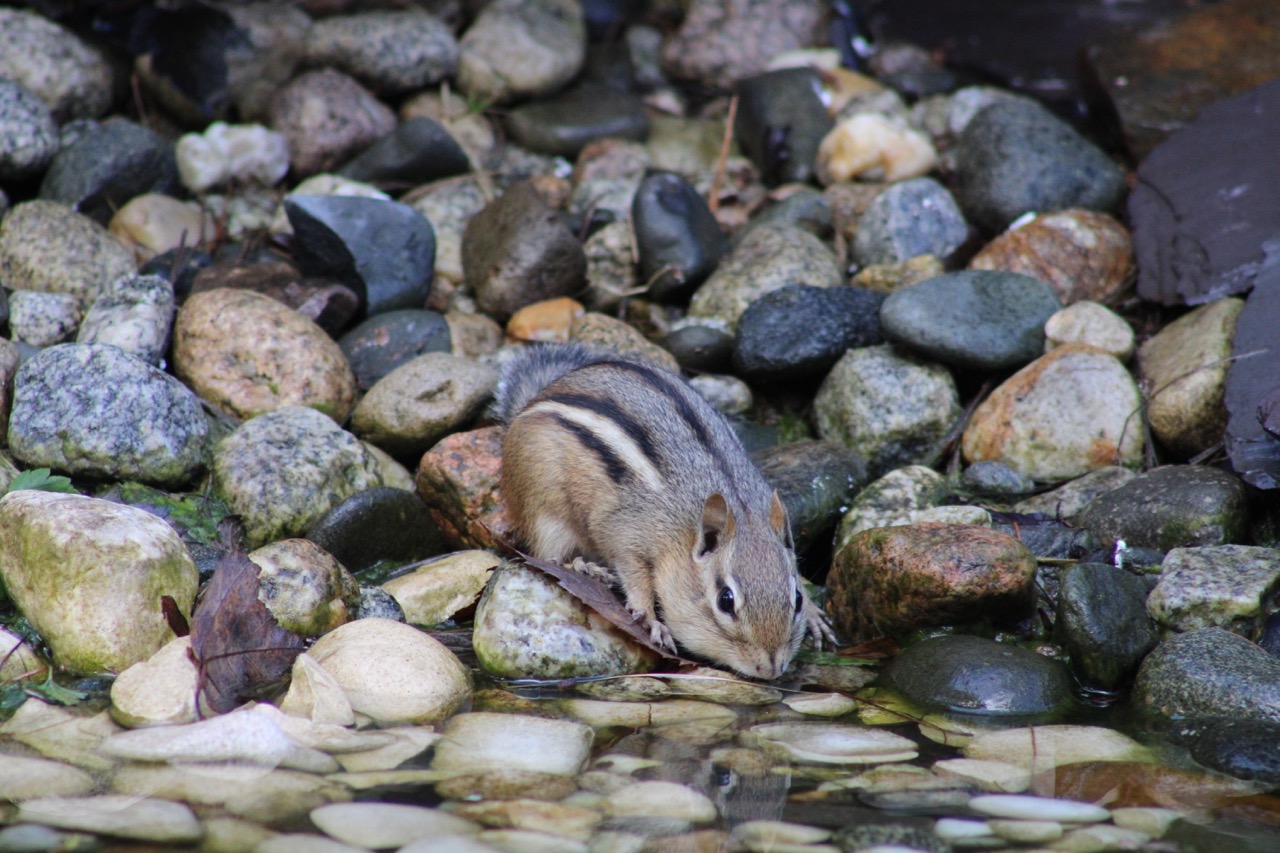
Chipmunk drinking water at the pond.

Photos help me see

Three frogs on rocks near pond
Three frogs on rocks.

Since beginning to blog, I have loved taking photos of creatures and plants. It is like a third eye that helps me to see the beauty all around me. Sometimes it helps me to look more closely, later. Like with the frogs in our pond–I think these three might be bullfrogs, because of the ridge that goes behind their tympanum (their external ear drum for hearing), but not down their backs. I tried comparing them with images online, which helped, but then I noticed how often frogs have actually been misidentified in photos on the web. So I am not sure. They are bigger than some of the frogs that have been in the pond.

But when I look back to earlier photos of frogs that I identified as green frogs, I am confused. I knew those were green frogs because they were very small, and their little squeak as they dove into the water was distinctive. But they also seemed to have the ridge behind their ears and not always down their backs. Photos enable me to keep looking and wondering. I’ll have to wait and hear what these frogs sound like. They were out on those same rocks today.

Pink cosmos blooms
Pink cosmos blooms

Sometimes, photos help me see beauty that is ephemeral yet durable. This cosmos was a volunteer by the side of the road, and started tall, with just one blossom. In the winds of last weekend, it fell over, but it keeps blossoming, and the bees keep coming by for nectar. It just keeps on blooming. It makes me smile.

Then, the other morning these turkeys wandered into the orchard, the sun making a little halo around their funny heads and big bodies. I was sitting in my chair and saw them outside the window. So I jumped up to go outside to take photos. The camera motivates me to watch them on their travels through the back yard. Then I can enjoy them once again in the photos.

Turkeys with sun making halo around heads and bodies.
Turkeys in the morning.

Pond lily surfacing

Pond, with stone edges, ninebark bush in back, spiky green blue flag leaves in front, and on surface of pond, two round red leaves of a pond lily.
The pond lily leaves have reached the surface of the water.

Last fall, I moved my pond lily plant, pot and all, to the bottom of the pond, from where it had been positioned on a step about 18 inches down. This was to help it survive freezing temperatures in winter. I wasn’t sure what would happen, but I was delighted to see red leaves starting to form around April 22, when I took the following blurry photo through the water.

blurry all over, through water, faint sign of red leaves forming in pot.
Red pond leaves seen through the water.

Thursday, the first leaf reached the surface on a tall thin stem, and others are following. They are red and round, but I imagine that they will turn green as the sun shines on them, since last year they were green. In the up and down world of gardening, it is thrilling when the perennial plants thrive on their own.

Red round leaves on surface of water.

The sweet flags I planted this year are also doing well–you can see them in the top photo near the stones. The blue flag irises are also coming back strong–their leaves are in the foreground. Meanwhile, the green frogs are happy–I’ve seen three so far. The bees are happy, and the tadpoles are still around. The maple trees scattered their seeds all over the yard, and many fell into the pond, but I didn’t scoop them out.

Green frog with stripey green and brown body sitting in water, with honey bee nearby on rock, drinking, and small tadpoles swimming.
Green frog, bee, and tadpoles in the pond.

Certified Wildlife Habitat

Small sign saying Certified Wildlife Habitat on metal post, near raised bed, and steps to front door of house.

It’s official. We’ve been designated by the National Wildlife Federation as a Certified Wildlife Habitat. This means that our garden “provides natural sources of food, water, cover, and places to raise young, and is maintained in a sustainable way that incorporates native plants, conserves water and doesn’t rely on pesticides.” We posted our sign in our front yard. We are one of over 227,000 such gardens in the United States, and they are hoping to reach 300,000 this year.

In order to be certified, you fill out a form at https://www.nwf.org/CertifiedWildlifeHabitat and give a donation to the organization. It’s on the honor system–you tell them the sources of habitat in your yard, in several categories. For food in our yard we have native plants, berry bushes, and fruit trees, as well as our bird feeder, and the pond. One of my favorites is evening primrose that grows wild. We keep several, only cutting in places that don’t work to have a tall plant–last year there were goldfinches all over this plant, and hopefully more this year.

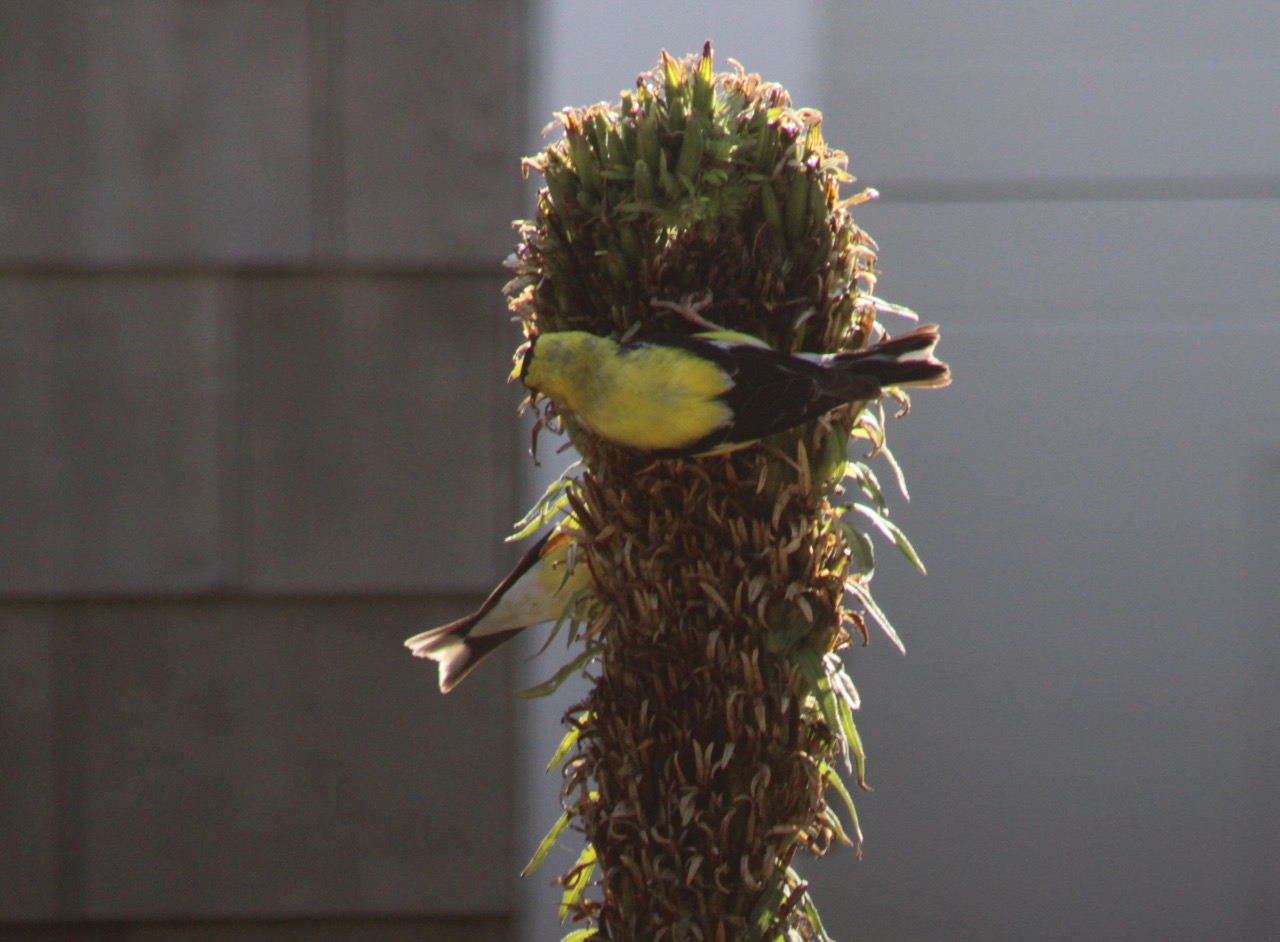
Goldfinches eating seed on round plant head.

We provide water especially with the pond. The pond serves so many purposes–food, water, a place to raise young (the tadpoles!), cover for frogs. When I walk in the morning, I see birds bathing, bees taking a drink, frogs sunning and snatching flies. But any kind of water brings wildlife to a yard–small or large. We also have a bird bath near our patio, and see birds and squirrels getting drinks there.

Cover is used to protect from bad weather, hide from predators, or hunt prey. Around the edges of our yard there are trees and bushes, and piles of branches that provide cover for small critters, and places to raise young. Ever since the orchard trees and hazelnut bushes have grown up, birds are always perching there, sometimes on their way to the bird feeder, sometimes eating insects. I’ve posted about the robins raising young in a nest on our back porch. But we’ve also seen young squirrels in trees, and chipmunks coming from underground.

As for sustainable practices, we never use pesticides, and we compost our food waste and leaves. We conserve water with our rain barrels, and if the pond needs topping up, that comes from the rain barrels too. We try to incorporate native plants wherever we can–mostly by not pulling the weeds that emerge on their own: violets, pansies, daisies, wild strawberry, goldenrod among many others. I use an app to identify plants that come up. We do also have invasive plants that we are trying to get rid of.

The official designation and sign were a gift to ourselves, and to make our intentions more visible in the neighborhood. Most of the actual habitat is in the back and side yards. Have any of you participated in this program? Maybe you might like to check it out. There are little things that each of us can do to care for the earth community, and foster habitat for wildlife.