Respite for Mother Earth

Today I am participating in a non-action, non-event. It is being sponsored by Dawnland Environmental Defense, an alliance of Native and non-Native peoples united in the protection of the Dawnland with particular focus on the sacredness of Water. The “Dawnland” is the land of the indigenous Wabanaki, this place where dawn first comes to our country. Everyone is invited to participate in a RESPITE for Mother Earth ~ “stay home, do little, pollute little, buy nothing (especially gas!), explore ways to lower your carbon footprint, regroup, relax, and give your Mother a break!” (It actually covers Aug 13-15 but today is the day I am able to participate.)

In our search for greener housing, there are times when it seems important to stop looking, stop driving around, stop even thinking about projects and buildings, and remember the ground underneath our feet, the root of life, the Earth who is Mother of all. I was able to go outside this morning and listen to the crows and chipmunks sounding an alarm–I think I may have seen a small hawk in the neighborhood. I washed out our bird feeder, and filled it with fresh seed. I read somewhere that bird calls wake up the plants each day, and can wake up our hearts as well.

There is one task I am doing–writing and emailing a letter about a mega-dump that is threatening the Penobscot River. If anyone is willing to help, especially Maine residents, you might use this information to create your own letter, or look at the Dawnland Environmental Defense page for further information.

Michael T. Parker, Maine Department of Environmental Protection, Solid Waste Program, 17 State House Station, Augusta, ME 0333-0017

michael.t.parker@maine.gov

Application #: DEP # S-20700-WD-B1-N

I am writing to request a public hearing on the expansion of Juniper Ridge Landfill, which is located just upstream from Indian Island. It is already a threat for the future viability of the river, and doubling the size (as is now being proposed) will allows a larger mountain of toxic trash to be placed on sensitive wetlands. This will have a detrimental affect on Penobscot people as well as all people who love the Penobscot River.

It is important that affected citizens have a voice in this proposal that threatens their water, the wetland ecology, and the air. It is important that hearings be held in a location convenient for those who will be most affected, such as in Old Town, Orono, Alton, or the Penobscot Nation area. Please inform me of further details on such a hearing.

Sincerely,

The Rev. Dr. Myke Johnson

Ma'skwasi Sipo (Birch Stream), traditional Penobscot hunting, fishing, and gathering territory, is located in close proximity to the mega-dump, Juniper Ridge Landfill.

Ma’skwasi Sipo (Birch Stream), traditional Penobscot hunting, fishing, and gathering territory, is located in close proximity to the mega-dump, Juniper Ridge Landfill. Photo from Dawnland Environmental Defense Facebook page.

Another Reason I Love Maine

Our appraiser rescues injured birds!

As part of our search for greener housing, we are applying for financing with our local bank, based on our equity in our current house.  That way, we don’t have to exactly synchronize the buying of a new house with the selling of our current house. Yesterday, an appraiser came to our house, as part of that process. We had de-cluttered the house and tidied and cleaned before she arrived.

Window MJ DSC00331But what I love about Maine is that people don’t stay on topic or on task. She noticed the striping we had put on some windows to help prevent birds from crashing into them, and we got talking about birds. It turns out she cares for injured and orphaned birds. She has been doing this for many many years, in conjunction with a local vets office. She spoke about her robin that can’t fly, but hops around on the enclosed porch, and sometimes releases the earthworms instead of eating them. She has cared for bluejays who could speak words, and a crow who liked to wait for the fax machine in her office to get an incoming fax so he could tear it apart. When possible, the birds were released after they had grown up or healed, but a few she kept on.

She described each bird by name and I love how much she appreciates their intelligence and their unique personalities. I love that she searches for the perfect beach to release young seagulls who are now able to make it on their own. I love her story of the crow barking like a dog because he had been raised around her dogs.

You never know what little delights a day will bring, and I love that in Maine, folks don’t stay on task, and you can discover kindred spirits when you least expect it.

Stuff

Vase on Mantel DSC00542Today was one of those days when the idea of actually sorting through and giving away or packing our stuff seemed pretty overwhelming. Part of our search for greener housing includes this process of dealing with our stuff. How did I get so much stuff? I remember being able to put almost everything I owned into a backpack, along with a tent, and carrying it on a bus when I went to join the Women’s Encampment for a Future of Peace and Justice in 1985. I must have had a few boxes of stuff stored with a friend back in Chicago, but not much. Now, our stuff fills a house.

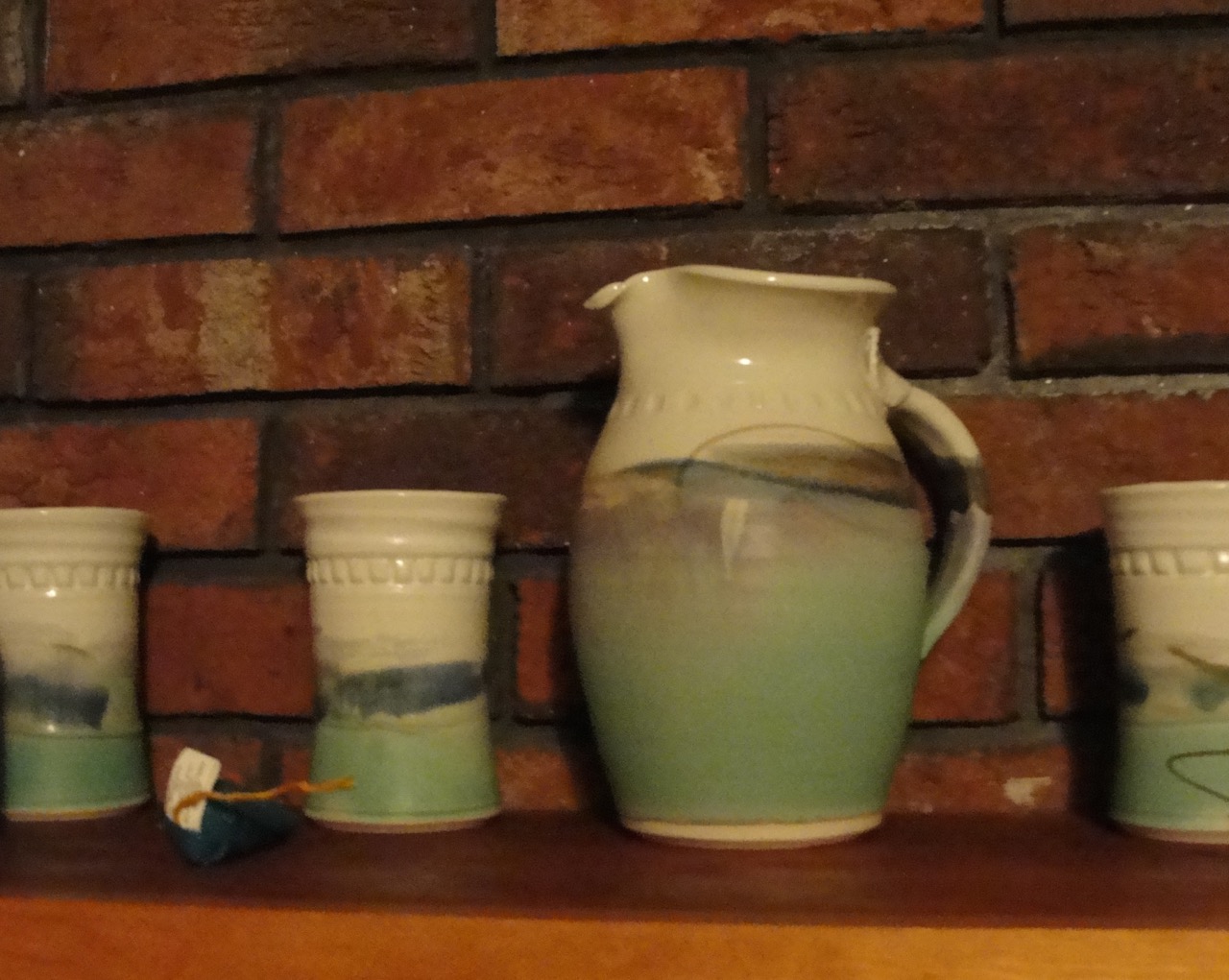
Maybe some people feel happy having lots of stuff, but I often feel uneasy about it. I grew up with St. Francis of Assisi as a role model, the patron saint of voluntary simplicity. I had to learn to appreciate the value of creating a beautiful and welcoming household. I was reminding of that value when a friend visited this weekend and remarked about how wonderful it was to be in such beauty. And I do love our home, and the stuff that helps to bring it alive. Some of it is practical–a kitchen table, chairs, beds, desks, bookcases, dishes. Some of it is sentimental–gifts from friends or a few cherished pieces from family. Some of it is just for beauty–the pitcher and cups on our mantel, a wall hanging of the tree of life.

But when I think about having to move it all from one place to another, it feels daunting. Today we were cleaning up some of our clutter in preparation for a visit from an appraiser. Not quite as daunting as preparing the house for showing to prospective buyers, but that will be coming up too. It is funny that as Americans have become more mobile, we have also accumulated more and more stuff. Is our attachment to our stuff trying to make up for our loss of attachment to land and community?

There are a lot of guides out there for helping to get rid of excess stuff. Common questions to help in the process include these: Have you used it within the last year? Does it give you joy? I have added another: Is this worth saving for my permanent personal archives? That one covers the fact that as a writer I am attached to keeping all of my personal journals. The last time we moved I even purchased archival quality boxes to store them in. I understand the process we need to go through. I just can’t imagine how we’re going to find the time to get it all done.

I am reminded of a quote by Wendell Berry. It isn’t really about stuff, but about anything that feels daunting or too big. I have it posted on the bulletin board next to my desk:

“It may be that when we no longer know what to do, we have come to our real work, and that when we no longer know which way to go, we have begun our real journey. The mind that is not baffled is not employed. The impeded stream is the one that sings.”

Or perhaps it would be helpful to take the advice of Dory in Finding Nemo:  “Just keep swimming.”

The Sacredness of In-Between

Circle Stone MJ DSC09547I love that there is a word for the sacredness of being in between one time and another, one place and another. It is called Liminal Time, or Liminal Space. It is the moment when magic can happen, when anything can happen.

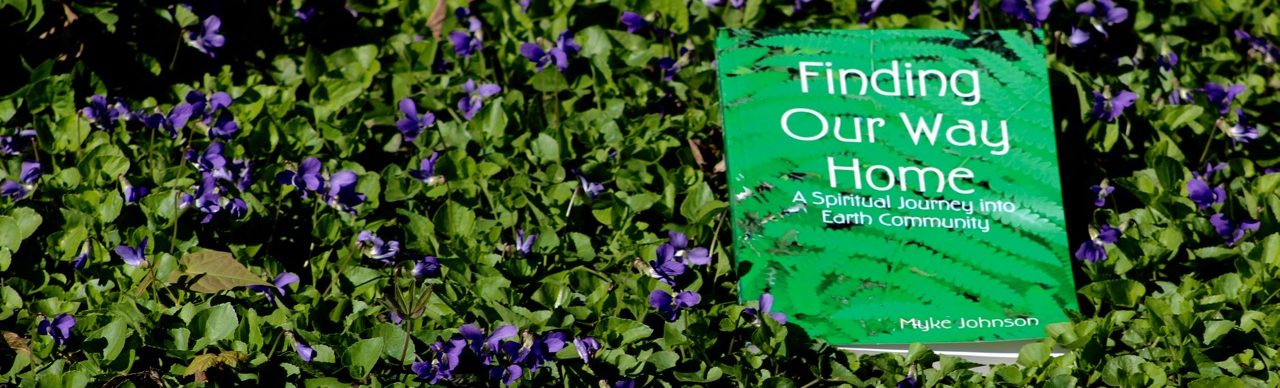
I am now in the last week of my four-month sabbatical, and I am noticing that I haven’t finished any of the big goals I set for myself at its beginning. But that is okay–I am in a liminal space with each of those goals.  One goal is to publish my book, Finding Our Way Home. I have completed another full edit, and sent out queries to some publishers and sent out the manuscript. Now I am in the time of waiting to hear back.

Another goal is to find greener housing. Again, Margy and I have started on that process–we talked about what we want in a new home, we engaged a green realtor, we looked at some houses that didn’t fit, we sorted out some financing options. I’ve begun the process of simplifying and letting go of things I no longer need. That process will take a lot more time, and we are waiting for the right house to show up on the market.

A goal that emerged during these months is to do more with the Work that Reconnects. I want to devote myself to making changes that will move human beings into a more beneficial relationship with all life on earth. That in itself is not a new goal, but rediscovering the tools that Joanna Macy has created for this work has been a true gift of these months. I am imagining how I can bring those tools to my ministry in the congregation, and beyond. I’ve had a chat with a local colleague who is also interested, and I look forward to plotting together.

I feel like I have been planting seeds and tending the soil, but the harvest time is still up ahead somewhere, unknown and unknowable. And for now, it is important to let it be unknowable. If I want to experience the sacredness of this time, I must open to its mystery and uncertainty, I must celebrate its possibility, I must wait for its unfolding. The Holy is right here.

Why find greener housing, anyway?

Oil furnace DSC01553We have to wean ourselves away from our dependence on fossil fuels. Think about petroleum. The industrial economy treats oil as a resource free for the taking, with a price based only on the cost of extraction and delivery. It shaped a world which became completely dependent on cheap oil. But we have passed the time when oil can be easily extracted, and now riskier and dirtier methods are required. Deep sea drilling like that which caused the spill in the Gulf of Mexico. Tar sands mining in Alberta Canada that destroys the forest, and devastates the health of the people and animals of the region. Arctic Sea drilling. Burning oil for fuel will increase greenhouse gasses and bring our climate closer to disastrous changes.

I know we have to stop burning oil. But when I look at my own life I see how big a challenge that will be. Our home is heated by oil. I drive a car than runs on gasoline made from oil, to buy food and other needed items, and also to go back and forth to the congregation I serve. It would take several hours to walk to these destinations from my house, and there is no public transportation nearby. The whole structure of suburban life is dependent upon oil. My congregation is a suburban congregation, and almost every person who comes to worship drives there in an automobile. Without oil, it is likely the church, and my house, would not have been built in these locations. The whole geographic structure of our society has been shaped by oil.

And not only that—many material goods in our lives are also fabricated from oil. Plastics are made from petroleum, and there is plastic in every room in our houses. I write on a computer with plastic components. Alarm clocks, toothbrushes, synthetic fabrics, telephones, televisions—all from oil. Modern agriculture is dependent on fertilizer made from oil, and machines that use oil, and a transportation system that uses oil. The asphalt on our roads is made from oil. If oil disappeared tomorrow, the whole system would collapse. And eventually, oil will run out. That is one of the realities we are learning in our time.

None of us have the ability to undo our dependence on oil individually. It is too entrenched, too societally enmeshed. But we can begin to imagine some partial solutions—in fact, the technology to live without oil already exists. I was inspired when I learned about “zero-carbon” houses that actually generate more energy than they use. We may not be able to fully achieve such a goal, but why not try to get closer to that ideal?

I know that even if we succeed beyond our wildest dream—even if we create a zero-carbon home from which we could walk to most functions of our lives, even if we could afford an electric vehicle that we charge from solar panels for other transportation—oil companies will still be breaking open the earth in Alberta, and spilling oil into the Gulf of Mexico. The children living near refineries will still be getting asthma. The ice of the arctic will still be melting, and thousands of species will go extinct each year. We need not only individual change, but a social will to transform our relationship to the earth. But I believe that each change we pursue as individuals also works its magic on that larger transformative process in ways that we can’t fully understand. And so we take the one step we are able to take.

In the Talmud it says, “Do not be daunted by the enormity of the world’s grief. Do justly, now. Love mercy, now. Walk humbly, now. You are not obligated to complete the work, but neither are you free to abandon it.”

Prayers at Dawn for our Housing Search

I wake today about 5 a.m. and feel called to come outside to pray in the dawn light. It rained during the night and the morning is misty and golden. I am visited by a cardinal, whose silhouette on a branch is dark against the eastern sky. I hear it chirping as another cardinal a bit further away trills their evocative songs. I am visited by a tiny toad or frog (I am not sure which), who moves quietly along the edge of the screen tent where I am sitting. I am visited by a golden slug my old teacher of slowness. A pileated woodpecker pounds away on some dead branches looking for breakfast. I hear the familiar songs of many tiny birds as they wake the sun, which is starting to appear through the branches of the spruce. Later, in the light, the chipmunks and squirrels dash about.

I feel so grateful for this place of trees and birds and critters. In our search for greener housing, I pray that we can find a home where I am called outside in the morning by the songs of cardinals, where Margy can find frogs and toads where they hide in the damp. I pray for this journey we are walking, hoping to move closer into harmony with all beings. I call on the magic of the dawn and the magic of all these beings to help us find our way. And, I open my heart to change, to what is hidden and cannot yet be seen.Morning Photo on 8-4-15 at 7.02 AM

The Search for Greener Housing, Part Two

After deciding it is the right time to start searching for a more ecologically friendly house, my partner and I sit down together and make a list of what we hope for in a home.

  • One-level living that can be made wheelchair accessible (because my partner can’t do a lot of steps, and we have friends who use wheelchairs, and universal design makes sense for a house we want to get older in.)
  • South facing roof that is solar energy suitable
  • Able to be retrofitted with more insulation and air-source heat pumps
  • Location closer to Portland and public transportation, near some sort of village center
  • Quiet street
  • An area safe for lesbians and people of color
  • Privacy in the back yard
  • About a quarter-acre lot, smaller than where we are now, but still room for permaculture gardening. Some parts shady with trees, some parts sunny, and flat enough for easy access. We want to get rid of lawn to mow, and have other kinds of plantings instead.
  • And, perhaps counter to our village center idea, a location close to woods and critters?
  • About 1200 square feet of house (this number to be adapted as we actually look at houses and see what the spaces feel like.)
  • Two bedrooms plus some office space and guest space
  • Living area that can hold ten people or so for gathering together
  • Some extra space, like a basement
  • Wood floors or equivalent–no carpet, no mold, no smokers. (We have allergies. If there is carpet, plan to replace with wood floors.)
  • Big windows, lots of light
  • Two-car garage (because of Maine winters, and for now we need two cars)
  • Laundry on first floor
  • Mudroom area
  • Fireplace or wood stove, more for the feeling of a hearth than for heat
  • Deck
  • No vinyl siding (That stuff is really bad for the environment! Watch the documentary Blue Vinyl!)
  • Electric appliances

Okay, that’s our list, that’s our desire. And of course, we want a sound, well-built house that will last. The other part of the equation is that we want the price to be enough less than our current house so we can afford to do the retrofits and add solar energy without taking on more debt. Our goal is to own it debt-free before we come to retirement, and to have the ongoing taxes and utilities and maintenance costs affordable to us on a low retirement income.

There is a strange magic to finding a new home. There are practical steps we need to take, but then, it all depends on what is out there. And what will emerge in the next day or week or month. I have moved dozens of times in my life, and it always brings up a lot of anxiety for me. Will we find a home that works for us? Will we recognize it when we see it? What is essential on our list, and where can we compromise? It took us four months to find our current home when we moved here to Maine. Will it take that long for this process? If we find a house we like, will we be able to bid for it successfully? My partner has her own list of fears.

In this magic of finding a new home, we are placing our desires up against our fears. That is why it feels important to me to name our very specific desires for a new home, and also to acknowledge and honor our fears. I know that magic works that way. But there is another deeper movement going on as well. It comes to mind again as I look at houses-for-sale online. In the listings, they don’t mention the orientation of the house, so I try to figure it out by looking closely at the maps. It is discouraging how few houses have a south-facing roof.

Then I remember that we are trying to do something new with this move–we are trying to re-orient our home environment into harmony with all life on earth. The current built environment is oriented around cheap oil and other fossil fuels. It can’t last. We are trying to take our own small steps closer to a whole new way of living that is about beauty and sustainability and a future for the generations yet to be born. There is a great Earth energy that is beneath our feet guiding our way down this path.

It says to me, “Remember to embrace the process. Enjoy the whole journey, right now! You don’t have to wait until everything is ‘settled.’ Keep taking small steps until you are ready to leap. Until the time comes when it is clear. You do not have to rush. Keep holding hands with the ones you love.”

Photo by Margy Dowzer

Photo by Margy Dowzer

The Search for Greener Housing, Part One

For a long time, I have been saying to whomever might listen that my fantasy is to live in a zero-carbon home, a home that is so energy efficient that it doesn’t put carbon into the atmosphere through burning fossil fuels, or use energy that is based on fossil fuels.  There is more to it than that, but ultimately, I am hoping for a way to live more in harmony with the whole of the living earth, to live as if our human future holds life-sustaining possibilities.

So, my partner and I have started on a new adventure toward this greener living.  We have decided to downsize from our current home, and look for a smaller home that could be retrofitted to approach zero-carbon efficiency.  It is an adventure full of anxieties and tensions, so I decided to create a blog journal as we go.  I want to remind myself of the core values involved in this transition, and the grace and magic available to us when we take steps toward our deepest earth connection. It is also a way to honor the challenges we face as we seek to create change.

Our house with trees

Our house with trees

There are so many things we love about our current home–it is a well-built ranch-style house on one acre of land full of grand mature trees–large maples in the front yard, and tall oaks, pines, hemlocks, spruce, and birches in the back yard. We have such privacy and beauty around us when we go outside, and this place has been a teacher for my journey into deeper connection with the earth. There are birds and chipmunks and other critters who wander through. The house is full of light.

So why leave? For one reason, there are limits to what can be done with this house toward greater sustainability.  It doesn’t have the right alignment for solar power, for example. Secondly, it is out in the country/suburbs, and totally dependent on automobile transportation for every human need. So even if the house could be made more efficient, the location is oil-dependent. Thirdly, and perhaps most basically, it is more house and land than we really need, and expensive for us to maintain and take care of.  We couldn’t afford to do much more than we have already done toward greener living in this house. And as we look toward the possibility of future retirement, we realize we couldn’t afford to stay here at all on a retirement income.

One essential part of this process of change is the grief that emerges when we contemplate letting go of a home we have loved, and these trees that are older than we are. When we open our hearts to the land, we open our hearts to the particularity of a place.  This unique place.  I have taken hundreds of walks down this road, taken photos of these trees in all seasons, walked to the conservation land and the water district land just half a mile away.  I’ve cross-country skied back behind the yards and houses through little paths in woods out to hidden fields.  I know where the lady slippers bloom in the spring. We’ve planted flowers and bushes and young trees here, along with blueberries and raspberries.

Can a part of the magic of this change create protection for this land we have nurtured? Only if some new resident falls in love as we fell in love when we arrived here. Maybe someone with more resources could even take this place further on its own path to sustainability.  In the meantime, we keep our hands in the soil and our hearts open. We gather this season’s raspberries and keep going outside. Perhaps our love for this land is a part of the magic of this journey.

Next time, I will share our particular dreams for the new home we are seeking…

Changing Lanes Without Signaling

"Ta-Nehisi Coates" by Eduardo Montes-Bradley. Licensed under CC BY-SA 4.0 via Wikimedia Commons

“Ta-Nehisi Coates” by Eduardo Montes-Bradley. Licensed under CC BY-SA 4.0 via Wikimedia Commons

Ta-Nehisi Coates’ new book, Between the World and Me, is a powerfully devastating window into the experience of living in a black body in America, a body that is constantly vulnerable to assault, to capture, to torture, to destruction, to death.

I am a white woman who has long been involved in the white anti-racist struggle–I say this, not with any attempt at boasting, but merely to point out the map that my reality has followed over the last more than thirty years of my life. But even so, Coates’ words painted a picture of soul-shattering fear that struck me to the core.

I grew up with a general feeling of safety. I belonged to a working class family in Michigan, living in suburban Detroit for the most part, raised to believe that “all people are the children of God,” but also living in all-white communities where racial violence was something that appeared only on our television screen. A liberal white world aspiring to be “colorblind,” in the “Dream” that Coates describes as the place where white America lives as if asleep, unaware that it is built on the violence against black bodies.

I was asleep like that, but in my young adulthood I began to wake up to the horrific realities that America was built upon–the theft of the land and destruction of Indigenous people, the slavery and destruction of Black people. The first window into those realities came through my own awakening to the violence that was perpetrated on female bodies. That violence was hidden under the mantle of (white) safety. I did not actually experience sexual violence in my own body, only the constant threat and fear of it. Don’t go out at night, don’t talk to strangers, don’t dress to draw attention to your body, and so on. But here was the irony–a woman could “feel” safe if she stayed “asleep.” It was only upon waking that the fear undergirding my life became visible.

Once I woke up to that illusion, other illusions began to break through as well, and racism became visible and anti-racism became important to me. But so much remained hidden. Layer upon layer, I kept being surprised again and again at the horror of it, the extent of it, the insidious forms it takes, the interlocking systems that perpetuate it. I got it that we are all implicated, that no one can escape the systems in which whiteness benefits those who are understood to be white, and devastates those understood to be not white.

Ta-Nehisi Coates broke open for me a new and deeper layer of the reality of racism–his words, along with the revelations of the #blacklivesmatter movement, which have kept before the public eye the many recent killings of black people by police. Last week, I watched videos of the police officer’s traffic stop of Sandra Bland. Pulled over for failing to signal a lane change, three days later, she was dead in her jail cell. Something about her story–her innocent journey to start a new job, her bright spirit–brought it all home. No black person is safe anywhere.

This week, as I passed the flashing lights of a police vehicle behind a pulled-over car, I felt an unfamiliar shudder in my gut. A tiny glimpse into the terror. When I read Coates describing the terror he felt when he was stopped in his car by police, these images and videos came to mind, and I understood his fear for his life, his shaky relief when he was let go. A few months later, his friend was killed by the same police force.

The thing is, Coates continues to live with this original and constant fear in his body, just as my body still holds that original feeling of safety, even though I realize its illusory nature. I have to choose to stay awake, to remember. I can take a break, not think about it for a while.

It is not easy to stay awake. Mab Segrest talks of choosing white anti-racism as becoming a “Race Traitor.” There is a loneliness in it, a separation from the mainstream American dream, a separation from family and friends. Most often, I feel more resonance with my friends who are people of color, but I will never really belong to that world either. So staying awake is often lonely and sad. I usually don’t have a clue how to create change, or make things any better. But I believe that if we stay asleep we will never find transformation. We have to wake up to reality, bear its pain, before any change can happen. So thank you Ta-Nehisi Coates for being willing to be so open about the reality in which you live, in which we all live.

How to Face the Mess We’re In Without Going Crazy

Redwood Sky DSC06718I was away for eleven days at an intensive retreat in northern California on The Work That Reconnects with Joanna Macy. I have loved Joanna’s work for over thirty years, from when she was leading workshops on Despair and Empowerment in a Nuclear Age.  If you haven’t yet encountered her work, a great book to begin is Active Hope:  How to Face the Mess We’re in without Going Crazy, co-authored with Chris Johnstone.

Here is the description of the book from the publisher’s page:

The challenges we face can be difficult even to think about. Climate change, the depletion of oil, economic upheaval, and mass extinction together create a planetary emergency of overwhelming proportions. Active Hope shows us how to strengthen our capacity to face this crisis so that we can respond with unexpected resilience and creative power. Drawing on decades of teaching an empowerment approach known as the Work That Reconnects, the authors guide us through a transformational process informed by mythic journeys, modern psychology, spirituality, and holistic science. This process equips us with tools to face the mess we’re in and play our role in the collective transition, or Great Turning, to a life-sustaining society.

A true gift I have experienced in Joanna’s work is a way to experience my own grief for the world, not as a debilitating or paralyzing weight, but as a doorway into experiencing my deep interconnection with all beings.  We begin in gratitude, and the spiral of the work takes us through grief and interconnection, and we go forth with new strength for changing our lives and our world. I came away from the intensive feeling more alive and whole, and with new ideas for bringing people together around this work. Reading a book or a blog can be a solitary experience, but gathering with others to discuss a book, or doing practices together that make the ideas come alive, can be profoundly healing.  I am dreaming of how I might bring this work to Maine.