Robins building nests

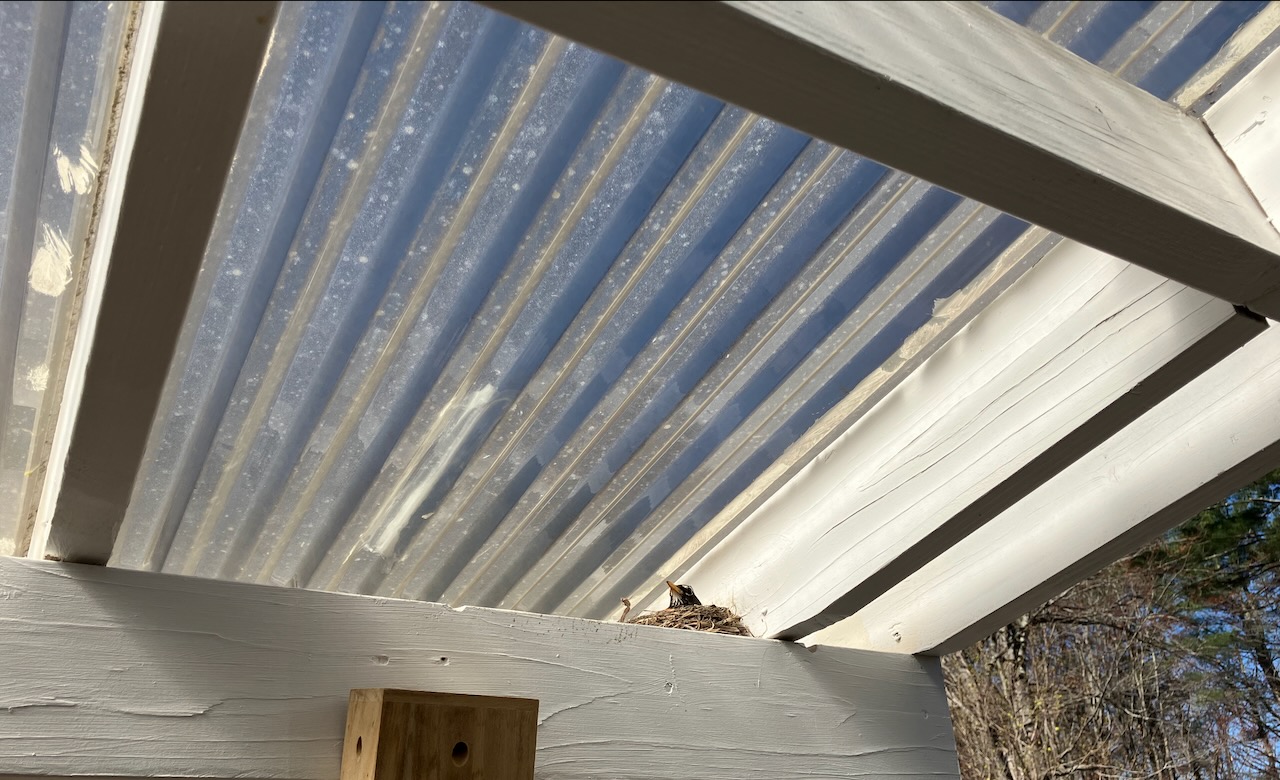
clear ceiling over deck beam with robin in nest on beam

We have robins nesting again in the beams of our deck! Two years ago, a pair of robins raised three broods of chicks over the course of the season. The year before that, in 2022, they had tried, but failed, and it seemed the clear ceiling raised the heat too much for the babies. So I created a shade from cloth to go over them. That worked for 2023. Last year, no nests on the deck. But this year, they were rooting around again on the beam. Imagine my chagrin when a robin starting building a nest in a different section of the beam, with no shade cloth. I could already see her with her beak open on a warm sunny day. One day when she was gone from the nest, I counted three blue eggs.

So I tried a different solution. It was a bit of a risk, but I went out with a ladder and painted the ceiling above the nest with some white primer/paint. She had flown off when I got close, but after I finished she came back, and I am happy to say has continued to sit on the nest every day. I hope this helps her babies to thrive, as I wish for all babies to thrive. I am thinking of the babies in Gaza who are being starved right now.

Robin in nest with shade from painted ceiling

Another joy is that there is also a robin nesting in the bush near our front door. You can just barely see her from our living room windows–she is so well camouflaged from above. But she too is still sitting.

Spring is bursting all over. The cherry trees have some blossoms and the peach tree is starting too. I just hope all this rain we are getting this week doesn’t prevent them from being pollinated. The rain is much needed because of drought, but I miss the sunny days we had last week. I did a holistic spray for the trees the week before. Our trees struggled last year so I am trying to be more attentive this season.

Cherry blossoms against blue sky

Being in the garden is so healing in light of all the devastating news each day from our country, and from the world. One more photo of beauty, daffodils Margy picked from the garden. May the beauty be a prayer for peace.

yellow and orange multi-layered daffodils

Ephemeral

Trout lilies are blooming near the brook.

There is so much beauty in the spring, but it all seems to be moving so fast. I can’t keep up. Mayday has come and gone. Already this season is half over. After two months of physical therapy for my hip and lower back, I am able to walk fifteen minutes and more again. The other day I walked to Capisic brook and onto the path nearby, and saw the trout lilies that usually grow there, a lovely spring ephemeral. American Heritage Dictionary defines ephemeral:

  1. Lasting for a markedly brief time.
  2. Having a short lifespan or a short annual period of aboveground growth. Used especially of plants.

Spring itself and all its beauty feels markedly brief. Is my love of photos a way of trying to hold on to all that is ephemeral? Is my need to write an attempt to halt the relentless flow of time?

I have been drawn outside more and more each day, excited to see daffodils and violets and green shoots coming up everywhere. And, happily, the peach tree is now covered with pink blossoms, and the cherry trees have many blossoms too. Last year, because of the weather, there were none–so these beauties seem fragile and extra special because of that vulnerability.

Peach blossoms on a foggy day.

There are many projects in the yard to attend to. Many branches fell from trees in the storms of winter and early spring. Margy has been cutting them up and hauling them around. Some of these we’re using to make a brush pile in the back corner for wildlife habitat. The other day, I cleared that space of invasive plants. I also set up our eight rain barrels again. We are going to get an new order of firewood, after using up our last old logs in the storms. So we are working on the space for the firewood, and purchased a rack to keep them off the ground.

Yesterday, I added two more pond lilies to the plants in the little pond, and as I was tidying up old dead shoots from other plants, I found strings of toad eggs attached to the old ferns. (So of course I left those.) We haven’t had toad eggs in the pond before. But there are a few frogs beginning to make an appearance–shy ones who have been diving under when they hear me approach.

The robins did not come back to the nest on our back porch that they had used for two years. Maybe that pair are no longer living. I read that their average life span in the wild may be just two years. I also read that they often don’t reuse nest sites–so we were lucky to have them in that spot for two years. Another ephemeral.

Then we discovered a nest in the yew bush near our front door–able to be partly seen from our living room window. So new robins are raising young nearby again. Maybe one of them fledged from the back porch.

Blue robins egg barely visible behind branches.

Is my love of photos a way of trying to hold on to all that is ephemeral? Is my need to write an attempt to halt the relentless flow of time?

I was cuddling with my cat Billie on the couch and suddenly felt a deep sense of our own impermanence. She is 13, I am 70. Senior cat, senior human. How much more time do we have? Someday, I won’t be able to feel her warm little body, with its soft fur and sweet smell, curling up on the pillow near my face. Someday, she will be gone; someday, I will be gone. We too are ephemeral. I want to hold on, but life seems to be about movement, about letting go into the next moment.

Hibernators Awake!

The chipmunks woke up from their hibernation earlier this week. Peeking out from their warrens beneath the garage. It’s a good thing we don’t have bears. My friend who lives in the woods had a bear arrive in the night to break apart their bird feeders this past week. Our chipmunks merely climb the pole and share in the bounty. The wake-up seems early this year, and probably is. The winter was too warm and too short. But here we are, in a climate changed world, loving the earth as well as we can.

Today is the Spring Equinox! Equal parts night and day. I want to take a moment, in the midst of the vast troubles of the world, to express delight at the turning of the seasons. Small bits of green emerging from the perennial plants. And I am grateful that after five sessions of physical therapy I am beginning to get some relief from my hip pain. My PT person uses Integrative Manual Therapy, and it is a miracle worker. There are still many sessions to go, and I am hopeful that healing will happen. I took a very short walk each of the last three days–my five minute walk to the end of the block–which actually takes ten minutes with my current walking status. It feels good to be outside.

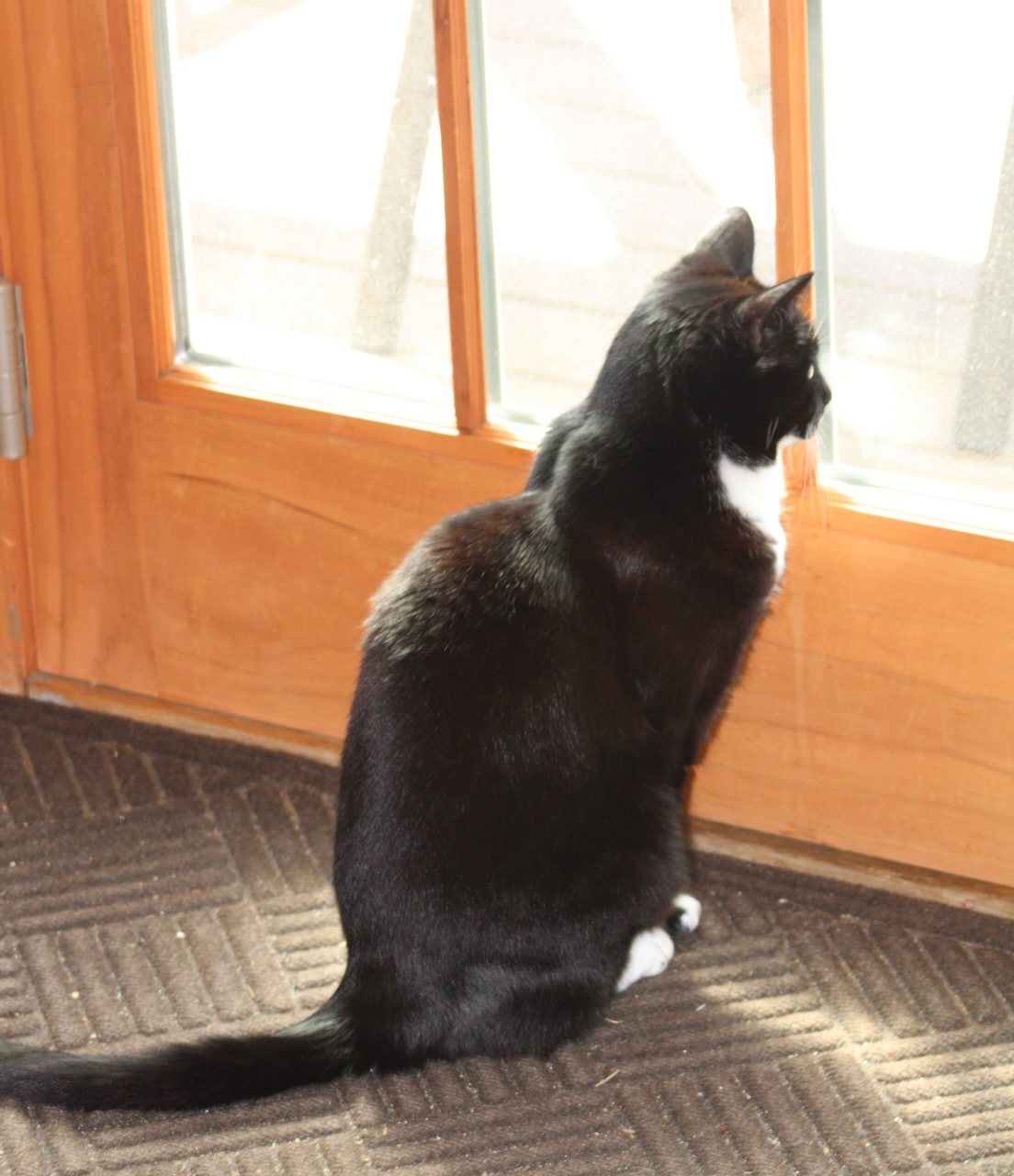
Meanwhile, the cats have new critters to watch through the windows. (They are indoor cats only.) Here is Billie looking out the back door.

I think about vulnerability. What it means for me to be 70 years old. I didn’t hurt my hip by falling or anything like that. I woke up one morning and there it was. It is a reminder to me to cherish the joys of each day. Who knows what tomorrow will bring? I can be prone to anxiety, and feel deeply the troubles of the world. I will keep bearing witness. But I will also find joy in these simple moments, these earth awakenings.

Roadside Garden Flowers

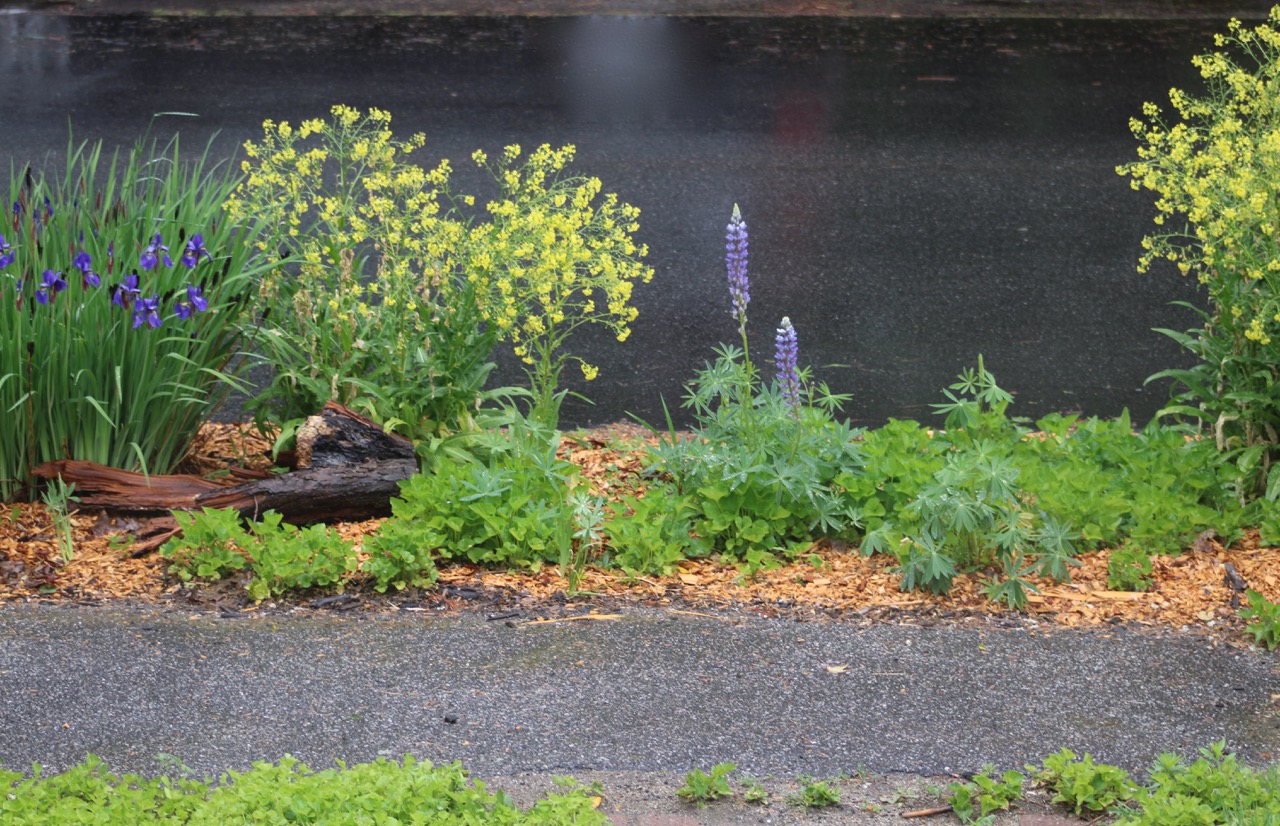
Roadside garden with siberian iris purple flowers, turkish rocket yellow flowers, lupine purple flowers.
Siberian iris, turkish rocket, lupines in bloom.

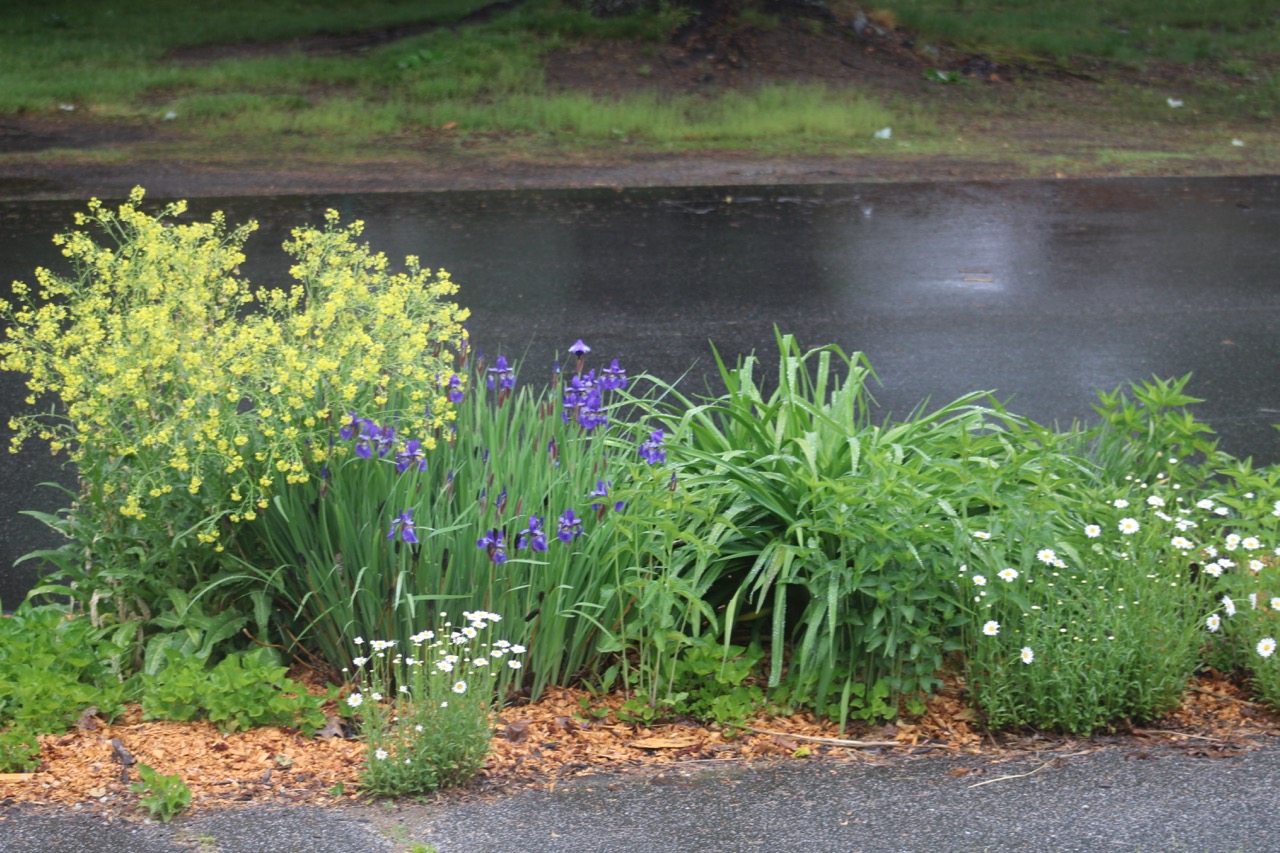
This is my favorite time of year for the roadside garden. The flowers are in contrasting colors of bright yellow, purple/blue, and white, with lovely green leaves of all shapes and sizes. Despite the cold and rain of the past week, it seems to send off a glow into the gloom. It was a garden formed originally from gifted hardy perennials, and others have naturalized to find their own places, like the white daisies.

Yellow flowers of turkish rocket, purple Siberian irises, daisies, in front of rain slicked pavement road.
Turkish rocket, Siberian iris, wild daisies in bloom.

Before the rain, we planted random and unknown flower seeds in one of the garden beds in the front, and carrot seeds in the other (next to broccoli seedlings). I had also planted zucchini and cucumber seeds in the hugelkultur mound. I hope the rain waters them gently and they sprout. Most of our seeds are from prior years, so it is a gamble. But it did seem like good timing.

And for those who have been following this blog, you might be delighted to learn that after the robins fledged, the parents are now starting a second batch of eggs. Once again, she laid one egg per day, but this time, there are four!

Four blue robin's eggs in nest

Pond lily surfacing

Pond, with stone edges, ninebark bush in back, spiky green blue flag leaves in front, and on surface of pond, two round red leaves of a pond lily.
The pond lily leaves have reached the surface of the water.

Last fall, I moved my pond lily plant, pot and all, to the bottom of the pond, from where it had been positioned on a step about 18 inches down. This was to help it survive freezing temperatures in winter. I wasn’t sure what would happen, but I was delighted to see red leaves starting to form around April 22, when I took the following blurry photo through the water.

blurry all over, through water, faint sign of red leaves forming in pot.
Red pond leaves seen through the water.

Thursday, the first leaf reached the surface on a tall thin stem, and others are following. They are red and round, but I imagine that they will turn green as the sun shines on them, since last year they were green. In the up and down world of gardening, it is thrilling when the perennial plants thrive on their own.

Red round leaves on surface of water.

The sweet flags I planted this year are also doing well–you can see them in the top photo near the stones. The blue flag irises are also coming back strong–their leaves are in the foreground. Meanwhile, the green frogs are happy–I’ve seen three so far. The bees are happy, and the tadpoles are still around. The maple trees scattered their seeds all over the yard, and many fell into the pond, but I didn’t scoop them out.

Green frog with stripey green and brown body sitting in water, with honey bee nearby on rock, drinking, and small tadpoles swimming.
Green frog, bee, and tadpoles in the pond.

Babies in the Garden

Slightly behind a white crossbeam is a parent robin with two little babies with open beaks in a nest.
Two baby robins with open mouths waiting on parent.

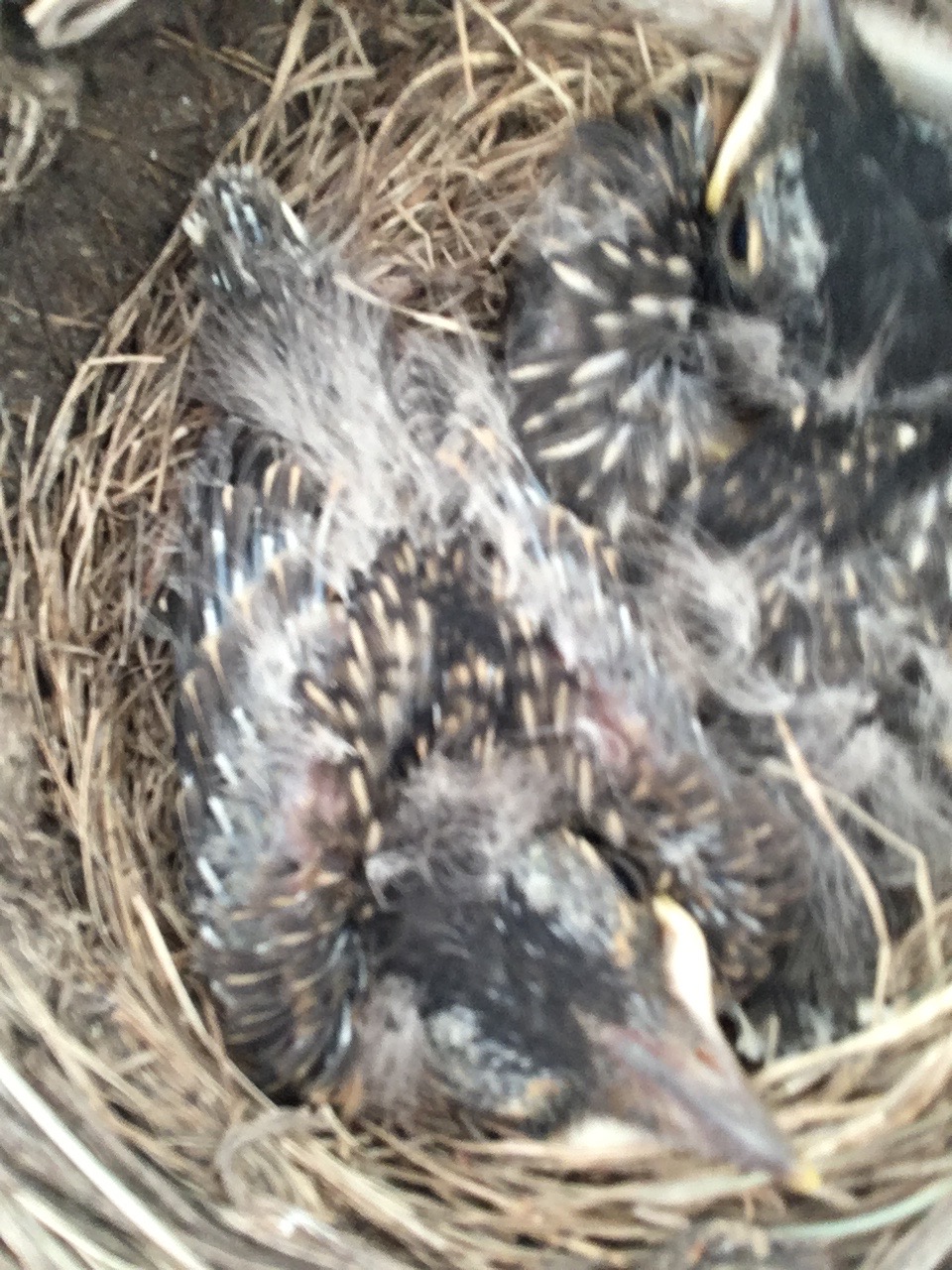
I’ve waited to post about the baby robins because I didn’t want to presume anything or jinx it. But it seems after the mama robin laid three eggs in the nest on our back porch beam, we now have two babies who have feathers and are poking their heads up to be fed. They don’t make a sound, and most of the time they are hiding deep in the nest while the mom and dad go about getting food, or just sitting on top of them resting. When the parents were gone for a bit today, I snatched this “selfie” with my phone over the nest. We mostly try to leave them be and not make a lot of noise on the porch.

Two baby robins, a mass of brown and white feathers with beaks and eyes, barely distinguishable from brown nest.

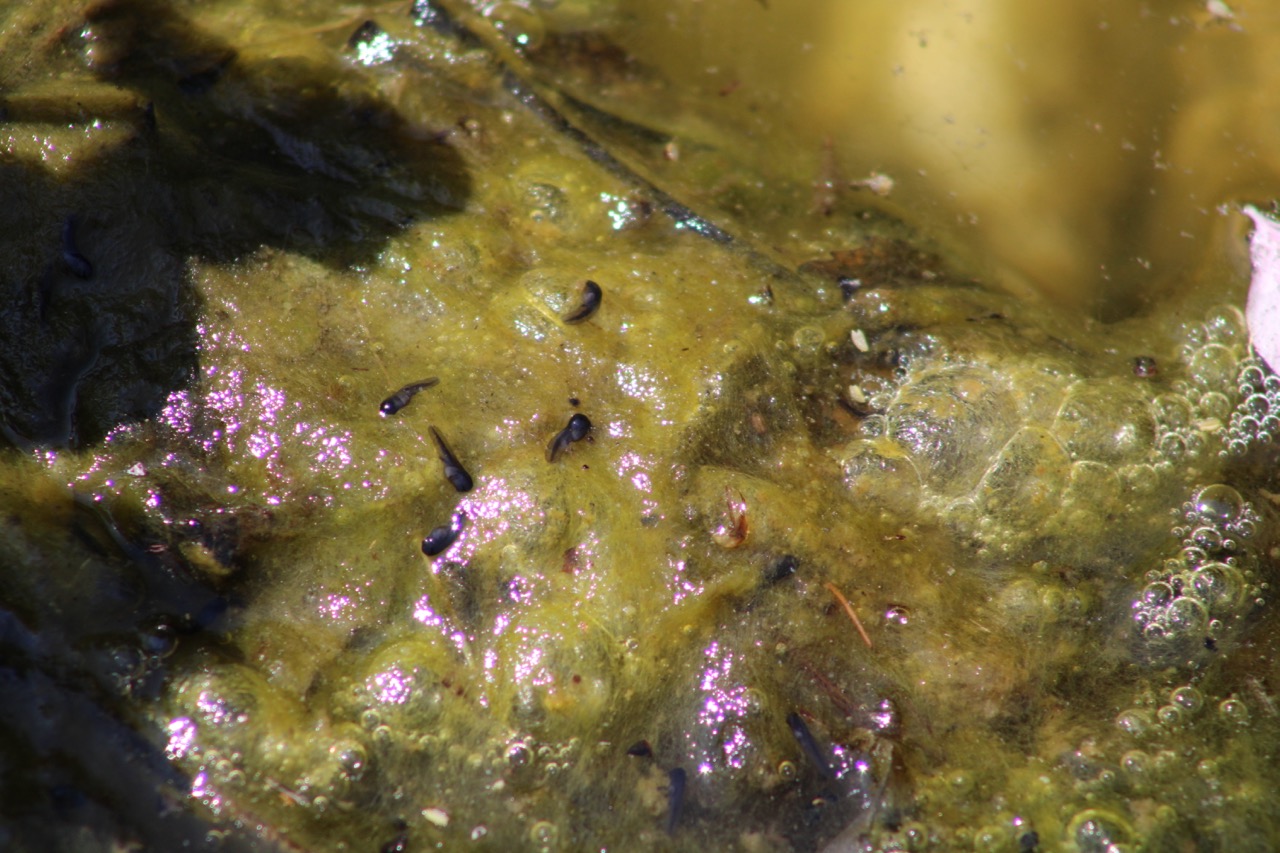
While not as photogenic, I also discovered we have tiny tiny tadpoles in the pond. I was lifting some algae with my net, and uncovered a whole group of them. Here is a close-up, but just imagine them about 1/4 inch from head to tail. Apparently they eat algae, so they must be happy where they are. Hurray! I would guess they are tree frog tadpoles, since the tree frogs have been singing, but I couldn’t find any confirmation of that in online searching–we’ll have to wait until they get a bit bigger.

Tiny black tadpoles in green algae in the pond.
Tiny black tadpoles in algae in the pond.

Finally, I planted some kale and lettuce and broccoli seedlings this morning, after adding more compost to raised bed, then using chopped leaves as a mulch. I put netting over them to deter animal neighbors–it doesn’t keep away cabbage moths, but seems to work for groundhogs and squirrels and such. Plant babies finally in the ground!

Rectangle wooden raised bed with frame and black netting over it, planted with small kale and lettuce.

So Much Beauty

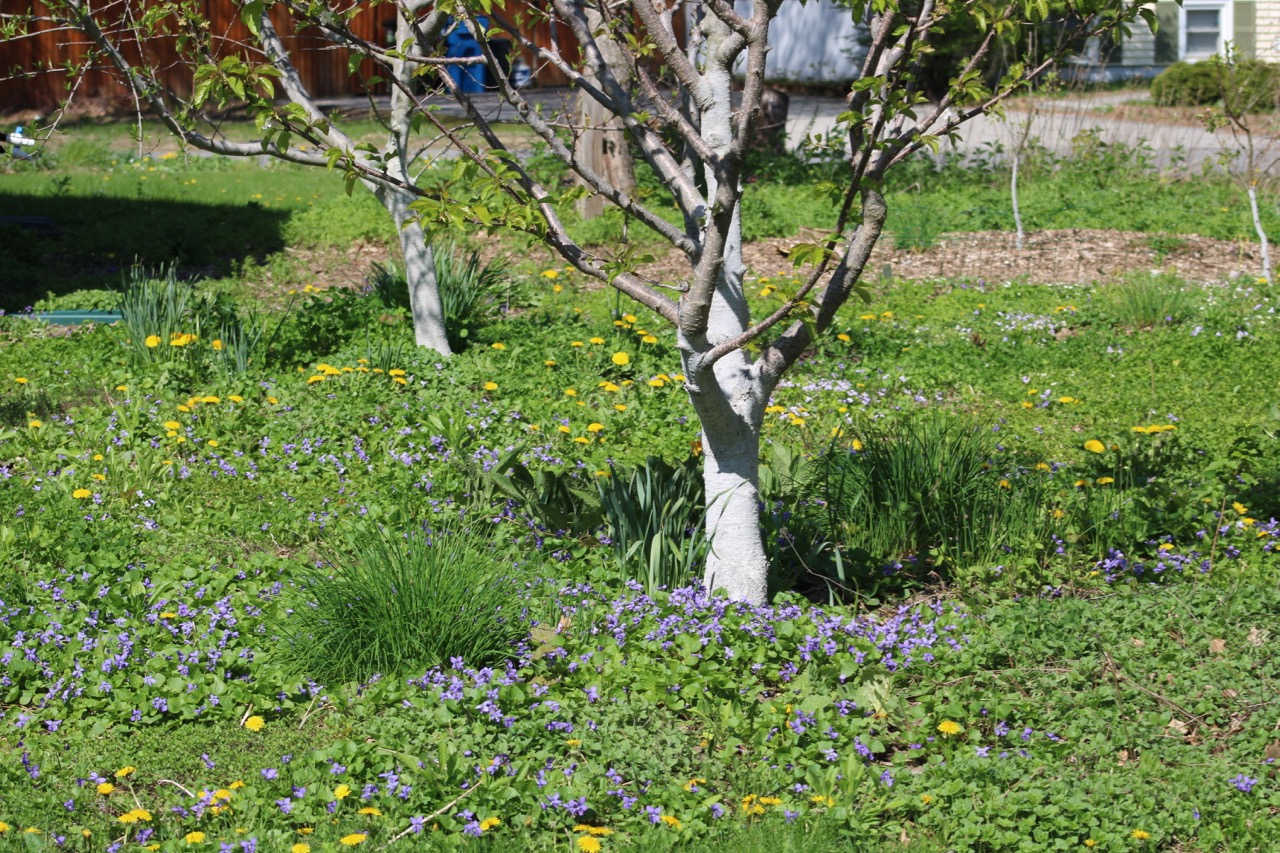
Orchard scene with tree trunks and branches painted white, surrounded by ground cover of violets, dandelions, and chives

I walk through the orchard and marvel at the beauty of violets which have naturalized all over the ground. Dandelions offer a scatter of yellow along with a few daffodils, and clover has spread over the beds and paths in a swath of green. Chives and oregano and thyme are coming up in their clumps. I can’t capture it in a photo, but perhaps the one above hints at how lovely it has grown, mostly all on its own.

The cherry trees actually now have a few blossoms–maybe a dozen new buds have opened after initially all of the buds were empty. Not enough really for a fruit crop, but I wanted to note it. However, our Honeycrisp apple tree is covered with buds, for the first time. Maybe this will be the year of our first apple harvest?

I haven’t tried to do any veggie planting yet. Mostly I just walk around enjoying how the wild flowers shine in the sun. Yesterday I lay in the hammock reading for a while, and we had a lovely visit with a friend by the pond. We haven’t seen any tree frog eggs there, despite the repeated singing in the night. It is all a process of discovery–will they choose our pond or not? Meanwhile, the marsh marigolds have bloomed! My favorite flower colors are yellow, blue, and violet, so right now I am in paradise!

Marsh marigolds have yellow buttercup style flowers on tall stems, with round green leaves. the background is pond water with out of focus reflections of trees.
Marsh marigolds in the pond.

Apple Tree Transplant

Blue Pearmain Apple small tree with wood chips on ground around it, and a garden hose lying nearby.
Blue Pearmain Apple transplanted into new spot

Four years ago I attended an apple grafting workshop, and created four grafted plants to bring home. I planted them in a “nursery” bed in the orchard, a Black Oxford variety in the center to remain there, and the others to later transplant. The root stock was called M111, a semi-dwarf variety. But I wasn’t sure where to put them, so it has taken until now before I transplanted any. Two didn’t survive, but today I move this Blue Pearmain variety about 12 feet over to a new bed.

Both of these are heirloom varieties for New England. According to Fedco, Blue Pearmain is a fall/winter apple, “our favorite for baked apples—it was made to be stuffed. Moderately juicy flesh, firm, dense and slightly crisp, sweet with a bit of a tart background flavor. Incredibly beautiful medium to very large fruit is streaked and splashed with purplish red, mottled with russet and covered with a distinct dusty blue bloom. In a pie, it has just enough firmness and a good balance of sweet and tart with hints of pear. Tart coarse yellow sauce cooks up in a couple minutes. Tasty eaten out of hand. One of New England’s most famous varieties. Mentioned by Henry David Thoreau as a favorite in his wonderful essay “Wild Apples.” Grown throughout much of Maine for well over 200 years. Massive trees still found here and there. Keeps in the root cellar until midwinter. Blooms midseason.”

Black Oxford was created from Hunt Russet x Blue Pearmain, in Paris, Oxford County, Maine, about 1790. A winter apple, “this outstanding apple, a favorite long ago around much of Maine, has made a huge comeback. Medium-sized round fruit, deep purple with a blackish bloom. From a distance you might think you’d discovered a huge plum tree. Excellent pies, superb late cider. Leave the skins on for a delightful pink sauce. Best eating late December to March, but we’ve eaten them in July and they were still quite firm and tasty. They get sweeter and sweeter as the months go by. Good cooking until early summer. Some insect and disease resistance. Unusual light pink blooms early to midseason.”

According to the Holistic Orchard, Black Oxford is “A rare treat reminiscent of an exotic tropical fruit; exceptional sauce apple, stunning drying apple.” It is slow to come into bearing, but resistant to insect problems. It can tend toward biennial bearing. Ripens in late October into November.

Even though they are four years old from grafting, they still seem like baby trees to me. I still need to do some pruning to help them find good shapes. But I am excited that I was able to get the Blue Pearmain to a spot it can remain. This past winter, one of our old ornamental crabapples fell in a storm. The one that is left leans heavily toward the road, and we’re imagining that it might not survive for long either. So this Blue Pearmain is positioned about half way between the Black Oxford and the crabapple. As it gets larger, eventually the crabapple might not be there. But in the meantime, it won’t cast any shade and they should both do fine. I still need to do some weeding and probably use cardboard to keep unwanted plants from growing too close to the tree. It had been on the edge of our friend’s herb bed that she is not using so much anymore.

It feels so good to be outside, to be tending to plants, to be celebrating the spring!

Two small apple trees growing close together with other trees in the background, and light green beginning to cover the ground.
Before: Black Oxford (left) and Blue Pearmain where they were growing close together before I transplanted the Blue Pearmain. There is a Honeycrisp tree exactly behind the Black Oxford, a little bigger.

February Sunlight

Bright sun shining on snow with small dark tree on left side, shadows marking places where tracks were made.
Bright February sun shining on bright snow.

We are halfway to Spring! So many cultures celebrate this day, or this change of season. For just a few examples: Imbolc or Brigid’s Day for Celtic people, Apuknajit (the winter spirit) for Mi’kmaq people, Candlemas in Catholic liturgy, Groundhog Day in secular America. They hearken to the coming Spring, and offer courage for getting through the rest of the winter. Here at our home in Maine, I can feel the change in the quality and angle of the sunlight. My heart is lifted by its brightness.

We’ve recently had a triple set of snowstorms, so the ground is finally covered in snow after nothing much in December. It too adds to the brightness. I love how it also reveals the creatures who live here with us. I’ve seen deer tracks going through the orchard all the way back across the frozen pond and into the hedgerow. You can see their traces in the photo above. I was also delighted to find these distinct squirrel prints after a rain on top of the snow a week ago. Like little hands.

Squirrel prints on snow, on a gray day.
Squirrel prints

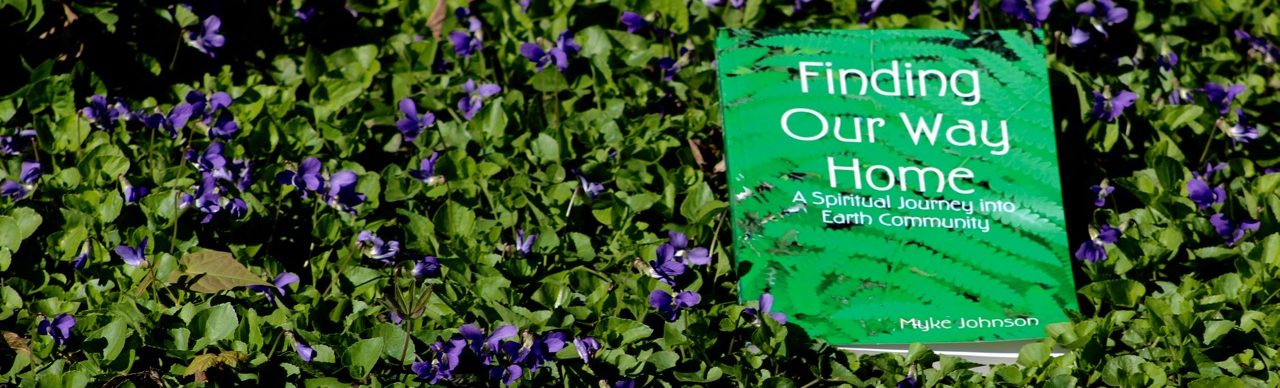
I’ve been continuing my winter project of sorting, organizing and winnowing old papers in the basement. I had started with my years in Boston 1986-1999, then moved backwards in time. I am now finished with the very earliest files-hurray! So then I moved forward from 1999. I’ve begun to sort through papers from my years on Cape Cod, 1999-2005. That has meant that I’ve also started to incorporate the winnowing of digital files on my laptop for the same years. Some of it is plodding work, comparing documents to put duplicates in the trash, renaming documents so they are easier to organize, stuff like that. But some of it includes moments of sweetness, like finding a letter from a young queer person whose life was helped along by a sermon I preached called “Believing in Fairies.” [A version of which found its way into my book, Finding Our Way Home, and was excerpted in the post The Mystery Seed.]

It does my heart good to think of those seeds of blessing planted in the hearts of people I met along the way. Sometimes we hear about it afterwards, and sometimes we may never know. When the interactions were not so blessed–since I had my share of conflict and trouble along the way–it does my heart good to shred the remnants of those interactions, and let go. Lighten the load.

Imbolc is a time for setting intentions, for shaping our hopes for the future. It is kind of like looking through seed catalogues imagining what we will plant when the next season turns. I’m not ready yet for seed catalogues and intentions. But it is good to remember that the sorting and winnowing of my past life will not go on forever. I don’t know what sort of seed I want to plant for the future. That is still a mystery to me. But I am good with a mystery seed.

I saw a funny story on Facebook about a child who thought that bird seed grew birds. They showed their parents the proof–they planted a big pile of bird seed outside, and the following day, there was a whole flock of birds gathered round the spot. Maybe that is what I will plant today–filling the bird feeder with seed so that they will have nourishment for the deep freeze we are expecting in a couple days. I understand that Mi’kmaq people put out food for Apuknajit so that the winter spirit will be remembered and be kind. Maybe that is part of feeding the birds too–to remember our fellow creatures during these cold winter times, so that all of us might make it through to the spring.

Small brown bird perched on a stick on green bird feeder, with snow on top of it.
Bird on feeder today.

Tiny Magical Moments

Dandelions with puffy seed heads, after the birds were gone

Sometimes the best pictures are only in the mind, never caught on a camera. I was sitting with Billie in my blue easy chair in the bedroom, and something caught my eye outside the window. It was a goldfinch couple, perching in the peach tree, and then hopping down to the plants beneath. The bright yellow male landed on a dandelion stem–it was a long stem with the flower already gone to seed in a fluffy sphere. The olive green female was perched nearby on another long stem, with a closed flower head above her.

The male carefully made his way up the stem, even as it was bending down under his weight. He made a few tries on different stems. Finally, he succeeded in reaching the fluffy sphere and began pecking at the seeds. I never knew that dandelion seeds were a source of food for goldfinches. I’m glad that I didn’t cut them down! A short while later, they had gone, but I took this photo of the place where they had been. Even though you can’t see them there, in my mind, I can’t forget his purposeful climb along the stem.

Later, I went to sit by the pond, and noticed something tiny and new and green. Several of the perennial pond plants that I planted last year haven’t come back at all. Cardinal flower, blue-eyed grass, arrowhead, and pickerel rush. They were supposed to survive Maine winters so it was a great disappointment, but I kept waiting and watching, since this is the first spring for the pond. Well, today, I found three new tiny stems with distinctive leaves. There are three new arrowhead plants coming up. They are near where the previous plants were, but don’t seem to be emerging from the roots. Maybe they are sprouting from seeds that fell into the water last fall?

You never know when something new might emerge from the hard work that you did before.

New arrowhead shoot with one leaf, enlarged photo