Listening for Spirit

Dawn colors and clouds, pink and blue over trees and shadow of a house

Our house isn’t best situated for seeing the beauty of sunrise or sunset. Too many trees and buildings. But the other morning, when I opened the blinds in my room, I saw this outside my window. Dawn magic.

Yesterday I was so sleepy and almost napping on the couch when I happened upon a documentary on PBS about Howard Thurman, Backs Against the Wall. I knew of Dr. Thurman but I don’t remember if I knew so much about him as was shared in this film. African American theologian, author, and teacher, he was deeply spiritual, became dedicated to nonviolent activism, and was the mentor to Dr. Martin Luther King, Jr. and other civil rights leaders. The film stirred something in my soul.

First of all, I found myself feeling a bit of envy–my old sin. I always wanted to “be somebody.” You know, one of those people you heard about, a saint, a well-loved thinker and author, an influential leader, recognized by the world. And I wasn’t that, except, to be fair, in the most local context. I was, for a while, a local spiritual leader. I saw something in Dr. Thurman that reminded me of myself, except writ large.

Most importantly, he reminded me of my own mysticism, my own deep connection to spirit. And I asked myself, am I listening to the voice of the spirit within me, am I paying attention to what the spirit is telling me right now, in this time? The truth is, illness dampens the energy of the body, but it also dampens the energy of the soul. It has been harder to hear the voice of spirit since my retirement due to chronic illness. I remember at first, spirit said, Rest and Joy, let that be your guide. And I did rest, and chose activities that linked to joy in me.

But I still wrestle with questions all the time. What is this chapter of my life all about? What can I do in the face of the brokenness of our world, in the face of war and oppression? If I can’t resist by marching in the streets, how can I resist such evils as the genocide in Gaza, the rising hatred toward immigrants in our own country, the demonization of trans and queer people by those coming into power?

At different times in my life, I was guided by an evolving sense of purpose. When I was in college, my friends and I would ask, “How would Jesus live in our times?” A few years later, I found the Catholic Worker movement, and to live and serve in houses of hospitality for people without homes–that felt like the embodiment of that purpose. When I woke up to the oppression of women in the church and in society, when I began to form community with other women waking up, I voiced this desire, this intention: “We mean to incarnate the goddess!” When I came out as a lesbian, I felt a deep sense of purpose in loving and affirming all of our beauty as women, as lesbians, to find the goddess in ourselves and each other.

There was always this pattern for me, listening and following the spirit as I was led into new understandings and new ways of living a purpose in the world. Following the distant voice of my ancestors into solidarity work with Indigenous peoples. Finding a home in Unitarian Universalist ministry, and serving in congregations as I was called, bringing together wider understandings of spirituality, and commitment to the work of justice activism in community. Coming to a deeper understanding of interconnection with all of life, and permaculture gardening, and a spiritual journey into earth community.

I see how lucky I have been, to be able to follow an inner stirring, to live and work from a sense of calling and purpose. Whether known or unknown. But I am still wrestling with questions now. What is my calling now? Can I hear the voice of spirit to guide me now? Here is something Dr. Thurman wrote about all this:

“How good it is to center down!
To sit quietly and see one’s self pass by!
The streets of our minds seethe with endless traffic;
Our spirits resound with clashings, with noisy silences,
While something deep within hungers and thirsts for the still
moment and the resting lull.…
The questions persist: what are we doing with our lives?—
what are the motives that order our days?
What is the end of our doings? Where are we trying to go?…
Over and over the questions beat in upon the waiting moment.
As we listen, floating up through all the jangling echoes
of our turbulence, there is a sound of another kind—
A deeper note which only the stillness of the heart
makes clear.
It moves directly to the core of our being. Our questions are
answered,
Our spirits refreshed, and we move back into the traffic of
our daily round
With the peace of the Eternal in our step.
How good it is to center down!”

I guess that is what I am trying to do, even now, to center down, to hear the deeper note. To let the questions come into that stillness. Even when it feels empty and dark, before the dawn has come.
What Unitarian Universalists Believe

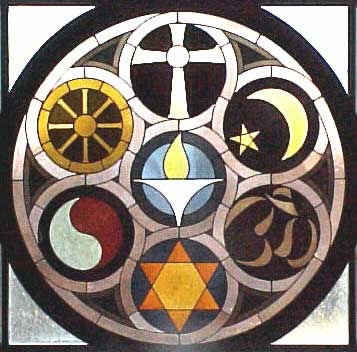
UU Chalice InterfaithI have found spiritual companions in Unitarian Universalism. Its  congregations now include people of many different spiritual beliefs: Christians, Jews, Buddhists, Muslims, atheists, pagans. We include people who believe in a personal kind of God, and those who believe in a divine force of connectedness between everything that exists. We include people who love the Goddess, and people who do not imagine any God at all. Sometimes people say that in Unitarian Universalism you can believe whatever you want—but that is not really true. Though we have many more diverse beliefs today as Unitarian Universalists, you could say we are still arguing with Calvin.

We don’t believe in a God of anger. We don’t believe that people are born evil. We don’t believe that our bodies are shameful. We don’t believe that someone had to die to appease an angry God. We don’t believe that God loves some people and sends other people to hell. We want to get rid of that guilt and shame producing kind of religion, that heavy burden people still carry around because Calvinism is so ingrained in our culture.

We do believe that Love is at the center of the Universe, and those of us who believe in a God, believe in a God of Love. We do believe that each person is important and lovable and that we are all part of one family. We do believe that we are called to live a life of service and compassion, and that human beings, however imperfect we may be, can make a choice to follow our values.

We believe in a democracy of spirit—that each person has a share of wisdom and truth and love. We believe in the importance of community—that we learn and grow most by sharing with each other. We believe that love is contagious, that we cannot find fulfillment and purpose without knowing that we are loved, and loving others. We believe that love can transform lives.

To believe in Love as the foundation of the universe is an act of faith. There is no proof, we don’t know in some objective way that love will win out over the forces of hate and greed. We have to make an experiment of it—perhaps that is why the Quakers could sing “Love is Lord of Heaven and Earth” with such conviction. They practiced nonviolent love in their doings with other people, and learned something of its strength. And perhaps we too have experienced something of its power in our times—those moments when gentleness transformed a heated situation, those historic movements when love crumbled oppression and brought justice into society.

To believe in Love, to make this act of faith, is to strengthen Love’s power in our world, to make it more likely that our relationships will be mutual and kind, that our society will bend toward fairness and compassion. May it be so.

Humility and Confidence

What do we do with people’s different understandings about God and the religious battles that go along with it? I believe we must begin by affirming that difference is real. People—in the same town and all over the world—think differently about the idea of God and have different experiences of God. That is real, and we can choose to fear it, or we can choose to welcome it, explore it, and even celebrate it.

But what does that do to our ideas about truth and reality? We might ask, for example, “Can God both exist and not exist at the same time?” That isn’t logical. But the truth is: both kinds of human experience exist! There are humans who experience or affirm God and there are humans who do not experience or affirm God. There are humans who experience or affirm certain images and ideas of God, and reject other images and ideas of God. We must take into account that all of our understanding about God comes through our human experience.

When my images and ideas about God began to change, something opened up before me. I embarked on a journey that demanded a deeper humility and a deeper confidence. I needed humility to recognize the incompleteness of my spiritual experience and the validity of truth beyond my understanding. I also needed to have confidence to claim my own experience as valid, whether or not others agreed with me.

I believe that each person’s experience is valid, at least in part, and the fullest truth is that which is weighed in community with the experience of others. This is one reason why I later chose to find a home within a Unitarian Universalist spiritual community that welcomes diverse beliefs. There is a Hebrew proverb: “Hospitality to strangers is greater than reverence for the name of God.” To live within a diverse spiritual community, we must cling more strongly to an open heart, than to specifics images and beliefs about God.

Heart StoneWhat this means for me is that the real God might be everywhere—hidden within each person, in each plant or animal, in each sunrise or stormy day, in the ordinary and the spectacular alike. Or God might be no where at all. It means that revelation is continuous and always unfolding. It means that words and images like God or Spirit or Mystery are metaphors trying to describe what is indescribable. The Sufi poet Rumi said,

“Just remember: it’s like saying of the king, he is not a weaver… words are on that level of God-knowing.”

My colleague the Rev. Forrest Church has said:

“The power which I cannot explain or know or name I call God. God is not God’s name. God is my name for the mystery that looms within and arches beyond the limits of my being. Life force, spirit of life, ground of being, these too are names for the unnamable which I am now content to call my God.”

Quote from The Soul of Rumi: A New Collection of Ecstatic Poems, translated by Coleman Barks, p. 77.