Tiny and partial

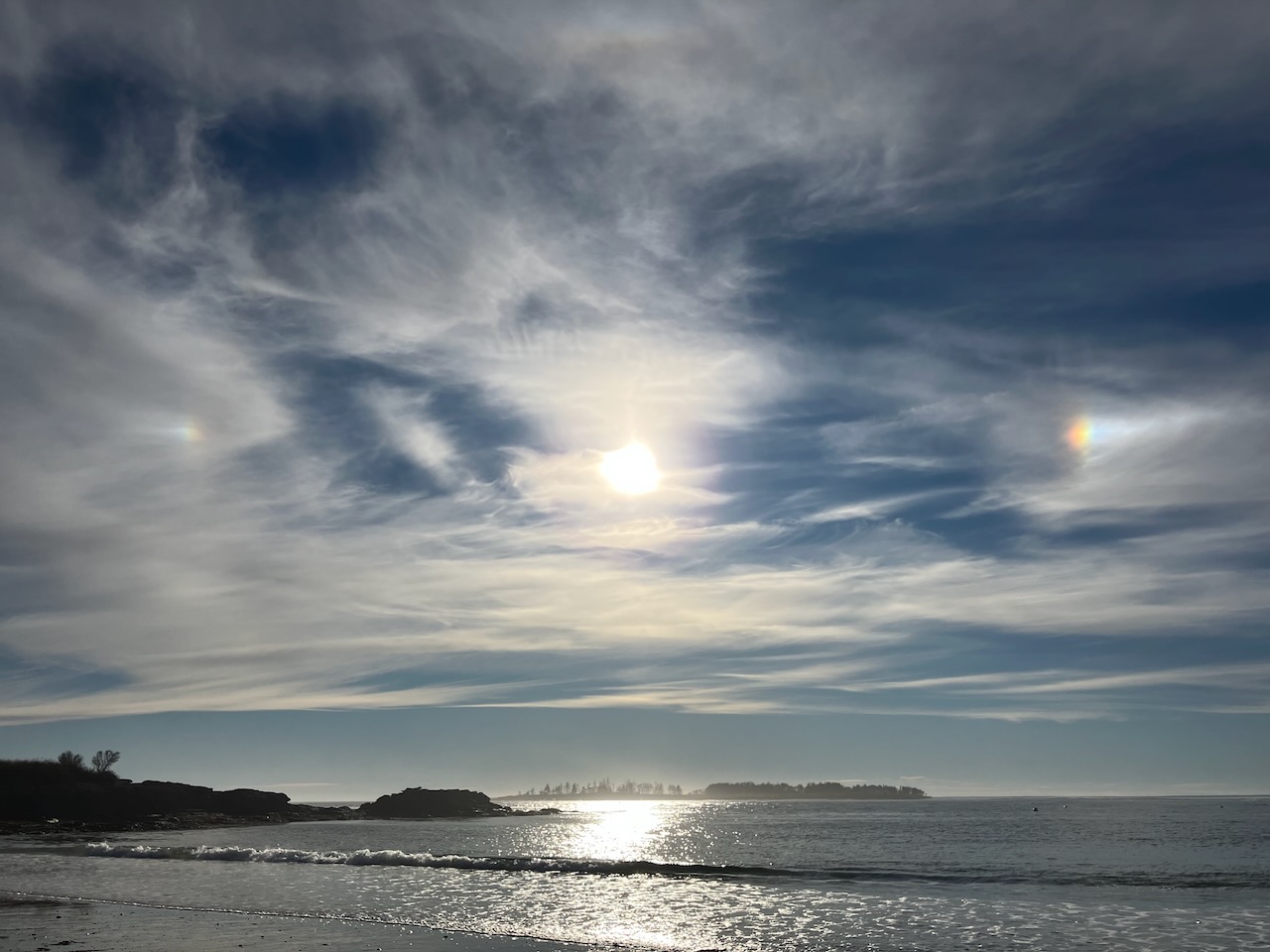
On the last day of 2024, Margy and I went to Kettle Cove beach. I saw this tiny partial sunbow in the sky, bursts of color hanging on either side of a bright sun. Tiny and partial are the words for today. There is so much suffering in the world, so much violence and evil. I can’t stop the devastation of Gaza, or the cruelty of the Israeli army continuing to kill scores of people even after a ceasefire has just been signed, to take affect on Sunday. Why not stop the killing today? All I can do is bear witness, share posts on Facebook. Tiny and partial.

What can we do to bring good to the world? I think about my visit to my friend at the nursing home yesterday. He was happy to see me–I went to wish him happy birthday and we had a good visit. But immediately afterward I felt a sense of guilt that I can’t visit more often than every months or so. What I can offer him is tiny and partial. But perhaps it is important, especially in the face of large and unrelenting troubles, to honor the tiny and partial acts of goodness we do? And what can he offer now, my old friend, after years of activism and kindness? Perhaps merely to receive with cheerfulness the help he now needs. We each bring goodness in the tiny and partial ways that we are able.

Each morning I take a walk. I have been able to take a little walk most days, after a message a year ago that “walking will be needed.” I have been able, ever so slowly, to increase my walk to about 20 minutes, no longer going directly to the brook and back, but making a little circle around the neighborhood, on my way there. It feeds my spirit, and reminds me to be in love with the earth, the sun, the water, the place where I live. It is a tiny walk as walks go, but by tiny increments, a little more.

Before I walk, I empty and refill the water that we have in a heated tray for the birds. Perhaps that is my tiny gift to the creatures who live here with us on this land. It feels like a prayer each morning. It reminds me of the importance of giving what we are able to this wider community of life. The other day I saw the crows laughing and jostling each other as they perched on the edge and dipped their beaks in.

We are living in very troubled times. Some will be called to wise analysis, and great acts of heroism, and energetically building the systems that honor our deepest values. But all of us, no matter how tiny, must still cling to kindness, cling to our interconnected earth community, and give what we can, no matter how partial. And I hope I remember to celebrate the brightness of the colors revealed in those gifts.

Be like the crows

Crow on the top of bare branches of a tree against a blue sky
[A crow is perched high in the bare branches of a tree outside my house. This photo is not from yesterday, but reminds me of the crow I saw yesterday in a similar perch.]

After blogging yesterday morning about Listening for Spirit, I bundled up in warm clothes to take a walk in the cold. As I stepped off the back porch, I heard the raucous calling of crows, and looked up to see a crow high in the branches of a tree. Then I saw two others, all of them agitated and calling. They flew over our back yard and kept calling and scolding.

I walked down the driveway, turned right onto the street, went past our neighbor’s house and then around the corner, on my usual route for a morning walk. I could still hear those crows! Then I saw the cause for the crows’ alarm–it looked like a huge hawk up in a tree near another neighbor’s house. I could see the white feathers of its belly as it perched and I crossed the street to confirm its identity. Then it suddenly flew off, obviously bothered by the relentless scolding of the crows. They didn’t stop, but kept after it until it was gone.

Then Spirit said, so clearly, “Be like the crows! Keep calling out to alert everyone to the presence of a huge predator! Keep calling out together.”

I was reminded of the line in a song that I have been singing and translating. “Even as the hour grows bleaker, be the singer and the speaker.” [from The Lost Words Blessing] In Passamaquoddy, verbs are more fundamental than nouns, so the end of that line became, “…ahtolint on ktahtolewestun” “…keep singing and keep speaking.”

I have watched people talking about facing encroaching fascism by deleting their public presence on social media, by using encrypted forms of communication like Signal, by using extreme caution about what is said and what is shared. And there are situations that definitely warrant those precautions. Definitely. But I believe that there are also reasons to keep speaking and keep sharing. Keep naming our values, keep claiming our experiences, keep identifying what we witness.

If we are called to that. And not alone, but in groups, even groups of three. Three crows can annoy a hawk enough to make it leave. I felt the presence of Spirit so strongly in those crows that it gave me courage to say, I can do that. I can keep speaking here, as long as I can.

Listening for Spirit

Dawn colors and clouds, pink and blue over trees and shadow of a house

Our house isn’t best situated for seeing the beauty of sunrise or sunset. Too many trees and buildings. But the other morning, when I opened the blinds in my room, I saw this outside my window. Dawn magic.

Yesterday I was so sleepy and almost napping on the couch when I happened upon a documentary on PBS about Howard Thurman, Backs Against the Wall. I knew of Dr. Thurman but I don’t remember if I knew so much about him as was shared in this film. African American theologian, author, and teacher, he was deeply spiritual, became dedicated to nonviolent activism, and was the mentor to Dr. Martin Luther King, Jr. and other civil rights leaders. The film stirred something in my soul.

First of all, I found myself feeling a bit of envy–my old sin. I always wanted to “be somebody.” You know, one of those people you heard about, a saint, a well-loved thinker and author, an influential leader, recognized by the world. And I wasn’t that, except, to be fair, in the most local context. I was, for a while, a local spiritual leader. I saw something in Dr. Thurman that reminded me of myself, except writ large.

Most importantly, he reminded me of my own mysticism, my own deep connection to spirit. And I asked myself, am I listening to the voice of the spirit within me, am I paying attention to what the spirit is telling me right now, in this time? The truth is, illness dampens the energy of the body, but it also dampens the energy of the soul. It has been harder to hear the voice of spirit since my retirement due to chronic illness. I remember at first, spirit said, Rest and Joy, let that be your guide. And I did rest, and chose activities that linked to joy in me.

But I still wrestle with questions all the time. What is this chapter of my life all about? What can I do in the face of the brokenness of our world, in the face of war and oppression? If I can’t resist by marching in the streets, how can I resist such evils as the genocide in Gaza, the rising hatred toward immigrants in our own country, the demonization of trans and queer people by those coming into power?

At different times in my life, I was guided by an evolving sense of purpose. When I was in college, my friends and I would ask, “How would Jesus live in our times?” A few years later, I found the Catholic Worker movement, and to live and serve in houses of hospitality for people without homes–that felt like the embodiment of that purpose. When I woke up to the oppression of women in the church and in society, when I began to form community with other women waking up, I voiced this desire, this intention: “We mean to incarnate the goddess!” When I came out as a lesbian, I felt a deep sense of purpose in loving and affirming all of our beauty as women, as lesbians, to find the goddess in ourselves and each other.

There was always this pattern for me, listening and following the spirit as I was led into new understandings and new ways of living a purpose in the world. Following the distant voice of my ancestors into solidarity work with Indigenous peoples. Finding a home in Unitarian Universalist ministry, and serving in congregations as I was called, bringing together wider understandings of spirituality, and commitment to the work of justice activism in community. Coming to a deeper understanding of interconnection with all of life, and permaculture gardening, and a spiritual journey into earth community.

I see how lucky I have been, to be able to follow an inner stirring, to live and work from a sense of calling and purpose. Whether known or unknown. But I am still wrestling with questions now. What is my calling now? Can I hear the voice of spirit to guide me now? Here is something Dr. Thurman wrote about all this:

“How good it is to center down!
To sit quietly and see one’s self pass by!
The streets of our minds seethe with endless traffic;
Our spirits resound with clashings, with noisy silences,
While something deep within hungers and thirsts for the still
moment and the resting lull.…
The questions persist: what are we doing with our lives?—
what are the motives that order our days?
What is the end of our doings? Where are we trying to go?…
Over and over the questions beat in upon the waiting moment.
As we listen, floating up through all the jangling echoes
of our turbulence, there is a sound of another kind—
A deeper note which only the stillness of the heart
makes clear.
It moves directly to the core of our being. Our questions are
answered,
Our spirits refreshed, and we move back into the traffic of
our daily round
With the peace of the Eternal in our step.
How good it is to center down!”

I guess that is what I am trying to do, even now, to center down, to hear the deeper note. To let the questions come into that stillness. Even when it feels empty and dark, before the dawn has come.

Sustenance

Today I saw this gray goldfinch on a gray seed-head of evening primrose! Both the bird and the flower have let go of their bright yellow plumage as we enter the dark season. But still so beautiful in their subdued and subtle way. We haven’t cut down the “dead” plants because they are still such a source of sustenance and life to our little friends.

It is these small beauties that are sustaining me during these anxious days in the United States election season. It is terrifying to me that there is a close race between a mentally-unstable fascist who spreads hate wherever he goes, and a very qualified woman with whom I disagree on certain policies, but who will be president of all the people, and uphold the basic principles of democracy. My partner and I dropped off our absentee ballots last Monday, and gave Kamala Harris our votes.

It breaks my heart that some people I love seem to have been taken in by the lies of the MAGA propaganda machine. I don’t know how to ease that pain, except to pray that the fascists don’t win.

I haven’t forgotten the genocide that is being perpetrated by the Israeli government in Gaza, and expanding to Lebanon. I will continue to protest that killing in whatever ways that I can, small though they may be, every day. I have heard that some folks say they can’t vote for Harris because of her association with the Biden administration’s participation in the genocide. I don’t know what might happen under a Harris administration. But I know that the other side will be much worse, and would accelerate the destruction.

For me, voting is strategic. I have protested in some way every administration of our country–but there are better and worse administrations. For all of my adult life, I have been part of the movements to expand equality and democracy–to women, to people of color, to queer folks, to disabled people. I have protested the wars of empire and supported the raising of our awareness of the interconnected web of life, and the challenges of climate destruction. We keep pushing toward the hopes, and resisting those who would take all of that away in favor of hierarchical despotism.

In this season when the veil between the worlds of the dead and the living is thin, I think of my uncle Jim, who fought fascists in World War Two, and then grew marvelous gardens when I knew him. I think of my uncle Richard, whom I never knew because he died in that fight. May their spirits help us now. May all the spirits who cherish peace and liberation help us now.

Peach Cobbler

This year, our peaches were extra fragile as they ripened, so we picked them and cut them up and froze them before they could go bad. The upside to this turn of events is that I discovered the joy of peach cobbler. I created/adapted a gluten-free recipe that we love. It also works for raspberries. I’ve turned into an obsessive cobbler baker for the cool fall days.

Gluten-Free Peach Cobbler

Preheat over to 375 degrees. Grease a 9 x 9 glass pan. Fill it about half full with frozen cut peaches, and sprinkle liberally with cinnamon.

Mix together 1 cup oat flour (made by blending gluten-free rolled oats), 1 cup almond flour, 2 teaspoons baking powder, and 1/2 teaspoon salt. Set aside.

Mix together 1 egg, 1/2 cup yogurt (we use whole milk organic greek yogurt), 1 teaspoon vanilla extract, 1 tablespoon honey, and 2 tablespoons soft butter. Beat together with a fork, and then add to dry ingredients, scraping the sides with a spatula to get it all. Mix together.

Then use the spatula to put the dough in clumps on top of the peaches, and gently spread out over the top of the peaches. Bake at 375 for 30-35 minutes. The cobbler should be golden brown, and the peaches bubbling; add some more minutes if it’s not quite brown enough. I’m not an expert, but as far as I can figure, with 9 servings, each serving has about 7 grams of protein and 14 grams of carbs.

I find that it actually tastes better after cooling off, because the juice from the peaches is absorbed into the cobbler. [If I make it with raspberries, I add 1/8 cup sugar to the raspberries to make them a little less tart.] It also tastes great with Greek yogurt on top, or ice cream.

The Lost Words

I haven’t had many words this autumn. Now, here we are in mid October. Leaves changing color, lovely cool days and cooler nights.

On the autumn equinox, we had a ritual with a few friends around our fire outside. I had gathered some acorns and we passed around a basket of them and each took out one acorn to express our thanks for some aspect of our lives, and then one for a wish or intention that we wanted for the next darker season. My intention was to bring back more music into my life. For whatever reason, I hadn’t been singing or playing my guitar for ages–I mean, years. So I put on new strings, and tuned the guitar, and then started singing a song here and there.

I found this hauntingly lovely song, Lost Words Blessing, originally shared by a colleague in a worship ritual. The song was inspired by a book The Lost Words created by by Robert Macfarlane and Jackie Morris. “The book began as a response to the removal of everyday nature words – among them “acorn”, “bluebell”, “kingfisher” and “wren” – from a widely used children’s dictionary, because those words were not being used enough by children to merit inclusion. But The Lost Words then grew to become a much broader protest at the loss of the natural world around us, as well as a celebration of the creatures and plants with which we share our lives, in all their wonderful, characterful glory.” [You can find out more about it on their website, and order books and albums there as well.]

One of my favorite things to do with songs is to figure out how I can sing and play them, and so I did with this one. And then, I found myself thinking about Passamaquoddy/Wolastoqey words, and how the language is in a fragile place, with original speakers growing older, and newer speakers trying to find their way into the language after long years thinking in English. How many of those words have been lost, or almost lost?

It has been a powerful gift for me to be learning the language with Roger Paul, via the University of Southern Maine during the last six years. Roger told us that the elders had given permission to share the language with outsiders, so that others might wake up to the world view hidden within. But I am always conscious that the language is filled with triggers of pain for all that was lost and taken by the violence of colonization.

There was something about the language that resonated for me with the song “The Lost Words Blessing.” So I decided to try to translate the song into Passamaquoddy–which I quickly found out isn’t really possible. It isn’t possible in part because the structure of English poetry is based on filling the lines with many words to evoke an experience, while the structure of Passamaquoddy, as well as I can understand it, is to use words that themselves are full of descriptive action. I learned a lot about how different the two languages are, by trying to create a version of the song in Passamaquoddy.

Still, I kept at it, not “translating” but pulling out words and sentences that created a similar experience in me, and also fit the phrasing of the music. While I am only an intermediate learner, I have learned how to research using the pmportal.org, to try to identify patterns and options and vocabulary. I couldn’t do it without that aid, and likely I made mistakes. I still don’t know if or when it might be respectful for me to sing this song. Can I, as a white woman, bring the language into this particular experience? When might it be appropriate to enter deeply into the language such that I can create a song with it? But to learn the language is, in a way, to fall in love with it. I want to honor Roger’s teaching by speaking as well as I can. Whether I ever sing the song for anyone but myself, I have learned so much by trying to create it.

Here is a sample, the first verse, with the original English, the Passamaquoddy, and then a more literal rendering of the Passamaquoddy into English. [Note: edited Dec 2024 with updated draft]

  • Enter the wild with care, my love
  • Kuli-nutahan elomahkiwik
  • In a good way, go out to the wilderness
  • And speak the things you see
  • on ktitomon keq nemihtuwon
  • and say what you see
  • Let new names take and root and thrive and grow
  • Piliwihtomun on kminuwiwihtomon
  • Name it/them newly and name it/them repeatedly
  • And even as you travel far from heather, crag and river  
  • Peci-te pihcehkomon nit sip weceyawiyin
  • Even when you go far from the river where you are from
  • May you like the little fisher, set the stream alight with glitter
  • Ansa pokomkehsis sipuhsis seskahtuweht
  • Like the little fisher make the stream sparkle brightly
  • May you enter now as otter without falter into water
  • Ansa kiwonik cupotomhat, kini-cupotomha
  • Like the otter slides into water, boldly slide into water

Sunflowers & Pond Lilies

This is the view outside our back windows. We didn’t plant these sunflowers, they came up on their own, with help from squirrels and the bird feeder. These are the ones that goldfinches and bees love so much. Even a photo can’t capture the brightness of the flowers. They glow! They make me so happy each time I see them. I also always think of a dear friend who loves sunflowers, and that makes me happy too.

Another source of joy are the pond lilies, that have also multiplied. In other years, we’ve had many one bloom the whole summer, or maybe one bloom at a time. So in the morning, I see these sunflowers out my window. Then I take a little walk back to the pond, and see the blooms, and the little frogs. I hope they will bring a smile to you as well.

Food for Wildlife

Three goldfinches were perched on this volunteer sunflower!

We haven’t been that successful in growing food for ourselves in the garden. (Yes, the experiment with the kale worked well. And we harvested blueberries and raspberries.) But right now the peaches are getting mold on them just as they ripen. Another fungal issue. I’ve started harvesting some that are not yet quite ripe, and just cutting them up to put in the freezer. But in the meantime, the squirrels and a groundhog are happily coming to the tree each morning to eat a peach. The squirrel climbs up the branches to pick her own, but the groundhog takes one that has dropped off.

The squirrels are always fairly bold, but the groundhog is shy and runs away as soon as she sees us on the back porch. So this photo was from a back window.

The more I try to garden, the more I realize what I don’t know. But it makes me happy that critters feel at home with us here. Unfortunately, the groundhog has dug a few holes to get under our garage–we don’t want her to feel that at home, such that she undermines the foundation. So I refill the holes any time I see them, and then pour some human urine on the area, hoping it will discourage her from more digging. Marking our territory, so to speak. We’ll see if that keeps working.

Meanwhile, the birds are relishing the volunteer sunflowers and evening primroses that are blooming and going to seed in lots of places. Also the elderberry bush. They seem to like everything about our yard. That makes me really happy.

Three new little frogs

We’ve had a string of very hot weather and then lots of rain, and I hadn’t seen our three bullfrogs in the pond for a while. I wondered what that might indicate? Today, I went out and a pond lily was blooming, and there were three new tiny green frogs sitting on lily pads. Who knows where they came from?

I woke this morning feeling heavy and sad with all the problems in the world, with isolation, with a lack of direction or purpose. So I brought myself outside and this little surprise happened and it lifted my spirits. I am grateful for that.

What the garden does with us

Monarch caterpillar on milkweed

While on my morning walk, I suddenly saw a monarch caterpillar on a milkweed that had planted itself in our roadside strip. The next day (today), I saw three more. All we did with the milkweed was let it keep growing where it showed up on its own. There are two plants by the road, and three or four more in a patch out back near the pond. But the monarchs found them all the same.

I have been feeling discouraged lately about my ability to garden. First of all there is the challenge of chronic fatigue that limits my energy such that even one small project outside in the morning can wipe me out for the rest of the day. But then there is the limitation of my own knowledge about the green growing beings. Right now, it is the cherry trees that are struggling with some disease. I am thankful to Aaron Parker of Edgewood Nursery who suggested, after seeing photos, that they are most likely dealing with Cherry Leaf Spot.

The possible answer is to clean up all the infected leaves on the ground and on the tree, and use an organic probiotic “Monterey complete disease control.” But even so, it might not work. Another website suggests natural remedies such as neem oil, potassium bicarbonate, and copper fungicides, which can be used to manage fungal infections like leaf spot. This season, I hadn’t done any holistic sprays because the sprayer takes a lot of personal energy to use. So I feel sad about the cherry trees, and even though I ordered some of the Monterey remedy, I feel discouraged about how much more work I’ve made for myself. Will it even help?

But in the midst of this discouragement, the caterpillars showed up on their own. And meanwhile, a turkey mom and her three babies have wandered through the yard a few times. Here we see them scooting under our canopy where we sit outside in some shade.

Meanwhile, the front raised bed that we didn’t plant decided to grow evening primrose on its own, and today I saw a gold finch happily checking out the yellow flowers. He was too quick to get into the photo. So I guess as a wildlife habitat, we are doing okay!

Then I saw this quote on Facebook this morning, posted by a colleague, and it was a good reminder that it isn’t really about how well we can garden. Something more magical is going on, and I must remember that.

“There was one thing I suddenly knew with absolute certainty: magic is not just something you do or make, it is something the universe does with you. It is our relationship to the Divine. There is nothing more magical than the presence of the sacred in one’s life. It changes everything. … It isn’t something one does to the universe; it’s what a living universe does with us once we have awakened to its Divinity.” Phyllis Curott in Book of Shadows

And maybe, it’s what the garden does with us once we have awakened to its Divinity.