Celebrating Ministry

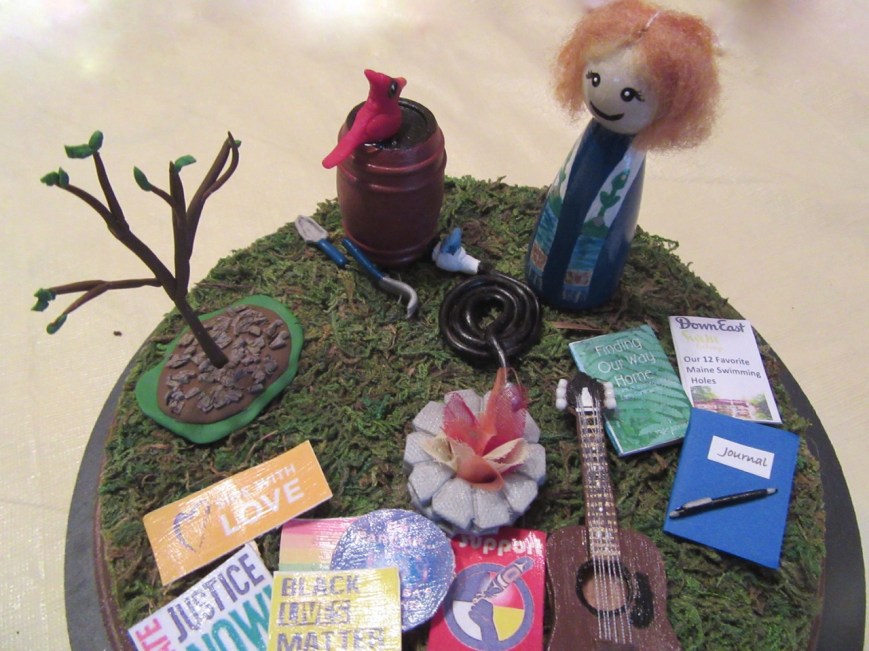
Diarama of Myke – Version 2

On Sunday, June 17, my congregation celebrated my ministry of thirteen years, upon the occasion of my retirement.  (I will still be working behind the scenes in June and on-call through July, but that was my last Sunday service.)  I was overwhelmed with their expressions of love and appreciation.  I will miss everyone so much.

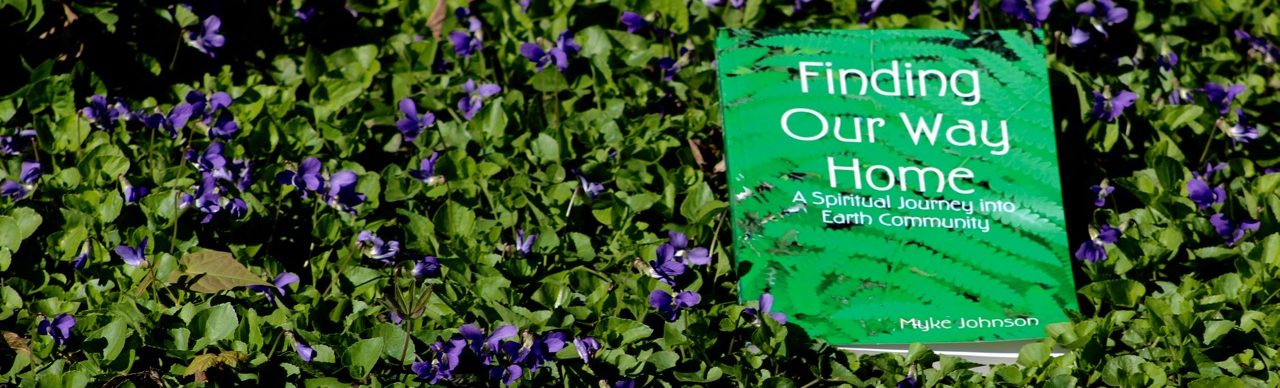
There were so many amazing touches to the celebration, including this tiny (6 inches across) diorama of my life created by Kathy N. with details including my guitar, a stole I wear when I preach, tiny protest signs, the cover of my actual book, our fire circle, cherry tree, rain barrel and garden tools.  The celebration included a reflection from me and testimonials from a few church members, and a poem and a funny song created for me, and more.  There was a gorgeous rendition of Jeremy Geffen’s song “Mystery,” done by the choir and instrumentalists, along with other beautiful music.  They also honored me with the designation of Minister Emerita, and gave me beautiful gifts.  There was a photo slideshow of moments from my ministry.  We danced around the dawn redwood tree.  And ate delicious food, and I received so many hugs, including from the children.

The ministry relationship is so very deep in a particular way.  Not the same as friendship, but filled with intimacy.  During conversations with people during the meal, I kept remembering the significant moments I had shared with them. I remembered their loved ones who had died during my ministry.  I remembered the joyful weddings, and the painful separations.  I remembered our work together in the community that I helped to hold and cherish.  I felt the blessing of our relationships.

In retirement, I am leaving those relationships behind.  That will be the hardest part.  I am relieved to let go of the work.  My body just can’t do it any longer.  This year has been hard with many auto-immune flare-ups, days of exhaustion, and just barely keeping up with everything.  I am ready to lay that down.  But I will miss the people.  Not that I will never see them again.  I will be in the same city, and our paths will likely cross occasionally.  But in our tradition, the retiring minister disappears for a while, to give people a chance to form a ministry relationship with someone new.  The Interim Minister has already been chosen, and will arrive August 1st.

Meanwhile, I am cleaning out my office, and saying goodbye to staff members, and taking care of transitional details.  But I feel absolutely full of gratitude and amazement for these wonderful people, that I was lucky enough to serve and to love during these past thirteen years.  Just wow!

My Mystic Father

Dad at 48

[My dad at the age of 48.]

My father Richard Johnson’s funeral is today, and one of my family members will read this story I shared in my book:

I grew up with a father who was a mystic. My father didn’t merely believe in God, he was in love with God. He had called out to God and experienced an answer. It filled his life like a contagious fire. A spark of that fire ignited in my heart too.

My father later described to me his own pivotal experience, which occurred when I was about eight years old. He told me that one day in prayer he had offered his life to God unreservedly. A few days later he was lifted to a state of spiritual bliss that continued for two weeks. During that time, he could feel no pain, and he said if he went walking in the rain, he literally did not get wet. It was during the time when the Russian cosmonauts became the first human beings to leave the earth’s atmosphere, and when he tried to explain what had happened for him, that became his metaphor—he was lifted out of this world. When he read the Christian scriptures, he was struck by the message that Jesus, who had been in glory with God, left that glory to become a human being. He felt then, he too should let go of this heavenly state, and come back into the ordinary human world of suffering and joy, so he could be of service. And so he did.

Living with a mystical father was a powerful gift for me. From my earliest memories, I was familiar with the idea that God could touch our lives. Learning to pray was like learning to talk—there was an expectation someone was listening. God lived in our house like another member of the family. God was talked about as a source of infinite Love. I experienced moments of being held in the care of a strong and cherishing presence.

Fathers

Victor Carpenter

[Rev. Victor Carpenter] 

I learned yesterday morning of the death of my mentor, Rev. Victor Carpenter.  He was my internship supervisor in 1998-99 at the First Church of Belmont, MA, and truly a ministry “father” to me.  He was the same age as my dad, and taught me all the practical ins and outs of life in the ministry, especially a ministry infused with a passion for justice. But the best gift he gave me was his expression of belief and confidence in me–through Victor, I felt I could do everything!

I was ordained at the Belmont church on Fathers Day, June 20 in 1999.  Victor preached the sermon at my ordination, and I was grateful that my dad was also among the many people who participated in the laying on of hands that blessed me for my work in ministry.  That work took me away from the Boston area, so I only saw Victor during occasional visits after that internship year, but his love and belief stayed with me through all the years of my ministry.

I should say a little more about him for those who do not know him.  Victor was a graduate of the Harvard University Divinity School class of 1959.  Along with Belmont, where I knew him, he served churches in Norwell, Massachusetts; Philadelphia; Arlington Street Church in Boston; and The First Church of San Francisco.  He also served The Free Protestant Church of Cape Town, South Africa; perhaps pivotal in shaping his own passion for social justice. After retirement, he was an interim minister in Dorchester, Carlisle, and Hingham, MA.

He received an honorary Doctor of Sacred Theology degree from Starr King School for the Ministry in 1987. In 2011 he received the Unitarian Universalist Association Distinguished Service Award.  (You can read more about his amazing ministries at that website.)  He was active for racial justice, peace in the middle east, access for people with disabilities, and an end to oppressions of all kinds. He was also kind, funny, savvy, and did I say passionate? He was a mentor and support to many others in ministry.

Today I am thinking about his wife Cathe, who herself has been a fierce and loving advocate and educator, and his children and grandchildren, and all of us who were touched by his life and ministry, and feel his loss.  I am also pondering this unlikely juxtaposition for me personally–his death occurring in the very same week as my own dad’s death.  I had known that Victor was terminally ill with cancer, so it wasn’t a complete surprise.  But I feel the double loss of these two father figures in my life, in many ways so different from each other, yet each so pivotal in my spiritual journey. I feel so grateful for the gifts I received through their fathering.


Almost Heaven

Rich & Mitzy 2016

[My dad & mom in 2016]

On Saturday May 26, at about 7:45 a.m., my father Rich Johnson breathed his last breath. I was sitting beside him with my mother, and it happened very gently and quietly. My sister Julie and brother Tim had just left the room, after playing a song for my mom. Tears sprang to my chest in a sob, but they were not tears of sadness. Rather they were a spilling over of love, the primal love I feel for my dad, and the overflowing love of my family that filled his room during the preceding days as we gathered.

I can barely describe what that week was like. I had arrived in West Virginia on Monday evening, and met my sister Julie and my mom at the nursing home. Others continued to arrive through the next days. We gathered in Dad’s room–they had moved him to a private room. Dad was mostly sleeping, but would wake sometimes, not talking, but aware of us. We gave each of us time alone with Dad as we needed it, but mostly we were together, sometimes all of us, sometimes various combinations of us, and one or two people would stay the night each night. We kept in touch with our siblings who were not able to travel to be with us through texts and phone calls.

Mostly, I remember the music–so much music. At first we played CD’s he had in his room, but then folks started playing songs on their phones–country songs, God songs, sad songs, songs of love. Then my brother brought in a guitar and we started singing songs. We have such a musical family! In between, we’d remember jokes my dad would tell, and how sometimes he’d start laughing so hard that he couldn’t get to the punchline. And we’d be laughing too. For example, my dad once talked about starting a nursing home in West Virginia. He would name it “Almost Heaven.” (And we sang that John Denver song too.) We filled his room with music and laughter and tears and grace.

Raccoon – CloserOutside his window was a bird feeder (that was true of all the windows at his nursing home) and sometimes the birds would sing too. Then in the evening, a little raccoon would come to the window, totally fearless, to get his dinner at the bird feeder, and bring us more laughs. My nephew named him (or her) Bandit.
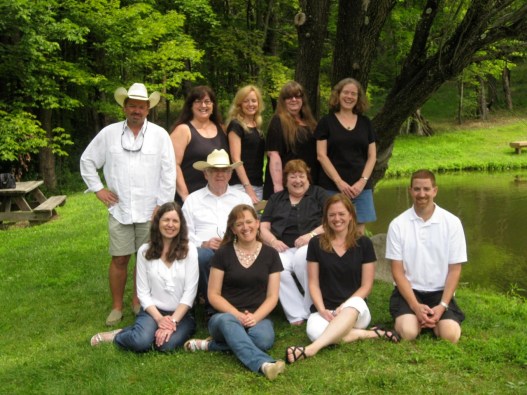
I came home on Sunday the 27th, still overflowing with tears of love. I feel grateful that my dad had a long life–87 years–a good life, and a good death, surrounded by love. I feel grateful for my family. We live far apart from each other, from Maine to Montana, from Michigan to Texas, and we have very diverse viewpoints and perspectives on the world. But we make music and laugh and love so beautifully. These days were like being in ceremony, in the presence of the holy, we were touching mystery. Maybe our time together was a last blessing from our dad, who gave us so many blessings during our lives. Or maybe the blessings just continue.

Johnson family 2013

[Johnson parents and siblings in 2013]

Critters


Squirrel on deckSo I was sitting on the deck, just writing in my journal, and this little being came within a few feet, just looking at me.  No fear, just curiosity.  We live together in this beautiful place, and perhaps he/she is acknowledging that?  Or saying “Thank you for the sunflower seeds, but why do you make them so hard to get in that crazy contraption?”
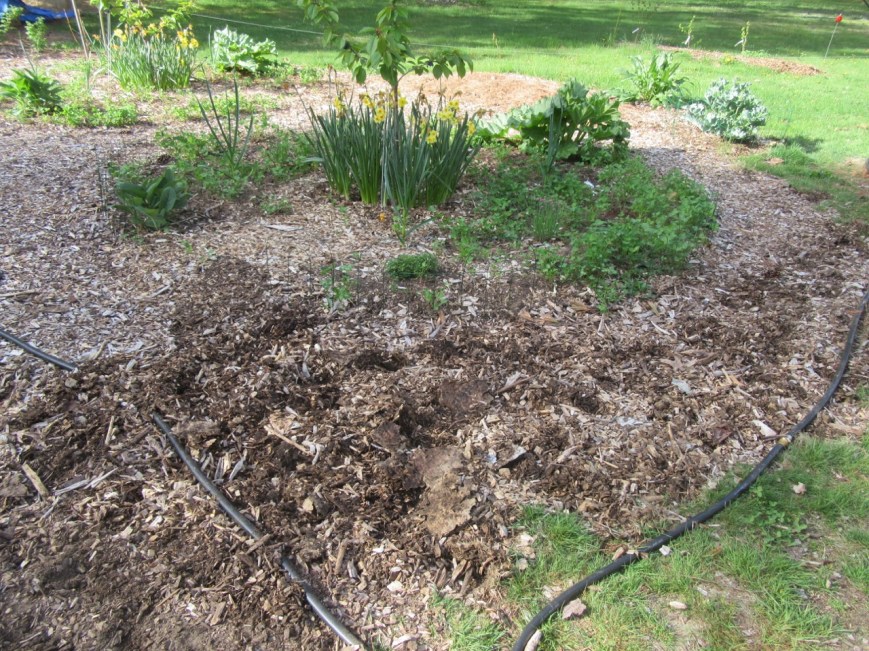

Meanwhile, our nocturnal digger has also returned, very politely avoiding the plants and digging up the paths.  I am assuming it is our resident nearby skunk, though it is here earlier than last summer. This year I haven’t even been trying to straighten everything back again, unless it has dug a hole close to a plant.  But as you can see, everything is getting lush and leafy–rhubarb, sea kale, turkish rocket along the back.  Every tree is surrounded by herbs and clover.Nocturnal digger back

This morning I wandered for an hour in the garden to feel the ground and do last minute care-taking before I fly to see my parents today.  I planted some lovely basil that was a gift, watered the annual bed (and discovered some other little neighbor has eaten one of the broccoli seedlings–oh well I hope you enjoyed it), put more compost on the growing asparagus plants, and also watered the summer sweet bush cuttings that are temporarily in a pile of compost as well waiting to be planted.  Margy will tend the garden while I am gone.

I am thinking of my dad today, my spirit is with his spirit during this journey.  May this day be blessed with safe and smooth travels of whatever kind.

Mirror

Cardinal looking at side mirror – Version 2The other day on my walk, I saw a male cardinal fly back and forth to a side mirror on an automobile.  I could imagine his inner dialogue: Who is that other cardinal who is invading my territory?  I will scare him away by attacking him!  Hey, he is still there!  Get out of my territory, you interloper.  Stay away from my nest.  Go on!  Get away. Hey, you’re still there.  I’ll show you who’s boss!
Sadly, the drama continued as I walked on.  But every once in a while, he sat proudly on top, as if he was satisfied that the foe had been vanquished.

We never do that, do we?  Imagine that the enemy is out there, and we’d better keep our guard up–only to discover that the enemy is ourselves?  Or that, in fact, we are the only ones in the arena of our lives?  Maybe it doesn’t matter what we think the other folks are doing–maybe competition is like that mirror–there is no one here but us.

Cardinal on side mirror – Version 2


Synchronicity

Today I woke late, so I started my walk late–and just as I was coming out onto our street, I said hello to a woman who was walking with her big black dog.  Turns out, she grew up in our house–her family built it. Her dad, who passed away earlier this year, had a huge garden in the back yard. He used a rototiller, and brought in manure and loam, and involved all the neighbor children in planting vegetables.  He’d give them a stick and point to its length and say plant the seeds this far apart.

He planted a peach tree–which did very well, (sadly no longer here) and lots of raspberries and blackberries–which are still coming up behind the garage on the land just next to ours which had belonged to them.  (It still belongs to her mother who lives in a house we can see from our yard–which we already knew.)  Her dad would do the planting and her mother liked to weed.

The big spruce tree next door would be lit up like a Christmas tree every year, to the delight of all the kids.  The man who lived there was in the fire department, so when the tree got tall, he would put on the lights with a fire truck ladder.  (Sadly, that spruce, along with the others in our yard are no longer doing very well.)  At that time, all the families in the neighborhood knew each other, and the kids played together all the time.  She also spoke about the delight of wandering into the big woods behind the house.

She was thrilled about our solar panels and our rain barrels, and hoped she might do that where she now lives on an island.  She is staying with her mother a few nights a week while she takes a class in town. I invited her to come back sometime when the snow had cleared and we were able to be out in the yard.

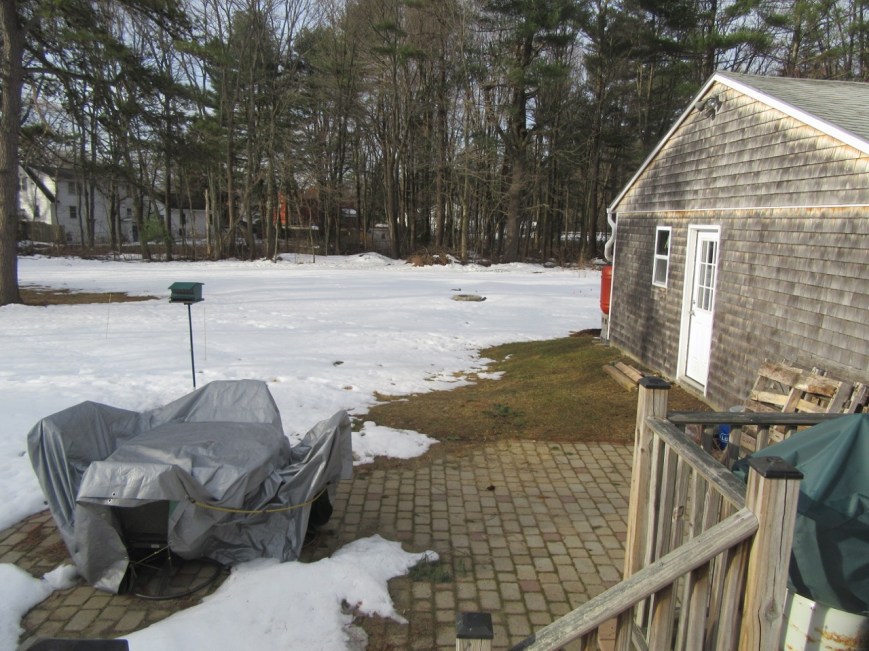
It delights me to know that there were gardens in this place fifty years ago, and people who were tending to it with care. It delights me that a small unexpected change in my routine led to an unexpected encounter.  Meanwhile, the snow is melting, and the ground will soon be workable–maybe peas this weekend?

back yard

The Back Yard


Cascoak

Our Beloved KinI was excited to hear Lisa Brooks speak at the Maine Historical Society last night.  Lisa is the author of Our Beloved Kin: A New History of King Philip’s War, which is an amazing narrative.  She goes back to original documents and source material, combined with local Indigenous knowledge to reexamine the stories of the New England colonies and the Indigenous peoples during the later 1600s, particularly the unfolding of hostilities that came to be known as King Philip’s War.  I wrote about some of my first impressions in an earlier post.
In her talk, she focused on the parts of the book that were about Wabanaki territory, what we now know as Maine.  One of the things I especially noticed was the name of this place–greater Portland–before it was occupied by settlers–Cascoak.  The Fore River used to be called the Casco River.

I learned more about Skitterygusset, the sachem who first made an agreement for a settler to live near Capisic Brook and its uplands (where Margy and I now live).  Lisa talked about how after the deaths from disease that happened during first contact, many native people were building new alliances between regions, through marriage and family relationships.  Thus, Skitterygusset cannot be understood apart from his relationship to his sister, Warrabitta, who was the leader of Owaskoag (now Scarborough).  Women were often rulers, especially in places where planting fields were located, since women were responsible for the planting fields.  Owashkoag was a sweetgrass gathering place.  Their brother, Sagawetton, lived with his wife on the Saco River.

In settler narratives, when they talk about Indian raids, they write as if the hostilities were random acts of violence.  But Lisa talked about how the raids were focused on settlers who were upsetting the balance of communal subsistence living.  One example was the settlers who had built their houses at Amancongon, which was an important planting field on the Presumpscot River (now part of Westbrook).  Another target was to burn the mills, set up at falls on multiple rivers.  By the time of the “Indian wars” there were 50 saw mills that had been built: they cut and harvested the huge white pines of the forest, processing 1000 feet a day of pine board.  Destruction of the forests meant destruction of the game that was hunted.  The mills also prevented fish from migrating upriver, thus cutting off another important source of food.

I have to stop for now, but I was newly inspired in my quest to understand the history of this place.  I can’t recommend this book highly enough!


Spring Arrives in Maine

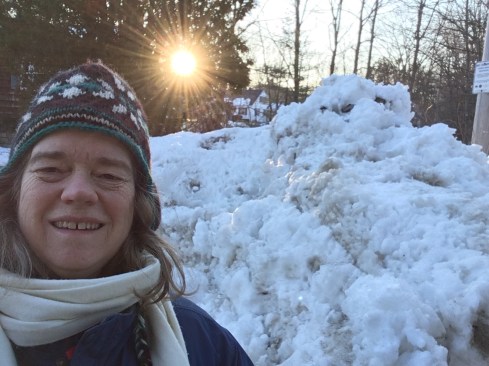
Spring Arrives in MaineToday is the first day of spring everywhere in the Northern Hemisphere.  What it looks like in my neighborhood is huge piles of snow and a really cold morning, but with a bright sun leading us into a clear day.

Margy and I hosted an Equinox ritual at our house last night.  It was a small group of five this time, and most of us were weary from the winter, so our ritual was simple and low key.  We named the friends who had joined us for Solstice and Imbolc, and sent blessings to all of them.  (You know who you are!)  We shared thoughts and readings about our lives and about winter and spring.  We talked about what we wanted to let go from the winter season, and what intentions we wanted to carry into this new season.

I thought about the next several weeks until Mayday.  The snow will disappear, and the ground thaw, and begin to fill with green.  Our plants will arrive from Fedco:  an apple tree, a peach tree, two blueberry bushes, three hazelnut bushes, a mulberry tree, a licorice plant, 25 asparagus plants, and 3 golden seal plants.  By Mayday, I hope they will be in the ground.  Our friends volunteered to help with the planting.

I remember when we first imagined this new home, when we began to lay out our intentions to find greener housing in the summer of 2015.  Our intentions included creating a permaculture garden, and having space in our living room for people to gather.  And here we are!  Living those dreams into reality.  The magic of deeply felt intentions can be surprisingly powerful.

Large scale hydro is not clean energy

I sent a letter today responding to a Portland Press Herald Maine Voices column about Central Maine Power’s push for transmission lines through Maine to bring Canadian hydro power to Massachusetts.   I agree with the column, by the way, but an issue that troubles me is the statement often repeated in the Press Herald that Canadian hydropower is clean renewable energy.  Large scale hydropower cannot truly be considered clean and renewable energy.

First of all, large scale hydro floods huge areas of the best land in the northern climate—river valleys that are home to the most diverse plant and animal life in the region. The resulting reservoirs are not the same as natural rivers or lakes. They become contaminated with methyl-mercury, poisoning the fish and any who eat them. Methane gas is emitted from the decomposition of flooded plant life. And because of silt build up, the dams may not last more than several decades.

Secondly, these dams are being built in the territories of indigenous Cree, Innu, and Inuit peoples, with a destructive effect on their culture, lifestyle, food sources, hunting and fishing, burial sites, and ultimately, their sovereignty. The LaGrande project was built in the 1970s without any consultation with the Cree or Inuit, and then later projects have been and still are initiated without giving any true choice to the people who have lived along these rivers for millenia.

photo-hydro-quebec-99-185-7-12

[La Grande 1 Generating Station]

We know that Maine Governor LePage is not interested in renewable energy, nor is he concerned with the rights and sovereignty of indigenous peoples, as witnessed in this government’s actions toward the Penobscot people and their river. But the rest of us who live in Maine must be better than that.  We should support true renewable energy, and also support the human rights of indigenous people both here and in the lands to the north.