Some ministry colleagues shared these beautiful poems, and I thought that there might be someone out there who needs them today.

Sweetness by Stephen Dunn (from New and Selected Poems 1974-1994. Copyright © 1989.)
Just when it has seemed I couldn’t bear
one more friend
waking with a tumor, one more maniac
with a perfect reason, often a sweetness
has come
and changed nothing in the world
except the way I stumbled through it,
for a while lost
in the ignorance of loving
someone or something, the world shrunk
to mouth-size,
hand size, and never seeming small.
I acknowledge there is no sweetness
that doesn’t leave a stain,
no sweetness that’s ever sufficiently sweet . . .
Tonight a friend called to say his lover
was killed in a car
he was driving. His voice was low
and guttural, he repeated what he needed
to repeat, and I repeated
the one or two words we have for such grief
until we were speaking only in tones.
Often a sweetness comes
as if on loan, stays just long enough
to make sense of what it means to be alive
then returns to its dark
source. As for me, I don’t care
where it’s been, or what bitter road
it’s traveled
to come so far, to taste so good.
My Dead Friends by Marie Howe (from What the Living Do, © W.W. Norton & Company, 1998.)
I have begun,
when I’m weary and can’t decide an answer to a bewildering question
to ask my dead friends for their opinion
and the answer is often immediate and clear.
Should I take the job? Move to the city? Should I try to conceive a child in my middle age?
They stand in unison shaking their heads and smiling – whatever leads to joy, they always answer,
to more life and less worry. I look into the vase where Billy’s ashes were – it’s green in there, a green vase,
and I ask Billy if I should return the difficult phone call, and he says, yes.
Billy’s already gone through the frightening door,
Whatever he says I’ll do.
Blessing for the Longest Night by Jan Richardson (from The Cure for Sorrow
© Wanton Gospeller Press, 2016)
All throughout these months
as the shadows
have lengthened,
this blessing has been
gathering itself,
making ready,
preparing for
this night.
It has practiced
walking in the dark,
traveling with
its eyes closed,
feeling its way
by memory
by touch
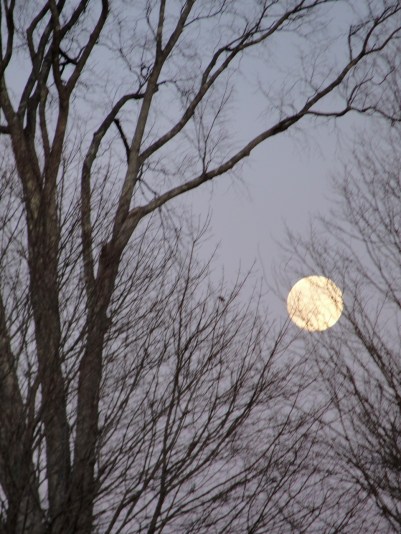
by the pull of the moon
even as it wanes.
So believe me
when I tell you
this blessing will
reach you
even if you
have not light enough
to read it;
it will find you
even though you cannot
see it coming.
You will know
the moment of its
arriving
by your release
of the breath
you have held
so long;
a loosening
of the clenching
in your hands,
of the clutch
around your heart;
a thinning
of the darkness
that had drawn itself
around you.
 This blessing
does not mean
to take the night away
but it knows
its hidden roads,
knows the resting spots
along the path,
knows what it means
to travel
in the company
of a friend.
So when
this blessing comes,
take its hand.
Get up.
Set out on the road
you cannot see.
This is the night
when you can trust
that any direction
you go,
you will be walking
toward the dawn.
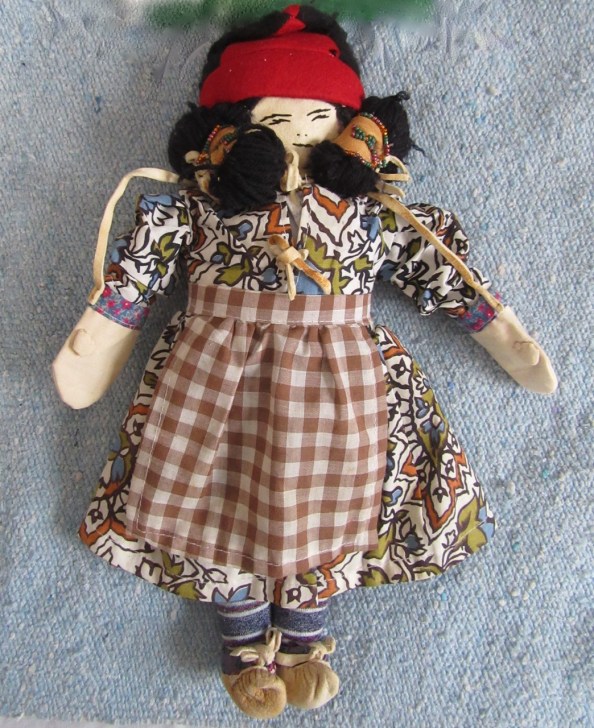
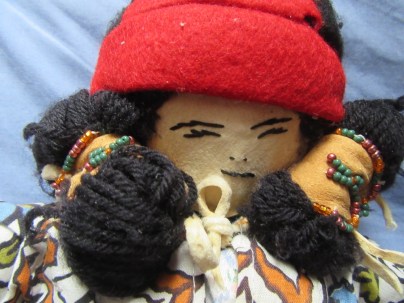 This doll was created by Angela Andrew, an Innu elder from the Innu Nation in what is now called Labrador. It is hard to show in photos, but the doll is made of cloth, except her face and moccasins are smoke-tanned caribou skin. Each layer of clothing is distinct and can be taken off and on. She has a flannel shift and long pants, with knitted socks, underneath the broadcloth dress and apron. Her hair is black yarn, and fastened in place with beaded leather ties. Her hat is a traditional Innu head covering. The clothes are tied with little strips of leather, and her mittens are held in place by a long leather string going behind her neck. Does anyone else remember when our mittens were held in place with a long string like that as children?
 Nomiya munimqehs kihkanok. N’ciciya wot.

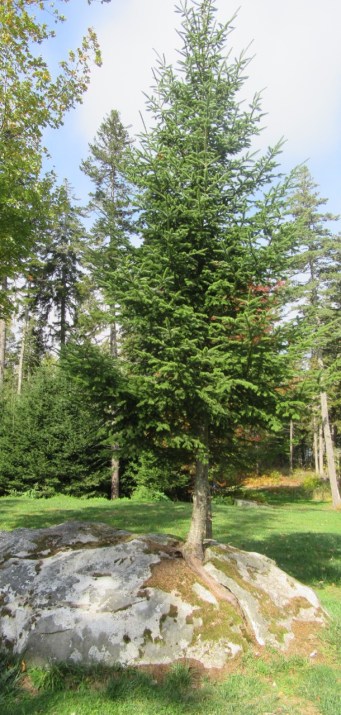 Life holds a strength that will not be extinguished, that will crack open the most oppressive of constraints. When I was in Tenant’s Harbor, a few weeks ago, I saw this spruce tree growing out of a huge boulder. Its roots were literally embedded in a crack in the rock itself. I wondered if a seed had found a tiny patch of soil within a crack, or if in fact, the seed, rooting, had created the crack in the rock. But however it first took hold, the roots were now literally splitting the rock in two.
 I had almost forgotten about the incredible doom of the draft lottery of 1969 and the years following. But recently, I happened upon two fictional accounts of lives being undone by this lottery, and it all came back to me. One came in the television drama This Is Us, in an episode about the back story of Jack’s time in Vietnam. (Spoiler alert!) Jack and his younger brother Nicky are at a bar on December 1, 1969, waiting to see what birthdays will be chosen for the draft call-ups. Nicky is portrayed as a gentle, glasses-wearing kid, not tough, not cut out to fight. Jack is his protector. Nicky’s birthday, October 18th, is chosen as number 5, which means he is sure to be inducted. Their dad tells him only, “Make me proud.” Jack and Nicky consider options, maybe Canada, but Nicky succumbs to the pressure and joins up. We learn that Jack himself had had a deferment because of a rapid heartbeat condition. But when Nicky writes from Vietnam that he has gotten himself into trouble, Jack finds a way to enlist, so he can watch over his brother.
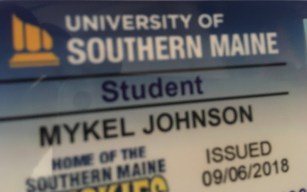 I have a feeling of glee because I am taking a class at the University of Southern Maine. Well, actually I am auditing it. I discovered that anyone 65 and over can audit classes almost for free (compared to actual tuition costs). I had to pay a $55 “transportation” fee, and then learned that with my student ID (I have a student ID!) I can take the metro bus for free. So many new things, and it reminds me of my excited feelings of going back to school when I was a kid.

 Finding Our Way Home