
[View from our tent Friday morning, photo by Margy Dowzer]
Wabanaki means people of the dawn, and there were ceremonies at sunrise each day led by Bobby Billie, a spiritual leader from the Seminole in Florida. I am also a person called to the dawn, so I was present each day for that time.
The first day, several of us had gathered near the arbor in the mist around 5 a.m., but no one had yet arrived to lead the lighting of the fire. So I prayed my own dawn prayers, and felt this message from the sun–“You are all bathed in love.” Later that morning, Anishinaabe women from the Midewiwin Lodge sang a song about the love the Sun has for all of us. I was so moved by the melody, the voices, the drumming on the Little Boy drum. It went straight to my soul. They said it was about the first woman to walk the earth, expressing her joy at seeing everything in creation.
The first day was devoted to healing the wounds carried within the hearts and minds of the people from our long history of violence. The wound that became clear to me was a Great Forgetting: first there was a great disconnection of my ancestors from their connection with all of creation, and then there was a great forgetting so that the people would be unaware that they were wounded, disconnected, and thus never realize that they had once been connected. At the end of the ritual, we each were invited to offer tobacco to the fire and make a solemn promise. My promise was to remember, to remember the wound and to remember the connection.
Also coming into my thoughts was the herb that has appeared on our land–St. John’s Wort–which has traditionally been understood as useful for depression, and also as a wound healer. I seemed to hear in my mind, this plant can help when you remember the wound of disconnection, when you open to the pain underneath the great forgetting. I had harvested some of the plants earlier in July, and they were infusing in oil at home–the oil turns red from the plants. When I got home, I also harvested more of the plants and hung them to dry in our garage, for making tea.
I know that there will be many more rememberings, lessons I carry from this time, but perhaps that is enough for now. I do want to offer my thanks to Sherri Mitchell who has carried the dream of these ceremonies for many years, and who called us together and enabled it to come alive.

 Coming back to the Permablitz of June 24, another project that was completed that day was a fire circle. As Lisa Fernandes said, every home needs a place to burn things. So she was our team leader for the fire circle, and gathered in the layers of community for the element of fire. With a community of workers!
 First they had to remove big pile of bittersweet brush (that we will eventually burn) from the spot we had chosen. Lisa and Kristen gathered together the stone blocks that would be used. (But there could have been other helpers–at that moment I was over in the garden beds.) Then they prepared the ground with a layer of sand. Our youngest permablitz members got into the sand-tamping process, as well as Lisa and Kristen.
 Finally, they brought a whole pile of pine mulch for the seating area around it, and then laid some bittersweet brush and pine cones for our first fire. Permaculture is not just about a way of gardening but also about how communities care for each other. Its three principles have been summed up as earth care, people care, and future care. So having a place to gather with others is an integral part of our permaculture design.
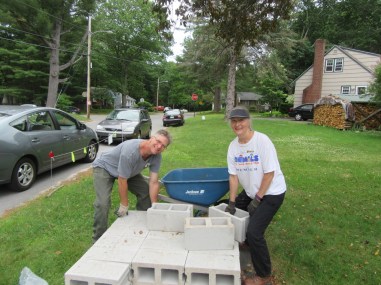


 With all that done, the barrels could be positioned on the concrete blocks. Then, the downspouts were cut short, and a curvy connector was attached to bring the water to the barrel.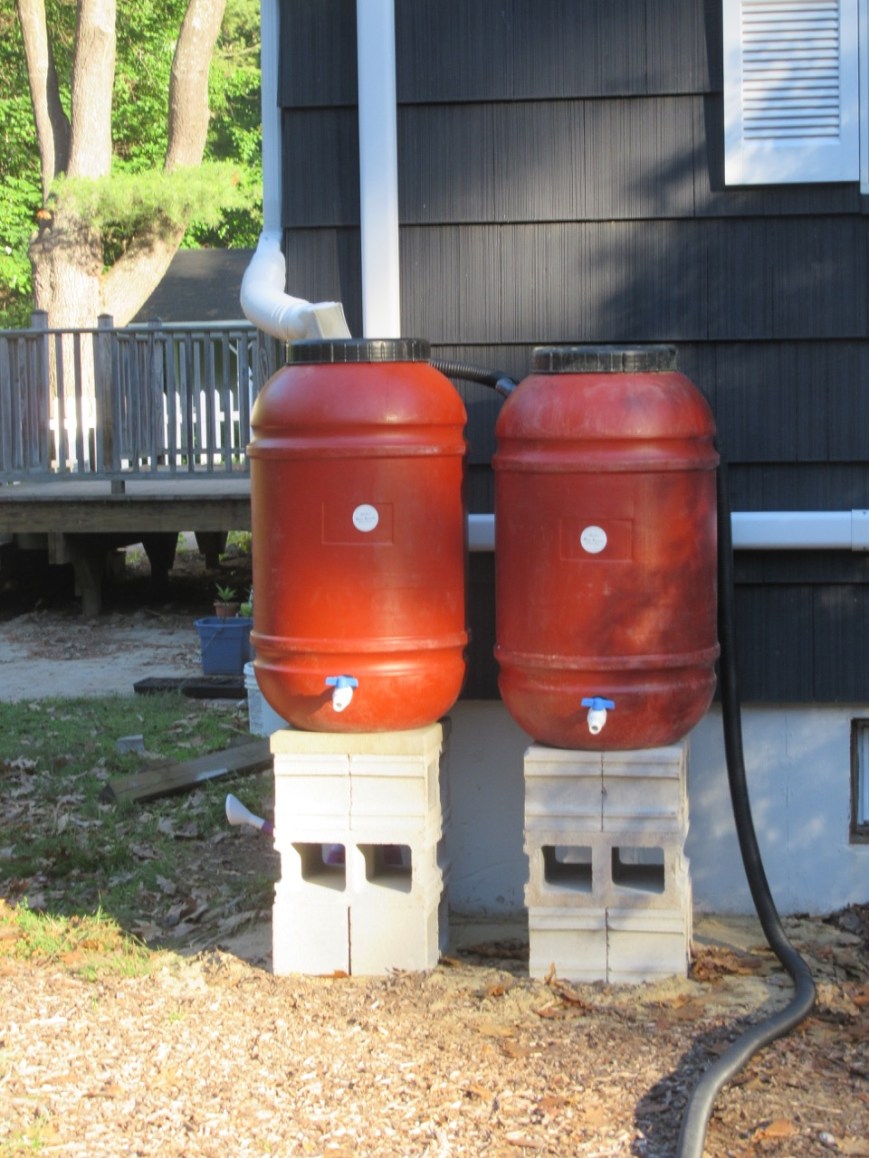



 This is a section of our evolving Permaculture Design for our yard. (It didn’t really work to try to put the whole design into one photo, so this is of the half of the yard nearest the house.) I had started this design by measuring everything in our yard and putting them on grid paper–the grids equate to 3 feet square. Then we had lots more input with our


 Finding Our Way Home